Archive
Conservation-Of-Madness Strikes Again
All the rain in the world (and it seems like we got, in fact, all the rain in the world) was unable to long dampen spirits of equity traders. Although the market started off with a small slither lower, the upward momentum remains in place although to be fair the last couple of days’ worth of flirtation with the January highs of the S&P hasn’t exactly blown away the skeptics. Stocks today closed roughly unchanged after a soft open. June 10y Note futures gained about 2 ticks in a quiet session.
It appears as if the March-Lack-of-Madness has already hit the bond market (under the conservation-of-madness principle, NCAA March Madness seems to be mirrored by lethargic trading every year – at least in the fixed-income world), but there is a lot on tap this week that could change that. Not standing a chance, though, were today’s slightly stronger-than-expected Empire State Manufacturing Report (showing that last month’s jump in the index wasn’t entirely fluke) and slightly weaker-than-expected Industrial Production and Capacity Utilization numbers (overall strength in the numbers masked the fact that most of that strength was from utilities output – the cold weather giveth, and the cold weather taketh away).
I like looking at seasonally-adjusted electricity use. Although over a long-term chart it muddies the question of productivity improvements, over the short-term it’s pretty interesting. It’s hard to make a lot more output without some more input. And here the picture is decidedly less rosy than the Industrial Production data. I wonder whether this indicates a movement of the production away from products that require high energy input (autos? raw steel?) to less-energy-intensive stuff. I don’t know the answer, but I find the divergence of this series from the Industrial Production index series to be curious.

Going Green The Hard Way!
Tomorrow’s release of Housing Starts (Consensus: 565k versus 591k last month) has a somewhat better chance of rocking the boat, but only if those Starts convincingly break above 600k – where they haven’t been for more than a year. The chart below (Source: Census Bureau) illustrates that even an annual pace of 600,000 units started…about three months’ worth at the peak…wouldn’t exactly, um, ‘break new ground’ so to speak.

Wouldn't 600k be really great? No?
Although such a figure wouldn’t exactly trigger paroxysms of joy, I think it would have an impact as the “second derivative” crowd would be excited at the improvement. Face it, the level isn’t going to be exciting. And the rate of change (first derivative) over the last couple of years is pretty ugly; over the last year or so it has gotten flat. A 600k would excite people who put a lot of importance on the mere transition from declining, to flat, to rising (even though, within the usual variance of the data, it would be hard to make such a pronouncement).
More important – and at least the source of more nervousness – will be the Fed’s post-meeting announcement late in the day. Here, again, we have a Fed in a transition from very easy policy to something close to neutral to something tighter; at least, that is what we are supposed to believe. While some of the more vocal hawks on the Fed are supposedly agitating for tighter policy, I think last month’s snugging of the discount rate was a bone thrown to them to keep them at bay for a bit. I doubt very seriously that the Committee feels like experimenting with a dramatic new statement, especially since there is already a pending experiment at the end of this month when the Desk stops buying mortgages. I don’t expect anything of significance out of this meeting (for example, a change in the statement to suggest that the time of low rates is drawing to a close), but even minor changes in the statement will likely lead to some post-release volatility.
The Fed’s first move toward tightness, when it does come, will be a good test to see if the conditions in the equity market are bubbly or just reflecting improved conditions over the last year. A bubbly market, such as the one we saw in the late 1990s, tends to take news that the Fed is hiking rates as “evidence that the economy is strong,” which is absurdly inconsistent with the notion that equities are near fair value considering the level of interest rates – that sort of absurd inconsistency would itself be an indication of bubbly conditions. A more rational response to the eventual hiking of rates would be a decline in the equity markets of a few days to a few weeks, as some marginal owners of equities shift to interest rate vehicles that are suddenly more attractive.
As I say, that musing is likely to be out-of-place on Tuesday, as I don’t expect the Fed to do anything significant. (It may take a little while to figure out that it isn’t significant, however!).
Give Me A One-Handed Economist
Wednesday was another in a string of boring days – welcome boring days, given that Old Man Winter seems finally to be loosing his icy grip – with stocks rallying again (+0.5%). The quiet is certainly helping stocks, and assuming the S&P can break through the January highs around 1150 it looks like a fairly easy cruise to 1175 merely on technical momentum (that level is the ultimate target of that inverted head-and-shoulders pattern, and also roughly the projection off the Nov and Jan highs). After that, though, I am increasingly skeptical. The low levels of risk aversion admit of two potential outcomes: a slow and painful grind higher, or a sharp and painful trade lower. Either way, painful.
The 10y note contract today weakened 6 ticks, with the 10y yield moving back to 3.72%. The market was a little weaker than that prior to the 10y auction bidding deadline – in quiet markets, the concession for supply is more obvious. After the auction, which went fine, prices recovered somewhat.
Tomorrow brings some data, finally, with Initial Claims due (Consensus: 460k). Recall that Claims recently had been rising but dipped last week to 469k. The economist consensus of 460k is simply saying that the recent rise we have seen in Claims is false and we ought to be improving once again. Frankly, it is a little wishy-washy given all that I have been reading about how Payrolls ought to be zooming next month. If we’re growing at 200-350k new jobs per month, Initial Claims shouldn’t be here (see Chart, source BLS and Labor Department). Red marks the Feb Employment Report and the last ‘Claims figure.

Which is it? Are Payrolls going up or are Claims staying around here?
If Payrolls are running at 250k, we should be seeing 335k or so in Claims, about 135k/week better than we are actually seeing. If we generously assume that 100k of the Payrolls forecast is “make-up” for the February weather, then the trend would suggest around 360k new Claims per week to equate to 150k net new jobs per month. Even the upper end of the cloud near x=150k is y=375k-400k. If we ignore the Census jobs (although these data include two prior censuses), and say they are expected to add 50k…well, you get the idea: you have to make a bunch of assumptions, all of them on the generous side, to square Initial Claims of 460,000 with a 250,000 rise in Payrolls for the month. That isn’t saying it can’t happen, but we ought to be skeptical of what the economists suddenly seem so sure of: the next Payrolls report will be a huge gain.
By the way, the regression line I’ve drawn is linear, but you can see that Claims tend to be floored near 300,000; a more-accurate estimator would be nonlinear and would tend to make the current point more of an outlier. It doesn’t make a huge difference, though, and you get the point.
On an unrelated note: Ellyn Terry at the Atlanta Fed has posted an insightful commentary on the Atlanta Fed macroblog. She analyzes consumer credit and credit availability and finds that while the overall trends in consumer credit recently seem to be similar to prior recessions (except for the 2001 “recession,” in which consumer credit never even skipped a beat)…
“…once the current recession is separated into revolving and nonrevolving credit, the relationship to past recessions changes. Typically in a recession, nonrevolving credit shrinks considerably while revolving credit shrinks little if at all. The trend so far in this recession has been the exact opposite; nonrevolving credit essentially has remained unchanged while revolving credit has shrunk 11 percent.”
I think it’s a pretty interesting observation. Are people cutting up their credit cards and swearing off credit, or are banks not giving a new card to anyone with a pulse any more? You can read the full article, in which she goes on to examine whether the difference is on the credit demand or the credit supply side, here.
On Friday, economists expect roughly flat Retail Sales and Michigan Sentiment, once again at odds with the rising speculation about boffo Payrolls. I mention it today because I won’t be posting tomorrow as I will be traveling on business.
The Paper Anniversary
Congratulations to the stock market on the one-year anniversary of the lows. And congratulations to all of you who are net sellers of stocks, and will be as you enter your retirement. For you, an overvalued stock market is absolute gold. For those of us who expect to be net investors for many years, of course, an overvalued stock market is bad news, since we are buying at higher-than-fair values, but we still congratulate those of you who are lucky enough to be able to sell high while we buy high.
I never have understood why young people – certainly anyone under 50 – get so excited when stocks rally. If these same people walk into a 7-11 and see the price of a Slurpee rising every day, or go to fuel up the car and watch the price of gasoline going up every day, they’d be depressed and/or outraged. Even if they already own a car, they hate to see car prices rise because they know they will be buying another car eventually. So why does it make people so darn happy to see stocks rise when they know that they will be buying on balance for many years?
Maybe it’s the recency effect, whereby we tend to exaggerate the importance of local improvements simply because they happened recently. Interestingly, not all institutions have this bias; the etiquette books say that if a marriage breaks up before two years are out, the bride and groom should return the gifts to the givers. So the paper anniversary really is not such a big deal. It’s the second year that counts. I would say the same is true in this case, with the stock market. The one-year rally was impressive; a second year would be incredible.
Some people think that the conditions are right to extend this bull market because the economy is developing so nicely. After Deutsche more or less led the way by forecasting that 350,000 new jobs will be reported next month, a number of other economists have joined the chorus with better-than-200,000 forecasts. While Census hiring will certainly provide a boost, I have trouble seeing where the sudden growth is coming from. But then, at economic turns it is always difficult to see I suppose.
So equity bulls (who chased stocks higher today until a late-day fade left them up only 0.2%) opine that the stock market might not be overvalued if the economy is in fact beginning another 4-5 year expansion and we value on forward earnings estimates. That’s a lot of “ifs” for me, and I rather think that the one-year rally in stocks just might discount some of that growth, don’t you think? Surprisingly, bonds did fine despite the new-found economic exuberance, with June Notes +4.5/32nds and the 10y yield down to 3.70%.
Investors (and that’s most of us, even if you’re only putting aside a few dollars a month in a 401(k) plan), as I said, tend to focus on the short-term growth in their fortunes rather than trust in the fact that if they systematically make good decisions, then over the long run they’ll pull ahead. Buying low and selling high, systematically, is lots more important than what your net worth did this month, but it is hard not to look at that broker statement and feel elation or depression. Ironically, this is one reason that surveys of consumer confidence are such effective early reads of changes in the economy: consumers tend to be very sensitive to small changes that don’t mean much in the big picture, and often do better at filtering out the “noise” than all of our Kalman filters and other fancy econometric methods.
But perhaps this time they feel like they are stuck in the bottom of a well and can be excused if they don’t get excited the moment they set foot on the first rung of the ladder out? The chart below (Source: Federal Reserve) shows the net worth of American households and nonprofits (I have no idea, by the way, why these two groups are lumped together), which have obviously taken quite a hit this decade.

Net Worth of US Households in Dollars
Still, really, households aren’t doing too shabbily. Sure, net worth is well off the highs but is probably reasonably close to the long-term trend. You may have left the casino without that wad of cash, but you still have what you came in with.
Or do you? As an inflation guy, I am not really comfortable with measuring my wealth in terms of dollars. The purpose of investing isn’t the accumulation of money, after all. As Marie (Bernadette Peters) said to Navin (Steve Martin) in the movie The Jerk, “I don’t care about losing all the money. It’s losing all the stuff.” Investing is about accumulating stuff, and if you don’t agree then look at those Zimbabwean dollars I posted last month and tell me how those trillionaires feel about the phenomenal return on investment they have had.
Deflating wealth by CPI is one way to look at “real wealth,” but while I think CPI is a very well-done number it is undeniably complex. Another way to look at real wealth is simply to convert into units of other stuff (of course, this is what CPI is trying to do, where the ‘other stuff’ units are standard baskets of consumption goods). One popular unit of stuff is an ounce of gold, which (as any number of gold bugs will tell you) is an efficient store of value compared to fiat money, even if subject to occasional fits of speculative euphoria. So let’s look at the same chart of household wealth denominated in ounces of gold (Source: Bloomberg, Federal Reserve):
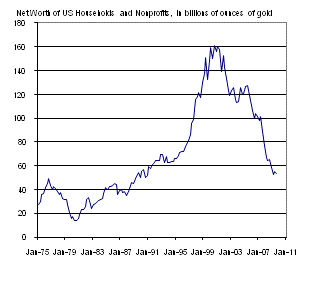
Net Worth of US Households...in ounces of gold
Hmmm. Well, I guess people can be excused, perhaps, for feeling a bit down in the dumps. If they had simply converted their wealth into bullion in the early 1990s, then they would be in the same place they are today in terms of wealth without all the angst – even though gold pays no dividend and (thus) has an expected long-run real return of zero.
Of course, the story doesn’t stop there; by the same measure (see below, Source: Bloomberg and National Association of Realtors) houses are screamingly cheap. That is somewhat hard for me to believe; the alternative is that gold is expensive. Yes, both of these statements are true, since gold is expensive relative to housing and housing is cheap relative to gold. It’s really just a question of your choice of yardstick. But, since many more people own houses than own gold, this is another reason that consumer surveys could be a little more morose than the level of economic growth (at least according to Deutsche) would lead us to believe. I remain to be convinced on this point, but need to keep an open mind.
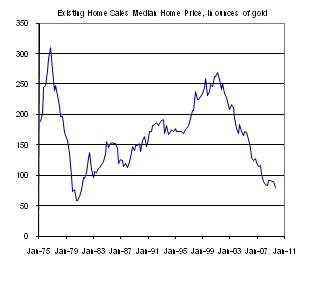
Existing Home Sales Median Price...in ounces of gold
No data that is due out tomorrow will affect that view. The calendar is again quite sparse and the weather in New York due to be quite nice. Expect another slow session.
Skeptical Of Perpetual Motion
Monday was as-expected…which is to say, it was quiet. Stocks ended the day flat; fixed income lost a little more steam but the 4/32nds decline in the June Note contract was not exciting. The 10-year Treasury now yields 3.72%: still firmly within its recent range, but slipping a little to the high end of that range.
It will bear watching how yields develop over the next month as the Fed ends asset purchases. Tonight Brian Sack, head of the New York Fed’s Open Market Desk (SOMA), spoke to the National Association for Business Economics Policy Conference in a general reprise of his comments last December. His remarks tonight are at this link. My generally laudatory comments on his December talk are linked to here.
I really like the way that Dr. Sack explains how the asset purchases helped the market. In this speech, he says:
In my previous speech back in December, I discussed in detail the channels through which these market effects may arise. By removing large amounts of duration and prepayment risk from the market, the Fed’s asset purchases reduced the volume of risk that the market had to hold, which lowered the risk premia on those assets. Put differently, the purchases bid up the prices of those assets and hence lowered their yields. The lower levels of yields would be expected to boost other asset prices as investors substitute into alternative asset classes. These patterns describe what researchers often refer to as portfolio balance effects.
Where I disagree a bit with Sack is when he talks about the impact of the eventual exit. In both the December talk and this evening’s remarks, he expresses great confidence that the Fed can sell a couple of trillion dollars of securities into the market, as long as they do so slowly, or effectively shrink the balance sheet through massive reverse repurchase agreements. Recognizing that he doesn’t really have the option to say “Holy geez, this could get ugly,” I still think it’s worth pointing out that if it turns out to be the case that the Fed can keep rates low by buying lots of securities but can also sell them without impact (or add liquidity by buying them and drain liquidity by doing reverse repos), then we have a financial perpetual-motion machine.
I am generally skeptical of perpetual motion machines.
I rather suspect that when the Fed goes to sell a couple of trillion dollars’ worth of MBS, Treasuries, and agencies – and especially if they wait until the economy is growing nicely, as Dr. Bernanke has suggested they will – while the Treasury is also raising trillions in new money plus rolling trillions in maturing securities…the result may not be as graceful as Dr. Sack suggests. In several years in the early ‘Aughts…2001 and 2003, if memory serves…the bond market in October got absolutely shellacked when “convexity-related selling” overwhelmed a dealer community that was thin due to year-end risk budgets at some major dealers. The scale of that convexity selling was on the order of a couple hundred billion, and it moved thin markets a hundred basis points.
Yes, the Fed is not talking about doing this specifically in thin conditions at year-end…but the Volcker Rule being contemplated would make every day year-end for dealers, from the standpoint of their ability to take proprietary risk. These two policies are like elemental Sodium and water. They won’t mix well.
There is no data today, so I wanted to return very briefly to a comment that someone posted to this blog recently. As a reminder, I write this thing mainly so that I can receive (considered, and considerate) feedback on the thoughts and ideas, and link to greater ideas from greater minds. It also helps me avoid sloppy thinking when I have to explain my thoughts prosaically, and when a chance exists that someone will call me on the carpet for an error.
One of my favorite examples of this came not following a blog post but during a talk. I once spent a couple of days traveling to visit some investors with the great Bob Shiller. The company I was with was working with Dr. Shiller’s company on a product and we wanted to get some feedback from some important investors; people won’t open their doors for me, but Dr. Shiller always gets a meeting (especially in August 2007, when this happened). Well, at each meeting I would deliver the reasoning for the product we were working on jointly. And I would say something like “when spectacles were first invented, there weren’t lots of prescriptions. There was just one, and it probably improved your vision but it wasn’t made for you” and this led me into the meat of the pitch.
After delivering this line a couple of times, we were at another meeting and, after delivering the line I happened to glance over at Dr. Shiller, who was looking at me intently and curiously. He interrupted me, asking “Is that true? Was there really only one ‘prescription’?”
Well, I looked back at him and tried desperately to say with my gaze, “Not now. I am delivering a pitch. It’s not even important. It’s plausible. And it makes the relevant point.” But he didn’t get the impact of my gaze, and pressed me further on the point, whereupon I had to sigh and say “I think so. I’m not 100% sure, but I wouldn’t think that prescriptions preceded the invention of spectacles. But I don’t know.” Which was awesome, to have to deconstruct my analogy right in the middle of a pitch meeting. (It turns out that the answer is that we don’t know because no one is sure when spectacles were first invented, but that’s not the point dammit!)
So when someone raises an objection to something I say, then I will often go and check my facts (and again, unlike in the Shiller case this is actually a key reason I am writing this blog). Several days ago, someone mentioned that the BLS, in making the oft-maligned “hedonic adjustments” that correct the CPI for changes in the quality of the sampled items, “never makes negative hedonic adjustments.” (I hadn’t claimed otherwise, but I was discussing the importance of hedonic adjustment and how it factors into people’s perceptions of the CPI).
It turns out that isn’t true, and in fact the biggest component of consumer inflation is hedonically adjusted to reflect lower quality over time. The BLS hedonically adjusts the housing inflation figures to account for the aging of the housing stock. If you hate the concept of adjusting the computer price index (down) for quality even when the sticker price doesn’t change, then you ought to recognize that in the case of housing, the effect works in the opposite direction because the housing stock ages and so, if no adjustment is made, over the years a rental property that goes from a mansion to a decrepit hovel as it falls into disrepair, but carries the same rent, should show inflation since you’re getting less housing for your money.
The effect is about 0.3% or 0.4% per year on the housing part of the CPI, which doesn’t sound like much; housing, however, is about a third of the CPI so this effect adds 0.1% or so per year to the CPI. At the current level of core CPI, that is actually reasonably significant! You can read more about the update to the “Housing Age-Bias Regression Model” here.
As I have said before, I am convinced that of all the statistics put out by our government, the one that has probably been studied most meticulously and therefore does what it is supposed to do the best is CPI.
Shift-F9!
For the second month in a row, the Employment report was stronger-than-expected. Let me attach two caveats, however. First, this month’s exceeding of expectations was much more marginal than last month’s (unless you buy the Deutsche Bank argument; see below). Second, the report was stronger-than-expected mostly because expectations had been ratcheted back by other weak data. When success comes largely because a previously lowered hurdle was then cleared, we call that either (a) the soft bigotry of low expectations or (b) “normal,” if it involves technology company earnings reports. But I digress.
The Unemployment Rate, rather than rising as had been generally expected after the plunge last month, was unchanged. Exactly unchanged, to three decimal places! That will get some conspiracy nuts exercised, but of course any half-witted conspirator would make some change in the Rate to avoid suspicion. It actually sounded more like someone forgot to hit Shift-F9 on the spreadsheet (for those who don’t use spreadsheets: Shift-F9 is the Excel keystroke to force calculation of the page). On further review, however, it turns out that the Unemployment did in fact rise… to 9.6872% from 9.6866%. I think that is called, literally in this case, “close enough for government work.”
Payrolls fell 36,000, but with net positive revisions to the prior two months were effectively unchanged. Also, there were only 15,000 Census workers added, compared with roughly twice that expected, so on both the Payrolls and Unemployment Rate counts the data scored slightly better-than-expectations.
But not that much better. I was impressed that other sub-indicators improved, such as the diffusion index (more industries – roughly half – are now showing payroll growth) and the median and mean duration of unemployment. This is, as far as it goes, good news. If it is true that the employment situation is improving, then it is probably also true that (despite the recent declines in survey measures of confidence) the economy is growing. I find it hard to square those two things with the other data, but all will become clear in time. Perhaps in a deep recession the likes of which we are (perhaps) emerging from, consumer confidence lags all other indicators. Perhaps consumer confidence improves with payrolls – we usually assume this – but not in a linear fashion…when unemployment is very high, perhaps the level of the ‘Rate, and not the change, is what matters. As with many of these indicators, it pays to remember that we don’t have a lot of good data to mine from similar sorts of historical periods (because there aren’t many similar periods), so we need to be careful of making strong statements about the significance – either bearish or bullish – of the data we are seeing, when it seems to be confusing. Maybe it is just that we have the wrong context.
However, some observers did indeed make very strong statements about the Employment Report. People really got exercised by the fact that around a million people said they had a job but were not able to make it to work because of the weather. The normal average for this measure, in February, is 300,000. So, you might say, wow, 700,000 would have been counted as employed but weren’t?!?
Well, not exactly. The BLS doesn’t tell us how many of these people were counted as employed anyway. This measure comes from the Household survey, which establishes the Unemployment Rate; to be counted as employed in that survey, you need to have a job whether you got paid for it or not that week – if you couldn’t work because of weather, you still had a job, so you’re not unemployed; and this is why the Unemployment Rate is probably a better indicator this month than the Payrolls figure.
But to be counted as employed on the Establishment survey (where the “count” of Payrolls comes from), you had to be paid for some work done during the reference week. You are counted as employed, in this tally, if you got paid even though you didn’t come to work (for example, you are salaried), or if you worked as little as a single hour during that week.
There is absolutely no way to tell how many of those million people who were unable to get to work would have been counted as employed had they been able to get to work. More to the point, we don’t know how many of them in fact were counted as employed because they did make it to work for even a little bit, or were salaried. There is absolutely no way to tell. In such a case, there is no way to discern if the economists’ a priori estimates were too strong or too weak on this score, because none of them forecast this (logically useless) number. The BLS also made the astute observation that “some industries, such as those dealing with cleanup and repair activities, may have added workers.” In other words, heck if we know.
Deutsche’s economist (who is on record as saying that a strong recovery has begun), though, speculated that without weather effects, Payrolls would have been up about 300,000. No one else saw anything like the size of that effect, which would also be at odds with an unchanged Unemployment Rate (remember, that’s the cleanest piece of data we have in this report). Deutsche immediately forecast a 350,000 Payrolls rise for next month as a catch up. This is despite the fact that the ‘Rate was unchanged, none of the surveys of opinions about the job market are improving, initial claims are rising, and ADP – which has not historically shown any impact from weather – was about as-expected.
Personally, I suspect that in this economy, the weather would have less impact than otherwise because there isn’t much freedom to shut down business for a whole week, nor to stay away from work if it is humanly possible to make it to work. I suspect the Deutsche Bank economist will be off by at least 250k; I would say the miss would be by more except that there are census hires coming to the fore. (However, I also expect he will revise his guess to not be a huge outlier next month).
As I said on Thursday, what all these crosscurrents mean is that we have bigger error bars on the data than we otherwise would. That means that it is harder to reject the null hypothesis about the rate of growth in Payrolls than it otherwise would be. With the number near expectations, it is extremely hard to claim that we have any information about a sudden shift to a much higher rate of employment growth, especially with every other survey of employment conditions showing at best tepid expansion.
On Monday, there is no economic data on tap. I suspect we will hear some talk about the implications for the U.S. if China severs its peg to the dollar (many people assume the dollar will weaken and China’s unit will strengthen if this happens), which speculation was brought to the fore when the head of China’s central bank was quoted in the Financial Times this weekend. China continues to sound like she wants to find ways to take advantage of the position the U.S. is in right now with respect to needing the financial flows from China. I am not sure whether I would want, if I were China, for the U.S. to call my bluff. If you owe the bank $1,000, you have a problem, but if you owe the bank $1 billion, the bank has a problem. China is the bank.
.
As an aside, I really enjoy reading Dr. Thomas Sowell’s work. Sowell is a very good economist (and also a very sharp conservative thinker who gets the arguments right, so if that doesn’t describe your politics and you are not open-minded then just ignore the rest of this comment). His book The Vision of the Anointed: Self-Congratulation as a Basis for Social Policy

Beware Of Gifts Not Borne To Greeks
A month ago, in my column analyzing the January Employment report, I noted that there had been rumors that the EU would put together a bailout package for Greece over the ensuing weekend. Not much has really changed in the last month, has it? We are still talking about whether Greece will be able to defer its problems (no one really thinks that they are solvable in the near-term) long enough to prevent an acute crisis. Tomorrow German Chancellor Angela Merkel will meet with the Greek Prime Minister, but it appears to be mostly a photo op; according to an article in the online Wall Street Journal, Germany is not bringing the Greeks any gifts:
BERLIN (Dow Jones)–It is Greece’s responsibility to solve its budget problems on its own and Chancellor Angela Merkel will make this “very clear” in her meeting with Greek Prime Minister Georgios Papandreou Friday, German Economics Minister Rainer Bruederle said Thursday.
One thing that has changed, I suppose, is that we seem not to be worrying about Greece any more. The Nintendo Generation likes to see results quickly, or their attention drifts (that is one thing that politicians these days really count on!). No blowup in a month? Okay, move on to the next thing.
Global geopolitics is a “confidence game” in the original sense of the phrase: politicians play to be our confidantes and try and persuade us not to worry about little things. Little things like Greece defaulting, the tenability of the European Union, bank solvency, economic growth and inflation.
And so we hear the endless repetition of talking points designed to anesthetize us into believing that the talking points must be true if everyone is saying them, or (almost as good) to exhaust us into thinking that we don’t even care any more.
The Federal Reserve, once it commenced its Age of Openness, was destined to move one of two ways from that unsustainable (and mistaken) plateau: they could either become closed again, keep their own counsel and make decisions without needing to show everyone how unsuccessful they actually are at macroeconomic forecasting, or they could enter an Age of Persuasion, in which they attempt to actively influence economic outcomes by trying to convince economic actors to behave in the way that would be convenient to the Committee.
So today, Chicago Fed President Evans said he expects 3-3.5% growth this year with a “modest” decline in unemployment and stable inflation. He declares that the recession is over (albeit in a “narrow, technical sense”) and that while monetary policy cannot remain accommodative for too long, the end of accommodation is “probably quite a ways away.” The message is: don’t worry, things are getting better; please behave as if the recession is over and become more confident. Bond people: don’t worry about inflation, because we won’t remain accommodative for too long; equity people: don’t worry because inflation is stable and rates are going to stay low for a while anyway.
The Fed earnestly believes, we are led to think, that there can be no inflation with this large an output gap, and they want us to think so as well since “inflation expectations” play such an important role in their models. But if they really thought that inflation depended mainly on the output gap, then wouldn’t they be quite irresponsible to not print as much money as possible right now, since there is no downside? What restraint they have shown over the last year – and the growth rate of money aggregates has come way down from what it was during the crisis – is inconsistent with the expressed belief that the output gap dominates as a cause of inflation and that money is more or less inert. The truth is that they’re not sure (it isn’t settled science, after all), but if they behave as if they aren’t sure then how in the world are they going to persuade Congress that they should have the power they have? They need to at least appear assured of the efficacy of their policies.
These musings may appear a bit off-point, but a reading of Federal Reserve history makes it hard to conclude anything other than that the institution is very often feeling its way when making really big, important calls about how to manage the economy. The “science” of economics is still so new, and the difficulty of proving anything from noisy data so difficult, that it would be remarkable if the Fed had the powers that they actually represent that they have. This is all fresh in my mind because I recently finished reading The Federal Reserve And the Bull Markets: From Benjamin Strong to Alan Greenspan
“My view is that what is missing in Keynes’ general theory is a significant negative effect on the marginal efficiency capital from the types of actions that are implicit in very large fiscal stimulus. I can argue, and do indirectly through the hurdle rate of return, that substantial fiscal stimulus, working through inflation and a number of other things, sharply depresses effective private demand; while it may be expansionary in the short-run, it is not over the long-run and usually is counterproductive.” (citation is to Hargrove & Morley, eds, The President and the Council of Economic Advisers: Interview with the Chairmen)
(I quote that here mainly because a reader of this column said I didn’t understand Keynes when I said basically the same thing. I am not a fan of Greenspan but I imagine he understood Keynes.)
While I know a reasonable amount about Greenspan, I was delighted (and educated) by the deep historical research and analysis of Strong and Martin. The purpose of the book is to analyze these three Fed Chairmen, all of whom presided over lengthy equity bull markets, both in terms of their stated goals and in terms of their actions taken as Fed chiefs. It is remarkable how often these men railed about speculative excess but seemed powerless to know what to do with it or what their actions to restrain a runaway market might do in collateral damage to the economy. Moreover, the econometric modeling showed that Fed policy in terms of the policy rate itself responded only slightly to speculative excess: in the case of the Martin Fed, every 5% overvaluation in stocks produced a 14bps increase in the Fed funds rate; for the Greenspan Fed that was 18bps but their basic fitted model still indicated that policy was still too loose in 1999-2000 by some 150bps.
Again, the point isn’t that Chairmen are prone to let the stock market get overvalued, but that the Fed in general often isn’t sure what to do. This is why they really ought to keep their mouths shut and work it out behind closed doors; and it is also why observers should take everything they say that sounds definitive with a big shaker of salt. The Fed is really not worried at all about inflation while Unemployment is so high, we hear, although they may be concerned down the road a bit. If that is true, it is monetary malpractice because at the very least they ought to be worried about it. If it is false, then they’re just saying that to make us feel better. And that doesn’t make me feel better.
Now, I’m not saying that I could do a better job (or keep my mouth shut). But I think that I have a good respect for what I don’t know. For example, I have no idea what Payrolls will show tomorrow and I am dang glad I do not have to make a prediction. The consensus estimate is -50,000. But there are two large, indeterminate forces working at cross-purposes: the weather, which Goldman economists think could drop 100k from the number, and hiring for the decennial Census, which may add around 30,000. The important point is that whatever the usual variance we consider “normal noise” around the trend, it is significantly higher this month.
The January Employment report was pretty strong overall. The -20,000 jobs lost was worse than expectations, but the Unemployment Rate plummeted to 9.7% from 10.0% and, importantly, the decline came from a drop in the number of unemployed persons rather than from a rise in the Civilian Labor Force. This tends to give more confidence that the decline in the ‘Rate was at least partly real, which is probably why consensus expectations are only for a small bounce to 9.8%. Another decline in the ‘Rate, which I do not expect, would be serious news indeed. But the caveat to everything that we think we know from last month is that it was the January report, and subject to wider-than-usual error bars for that reason.
Personally, because of the recent decline in the absolute surveys I would be tempted to take the “under” on Payrolls and the “over” on the ‘Rate, but I have very low confidence in that guess and I wouldn’t even put a dollar on it.
Stocks today, with the 0.4% rally, moved the right direction technically, but are still within the range of the last three days. Neither stocks nor bonds, that is, are in a secure place where the market can take whatever the economic data throws at it. That is to say that the number will likely call the tune not only for the day, but probably for the next week, if it differs from expectations (as I said, there should be big error bars on the number but I don’t believe the market will respond cautiously). If the economists actually have gotten fairly close to the data, though, then perhaps it’s okay to turn one eye to the EU and see if anyone comes bearing gifts for the Greeks.
A Long Slog
Sometimes Employment week can be a long slog before we get to the Main Event, and this week is proving no exception. It is unfortunate, because March also tends to slow down in the middle of the month when the NCAA tournament gets underway and traders keep (at least) one eye on the television or scoreboard. I have never done the hard-core research, but I suspect that March is a great month in which to sell volatility. Heck, you’re not going to be sleeping anyway…
Today’s shot at excitement was the ADP report, but it came in about as-expected at -20k (though there was a downward revision to last month’s figure of ~40k). After that, we entered a fairly slow snooze. Stocks shot higher at the open and then drifted until President Obama spoke about his preferences for the health care bill. Specifically, he expressed his willingness to pass a bill that only garners his party’s support, and to use the reconciliation process (the so-called “nuclear option,” although it is used quite a bit more than nukes are) in order to pass his bill. Although polls repeatedly show that a majority of Americans oppose the plan (see, for example, the regular polling on the question at Rasmussen Reports here) and that a large majority of Americans are happy with their insurance as it is, the Administration’s determination to get the bill they want, damn the torpedoes, has greatly improved the odds of passage. According to the real-money markets at Intrade.com, the odds of “Obamacare” passing by mid-year are now better than even (see Chart below, which illustrates the recent spike).

People with money on the outcome think Obamacare passes soon.
Good for Obama, but stocks dipped when he started talking. There are good reasons to be concerned, if not terrified, of parts of the bill. The part that I can hardly believe is in there is the provision for another new agency, the “Health Insurance Rate Authority,” which will not only set “guidelines” for insurance rate increases that the government thinks are “reasonable” but also would allow the Health and Human Services Secretary to block those increases.
Everyone who thinks price controls work, please raise your hand. Hmmm, I see that none of you who raised your hand is old enough to remember Nixon’s wage and price control calamity, but you ought to realize what will happen to insurance companies that cannot cover their costs because they’re not allowed to recapture cost increases through premiums. As a hint: it’s almost impossible to get car insurance in New Jersey.
It being a lethargic Employment week, though, even the setback on the President’s speech was dull. The S&P ended up less than 0.1%; June Note futures rose 1/64 again, and 10y yields ticked up to 3.62%.
The stock market hasn’t done anything technically wrong yet, but it’s a little less than inspiring how it hasn’t managed to break away from the neckline of that head & shoulders pattern. For the second day in a row, the market sprang higher only to fade back. Perhaps it’s too much to ask for investors to commit chips to a technical breakout when important fundamental data is only a day or two away, but it may be now or never.
On Thursday, Q4 Production and Unit Labor Cost revisions are due (little change is expected from +6.2%/-4.4% last announced). More important is Initial Claims (Consensus: 470k from 496k last week; expect a comment from BLS on the weather effects). Also out are Pending Home Sales, chain store sales, and Factory Orders among the second-tier releases. Prior to the Employment report on Friday, they’re probably all second-tier releases, and I would expect that we have another quiet day ahead of us.
Am I Really Missing The Volatility?!
It was another quiet day on Tuesday. The stock market opened with a gap up, but faded; bonds with a gap down, but covered that gap into the close. June T-Note futures closed 1/64th higher, with 10y yields unchanged at 3.61%.
The only economic datum was vehicle sales, which ended up approximately on-target thanks to an exceptional performance by Ford, which sold more vehicles than GM for the first time (but probably not the last!) in a very long time. Apparently, consumers are choosing private enterprise over Government Motors. Go figure! (Polls tell us the same thing is true when it comes to choosing health care, but some folks think they know better.)
Domestic car sales ended up at about 7.9mm units, essentially flat to consensus estimates and a continued recovery from very low levels seen pre-cash-for-clunkers last year (see Chart, source Bloomberg). It wasn’t so long ago that 12mm units was considered a bad year, although it pays to remember that from about 2000 through 2006 car sales were kept artificially high through crazy dealer incentives. In those days, 0% financing for 5 or 7 years represented a 30-40% discount in the cost of a car to the consumer, and the fact that the auto majors couldn’t wean themselves of such ridiculous discounts should have been a clear sign that the structure of the industry in the U.S. was unsustainable in the long run. (Of course, now 0% financing isn’t a big deal, since all rates are about 0% anyway!)

Not so long ago, 12mm cars was a bad year (thanks to incentives).
On the day stocks added only 0.2%, but importantly the positive close was approximately at the low of the day after a gap above the “neckline” of the head and shoulders pattern I mentioned yesterday. I am not a big techie, but if the market can open positive on Wednesday then I would expect momentum to grow toward a test of the January highs. It’s important to remember that this isn’t a bull market lift-off we’re talking about; it’s 4-5% and I wouldn’t expect anything beyond that, even if we get there.
On a quiet day I found myself musing about just how quiet it has been for a while after the gyrations of 2007, 2008, and part of 2009. Remember, even prior to the crisis the shape of the yield curve had been quite volatile (a neat dynamic illustration of the yield curve is available here); one of the early painful episodes in the financial crisis was the dramatic inversion of the yield curves in the U.S. and abroad, driven partly by the need to hedge billions of “non-inversion notes” that all tended to need hedging at about the same time.
In inflation-land, the curve was inverted as recently as the summer of 2007, when high near-term energy prices led people to expect that inflation would stay high for a couple of years and then decline to some long-term average. As the crisis hit, the 1y inflation swap collapsed from 3.83% in July of 2007 to -5.35% in mid-December 2008, before finally bouncing as people jumped on 8+% short-term real yields.
But since early 2009, the inflation curve has been remarkably stable. The chart below (Source: Bloomberg data) shows inflation swap curves (2y, 5y, 7y, 10y, 30y) on the first business day of the month from March 2008 to March 2009. The months aren’t labeled, because the sequence isn’t important. What is incredible is that the curve moves up, the curve moves down, but the moves have been almost in parallel for the period of a whole year.

Over the last year, the shape of the inflation curve has been amazingly consistent.
That is nothing short of amazing. Everybody agrees that inflation should rise in the future; what changes is the perception of from-what-level. I won’t say anything about how to play that in inflation-space, but I will say that the expectation of low inflation evolving very gradually into acceptable and moderate inflation is a recipe for good equity market performance. It isn’t clear how we could have an inflation curve much more supportive of equities than it is and has been since the stock market bottom last year.
It won’t always be that way. Remember that.
Tomorrow, Employment-Week hype gets started with the release of the ADP figures (Consensus -20k vs -22k last month). Goldman Sachs points out that while their weather models suggest a 100k drag to Payrolls, the ADP doesn’t seem to have any weather bias they can detect. Still, a weak figure will likely be written off to…er…global warming while a strong figure will probably provoke more relief given the recent skein of weak data.
Also out is the ISM Non-Manufacturing report (Consensus: 51.0 vs 50.5 last). The Non-Man ISM seemed like a good idea when they first split it out from the Manufacturing ISM, but now it doesn’t seem like anyone cares very much.
With the positive technical situation in stocks and a built-in excuse for economic weakness, I’d prefer to play these numbers from the short (fixed-income) side, even though I don’t really believe those excuses.
Of Shenanigans Past And Prospective
Monday was a reasonably quiet day, with stocks up 1% on no real news (gap open and then trade dully), as they continue to build momentum back towards the January highs. The day’s highs correspond pretty cleanly to the neckline of what even a school child can see is an inverted head-and-shoulders (although purists would say that the decline from the January highs wasn’t deep enough in relation to the scale of the head-and-shoulders to conclude that normal projections will apply). Further advance on Tuesday will likely create some itching among techies to at least re-test the highs.
June T-Notes were down 3/32nds, and 10y yields remain aimlessly in the middle of the range at 3.61%.
The economic data was not particularly exciting, either. Personal Income was a little weaker-than-expected, Personal Spending a tad stronger. ISM was 1 point weaker than expected at 56.5, but the Employment subindex rose to 56.1 from 53.3 (although New Orders and Production subindices declined), so you can take what you want out of that figure.
AIG sold a $35.5bln chunk of the company and is working on calving off other pieces. Folks seem to think this is great news, but they seem to think that it’s great news for everyone (taxpayers, AIG management, the buyers) and few of the observations seem to have anything to do with the price at which the unit was sold. I don’t have an opinion on that, but it seems to me like it might matter. Well, perhaps to AIG the value of getting the public off its back outweighed any haircut they took on the assets. I hope that isn’t Benmoche’s reasoning, because I doubt the people carrying flaming brands up to AIG’s castle care very much about the particulars of acquisitions and divestitures. Especially the ones who are agitating the masses in order to divert the masses away from their own castles.
Speaking of scapegoats, Richmond Fed President Jeff Lacker apparently feels put-upon, and that some people are scapegoating the Fed for similar reasons relating to politics. Perish the thought, but what is interesting is what Lacker also said in the context of the Federal Reserve and the crisis. For example, he opined that the Fed ought to be out of the mortgage finance business, and is likely to end mortgage purchases on schedule this month (as almost everyone expects). Of course, it was the Fed who originally put themselves into that business. Lacker also declares that the Fed’s emergency authority ought to be “sharply” limited.
Well, he will get a lot of “amen!” from the congregation on that one, although less-charitable souls may point out that the prior limits on the Fed’s authority didn’t seem to bind them during the crisis when they felt that, for example, guaranteeing low-quality, non-bank assets to facilitate the “purchase” of Bear Stearns by JP Morgan was acceptable because, darn it, something needed to be done! Lacker, as a member of the FOMC but not of the Board of Governors, was not party to the invocation of exigent circumstances, and this may be his reasonably-tactful way of pointing out that someone needs to put restraints on Frankenstein’s monster in case he wrecks the place next time.
I generally agree with most of what Lacker said, including his comment that there is a relatively minor risk of a double-dip recession. I just think that the one we are still in isn’t going to be over very soon! But as a former member of another scapegoated demographic (traders on Wall Street), I don’t have a lot of sympathy for his pity party on that score. Cry me a river, Dr. Lacker.
One person I am surprised hasn’t gotten more positive attention in all this mess is about to publish a book (due out tomorrow) that I am anxious to read. Harry Markopolos, who tried to alert the SEC to inconsistencies in Bernie Madoff’s pitch for a long time, gave a Bloomberg interview today in which he declared that the SEC should pay “Wall-Street-like bonuses” for finding financial fraud. I think this is a brilliant idea, and it probably wouldn’t even cost very much since you could cut the actual size of the staff if they were incentivized properly to find the real problems. Of course, I could be cruel and point out that “Wall-Street-like bonuses” aren’t what they used to be; one of my former employers is in the process of paying US employees uniformly $0 for the second year in a row (whether your book was +$100mm or -$100mm…yes, that’s the way to incentivize good performance!). Anyway, Markopolos’s book “No One Would Listen: A True Financial Thriller

You might as well order the books. There aren’t any crucial economic reports out on Tuesday, although auto sales will be released throughout the day. Keep an eye on the S&P “neckline,” as that may well be the main source of excitement for the day. And stay out of trouble.
