Real Yield Rise is Not That Mysterious
A lot recently has been made about this chart.

We all know that nominal yields have been shooting higher since the spring, when the Iran war began pushing energy prices up. What is surprising to some people is that while shorter-term inflation expectations have risen (they track gasoline prices with high precision, so that’s not a shock), longer-term inflation expectations have not. That means that the driver of higher nominal yields has not been inflation expectations, but real yields![1]
What does it all mean? So you’re saying it isn’t inflation that is pushing rates higher?
The naïve interpretation is that the fact that real yields are driving nominal yields higher implies that it’s a positive growth shock, and/or a cost-of-money due to creditworthiness or anger-at-America problems. But if you look at the chart above, you can see this isn’t new in 2026. For two and a half years, the correlation between weekly changes in real yields and changes in nominal yields has been 0.92, with a beta of about 1.1. Okay, then this can’t be a reaction to positive growth; it must be a reaction to extended deficits and the debanking of America!
So the investment advisor or OCIO who put you into TIPS as an inflation hedge was wrong – TIPS yields rose, even as inflation bottomed and turned higher, but that’s because growth is great. Or because the Chinese are selling all their bonds. It isn’t their fault; they’ll tell you it makes sense to buy TIPS for near-term inflation protection ‘most of the time. Just not this time.’ Right?
Well, wrong.
At Enduring Investments, this isn’t at all surprising because 17 years ago we made a very important observation about how real interest rates and nominal interest rates behave with respect to each other. In a nutshell, inflation expectations do all the heavy lifting for very high nominal rates but real rates do the heavy lifting at low nominal rates, because of natural limits on the range of real rates and inflation expectations. We came up with the theory and the implication of what the ratio of real to nominal yields should look like, and then tested it on the longest outstanding history of inflation-linked bonds available. Not only did it exactly conform to our expectations, it was amazingly regular…and when we subsequently saw extremely low nominal interest rates, the reality fell directly on our model even though those were out-of-range in the original study. This is the first time this chart has ever appeared in the clear.

I’ve left the y-axis without units here; as it is, I’m telling you something that we use to drive a lot of our advice and models and it kinda makes me a little ill to just tell you. You can figure it out without much trouble, anyway. But I guess if competition is 17 years behind, that’s okay.
I’ve mentioned this model before. 10 years ago I used the model to create a process-consistent long-term series of real interest rates that made lots more sense than the extant attempts (see “A (Very) Long History of Real Interest Rates”).
So “why are real yields rising this much when nominal yields are rising?” Don’t overthink it. The answer is: because that’s how they normally behave. If you have the model, it’s pretty easy to answer the question “how should real yields and inflation expectations be moving, at this level of interest rates?”
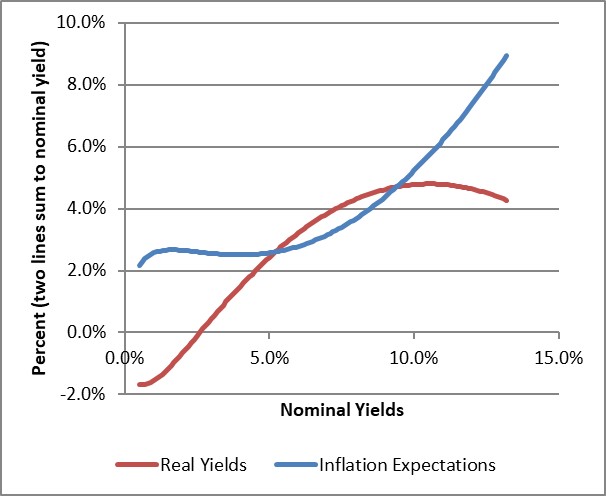
Notice that if your manager was aware of this model (I’ll save you the trouble of checking – it’s consistent across the US, UK, EU, Sweden, mostly in Japan…and the exceptions in Japan are interesting), they’d tell you that investing in TIPS as an inflation hedge is not really effective until nominal yields get pretty high and expectations are actively rising as well. That isn’t to say that TIPS aren’t a good investment when real yields are up at 2.90% (10y) or 3.29% (30y). On the contrary, a guaranteed real yield around 3% is pretty great assuming you hold to maturity. But as a hedge to protect your portfolio? No, you don’t want to be playing in the intermediate/long end of the real yield curve for that.
We knew that. And now so do you. Use this knowledge wisely or, better yet, come invest with us and we’ll use it together, along with 17 more years of innovation that happened after that.
This seems like a good time to bring this up again…as some of you know, Enduring Investments is in the midst of a capital raise – our first truly outside equity raise outside of friends and family, after 17 years of bootstrapping the firm. We’re offering Class C Units in a Reg D 506(c) offering: $1.5mm total, in $100k increments, at a $10mm pre-money valuation. The subscription window is currently open. If you’ve followed my work here or on the podcast for any length of time, you know what we do and why we do it – we are, as far as I know, the only asset manager in the country focused exclusively on inflation-related mandates, across separately managed accounts, our 3(c)(1) private fund, USDi…with some interesting new product lines in the pipeline as well. We think this is a good time to be raising growth capital for a firm at this inflection point, and if you’re an accredited investor and interested in learning more, send a note to partner@enduringinvestments.com and you’ll get our Opportunity Summary and a link to the full pitchbook. Note that this is not a new fund we are offering; it is ownership in the manager. I appreciate your time.
[1] Nominal yields are the sum – approximately – of real yields and inflation expectations. The technical imprecision in that statement is not relevant to this discussion.
Leave a Reply

Hi there, thank you for your generous replies every time.
The September inflation data will be critical for the October FOMC meeting. Markets are currently pricing in less than a 20 % probability of a Fed rate hike in October. That said, September headline CPI is set to rise. Consensus forecasts point to a +0.6 % month‑on‑month increase for headline CPI and +0.2 % month‑on‑month for core CPI. Do you think the actual prints will come in above market expectations?