Archive
Inflation Guy’s CPI Summary (August 2026)
Core CPI has been mostly boring and fairly trendless over the last 6-8 months. Not so high as to be worrisome, but not obviously declining, either. Headline CPI of course has been quite volatile, mostly due to energy prices and the war in Iran – but also recently due to food prices, and increasing risks emanating from the Ukraine/Russia conflict. Of course, we prefer to abstract from headline inflation, because food and energy are both largely mean-reverting relative to their volatility. But while I still feel that way about energy, I’m less confident about Food – both because of the knock-on effects of energy into food (trucking, packaging, etc) but also because of wages. A lot of the inflation in Food will be mean-reverting, but more will be sticky than is usual, I suspect. Anyway, not today’s story.
Today’s story, lest we forget, goes beyond CPI. It’s the 25th anniversary of 9/11. It’s hard to believe it has been a quarter century since the day I ran through streets being fairly convinced that the building was falling towards me, not straight down. It’s a difficult day for many, and so let’s all raise a glass to the fallen…and to the united country we were, for just a little while, in the days following the terrorist attack.
Coming into today, the consensus expectations for CPI were for +0.38% on headline CPI and +0.21% on core. There were some big moves in rates this month.

Ten-year real yields rose above 2.5% for the first time since 2007 (well, abstracting from the 2008 spike caused by Lehman’s failure). The last time 10-year real yields were above 2.5% for any sustained period was 2002, when TIPS yields were generally declining from very high levels as they were first starting to be broadly included in institutional portfolios. It is worth noting what is not at multi-decade highs: 10-year inflation expectations, which around 2.5% are in the range they’ve been in for years.
So this increase in nominal interest rates is not because inflation expectations are exploding higher (which is your first clue that maybe the Fed doesn’t need to aggressively hike short rates). It’s because of a sharp increase in real interest rates. The optimist says this is because real growth is strong, and that should raise the equilibrium level of real interest rates. The pessimist says it is because the world’s governments (and AI projects) are issuing too much darn debt, and higher real yields are needed to induce buyers for that debt. Probably some of column A, some of column B. But in neither case does the Fed need to hike – or anyway, that’s what longer-term rates are telling us.
But by the way…so you’re long TIPS to protect against inflation? This real yields thing is why that’s only an adjustment to soften your fixed-income losses, not to offset them, in an environment of rising inflation.

That said, the higher real yields make a lot of assets look more attractive from these levels. But if you already rode those assets down to these levels…well, that’s buy and hold and that’s just how it works.
Anyway – on to the CPI report.
There was an upside surprise: headline was +0.396% m/m, pretty close to expectations; core though was +0.29%. And that got people upset and immediately calling for a Fed hike. It seemed to be a race to call for it.

As I said last month, this doesn’t look like it’s decelerating and the last point here is ominous. It’s still all in the 0.23%-0.3% range, so not alarming if it merely stays here, but it isn’t looking like a deceleration at all. We’ll see in a bit though that this is less ominous than it looks. Probably.
The 8 major subgroups table has some interesting offerings.
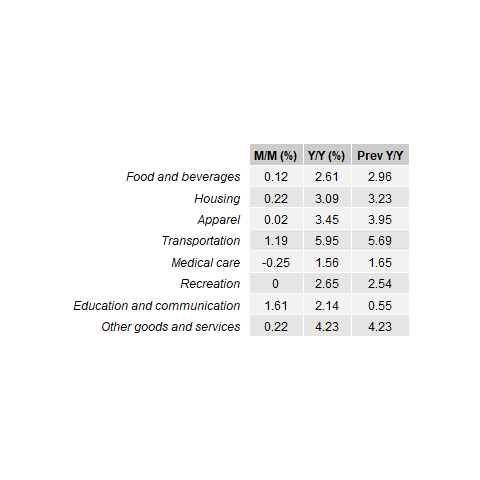
Food and beverages only +0.12% surprised me a little. It’s also interesting that Medical Care is still a drag – it was actually a drag across all three major components (Hospital Services, Doctors’ Services, and Medicinal Drugs). But we have an interesting clue here: “Education and communication” at +1.61% m/m is pretty unusual for a category that had been running at +0.55% y/y. More on that later after the main charts.
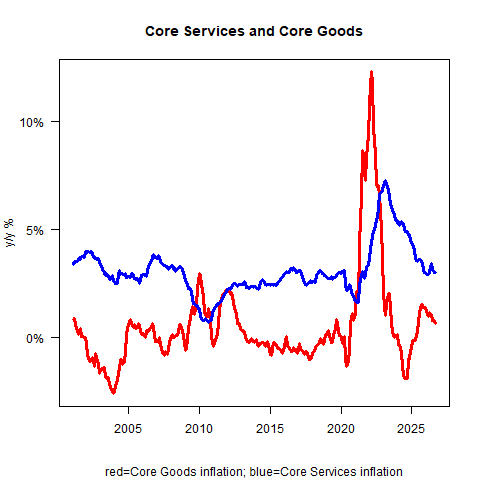
Core goods: +0.68% y/y; Core services +3.01% y/y. Both mild decelerations.
Rents were soft this month. Primary rents rose +0.17%, 2.75% y/y, while Owners’ Equivalent Rent rose 0.19% m/m.

So normally, when there is a surprise on core we first look to housing, but these are low surprises, if anything. They’re not wildly out-of-line…basically on our model. The model also says that we have gotten all the juice out of squeezing rents lower.

In other categories, there was a mild surprise that Used Cars rose (+0.37% m/m). Airfares were +2.7% m/m, which isn’t shocking considering jet fuel. Loding away from home (+2.36% m/m) rebounded from the decline last month, but didn’t we think that was World Cup related? Without the bump from Lodging Away from Home, the shelter category would have been even softer.
Now, the plot thickens. Here is my early guess at Median CPI. It’ll be off slightly because the median category looks like a regional OER subindex, but not drastically off. I’m calling Median +0.175% m/m.

Now that’s a different story. Still not declining, but not looking so ominous. And if anything, a surprise on the low side this month rather than the high side. This chart tells you that Core is high because of some large long-tail one-offs. It’s not a good number, but if “underlying inflation” is what you’re looking at, Median is a better number and it is relatively tame this month. At first glance this decreases, not increases, the chance for a Fed hike.
Now, I’m going to show you Supercore, which accelerated a bit this month to 2.99% y/y.

Nothing really to write home about, and the uptick is at least partly from airfares (which is really energy). But I will add “yet,” because there are some signs that we should be keeping a wary eye on. One of them just came out yesterday – the Atlanta Fed’s Wage Growth Tracker. It’s the best steady measure of wage growth, as it measures the median changes of continuously-employed people (so it doesn’t suffer from the composition shifts month to month of, say, Average Hourly Earnings in the Employment report). It just jumped back over 4%. Fair to say this is not something that people have been watching. I’m showing this right after the Supercore chart because also in Supercore are things like…lodging away from home.

Trend change? Too early to say. But not too early to watch it.
Anyway – the high core and low median implies we’re looking for the long tails in small categories. It could also be a nudge of the main body of the distribution, so we will look at that later. But in NSA terms, something like Appliances (which jumped 1.4% m/m, though it’s only 0.2% of CPI but fun to point out). Or, more prosaically, “Water and sewer and trash collection services”, which is 1.1% of CPI. It rose 0.49% m/m, but that’s not terribly out of line since its y/y increase is about 4.8%.
Here’s one: telephone services, which is 1.47% of CPI, rose 5.37% m/m.

That’s a chart of the cell phone services price index. And that basically adds up to the miss on core CPI. Do you think the Fed is going to hike rates because cell phone service prices jumped? That’s the bet you’re making if you think the high core CPI forces the Fed to hike.
I mean, maybe. It depends how much the FOMC members hate Trump, and some of them are positively frothy. But there isn’t a good monetary policy reason for it. Or at least, no better of a reason than there had been. It would probably be a better idea to shrink the Fed’s balance sheet first, rather than continuing to expand it.

The only category in Median CPI to decline faster than -10% annualized was Jewelry and Watches (-17%). Rising faster than +10%, in core categories: Education (10%), Motor Vehicle Maintenance and Repair (14%), Misc Personal Goods (+16%), Car & Truck Rental (+30%), Communication (+31%), Public Transportation (+31%), and Lodging Away from Home (+32%). So those are your tails pulling the number higher, while rents are holding it down.
Don’t get me wrong. This isn’t a beautiful inflation number. But if the FOMC is being honest, it shouldn’t move the needle. And certainly, hiking rates while they’re also expanding the balance sheet makes no sense. This is the first test to see if Warsh is indeed different, and (jointly) whether he can manage the other Fed voters to get the sensible outcome. The sensible outcome is to stand pat on rates, but start shrinking the balance sheet.
The Enduring Investments Inflation Diffusion Index declined slightly this month, while remaining elevated overall. The monthly decline tells us that the surprise this month was more long-tails than central-tendency-shift, so it reinforces the message of Median CPI that this is not an alarming acceleration.

To sum up: this was an acceleration from recent low headline figures, and next month’s headline will also be high. With the artificially-low core CPI prints from the 2025 government shutdown dropping out of the data over the next three months, we’re going to see some acceleration entirely from base effects (so, if you’re a Fed voter, and you’re worried about the opinions of people who don’t understand base effects, it’s cover for a hike. I’m not sure that’s the right audience to be performing for, but gotta mention it.)
Core was a surprise, but it was significantly due to cell phones. That seems a thin reed on which to hike rates, especially when you’re still accelerating the money supply by raising rates. Warsh will understand this, I think…but he will have to battle against some intransigent members of the FOMC who will want to hike (a) because the fancy economists they listen to in the market are telling them to, (b) the ‘market’ is telling them to, and (c) they really don’t like Trump or, by extension, Warsh.
On (a), I don’t like fancy economists anyway. On (b), notice what I said earlier about real rates and inflation. The ‘market’ is not asking for a Fed hike; inflation expectations aren’t actually moving much. And on (c), ‘nough said.
Chairman Warsh has made a point recently of saying the Fed wants to look at the underlying inflation trend. Core CPI is a better measure than headline CPI in that regard, but it isn’t as good as some other measures like Median CPI – and for exactly the reason we saw today. This CPI figure shouldn’t move the needle towards a hike, but it probably will. If the market fully or almost-fully discounts a hike, I’d look for a low-risk way (such as buying Fed funds futures once the hike is priced in) to take a flyer on no-action. The point of strategy is not to plot a path to victory, but to plot such that all paths lead to victory.
All that being said, my models have inflation accelerating moderately from here. Not hugely, but also not decelerating. There is work to be done from the central bank. Just not the work the market is trying to push them to do.
And now a word from our sponsor.
Enduring Investments Opens a Capital Raise
For 17 years, Enduring Investments has done one thing: manage money against inflation. We’re the only firm built exclusively around inflation-related mandates — retail separately managed accounts and a private inflation-tracking fund among them.
We’re opening a capital raise to fund our next phase of growth.
This offering is open to accredited investors, and as required under SEC Rule 506(c), we verify accredited status as part of the process.
If you’re interested in learning more, email partner@enduringinvestments.com and we’ll send our Advance Opportunity Summary.
