Inflation Guy’s CPI Summary (July 2026)
The Bloomberg survey’s consensus numbers headed into CPI today were for +0.11% on headline inflation and +0.20% on Core. Considering the downside surprises last month, that’s a pretty tame forecast that says ‘no givebacks’ for the surprises.
Last month’s downside outlier on CPI, which cemented market consensus that the Fed wouldn’t hike rates in July, was mainly the result of surprises in rents, cell phones, and car insurance. The latter effect (as noted by a commenter on the inflationguy.blog, was due to a very large one-time State Farm special dividend to policyholders – obviously not repeatable.
What matters to the Fed, not to mention consumers, is the core number and changes in the trend. But it takes a few numbers to see a change in trend. So far, we haven’t seen a change in trend!
And…that evidently isn’t happening this month either. Headline CPI was +0.074%, a smidge below expectations, while Core CPI was +0.215%, just a pip or so high. As expected, that makes last month a pretty obvious outlier.

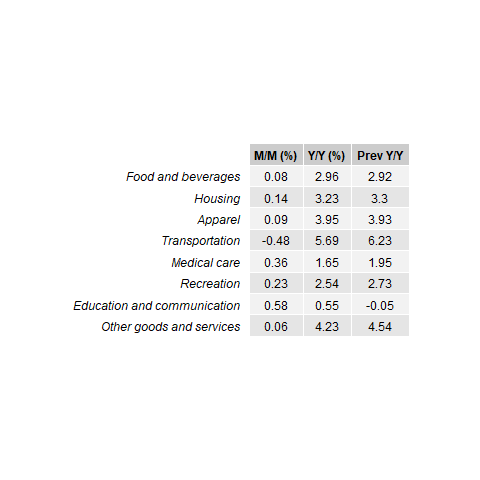
All of the groups rose on the month with the exception of Transportation, which was obviously mostly gasoline. Note that seasonal adjustment this month adds a bit to the NSA print, as we “expect” gasoline to be a drag in July. NSA CPI was actually -0.01%.
Also interesting to note are the y/y numbers for the 8 major subgroups. Of them, only Medical Care and Education/Communication are below what we have traditionally called the Fed’s target of 2%! This is one reason why the Enduring Investments Inflation Diffusion Index remains elevated even though Core and Median numbers are gradually coming down…so far.

(I usually put the EIIDI at the end, but it made sense to put it here for exposition reasons.)
Core Goods is down to 0.81% y/y; Core Services to 3.01% y/y.
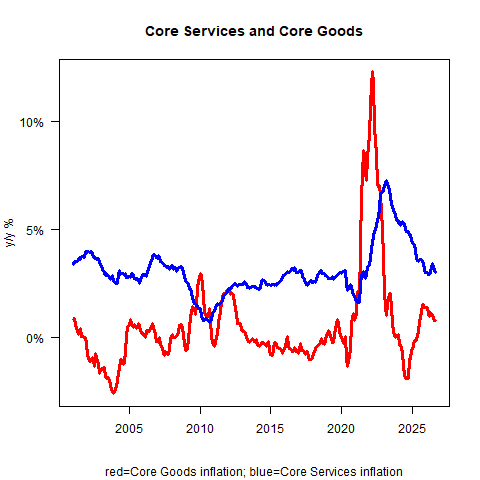
Core commodities continues to moderate. But this is not what people thought we were going to be getting once the tariff effect had finished washing through – and it has. This post-tariff residual is more important. I had expected core commodities to remain very slightly positive rather than going back to the perennial deflation of the globalization era, but this changes things if it instead settles around 0.5-1.0%. As I’ve noted, it becomes hard to get core to 2.0% in that case. By the way, that run rate of 0.8% is with Medical Care Commodities in outright deflation. Medicinal Drugs declined again. TrumpRX baby!

Okay, so some of the buoyancy in core goods overall is probably a pass-through of the energy spike…via packaging, much of which derives from petroleum products, and other trucking rates which pass through into other goods. But still – this is the part I thought would be easy, and it would be core services that would be slow and sticky. More on that in a bit.

Primary rents were +0.26% m/m, stabilizing y/y at +2.86%; Owners’ Equivalent Rent was also +0.26% m/m, and 3.23% y/y. I said in last month’s CPI summary that “Rents will probably recover to get back to a more-normal run rate of +0.25%/month,” and that’s just what happened. That had been one of last month’s outliers, and it went away. There was no payback rebound, but since housing inflation is right on the model I didn’t expect one.
Lodging Away from Home was -2.8% m/m. Now last month Lodging Away from Home was also a decline, and that was a surprise because people thought the World Cup would elevate the hospitality price pressures. Some people had suspected a calendar quirk leading to that decline, but this month’s further drop means it probably wasn’t a calendar quirk. Honestly, I think maybe the Cup effect was overblown. Compared to the number of hotel rooms could it really have been that big an effect? In France, sure. In the US/Mexico/Canada? Regardless, SA Lodging Away from Home is back to where it was in November of last year. It has really gone nowhere for 3.5 years. Airfares rose 2.22% on the month – a pass-through of the energy spike again.
Used cars and trucks were +0.4% after -0.23% m/m last month. New Cars were +0.08% versus -0.02%. Those were also ‘drag’ categories last month, back to normal this month.
My guess at Median based on today’s numbers (actual numbers come out in about an hour) is +0.256% m/m.

How much of a downtrend this is depends on how nearsighted you are. Over the last 4 months? Downtrend. Over the last 9? Uptrend (although that includes the shutdown aberration). Most honest read is probably flat to very slightly down over the last year. But 0.25% monthly is still a 3% run rate of Median. That’s not where I think it is going to settle, but it’s higher than Warsh wants it.

Core Services less Rent of Shelter declined to 2.81% y/y. This is the most encouraging piece, because it’s more wages-based and so the wages/prices feedback adds stability and persistence. I don’t know that I’m confident this is going to keep sliding, but the trend is your friend and if core commodities is not going to go negative, then we need this to decelerate below the pre-COVID levels. Like I said, I thought this was the part that would be slow and sticky. I suppose it is – certainly improvement has been slow – but it is the best trend in the data I think. Is it enough? Hmmm…I suppose it depends on Warsh.

Motor Vehicle Insurance (seasonally-adjusted index shown above), which was one of the outliers last month thanks to that State Farm dividend, fell again…but just slightly. This may be a residual of that dividend, or it may be real. I doubt it’s real. Declining used car prices helps some but there are too many other upward pressures. Flat is the best we can really hope for I think and flat is what we were getting in Q1 2025 through Q1 2026.
Core categories declining faster than 10% annualized this month included Car and Truck Rental (-30%), Lodging Away from Home (-28%), Infants’ and Toddlers’ Apparel (-16%), and Motor Vehicle Fees (-11%). There aren’t a lot of future repeaters there that we can count on. On the other hand, rising faster than 10% annualized we only have Nonalcoholic Beverages and Beverage Materials (+11%), Public Transportation (+22%), and Jewelry and Watches (+29%). So not a lot of repeaters in the upper tail either.
This is the number I thought we would get last month. Boring, right on expectations. The bad news is that it is boring and right on expectations…at 3%.
This doesn’t change anything about the Fed outlook, but not for the reasons people think. My outlook depends a lot on Chairman Warsh. If Powell was still in charge, then the Fed would almost certainly be nudging up rates (even as the balance sheet grows) because inflation is being stubborn. But Warsh has stated a desire to tighten policy – by shrinking the balance sheet. I don’t know why pundits seem to think this isn’t hawkish. I suppose 30 years of being told that policy rates are the only things that matter to monetary policy will produce lots of analysts who think that is the case.
Currently, the balance sheet is still growing, and short rates are stable. I expect that as long as Warsh wins the philosophical argument in the Eccles Building (no sure thing), the balance sheet growth will soon reverse and rates will then start to come down – not go up. Right now, Fed Funds futures have basically become an event contract on “Will Warsh win control of the Fed, or be captured?”
Policy needs to be tighter. The sticky inflation makes that clear. But that’s a balance sheet thing, not a rates thing. But stay tuned for news from Jackson Hole!
Leave a Reply

The August non‑farm payrolls came in much stronger than expected. What is your view on the August CPI?We are looking at a 0.4% month‑on‑month rise in headline CPI and a 0.2% month‑on‑month increase in core CPI. Do you see upside or downside risks that prints could beat or miss consensus forecasts?
Sorry late answer. I think most risks here are pointing higher but not sure that month-to-month how that resolves. Consensus on core looks like 0.21%, which seems low, but used cars dragging it down so the composition will matter. But 3 months out, the risks are all higher, not lower (except for gasoline, which will do whatever it does based on when Iran finally gives up a war they lost months ago). I just don’t know how/if that manifests in THIS report.
Thanks for your reply. The CPI number matters a lot for next week’s FOMC meeting, but the market has a tight consensus on CPI.