Archive
Real Yield Rise is Not That Mysterious
A lot recently has been made about this chart.

We all know that nominal yields have been shooting higher since the spring, when the Iran war began pushing energy prices up. What is surprising to some people is that while shorter-term inflation expectations have risen (they track gasoline prices with high precision, so that’s not a shock), longer-term inflation expectations have not. That means that the driver of higher nominal yields has not been inflation expectations, but real yields![1]
What does it all mean? So you’re saying it isn’t inflation that is pushing rates higher?
The naïve interpretation is that the fact that real yields are driving nominal yields higher implies that it’s a positive growth shock, and/or a cost-of-money due to creditworthiness or anger-at-America problems. But if you look at the chart above, you can see this isn’t new in 2026. For two and a half years, the correlation between weekly changes in real yields and changes in nominal yields has been 0.92, with a beta of about 1.1. Okay, then this can’t be a reaction to positive growth; it must be a reaction to extended deficits and the debanking of America!
So the investment advisor or OCIO who put you into TIPS as an inflation hedge was wrong – TIPS yields rose, even as inflation bottomed and turned higher, but that’s because growth is great. Or because the Chinese are selling all their bonds. It isn’t their fault; they’ll tell you it makes sense to buy TIPS for near-term inflation protection ‘most of the time. Just not this time.’ Right?
Well, wrong.
At Enduring Investments, this isn’t at all surprising because 17 years ago we made a very important observation about how real interest rates and nominal interest rates behave with respect to each other. In a nutshell, inflation expectations do all the heavy lifting for very high nominal rates but real rates do the heavy lifting at low nominal rates, because of natural limits on the range of real rates and inflation expectations. We came up with the theory and the implication of what the ratio of real to nominal yields should look like, and then tested it on the longest outstanding history of inflation-linked bonds available. Not only did it exactly conform to our expectations, it was amazingly regular…and when we subsequently saw extremely low nominal interest rates, the reality fell directly on our model even though those were out-of-range in the original study. This is the first time this chart has ever appeared in the clear.

I’ve left the y-axis without units here; as it is, I’m telling you something that we use to drive a lot of our advice and models and it kinda makes me a little ill to just tell you. You can figure it out without much trouble, anyway. But I guess if competition is 17 years behind, that’s okay.
I’ve mentioned this model before. 10 years ago I used the model to create a process-consistent long-term series of real interest rates that made lots more sense than the extant attempts (see “A (Very) Long History of Real Interest Rates”).
So “why are real yields rising this much when nominal yields are rising?” Don’t overthink it. The answer is: because that’s how they normally behave. If you have the model, it’s pretty easy to answer the question “how should real yields and inflation expectations be moving, at this level of interest rates?”
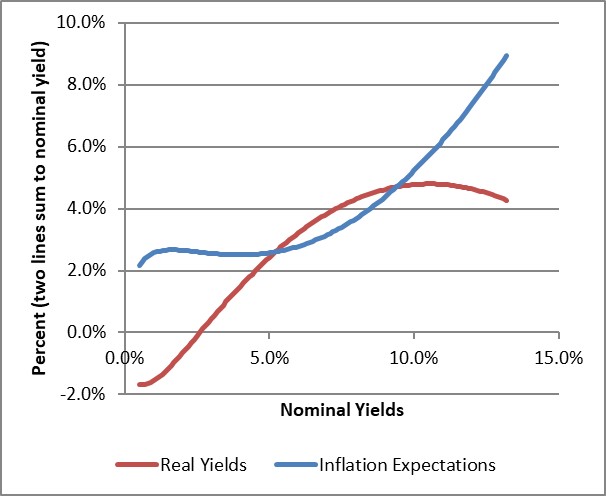
Notice that if your manager was aware of this model (I’ll save you the trouble of checking – it’s consistent across the US, UK, EU, Sweden, mostly in Japan…and the exceptions in Japan are interesting), they’d tell you that investing in TIPS as an inflation hedge is not really effective until nominal yields get pretty high and expectations are actively rising as well. That isn’t to say that TIPS aren’t a good investment when real yields are up at 2.90% (10y) or 3.29% (30y). On the contrary, a guaranteed real yield around 3% is pretty great assuming you hold to maturity. But as a hedge to protect your portfolio? No, you don’t want to be playing in the intermediate/long end of the real yield curve for that.
We knew that. And now so do you. Use this knowledge wisely or, better yet, come invest with us and we’ll use it together, along with 17 more years of innovation that happened after that.
This seems like a good time to bring this up again…as some of you know, Enduring Investments is in the midst of a capital raise – our first truly outside equity raise outside of friends and family, after 17 years of bootstrapping the firm. We’re offering Class C Units in a Reg D 506(c) offering: $1.5mm total, in $100k increments, at a $10mm pre-money valuation. The subscription window is currently open. If you’ve followed my work here or on the podcast for any length of time, you know what we do and why we do it – we are, as far as I know, the only asset manager in the country focused exclusively on inflation-related mandates, across separately managed accounts, our 3(c)(1) private fund, USDi…with some interesting new product lines in the pipeline as well. We think this is a good time to be raising growth capital for a firm at this inflection point, and if you’re an accredited investor and interested in learning more, send a note to partner@enduringinvestments.com and you’ll get our Opportunity Summary and a link to the full pitchbook. Note that this is not a new fund we are offering; it is ownership in the manager. I appreciate your time.
[1] Nominal yields are the sum – approximately – of real yields and inflation expectations. The technical imprecision in that statement is not relevant to this discussion.
Inflation Guy’s CPI Summary (August 2026)
Core CPI has been mostly boring and fairly trendless over the last 6-8 months. Not so high as to be worrisome, but not obviously declining, either. Headline CPI of course has been quite volatile, mostly due to energy prices and the war in Iran – but also recently due to food prices, and increasing risks emanating from the Ukraine/Russia conflict. Of course, we prefer to abstract from headline inflation, because food and energy are both largely mean-reverting relative to their volatility. But while I still feel that way about energy, I’m less confident about Food – both because of the knock-on effects of energy into food (trucking, packaging, etc) but also because of wages. A lot of the inflation in Food will be mean-reverting, but more will be sticky than is usual, I suspect. Anyway, not today’s story.
Today’s story, lest we forget, goes beyond CPI. It’s the 25th anniversary of 9/11. It’s hard to believe it has been a quarter century since the day I ran through streets being fairly convinced that the building was falling towards me, not straight down. It’s a difficult day for many, and so let’s all raise a glass to the fallen…and to the united country we were, for just a little while, in the days following the terrorist attack.
Coming into today, the consensus expectations for CPI were for +0.38% on headline CPI and +0.21% on core. There were some big moves in rates this month.

Ten-year real yields rose above 2.5% for the first time since 2007 (well, abstracting from the 2008 spike caused by Lehman’s failure). The last time 10-year real yields were above 2.5% for any sustained period was 2002, when TIPS yields were generally declining from very high levels as they were first starting to be broadly included in institutional portfolios. It is worth noting what is not at multi-decade highs: 10-year inflation expectations, which around 2.5% are in the range they’ve been in for years.
So this increase in nominal interest rates is not because inflation expectations are exploding higher (which is your first clue that maybe the Fed doesn’t need to aggressively hike short rates). It’s because of a sharp increase in real interest rates. The optimist says this is because real growth is strong, and that should raise the equilibrium level of real interest rates. The pessimist says it is because the world’s governments (and AI projects) are issuing too much darn debt, and higher real yields are needed to induce buyers for that debt. Probably some of column A, some of column B. But in neither case does the Fed need to hike – or anyway, that’s what longer-term rates are telling us.
But by the way…so you’re long TIPS to protect against inflation? This real yields thing is why that’s only an adjustment to soften your fixed-income losses, not to offset them, in an environment of rising inflation.

That said, the higher real yields make a lot of assets look more attractive from these levels. But if you already rode those assets down to these levels…well, that’s buy and hold and that’s just how it works.
Anyway – on to the CPI report.
There was an upside surprise: headline was +0.396% m/m, pretty close to expectations; core though was +0.29%. And that got people upset and immediately calling for a Fed hike. It seemed to be a race to call for it.

As I said last month, this doesn’t look like it’s decelerating and the last point here is ominous. It’s still all in the 0.23%-0.3% range, so not alarming if it merely stays here, but it isn’t looking like a deceleration at all. We’ll see in a bit though that this is less ominous than it looks. Probably.
The 8 major subgroups table has some interesting offerings.
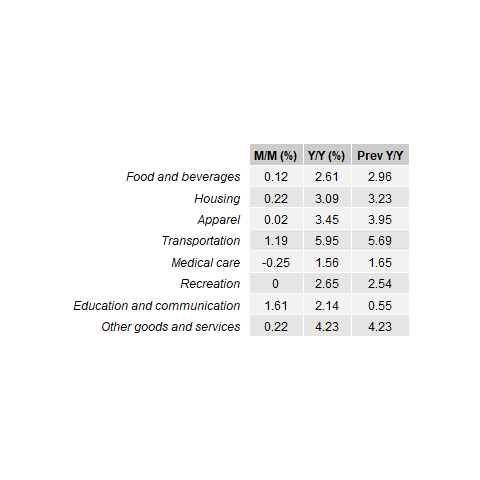
Food and beverages only +0.12% surprised me a little. It’s also interesting that Medical Care is still a drag – it was actually a drag across all three major components (Hospital Services, Doctors’ Services, and Medicinal Drugs). But we have an interesting clue here: “Education and communication” at +1.61% m/m is pretty unusual for a category that had been running at +0.55% y/y. More on that later after the main charts.
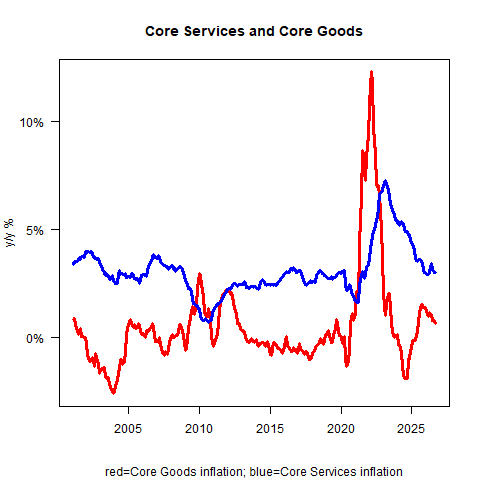
Core goods: +0.68% y/y; Core services +3.01% y/y. Both mild decelerations.
Rents were soft this month. Primary rents rose +0.17%, 2.75% y/y, while Owners’ Equivalent Rent rose 0.19% m/m.

So normally, when there is a surprise on core we first look to housing, but these are low surprises, if anything. They’re not wildly out-of-line…basically on our model. The model also says that we have gotten all the juice out of squeezing rents lower.

In other categories, there was a mild surprise that Used Cars rose (+0.37% m/m). Airfares were +2.7% m/m, which isn’t shocking considering jet fuel. Loding away from home (+2.36% m/m) rebounded from the decline last month, but didn’t we think that was World Cup related? Without the bump from Lodging Away from Home, the shelter category would have been even softer.
Now, the plot thickens. Here is my early guess at Median CPI. It’ll be off slightly because the median category looks like a regional OER subindex, but not drastically off. I’m calling Median +0.175% m/m.

Now that’s a different story. Still not declining, but not looking so ominous. And if anything, a surprise on the low side this month rather than the high side. This chart tells you that Core is high because of some large long-tail one-offs. It’s not a good number, but if “underlying inflation” is what you’re looking at, Median is a better number and it is relatively tame this month. At first glance this decreases, not increases, the chance for a Fed hike.
Now, I’m going to show you Supercore, which accelerated a bit this month to 2.99% y/y.

Nothing really to write home about, and the uptick is at least partly from airfares (which is really energy). But I will add “yet,” because there are some signs that we should be keeping a wary eye on. One of them just came out yesterday – the Atlanta Fed’s Wage Growth Tracker. It’s the best steady measure of wage growth, as it measures the median changes of continuously-employed people (so it doesn’t suffer from the composition shifts month to month of, say, Average Hourly Earnings in the Employment report). It just jumped back over 4%. Fair to say this is not something that people have been watching. I’m showing this right after the Supercore chart because also in Supercore are things like…lodging away from home.

Trend change? Too early to say. But not too early to watch it.
Anyway – the high core and low median implies we’re looking for the long tails in small categories. It could also be a nudge of the main body of the distribution, so we will look at that later. But in NSA terms, something like Appliances (which jumped 1.4% m/m, though it’s only 0.2% of CPI but fun to point out). Or, more prosaically, “Water and sewer and trash collection services”, which is 1.1% of CPI. It rose 0.49% m/m, but that’s not terribly out of line since its y/y increase is about 4.8%.
Here’s one: telephone services, which is 1.47% of CPI, rose 5.37% m/m.

That’s a chart of the cell phone services price index. And that basically adds up to the miss on core CPI. Do you think the Fed is going to hike rates because cell phone service prices jumped? That’s the bet you’re making if you think the high core CPI forces the Fed to hike.
I mean, maybe. It depends how much the FOMC members hate Trump, and some of them are positively frothy. But there isn’t a good monetary policy reason for it. Or at least, no better of a reason than there had been. It would probably be a better idea to shrink the Fed’s balance sheet first, rather than continuing to expand it.

The only category in Median CPI to decline faster than -10% annualized was Jewelry and Watches (-17%). Rising faster than +10%, in core categories: Education (10%), Motor Vehicle Maintenance and Repair (14%), Misc Personal Goods (+16%), Car & Truck Rental (+30%), Communication (+31%), Public Transportation (+31%), and Lodging Away from Home (+32%). So those are your tails pulling the number higher, while rents are holding it down.
Don’t get me wrong. This isn’t a beautiful inflation number. But if the FOMC is being honest, it shouldn’t move the needle. And certainly, hiking rates while they’re also expanding the balance sheet makes no sense. This is the first test to see if Warsh is indeed different, and (jointly) whether he can manage the other Fed voters to get the sensible outcome. The sensible outcome is to stand pat on rates, but start shrinking the balance sheet.
The Enduring Investments Inflation Diffusion Index declined slightly this month, while remaining elevated overall. The monthly decline tells us that the surprise this month was more long-tails than central-tendency-shift, so it reinforces the message of Median CPI that this is not an alarming acceleration.

To sum up: this was an acceleration from recent low headline figures, and next month’s headline will also be high. With the artificially-low core CPI prints from the 2025 government shutdown dropping out of the data over the next three months, we’re going to see some acceleration entirely from base effects (so, if you’re a Fed voter, and you’re worried about the opinions of people who don’t understand base effects, it’s cover for a hike. I’m not sure that’s the right audience to be performing for, but gotta mention it.)
Core was a surprise, but it was significantly due to cell phones. That seems a thin reed on which to hike rates, especially when you’re still accelerating the money supply by raising rates. Warsh will understand this, I think…but he will have to battle against some intransigent members of the FOMC who will want to hike (a) because the fancy economists they listen to in the market are telling them to, (b) the ‘market’ is telling them to, and (c) they really don’t like Trump or, by extension, Warsh.
On (a), I don’t like fancy economists anyway. On (b), notice what I said earlier about real rates and inflation. The ‘market’ is not asking for a Fed hike; inflation expectations aren’t actually moving much. And on (c), ‘nough said.
Chairman Warsh has made a point recently of saying the Fed wants to look at the underlying inflation trend. Core CPI is a better measure than headline CPI in that regard, but it isn’t as good as some other measures like Median CPI – and for exactly the reason we saw today. This CPI figure shouldn’t move the needle towards a hike, but it probably will. If the market fully or almost-fully discounts a hike, I’d look for a low-risk way (such as buying Fed funds futures once the hike is priced in) to take a flyer on no-action. The point of strategy is not to plot a path to victory, but to plot such that all paths lead to victory.
All that being said, my models have inflation accelerating moderately from here. Not hugely, but also not decelerating. There is work to be done from the central bank. Just not the work the market is trying to push them to do.
And now a word from our sponsor.
Enduring Investments Opens a Capital Raise
For 17 years, Enduring Investments has done one thing: manage money against inflation. We’re the only firm built exclusively around inflation-related mandates — retail separately managed accounts and a private inflation-tracking fund among them.
We’re opening a capital raise to fund our next phase of growth.
This offering is open to accredited investors, and as required under SEC Rule 506(c), we verify accredited status as part of the process.
If you’re interested in learning more, email partner@enduringinvestments.com and we’ll send our Advance Opportunity Summary.
There Are Warsh Things I Could Do
Honestly, I feel like I would really like to write about something other than new Fed Chairman Kevin Warsh. Because it feels like everyone is writing about him, and about his remarks at Jackson Hole. What I found remarkable was that his comments actually seemed to have relatively little effect on markets, compared to prior Fed Chairmen. I’m pretty sure that’s by design, but what is really fascinating is that while what he said seemed pretty clear to all pundits every one of them seemed to have a different read. It’s like the old story of the blind men touching an elephant and coming to different conclusions about what they were touching depending on whether they had encountered a leg, a trunk, or a tail. Or perhaps he is just channeling Greenspan, who famously said during Senate testimony “If I seem unduly clear to you, you must have misunderstood what I said.”
With a heavy sigh, let me apply my own three-and-a-half decades of Fed watching to Warsh’s Jackson Hole speech. In doing this, I’m not trying to assess the likely course of interest rates per se: I’m just trying to assess whether Warsh is still heading in the right direction to restore inflation-fighting credibility to the Federal Reserve. (Given the inflation outcome since 2020, if you still think the Fed is a credible inflation-fighter then please explain to me what would need to happen for the Fed to lose credibility! With friends like that, we don’t need enemies.)
Here we go.
Artificial Intelligence (growth and inflation effects)
Warsh starts with his own pet cat, the rise of Artificial Intelligence to be economically and financially significant. One thing I already appreciate about the Chairman is that he has a tendency to ask the right questions. We will find out later if he gets the answers right, but if you start with the wrong questions – as prior Fed Chairmen have done for a while – then you’re unlikely to get the answers right.
Here is the right question: “Will the application of AI cause a significant, sustained rise in productivity across the economy? And if so, when? Will token usage be complementary or competitive to labor? Will the next generation of AI models demand even greater capital intensity, or will the models themselves help devise a capital-light solution?”
Warsh mentioned Moore’s Law[1] in his musings. Now, while I think that AI is already reaching some pretty difficult barriers to future exponential growth – for example, the pushback against data center construction and the resource (electricity, water, etc) stress that comes from such growth – Warsh’s mention of Moore’s Law brings up a pretty important caveat to that. If the computing power consumed by AI stayed constant, its energy use would be expected to decline rather sharply over time because of Moore’s Law; so, all that really needs to happen for AI to continue to grow in importance without befouling the planet is just for it to slow down its growth rate a little. Yes, that will suck for the stock prices of AI-involved companies but it isn’t the hard wall I was starting to think it was.
More interesting to me, when we think about AI’s impact on growth and inflation, is that the assumption seems to be that AI will somehow be even more impactful than the rise of the internet and world wide web, and the rise of computing generally. Those were massive innovations of the last 50 years that did not meaningfully impact inflation or growth…as far as we can see in the data. Innovation is normal. Breakthrough innovation is normal. It needs to be an order of magnitude more impactful than the Internet to be noticeable, and if it gets to that point then we need to watch out for Skynet.
Forward Guidance
Warsh’s analysis of the constrictions of forward guidance is right on point, when he notes that the more forward guidance the Fed gives, the more they box themselves in. That’s why he is going to stop it. What’s amazing is how few people recognize he is just channeling the Dread Pirate Roberts in this.
Reporter: “What is the Fed going to do?”
Warsh: “Nothing of consequence.”
Reporter: “I must know.”
Warsh: “Get used to disappointment.”
Humility in the Face of Uncertainty
It is weird to think of anything going on in the Eccles building that we could brand with the appellation “humility.” It is so refreshing!
“So, if forward guidance is ill-suited to normal times, then how about the new Fed chief commits—at the very least—to an explicit reaction function? Surely, he should tell us his interest rate path—if, say, the data were to come in hot or cold.
“I wish our understanding of the economy were so precise as to provide a mechanical, tried-and-true answer—that some simple function like a Taylor rule could be rigorously relied upon. But our knowledge just doesn’t extend that far—at least not yet—and the factors most relevant to the proper conduct of monetary policy change over time…
“In my term as Chairman, my colleagues and I will endeavor to construct more reliable models and more robust rules to guide policy decisions. We’ll do this knowing that accuracy in economic forecasting is still just an aspiration. With so much changing so fast in geopolitics, global supply chains, and technology, it’s wise to be modest about what we can and cannot know.”
Wow. I just want to slobber over this because it’s my own pet cat.[2] It’s something I’ve been saying and writing about since the late 1990s – indeed, I even wrote about it in Maestro, My Ass!, as an argument for why the Federal Reserve should be much less active than it was and has remained. The idea is that in general, because economic data is an imperfect measure of the underlying economic reality, and subject to massive error bars, it’s hard to reject the null hypothesis that whatever we previously thought about the economy hasn’t changed, with the introduction of a new data point. Ergo, the Fed should have quite a high bar for moving policy off of neutral, and in general shouldn’t do much. Plus one for Fed credibility!
The Fed’s Price Target
“Third, there should be no misunderstanding: The Fed’s price-stability objective of 2 percent, as measured by the personal consumption expenditures (PCE) price index, is a firm, fixed target.”
This is huge, but most people didn’t notice it was huge because they totally missed the fact that the Fed under Chairman Powell had first moved to “Flexible Average Inflation Targeting” (FAIT) …and then at the Jackson Hole colloquium last year Powell told the world they were removing the “makeup” strategy. Effectively, that mean there was no ‘target’ in the sense that the Fed would watch inflation, but not try to achieve any particular average inflation. Warsh’s declaration means that FAIT is dead. He took a much more direct path. FAIT was implemented because the Fed realized they weren’t very good at targeting inflation. Warsh simply did away with the smokescreen and said ‘yeah, we’re not very good at forecasting.’ Plus one for Fed credibility again!
Short-term Interest Rates
I don’t love this:
“Fifth, short-term interest rates are the predominant tool to achieve the dual mandate.”
You don’t cause scarcity by moving the price. You move the price by causing scarcity (of reserves). Moving interest rates, instead of adjusting reserves (which has a side-effect of moving interest rates), is backwards. I thought Warsh knew that, and he seems to say other things that indicate he does. But in the meantime, minus one for fed credibility.
Money Matters
“Sixth, money matters. It’s not fashionable these days, but my view is that money has something important to do with monetary policy.”
This is about as unpopular a view in academic monetary policy circles these days as there is. But he’s right! Plus one again. And if money matters, it suggests the Fed might prefer to adjust money and let interest rates happen organically than adjust interest rates and let money growth happen spontaneously. You can’t do both, without a whole lot of difficulty.
Wages and Prices
“The data also show moderate wage growth. But in tracking underlying inflation, wage growth has not proven a reliable indicator of future inflation for a very long time.”
Another pet cat of mine: obviously wages follow prices. Shiller pointed out decades ago that if inflation went up after wages went up, everyone would love inflation. But we all know that inflation sucks, since prices go up and then if we’re lucky the boss man will give us a cost-of-living adjustment. It does not happen proactively. It’s fiendishly difficult to prove that with data, but the burden belongs to people who propose a non-intuitive result. Warsh is right. Plus one again.
Big Finish
“Here is my standard: We must be confident that underlying inflation is moving to our objective, clearly and at sufficient speed. Otherwise, we have work to do.”
This is where people concluded ‘the Fed is going to raise rates!’ But this statement, in the context of this speech especially, does not imply that at all. Shrinking the balance sheet is work that has not yet begun, but needs to be done, and frankly needs to be done first, before worrying about modest changes in short-term policy rates. Shrinking the balance sheet, of course, will cause market interest rates to rise (make the largest buyer of Treasuries, the Fed, into a seller. It would be weird if something else happened). Which, if long-term interest rates really do matter to inflation, checks that box without moving policy rates.
Now, the Federal Reserve may indeed hike policy rates. The Federal Open Markets Committee is after all a committee, and while prior Fed Chairmen basically got to pick the direction of travel Warsh has two disadvantages that imply he might have to give some to get some. His first disadvantage is that President Trump appointed him and likes him, and to certain FOMC members that means that whatever Warsh wants, they want the opposite. Especially if it hurts Trump. His second disadvantage compounds with that: he is trying to effect real change, and ossified institutions hate change and actively resist it. It isn’t clear to me yet whether Warsh is going to win or not. His appointments to the Inflation Frameworks Task Force were not encouraging, but maybe that’s part of his compromise to win people to his side.
All I know is that so far, I like him and I think he can make the Fed a much-improved institution. His Jackson Hole speech is consistent with what we have heard so far – and that’s encouraging.
[1] Moore’s Law was expounded by Gordon Moore, Intel’s founder, in 1965. As amended in 1975, it states that the number of transistors on a microchip, and thus computing power, doubles every two years.
[2] Since I’ve now used this twice, I guess I should define it. “Pet cat” is used in sports to refer to a player, usually a minor or unknown player in training camp, that a writer or coach advocates aggressively for. The term was popularized by former NFL Coach Bill Parcells, who would mock reporters asking about such players by asking if that player was the reporter’s ‘pet cat’, living at home with them. So a ‘pet cat’ is like the opposite of a pet peave.
