Archive
Inflation Guy’s CPI Summary (September 2026)
It’s time for another CPI report. The next couple of months after this one will be interesting, since the government shutdown really screwed up the October 2025 (which didn’t exist) and November 2025 (which used some odd assumptions about October) comps. But for now, we’re still calculating y/y over data that exists, so we have that going for us.
Last month, recall that we had an upside surprise but it was due to long tails (e.g., cell phone services). The Median CPI wasn’t too surprising, and it was actually a reasonably tame report. The Fed hiked anyway, which tells you that the hike was already baked into the cake – it isn’t like the Federal Reserve was unaware that the number was hot mainly for one-off reasons.
Or…maybe the aberration last month was on the low side? That’s what we wrestle with today. Consensus for September’s CPI was for +0.57% headline, due to rising-again energy prices, and +0.22% on core, and that was expected to push the y/y higher to 3.6% and 2.5%, respectively, with core inflation rising mainly on base effects.
Markets-wise, over the month inflation swap rates were down but Treasury yields were up. Yes, that implies real yields rose more than nominal yields! See my last comment posting for why the real yield rise is not that mysterious.

The actual number for September turned out to print hot. Headline was +0.649% m/m (3.7% y/y) and core was +0.335% (2.6% y/y). Here’s a chart of the last 12 core CPI figures:

Food and beverages was blessedly lower this month, but there was heat in housing, apparel, transportation (even without fuel), and recreation.

Core Goods prices: +0.74% y/y; core services +3.15% y/y.
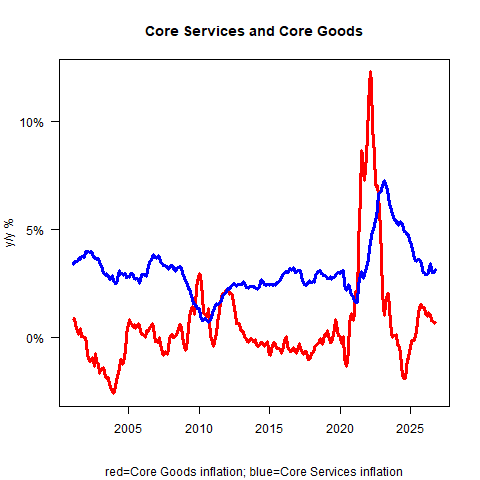
I don’t really love how core services appears to have arrested its decline. Some of that is still due to one-offs where commodity pressure is coded as services (e.g. airfares) but some, probably a lot, is legitimate pass-through.
There is at least some part of the explanation in rents and I don’t love how this next picture looks either. Rent of Primary Residence was +0.25% m/m, 2.78% y/y; Owners’ Equivalent Rent was +0.35% (3.28% y/y).

As I said earlier, last month the increase in core was less alarming because it was long-tail things while the main slow-moving things, like rents, were actually somewhat low. The low rent print last month now looks like a one-off. Primary rents were +0.17% in September and 0.25% in October; OER was +0.19% in September and +0.35% in October.
There was a fair amount of breadth here. Airfares were +1.16% m/m; Lodging Away from Home +2.04% m/m; Used Cars/Trucks +0.67% y/y; New Cars/Trucks +0.2% m/m. The persistent increase in Lodging Away from Home is interesting to me. This usually bucks and bobs and weaves but the last couple of months have been strong. Back in July it looked like the price level for hotels was going back into the range of the last few years; now it looks like it’s moving higher out of the range (see the price-level chart for Lodging Away from Home, below). Since wages and other costs of running a hotel are rising, I guess this shouldn’t be surprising.

Okay, here’s Median. My guess for the latest number is +0.282% m/m, moving y/y to 2.66% from 2.58%. That’s the wrong direction, and it’s going to continue as the base effects make it easier for a few months.

So, again: whereas last month the data was less concerning because Median was low, suggesting the rise was due to movements in the tail – this month it’s more concerning because Median jumped back up. This month’s Median CPI (or anyway, my guess about it), compounded 12 months, would be 3.4% y/y. Make a mental note of that for later.
None of the big macro pieces of CPI look especially cheerful. For new readers: these four pieces are all roughly a quarter of the CPI. In most-volatile to least, those pieces are Food & Energy, Core Goods, Core Services less Rents (aka Supercore), and Rent of Shelter.


Indeed, I don’t really see a lot of mitigating factors in the data to what looks like a pretty ugly number. I suppose you can argue that core ex-housing rose to only 2.04% y/y from 1.98% y/y. But that was still +0.29% m/m. It’s encouraging I suppose thatis core goods category is ebbing still, but remember – to get to 2% target inflation, you really need core goods to be deflating and it’s not getting there as fast as people hoped. (Personally I don’t think it’ll get very negative at all for a while. It will eventually, but deglobalization will be an upward pressure on this just as globalization was a downward pressure.)
I want to show where rents are against our model, again. Partly, that’s because I love this chart but also as a reminder that while m/m rents rose a lot this month and were soft last month, in the grand scheme of things they’re doing what we expect them to do. Do note that next year, there’s some upward pressure coming.

Continuing to talk shelter: I should note that existing home prices (see below) are only +1.3% y/y. Some forecasters use lagged home prices to drive their rents model. (This works when inflation is low and stable but we find building up from landlord costs is more accurate.) But this is your periodic reminder to keep home sales separated in your mind from home prices. As mortgage rates go higher, sales lag. However, the first principal component of home prices is the overall price level. Even if there was a big surplus of homes, real prices can fall (as they are now, with prices rising less than inflation) but nominal prices are unlikely to decline much if at all in an environment of 3%+ general inflation.

Let’s look at some broader distribution issues. Here’s one way to look at the gosh-we-aren’t-getting-there problem. This is the weight of CPI components that are inflating greater than 3% y/y. Since the Fed started the mad money-printing experiment, most prices have been rising faster than 3% y/y. That peaked a few years ago, but…seems to be leveling out above 50%.

And here is the Enduring Investments Inflation Diffusion Index, which says much the same thing – the underlying inflation dynamics are settling in, but at a level higher than the Fed would like it to be. These dynamics suggest median inflation should be headed back to the mid-to-high 3% range over the next year or so.

For a long time, I’ve said Median was tracking to end up in the “high-3s, low-4s” after the dip (mostly from rents and the shutdown mechanics) took us lower. That forecast now seems a little high, but mid-3s on Median is still worlds higher than almost anyone has been forecasting. Bottom line is – we’re not placidly settling back to 2% on core PCE.
Now, this is going to drastically raise the market odds of a Fed hike just like the Payrolls report drastically lowered them. I really don’t think the FOMC is swayed that dramatically from one data point to another. Or at least, I hope not. The underlying story has been the same for quite a while now – inflation is still gradually ebbing from the very high levels caused by rapid money printing during COVID, as (and because) money growth has slowed. The solution is a smaller Fed balance sheet and slower money growth, not higher interest rates, but there is still a vast contingent of people who think that growth, and expectations thereof, is the cause of inflation and therefore higher interest rates are needed to cool growth. Heck, the Nobel prize for economics was just awarded to a guy (Woodford) who is the poster boy of New Keynesianism, and who says the rate rule and expectations are what cause the price level (despite all the data indicating they don’t).
That being said – more data like this will certainly indicate that the Fed’s job isn’t done yet (in case you thought it was!) The only question is what the Fed does about it. Warsh has plainly indicated he wants to shrink the balance sheet and give less primacy to rates, but the last vote of the FOMC shows he doesn’t feel he has enough pull yet to do it his way. Going forward, the traditional FOMC is likely going to have to balance the question of slowing economic growth at the margin, versus sticky price pressures. The right answer near-term is ‘wait and see,’ and it’ll depend on whether the jobs figure is worse than the inflation figure. It’s probably as simple as that. I don’t have any insight on the jobs data. But I don’t think the inflation data are going to be helpful for a while.
Enduring Investments Capital Raise
For 17 years, Enduring Investments has done one thing: manage money against inflation. We’re the only firm built exclusively around inflation-related mandates — retail separately managed accounts and a private inflation-tracking fund among them.
We’ve opened a capital raise to fund our next phase of growth.
This offering is open to accredited investors, and as required under SEC Rule 506(c), we verify accredited status as part of the process.
If you’re interested in learning more, email partner@enduringinvestments.com and we’ll send our Advance Opportunity Summary and pitchbook.
Inflation Guy’s CPI Summary (August 2026)
Core CPI has been mostly boring and fairly trendless over the last 6-8 months. Not so high as to be worrisome, but not obviously declining, either. Headline CPI of course has been quite volatile, mostly due to energy prices and the war in Iran – but also recently due to food prices, and increasing risks emanating from the Ukraine/Russia conflict. Of course, we prefer to abstract from headline inflation, because food and energy are both largely mean-reverting relative to their volatility. But while I still feel that way about energy, I’m less confident about Food – both because of the knock-on effects of energy into food (trucking, packaging, etc) but also because of wages. A lot of the inflation in Food will be mean-reverting, but more will be sticky than is usual, I suspect. Anyway, not today’s story.
Today’s story, lest we forget, goes beyond CPI. It’s the 25th anniversary of 9/11. It’s hard to believe it has been a quarter century since the day I ran through streets being fairly convinced that the building was falling towards me, not straight down. It’s a difficult day for many, and so let’s all raise a glass to the fallen…and to the united country we were, for just a little while, in the days following the terrorist attack.
Coming into today, the consensus expectations for CPI were for +0.38% on headline CPI and +0.21% on core. There were some big moves in rates this month.

Ten-year real yields rose above 2.5% for the first time since 2007 (well, abstracting from the 2008 spike caused by Lehman’s failure). The last time 10-year real yields were above 2.5% for any sustained period was 2002, when TIPS yields were generally declining from very high levels as they were first starting to be broadly included in institutional portfolios. It is worth noting what is not at multi-decade highs: 10-year inflation expectations, which around 2.5% are in the range they’ve been in for years.
So this increase in nominal interest rates is not because inflation expectations are exploding higher (which is your first clue that maybe the Fed doesn’t need to aggressively hike short rates). It’s because of a sharp increase in real interest rates. The optimist says this is because real growth is strong, and that should raise the equilibrium level of real interest rates. The pessimist says it is because the world’s governments (and AI projects) are issuing too much darn debt, and higher real yields are needed to induce buyers for that debt. Probably some of column A, some of column B. But in neither case does the Fed need to hike – or anyway, that’s what longer-term rates are telling us.
But by the way…so you’re long TIPS to protect against inflation? This real yields thing is why that’s only an adjustment to soften your fixed-income losses, not to offset them, in an environment of rising inflation.

That said, the higher real yields make a lot of assets look more attractive from these levels. But if you already rode those assets down to these levels…well, that’s buy and hold and that’s just how it works.
Anyway – on to the CPI report.
There was an upside surprise: headline was +0.396% m/m, pretty close to expectations; core though was +0.29%. And that got people upset and immediately calling for a Fed hike. It seemed to be a race to call for it.

As I said last month, this doesn’t look like it’s decelerating and the last point here is ominous. It’s still all in the 0.23%-0.3% range, so not alarming if it merely stays here, but it isn’t looking like a deceleration at all. We’ll see in a bit though that this is less ominous than it looks. Probably.
The 8 major subgroups table has some interesting offerings.
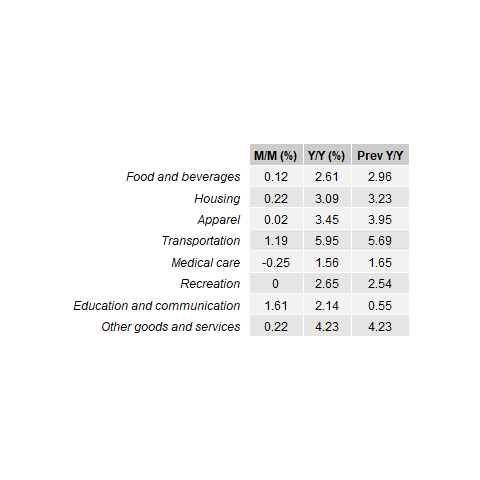
Food and beverages only +0.12% surprised me a little. It’s also interesting that Medical Care is still a drag – it was actually a drag across all three major components (Hospital Services, Doctors’ Services, and Medicinal Drugs). But we have an interesting clue here: “Education and communication” at +1.61% m/m is pretty unusual for a category that had been running at +0.55% y/y. More on that later after the main charts.
Core goods: +0.68% y/y; Core services +3.01% y/y. Both mild decelerations.
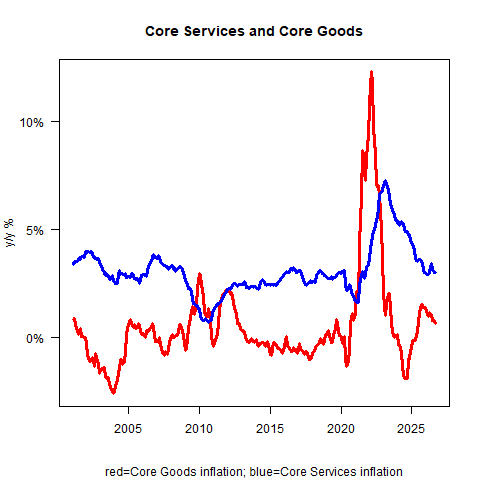
Rents were soft this month. Primary rents rose +0.17%, 2.75% y/y, while Owners’ Equivalent Rent rose 0.19% m/m.

So normally, when there is a surprise on core we first look to housing, but these are low surprises, if anything. They’re not wildly out-of-line…basically on our model. The model also says that we have gotten all the juice out of squeezing rents lower.

In other categories, there was a mild surprise that Used Cars rose (+0.37% m/m). Airfares were +2.7% m/m, which isn’t shocking considering jet fuel. Loding away from home (+2.36% m/m) rebounded from the decline last month, but didn’t we think that was World Cup related? Without the bump from Lodging Away from Home, the shelter category would have been even softer.
Now, the plot thickens. Here is my early guess at Median CPI. It’ll be off slightly because the median category looks like a regional OER subindex, but not drastically off. I’m calling Median +0.175% m/m.

Now that’s a different story. Still not declining, but not looking so ominous. And if anything, a surprise on the low side this month rather than the high side. This chart tells you that Core is high because of some large long-tail one-offs. It’s not a good number, but if “underlying inflation” is what you’re looking at, Median is a better number and it is relatively tame this month. At first glance this decreases, not increases, the chance for a Fed hike.
Now, I’m going to show you Supercore, which accelerated a bit this month to 2.99% y/y.

Nothing really to write home about, and the uptick is at least partly from airfares (which is really energy). But I will add “yet,” because there are some signs that we should be keeping a wary eye on. One of them just came out yesterday – the Atlanta Fed’s Wage Growth Tracker. It’s the best steady measure of wage growth, as it measures the median changes of continuously-employed people (so it doesn’t suffer from the composition shifts month to month of, say, Average Hourly Earnings in the Employment report). It just jumped back over 4%. Fair to say this is not something that people have been watching. I’m showing this right after the Supercore chart because also in Supercore are things like…lodging away from home.

Trend change? Too early to say. But not too early to watch it.
Anyway – the high core and low median implies we’re looking for the long tails in small categories. It could also be a nudge of the main body of the distribution, so we will look at that later. But in NSA terms, something like Appliances (which jumped 1.4% m/m, though it’s only 0.2% of CPI but fun to point out). Or, more prosaically, “Water and sewer and trash collection services”, which is 1.1% of CPI. It rose 0.49% m/m, but that’s not terribly out of line since its y/y increase is about 4.8%.
Here’s one: telephone services, which is 1.47% of CPI, rose 5.37% m/m.

That’s a chart of the cell phone services price index. And that basically adds up to the miss on core CPI. Do you think the Fed is going to hike rates because cell phone service prices jumped? That’s the bet you’re making if you think the high core CPI forces the Fed to hike.
I mean, maybe. It depends how much the FOMC members hate Trump, and some of them are positively frothy. But there isn’t a good monetary policy reason for it. Or at least, no better of a reason than there had been. It would probably be a better idea to shrink the Fed’s balance sheet first, rather than continuing to expand it.

The only category in Median CPI to decline faster than -10% annualized was Jewelry and Watches (-17%). Rising faster than +10%, in core categories: Education (10%), Motor Vehicle Maintenance and Repair (14%), Misc Personal Goods (+16%), Car & Truck Rental (+30%), Communication (+31%), Public Transportation (+31%), and Lodging Away from Home (+32%). So those are your tails pulling the number higher, while rents are holding it down.
Don’t get me wrong. This isn’t a beautiful inflation number. But if the FOMC is being honest, it shouldn’t move the needle. And certainly, hiking rates while they’re also expanding the balance sheet makes no sense. This is the first test to see if Warsh is indeed different, and (jointly) whether he can manage the other Fed voters to get the sensible outcome. The sensible outcome is to stand pat on rates, but start shrinking the balance sheet.
The Enduring Investments Inflation Diffusion Index declined slightly this month, while remaining elevated overall. The monthly decline tells us that the surprise this month was more long-tails than central-tendency-shift, so it reinforces the message of Median CPI that this is not an alarming acceleration.

To sum up: this was an acceleration from recent low headline figures, and next month’s headline will also be high. With the artificially-low core CPI prints from the 2025 government shutdown dropping out of the data over the next three months, we’re going to see some acceleration entirely from base effects (so, if you’re a Fed voter, and you’re worried about the opinions of people who don’t understand base effects, it’s cover for a hike. I’m not sure that’s the right audience to be performing for, but gotta mention it.)
Core was a surprise, but it was significantly due to cell phones. That seems a thin reed on which to hike rates, especially when you’re still accelerating the money supply by raising rates. Warsh will understand this, I think…but he will have to battle against some intransigent members of the FOMC who will want to hike (a) because the fancy economists they listen to in the market are telling them to, (b) the ‘market’ is telling them to, and (c) they really don’t like Trump or, by extension, Warsh.
On (a), I don’t like fancy economists anyway. On (b), notice what I said earlier about real rates and inflation. The ‘market’ is not asking for a Fed hike; inflation expectations aren’t actually moving much. And on (c), ‘nough said.
Chairman Warsh has made a point recently of saying the Fed wants to look at the underlying inflation trend. Core CPI is a better measure than headline CPI in that regard, but it isn’t as good as some other measures like Median CPI – and for exactly the reason we saw today. This CPI figure shouldn’t move the needle towards a hike, but it probably will. If the market fully or almost-fully discounts a hike, I’d look for a low-risk way (such as buying Fed funds futures once the hike is priced in) to take a flyer on no-action. The point of strategy is not to plot a path to victory, but to plot such that all paths lead to victory.
All that being said, my models have inflation accelerating moderately from here. Not hugely, but also not decelerating. There is work to be done from the central bank. Just not the work the market is trying to push them to do.
And now a word from our sponsor.
Enduring Investments Opens a Capital Raise
For 17 years, Enduring Investments has done one thing: manage money against inflation. We’re the only firm built exclusively around inflation-related mandates — retail separately managed accounts and a private inflation-tracking fund among them.
We’re opening a capital raise to fund our next phase of growth.
This offering is open to accredited investors, and as required under SEC Rule 506(c), we verify accredited status as part of the process.
If you’re interested in learning more, email partner@enduringinvestments.com and we’ll send our Advance Opportunity Summary.
Inflation Guy’s CPI Summary (July 2026)
The Bloomberg survey’s consensus numbers headed into CPI today were for +0.11% on headline inflation and +0.20% on Core. Considering the downside surprises last month, that’s a pretty tame forecast that says ‘no givebacks’ for the surprises.
Last month’s downside outlier on CPI, which cemented market consensus that the Fed wouldn’t hike rates in July, was mainly the result of surprises in rents, cell phones, and car insurance. The latter effect (as noted by a commenter on the inflationguy.blog, was due to a very large one-time State Farm special dividend to policyholders – obviously not repeatable.
What matters to the Fed, not to mention consumers, is the core number and changes in the trend. But it takes a few numbers to see a change in trend. So far, we haven’t seen a change in trend!
And…that evidently isn’t happening this month either. Headline CPI was +0.074%, a smidge below expectations, while Core CPI was +0.215%, just a pip or so high. As expected, that makes last month a pretty obvious outlier.

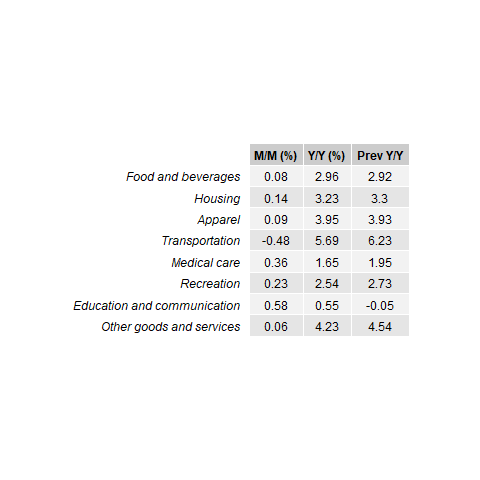
All of the groups rose on the month with the exception of Transportation, which was obviously mostly gasoline. Note that seasonal adjustment this month adds a bit to the NSA print, as we “expect” gasoline to be a drag in July. NSA CPI was actually -0.01%.
Also interesting to note are the y/y numbers for the 8 major subgroups. Of them, only Medical Care and Education/Communication are below what we have traditionally called the Fed’s target of 2%! This is one reason why the Enduring Investments Inflation Diffusion Index remains elevated even though Core and Median numbers are gradually coming down…so far.

(I usually put the EIIDI at the end, but it made sense to put it here for exposition reasons.)
Core Goods is down to 0.81% y/y; Core Services to 3.01% y/y.
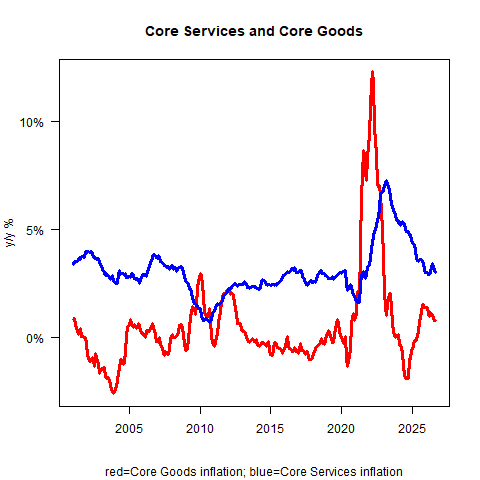
Core commodities continues to moderate. But this is not what people thought we were going to be getting once the tariff effect had finished washing through – and it has. This post-tariff residual is more important. I had expected core commodities to remain very slightly positive rather than going back to the perennial deflation of the globalization era, but this changes things if it instead settles around 0.5-1.0%. As I’ve noted, it becomes hard to get core to 2.0% in that case. By the way, that run rate of 0.8% is with Medical Care Commodities in outright deflation. Medicinal Drugs declined again. TrumpRX baby!

Okay, so some of the buoyancy in core goods overall is probably a pass-through of the energy spike…via packaging, much of which derives from petroleum products, and other trucking rates which pass through into other goods. But still – this is the part I thought would be easy, and it would be core services that would be slow and sticky. More on that in a bit.

Primary rents were +0.26% m/m, stabilizing y/y at +2.86%; Owners’ Equivalent Rent was also +0.26% m/m, and 3.23% y/y. I said in last month’s CPI summary that “Rents will probably recover to get back to a more-normal run rate of +0.25%/month,” and that’s just what happened. That had been one of last month’s outliers, and it went away. There was no payback rebound, but since housing inflation is right on the model I didn’t expect one.
Lodging Away from Home was -2.8% m/m. Now last month Lodging Away from Home was also a decline, and that was a surprise because people thought the World Cup would elevate the hospitality price pressures. Some people had suspected a calendar quirk leading to that decline, but this month’s further drop means it probably wasn’t a calendar quirk. Honestly, I think maybe the Cup effect was overblown. Compared to the number of hotel rooms could it really have been that big an effect? In France, sure. In the US/Mexico/Canada? Regardless, SA Lodging Away from Home is back to where it was in November of last year. It has really gone nowhere for 3.5 years. Airfares rose 2.22% on the month – a pass-through of the energy spike again.
Used cars and trucks were +0.4% after -0.23% m/m last month. New Cars were +0.08% versus -0.02%. Those were also ‘drag’ categories last month, back to normal this month.
My guess at Median based on today’s numbers (actual numbers come out in about an hour) is +0.256% m/m.

How much of a downtrend this is depends on how nearsighted you are. Over the last 4 months? Downtrend. Over the last 9? Uptrend (although that includes the shutdown aberration). Most honest read is probably flat to very slightly down over the last year. But 0.25% monthly is still a 3% run rate of Median. That’s not where I think it is going to settle, but it’s higher than Warsh wants it.

Core Services less Rent of Shelter declined to 2.81% y/y. This is the most encouraging piece, because it’s more wages-based and so the wages/prices feedback adds stability and persistence. I don’t know that I’m confident this is going to keep sliding, but the trend is your friend and if core commodities is not going to go negative, then we need this to decelerate below the pre-COVID levels. Like I said, I thought this was the part that would be slow and sticky. I suppose it is – certainly improvement has been slow – but it is the best trend in the data I think. Is it enough? Hmmm…I suppose it depends on Warsh.

Motor Vehicle Insurance (seasonally-adjusted index shown above), which was one of the outliers last month thanks to that State Farm dividend, fell again…but just slightly. This may be a residual of that dividend, or it may be real. I doubt it’s real. Declining used car prices helps some but there are too many other upward pressures. Flat is the best we can really hope for I think and flat is what we were getting in Q1 2025 through Q1 2026.
Core categories declining faster than 10% annualized this month included Car and Truck Rental (-30%), Lodging Away from Home (-28%), Infants’ and Toddlers’ Apparel (-16%), and Motor Vehicle Fees (-11%). There aren’t a lot of future repeaters there that we can count on. On the other hand, rising faster than 10% annualized we only have Nonalcoholic Beverages and Beverage Materials (+11%), Public Transportation (+22%), and Jewelry and Watches (+29%). So not a lot of repeaters in the upper tail either.
This is the number I thought we would get last month. Boring, right on expectations. The bad news is that it is boring and right on expectations…at 3%.
This doesn’t change anything about the Fed outlook, but not for the reasons people think. My outlook depends a lot on Chairman Warsh. If Powell was still in charge, then the Fed would almost certainly be nudging up rates (even as the balance sheet grows) because inflation is being stubborn. But Warsh has stated a desire to tighten policy – by shrinking the balance sheet. I don’t know why pundits seem to think this isn’t hawkish. I suppose 30 years of being told that policy rates are the only things that matter to monetary policy will produce lots of analysts who think that is the case.
Currently, the balance sheet is still growing, and short rates are stable. I expect that as long as Warsh wins the philosophical argument in the Eccles Building (no sure thing), the balance sheet growth will soon reverse and rates will then start to come down – not go up. Right now, Fed Funds futures have basically become an event contract on “Will Warsh win control of the Fed, or be captured?”
Policy needs to be tighter. The sticky inflation makes that clear. But that’s a balance sheet thing, not a rates thing. But stay tuned for news from Jackson Hole!
Inflation Guy’s CPI Summary (June 2026)
Okay, I will admit that I came into today thinking ‘this is one of the more low-stress releases in quite a while. We know headline inflation is going to be negative, and it’s just a question of whether core is 0.20% or 0.26%.’ The Bloomberg consensus was for -0.12% (seasonally adjusted) on headline CPI, and +0.23% on core CPI. That core CPI forecast would annualize to 2.8% or so, clearly indicating that inflation hadn’t fully returned to target but also not super alarming. The swap market was aligned with economists’ forecasts.
Wow, were we collectively wrong on that!
The conspiracy nuts are going to have a field day with this, even though the Federal Reserve has nothing to do with the Bureau of Labor Statistics. We get a new Fed Chairman and wham! Inflation suddenly has a sharp, surprising drop. I don’t think we need to get involved in that. There are some weird things with this number, and they all sort of got weird in the same direction, but I wouldn’t call them suspicious. However, the conspiracy nuts will point out – rightly – that there’s nothing other than gasoline that feels like its price is declining. And yet…the actual data for today showed a m/m decline in headline cpi of -0.42% and a decline in core of -0.02%.
That is a massive miss in core and the biggest decline – outside of March, April, and May 2020 – since March 2017. And in March 2017, the dip was caused by a 7% single month decline in Wireless Telephone Services, caused because the sudden shift to ‘unlimited data’ plans blew up the hedonic adjustment for data…going from 5gb to ‘infinity’ caused issues. (I wrote about that in How the BLS Methodology for Wireless Plans Exaggerated a Small Effect). Before that, January 2010 when post-housing-bubble home prices and rents were in retreat and almost turning the y/y core inflation negative (it got down to 0.6%). Before that, 1982. So, an outright decline in core CPI is rare, and especially with the overall trend firmly in the too-high-for-the-Fed zone, this is a large outlier.
The last-12-core numbers chart looks more like headline CPI than core CPI. That’s partly due to the Oct/Nov dips caused by the way the BLS handled the shutdown, and the April spike due to the payback on the rental survey. But let’s say that if you were selling straddles on core inflation, this is drastically more vol than you were pricing.

So, we go hunting for culprits. Breaking into the 8 major subcategories suggests some places to look.

A lot of the Transportation decline is of course gasoline, but the gasoline drag was pretty much spot-on what had been in the forecast. The forecasts had been looking for an 0.35% difference between headline and ex-food-and-energy CPI, and we actually had 0.40%.
One part of the explanation – as every part of a big miss on core must be – comes from rents. Primary Rents were +0.15% m/m, and OER was +0.24% m/m. Last month, those were +0.36% and +0.30%, which were not drastically far off from the current trend. But this month, the y/y decelerated again.

Airfares was +0.21% m/m; that’s a place I looked as a possible culprit since while it’s in ‘services’ these days it’s mostly a pass-through for energy and with energy dropping sharply I thought it was possible. It hasn’t happened yet, though. Lodging Away from Home was a surprising -2.32% m/m (surprising because the assumption is that the World Cup would keep it bid for another month), but LAfH moves around a lot and we can’t put it all at the feet of the hotels. Used Cars was -0.23% m/m, and New Cars -0.02% m/m, and that’s part of it too but hardly big enough to call it a major surprise.
So we continue to investigate but note that Median CPI is likely to be low also. My early estimate is +0.156% m/m, although I note that the median category is probably one of the regional OERs so I’ll be off by a little bit at least.

If that sort of Median CPI was repeated 11 more times, it would mean y/y Median CPI would be at 1.9%, well below the Fed’s target (since Median is typically above core by 0.25%-0.50%). Color me skeptical.
It’s worth noting that Core Goods inflation did not abruptly collapse. My thesis is that if the Fed’s going to get back to target, and I’m even vaguely right about housing, then you really need to see core goods to be around zero to have a good shot of getting there. And we aren’t really even sniffing it yet.

Or, alternatively, we would want to see SuperCore drop sharply. There’s no obvious sign of that, but it does bear noting that Core-Services-ex-Housing was -0.21% m/m.

That was the lowest supercore since 2020, and before that the Cell Phone Services thing in 2017.
Let’s look, since I’ve mentioned it twice now, at cell phone services.

Three things bear pointing out here. First, note the general deflation in cell phone services prices. Yeah, yeah, I know your contract hasn’t gone down in price much but you’re getting more and more quality. It’s a pretty steady trend. Second point: note that the upward divergence in 2023 almost exactly mirrors the downside divergence in 2026 before this month. The shapes are actually almost congruent. You get that frequently in a year/year rate when an item spikes in price, and then that spike falls out of the y/y. But this isn’t a year/year rate. This is an NSA price index. I can’t think of any reason for that weird phenomenon…it must be methodological somehow. Third point: this month’s spike is clearly an outlier. That doesn’t mean it isn’t real, but it does mean I don’t expect it to be repeated. For scale, note that the change is about 1.5 points on the index. The 2017 decline was 3.7 points. Odd, and I can’t explain it yet, but again: unlikely to be repeated. For what it’s worth, this is not an irrelevant weight: “Telephone Services” in the CPI carries a 1.5% weight. Thanks, “screenagers!”
I always survey the biggest-gainers and biggest-losers monthly change list, using the breakdown the Cleveland Fed uses for Median CPI. Because they are the tails, they don’t affect the median but they do affect core. This month, the biggest losers list included Lodging Away from Home (already mentioned), Jewelry and Watches (small weight), Communication (just mentioned), Infants’/Toddlers’ Apparel (small weight), and … Motor Vehicle Insurance, which declined at an annual rate of 22%. Odd?

Car insurance is 2.7% of CPI, so it is noticeable. Does this make sense? It’s possible, I suppose, because of the decline in used car prices…and, perhaps, there’s an effect from mass deportations here, since if you have fewer uninsured motorists then the cost of insurance should fall. I did not see it coming, and unlike the telephone thing I can imagine there could be some modest further declines ahead if I’m right about the causes.
So: housing, cell services, car insurance. Definitely some outliers. Rents will probably recover to get back to a more-normal run rate of +0.25%/month – after all, even with this surprise we’re right on our model.

Is it only outliers? The Enduring Investments Inflation Diffusion Index declined, so there was some narrowing of the inflation advance, but it didn’t exactly plunge. I’m going to say then that this was more the outliers than a fundamental shift of inflation momentum (at least, that’s what I think right now!)

From the Fed’s perspective…from Warsh’s perspective…this is obviously very welcome. There is little chance of any hike in US policy interest rates this year. There wasn’t much chance of it before this number either, since the new Chairman’s stated preference is for a smaller balance sheet and lower interest rates (both of which policies retard inflation, in different ways). But there is even less of a chance of a rate hike now. However, it does bear remembering that as we move later in the year, the core and median y/y numbers are going to rise, simply from base effects, and especially in October and November when the shutdown effects fall out. Ergo, it may be difficult to price out all hikes from the yield curve, unless the economy starts to visibly weaken.
Let me leave you with one last chart, to remind you that it is premature to declare victory over inflation.

M2 y/y growth is back to 5.6% y/y, and climbed at a 7% annualized rate over the last 6 months. The balance sheet has actually been growing, not shrinking, since December. Is that Powell’s last middle finger to Trump? In any event, that’s one reason that money growth is back in the range that was normal prior to COVID. But during that pre-COVID period, there were unique trends that held inflation lower than it otherwise would be: demographics and globalization being two of them. Those effects have reversed, and consequently (I’m sorry but I can’t say it often enough) a 6%ish growth in the money supply is no longer consistent with 2% inflation. Either the Fed needs to get religion (and Warsh has the hymnal open, but it’s not clear yet if anyone is going to sing along with him) and shrink the balance sheet to rein in money growth, or inflation is going to remain stubbornly resistant to a return to 2%. Phones and car insurance can’t do it all.
Inflation Guy’s CPI Summary (May 2026)
While the worst is probably over for the monthly CPI prints, the real question going forward is ‘how much better does it get?’ We know that energy prices will eventually retreat, but even if they merely flatline they will stop flattering headline CPI. But where does core and more importantly median CPI settle in? That’s the real question. For now, we just have one more month of data so let’s dig in.
The economist surveys had CPI at +0.51% headline and +0.27% core. The inflation swaps market was in roughly the same place, with +0.66% NSA the last trade.
The last month has seen a lot of volatility in markets (duh), but in particular a significant increase in real yields.

Nominal yields have risen a bit, and get all the ink when 30-year yields peek above 5%. That actually masks the real problem, which is that nominal yields have risen so little only due to the sharp decline in inflation expectations. In the front of the curve, that decline in breakevens is significantly a carry phenomenon (as we roll through months with solid NSA accretion) and so, therefore, is some of the rise in real yields. But a 40bps increase in real yields at the 5-year point gets one’s attention. And at 2.17%, 10-year real yields are near the absolute highs they’ve seen since the Lehman-related spike over 3% in 2008.

(Oh, and if any technician tells me this is a ‘flag’ formation projecting to 5%, I’m going to smack you. Real yields don’t go to 5%.)
The uptrend in real yields, as an aside, has also been bad for gold. Gold behaves like a long duration TIPS bond and as TIPS have sold off, gold has been a whipping boy. That won’t last forever. I like buying 10-year TIPS anywhere north of 2%, and if real yields get above 3% some day – back up the truck. Let’s hope that isn’t soon though.
The actual data comes in today at +0.473% m/m on headline CPI and +0.208% on core CPI. Both of those are below expectations, with core a meaningful miss. Here are the last 12 core CPI figures (keep in mind that last month’s jump was a payback for the 6-months-ago quirk in rents due to the government shutdown).

And here are the m/m, y/y, and prior y/y for 8 major subgroups. It’s striking that Apparel is +4.8% and “Other” is +4.9%. Those are not usually exciting categories! I’ll return to this a little later.

Here is the coarse breakdown of core goods (+1.06% y/y) and core services (+3.42%).

It isn’t surprising that core goods is decelerating. It’s actually somewhat concerning that it isn’t decelerating faster. The hook higher in core services bears some further investigation. Even though the overall numbers looked good this month, this breakdown isn’t all sunshine and roses.

Primary rents were +0.36% m/m, and 2.92% y/y versus 2.79% last month. OER was +0.3% m/m, 3.32% y/y. The jump in Rent of Primary Residence is a little concerning (although I will note that it puts the actual y/y number exactly on our model, which goes pretty flat near this level for the next year). Last month’s hook higher made sense because of that make-up month due to the shutdown/6-month lag effect. But that isn’t the issue here. Lodging Away from Home was alto +0.4% m/m, 5.2% y/y. Some people will say this is a World Cup effect, and possibly we are seeing a little bit of that in Lodging Away from Home. But this isn’t France. The US is a pretty huge country and there is no way that World Cup tourism is enough to move rents for the entire country.
But landlords are seeing higher direct and indirect costs. This is why rents are not going to go into broad deflation any time soon.
What might also be flagged as a World Cup effect, but more likely is just jet fuel pass-through, is the 2.69% m/m rise in Airfares after a 2.82% rise last month. I have airfares just slightly above the model given jet fuel prices, and within the error bars, so if there’s an impact there it’s pretty small. I think this is worse in Europe. Airfares are indeed part of the story in the core-services move higher that I noted above. Rents are too, but the airfares increase is easier to figure out.
The median category this month looks like Recreation at 3.51% annualized m/m. I may be slightly low, depending on where the regional rent indices get adjusted, but my guess for Median CPI is +0.287% m/m for a small acceleration y/y to 2.83%.

I have to say – if you shovel some of April’s jump back into October and November where it belongs – it still doesn’t look like deceleration to me.
Okay, here are the four pieces charts. Food & Energy +9.81% y/y. Core Commodities +1.06% y/y. Supercore +3.55% y/y. Rent of Shelter +3.33% y/y


The Core Services less Rent-of-Shelter (Supercore) is the one I don’t like, but again part of that is the Airfares/energy thing. None of this looks like super good news, though.
By the way, there were only 3 categories that declined at a faster annualized rate than 10% this month: Car and Truck Rental (weird) at -40% annualized, Motor Vehicle Insurance (very weird) -18%, and Misc Personal Goods -11%. Above 10%, and ignoring food and energy, we have Jewelry/Watches (41%), Misc Personal Services (28%), Communication (17%), Tobacco and Smoking Products (+13%), Infants/Toddlers Apparel (+12%). Motor Vehicle Maintenance and Repair just missed the cut at +9.95% annualized.
Here are a couple of interesting things I’m watching. This chart is Computer Software and Accessories, and it’s where AI tools land. Now, it’s a tiny, tiny part of the basket at the moment but I’ll bet it’s larger when they reweight next year. This is the NSA price index, not the rate of change – so prices for computer software and accessories are higher than they’ve been for years.

Like I said, this is a tiny category but it actually matters more for PCE. That fact annoys the Fed, who just published a research piece (https://www.federalreserve.gov/econres/notes/feds-notes/measurement-of-computer-software-and-accessories-inflation-20260522.html) explaining that this is partly ‘measurement error.’ Uh-huh. Boy are we getting picky.
Also, I happened to notice that computer prices are actually increasing, due to upward pressure on DRAM and other component prices thanks to AI demand. This sort of annoys me because I need a new laptop and the prices aren’t going down like they usually do if you wait. And yes, that’s the main reason I noticed.

This is one of those categories that animates conspiracy theorists because the BLS hedonically adjusts it…so since computers are always improving, there’s a general decline in the quality-adjusted-price over time. Well, not just a general decline, but a pretty large decline. “But computer prices haven’t actually fallen! Yes I get more computer but I don’t have the option to get the old one! I want my Windows 95!”

So prices going up, at least if it continues, is interesting. It’s a symptom of AI demand. It’s still not a large part of CPI, but I think AI is going to start showing up more here and there. Like here:

This is obviously not all AI – the upswing happened in the aftermath of COVID, possibly partly because work from home means power needs are broader throughout the day. But the continuation recently…I am pretty sure AI data center demand, if it isn’t yet affecting this, is going to!
And that is emblematic of the long-term story here. Not this month’s story per se. But these upstream pressures on petroleum and electricity are passing through more and more downstream. And that’s a hard dynamic to arrest. It is difficult to put that genie back in the bottle.
Now, this isn’t to say there is no good news.

This is Medicinal Drugs, aka pharmaceuticals, in core goods. It was -0.8% this month after -0.3% last month, and is -2.2% y/y. This looks like a real TrumpRX effect. On the other hand, Hospital Services is still rising at about 6% y/y, so while overall Medical Care in the CPI is +2.6% y/y, that’s being flattered because of the TrumpRX effect which won’t last forever.
Now, earlier I pointed out Apparel’s interesting y/y increase. The absolute price of apparel basically peaked in 1993 or so. This is a wonderful picture of the power of offshoring, as we went from producing a lot of apparel domestically to producing basically nothing, and saw apparel prices decline in real terms and even in outright terms for nearly 30 years. There was a sharp dip and recovery due to COVID, but in the last year or so the Apparel index has actually gone to new all-time highs.

Some of that is re-onshoring. Some right now is actually petroleum since many types of fibers are downstream petroleum byproducts. Think polyester, but it’s broader than that. But prices prior to the energy spike were already at 20-year highs.
The bottom line here is that the rise in the headline CPI is causing some people to shrilly declare that the Fed needs to raise rates. That’s ridiculous – the Fed looks through energy price increases. Although as I said before, those energy price increases, if they are sustained long enough, start to percolate through, and they appear to be…core and median and trimmed mean CPI won’t be heading back to target (not that there is a target any more) any time soon. As long as the economy stays pretty strong, the Fed has actually stumbled into what should be a comfortable spot for a while. Warsh will work on trimming the balance sheet, hopefully, but I wouldn’t expect rate changes for a while and that’s a change in my view from before when I thought the Fed would be easing (I thought growth would be weaker and I continue to be confounded on that). I’m saying that while the headline inflation data look ugly, that will pass as energy prices decline. But I do think it will be difficult for the Fed to get comfortable with Median CPI going back up, or just not going back down, while growth is strong.
“Mike, Mike, Mike…you’re making too much of these little things! Core doesn’t look too bad. Median is not alarming.”
Yes. But electricity, petroleum, the demographic pivot, re-onshoring, and let’s not forget money growth. These are not small things and they affect how difficult the future looks with respect to inflation. The tree’s leaves are pretty but the trunk is rotten. I am not optimistic about future shade.
Inflation Guy’s CPI Summary (April 2026)
Here we are again, on the monthly CPI roller-coaster. Consensus coming into the day was +0.60% m/m headline, +0.33% core, pushing the y/y numbers to 3.7% and 2.7% respectively. The headline print will obviously be flattered by energy prices again, but the core number may seem surprising since we have been running between 0.196% (last month) and 0.313% (last July) for the last year. Why so high? To be honest, the core forecast seems lowish to me: this is the month where the shelter rebound is to take place. As a reminder, the BLS methods from the missed month of CPI in October implied no change for shelter, and that’s clearly wrong; because of the way the sample rotates, we had to wait 6 months to get the correction. That day is today. The consensus of good inflation shops seems to be that the correction will be worth 0.14% on Core, which makes you wonder…0.33% minus 0.14% would be 0.19%, so essentially economists are expecting new lows in m/m core? Seems curious.

Last preliminary point – the market over the last month has generally impounded higher inflation expectations (far left, inflation swaps). The sharp decline in 1y CPI is an artifact of the fact that over the last 30 days or so, a lot of good carry rolled off the front. In fact, that makes the 2y look all the more remarkable. Nominal govvie rates are higher (right column), but that’s a good bit due to higher real interest rates (third column) more than inflation expectations. Which is interesting.
Now for the actual data and the rain of charts.
The actual print for CPI was +0.64%, with m/m core CPI of +0.376%. So the economists were low, and even the swaps market was low as NSA printed +0.85% m/m.

The jump, as I said, is partially a repayment for the very low Oct/Nov numbers last year (there was no October, so this chart divides the very low 2-month change in November). Figure if the run rate was +0.25% or so per month, we were a cumulative 40bps too low over those two months. Not all of that was given back today; much of it showed up in December and January. But that is the context for the big spike on the right-hand side. It’s not as bad on the (estimated) median chart. My guess is +0.33% m/m for Median, but that’s almost certainly off by a little since the median category is going to be one of the regional OERs.

Core Goods inflation dropped to +1.1% y/y this month, while Core Services rose to +3.3%. In September, before the shutdown, the numbers were +1.5% and +3.5% respectively, meaning that we have made some progress – but not as much as we need to – on core goods and very little progress on core services. Bottom line is, the improvement it appeared we were seeing in CPI over the last six months was basically an artifact of the shutdown.

Here are the rent charts, with a ditto mark for the prior comment. The jumps this month aren’t really a hook higher; they’re correcting the erroneous y/y numbers that the last 5 months showed. We have still made progress – back in September these numbers were 3.39% and 3.76% respectively. Just less than we thought. The m/m increase in Primary Rents was +0.55%, bringing the y/y to 2.79% from 2.56%; for Owners’ Equivalent Rent the numbers are +0.53%, taking it to 3.3% from 3.1%.

Additionally, Lodging Away from Home rose 2.44% m/m. This category did not have the same problem that the Rents series did, or rather the correction happened previously – there is no 6-month rotating survey for Lodging Away from Home. Lots of shelter inflation this month!
Airfares were +2.82% m/m. That’s in services, but it’s significantly related to jet fuel of course. With this increase, airfares are now roughly in line with the increase in jet fuel. Of course, mergers of giant air carriers and the bankruptcy (Spirit Airlines) of regionals are both damaging to the competitive nature of airfares, so it remains to be seen how much that effects prices in the long run. It probably shifts higher and steepens the chart below somewhat.

Here are the Four Pieces charts. Food and Energy +8.03% y/y. Core Commodities +1.13% y/y. Core Services less Rent of Shelter +3.28% y/y. And Shelter +3.26% y/y. These four pieces, in descending order of volatility, add up to the CPI and they’re each between 1/5th and 1/3th of CPI. The one we tend to focus on, rightly because it incorporates the feedback loop of wages to prices, is the “Core Services less Rent of Shelter” one, aka Supercore, and it is not looking as positive these days. Indeed, none of these charts are doing what they need to do if we want to see 2%!


Here is median wages – the Atlanta Fed Wage Growth Tracker – vs Supercore. Median wages have increased the last couple of months. You can’t really call it a trend change yet. But, this is the feedback loop. If you want 2%, you really need wage growth to be about 3%. No real sign of that yet.

Here is another way to look at ex-shelter inflation. Above we saw core services ex shelter; the chart below is core (goods+services, not just services) ex-shelter. That line is in dark blue. Shelter inflation is in light blue. If you’re really optimistic about shelter coming down to below 2%, then you can argue the rest of core CPI is only a bit above 2% (about 2.6%). But historically, as you can see from the chart, you wanted most of core to be below 2% while shelter ran a bit above it, if you were going to be in a placid inflation environment. So that doesn’t look quite right yet. Plus…there’s no sign shelter is about to drop below 2%.

When I say ‘no sign shelter is about to drop below 2%, the chart below is what I mean. It had appeared that rent inflation was dipping below my model. But it turns out, the model wasn’t high at all – the dip was the artifact of the shutdown. So rent inflation is 2.8%, the model is at 2.8%, and the model a year from now is at 2.8%. That doesn’t seem like the right sort of trend. I seriously doubt rents are going to do the heavy lifting getting inflation down to 2%.

By the way, let’s not sleep on food prices. They were up 0.5% overall this month. This chart shows the level in the top panel (note that food doesn’t mean revert like energy does), and the rate of change down below. The 2024 dip was a rebound from the 2022 spike, but we’re crawling back up. Note that unlike energy in the CPI, the food category isn’t just a pass-through of commodity costs. Higher packaging, trucking, marketing, etc costs are more important long-term drivers than the cost of the commodity – and in Food Away from Home, obviously wages matters too. Food is just another category – a major one, to be sure – that doesn’t look like it is placidly dropping to 2%. Although, since it’s not a core category, the Fed could theoretically ignore it. It’s harder to look through food price increases than energy price increases, since as I said food price increases don’t typically mean-revert.

Now for the good news portion of our broadcast. The combination of Trump RX and the new “most favored nation” policy on drugs is having some effect on the CPI for “Medicinal Drugs” (which includes both prescription and non-prescription drugs). Prices are in fact declining. I would argue it isn’t super dramatic yet, but drug prices are coming down.

Put this all together and the Enduring Investments Inflation Diffusion Index rose again – reaching 44, which is the highest level it has ever seen other than the 2020-2022 spike.

With this April CPI, we now know the USDi coin’s price through the end of June. The current USDi price is 1.0394. By the end of June, the price will be 1.05488. That’s 1.49% over the next 49 days, so about 11% annualized.

Furthermore, inflation swaps for May’s CPI are suggesting another hottish NSA CPI of +0.55%, which would annualize to 6.6% if it happens. After that, energy correction (we hope) should weigh on CPI but for now, it looks like a hot summer for USDi. You can mint the coin at https://usdicoin.com/coin.
Wrapping this up, the read is actually pretty easy. Inflation is not just in energy, but right now is fairly wide as the diffusion index shows. Some of that is related to energy…the price of diesel fuel affects trucking costs, which affects other goods prices…and some of it is related to the fact that wage growth is no longer slowing. Any way you look at it, as I said the read is pretty easy: the Fed obviously isn’t going to be tightening into an oil shock. But there is nothing here that gives them cover to ease into an oil shock either. Warsh inherits a pickle.
Inflation Guy’s CPI Summary (March 2026)
Today we get the CPI data that will finally unleash Trump’s critics and cause them to criticize the war effort to rein in Iran. (Just kidding – obviously Trump’s critics need no excuses!) We see the direct effects of the war on consumer energy prices, which the consensus expects to produce a headline m/m, seasonally adjusted CPI figure of +0.96% (consensus on core is +0.28%). The range of estimates is 0.6% to 1.5%, which is sort of crazy…it is hard to imagine how you get a +0.6% out of this. (Most of us are around 0.9%-1.1% though.) A couple of notes before we look at the actual number.
First, note that at this time of year the seasonally-adjusted number is lower than the NSA number is. NSA, the Bloomberg consensus is for about +1.15%!
Second, it is important to remember that before the Iran war, we were still unwinding the data artifacts that resulted from the 1-month gap in the CPI produced by the government shutdown last fall. Next month’s core inflation numbers were already going to be a bit higher than trend because of the payback in rents at the 6-month point after the October gap. The war doesn’t make the unraveling any easier, though we were getting to the end of that process. Key point though is that we don’t yet have a read on where trend core or median CPI is settling.
Which brings us to the main point looking forward to today’s figure, and thinking about the effect the war is having. The impact on energy prices is pretty transparent, and while important it is also ‘transitory.’ Energy prices mean-revert, and eventually gasoline prices will either decline back to some semblance of where they were – or they will at least flatten out and no longer contribute plusses to the monthly figure. There is almost no trend component to energy, which is why policymakers want to look at core and median. So that is the real item of importance today, and for the next couple of months: we want to look at signs of pass-through beyond energy, not just into core commodities (higher energy prices pass through via things like shipping and packaging, for example, pretty quickly) but more importantly into supercore (core services ex rents). So next month, we may or may not see lower gasoline prices…but we will also see the rents payback (higher), pass-through into core commodities (higher), and possibly growing signs of an inflation uptick beyond that – not just from the war, but from any trend that was developing pre-war. I take administrative notice of the Atlanta Fed’s Wage Growth Tracker, which in February and March rose from 3.6% y/y to 3.9% y/y. There isn’t a war effect in that, and while this doesn’t exactly break the downtrend in nominal wages (see chart below, source Bloomberg)…it also wasn’t entirely unexpected that wage growth would be bottoming near here.

Finally one last pre-number observation: I want to reprise my chart from last month showing 5-year inflation swaps on the Continent compared to 5-year inflation swaps in the US. The US swaps curve is still not showing any effect at all from the war.

Now, as I said energy prices are mean-reverting so the forwards shouldn’t show a lot of impact…but it almost always does because no one ever treats inflation as unit root. That is, when spot inflation goes up the curve almost always shifts up a bit along its length because every swap on the curve starts with a 1-year swap. If energy mean reverts, the 1y, 1y forward should shift lower to reflect that…but it almost never does. This is unusual, and curious. And it sort of implies a strengthening dollar, since if global inflation is higher because of aftereffects from the war, then weaker currencies will end up owning more of that inflation than stronger currencies. That happens to fit my thesis of dollar strength, but it’s still weird.
And now for the number…
Headline CPI came in at +0.865% seasonally-adjusted m/m, raising the y/y to 3.3% from 2.4%. The year/year number will rise further over the next few months to approach 4% before hopefully receding some. The NSA number for headline (which matters for USDi accretion in May – get it while it’s hot!) was +1.049% m/m. Seasonally-adjusted Core CPI was very tame +0.196%.

Among the major categories, Apparel was +1% while Medical Care, Recreation, and Other goods and services were all negative m/m.

Now, core goods rose to +1.18% y/y. This is interesting, because one thing that pundits were saying that that there was ‘some evidence that the invalidation of Trump tariffs led to lower goods prices.’ Not really. Apparel as I said was +1%, and core goods rose y/y even with surprising softness in Used Cars (where surveys suggested an increase). Core Services also ticked up, which is very interesting given what we saw in rents.

Primary rents were +0.19% m/m, and by my calculation will be the median category (spoiler alert: my estimate of median CPI is +0.19%). Owners’ Equivalent Rent was +0.28% m/m. Both were higher than last month’s surprises but y/y is still sagging.

Airfares were up +2.67% m/m, which is one core service that actually has a lot of energy in it. We’ll see a further rise from Airfares going forward. But here is supercore, and as I said this is the part we want to watch closely. We knew energy would be higher, but it mean-reverts. Rents will jump higher next month to re-pay the October zero, but rents already look like they’re leveling off after a long decline. We need to watch core commodities for energy pass through over the next few months. But the key is Core Services less Rent of Shelter. It has a small hook higher over the last couple of months, which is consonant with the Median Wages chart I showed earlier.

Wages, potentially pushed higher a little bit because of the shrinking workforce due to ex-migration, feed into supercore and that’s the feedback loop that I think will end up keeping us in the mid-to-high 3%s for median over the medium term.
Core ex-shelter rose to 2.27% from 2.09%. That’s not a big thing, but it’s something to watch. Rents are now definitely holding down overall inflation slightly. Rents are tracking below my model right now, but within the error band. They may just be running ahead of my model by a few months. Or, the ex-migration may be weighing on rents at the same time it is helping wages. Certainly, that will be true in some areas seeing larger ex-migration effects.
There was a significant fall in Medicinal Drugs this month, -1.05% m/m. It brought the whole Medical Care subindex down on the month, even though Doctors’ Services (+0.67%) and Hospital Services (+0.41%) both rose.
I noted before that my expectation for Median CPI is +0.19% m/m, which is not alarming. But here is the list of core categories below and above a 10% annualized m/m change:
Below: Miscellaneous Personal Services (-14% annualized) and Medical Care Commodities (-11%, mostly the aforementioned pharmaceuticals).
Above: Women/Girls’ Apparel (+23%), Misc Personal Goods (+21%), Public Transportation (+20%), Car/Truck Rental (+16%), Motor Vehicle Maintenance and Repair (+16%), Jewelry and Watches (+12%), Tenants’ and Household Insurance (+11%), and Footwear (+11%).
You can see in that, and in what I’m about to show, what the Fed’s study (https://www.federalreserve.gov/econres/notes/feds-notes/is-the-inflation-process-in-advanced-economies-different-after-the-pandemic-20260330.html) recently suggested, and that is a distribution that is shifted to the right even though it has tails on both sides and a median which, thanks to soggy rents, is scootching (technical term) to the left a little.

Median y/y should be roughly 2.7% after today’s figure, which I think ought to be about the low. One reason is that with median wages now 1.2% above median inflation, the upward feedback loop will help support prices.

Two final charts. The first one is the distribution of y/y changes. The big middle finger is rents, and that dominates the median calculation. But if you remove the middle finger, you can see there is a very broad middle, from 2% to nearly 6%.

And the final chart, BOOM, is the Enduring Investments Inflation Diffusion Index, which measures the distribution in a single number. Overall, there isn’t a lot in today’s report that is immediately alarming. But this captures the subtle piece that is alarming, and that is the broadening of inflation pressures.

The underlying message is that as the October surprise is resolving, and the war volatility is passing through, we are seeing beneficial moves in rents (lower) and wages (higher) thanks mostly to the shrinking of the pool of available labor. But outside of rents, which flatters the data, there are upward pressures. They don’t look disturbing, because it isn’t one thing (“oh, Used Cars was higher this month and that did it”) but small accelerations in a lot of things. That’s what we need to be watching over the next few months, as energy prices revert. Longer-term pass-through dynamics will matter and will show at asynchronous intervals. But there’s also a signature here of a turn back higher in inflation.
What does it mean for policy? It doesn’t really matter right now because there’s no way that Powell, due to his animus with Trump, is going to lower rates in the near term absent a financial accident and there’s nothing in the raw numbers that will make the Fed reach for the ‘tightening’ button. It’s not a lovely setup for the summer, though. I actually still think the next move will be an ease, but right now it looks to me like short rates aren’t due to move far in either direction for a while.
Inflation Guy’s CPI Summary (February 2026)
It’s going to be hard to get too jazzed about today’s CPI report. Because it is entirely a pre-Iran-war number, it won’t have any of the energy spike that will make next month’s figure so exciting/alarming. Now, ordinarily I’d say that this will be the last ‘clean’ number without those influences, but this number isn’t in any sense clean because there are still echoes of the shutdown in it. Still, the fun part of those echoes will be in April’s number when the rent figures will have a one month spike as the October OER sample (all zeroes by assumption) drops out of the calculation. And that month will have Iran in it also. So buckle up for the next couple of months.
For February’s figure, though, the expectations were for +0.26% on headline inflation and +0.24% on core. Right around 3%, and not representing a return to the Fed’s target, but not too far off – except for the fact that it looked like they were on the upswing even before the Iran thing. Will anyone care?
Now, the US CPI swaps curve does have the influence of the war in it. But I present it here because it’s interesting. It isn’t surprising that it is inverted, with the near-term inflation higher due to energy, but the long end lower? That looks odd. But I’ll circle back to this later as it is actually a good reminder.

Also interesting, by the way, is the following chart of 5-year inflation swaps in several theaters. It is interesting that despite the wild ride in energy, US 5y CPI swaps haven’t moved very much – and certainly less than elsewhere. That’s partly because the US is less sensitive to oil prices than some other economies but also because the dollar has tended to be positively correlated with oil prices, dampening the direct pass through. It still looks like a lot to me, though. This is a 5-year tenor so also surprising that it moves that much with spot energy being the main source of volatility.

With those preliminaries, let’s look at the actual data.
The forecasts were pretty good: actual headline CPI was +0.267% while core was +0.216%.

The Apparel price spike is odd, but these happen from time to time and it’s a small category. The rise in Medical Care, which was mostly Hospital Services, was mildly discomfiting but on the other hand shelter was soft.

Core services and core goods both softened y/y. Core goods is at +1% y/y. The downward hook is expected, but the real question is whether it settles at +0.5% or -0.5%. I’m betting 0.5%. Still, it’s good news.

The singular surprise/miss was in Primary Rents. Owners’ Equivalent Rent was +0.22% m/m, about the same as last month and drifting lower y/y (although that will change in a couple of months when the OER sample rolls out the October zeroes). But Rent of Primary Residence was +0.13% m/m.

Clearly the trend is lower, but the sharp break (probably retraced somewhat next month) is quite surprising given the upward cost pressures on landlords. I suspect there are some big compositional changes here – rents possibly under pressure in big cities where reverse immigration flows are relieving pressure on the housing stock, and possibly some effect from NYC’s outmigration as well. I will have to dive into the details to see. But not right now.
Lodging Away from Home was +1%. This has been recovering from the dip last year but hotel prices are still below the post-COVID “gotta get away” highs. It’s a decent bet that we will see new highs here in 2026.

Airfares were also up, +1.4% m/m. Keep an eye on this. With energy prices going up, this is a fairly direct passthrough. Not this month, which is for February, but if jet fuel prices remain elevated then airfares will go up (and that ‘looks’ like core inflation even though it really isn’t).

The red dot is end-of-February numbers. But currently, Jet Fuel is at $3.49…it was at $4.11 just a couple of days ago. This will show up in airfares next month.

Let’s look at ‘supercore’, core services ex-shelter. Last month, supercore was +0.59% m/m; this month it’s “only” +0.35% m/m. Right now, on a y/y basis, Core Services ex-Rents is 2.94%, but that will jump next month as we are rolling off a very weak figure from last March. That’s when we had Airfares -5.27%, Lodging Away from Home -3.54%, and Car and Truck Rental -2.66%. That’s all dropping off, so next month we will see a rise in y/y supercore even if the m/m figures are soft. And they won’t be.

The distribution of price changes overall this month is interesting. There were a number of categories that rose less than 1% on an annualized m/m basis, but most of them not by very much. (The red text indicates the change is based on my estimate of the seasonality rather than the way the Cleveland Fed does this.)

There were also a lot of upper-tail categories, but the upper tails are longer. Of course, Median CPI (I don’t trust my estimate this month but I think it will be soft, probably less than 0.2%) doesn’t care how long the tails are. That’s the point of median.

So normally, median is comfortably above mean CPI because for a long time we have been in a disinflationary regime where tails were longer to the downside (aka negative skewness). This month that might not be true. I’ve written about this in the past: in inflationary cycles, long tails are to the upside so mean tends to be above median. But this is just one month and I’m not going to read too much into it yet.
On Fed policy: given what has happened in March, the February numbers aren’t going to be very meaningful. But the market seems to be misunderstanding the importance of the energy spike, treating it as an inflationary impulse that makes the Fed’s job difficult given weak employment data. That’s wrong. A rise in CPI that is caused by energy is not the sort of inflation the Fed leans against. That’s because energy is mean-reverting, but also very anti-growth. Remember that earlier I noted that the CPI curve was inverted but also the longer tenors were lower than a month ago? That’s probably because the inflation market is pricing a recession (which isn’t disinflationary, but the market believes it is). Anyway, if the Fed tightened into an energy price spike, they’d be making a recession worse. That was a big part of the 1970s Fed errors. The Fed knows about those errors, and so an energy price spike is more likely to produce a Fed ease in context with weak employment data, than a tightening. This isn’t stagflation, if core continues to decline. It’s stag, but headline CPI heading higher is not inflation if core/median remains tame.
(To be sure: I don’t think core and median are going to remain contained and in fact I think they are already starting the process of rolling back to the mid-to-high 3s. The Enduring Investments Inflation Diffusion Index is confidently moving higher.)

(But the Fed doesn’t believe that. We could well end up talking about stagflation properly but people will still get confused with the headline spike. Sigh.)
Here’s another important implication: given what has happened in March, the February numbers aren’t going to mean much for policy, so people will move on quickly from this especially as they were close to expectations. But, the NSA increase this month was +0.47%, so that is what matters for USDi. In March, USDi will increase 0.37% (4.5% annualized). In April, it will increase +0.47% (5.8% annualized). And here’s the thing: right now the inflation swaps market is pricing March CPI at +0.91% NSA…if that happens, then the May USDi increase will be at an 11% annualized rate…
The bottom line for this report is that February’s number is going to be swiftly forgotten. The next few are going to be very exciting, and not in a good way!
Inflation Guy’s CPI Summary (January 2026)
Let’s start by setting the context for today’s CPI number.
A couple of months ago, we missed a CPI because of the shutdown. The BLS simply didn’t have any data to calculate the October 2025 CPI. That wasn’t the real problem. The real problem was that the BLS’s handbook of methods more or less forced it, in calculating the November CPI index, to assume unchanged prices for October for some large categories – in particular, rents. This caused a large, illusory decline in y/y inflation figures. Importantly, this was also temporary – there has been some catch-up but the big one comes in a few months when the OER rent survey rotation will cause a large offsetting jump in that category, exactly six months after the illusory dip. Until then, inflation numbers will be more difficult to interpret and the year-over-year numbers will be simply wrong. So when you read that today’s figure resulted in the “smallest y/y change in core inflation since 2021, and consistent with the Fed reaching its target” – that’s just wrong. The true core y/y number is roughly 0.25%-0.3% higher than what printed today. The CPI ‘fixings’ market is currently pricing headline CPI y/y to rise to 2.82% four months from now, and that isn’t because of a coming rebound in energy prices.
I guess what I am saying is this:
Ladies and gentlemen, please take your seats. We will be experiencing some mild turbulence.
January, in general, is already a difficult month in CPI land because of the tendency for vendors of products and services to offer discounts in December and then implement annual price increases in January. But those price increases are not systematic, which means they are difficult to seasonally-adjust for. Ergo, January misses are rather the norm.
So with that context, the consensus estimates for today’s number were for +0.27% m/m on the headline CPI, and +0.31% on core. Some prognosticators were quite a bit higher than that – I think Barclays expected +0.39% on core CPI. The question was basically whether there is still any tariff increase that needs to be passed through; if so then January is a good time to do it. That didn’t really happen. The actual print was +0.17% on headline and +0.30% on core.
The miss on headline happened because while gasoline prices actually rose in January, the average price in January was lower than the average price in December – because in December, gasoline prices dropped sharply. While Jan 31 gas versus Dec 31 gas was $2.87 vs $2.833 (source AAA), January 1 vs December 1 was $2.83 vs $2.998. So, even though gasoline prices rose over the course of January compared to the end of December, that’s now how the BLS samples prices.
Be that as it may, core inflation was pretty close to target. One way to look at it is that y/y Core CPI, at 2.5%, is the lowest since March 2021. Another way to look at it is that the m/m Core was the third highest in the last year, and annualizes to 3.6%. So is it ‘mission accomplished’ for the Fed? Erm, nothing in the chart below tells me inflation is trending gently back to 2%. You?

The core number was actually flattered by a large drop in used car prices, -1.84% m/m. Used car prices actually rose in January, but less than the seasonal norm so that resulted in the large drop and that caused a meaningful drag. (Let’s not get in the habit of just dropping everything that doesn’t fit the narrative, though.) Anyway, core goods as a whole dropped to 1.1% y/y from 1.4%, while core services eased to 2.9% y/y from 3.0%.

While core goods fell more than expected because of that Used Cars number, it’s not surprising that it is moderating some. The question isn’t whether core goods prices will keep accelerating to 3% or 4%; the question is whether it stays positive, or slips back to the negative range it inhabited for many years. That’s an important story even though core goods is only 20% of the CPI. Until now it has been a ‘tariffs’ story, but going forward it’s an ‘onshoring’ story. My contention is that we should not expect a return to the persistent goods deflation that flattered CPI for a generation thanks to offshoring of manufacturing to low-labor-cost countries, because the flow is reversing. That is the story to watch, but it isn’t January 2026’s story.
While we are talking about autos, I’ll note that New Cars showed a small increase. I wonder (and I don’t have a strong forecast here) what the changes in car sales composition now that electric vehicles are no longer being pushed by the executive branch. Obviously non-electric cars are cheaper, so if we had a real-time measure of the average sales price of a car it would probably fall as consumers go back to buying cars they want instead of cars that look cheaper because of tax breaks. I don’t know though how much actual sales will change (auto production will certainly change as carmakers no longer have to check the box by making a certain number of cars that were hard to sell), and I don’t know how detailed the BLS survey is and whether it takes into account fleet composition. I guess we know that if there’s any effect, the sign should be negative. I suspect it is a small effect.
Turning to rents, as we do: Owners Equivalent Rent was +0.22% versus +0.31% last month. Rent of Primary Residence was +0.25% vs +0.27% last month. The chart below shows the m/m changes in OER… except that it does not show the 0 for October. There’s clearly a deceleration here, but my model says it should be flattening out right about at this level. Also not January 2026’s story, but it will be 2026’s story.

There was a small decline, -0.15% m/m, in Medicinal Drugs. Some folks had been eagerly waiting for that to show a large drop, thanks partly to the Trump Administration’s efforts to force drug manufacturers to align prices in the US market with prices in the ex-US market. There is not yet any discernable trend. Potentially more impactful is the Trump RX initiative, which by bringing transparency and cutting out the middleman in the really-effed-up consumer pharmaceuticals pipeline (dominated by three big wholesalers and three big pharmacy benefit managers, each of which is highly opaque about pricing) could well cause a significant decline in consumer-paid drug prices. But…remember that when those drugs are paid for by the insurance company, it isn’t a consumer expense and only shows up indirectly in the CPI. Yeah, that makes my head spin also. Bottom line: pharmaceutical prices are likely to decline some for consumers, but we just aren’t really sure where that will show up in the CPI and how soon it will happen.
The best news in the report today is the continued deceleration in core-services-ex-rents (‘Supercore’), which decelerated even with Airfares being +6.5% m/m.
Psych! You fell victim to one of the classic blunders! This is again a y/y figure that is flattered by the lack of October data. On a m/m basis, supercore had the biggest jump in a year, +0.59% (SA). Still, I think this is decelerating along with median wages deceleration. Of course, all of that data is messy right now as well, but the spread of median wages over median inflation remains right around 1%.

There is some early evidence that the downward slide in wages might be leveling off; if it does, that will limit how fast supercore can moderate. There are also some cost pressures in insurance markets that are probably going to show up in the next 6 months or so. But that’s not January 2026’s story.
The story in January 2026 is that the waters remain muddied by the government-shutdown-induced gap. The current y/y figures are all flattered by that event, and exaggerate how good the inflation picture is. That’s how the Administration can trumpet victory while the reality on the ground is that inflation is not converging to trend.
I’m working on the assumption that the Fed knows this, and the combination of core inflation that seems steady around 3.5% (abstracting from the shutdown gap), better-than-expected labor market indicators, and a distinct animus among current Fed leadership towards the President means that there’s no reason to expect an adjustment in overnight rates any time soon. Frankly, I think the argument is better for a rate increase than a rate decrease. On the other hand, rents do appear to be continuing to decelerate even if we ignore the October gap. My model says that isn’t going to continue, and even if I’m wrong I’m likely to be closer than the folks calling for deflation in housing. And moderation in Supercore is encouraging, even if – again – I don’t think that continues to the point the Fed needs it to be. Core goods inflation appears to have peaked, and the question is whether we go back to core goods deflation or not.
In each of these cases, my modeling suggests that the current level of median inflation of around 3.5% (ex-gap) is likely to end up being an equilibrium-ish level. But it isn’t ridiculous to look at the current trends and see good news on inflation. Either way, there’s not a Fed ease coming imminently. But if those trends continue until Warsh is confirmed and becomes Fed Chairman, there could be a rate cut later in the year.
But that’s not January 2026’s story.
Inflation Guy’s CPI Summary (December 2025)
Let’s start this month by remembering the absolute dumpster-fire that was last month’s CPI. The number for November was patently ridiculous on its face, and it took mere minutes to realize that the BLS was showing 2-month changes for what were essentially one-month changes:
“Because what it looks like is that for many series the BLS didn’t calculate a two-month change based on the current price level – it looks like, especially for housing, they assumed October’s change was zero so that the two-month change reported for this month was actually a one-month change spread over two months. For example, even with the low Owners’ Equivalent Rent print in September, the y/y figure was 3.76%, so about 0.31% per month. The BLS tells us that the two-month change in OER was +0.27%. That looks more than a little suspicious to me.”
That in fact was what had happened. The BLS has clearly spelled-out procedures for what happens when they cannot collect a price. If they can collect the price for other similar items, they impute the data for the uncollected price by ‘adjacent cell imputation.’ Happens all the time, and has happened more since there have been fewer data collectors, and that has upset a lot of people…but it’s no big deal. What happens less often is that the BLS can collect no similar price, or they don’t have a statistically-significant sample; in that case the BLS procedures call for the prior price to be carried forward and then the price gets naturally corrected the next time it can be gathered. I’ll talk more about this in a week or two, but if the item was generally rising in price that unchanged estimate for monthly price change will be a little low in the first month and a little high in the second month. If the item was generally getting cheaper, you’ll be a little high and then a little low when you catch up. But that’s better than taking a wild unscientific guess.
But normally, that happens for tiny categories. In this case, since no prices were collected, the BLS realized that its procedures called for carryforward pricing. After the data were released, they were very transparent about the fact that this caused understatement in the CPI, and that while most categories will be corrected by normal sampling in a month or two, the rent and OER samples will take about six months to correct because of the way those samples use overlapping six-month survey panels. You don’t need to worry about the fine details here, but to realize that the October number is missing, the November number is garbage, and the year/year numbers won’t be “right” for a while.
Ergo, take everything in today’s number, and all the charts, with a grain of salt.
A little side note is that the BLS was able to collect some data for November, when there was historical data available, so some of the series are complete. And some series have a dash (“-“) for November. Bloomberg simply omits October for those series. The practical consequence is that this is a massive mess for anyone who has built spreadsheets based on fairly normal assumptions about data structure! And it will be for a while. Anyway, on to today’s number.
Over the last month, inflation markets have been little changed.

They’re actually even more unchanged than that looks like, because the apparent rise in short-term inflation expectations is a quirk of the fact that every day, the window covered by a 1-year swap rolls forward one day, and as it turns out the day that it loses on the front end is a day when the NSA CPI was declining sharply thanks to the garbage report we just mentioned. So, the new 1-year swap has less of that garbage dragging the y/y rate down, and so it rises slightly. The net result is that inflation expectations at the front end are not really rising.
The expectations for the December CPI were for +0.31% on the seasonally-adjusted headline, with +0.32% on Core. These are even more guessy guesses than normal, since economists had to figure which categories might jump back and by how much. The actual CPI came in at +0.307% (SA) on headline CPI, and +0.239% on Core CPI. We will ignore the y/y rates for now. If we take those numbers at face value, it would annualize to 2.9% on Core CPI and 3.75% on headline CPI. That doesn’t seem wildly off, with the obvious caveat that annualizing a one-month change is stupid. Sorry.

Now, the Median CPI is going to be a snap-back sort of month. I think. The median category appears to me to be one of the regional OERs, so the actual number will depend on the seasonal adjustment the Cleveland Fed applies to that subindex. And I don’t know what the Cleveland Fed did for their last data point so they may be jumping off differently than I did. But any way you slice it, we’re going to be around 0.30-0.35% for median.

This is right about where the trend was prior to September. A word on September: while it is convenient to think that September was the ‘last good data point’ we had before the shutdown, remember that month had an outlier Owners’ Equivalent Rent number (0.14%, vs a series of 0.28%-0.40% that happened in the year prior to that) that we expected to rebound in the next month. We never saw the rebound. Median CPI was also affected by that, and so the last truly normal number was August. The upshot of it is that there may be some continued deceleration in median CPI, but it isn’t clear at all.
Core goods as of this month were +1.42% y/y. They look to be leveling off a bit, and it may be that the bump from tariffs (which, contrary to economic theory but in keeping with the way it really works, got bled into prices over a period of time rather than all at once) is petering out. Too early to tell, and part of this leveling out is due to soft Used Cars data in this month’s release. Core Services, mostly housing, continues to decelerate but see all of the caveats about rents.

And yes, rents went back to doing what they had been doing. Primary Rents were +0.26% m/m, and Owners’ Equivalent Rent was +0.31% m/m. So, yeah: that dip in OER in September was a mirage, and we’re still running at 3-4% in rents although the one-month BLS blip makes it appear that we’re still decelerating. I am not sure that’s really true.

Speaking of rents, Barclays put out a great piece earlier this week. It’s called “Apples and oranges in the CPI basket: Why market rent gauges mislead on shelter,” and if you have access to it you should read it. If you do not have access to it, you can just read my articles from the last few years. Seriously, though – it’s a very good piece and I’ll talk about it more in a week or so. But here are two of my favorite exhibits from their writeup.

Since 90% or so of rents are continuing rents, and all of the high-frequency rent indicators are recording new rents…can you see why there’s a problem?
That’s why a few years ago I migrated my model for rents to be based on a bottom-up estimate of what landlord costs were doing. Here is that model with the updated Primary Rents.

Normally, the Enduring Model has more lead time, but since part of it relies on PPI data that haven’t been released since September (and which is coming out tomorrow), the look forward is shorter than normal. Still, it says the same thing I’m saying above and approximately what Barclays is now saying – 3% on rents is about where it should be. It is not likely to decline sharply from here. And that means that getting CPI to 2% is going to depend on a collapse in goods prices or core services ex-rents, neither of which I see happening soon.
Although I should point out that core services ex-rents, aka Supercore, has been looking better of late.

As with everything else, we need to wait and see how this evolves once we get a few more months of decent data. I expect core services ex-rents to continue to decelerate a little, but that’s mainly because of Health Insurance (which fell -1.1% last month, and because of the way the Health Insurance estimate changes only once per year and gets smeared over 12 months this should work out to a drag of about 1bp/month on Core CPI). Outside of Health Insurance, the downward pressure on core services ex-rents is lessening.
And really, that’s the summary of the number: some of the effects from bad stuff (e.g. tariffs, which were never as big a deal as people treated them) are wearing off but some of the positive trends (e.g. the deceleration in rents) have also mostly run their course. The Enduring Investments Inflation Diffusion Index shows that there’s a bit of an upward trend in the distribution of accelerations/decelerations.

All of which points to the same thing I’ve been saying for a while, and that’s that once the spike was over we knew inflation would drop but it was likely to settle in the high 3s/low 4s (since amended to mid-to-high 3s). The tailwinds on inflation have turned into headwinds, so monetary policy overall needs to be tighter than it otherwise would be. The Fed doesn’t see it that way yet, and new additions to the Board of Governors are definitely more likely to be dovish than hawkish. Not only that, the federal government is also adding liquidity…or will be, if the President convinces Fannie Mae and Freddie Mac to buy $200bln in mortgages. A Federal Reserve which appreciated the inflation risks would be preparing to drain away that liquidity, no matter what it was going to do on interest rates. There’s no sign of that.
As a result: I think it’s reasonable to expect dovish outcomes from the Fed from here, although Chairman Powell will doubtless try to stick it in the eye of the President (and the American people get caught in the crossfire) before his term is up. That differs from the Fed of the last 30 years only in degree. They are going to be too loose, and there’s a good risk that inflation heads higher from here (not to 9%, mind you, but getting the sign right will matter).
