Archive
Dirty Little Secret
Who needs data to lighten the mood when the mood seems to lighten spontaneously every night? Stocks rallied early and today actually held onto their gains, finishing +3% on the day (the third best rally of the year) albeit on much lighter volume than on recent sessions.
It is highly unlikely that the market rallied so sharply because of good growth reports from China, Japan, and Australia, as Bloomberg suggested. It also seems unlikely to me that the failure of the ECB to cut interest rates today (Nouriel Roubini says that they ought to move rates to zero immediately to offset the austerity plans being implemented) is salutatory for dollar markets.
Initial Claims were a little weak, at 456k versus 450k expectations and with an upward revision to the prior week. No good rally reason there. Maybe some oscillators were oversold…
Whatever the reason, there is no doubting the result (although we may fairly doubt whether it will continue tomorrow, especially given the tepid volume). Bonds, too, were under pressure: the Street has a bunch of paper to distribute after the auctions this week, and they were distributing it into a falling market as the 10y Note futures fell 32.5/32nds and the 10y yield rose to 3.32%. Inflation swaps rose 2-4bps, which is actually pretty weak considering the 13bp rise in yields.
I continue to be negative on stocks. I am unimpressed by rallies on declining volume. And I am not nuts about bonds at a 3.32% yield, and TIPS are not cheap either. Commodities don’t pay dividends, and while I think everyone should have some money in a commodity index because the long-run sources of return are robust and have little to do with commodities (or other assets), you can’t put all your money in that basket. We’re all worried about what will happen to cash when inflation arrives, as I am confident it eventually will since it is the only way to escape this vortex. So what’s an investor to do?
Here’s a dirty little secret that inflation people do not like to mention very much. Treasury bills, or other short-term paper, are not horrible investments in inflationary times.
The reason for this counterintuitive result is that central banks’ reaction function is tied at least informally to inflation (if a central bank follows the Taylor Rule religiously, it is almost formally tied to inflation). When inflation goes up, so do short-term interest rates, albeit with a lag; when inflation goes down, short-term interest rates often follow. In the chart below, covering the period of the modern Federal Reserve (basically from Chairman William McChesney Martin onward), I’ve plotted the 3-month Treasury Bill rate and the year-on-year change in headline CPI. There is a very high correlation, and it is plainly not spurious: high inflation tends to cause interest rates to rise since investors insist on at least some real return; moreover, of course the Federal Reserve tends to reinforce that effect by raising the overnight rate and restricting liquidity to choke off inflation.

Historically...Tbills aren't so bad!
As an aside, for the 3-month Bill I used the monthly auction average (provided by a great little site called EconoMagic that I subscribe to) from 1951 until 2000, when the series was discontinued; thereafter I used the H.15 average TBill rate for the last business day of the month (Source: Federal Reserve).
So the message is that by sitting in cash you won’t do spectacularly well, but you probably won’t get killed, either. And you don’t have as much to worry about from inflation as you may think. Note of course that I distinguish cash-type investments from currency, which naturally is eroding away with every tick of the price level.
Now, it is fair to ask whether the current situation may make cash slightly less attractive, since there is a plausible argument for the FOMC to keep rates very low in an attempt (admitted or not) to push inflation just a bit higher. After all, the current 0.1% rate for TBills is below both the core and headline inflation rates. But even though I think this is likely to be the case, it isn’t a horrible opportunity cost. In most cases you may lose 1-2% in real value per year until the Fed normalizes interest rates; in the case where you would lose more, because inflation accelerates suddenly, you will still be better off than in other asset classes such as stocks (which get killed in rising inflation environments) or bonds. Losing 3-4% beats losing 40% any day.
If inflation explodes, you lose a lot of real value in Bills, stocks, and bonds…but if you’re worried about that case then just buy TIPS even though they are a little bit rich and be done with it. (By the way, at the moment a decent alternative to buying TBills, if you can get a decent price from your broker, is to buy the Jan 11s or Apr 11 TIPS).
So, although I am largely in cash right now, I’m not as worried as you would think I should be, since I have one eye on the inflation situation.
.
I will not publish a comment tomorrow (and thanks in advance to all of you who will write lovely notes or even poetry telling me how much you miss it!), but there is some economic data. Retail Sales (Consensus: +0.2%, +0.1% ex-auto) and the Michigan Sentiment number (Consensus: 74.5 from 73.6) will preoccupy us, a little, although as today’s action showed there is more going on behind the scenes than economic wiggles can explain. Next week we get inflation data! In the meantime, probably the most significant thing happening tomorrow is the kickoff of the World Cup. Expect liquidity off the Continent to begin to slacken around 10:00 ET, when South Africa plays Mexico. At 2pm France “battles” Uruguay, but by that time of the day the Europeans aren’t providing as much liquidity in our markets anyway.
U.S. battles England on Saturday. It would be a huge win (or even draw) for the Yanks, but I’m not holding my breath. We just want to get out of group.
Empty Words For An Empty Set Of Policy Choices
Recently, I have noted several times that the failure of the massive federal fiscal stimulus to provide a lasting spark to growth should not be particularly surprising, since when the government spends it also takes the money away from alternative spenders currently (through taxes) or in the future (by borrowing). For example, see Monday’s comment here. Moreover, while small deficits might provide a spark, since the government’s ability to service debt – and therefore to postpone indefinitely the repayment of that redirected spending – grows with the economy over time, large deficits should have less current impact than a mere multiplication of small-deficit effects would suggest. This happens because with mammoth deficit spending, as we have seen, the rational response of the folks who know they will one day have to pay taxes to service this debt is to start saving now.
I was delighted to find out that recent research has actually established a pretty clear link between increased government spending and decreased private spending. A friend pointed me to research done by Harvard Business School professors that examined what happens to private spending in states when pork-barrel money starts to roll in. Advocates of deficit spending would say that this should have a salutatory effect on private production, or at worst is neutral. In fact, the authors of this paper (“Do Powerful Politicians Cause Corporate Downsizing?”, available here) find that once a powerful congressman ascends to a committee chairmanship and begins dispensing pork, the average firm in his/her home state cuts capital expenditures by 15%.
The implications are clear, as spelled out in the question-and-answer on an HBS blog:
Q: These findings present something of a dilemma for public policymakers who believe that federal spending can stimulate private economic development. How would you suggest they approach the problem that federal dollars may actually cause private-sector retrenchment?
A: Our findings suggest that they should revisit their belief that federal spending can stimulate private economic development. It is important to note that our research ignores all costs associated with paying for the spending such as higher taxes or increased borrowing. From the perspective of the target state, the funds are essentially free, but clearly at the national level someone has to pay for stimulus spending. And in the absence of a positive private-sector response, it seems even more difficult to justify federal spending than otherwise.
I post this mainly to reassure readers who may think I assert such verities based on theory but who do not believe there is empirical support for the matter. In fact, as if the experience of the last year is not sufficient anecdotal evidence, the academic case appears even stronger than I would have suspected (given how messy data tends to be when studying this sort of thing).
But enough of self-congratulations; let’s talk about the markets. Today the 10y Note futures declined 5.5/32nds, remaining in the recent holding pattern (10y yields rose to 3.19%), while stocks shrugged off solid early gains to slide on increasing volume into the bell, finally finishing at -0.6%.
The initial rally seemed driven by the same relentless, unreasoning optimism that keeps investors believing that the problems in Europe and in the U.S. are going to go away. Of course they will, eventually; but probably not the way these folks want it to happen. Whether the crisis in Europe experiences a short-term lull or not, the mathematics are compelling. Greece has a better chance of winning the World Cup than of escaping the clutches of the crisis, and the rest of the developed world is in not much better shape. Look, following from the argument above: if government spending makes things worse in all but the very near-term, then public spending cannot be the answer. But private spending appears unmoved, locked in its own overdue retrenchment. This leaves two possibilities, and they’re the same ones a no-longer-competitive company faces: a long, grinding restructuring of its business or a short, bloody restructuring of its debt. Neither one will be fun, and neither one will admit to equity market values like we are seeing now.
Now, that’s a long-term concern of course. In the short term, stocks are being supported by investors who are deterred by the apparent opportunity cost of being in low-yielding debt. This causes stocks, too, to be priced (high) to deliver low returns (with the added benefit of extra risk). The stock market is unlikely to experience its ultimate lows until interest rates come unglued and start to price a higher cost of public and private capital.
The simmering crisis keeps those rates down, ironically providing a measure of support for equities. But I fear that the break will be unlike the usual pattern with interest rates, with a reasonably gentle rise. If debt markets become sated or scared, the break to higher rates could be sudden. Greece’s rates, after all, were so low that they were complaining about selling debt at 5% rates, but those rates rose rather quickly. Portugal, today, sold some new debt at what some analysts said was “50bps too high.” (Unlike Greece, Portugal didn’t complain and I imagine they would gladly hit the bid to roll over all their debt at today’s rates, if the bid was there).
But consider again where we may go from here. Additional federal spending is neither useful nor, probably, available – the best we can hope for at this point is for Congress to delay the huge tax increases due next year so that we don’t have taxes and spending. Monetary policy can help, but is being held in abeyance on what is I think a vain hope that somehow we’ll get out of this mess organically. The Fed is limited at the moment to putting the Chairman on television to coo reassuringly, “…we will take the actions necessary to ensure stability and continued economic recovery.” Investors liked those words, but they are empty. We don’t know what those actions are; they may even be the proverbial empty set.
I continue to regard the market defensively. The schuss into the close, on rising volume, is disturbing. The market traded more than 1.6bln shares today although at 3:00 we were trailing yesterday’s pace. There is no scheduled economic news that might lighten the mood; today’s Beige Book showed growth, albeit modest, in all twelve districts but the market didn’t seize on such a Pollyanna depiction of the current situation. I think the math is starting to dawn on some of the savvier investors, and I think we have some distance to go on the downside.
What Denotes A Dip Doubled Or Deep?
Today’s breaking news: last night, Bernanke said the Fed might not wait until full employment is reached before increasing rates.
Wow, that’s really a bulletin – certainly worthy of the key spot on Bloomberg’s Top News scroll that it maintained for much of the day. Full employment…whether that’s 4%, like the Fed thought in the late 1990s, or 5%, like they thought in the 2000s, or 6%, like they think now…is years away, 2012 at the earliest. Yes, it seems a fair bet that if unemployment drops 3% or so from the highs then the economy is booming enough that the central bank can move rates from zero. Thanks for that post, Dr. Obvious.
But that doesn’t mean, of course, that the FOMC will be tightening any time soon. With the Unemployment Rate at 9.7%, and likely to rise once Census workers start being pitched back into the labor pool, there is no credible reason that the Committee will be hiking rates very soon.
The Chairman also says that there will be “no double dip” recession. To be fair, though, he never saw the first one coming. Remember that in August 2007, only days before the quant fund melt-down that precipitated a 100bp cut in the Fed Funds rate over the following month, the Fed saw “no moderation in inflation pressure, and in June 2008 they adopted a balanced directive with “upside risk to inflation.” They maintained that view through the September meeting, which occurred after the seizure of Fannie Mae and Freddie Mac, the bankruptcy of Lehman, and on the same day as the Fed extended an $85bln lifeline to AIG. Inflation subsequently ebbed from 5.6% to -2.0% over the next year, and rates went to zero rapidly (beginning with an emergency cut, finally, on October 8th).
Moreover, his answer may be right but for the wrong reason. I think it’s incorrect even to think of the coming second dip as a double dip; it is, after all, eminently arguable whether we would have been out of the first dip without the machinations of fiscal and monetary policy. As I mentioned yesterday, those bounces look played out and it seems they may not have produced the organic growth that represents a true end to the recession. (Since GDP is C+I+G+(X-M), any government that relies on the “two consecutive quarters” definition of recession can create an “expansion” by goosing G sufficiently, but of course this just moves around growth from one quarter to another). Heck, there’s even a chance, if we slip “back” into recession, that the economic cycle dating committee will consider it a single recession anyway…they haven’t yet declared the last one over, since most of the normal signs of growth are tepid at best.
None of that affected trade today, which was all about the struggle to avoid a critical break below support levels. The S&P flirted with the lows around 1040 a couple of times, but ultimately managed to close near the highs of the day +1.1%. A sinister note, however, is that the trading occurred on volume that was quite heavy. In fact, volume was heavier today than during the 3.4% slide on Friday, and the highest (therefore) of the month. Selling activity is not being exhausted at lower levels, that is: it is increasing. This does not augur well.
September TNotes managed a 5/32nds gain, with the 10y note yield down to 3.17%, but fixed-income is not the main event at the moment.
On Wednesday, the only important quasi-important economic release is the Beige Book, but there are two key speakers to be aware of. Bernanke speaks to the House Budget Committee beginning at 10:00; also, the head of the NY Fed’s Open Market Desk, Brian Sack, speaks to the NABE around noon. In prior speeches, Mr. Sack has discussed the mechanics of withdrawing stimulus, and so it is worth listening to whether he has anything new to add.
Played Out
More and more, it appears the bounce is played out. Not just “the” bounce, but all of the bounces – the one that had stocks threatening to double from the March 2009 lows; the bounce in bond yields; the bounce in economic growth.
Markets and economic variables experience tides of ebb and flow, with smaller ripples around those tides. This isn’t a revelation, of course: R.N. Elliott founded an entire school of technical analysis on this observation. (I tend to be skeptical of strict Elliott Wave counts myself, since Wave practitioners tend to assert great insight into market wiggles so fine that surely the noise outweighs the signal, but I do occasionally refer to Wave principles in big moves.) The economic tides are harder to discern than some of the market’s patterns , but I believe that is mainly because economic variables are imperfect measures of the underlying activity that is subject to society’s grand vicissitudes.
But it is good to keep in mind, whether you are riding with the tide or fighting it, that tides will change; moreover, even if you have the tide right the waves may temporarily be against you. Economists are not very good at identifying these shifts, again partly because the data they are tracking are noisy, but there is a larger behavioral issue at work too. When I was just starting my career, the firm’s chief economist told me that she always would forecast a zigzag because then she could point to the half that was right. Either “we expected this weakness,” or “the strength in today’s number suggests that our longer-term view may be coming to fruition earlier than we had expected.” Needless to say, with that approach she tended to be big-picture bullish on the economy, since it really didn’t make much difference and it was more cheerful to zigzag that way than the other way.
I mention this because as I said we seem to be undergoing another zig that in my opinion was overdue but more importantly was completely missed by most observers. Despite the fact that the ADP report last week set off flares, calling attention to the fact that private payroll growth seemed very weak compared to what economists were forecasting (see my Thursday comment – I was not sufficiently confident, however, to do more than make my observation parenthetically), the whole Street was shocked by a Payrolls figure that was “only” 431k , with hefty downward revisions and virtually all of the growth provided by Census hires.
One of the reasons that people professed to be surprised is that President Obama, early last week, had expressed confidence that the employment data were going to be very strong. The market took administrative note of this utterance, and assumed that “Obama must know something.”
As many other events during the first 17 months of this administration must have made clear by now, “Obama must know something” is usually a bad bet.
But easy snide remarks aside, this is a silly reason to expect a good Employment report. The Employment Report isn’t even assembled until the night before the release; some of the data comes from outside of the BLS, and so the final numbers aren’t available – even to the President – before then. The average man on the street probably doesn’t know this; the average Wall Street economist has no excuse not to know it.
So then why did he say what he said? Simple: like everyone else, Obama knew the headline number would be the biggest in a while, and he thought that (as in the past) he could put one over on Americans who would be too dumb to know that Census jobs are temporary and should be ignored. He also probably trusted the media to back his play on that one, and to hype the “big number” as good news. Seriously, how many Americans would have looked critically at a 431,000 Payrolls number, combined with a decline in the Unemployment Rate to 9.7%, if everyone had stuck to the White House’s line? It is a measure of the lack of health of the Administration – shocking, this early in Obama’s term – that no one bought it. It, too, is looking played out.
A potential implication of the weak Payrolls growth is that the pilot light of overwhelming government spending failed to ignite the broader organic economic growth that is crucial if we are ever to pay for that overwhelming spending. But, indeed, it appears that we should score one here for economic philosophers: since it was clear from the vast size of the fiscal stimulus that some belt-tightening would eventually be required, economic actors behaving according to rational expectations would decrease rather than increase their spending compared to what it otherwise would have been. We all knew that taxes would eventually rise to pay for this massive deficit, and the immediate result of that realization is to cause us as consumers to rein in spending and accelerate plans to save. It should not be surprising that fiscal policy failed to cause lasting growth – if government could run huge deficits and pay for them later with no friction, then we would never have been in this circumstance to begin with. Fiscal policy can move demand forward, or push it back, or (with carefully considered policies) reallocate income and wealth to different sectors. But unless (1) government spending is systematically more productive than private spending (and evidence is rather the opposite), or unless (2) debt never needs to be repaid (within limits, there is some traction to that thought, but we are wayyyyyyy beyond those limits), a bigger role for government implies a lower standard of living in the long run.
And the stimulus is played out. There is no more money to spend, and in fact the piper is already demanding payment. Past stimuli have precipitated longer bounces, partly because they were tax- rather than spending-based and so the money went into the hands of the more-efficient private sector and partly because they were smaller so that the rational expectations of economic actors didn’t require a duck-and-cover response.
We will be arguing about these effects for a long time, but the salient point at the moment is that the tide is still going out, and the wave of stimulus is receding, and although we are swimming as hard as we can we have not yet reached the shore. In fact, we seem to be getting swept back out to sea. On Friday, fears suddenly developed about Hungary when senior Hungarian officials reportedly said that country has “a slim chance of avoiding the Greek situation,” but will not implement austerity measures. They’re actually in a better situation than Greece; Hungary doesn’t use the Euro and its bonds are denominated in its own currency, so it can always meet its obligations with the printing press. Surprisingly, the Hungarian Forint is only down a little bit compared to the Euro even though this option would imply the chance for a sharp devaluation in the future.
Meanwhile, the EU’s big “shock and awe” package is looking increasingly played out as well. The Financial Times notes that the most important near-term part of that package, the supportive purchase of sovereign debt markets, would be more-aptly characterized as “shock and yawn” as the ECB has bought a fairly small amount of such paper (and declining each week).
As these economic trends sputter, the financial markets trends continue to roll over as well. The S&P lost another 1.4% today, following Friday’s 3.4% shudder, and is back below the “flash crash” lows. That marks the lowest close of the year, and only 1% or so separates the current print from intraday lows last month. Below there be dragons.
The 10y Note contract gained 3.5/32nds, with the 10y yield falling to 3.19%. Here, too, a slim margin separates these markets from the abyss. We are plainly near levels where the market’s give and take has become mostly “take.” Some people will surely say that the stock market is oversold, since the alternative is disheartening.
Checking the tide charts, it does not seem likely that they will turn on Tuesday. There is no important economic data due, and the Fed’s auction of $36bln 3y notes just sucks up more money from other asset classes. I suspect the stock market will make a run at the 2010 lows, and right now that’s probably a wave worth riding.
Never Hurts To Have A Life Vest
Trading in the equity arena is getting back to normal, slowly, which is to say that investors are back to behaving semi-irrationally.
The S&P tacked on 0.4% today, while TYU0 declined 6/32nds and the 10y yield moved to 3.37%. But why did stocks rally?
Initial claims were approximately as-expected at 453,000 and remain in the range. ADP was weaker-than-expected at 55k; that may not matter since tomorrow’s Payrolls data will be dominated by Census hires anyway. The Non-Manufacturing ISM at 55.4 was unchanged and right about where folks were expecting to see it.
Oh, and in the meantime, banks invested a record €320bln (nearly $400bln) in overnight deposits at the ECB. This means that European banks are even more wary of lending to each other than they were at the nadir of the FNMA/FHLMC/AIG/Lehman disasters. Meanwhile, G-20 finance ministers have decided to postpone the time when they will begin to withdraw stimulus from the global economy, because the banking/sovereign debt/credit crisis in Europe makes that plan seem a mite premature.
I don’t think that equity investors seem to get the joke right now. There is a tide of bad things that is rising right now, and any of them might swamp the boat. Unlike in 2008, the number of tools available to avert a repeat (really, a continuation) of the banking crisis is significantly limited. One of those tools is pure monetization, which may be why inflation-linked bonds recovered somewhat today. The inflation curve has begun to look somewhat peculiar. The chart below shows the current spot inflation swaps curve as of today’s close; the pale line shows the 1y forward inflation implied by those rates (that is, 1y inflation 1y forward, 1y inflation 2y forward, etc). Evidently, investors expect low inflation for the next year (1y swaps are at 0.50%), low inflation for the year after that (1.5% forward inflation), and then a rapid rise to around 3%, where it will level off. Curious.

Forward inflation (indicated by the pale line) is expected to rise sharply and then level off
I don’t know whether it is that familiarity breeds contempt and we have become “familiar” with the crisis, but we are walking down a dangerous path and the stock market seems ridiculously sanguine.
Perhaps it is that people have been listening to all of these hearings where some windbag declares “we need to pass rules so that this can never happen again.” Maybe investors believe that we are safer now; we have solved the problems and it will never happen again because this time, we are paying attention. But of course, “it” not only can happen again, it is absolutely guaranteed to do so eventually. Nothing that anyone can do can stop the natural rhythms of society and behavior. Even if the market is completely stopped, and the economy completely controlled, it cannot stop these rhythms – or have we forgotten already that the USSR experiment ended in a colossal failure?
Working to constrain these natural tendencies merely makes the ultimate break worse. Greenspan’s quixotic quest to eliminate the downside of the business cycle served only to encourage investors to abandon their margins of safety, which are considered expensive if a disaster isn’t going to strike. What made the break so bad is that almost every investor had an inadequate margin of safety. Have we learned any lesson? Today, we are told that a 0% yield for money is too low, that we need to “put money to work.” A big chunk of my money is working to protect me, thank you very much. Around my portfolio, I do the earning and my investments are meant to protect me. I don’t ask my investments to earn much…just be there when I need you.
.
Tomorrow, the monthly Employment report ought to be fun. The consensus estimate is for 525k new jobs, compared to 290k last month. Private payrolls are expected to add 180k (231k last month), with Census workers providing most of the rest. The private payrolls number seems high, considering the ADP data, doesn’t it? Economists also see the Unemployment Rate falling to 9.8% from 9.9%.
I think the market’s two-day rally, while not a huge run, makes it vulnerable to even an as-expected number because at the same time the geopolitical backdrop has been worsening. I would be very reluctant to carry heavy longs into the summer months knowing that (a) this Payrolls number is likely to be the best jobs data we see for a long time and (b) there are many other ways for things to go wrong from here, and not very many ways they can go very right. And neither equities nor bonds are priced with a margin of safety included. I am preparing to pull back into my shell.
I am not going to be writing a comment tomorrow…not because I will be stuck in my shell, but because I will be out of the office. Enjoy the weekend.
Where’s The Street-Wise Hercules To Fight The Rising Odds?
Equities skyrocketed today, rallying 2.6% as for a single day at least the depressing moorings of reality were loosened. Or, perhaps, merly ignored.
Economic data were positive but decidedly second-tier. Pending Home Sales exceeded estimates, but with the caveat that the expiring tax credit likely goosed sales. We will know more when we see how steep the fall-off is next month and can start to figure out how much of those pending sales were merely pulled forward by the credit. Car sales were also comparatively strong, but 11.64mm in total car sales is a far cry from what used to be considered a weak month (see Chart, source Bloomberg).
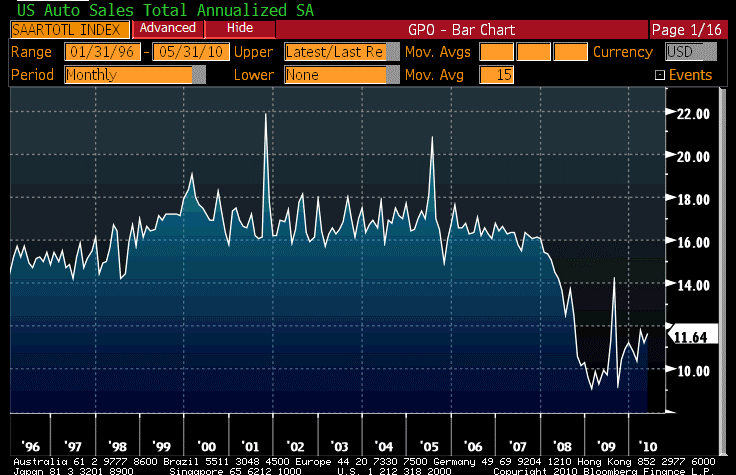
Total Car Sales - Today's level actually exceeded estimates.
I think the market was up partly because Warren Buffett was on TV. I think that for some reason, when a legendary buy-and-hold investor appears on television, it reminds people that buying and holding can work (or so the legend goes). Of course, Mr. Buffett bought extremely cheap companies according to Graham and Dodd principles, most of which have been long forgotten by the mo-mo crowd, but I still think that psychologically it helps.
But I think the real reason equities were up is sneakier. Everyone knows that the Payrolls number on Friday is going to show a huge increase in jobs due to Census hiring. Since this is widely known, in theory it should not have a big impact on the market. A lot of investors, though, figure that they’re smarter than all those other investors and so they’re getting long (or covering shorts) with the intention to sell into the rally. At the very least, we know the talking heads on CNBC will be chirping all day about how great the economy is…and who wants to be in the way of that? We don’t see this as often in equities, but the bond market from time to time will trade up or down pretty hard the day before Payrolls based on perceptions of where the number will come, so this isn’t an unprecedented event.
Such clever stratagems, however, have a way of failing. If stocks rally again on Thursday, it may provide a lower-risk point at which to short stocks before the data because, after all, the higher the market goes, the easier it will be for the actual data to disappoint.
.
More Unsettled Geopolitics
The minor clash between lightly-armed Israeli soldiers and lightly-armed “peace missionaries” when the latter tried to run the naval blockade of Gaza has generated quite a bit of heat (and surely, more so than light). What worries me is that although this is a minor skirmish at best, and may be a simple question of peaceniks daring the military to respond (remember the “human shields” who Iraq welcomed to position themselves at presumed targets leading up to the first Iraq War?) or something more premeditated, right now the US is aptly perceived as being leaderless and therefore any Israeli “provocation” could ignite a broader conflict. Another ship, which may or may not be escorted by Turkish warships, is apparently on the way to try and run the blockade in what certainly does not seem to be an effort to stand down and lessen tensions.
These are dangerous times. And this is why it is so important that the US be perceived as not only a superpower that can control geopolitics, but one that will, and can. It isn’t clear that financially right now we are easily able to do so, because so much money has gone to bail out the auto companies, banks, GSEs, delinquent mortgagees; for “general purposes”; and of course (although the amounts spent on actual war now seem quaint) for other military operations. But moreover, thanks to the multi-year effort of those who still regret that we didn’t lose in Viet Nam fast enough, it seem pretty clear that even if we can muster the ability to do so the party in power doesn’t have the will.
If that’s an incorrect and unfair assessment of the Administration, the important point is that it isn’t one columnist who holds that view but, evidently, a large part of the world. If the view is wrong, then it is rapidly becoming time to show decisively that it is wrong. Like the weak kid on the schoolyard, Obama needs to punch very hard the first time a punch is required – and perhaps convince our enemies that they would rather see the velvet glove than the iron fist. I am not terribly optimistic that the Nobel Peace Prize winner will be able to flex when flexing is required, but we may soon see.
Now, why do I comment on politics (about which I am probably even less qualified to comment than I am on economics)? It is relevant here because financial markets and politics are intricately intertwined. An environment where multinational corporations are the rule rather than the exception and where many investors hold investments in multiple currencies is one in which the center must be strong. We have already seen the effect on European institutions of a weakening of the center of the EU. A significant weakening of US hegemony, while philosophically welcomed by many (including many in the US), has terrible repercussions for investing. Increased volatility, not to mention the lower prices associated with securities whose outcomes are less certain – from Treasuries to corporate equity – is not something that investors want to see more of.
.
Now, stocks are looking and feeling (and smelling) a little better today than yesterday, but consolidation at these levels isn’t very soothing unless prices manage to get up and out of this zone soon. Volume is not abating – if it were, then I would tend to think that the lower market level was serving as a price concession to let nervous holders out; in that case, after volume declined sufficiently we might read into it an exhaustion of selling pressure. But that doesn’t seem to be happening, very rapidly anyway. Volumes are still quite a bit stronger than has been the norm so far in 2010. (That being said, with the prevalence of high-frequency trading it is harder to read as much into the volume statistics as we used to). The same can be said of bonds; the 10y note remains at the low level of 3.34% and the 10y futures contract fell 9.5/32nds today. Today’s “upward volatility” in equities might seem like a good thing, but this will only end up being the case if it is followed by further gains in fairly short order. I still believe that a deeper retrenchment is due.
Thursday’s economic release calendar is busy, but it is mostly noise before Employment on Friday. Since the Employment report itself will be tainted with a lot of unrelated noise, we probably ought to pay more attention to Thursday’s data but I doubt it will resolve anything. ADP (Consensus: +70k compared to +32k last month) is still showing feeble organic jobs growth, and anything less than the +70k forecast should be considered very bad news. After all, if you go out and hire hundreds of thousands of Census workers, you also generate demand ancillary to those direct hires! Also due out are final revisions to Q1 Non-Farm Productivity and Unit Labor Costs, which is a non-event, Initial Claims (Consensus: 453k from 460k as economists continue to look for improvement), Factory Orders (Consensus: +1.8% after +1.3%), the ISM Non-Manufacturing Index (Consensus: 55.6 from 55.4), and the ICSC chain store sales report.
It will be enough to keep us busy, even if nothing more happens in the Middle East or on the Continent.
“Inflation Protection” That Isn’t
We had a lethargic start to the week, which is not surprising: a long Memorial Day weekend that segues into a short week at the end of which the Employment data is released – that is a prescription for quiet trading.
True, over the weekend the President of Germany (Koehler) resigned, a fact which seems to have escaped most Americans; while ostensibly the trigger for his resignation was remarks made about Afghanistan, it is hard to imagine the growing Continental turmoil played no role. When times are good, one tries to ride out inconvenient political tempests. When times are not so good, well…”it may be time to write my memoirs!”
The ISM report was stronger-than-expected at 59.7, with decent internals. This plays distant second- or third-fiddle to the Employment report this week, but it helped stocks recover from a weak open, for a while at least. The Dallas Fed manufacturing index was weak, but ISM clearly trumps the regional figure.
Looking ahead to the Jobs number, by the way: while the data is likely to be quite strong because of Census hiring, note that HP announced 9,000 job cuts today and CitiFinancial declared it will close 376 branches, eliminating 720 jobs (those seem like pretty small ‘branches’, don’t they?).
Stocks struggled heroically to start June, but by the close the trading pattern ended up looking much like those we saw in May. The S&P lost 1.7% and the VIX rose to 35%-ish on volume of 1.4bln, similar to that seen Friday. The September T-Note contract closed basically unchanged with the cash 10y yield at 3.29%.
– – Soapbox Mode: On – –
Recently, I was shopping for some long-term care insurance. One of the options I could elect was whether I wanted “inflation protection.” Being an inflation guy, I was very curious about that option. It turns out that it is anything but “inflation protection,” and in my opinion the providers of this insurance ought to be sued robustly at some point for false marketing. The policy in question (and there are many other sorts of policies, as well as certain “target date funds” and the like that use this approach) considered it to be “inflation protection” if the stated amount of the coverage rose at 3% per year.
How in the world is that inflation protection? If medical inflation is 0%, how much does your insurance coverage go up? The answer is: 3%. If medical inflation is 6%, how much does the coverage rise? 3%. How about if inflation is 100%? Same answer: 3%. There is absolutely no protection whatsoever. It is just a way of selling you more insurance on the installment plan. Precisely 3% more insurance per year, which of course you pay for.
Now, it would be pretty easy for a company to turn that into something resembling true inflation protection. A 30-year inflation swap costs 2.89%; this means that instead of providing systematically 3% more coverage you could provide inflation-protection … at least, for headline inflation … quite easily at at roughly the same price. (N.B. “easily” might not be entirely correct, because there are actuarial dynamics to the pool that implies a level-payment inflation swap isn’t exactly correct, but the insurance company could offer a real product with a modicum of effort and risk, or jam a falsely-labeled product to an unsuspecting client who will be very disappointed if inflation goes to 10% and they discover they are not covered for inflation unless inflation happens to be exactly 3%. The latter approach is easier, which is why it is the default.)
It isn’t like this is ridiculously difficult, and that there’s no one out there who can show the insurance company how to do it. There aren’t thousands of us, but there are plenty who understand enough about inflation markets that we could help design such a product. In my days on the sell side, I tried desperately to find clients who wanted to create an inflation-linked life annuity, for example, and this is a similar concept. But, alas, there appears to be no appetite for products that people consider “difficult to understand,” even if they are vastly superior to the products on offer. This is a real tragedy, and not just for the people who sell such products. It is a tragedy for the people who would otherwise buy such products. 99% of them don’t even realize that there’s a better way, in the same way that most people didn’t realize that the internet was a real boon to humankind because they had never heard of it…
It is from the sell side where these ideas can easily propagate, and such innovations would go at least a little way towards healing the image of Wall Streeters as money-grubbing jerks who don’t care who they rip off. But the ideas don’t propagate, perhaps partly because all of those money-grubbing jerks are too busy figuring out who is going to get ripped off next. Oh, I should distinguish between jerks…by the latter group I meant Congress. What Wall Streeter can focus on building long-term relationships right now when it’s not clear what form the industry will be in, a year or two from now?
– – Soapbox Mode: Off – –
Pending Home Sales and Vehicle Sales are out tomorrow, but neither is a market-mover. The monthly ADP figures, normally released on Wednesday, have been pushed further into irrelevance by their postponement until Thursday. We will continue to focus on whether equities can continue to close above the flash-crash lows. I don’t think they can.
