Archive
Half Of A Pedestrian Day
At the risk of sounding bored, I don’t know that there are any deep inferences that we can draw about the state of the markets on the basis of the last two days of trading. Sure, stocks managed to eke out another win today, but the sum of the volume from Friday’s session and Monday’s session was only 1.6bln shares or so – or, in other words, the combined volume was just slightly above July 1st single-day volume. You don’t remember July 1st? Well, there is really no reason you should – it was a fairly pedestrian day. Today was, in fact, only half of a pedestrian day (and, as it happens, the boring half).
Okay, so that’s not entirely fair. Two developments presented themselves as worth commenting on.
The first of these is that Richmond Fed President Lacker today said that any further monetary policy easing is “very far away.” Now, we need to look at this in context, because up until a couple of weeks ago Fed officials were worrying about how quickly they might have to withdraw the stimulus, and testing procedures to do so when the time came. As of now, Lacker is talking about easing, although he says he is comfortable with policy where it is now (of course he is, or he would have dissented at the recent meeting). While Fed officials generally have an abysmal track record with public predictions and posturing about the state of the economy, we are still bound to listen for subtle changes in central bank perspectives. The second wave of quantitative easing is, I suspect, ahead, but the real question is how far ahead. Fed officials are, publicly at least, still very resistant to the idea. But they are moving in the right direction. Hopefully their delay will not worsen the crisis, as their hesitation in 2008 clearly worsened that stage of the crisis.
The second development is more ironic than illuminating. Thanks to my friend BN for pointing out this story. It seems John Paulson, who made billions in the collapse of the housing bubble and the ensuing mortgage crisis, has endowed two chairs at New York University. One is named after himself, and the other is in honor of…former Chairman Greenspan. This is wonderfully ironic since, after all, Chairman Greenspan’s policy flailings are a major reason that Mr. Paulson was able to make such lucrative bets against the bubbly housing market. It’s nice to know that he’s so appreciative.
I cannot endow a chair, but in honor of Chairman Greenspan (and of Paulson’s profiting from his errors) I am offering a special deal on my book, Maestro, My Ass!, if you order through my website (link). Only ten bucks, or twenty if you want it signed. That includes “slow way” shipping domestically.
Still, Paulson has made more money on Greenspan’s errors than I ever did. That being said, I’m just really happy to have not lost scads and scads of money, like many Americans did.
There is no more data due tomorrow, but on Wednesday Retail Sales (Consensus: -0.3%/-0.1% ex-auto) is expected to show a second consecutive decline in core sales, which hasn’t happened since the end of 2008 and is fairly rare in general – with the exception of the last five months of 2008, consecutive-month declines in core Retail Sales have only happened three other times this decade: once in 2001, once in 2005, and once in 2006. Needless to say, it isn’t a great sign. Also on Wednesday, the minutes from the recent FOMC meeting will be released.
For what it is worth, here is a musing about the market quiet over the last two days. Today after the close Alcoa kicked off the quarterly earnings season. Could the markets really be that quiet merely in anticipation of earnings? If so, it seems to me that implies something less than total commitment to the market – if stocks offer long-term value against long-term earnings, then who cares what short-term earnings are? And if they don’t, then…frankly…who cares what short-term earnings are?
But observers seem to be hanging the bunting in preparation for a celebration of rip-roaring earnings; at least, sell-side analysts have been telling us to be looking for such. If everyone believed it, then wouldn’t the market already be higher than it is? To be sure, I imagine most companies will hit this quarter’s targets. But I will be surprised if a number of them don’t try to talk down the analysts’ ebullience about future quarters a bit.
Maybe It’s The Watchers That Need Watching
Fortunately, by the time our power went out last night I had already sent my commentary – uncharacteristically early, and uncharacteristically lucky. It was only out for 13 hours or so, but plenty long enough for me to reflect on the Atlas-Shrugged-ian nature of scattered blackouts during hot, but certainly not unprecedented temperatures…and towards the end of the day, when air conditioners were presumably laboring less. For years upon years, this country hasn’t invested in significant upgrades of either power production (e.g., nuclear) or the grid itself, and so moderately-hot (but eminently foreseeable) weather simply cannot be accommodated. It isn’t a new phenomenon, of course. NIMBY has a good running start.
If there is a weakness in our version of Democracy it surely is that legislators are not accountable in any way for the long-term. Therefore, to the extent that we have legislators possessed of noble intentions and who serve mainly for love of country, we get good long-term law; however, the short election cycle means that elected officials are subject to a certain short-termism since it is on that basis to which they are held accountable. The result tends to be better short-term results traded for worse long-term results, and these are rolled forward from one Congress to the next and even one generation to the next until they can no longer be, whereupon the long term and the short term converge in a blow-up.
Sound familiar? With all of the ink spilled about the failure to align Wall Street compensation with the long-term welfare of the firms and the system, very few people wonder about the rotten incentives that legislators have. Sure, we’re all getting ready to throw the bums out, but if it happens in November it certainly will be a rarity, and arguably due almost as much to the failure to show short-term results as to the miserable long-term decisions they have made (to really get a wave of anger, I suppose you really have to get that convergence where you exercise both the voters focused on the short term and also the voters focused on the long term).
Congresspeople, angry at the damage wrought by bad incentives on Wall Street, have proposed caps on compensation, extremely long vesting periods for incentive compensation, and various forms of “claw backs” built into compensation. Some have even sought to make such structures the law. I think that this makes just as much sense for Congress. Total compensation for Congress, the overwhelming majority of which is in the perquisites of office, should be capped at a very low level, Congressional pensions should be tied to the level of the debt relative to GDP over the long term, and if the country runs a particularly large deficit at any point then former Congresspeople should be forced to return some of the pay they had previously received.
Now, I hope we all recognize that this is somewhat crazy. If we do this, then the quality of people willing to serve in Congress will fall even further. It isn’t fair that a retired Congressperson’s pension should be tied to the government’s fiscal position, which may have something to do with decisions that Congressperson made in office but also has a lot to do with whatever idiocy the current Congress is up to. And pulling back money that has already been paid has all sorts of problems.
Then why is it okay to do that to Wall Street? Or at the place where you work?
We all recognize these problems, but the alternatives all suck. The folks who put together our system of government recognized the problems (although they also assumed that mostly patriotic, noble-intentioned people would make the sacrifice to hold office), but that’s why we get to vote these people out. The Framers also assumed we would be paying attention to our long-term interests as well as our short-term interests. In other words, they assumed that there would be adequate surveillance, and that the system would survive the rare occasions when the surveillance failed.
So far, they have been correct, but lately it has been somewhat touch-and-go. There’s nothing wrong with the system of surveillance; the problem is in the regulators…that is, we voters. I would argue that the analogous condition holds for Wall Street. It isn’t that there isn’t enough regulation, it is that the regulators (led by the Fed) were doing a rotten job.
Enough of soliloquy for today. I am apparently tired and cranky.
Initial Claims produced a rare positive surprise for economists; net of revisions to last week’s figure, Claims was 3k lower than expected. Now the bad news; as pointed out by one or two economists, this year GM decided not to have a summer shut-down[1] and since the seasonal adjustments incorporate some effect of a shutdown over the next few weeks, ‘Claims are likely to be a smidge lower than they would otherwise be. The indicator is normally quite volatile in these few weeks anyhow, and the story remains the same: Initial Claims are still running at about 460k.
Of more note is the fact that the 10y TIPS auction bid was not only strong enough, it was plain strong. The auction stopped 3bps through the 1pm trading level, with a 2.88:1 bid-to-cover ratio despite the size ($12bln) being at the high end of Street estimates. We all see core inflation sliding (although ex-housing it is not)…so then why is institutional money so hungry for inflation-linked bonds? Yep, like you and me they can see the writing on the wall.
Equity traders cannot yet see the writing on the wall, but then for the most part they can’t read anyway (which helps explain the popularity of CNBC, by the way). After rallying more than 3% yesterday, stocks rallied another 1% today. The equity market now has its first three-day rally since April, and all it took was a 13% decline from the highs to make it possible! (Another 13% lower and you can have another 3-day rally). Investors are very optimistic about the earnings reports, seemingly because of the dearth of warnings, but I would be attentive to the guidance. It will likely be weaker than analysts are expecting. September 10y note futures fell 9/32nds, with the 10y benchmark yield up to 3.02%.
No data is due tomorrow, and it is likely to be a comparatively lazy summer Friday trading session.
One final note. Consumer Credit was just released, and fell yet again. The decline is mostly in revolving credit, and Chris Low from FTN Financial points out that this is probably related to changes in credit card regulation enacted late last year, which (by increasing risks for lenders) encouraged credit card firms to limit credit for riskier borrowers. The effect can be seen not only in the decline in revolving credit (which certainly cannot be a bad thing), but also in the decline in credit card delinquencies as the bad credits are squeezed out (this too, certainly cannot be a bad thing). In the chart below (source: Bloomberg), I have both credit card delinquencies and prime fixed-rate mortgage loan delinquencies. The point I want to make is that we shouldn’t be overly enthusiastic that the declining credit card delinquencies indicates personal balance-sheet improvement. It rather seems to indicate lender balance-sheet improvement as the result of tighter loan standards. Funny, that.
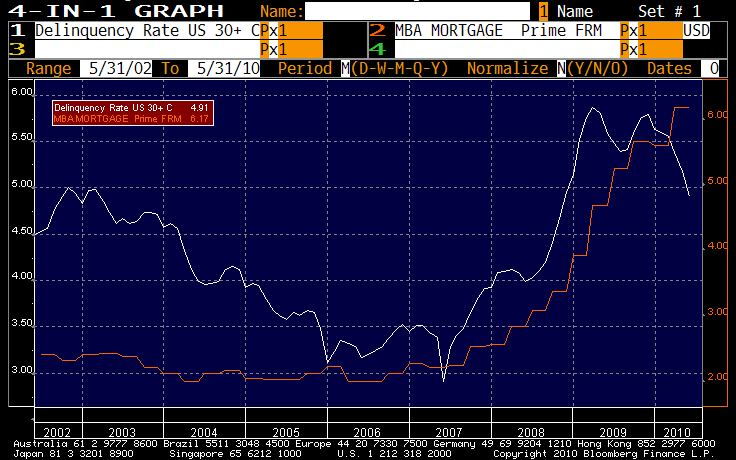
Declining credit-card delinquency rates are probably not indicative of improving personal credit
Footnote:
[1] Shocking! GM is owned by the government, and coincidentally is deciding that with unit car sales down about 25% from 2007-2008 levels, it is profit-maximizing to maintain full production!
Loose Ends
Apparently, it was too hot to do anything today but stay at home and put in equity bids, and stocks responded to the recent expression of market-indecision by rallying sharply. It surely didn’t hurt that Kansas City Fed President Hoenig opined that “current Fed policy makes asset bubbles more likely;” of course, equities are priced generously and buyers are seriously desirous of a bubble to jump aboard. I do not disagree with Mr. Hoenig, but in the current circumstance “more” likely is still pretty unlikely while wealth continues to be destroyed by a lengthening recession in employment. When the economy someday recovers and begins to grow, then he will be correct, but that bubble will take time to form. Today, I worry that several markets are priced – as I said – ‘generously,’ but I wouldn’t characterize stocks or bonds or credit or gold as being in “bubble” territory at the moment. For example, while 10-year yields sub-3% represents an investment that is very likely to be quite disappointing over that 10-year horizon, for it to be a true “bubble” I’d want to see near-unanimity of thought that there is nothing else that is a sure thing like owning 10-year Treasuries at 0%. I rather sense that skepticism about the bond market is quite high, and rightly so.
Since there weren’t any new economic data of note today, I want to tie up a few loose ends/idle thoughts I have had recently that didn’t necessarily fit at the time I thought of them, or that I recently thought of.
Inventory of homes
I read somewhere that “the national inventory of [new] homes available soared to an 8.5 months supply in May…” The market’s fascination with the months’ worth of inventory is unhealthy. The problem is that in a ratio such as this, it is probably worthwhile to separate the numerator and the denominator. In this case, the fact that the ratio shot up was due to the very low selling pace of new homes last month. In fact, the total seasonally-adjusted inventory of new homes is quite manageable, and suggests that builders have done a reasonable job of cutting back the supply (indeed, some of the low New Home sales rate might even be caused by the low inventory). See the chart (source: Bloomberg).
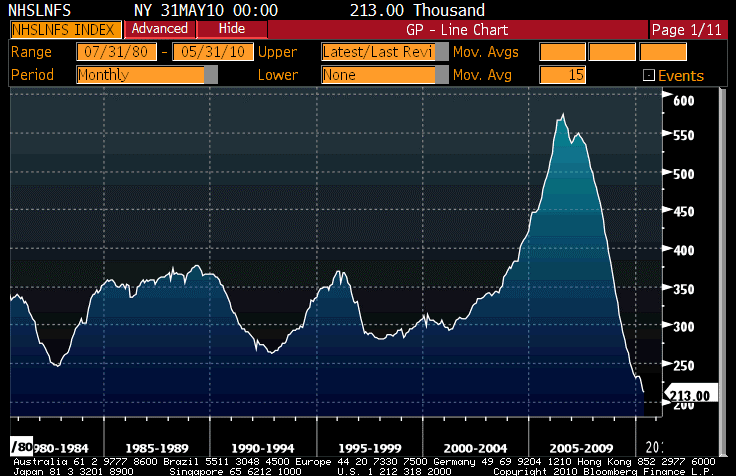
Inventory of New Homes is NOT that high...
The market made the reciprocal mistake in 2006, when the inventory was under 7 months of sales, but that was only because of a ridiculously high selling rate. The total inventory number told the real story: that there were an awful lot of homes out there, and if the pace of sales were to decline there would be a big problem. Looking at the ratio obscures this important detail. (People make the same mistake with the semiconductor book-to-bill ratio, where each part of the ratio matters too). Ratios like this are only particularly useful if the denominator is pretty stable.
Now, the bad news is that the inventory of existing home sales is still pretty high (see chart below, source Bloomberg). Why the difference? I suspect it is in the intake pipe…home builders are slowing their additions to inventory, but on the existing home side the bank REO will continue to add inventory for the foreseeable future. This hurts the builders too, of course, because the ready availability of a substitute keeps the lid on new home sales (and prices) as well. I think that when you eventually see the inventory of existing home sales dip back below 3mm again, it may be time to consider the builders.
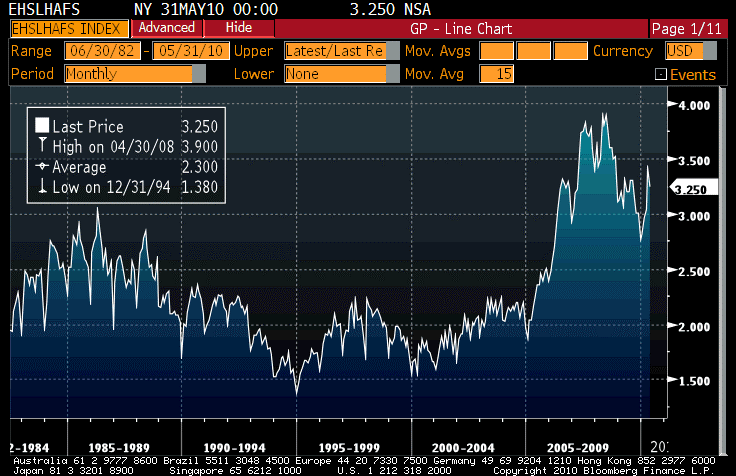
Unfortunately, inventory of existing homes is still elevated.
Problems with recession forecasting models
I am not a big fan of Goldman, but economist Jan Hatzius generally does a terrific job at spotting the key issue. In a recent article, he noted that “Typical recession forecasting models estimate a near-zero likelihood that the economy has entered recession again, or that it will in the near future. But they suffer from a serious bias: most models use the slope of the yield curve as a forecasting variable, with a flat or inverted curve a classic warning sign of a slowdown or recession.” This is a great point. Recently, Gene Epstein at Barron’s – who is the anti-Hatzius, and mostly misses the key points – has been touting the Credit Suisse “recession model” as virtual proof that there will not be a double-dip recession – see here for example. (My opinion is well-known. We are probably not going to have a double-dip because we are still in the primary recession, which will probably last for a while). Hatzius makes hash of these models by pointing out that the yield curve factor, which is normally a very important indicator of tight money and hence recession risk, is completely useless when the Fed has pedal pressed to metal. He reports that a forecasting model that leaves out the yield curve and also adjusts for “employment related distortions” (presumably Census stuff) estimates a 25% chance that the economy will be in recession six months from now. I would add, “still.”
Animal Spirits: A Book Worth Reading
Although Animal Spirits, by Akerloff and Shiller, isn’t the best book I have read that Shiller has written or co-written (that honor goes to Irrational Exuberance, of course), it is thought-provoking. The authors take issue with the current state of the economic “science,” which models economic actors as rational even while acknowledging that they are not. We all know this, but economics doesn’t really have any clever solutions or “workarounds” for the fact that there are many phenomena that aren’t explainable as the result of interactions of coldly-rational automata. Akerloff and Shiller, of course, are leading behavioral economists and believe that adjustments need to be made to the standard models to incorporate behavioral phenomena.
The best part of the book is Part One, where they discuss several aspects of “animal spirits”: Confidence, Fairness, Corruption and Bad Faith, Money Illusion, and Stories. I find especially compelling their suggestion that confidence and a “confidence multiplier” ought to be added to standard policy-multiplier models and find intriguing their speculation that confidence may be “contagious” and be model-able as an epidemic. My biggest complaint about the book, in fact, is that while they talk about such a thing they don’t actually propose the form of these adjustments (that point may be too academic for a popular book, but perhaps it will follow – or is already out there and I’m just unaware of it – in journal articles. Just because the standard models ignore behavioral factors doesn’t mean we can’t try and model these behavioral factors. Surely something between economics as pure science and economics as pure art is reasonable?). The authors go on in Part Two to discuss how such an approach to economics can help solve some of the classic conundrums: why depressions happen, why the labor market doesn’t clear, why personal savings is so arbitrary, etcetera. Some of the things they discuss in that section have been addressed by standard economics and the authors are just not happy with the answers…and they’re probably right.
In any event, this is a book worth reading, and it’s a fairly quick and easy read. You can find it on Amazon here
.
On Thursday the calendar has Initial Claims (Consensus: 460k from 472k). For 13 of the last 14 weeks, the economists have estimated too low compared to the eventually-revised number – on the June 18th week, the actual turned out to be 3k less than the consensus estimate. That is an amazing run of unrequited optimism about the economy, proving that economists don’t learn quickly. To be fair, the consensus estimate has risen from a low of 435k on the April 2nd week to the current 460k figure, so eventually economists will be in the right neighborhood.
The Treasury will issue $12bln in TIPS tomorrow. Dealers are very concerned about whether this issue will clear well, considering the low level of real yields (about 1.30% right now in the WI). They shouldn’t be. They should be concerned about the overall low level of yields (including nominal yields), but real yields are currently 41% of nominal yields, and haven’t been at an appreciably higher percentage since October. Put another way, the 10-year breakeven implied by TIPS and 10y nominals is around 1.72%, after having been as high as 2.43% as recently as April. That means that TIPS, while arguably expensive on some metrics, are still cheaper than they have been in a while. The auction may be sloppy, because dealers don’t have a lot of risk to take down paper like this, but I suspect the central bank bid will be pretty reasonable and the issue should clear up fine. I’d certainly bid for a tail.
Turn On, Tune In…Nah, Just Drop Out
SIFMA can declare that the Friday before the Independence Day holiday is a full trading session, but they can’t make traders actually trade that way. Stock and bond market activity was lethargic and fairly non-descript (stocks fell 0.5%, the 10y note finished at 2.98%); however, the Employment report at least made sure that everyone hitting the road for a long weekend will have something to think about.
The Payrolls number was quite close to expectations at -125k. Private payrolls contributed 83k, slightly below the 110k expectations but close enough, while economists did an excellent job of nailing the drag from Census workers. The Unemployment Rate took an unexpected drop, skittering down to 9.5% from 9.7% versus expectations for an uptick. But after that pleasant news, the rest of the report was pretty unfortunate.
The length of the average workweek dipped slightly. This number wiggles some from month to month, so by itself it isn’t so concerning. Average hourly earnings declined outright by 0.1%, the largest amount of this cycle. (When you combine those two facts – fewer hours and less pay per hour – it implies that income took a fairly large step back, at least on a monthly basis). And the reason for the decline in the Unemployment Rate appears to be not that workers are finding jobs, but that they are leaving the workforce because they are discouraged. The number of discouraged workers rose to a marginal new cycle high (see Chart below, source Bloomberg). People, in short, are giving up and dropping out of the work force.
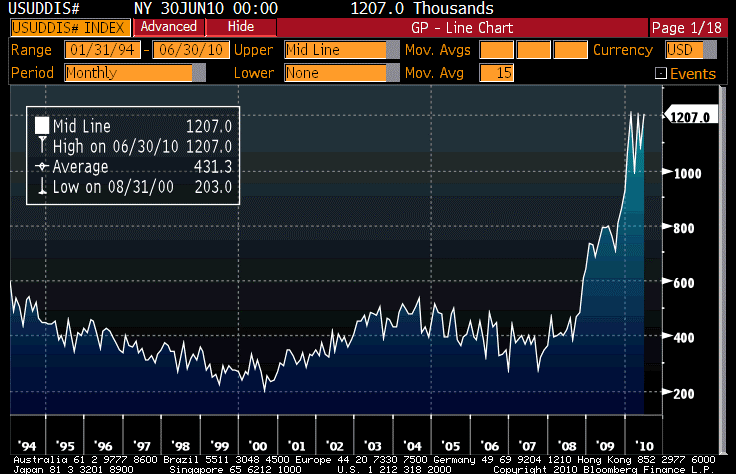
Discouraged workers at a new cycle high
And small wonder. The median unemployment duration went to a new all-time high (since the 1940s, anyway, when that series begins) and shows no signs of slowing its ascent (see Chart below, source Bloomberg).
Extended benefits and long periods of unemployment - which causes which?
Taken together, this paints the picture of an employment situation that is at best treading water, but more realistically one that is marginally worsening. The problem with the charts above aren’t the levels, per se – they are high, but six months from now they will still be high. The problem of course is the trend, or rather the lack of any sign that the trend is improving. I want to point out that this should not be news. None of the economic trends that we track from month to month is showing any sign of improving at this stage, and as I have pointed out repeatedly the economy looks to be plodding along in just about the condition it was in before Lehman’s bankruptcy, before the government saved Fannie and Freddie, before the Federal Reserve cut rates to zero, before the massive fiscal stimulus was voted on. Vehicle sales: weak. Employment: weak. Manufacturing output: good, but fading fast as the stimulus dollars fade. Construction, home sales, confidence: weak, weak, weak. Retail Sales: weak. Leadership: yep, that too.
Don’t ask me if I have a solution. I don’t have any “solution” if by that one means “something that doesn’t hurt very much.” Ripping off the band-aid is going to hurt. Suck it up.
Well, anyway, we get a long weekend. I am also taking Tuesday off; my wife and I are going to a spa for our anniversary. Yes, a spa. What I know about this particular spa is that no Diet Coke is available. That’s all I need to know. It’s going to hurt. But I will suck it up.
The comment will return on Wednesday.
Typical For Greenspan, Maybe
A late-day slide on Wednesday, another decline today before stocks bounced from being short-term “oversold” in the eyes of some…and on broadening volume. The S&P closed -0.3% today and is at the year’s nadir (so far).
That stocks are declining isn’t that surprising, in a sense; they were discounting robust growth and there were many ways reality could fall short of that expectation. It didn’t actually require a catalyst, merely gravity. However, there have in fact been catalysts, and the tea leaves have been surprisingly easy to read (so much so that even Wall Street economists are now actually lowering their growth forecasts although those forecasts still appear rosy in my view). Yesterday’s ADP was near consensus, but a shade weak. In the current environment, given what was expected, “a shade weak” is going to draw more reaction than “a touch strong,” although economically speaking the actual ADP was well within the error bar of the forecast – that is, we can’t really discern whether the underlying trend is weakening or not from that data.
But the misses are all starting to add up on the same side. The ECB saw €442bln mature in the 12-month facility, but lent €161bln in 3-month, €198bln in 1-week, and €136bln in 6-day money; in other words, there was net additional borrowing after the “withdrawal” of the 1y lending. Hmmm. Today, Initial Claims came out above expectations at 472k, continuing to bounce around in the range while economists keep forecasting a breakout improvement. ISM Manufacturing was 3 points below expectations, a pretty big miss in that number, and Pending Home Sales were off 30%. Some of this was expected – the expiration of the home buyer credit should of course lead to fewer homes being bought – but again, the misses are all on the same side. To be sure, ISM at 56.2 is still at levels indicating expansion, but vehicle sales were a weak 11.08mm units in June…again on the weak side. I guess I would say there isn’t one catalyst, but the data and events are collectively catalytic.
So this is pretty transparent. My main concern is that it has become very easy to be short; since stocks broke back into the ‘consolidation zone’ and nearly as quickly broke out of it on the low side, there have been almost no reasons for shorts to question their positions. Yet, tomorrow the monthly Employment numbers hit the tape at 8:30 ET (Consensus: -130k, 9.8% Unemployment Rate from 9.7%), and with the Census workers starting to return to the industrial reserve army of the unemployed, there is tremendous variance in the possible numbers tomorrow and several different ways to look at the results. (Personally, I suspect people will focus on the change in private payrolls, which economists forecast – somewhat implausibly, I think – at +110k from +41k). I am suspicious of bearish positions right now, and as I noted a couple of days ago (in the column about the implication of the Kelly criterion for trading) the level of market volatility argues that one should keep risk low whatever your view.
This goes for bonds as well. The uptrend there looks a little more tired today, with TYU0 +2/32nds and the 10y yield down to 2.93%. TIPS weakened sharply with breakevens down 5-10bps. This was partly because the Treasury announced the 10y TIPS auction next week will be $12bln rather than the $11bln most observers seemed to be expecting, but weak crude oil (-$3 today) and gold (-$47) didn’t help. I think the market will easily absorb the $12bln, but the auction itself may still be sloppy because dealers don’t sound as gung-ho to serve their typical underwrite-and-distribute function for this bond.
Today former Chairman Greenspan was on CNBC. This guy must have the greatest PR machine in the world. His forecasts have been among the world’s worst, even when he was actually controlling the policy levers that affected the outcomes. And yet, he still gets on CNBC and in the papers with regularity. It’s astonishing. Today he shared the brilliant insight that this is just a “typical pause” in the recovery due to a “short-term fear factor” that keeps employers from hiring. Seriously, in what way has anything about the last few years been “typical”?
