Archive
Clarifications and Updates
With little on the calendar for today, trading started out sluggishly but began to get more interesting as the day wore on. I am writing this comment earlier-than-usual today, because I am leaving soon to head to NYC and attend a very exciting meeting of the QWAFAFEW Quantitative Investment Society. The topic is “Chasing Bernie Madoff,” and the speakers are Harry Markopolos, Erin Arvedlund, Frank Casey, and Michael Ocrant. You will recognize these names if you read the excellent book No One Would Listen: A True Financial Thriller
Tomorrow’s trading ought to be slow; the only data are the trade balance (Consensus: -$45.0bln from -$46.3bln) and an Initial Claims (Consensus: 450k from 457k) figure that was pushed to Wednesday due to the Veterans’ Day holiday on Thursday. I would think that ‘Claims has some chance of exceeding expectations, since the earlier release may make it more difficult for all states to get their data in on time – and we have seen recently that when this happens, the BLS estimates tend to be mildly optimistic. (It isn’t an important enough report or likely to be an important enough difference that I would put any money on that supposition, but just be aware when the number is released that you need to ask “how many states didn’t report on time?”).
I need to make a quick note about yesterday’s comment. A reader who was confused (misled??) by my chart suggested that since the decline in the M2/M0 ratio wasn’t associated with deflation, the rise in the ratio may not be associated with inflation. I realized upon reading that remark that I probably should have shown a different chart because focusing on the ratio can be confusing. The point is not the level of the ratio, but rather the change in the level of M2 – that is what causes inflation. The ratio itself fell because the level of M2 didn’t change much when M0 ballooned, but that was (I think) because of IOER and perhaps other factors as well. The ratio fell, in short, because the denominator exploded. So, if the ratio goes back to its former level because the denominator (M0) collapses but the numerator (M2) is unchanged, that’s okay. But if it goes back to its former level because M2 explodes, that’s highly inflationary. So it isn’t the ratio you want to look at, it’s the level (really, the change) in M2. The chart below uses the same data, but separates the components. If you compare this chart to the ratio chart, it’s plain to see that it is the rise in the monetary base that drove the ratio lower. The question isn’t really whether the ratio moves, but whether M2 “catches up” or M0 declines back to its old levels. My math yesterday was meant to illustrate what M2 catching up would imply. To repeat yesterday’s caveat: I have no idea what will happen, and the point is, neither does the Fed…but the range of potential outcomes is large.

Splitting the ratio into its component parts makes my point clearer.
Thanks to the reader for pointing out this confusion.
.
A brief aside here on some other work I’ve been doing that may be of interest to readers, retail investors, or their advisors. I have written a paper called “Maximizing Personal Surplus: Liability-Driven Investment for Individuals” that is available at SSRN (here). Here is the abstract:
To date, the financial literature has focused on very simple algorithms designed to improve the solution to the two-part challenge of determining the optimal portfolio asset allocation strategy and determining the maximum sustainable withdrawal rate for retirees. Most research, for example the well-known “Trinity Study” of Cooley, Hubbard, and Walz, pursues the asset-allocation problem by maximizing long-run asset growth subject to a withdrawal rule and a given acceptable probability of remorse (a.k.a. shortfall). However, the Liability-Driven Investing (LDI) thought process improves the approach by seeking instead to maximize return for a given level of volatility of the portfolio surplus, rather than optimizing on the basis of the volatility the assets themselves; by more closely matching assets and liabilities, the sensitivity of the strategy to unexpected returns, risks, and correlations is greatly decreased. I update the Trinity Study to incorporate inflation-indexed bonds and then illustrate how the LDI thought process may be applied to individual investors.
One of the important things I do in the paper (at least, I think it is important) is to update a table that appeared in the original Trinity Study showing “portfolio success rates” for various combinations of stocks and bonds. When the original study came out, inflation-linked bonds were just getting started, so this important asset class wasn’t included. The analogous chart, based on Monte Carlo simulation (see the paper for more details) and including TIPS, is below.
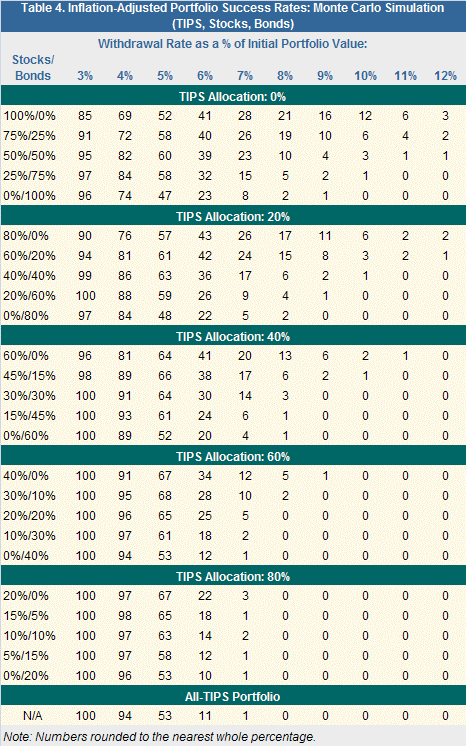
Updated Trinity Survey chart
If this interests you, take a look at the paper. I also illustrate how the “portfolio success rate” doesn’t necessarily tell the full story; you also care how long it takes, if the portfolio fails, for that failure to happen. Is it one year or 20? It makes a difference in planning. Moreover, the structure of your own “liabilities” matters in terms of finding the right allocation for you. If you’re interested, and read the paper, I am always interested in feedback.
Chairman H-E-Double-Hockeysticks
There is nothing quite like a national holiday on a Thursday for sapping market activity. I actually got a vacation response to an email I sent today that said the recipient was out until November 29th…and he wasn’t even European! But it’s hard to resist that sort of vacation: between now and the 29th of November, there are two Thursday holidays, bracketed by two sluggish Wednesdays and two pointless Fridays. Technically, to take these three weeks off requires 13 vacation days; practically-speaking, however, a trader is only missing nine days that have much chance of being interesting. Oh, wait, and one of those was today…make it eight days. Counting the 29th and 30th, there are effectively only ten liquid trading days left in November.
Heck, it’s almost year-end. Happy New Year!
The FX markets were the source of most of the volatility today. The dollar had a second strong up day as the zombie crisis in Europe (I have dubbed it thus, both because it threatens to turn many banks into nationalized banking shells as well as because it never…seems…to…die) continued to lurch anew. Irish bonds are the sorest spot, since pretty much every major Irish bank is either tottering or toppled, but Portuguese bonds were painted with the same brush today. Spain and Italy didn’t escape the sinkhole for PIIGS bonds, but it isn’t all bad news at least for politicians. Greek bonds rose slightly as it appears Prime Minister Papandreou received at least a tepid vote of confidence in Sunday’s elections (see FT story here). This is a risky precedent. If politicians can impose austerity measures and survive, then before you know it someone might actually try that here. Perish the thought that Americans might try to confront our problems head-on before the currency and bond market collapses! But I wouldn’t hold my breath.
Somewhat surprisingly, the markets didn’t react at all to several strident comments over the weekend from Chairman Bernanke and others from the Jekyll Island conference sponsored by the Atlanta Fed. On Saturday, Bernanke said “I have rejected any notion that we are going to raise inflation to a super-normal level in order to have effects on the economy.” Whew, what a relief! As long as he rejects the notion, we must be safe. I wonder if he has considered the possibility – it doesn’t sound like it – that he is capable of making a mistake? This sounds like overconfidence bias. According to the Wikipedia entry on “Overconfidence Effect,”
The overconfidence effect is a well-established bias in which someone’s subjective confidence in their judgments is reliably greater than their objective accuracy, especially when confidence is relatively high.[1] For example, in some quizzes, people rate their answers as “99% certain” but are wrong 40% of the time.
Traders and investors are very aware of this pitfall, and good traders develop mechanisms to check this natural tendency. It doesn’t appear, from this quote anyway, that Federal Reserve Chairmen do the same.
The Fed chief is clearly somewhat agitated. Here was one of his answers to an audience question:
“There’s a sense out there that, quote, quantitative easing or asset purchases is something completely foreign” and that “we have no idea what the hell is going to happen, and it’s just an unanticipated, unpredictable policy…Quite the contrary, this is just monetary policy.”
Well, Dr. Bernanke, I agree with you. The result of the policy is somewhat predictable. The policy will have no effect unless the LSAP finds its way into M2, and that seems unlikely to happen rapidly while IOER remains above zero. To the extent that this result is predictable, it is stupid. To the extent that the Fed doesn’t consider the possible ways it might not work the way they think, they are stupid. And to the extent that it doesn’t work out the way they think, then I promise you, they don’t know what the hell is going to happen (see “overconfidence bias” above).
I talk about this throughout my book. It is a major theme. The Federal Reserve, when it is making bad decisions, tends to make bad decisions in the same way: it chooses a course of action that has a limited upside, and usually a well-defined upside, and an unlimited downside or a very poorly-defined one. Someone who has a decent respect for Animal Spirits
Let’s do a little thought experiment.
For many years during the great inflation moderation, M2 was roughly 8.5 times the monetary base (in the more inflationary times of the 1980s and first half of the 1990s, it got as much as 12.4x). In the crisis, the Fed increased the money base by about 150%, but (as we know) M2 didn’t move so that M2 is now only 4.5x the money base (see Chart below).
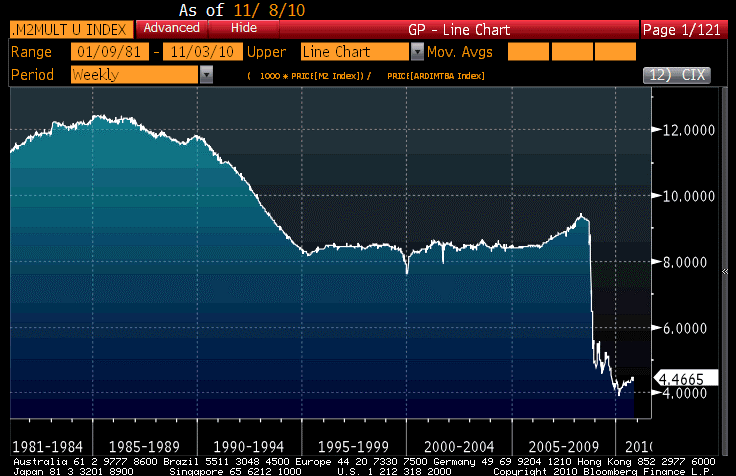
The crash in the M2/M0 multiple is the reason there was not inflation...LAST time
I believe, as I have written here, that the reason the money multiplier is broken is because the Fed is paying banks IOER and this keeps the money out of M2. But let’s suppose I am wrong, and the decline in the money multiplier was caused by something else. Now, suppose the new $600bln being added to M0 is translated into M2 at the old 8.5 multiple. In that case, M2 would rise about $5.1 trillion, or about 58%, in something less than one year. Such a development might, um, be inflationary.
Do I know that is going to happen? I really doubt that is going to happen. But can I definitively say it won’t happen? Well, do to that I would have to be able to assert that I know exactly what happened last time. Can I imagine that this is a plausible result of grossly expanding the money base during calmer economic times? You betcha.
By the way, let’s go further and suppose that when the Fed applies the paddles this time, the whole money multiplier snaps back to the old 8.5x. The old money base was $0.84 trillion and now is $1.962 trillion; after the $600bln in Treasury purchases it would be around $2.56 trillion. That, multiplied by 8.5, would imply M2 around $21.8 trillion. That’s a 149% rise from here. This too, might be possibly inflationary. And I can’t imagine it would be good for bonds or stocks.
Again, let me state very clearly that I think these are very unlikely outcomes from QE2. But I am basing that estimation on my belief of why the money multiplier got broken in the first place (IOER), and I completely recognize that I could be grossly wrong in that belief. I want to guard against having too much confidence in that belief. But these scenarios are also not wildly implausible – it takes very little effort to generate potential effects that are very large.
So, to summarize: if the Fed’s action “works,” we will get money growth of something between 4% and maybe 10%. If it doesn’t work, we could get 60% or 150%. As I said, the risks are non-linear. The Federal Reserve probably shouldn’t be shorting those options, but I know that they shouldn’t be acting so confident about it.
Hold Your Horses
Wow, the Employment number was a mess. I don’t know that I have ever seen the Establishment survey and the Household survey more at odds with each other. Private payrolls rose 159k, compared to 80k expected, with positive net revisions of 110k. So forecasters missed by 189,000 jobs. They missed because this huge strength was not hinted at in the Consumer Confidence survey, any of the regional surveys, the ADP count, or Initial Claims. At best, some modest improvement was expected.
On the other hand, the household survey showed a rise in the Unemployment Rate to 9.644% from 9.579%, barely missing an uptick. This is after several months in which an uptick was expected but not delivered. More disturbing, the labor force participation rate fell to a 24-year low (see Chart), hardly a sign of economic vigor. The average and median durations of unemployment both rose.
Now, the establishment survey is ordinarily the more accurate of the two surveys, since it relies on an actual count of employees rather than the self-identification by individual respondents, but it is not without its misses. There seems little doubt that the jobs picture is improving slowly, but there also seems little doubt that the jobs picture is not improving robustly, or we would have seen the evidence in other surveys. I think the overall message here is: hold your horses. This report is not the last word about the state of the economy, and there are good reasons to maintain some skepticism. Does this report improve the odds that the economy may be starting to accelerate? Surely, it does. But is it sufficient reason to make that the new null hypothesis, and to throw caution to the wind about the New Expansion? It most certainly does not.
On the news, the dollar shot higher. Bonds got smacked. Stocks rallied. These are all the usual responses to a strong Employment report. Quite interestingly, though, stocks were unable to hold the early gains. As a colleague of mine pointed out, this was a market that for months has been looking for reasons to rally – and today, with a reason to rally, it failed to rally. It is only one day, but it is interesting. (When this comment goes out, the market will also not yet be closed, so we could still get an end-of-day move…but with this data we shouldn’t need to wait that long, should we?) I noted yesterday that the S&P is right up in an area of resistance, so we probably need to give this thing time to play out.
Unfortunately, key economic reports like this have consequences that go beyond the interpretations and re-interpretations of economists. To the extent that this news is taken as a signal of a sudden resurgence in the economy, it will complicate the negotiations in Congress for an extension of the Bush tax rates. If the economy is really surging, then it ought also to foreshorten QE2, which program would now be unnecessary. Needless to say, I don’t think these are valid concerns after one strong number in the last 250 numbers, but this report has consequences that are more far-reaching than most.
There is still a great deal of uncertainty around, even if we take the establishment side of the report at face value. Today the ECB declined to disclose internal documents that explained how swaps had been used by Greece to hide her debt burden (story here). ECB President Trichet said that to release the documents would “undermine the public confidence as regards the effective conduct of economic policy” and create a “risk of adding to volatility and instability.” Well, thanks for that. Question: if someone says to you “I’m not going to tell you about what is happening in the other room, because if I told you then you’d probably panic and try to escape the building,” would you say, “Thanks. Then I’ll just watch the rest of the movie in peace”?
Economically speaking, there isn’t much data next week. There are some Fed speakers around, including over the weekend at the Atlanta Fed’s conference on Jekyll Island. Be forewarned that Minneapolis Fed President Kocherlakota speaks on Saturday on the the topic of Monetary Policy and Asset Bubbles. He might consider asking Bernanke and Greenspan, who are there to participate in a panel discussion on Saturday. I’m not kidding. The current Chairman and the last Chairman are both on a panel discussion about the Fed’s purpose, structure, functions, and future. And they are taking audience questions!
Do As I Say, No Matter What I Do
On Thursday, the markets acted as if they were surprised by the Fed’s action yesterday. Stocks leapt higher, along with bonds and (especially) commodities as the dollar declined to an 11-month low. Oil rose to nearly a 2-year high in response, and I hardly need to tell you what happened to gold and silver.
But the Fed action was very close to what was expected by the majority of observers. A few well-known shops expected more (Goldman was looking for up to $2trillion). I point this out because today’s action is either a further rebuke of the efficient market hypothesis (as if one was needed), the market is acting on what it perceives is new information, or there is manipulation going on. Let us stipulate that the Fed’s actions were approximately as-expected: they declared they will buy around $500bln (actually $600bln, but over a longer period of time than was expected, and they included an “out” clause in the statement), that they will buy only Treasuries, and that Kansas City Fed President Hoenig dissents.
So what else is new that might explain the market reaction? Let’s look around.
Well, in the last couple of days Australia and India both raised rates, while the UK did not add anything to its own quantitative easing program. If anything, this last point could be considered a disappointment, since one possibility was that central banks might ease in a coordinated fashion rather than simply letting the dollar go. The relative ease of central bank policy in the U.S. compared to the rest of the world might be considered a positive for domestic securities, but with the dollar also under pressure? Moreover, inflation swaps actually declined today (with the exception of the front end of the curve, where the rise in energy prices pushed 1y and 2y swaps higher), which is not exactly what you might expect if domestic central bank policy was easier than expected.
On the economic data front, Initial Claims were weaker than the majority of economists forecast. Claims rose to 457k. I suggested yesterday that this was likely, since the BLS last week stated that seasonal adjustment issues had led to the surprising decline in Claims. But economists can be very gullible in the direction of their pre-existing bias, and economists have been looking for a recovery in Claims for a long time. Maybe the job picture is improving some, but one week below 450k does not a trend make. We cannot reject my current null hypothesis that Claims continue to float along at a steady run-rate of 450-475k (see Chart). So Claims fails as an explanation because it is in the wrong direction to help equities, and it is one day in front of Employment anyway. The Productivity and Unit Labor Cost data fail as an explanation because those are pretty useless economic data until roughly the 25th revision. We don’t know how to measure either of these quantities well, and they rarely move markets.
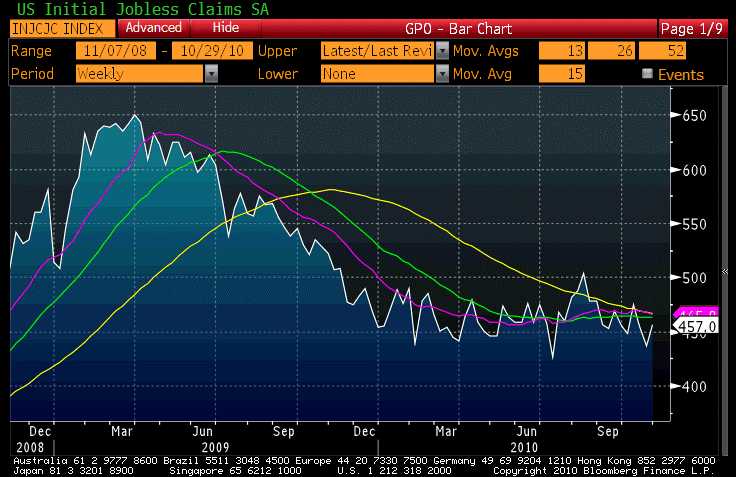
Initial Claims continues to do nothing important.
Perhaps missed, because of our tendency to focus on domestic issues to the exclusion of others, until these other issues are thrust in our collective face, was the fact that some European bond markets did not echo the US market rally. Specifically, while most European bond markets did rally, the following ones declined: Italy, Spain, Greece, Portugal, and Ireland. (Norway also, and certainly the Norwegians hope that is a coincidence). You may recognize that group as being the PIIGS countries. The rumors today concerned Ireland and the EU, but when one of the PIIGS countries gets pressured they all seem to look suspect. Many people – and I am one of these people – believe that the European sovereign debt crisis was not solved with the EU’s hollow pledge of support for Greece and the ECB’s decision to buy bonds of PIIGS countries. Many of us feel there is a second act coming. Is that act hastened when the Euro strengthens against the dollar, thus weakening an export sector that absolutely depends on the ‘States? Absolutely. A modest dollar retreat/Euro strengthening isn’t very important, but since the crisis “ended” in early summer the Euro has gone from $1.23 to $1.40 and today moved up over $1.42. Fairly soon, the ECB will need to join the Fed or watch the European economy finish what it started.
Still, this didn’t feel much like a flight-to-quality trade, and anyway it doesn’t explain why equities launched.
I suspect that no small part of the rally is related to Chairman Bernanke’s unprecedented op-ed in the Washington Post today. It is unprecedented because until a few years ago, Federal Reserve officials observed a silent period within a week or so of the meeting (both before and after). That policy has relaxed in recent years, but the spectacle of the Chairman himself writing a piece to explain what the Fed did and why it did it the day after the FOMC issued an official statement that is supposed to explain what the Fed did and why it did it is embarrassing and, frankly, inexplicable.
In this op-ed, Bernanke explained the mechanism by which he believes QE2 works:
This approach eased financial conditions in the past and, so far, looks to be effective again. Stock prices rose and long-term interest rates fell when investors began to anticipate the most recent action. Easier financial conditions will promote economic growth. For example, lower mortgage rates will make housing more affordable and allow more homeowners to refinance. Lower corporate bond rates will encourage investment. And higher stock prices will boost consumer wealth and help increase confidence, which can also spur spending. Increased spending will lead to higher incomes and profits that, in a virtuous circle, will further support economic expansion.
I specified “by which he believes,” because if the Chairman is writing his own explanation without the imprimatur of the entire Committee, it implies that the Committee doesn’t entirely agree with this explanation. Either they aren’t unanimous in believing that all of those transmission mechanisms are operative, or they aren’t generally in agreement in believing that all of these are necessarily good things or should be targets of the Fed. For example it isn’t clear, and remains a topic of heated debate, whether the Federal Reserve ought to target asset prices. In this article, Bernanke makes clear that they think this is an important mechanism and certainly implied that pumping up the stock market isn’t an unwanted effect.
And so perhaps the markets are not reacting to what the Fed did but to what the Chairman said. He came very close to declaring that the Bernanke Put is real. If higher stock prices are the mechanism by which the Fed encourages economic growth, and if the Fed is required to encourage economic growth, then et sequitur the Fed must support higher stock prices.
The argument is horribly flawed, of course. Lower corporate bond rates and higher equity prices encourage investment, true. They encourage mal-investment. They encourage companies and individuals to make decisions based on the availability of too-cheap capital. And that, as we have seen over and over for the last decade or two, means that ultimately a great deal of that capital must be destroyed.
If it were true that we could get all of the things that Bernanke promised without any costs – and he certainly didn’t mention any costs – then why indeed doesn’t the Fed pursue QE2 constantly? There must be something that the Chairman isn’t telling us. That something concerns the importance of sound money and markets that clear at prices and yields which represent a fair exchange of risk for expected reward. He kinda left that part out. Maybe he meant to say that, but it was edited for length. But at some point, we need to stop giving this guy the benefit of the doubt. (He is, though, giving me a lot of material for the sequel to my book, Maestro, My Ass!)
I think, though, it is likely that today’s rally resulted not from what the Fed did, but by the semi-promised reaction function implied by Bernanke’s article.
If true, then what are the investing implications of this observation? If the Fed is pumping stocks, and intends to keep them from going down and inducing a negative wealth effect, shouldn’t we jump on board? This is a difficult call, because of a couple of non-trivial facts. Fact #1: The work of the bear market was clearly never complete if people are more afraid of missing the next bubble than of avoiding the next bust. Fact #2: The Fed has shown that despite their best intentions, they are incapable of actually averting a crash, deferring a crash, or slowing a crash when a market crashed from an overvalued state. This should not be a surprise: for all the Fed’s trillions, the market is bigger.
I think it makes little sense to buy bonds here. The fact that inflation expectations declined today makes me wonder if nominal yields haven’t already fallen as much as the expected buying program should make them. I pointed out recently (link) that while nominal yields haven’t budged since August, real yields have fallen and inflation expectations have risen. If nominal yields are falling further but real yields are not, then it implies the nominal market is merely marking up prices to sell to the greater fool (the Fed). I don’t want to join them.
Stocks are a more difficult conundrum. If the Fed wants ‘em higher, then they may well be able to push them higher for a while until they crack and collapse. But the time to crack and collapse is inherently unstable (for two excellent explorations of this phenomenon, see Why Stock Markets Crash: Critical Events in Complex Financial Systems

I believe, however, that I will wait a bit before doing that. Today’s run by the S&P means that the market has just reached objectives from the breakout of the June-August consolidation period between 1040 and 1128 (projects to 1216 or so; if you think the pattern was an inverted head & shoulders – which I don’t, since the pattern was bigger than the decline into the pattern – then the projection is 1246-ish) and met the April highs. This seems to me to be the wrong price-time to be putting on more risk. I’ll buy a little higher, or a lot lower.
And, of course, I continue to invest in commodity indices and corporate inflation-linked bonds.
And with all of the foregoing, I have run out of much space to discuss the Employment figures tomorrow. The consensus is looking for an 80k gain in private payrolls (60k overall), with an Unemployment Rate stable at 9.6%. Remember, however, that last month the ‘Rate almost declined, barely missing being rounded down, while economists had expected an uptick to 9.7%. Lots of quirky things have been happening with the labor force, but so far it certainly looks like there are no signs that a downtrend in the jobless rate is in place.
Last month’s Employment data were dismal, but the market reacted positively because weak data promised a better chance of QE2. Another weak showing, however, is less likely to provoke a similar reaction with stocks at the highs for the year.
Cool The Engines
It will take some time for investors to finish reading the huge volumes of analysis that will be and have been written about the events of the last 24 hours. In an attempt to add to this pile, I offer the following.
The election results were qualitatively as-expected. The Republicans won a much larger margin in the House than most observers expected, but failed to overtake Democrats in the Senate. In my mind, though, the biggest positive for investment conditions were the changes in the state houses and governors mansions, which in several cases swung decidedly towards the more conservative (which is not necessarily to say “conservative”) party. There will be some shrinkage of government at the state and local level, regardless of what happens at the federal level; moreover, Republicans will tend to favor less spending and lower taxes – or, more realistically, lower taxes than would otherwise be the case. At the federal level, this is less likely to happen, because the Democrats can protest that Republicans are just being obstructionists who refuse to compromise (not that they themselves would ever do such a thing), while the party on the other side of the aisle has every incentive to push aggressively conservative plans that are wholly unpalatable to the Administration.
I found disheartening the President’s speech today, because he seemed to dismiss those who think cutting taxes is the right way to stimulate the economy, and appeared to suggest that both cutting some taxes (but only for the “middle class”) and increasing spending on some programs was the right approach. Assuredly, that way lies national bankruptcy. It is also hard to tell if the President truly understands the implications of the election; from his speech today it appeared that he did not. He said that his focus over the next couple of years is “making progress” on the economy, which he saw as the message from election night (I guess the focus over the last couple of years was creating grand new entitlements and sticking it to the wealthy). He got close to an epiphany when he said that the People “felt like government was getting much more intrusive into people’s lives…but this was an emergency situation.” He seems not to understand that one of the main reasons people are concerned about the government getting bigger and more intrusive – both of these, not just the intrusiveness, are causes for alarm for most people – is Obamacare, which (I don’t think) had anything whatsoever to do with the “emergency situation” that triggered the stimulus bill and the bailouts. After all, at least some of the latter can be legitimately laid at the door of the prior Administration…but Obamacare is all his own, and a big impediment to making budgets rational over the next few years. I expect that Obama will be willing to “compromise” and “make progress” any time that legislators want to agree with him, but he certainly didn’t seem to be very chastened by the election result.
Still, the change in representation at the local level, together with the implied threat to legislators who pursue aggressive Socialist agendas, are reasons for optimism.
One pundit last night raised an interesting point, though. I was beginning to be happy at the thought that the great increase in the quantity and variability of business regulation (the latter being more damaging to future growth) might be ebbing, and perhaps we may see more stability in the legislative and regulatory framework. That is the positive promise of “gridlock,” after all – while inferior to positive legislation, the expectation of no legislation is probably the next-best thing. But this pundit observed that the Administration may see gridlock in Congress as his carte blanche to implement his programs through executive orders and additional regulation from his branch. I hope this is wrong.
All in all, though, the trajectory of government clearly changed last night. Because of the gains at the sub-federal level, I am more optimistic about the economy (at the margin); unfortunately, I think the equity market already over-discounts my optimism. Stocks are too dear, especially as interest rates begin to rise and profit margins retreat to historic norms. I think, in short, that the investing climate improved last night, but it still underwhelms me.
Turning to the Federal Reserve, the Committee announced this afternoon that the Fed will buy up to $600bln in Treasury securities, around 5-6yr duration, between now and June, in addition to reinvesting an estimated $250-300bln in maturing securities and coupon receipts. Where I was surprised was on the magnitude of the reinvestment requirements, actually. Combining those amounts, $850-900bln over the next 8 months is actually slightly more than the $100bln/month that is roughly what is perceived to be the operational speed limit of the Fed’s LSAP program. In other words, in terms of the amount of money being promised, this is about the maximum possible over that time frame. The $600bln is what matters, not the $900bln, but the reinvestment requirements created limitations I hadn’t realized were there.
Except, however, that the Fed was “crossing its fingers.” In stating the goal for asset purchases, the FOMC also stated that “The Committee will regularly review the pace of its securities purchases and the overall size of the asset-purchase program in light of incoming information and will adjust the program as needed to best foster maximum employment and price stability.” Since this is already at the maximum pace that can be handled by the Fed, this is essentially saying “we’re going to buy bonds until we decide not to buy bonds.” It is a promise, therefore, only to the extent of about $75-100bln that will be executed between now and the next FOMC meeting.
This means that there will be extra “convexity” around economic reports in fixed-income, and a dampening of convexity for equities. Strong data will push bonds down not only because it suggests real rates and inflation expectations should rise, but also because it increases the chance that the LSAP might be prematurely arrested. On the other hand, strong data that would otherwise be bullish for equities will have a counteracting effect to consider. In short, being long fixed-income volatility and being short equity volatility is probably the right trade (if you can figure out the weightings!). The VIX agreed with at least half of that, dropping from 21.8 right before the Fed announcement to 19.5 one hour later. (As I pointed out yesterday, though, that’s partly because a couple of big events are now behind us).
None of this, in my view, gives any more reason to be long bonds or long stocks than we had yesterday. And we are now devoid of obvious catalysts for further gains in the equity bourses. While the S&P managed to end on the highs of the day and the month and the half-year, it looks to me like one booster stage just fell away, and the next one hasn’t fired yet. And I’m not even sure there is a next one.
There was other news, too. In the Treasury’s quarterly refunding statement, the department announced that there will be a TIPS auction each month in 2011, always on the Thursday prior to the end-of-month auctions (of 2y, 5y, and 7y securities). The schedule of auctions, by month, will be:
Jan: 10y (new)
Feb: 30y (new)
Mar: 10y (reopening)
Apr: 5y (new)
May: 10y (reopening)
June: 30y (reopening)
July: 10y (new)
Aug: 5y (reopening)
Sep: 10y (reopening)
Oct: 30y (reopening)
Nov: 10y (reopening)
Dec: 5y (reopening)
So there will be one 5y TIPS issue with two reopenings, one 30y TIPS issue with two reopening, and two 10y TIPS issues with two reopenings each. That’s a lot of TIPS – around $120bln, depending whose projections you look at, but at least for the next eight months or so it isn’t enough.
Remember that we have two TIPS maturing in 2011, in January and April. That represents something like $36bln in maturities, much of which will be rolled into other TIPS. Also, if the Fed adheres to its stated plan for QE2 it will be buying some $22bln itself between now and June. Using Credit Suisse’s forecasts for the TIPS auctions, through June the Treasury ought to produce some $82bln in TIPS, of which $10bln comes tomorrow in a 10y reopening. So of the remaining $72bln, $58bln is already spoken for by the Fed and the money from the maturities. That leftover $14bln ought to be pretty popular, and so while I don’t expect TIPS to rally dramatically further from here (I did recently sell the ones I owned) I would expect them to be reasonably well-supported for a while.
Also tomorrow, Initial Claims (Consensus: 442k from 434k) will be released, along with preliminary Q3 Productivity (Consensus: 1.0% vs -1.8% in Q2) and Unit Labor Cost (Consensus: +0.6% vs +1.1% in Q2) figures. Be forewarned that the BLS attributed the decline in Claims last week to seasonal adjustment issues having to do with the holiday, which to me suggests that Claims more like 450-460k might be produced this week. In any event, the Employment number is the following day and the ADP release today (about 23k stronger-than-expected) will have investors looking for good news on the job front, so a slightly-weaker Claims number may well be ignored.
C-SPAN/CNBC Effect?
Nearly 20 years ago, economists introduced a new term into the English lexicon. The “CNN Effect” was meant to help explain why consumer spending dropped so precipitously starting around mid-January 1991. Supposedly, shoppers stayed home from the malls to watch the first live war on television.
I don’t know whether anyone ever proved that a CNN effect actually existed, but I can remember staying up late and being more or less glued to the TV for a couple of weeks myself. I mention it because trading over the last couple of days seems so lethargic, activity so sparse, that it seems the whole world is waiting for the results of the next 48 hours. Yes, stocks rallied. Yes, bonds rallied. Yes, the dollar sold off. The counter-trend “trimming risk” moves that I expected before these events have not happened. But the price action now is on weak volume (“abysmal” was a better description until the last 10 minutes of trading had a flurry of last-minute trades). The market is marking time. And I wonder how much it is also true that businesses and consumers are marking time, waiting anxiously to see whether anything significant will change very soon.
Investors are glued to their Bloombergs, as well they should be. I can’t remember when the political-economic landscape last had such a potential for changing so dramatically in the space of two days (at least, two days that we knew about in advance). And, since we know that what we’re doing right now doesn’t seem to be working, anything that is likely to produce change is welcome (even if we would prefer to have intelligent change over random change).
Why is that? The economic situation we are in is analogous to a position of owning out-of-the-money (OTM) options. When you own OTM options, a rise in implied volatility will increase the delta of your option. Why? Well, because you are out of the money, all of the good things that can happen are “farther away” in a market-price sense. When conditions become more volatile, those “far away” possibilities become more possible, more likely, and our probability of ending up in-the-money increases. The opposite is true with an in-the-money (ITM) option. In this case, all of the bad things that can happen are “farther away.” When volatility increases, the delta of an ITM option decreases because the chances of these “bad things” happening (and pushing our option out-of-the-money) increase. Economically speaking, continuing the same policies is a good way to make sure the economy enjoys a similar trajectory to what it has recently seen – flat to weaker. I’d want to try something different. And it looks like the People feel the same way.
Now, this analogy works only as long as we believe that there is not much chance that we can be made substantially worse off with change. (The reason option deltas rise for OTM options when implied volatilities rise is that nothing can be worse than ending up out-of-the-money. In that case, the option is worth zero, so any chance of a non-zero outcome is beneficial.) Given how creative our leaders have been in this regard, it is far from certain that they can’t muck things up worse. But (and perhaps I am an optimist) it would certainly seem that there are more opportunities to improve our lot, if only by reversing policies implemented over the last couple of years that were clearly useless or damaging.
This may not be the best analogy, but it is my most hopeful.
When we wake up tomorrow, we will know what the new shape of Congress. We will learn early in the day something about the labor market (Consensus for ADP: +20k vs -39k last month); but by tomorrow afternoon when the FOMC statement is released (see my comment yesterday for my expectations about the likelihood of, and likelihood of effectiveness of, large-scale asset purchases) we will know dramatically more than we do today.
Or will we? The new shape of Congress and the new shape of monetary policy will affect expectations, but it will take months and months before we know whether any of these changes will be sufficiently salutatory to change our fortunes. I expect that once that fact sinks in, we will see the VIX (and fixed-income implied volatilities) decline and the stock market correct. We bought the rumor; now we will sell the news.
Brewster’s Trillions And The Week Ahead
Well, at long last the week we have been waiting for has arrived, and with it we can expect a degree of volatility that has recently been somewhat rare. Monday’s range on the S&P, for instance, was a smidge more than 18 points. Since the beginning of September, there have been only three days with a range more than 20 points (one of those was the 31.58-point range seen in the launch off the bottom on 9/1), so we are already seeing volatility which, though far from extreme, is more life-like than what we have recently seen. To be sure, both stocks and bonds closed near-unchanged, but there are definitely some volatile undercurrents. Investors by now should have their positions squared away for the election, FOMC meeting, and Employment, but some of these investors will discover that their positions are wrong.
I admit that I am surprised that the squaring-away of positions didn’t seem to involve much selling. Certainly most indications are that investors are quite long stocks as well as bonds, but apparently the risk of not being long enough heading into this week was taken to be greater than the risk of being too long. Investor and analyst surveys both show very high levels of bullishness and low levels of caution; while the VIX has risen to 22.3 (the highest since September), in the context of the event calendar that doesn’t seem to signal much nervousness to me.
I, for one, am nervous about a lot of things. I am not particularly nervous about the general outcomes. It seems clear that the Republicans are on pace to secure major victories in the House and Senate, although they will probably fall short of taking control of the Senate (considering that 40 seats held by Democrats were not even up for reelection in this cycle, that’s not terribly surprising. Democrats would have to lose 28 out of 37 races to cede control of the senior body, and occasionally incumbents do, you know, win). It seems clear that the Fed will announce some form of QE2; although “how much” and “when” remains in doubt, the market seems to be generally discounting “a lot” and “soon”, and will have some trouble being measurably surprised. The Payrolls number on Friday should be up in the ballpark of 50-75k; how much we care about a miss will be determined by the first two events and the market reactions thereto.
There is considerable resistance to the notion of QE2. I am pleased to have the company of such august market observers as Bill Gross of PIMCO and Jeremy Grantham of GMO. We all seem to dislike QE for different reasons.
Gross in his latest monthly letter describes QE as a “brazen” “Ponzi scheme.” I don’t agree with many of the things Mr. Gross says in this letter, but he surely isn’t far off in that description.
I agree with much more of what Jeremy Grantham says in his quarterly note that has the classic title “Night of the Living Fed” and a cover page that is already a classic. Grantham is a great strategist, even if he gets a little wacky with the whole global warming/climate change thing. His conclusion is basically that “Fed policy [is] a large net negative to the production of a healthy, stable economy with strong employment.” And he argues it extremely well. Readers of that piece will see some arguments similar to ones I have made in this space. Another useful summary as QE pertains to inflation:
“Thus, the Fed falls back on its last resort – quantitative easing. This has been used so rarely that its outcome is generally recognized as uncertain. Perhaps the most certain, or least uncertain, is that the eventual outcome will be inflationary or, at best, that it will be inflationary unless precise and timely countersteps are taken.”
My own objections to QE2 are less strident; I simply believe it will be ineffective and is therefore a waste of time. I am much more animated by the wasting of taxpayer dollars by the ridiculous fiscal policies we have pursued for several years now (like, 20). Damage done by quantitative easing can in principle be reversed, but now that the IRS has grabbed our legs and shaken us upside down to get at our loose change, so that the Congress and Administration can incinerate it faster than Richard Pryor in “Brewster’s Millions” (about 4 times as fast, come to think about it. Brewster had to spend $30mm in 30 days and have nothing to show for it; we’ve spent $3 trillion in 2 years with almost nothing to show for it), I doubt very much that we will ever see that money again.
Here is a quick summary of my own arguments about QE2:
- Further quantitative easing is likely to have little effect. The quantitative easing of 2008-09 went almost entirely into excess reserves, because the Federal Reserve paid banks to keep excess reserves. While the Fed continues to incentivize the carrying of excess reserves, quantitative easing is likely to go largely into excess reserves. The FOMC does not want to eliminate interest on excess reserves (IOER), or to make it negative, because they feel – probably correctly – that letting short rates go negative would decimate the money fund industry. This is probably true, but if they were really worried about the economy then presumably they would choose the economy over the money fund industry. The latter is easier to rebuild.
- If I am wrong, and QE2 gets into M2 quickly, then its main effect is likely to be on prices, not growth. For additional money in the economy to result in growth, there needs to be substantial money illusion. That is, consumers need to react to the additional money that flows into their salaries and in the value of their investments as if it is true wealth that is increasing and not just a slipping lower in the unit of account. (See my more-elaborate comments on the topic here) I think that such a reaction is more likely when the increase in circulating money is a surprise, rather than being trumpeted for several months in every major news outlet. Therefore, to the extent QE2 “works,” it will work mostly to push prices higher rather than growth.
- It also isn’t particularly clear that any such stimulus is even necessary. The economy is sickly, but sometimes economies are sickly. Prices ex-shelter over the last year or two have risen at a 2-3% rate, so the “deflation” argument only makes sense if you are trying to prevent a bubble from deflating (which may be the case, but is not in the Fed’s mandate) and so are focusing on core inflation including housing.
- While QE2 is likely to be ineffective, and the Fed probably knows it, they may have no choice politically. The beginning of 2011 will see substantial fiscal drag unless (a) the Republicans win the House and Senate, (b) the House and Senate repeal the Health Care Bill and so make serious progress in dismantling and reversing the recent growth of government, (c) with these savings, they manage to maintain the Bush-era tax rates, or something close to them, and (d) the Administration realizes that the mood of the country will not allow it to block these moves. I think this collection of events is supremely unlikely, which makes it highly likely that substantial fiscal drag is coming our way. In that context, the Fed cannot simply sit idly by lest it be accused of “fiddling while Rome burns.” Appearing to be doing something is necessary politically.
- The main effect of QE2 on real rates (down 50bps or so since Bernanke’s speech in August) and expected inflation (up by a like amount since then) has probably already been mostly felt. Moreover, the money supply is already accelerating, even without M2 (see Chart below). The 6-month rate of change is 7.2%, which is plenty high enough to support an economy growing at a suitable long-term rate. (Indeed, it is a bit too high, but since deleveraging continues and there is considerably economic slack to be taken up before the economy reaches its limit, this is probably acceptable.

Don't really need QE2 when M2 is recovering so well.
In summary, I think QE2 is going to happen, and I don’t think it will do much; if I am wrong, I believe I am mostly in agreement with Grantham when I say I think the errors will all be on the side of higher inflation. We have waited patiently for this week, but that doesn’t mean we have waited anxiously for it. Are we better off than we were two years ago? Three-quarters of the country in a recent poll said that things are going badly in the country, the highest such proportion in a few decades. But the poignant question will soon be “are we better off now than we were last week?” Let’s hope we can say so, but I have my doubts.
