Archive
The Next Bubble?
Initial Claims (444k today and upwardly-revised to 448k last week) continues to creep down, but seems very reticent to press below 440k or so. Considering the strong Employment data we digested less than one week ago, and the breathless analysis we saw of those figures, it qualifies as a disappointment the longer ‘Claims remain this high. As I pointed out last week, though, it is Payrolls that is the outlier: all other useful indicators of employment show improvement, but very slow improvement. The bond market was reasonably stable for a bond auction day, and ended near unchanged. TYM0 was +2/32nds, with the new 10y note at 3.55%.
Stocks weakened, partly because the Wall Street witch hunt is gathering steam (oddly, Bernanke weighed in on the side of keeping banks together with their swaps trading units, which this author has advocated, but the main news today concerned the widening probe into the influence Wall Street firms had on the ratings of mortgage bond deals). Another part of the equity weakness was, I think, because the euphoric bounce on the European bailout package was not followed up with any post-euphoric follow-through. Most opaquely, but perhaps most importantly, today’s wobbling of stocks may also be partly due to the slowly-dawning realization that the bailout package is less than meets the eye. The ECB has reportedly already slackened purchases of government bonds after an initial show of strength, but both the shock and the awe seem to be fading pretty rapidly…and it hardly bears noting that another weekend is approaching. Stocks ended the day down 1.2%.
.
Since the bursting of the property bubble, everyone has been asking “what’s the next bubble?” I don’t know what the formal definition of a bubble is, but it surely implies a trend that has carried much too far relative to fundamentals, usually accompanied by contemporaneously-generated explanations for why the difference makes sense.
In that context, I think perhaps we should consider whether the Euro itself was a bubble, which began to deflate shortly after the property bubble crested in 2006-2007 and has recently begun to recede somewhat more quickly. The chart below shows the relative strength of the Euro against the US$, adjusted for changes in the price level. (That is, since inflation has been modestly higher in the US than in Europe, arguably some of the rise in the Euro is explained by changes in purchasing power parity).

For years, it paid to love the Euro versus the Dollar.
The chart begins in 2001 because that’s when the Eurostat Eurozone HICP series begins on Bloomberg, but arguably true currency union didn’t begin until January 2002 when Euro coins and bills actually entered circulation. Since then, until late 2007/early 2008, the Euro has enjoyed an almost-uninterrupted rise against the dollar. (To be sure, some of that rise came because of dollar-loathing rather than Euro-loving, but a negative bubble is still a bubble no?)
Europhiles will perhaps raise an objection that the rise in the value of the Euro reflects the gains in efficiency from combining the riot of separate currencies. That is one of those contemporaneously-generated explanations for the strength of the Euro, but it doesn’t really withstand scrutiny over this time period. If in fact the creation of the Euro unleashed these terrific efficiencies, then one of two things must have happened: either prices in Euroland fell relative to the US (which effect is already included in the chart above) or output in Euroland outstripped that in the U.S.. That hasn’t happened either. I assembled the chart below from annual IMF data, adjusted for the EUR/USD exchange rate and then further adjusted for the purchasing-power-parity effect. In fact, Europe’s economy has actually shrunk a little bit compared to the US, once you eliminate the appreciating currency from the calculation.

European union hasn't really been a big bang.
So, in short, the Euro appreciated some 60% from 2001 to 2008, but the currency is associated with a bloc of countries who collectively have a sketchy work ethic, even-more-intrusive government, and awesome demographic challenges (to be sure, the U.S. is catching up on all three). The currency rose mainly because it became fashionable to believe in the Euro and, partly I am sure, because it did create a plausible alternative reserve currency and that fact enticed some international diversification.
Those effects are over, the bloom is off the rose, and international suspicion of the value of European Union is rising. I see no reason that the Euro shouldn’t drop another 40% relative to the dollar over the next couple of years.
Now, some people will say “wow, that means inflation in the U.S. will remain contained.” That is partly true: clearly, all else being equal a rise in the value of the USD will tend to depress domestic inflation relative to foreign inflation. But the sneaky part is in those last four words: relative to foreign inflation.
Think of a big vat filled halfway up with water. Give the vat a shove, and it will create a wave in the vat. Now, pretend the level of the water at any given point represents the price level in a particular country. It is a zero-sum game: if the water is a little lower in one area, because you’re near the trough of the wave, then it must be a little higher in another area…near the peak of the wave. Currency fluctuations set up these waves. They are zero-sum, depressing the price level in one country (the one with the appreciating currency) and raising the price level in another (the one with the depreciating currency).
However, suppose that while we are watching these waves lap around the tank, we are also pouring more water into it so that the average water level is rising. You can see that even though the waves themselves change the relative height of the water from one point to the next, the height of the water at every point is going to rise over time. This is the global inflation process, and it happens when more money is added to the economy than needed to support real growth.
So right now, while investors might breathe a small sigh of relief because the dollar is strengthening and that will tend to diminish inflation, they shouldn’t breath too easily because there are a lot of central bankers positioning their hoses over the vat, “just in case.”
This leads me to another issue. I wrote yesterday about one fear I have about my model: it incorporates M, but ignores (as most models of this sort do) V, and right now that is important. My model also incorporates the dollar, because over the last 20 years the water level has been more or less stable so that the ripples in the pool had added importance. This creates another concern in my mind about my model, and that’s that when inflation starts to rise appreciably on a global basis, the strength of the dollar will (correctly) indicate that U.S. inflation will be tamer than it would otherwise be, but the model will incorrectly assume that means it should be tame (absolutely speaking).
I guess that sort of makes it sound like my model sucks, but I think most inflation models probably suffer from the same shortcomings right now. In my case, at least I think I understand what those shortcomings are, I hope!
Tomorrow, we finally get some important economic data, although Retail Sales (Consensus: +0.2%, +0.4% ex-autos) this month suffers from extra-wide uncertainty because of the Easter effect. What that means for us is that a wider deviation from expectations can be tolerated before we conclude that a surprise was meaningful.
Industrial Production and Capacity Utilization (Consensus: +0.7%, 73.8%) is also due, along with the preliminary Michigan Confidence number (Consensus: 73.5 vs 72.2). All of these numbers continue the trend of upbeat forecasts from the bow-tied set, and hence make disappointment relatively easier to achieve. I think stocks are at an unstable equilibrium here. Even a small further decline could turn into a rout; a modest rally to new weekly highs, though, would raise a lot of spirits heading into the weekend. In short, I doubt we will trade here very long.
Never Happened!
Well, the stock market is back to where it was pre-Thursday, with the S&P rallying some 1.4% today on again-lower volume. There was, for the first time in a while, almost no financial news about Greece (although the unions have called for a strike) and almost nothing about the rescue package, whether the ECB is still buying stuff, which legislatures are approving the measures, or anything else. It is as if the whole thing never happened.
But it did.
I suppose investors may just be waiting for next week, when Greece needs to roll a big maturity, but it is odd to have a “$1 trillion rescue package” (quotation marks used intentionally) fade into irrelevancy that quickly. I guess eventually the trillions lose their meaning.
Now, fixed-income hasn’t completely forgotten. TYM0 was -7/32nds, with the 10y yield back to 3.58%, but that was with an auction today. Inflation swaps rose 5-6bps across the curve and gold rallied further. There is a little tension building between the markets on the true implications of the open checkbook.
One threat to the near-term possibility of inflation is the recent behavior of the monetary aggregates. Since the beginning of the crisis, commercial bank loan growth has been in the toilet, and it’s still at -5% year-on-year; however, recently the growth rate of the broad aggregates has been declining as well. Over the last 52 weeks, M2 growth is only +1.4%, and M3 within the OECD is at -0.8%. This reining in of money growth would almost smack of hawkish central banking, if it were intentional.
Then why are markets around the world responding as if there is easy money sloshing around the streets? I believe it is because of what monetary authorities have done to reverse the plunge in money velocity.
What matters for inflation prospects is not, technically, the amount of money (M), but the quantity of money circulated in a period of time. We measure that by taking the raw amount of money M and multiplying by the number of times each unit changes hands; this latter is designated velocity (V).
When the crisis first hit, central banks released a gusher of liquidity to counteract the plunge in velocity that happened when risk budgets were being sharply curtailed and money was being hoarded. It was all they could do in the short-term, but if velocity had continued to decline the central banks would have been hard-pressed to keep up. If V declines 20%, then M must increase 25% to counteract that decline (0.8 * 1.25 = 1.0), but if V declines 40% then M must increase 67% (0.6 * 1.67 = 1.0); the further velocity falls, the more dramatic the money-printing needs to be. M2 velocity in 2008/2009 in fact fell 10-11%, which was a lot – and could have been much more – but it was a feasible amount by which the money supply could be goosed.
The fact that it fell only 10-11% is testimony to the aggressive moves by central banks not merely to reliquify banks but also to encourage re-leveraging. I’m not saying that is a good thing, but if you take as your major premise that recessions are bad and must be avoided at all costs (rather than natural cleansing occurrences, as I believe) then, well, it seems it was successful.
So which is better? To have booming growth in M and collapsing V? Or declining M and rising V? Don’t answer right away. The advantage of the latter is that it is easier to reverse M than it is to reverse V, because policymakers actually can control the lever for M. Indeed, we can’t even observe V in real-time; we know it is related to leverage but loosely. The disadvantage of the latter is that you’re sucking away money at the same time that your system is getting levered up, and that would seem to me to risk a sudden breakdown…which would presumably be followed with more M. Does that oscillation – more M, less V, followed by less M, more V, then repeat – dampen over time, or amplify? I don’t want to find out.
So what are the implications for inflation? They are complex. My models look at long-term (several year) changes in M because it is reported in something close to a timely fashion while V is not ‘reported’ at all. But right now, I am wary that the tepid growth in money is sending a false signal because V is coming back with a vengeance if recent bank earnings and returns of fixed-income relative value hedge funds are any indication.
My models had shown a bottom in core inflation to be coming in Q3, and they still do, followed by a sharp jump. Visibility much beyond Q4 is difficult for any model, though, and moreover my models do not strip out housing from core inflation so they are subject to even more uncertainty than usual. That said, they’ve been doing surprisingly well over the last couple of years. Anyway, if the decline in money growth globally is sustained, then the model will likely show that the Q4 –ish turn that I expect doesn’t become a launch but merely an uptrend.
This does not mean that an investor should necessarily eschew inflation-linked assets. If, somehow, the Fed and ECB were to jointly steer core inflation gently back to the 1.5%-2.0% range, then it would be supportive for equities since the best environment for stocks is that of low, stable inflation. Stocks, however, already seem to incorporate this sunny possibility (as well as most other sunny possibilities).
But even if inflation might return to being low and stable, there are good reasons to include inflation-linked assets in a portfolio. Among them:
- The main investing goal is to maximize after-tax real returns; this implies that holding real assets tends to decrease a portfolio’s real risk (whatever it does for the returns). As Zvi Bodie has pointed out persuasively, being low-risk with one part of the portfolio frees up an investor’s “risk budget” to take more active risks with another part of the portfolio.
- Along similar lines, I think investors are well-served presently to tilt their portfolios to take relatively less risk since the range of potential outcomes over the next few years is unusually large.
- Even if you don’t think that inflation is tactically a threat, it may be strategically a threat; in this case you should patiently add real assets when they are less expensive. I think there will be better opportunities to buy TIPS later this summer as weak inflation numbers scare some investors off and the added supply weighs on the market in real as well as nominal rates, and finally,
- It is bad practice to eschew purchasing insurance merely because the house isn’t currently on fire.
I am not, in short, abandoning linkers. The transfer of debt from private entities to public ones greatly increases, in my view, the odds that monetary authorities will eventually be forced to monetize the debt. Of course, every central banker worth his/her salt will swear that will not happen, but a truly independent central bank does not exist. If the debt threatens to crush an economy, bankers will mix the cocktail they believe they know the hangover cure for: inflation.
Shock And Awwwww…
When I came in this morning, it looked like another brief EU-inspired rally was over. S&P futures were slumping by 13-14 points, and when I looked for a reason it seemed obvious. Like all of the other packages, this latest from the EU is mostly promises although it also includes some parts that are even less than that.
I hadn’t realized it before, but a friend pointed me to a Reuters article that quotes the number 2 guy at the IMF. Recall that the package announced on Sunday night trumpeted 250mm Euros in direct support from the IMF, loan guarantees from other EU participants, and ECB intervention in markets. We know that the intervention happened, and will (theoretically) be sterilized. By now, having seen these packages before, we all know that the promises of loan guarantees must be approved by the relevant legislatures and may or may not happen. But this package had the large IMF loan as a centerpiece. Or did it? From that article:
While an EU statement said the IMF would make available 250 billion euros, Lipsky said the institution had not earmarked any money for euro zone countries and financial help would be provided on a case-by-case basis.
The 250 billion euros cited by the EU was “illustrative” and a “hypothetical” figure of what the IMF could pony up if needed.
“We haven’t made any blanket commitments,” he said.
No commitment from the IMF means this package is almost the same as the previous packages: mostly words and little substance. Clearly, the cat was out of the bag, and stocks were already headed lower.
Then a funny thing happened. As the day wore on, news outlets simply ignored this not-unimportant detail that the IMF money was not only not guaranteed, but in fact hadn’t even been promised!
I warned yesterday that institutions can sometimes cheat when they are threatened. “Selfish memes,” Richard Dawkins would call it. (See The Selfish Gene: 30th Anniversary Edition–with a new Introduction by the Author
What I overlooked was the fact that the media is part of the institution. Now, it might merely be incompetence; maybe no one is scanning the Reuters wire. But I rather suspect that it is more likely that, consciously or unconsciously, producers decided that it is “better news” to applaud the saving of Mankind by all-knowing politicos. Or, perhaps, they skimmed the article and all the chatter about how this “clarifies” the IMF role without noticing the little detail that nothing is promised at all.
Whatever the reason, many investors seemed not to have heard the news that the package is something less than 750bln Euros. Closer to zero than to 750bln, in fact. But stocks recovered early losses, and actually had a nice rally on the day (8 points on the S&P or so) for a while.
Illiquidity is a sword that cuts both ways, and it isn’t clear to me that the liquidity is back. The ECB reported that it completed an 8-day tender for 9.2bln at the quite-high rate of 1.22% as part of the liquidity action. That level indicates that some stress is yet in the system, happy smiling faces aside.
Even though no one was throwing the story out there, some observers may have had an unconscious inkling that something was amiss, because Bloomberg was attributing the rally in stocks to the fact that the UK resolved its hung Parliament with a coalition government formed between the Tories and the Liberal Democrats. Because, as we know, the status of a coalition government in England is very important to U.S. equity prices. That sounds like a reach to me.
At around 2:15ET, Bloomberg included the Lipsky quotes in a story on their top news page – right about the time that stocks peaked. Better late than never. At the end of the day, the S&P had lost 0.3%, which is near enough to unchanged given recent moves. Volume fell further, to a mere 1.4 trillion shares. TYM0 rose 2.5/32nds, with the 10y yield at 3.53%. Not everything was unchanged: Gold rose $32 to a new all-time high and frankly looks like it may be entering a blast-off phase (see Chart, source Bloomberg). I am not a gold bug, because gold pays no dividend, but I am invested in the gold juniors ETF (GDXJ), which Fred Hickey of the High Tech Strategist has been talking about for a while.
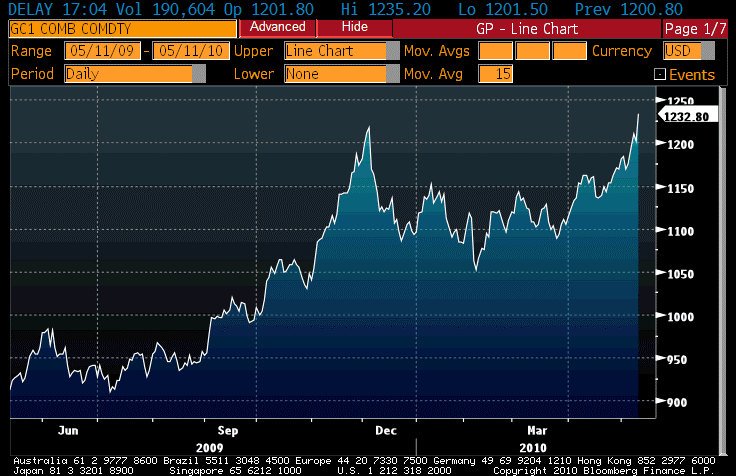
Someone in the monetary world smells a rat.
I might be wrong, but I don’t think the stock market is out of the woods yet. Because institutions cheat, I’m not bold enough to take a stab at the short side and options are no longer cheap…but I suspect we will see Thursday’s lows again.
There is again no data due tomorrow. The Treasury is selling $24bln of 10y notes tomorrow, and $16bln 30y bonds on Thursday. Does the coiling in the equity market continue, or do we make a move? For some reason I have a bad feeling in my belly. But that might be caused by the spectacle we’re watching.
Rattlesnakes At The O.K. Corral
The weekend finally produced something of substance, although how much substance is clearly still open to question. It has been called an “all-in” bet by the EU, a metaphor meant to indicate that this is meant to be a pre-emptive move so strong that the opposition (in this case, markets) must back down. The metaphor is apt in more ways than one; in an all-in bet, there is nothing left to wagered if the bet is called. It is all or nothing.
“The Bank and the politicians listened to what the dealers were saying and took exactly the kind of rapid, decisive action that was needed to avert a crisis,” said [European Primary Dealers Association director Sander] Schol. “The proof that this it is the right course of action appears to be demonstrated by the market’s reaction.” – “Trichet Defends ECB Independence Amid Market Relief”, Wall Street Journal, 5/10/10
So, the fact that markets are going up proves that everything is all right. Surely nothing is better than a rising market, regardless of the reason it is rising. These are the people driving the train along such a scenic route, without having checked to see if the track goes all the way to the destination.
The EU package is a conceptual grab-bag: a pledge of up to €750bln in loans and loan guarantees, including about a third of that from the IMF; open-market purchases of sovereign and corporate bonds by the ECB and member central banks; the Federal Reserve’s reactivation of currency swap lines; and unlimited auctions of short-term money.
“The central banks are buying government bonds issued by Greece, Spain, Portugal, Ireland and Italy, a spokesman for the Association for Financial Markets in Europe, or AFME, told Dow Jones Newswires.”
Markets rallied, at least partly because (in the case of sovereign debt) the ECB was buying. Investors seemed shocked that leaders on the Continent came up with something meaningful, after months of trying to finesse the problem.
But did they really come up with something meaningful? One bond salesman reported, in a summary of overnight events, “…when asked at the press conference, EU Monetary Affairs Commissioner Rehn could not explain how the money will be used, when the facilities will be operational, or how the decision to allocate access to the funds will be made. It’s not yet clear, who will have this designating power (IMF/EU/EcoFin).”
Moreover, while the European elites believe that this is the way that decision-making in the EU is supposed to work, as the product of a powerful central committee that considers all the ramifications of any action on the fortunes of all member states, it is not yet the case that it really is the way it works in the balkanized politics of Europe. Just this weekend, Angela Merkel’s party lost control of the upper house of the German legislature. Who, then, has the power in Germany to sign off on this pledge? The heat doesn’t necessarily produce a nice, smooth, unified front from the rainbow of political interests. It is more like a box of Mike and Ikes left in the car: a sticky, gooey mess.
The news that the ECB is buying bonds – which is the only part of this that we definitively know is happening – is particularly interesting. The purchases will be “sterilized,” which is to say that the ECB isn’t directly monetizing the debt, as would be the case if for example the various governments issued debt and used the proceeds to help Greece, and then the ECB printed Euros to go buy the debt those governments had issued. The money being injected as a result of those bond purchases will be drained, probably by issuing ECB debt certificates. But this presents problems as well, since the short-term markets have been unhealthy of late (recall the chart of LIBOR from Friday’s comment). That detail aside, this means that the ECB is effectively levering up to replace the leverage that the crisis has been leeching away. Such leverage is normal for a central bank to some degree – when the Fed needs to add permanent reserves, it does so by buying Treasuries outright in a coupon or bill pass. But the difference is that Treasuries are highly unlikely to default. The Federal Reserve is limited in terms of the credit quality of the instruments it is allowed to buy, and in ordinary times they observe those rules (there was, um, some “slippage” from those rules during the crisis). What happens when Greece does default, as she almost surely will since these measures do nothing to soften the impact of the austerity measures? Then the ECB is holding worthless paper, and still is obliged on the debt certificates – and it must roll those debt certificates perpetually, or print the money to pay it off.
Inflation markets, recognizing perhaps that this is at least a small step towards monetization (especially if it fails), rallied smartly today. USD inflation swaps rose 7-10bps.
“The message has gotten through: the euro zone will defend its money,” French Finance Minister Christine Lagarde told reporters in Brussels early today..” (Bloomberg)
Oh really? The EU defends its money…by printing money? That is an interesting theory.
The S&P ended up with a 4.4% rally, which failed to fully reverse the Thursday-Friday plunge but wasn’t a bad showing. Volume was lighter on the bounce, at 1.8 trillion shares compared to 2.3 trillion and 2.4 trillion the last two days. To be sure, 1.8 trillion represents comfortably above-average volumes. While in general technicians like to see volume confirmation of market moves, in this case there is a reasonable excuse in that there was an overnight gap – prices adjusted, in short, without needing volume to push them up. That also means that there may be “trapped money” short, or at least not as long as they want to be, below the market. In turn, that could mean that the next declines will be slower as this money will provide natural buoyancy when prices revisit those levels.
And revisit them I think we will. It is appropriate that stocks didn’t reverse all of the prior plunge, because that drop wasn’t merely about Europe. It wasn’t just about the oil spill, or the volcanic eruption grounding air traffic for a week, or Fannie Mae needing another $8.4bln from the government…oh, wait, that last bit was today’s news. The reaction of the market last week was that of an overvalued market that suddenly had vertigo. It isn’t plain to me that, even if these actions “fix” the problem in Greece, that the vertigo is cured.
That said, we must always be cautious when institutions act to preserve themselves, as they can be brutal. When Lagarde told reporters that the euro zone will defend its money, what she meant was “we are cornered, and we will do whatever is necessary.” Remember that in the 2008 crisis, for the Fed that meant doing a number of things that were not strictly allowed by its enabling legislation. Institutions in crisis can sometimes cheat.
In the long run, markets will win. They will win because fair value is more patient than politicians. But even when he has been bitten by a rattlesnake, the man with two six-shooters can still win a gunfight before the poison does its work. Be on the side of the rattlesnake, but stay out of the crosshairs of the pistols!
The 10y note contract today dropped 24/32nds with 10y yields rising to 3.53%. There is no data tomorrow. Can you guess what the focus might be?
Those Lights Are Off On Purpose
Forget for a moment all of the chitchat about how it was a computer error, and not a human error, that triggered Thursday’s stumble. Perhaps that is true – we may not know for a while – but it isn’t relevant. People who live parasitically on the market, like the talking heads on CNBC, want to get you to focus on the 1000-point slide yesterday and persuade you to think “oh, I guess it was all a mistake! I don’t want to miss the rally back up! Buy! Buy!”
But that is a red herring. It wasn’t a computer glitch that caused the oil spill in the Gulf, the riots in Greece, the hung Parliament in the UK, or the tightening of credit conditions between banks. It wasn’t a computer glitch that produced the first 350 points of yesterday’s slide (the part that stuck around until the close) or the 250-point decline today that was eventually trimmed to “only” 140 points. And it wasn’t a entirely a computer glitch that produced the two heaviest trading days in equities, with the exception of a couple of triple-witchings, since…are you ready?…October 2008. It wasn’t a computer glitch that lifted the VIX higher today: the VIX closed Friday around 41, about double where it was on Monday’s close and the highest level since April of last year before the Great Bounce of 2009 was very much underway.
It is frankly a little disconcerting that the market wasn’t able to do better today, given what news there was. Rumors circulated for much of the day about a supposed €600bln backstop that the ECB might be putting in place (for banks, maybe?) over the weekend. Germany’s parliament approved their part of the Greece bailout – which was somewhat surprising, and was probably encouraged by the waterfall decline in equities. And, of course, the Employment data.
Payrolls soared 290k, with a 121k upward revision to prior releases. Moreover, the gain wasn’t merely in Census workers: government hiring was only +59k. The net 411k jobs in the month, about 350k on private payrolls, is an economy-lifting-off sort of number. Except…somehow, this robust labor market was not picked up by ADP. And it wasn’t hinted at by Initial Claims, which generally fall as a prelude to Payrolls gains since employers typically stop firing people before they start hiring people. And the man on the street doesn’t see the labor market getting much better, based on his response to the Consumer Confidence survey “Jobs Hard To Get” question. Those are the top three indicators of employment after the employment data itself. The Payrolls number is an outlier.
That doesn’t mean that the data is wrong, but I think there’s something else going on here and I was pretty near to anticipating it yesterday. Unemployment also rose in the report, by 255k, and the Unemployment Rate rose to just under 9.9%. That is, more people this month found themselves employed, and more people found themselves unemployed.
As I suggested yesterday, the approaching end of the Emergency Unemployment Compensation program seems to have encouraged some people to start looking for work, discouraged or not. Many of them did not find work, and this is why I anticipated some chance of a rise in Unemployment. What I missed is that some of them found work, too.
I guess it’s natural to treat the number of new jobs as given, especially when the number of people looking for those jobs is clearly greater than the number of openings. But that’s not quite the right way to look at it. There are clearly some jobs that are open, and that remain open for a while, because despite the size of the industrial reserve army of the unemployed, the candidates are not a match (geographically, temperamentally, skill-wise, compensation-wise) for the jobs that are available. For example, despite the 9.9% unemployment, there are at least three or four sell-side firms and several buy-side firms as well that are looking for TIPS traders. That’s called structural unemployment. There are simply no experienced TIPS traders available among the millions of unemployed.
But when some of those folks come off the couch and dust off the resumes, some of them happen to match those jobs. More people looking for jobs actually produces more matches. Think about it like one of those games where you swirl a marble around and try to get it to settle in a little divot that has been made in a surface. If you add more marbles, then you increase the chances of getting a marble to stick – simple as that. It hadn’t occurred to me before, but I think that’s what is happening with Payrolls. Of course, either way it is good news for the economy, because it means more people are employed than would be otherwise, but it isn’t necessarily a sign of a rise in job growth as much as it might be a sign of a (one-time) decline in structural unemployment. We need to see some confirmation from other indicators before getting too excited that a normal recovery is, against all odds, underway.
One of the basic threats to the market these days, which I didn’t mention above, is the financial bill wending its way through Congress. The bill attempts to shackle all sorts of risk-taking, and to separate (where it cannot easily shackle) cheap capital from risk-taking activities. As I have noted before, the reason that market-makers are able to make markets – an inherently risky task – is that they tend to be associated with strong balance sheets with a low cost of capital. If you sever that bond, you reduce the market-maker’s ability to provide liquidity. And when you do that, you start to see ugly gaps like the one we saw on Thursday, more often. Why did some stocks trade to zero? Was it because of market manipulation, as Maria Bartriromo shrilly and irresponsibly suggested? Of course not. It was because market makers turned off their machines as the market slid, and some market orders were placed when the existing bids had been cleaned out. Market-makers serve a time-disintermediation function, matching the sellers of right now with the buyers of thirty seconds from now; when they are gone then the market order of right now just hits whatever bid happens to be there now. I suspect the “software glitch” that is being investigated is simply that the software failed to check and make sure there was a bid before hitting it.
About a month ago, in a response to a reader’s comment, I predicted that if the Volcker Rule passes, we would have a 40% decline in stocks within 5 years (see the comment at the end of the article here). I didn’t expect that 10% of that might come in a single day, but we almost got there and the Volcker Rule isn’t even law yet. Some traders in 2008 tried to make markets as best as they could, except for a brief period at the peak of the crisis when bank risk desks told everyone to basically stop trading. Those traders figured that if they did well, they’d be reasonably compensated for it. Now, traders know that they won’t get compensated for it, and probably will be vilified if they do. “This kind of risk isn’t in my job description,” they’re going to say more often. Take away the capital they can lean on to make prices, so that if they’re wrong they risk the firm itself, and it will get even worse.
We really need to take deep breaths before doing to financial services what we did to health care: we passed through brute force an ill-considered and overreaching bill whose unintended consequences are likely to be far larger than the authors of the bill can imagine. Let’s pass the rules incrementally. Discuss them. See what happens when you pass some of them. Read thoughtfully analyses such as this one (really worth reading) from law firm Cadwalader, Wickersham & Taft, discussing some of the big problems with the derivatives legislation.
On Monday, we will turn on the Bloombergs to see what happened in Europe over the weekend. That is all we can do, as there is no economic data on the calendar. There are a couple of TBill auctions, and while I normally pay less than zero attention to those auctions I will keep one eye on these as a fear gauge. I will also watch LIBOR (see Chart below, source Bloomberg), which is showing some strains in the interbank markets. Money is still changing hands – the deepest part of the crisis in 2008 occurred when 3-month money wasn’t available at any price – but stresses are showing. Let’s cross our fingers and hope that all we get out of this is a stock market that is closer to fair value. Good luck to you.
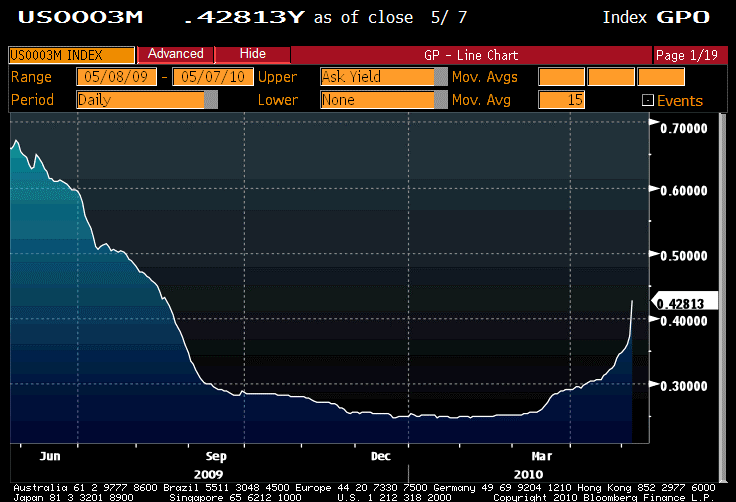
3-month LIBOR showing a bit of stress
Buy On The Sound Of Cannons?
The old saying is that you should “buy on the sound of cannons, sell on the sound of trumpets.” I think that adage applies, however, only if you are not in the crosshairs of the cannons; furthermore, it probably made more sense in the days when news of the cannons’ firing took some time to get around.
We have recently watched politicians trying to psych out the capital markets – today, German Chancellor Merkel said they are “determined to win the battle against the markets.” And later today, the markets responded.
The stock market didn’t start with a huge gap down, but just kept slowly sliding; inflation breakevens on the other hand were hit early as front end TIPS especially have been rather richly valued recently (thanks to the fact that everyone wants to hold inflation protection, but no duration), and whatever else the dollar’s rally does, it dampens inflation in the U.S. relative to Europe.
Stocks kept sliding, kept sliding, and the slide slowly accelerated until abruptly the market hit an air pocket. What happened next will take some time to sort out, but electronic trading systems were overwhelmed as the Dow dropped 998 points with the S&P printing a low of 1065.79 before bouncing. The prices were changing so rapidly that the “real time” ticker on CNBC was lagging behind by more than 100 points on the decline and was briefly 300 points behind when the market suddenly bounced aggressively. (This allowed Cramer to appear to be a genius when he cavalierly declared “just buy ‘em” right before the market leaped 300 points; of course, to the viewer it looked like he bought the market at -980, but unless he doesn’t have a Bloomberg machine he was actually saying it when he knew the market was at -650).
The CNBC crew immediately began to claim that the selloff “must have been an error,” simply because “Procter (and Gamble) doesn’t fall like that.” No authority has yet confirmed (as of this writing, Thursday afternoon) that there was either mechanical or human error involved, although the NYSE said that Nasdaq had “a number of erroneous trades.” We’re waiting to hear whether Nasdaq agrees, but Citigroup, who was rumored to have made the error, says it sees “no evidence of erroneous trades.” Some trades will be canceled, such as the ones where market orders hit no bid until $0.01 (on a $40 stock), but those were not erroneous but careless. Someone meant to sell, and meant to sell at the market, but failed to understand that when there are no specialists “the market” is whatever price someone has put on the screen. No one is obliged to make a market in Accenture.
So stocks rallied 650 points today, and that sure is impressive. Well, that was after they fell 998 points, but what are you – a pessimist?! The net loss on the day was a mere 3.2%. Peanuts, although it leaves the equity chart in shambles (see below). A re-test of today’s lows, followed by a 38% retracement of the rally (1008 on the S&P), would not surprise me over the next few months.
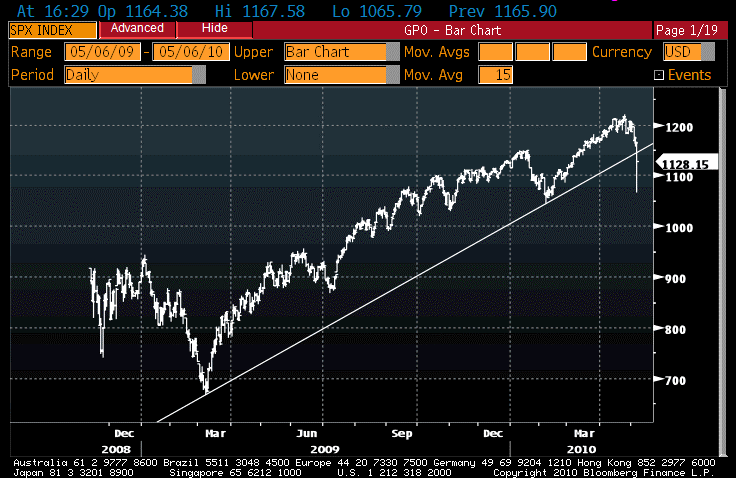
Not the strongest chart in the world.
Again, it helps to remember that none of the news we are seeing is surprising. We have been watching this develop, with the progress of the crisis fairly obvious, for many weeks now. But we have watched the news move from page 31, to page 12, to the cover of the Business section, to the paper’s front page, and now leading off the local broadcast news. So what is happening in Greece ought to be about discounted by now. Buy on the sound of cannons? The problem is that the stresses in Greece are starting to reveal and make plain all of the other faults. Bank solvency and liquidity issues are on page 31, moving up to page 12…(and all the while, financials are valued very highly). And that is but one example.
Oh, and lest we forget, we’re still working on resolving the last crisis. Freddie Mac has said that it needs another $10.6bln from the government, and says there’s more to come. In a statement it said:
“Freddie Mac expects to request additional draws. The size and timing of such draws will be determined by a variety of factors that could adversely affect the company’s net worth.”
Inflation breakevens were -10bps or more today (the marks were a little fuzzy). The June 10y Note rallied 1-08/32nds and the 10y Treasury note finished at 3.40%.
The economic data today is and was an afterthought. Initial Claims were slightly higher than expected at 444k. Productivity was a little higher, and Unit Labor Costs therefore a little lower, than expected, but those data get revised for years – Greenspan once opined that you need at least five years of Productivity data to spot a meaningful trend (which didn’t stop him from spotting one in the go-go 90s). Some investors looked askance at the chain retail sales from ICSC, which fell to only +0.8% year-on-year from the prior +9.0%, but no one forecasts this number and it is a little early to worry about that dip.
And I daresay that the economic data tomorrow may also be an afterthought, although the Employment data is ordinarily the most important release of the month (except of course for CPI, to an enlightened few). The consensus view is for a gain of 190,000 new jobs, with the Unemployment Rate steady at 9.7%. Remember that the official data, unlike the ADP, will include any Census-related hiring.
Last month, there were 162,000 new jobs, but remember that included a weather snap-back from February. Averaging the last two months, and taking out Census workers, produces underlying jobs growth of 42,000 jobs per month. I don’t know what we are expecting from Census hiring this month, but unless it is something over 100,000, the 190k forecast looks generous to me. Keep in mind that we haven’t seen any real improvement in Initial Claims or in any of the other job metrics. I think there is a real chance for a disappointment tomorrow. While I think the 9.7% Unemployment Rate is a little safer, since it was 9.749% last month and we know that some Census workers will be hired, I wouldn’t be shocked to see that number rise either since the approaching end of the Emergency Unemployment Compensation (EUC) program at the beginning of June will get more people out looking for work.
The market will take administrative notice of the numbers, but it will be blended with news from Greece and other EU countries, election results in the UK, and overnight equity markets. We are still in the process of moving stuff from the back page to the front page; I wouldn’t fade this move yet.
Senate Votes To Allow Financial Collapse
Many historians believe that, among the cocktail of things that produced the Great Depression, the Smoot-Hawley tariffs figured highly. Conventional wisdom seems to hold that natural forces can cause recessions but only boneheaded policy can turn those into depressions.
I don’t know if that is true, but I hope that we are not looking back in a few years and murmuring about the idiocy of the financial regulation bill of 2010. Today the U.S. Senate voted amid much fanfare to ban taxpayer-funded bailouts of Wall Street firms. That also means, of course, that the Senate voted “if we had to do it all over again, we would have let all those banks collapse in 2008.”
Now, I am all for removing the stink of moral hazard from policy decisions, and I am fine with letting poorly-run companies (although not just banks, mind you, but car companies and mortgage finance companies and airlines too) go bankrupt and be wound down. But this action is the height of cynicism: it was, after all, Congress who approved TARP and passed it despite loud objections from the People and dramatic market signals that this wasn’t wanted. Since Congress cannot bind a future Congress, this law doesn’t really seem to have any important force (and the banks, which know this, will be unlikely to change their behavior in response) other than political. And if it did have force, then it is a silly idea because it takes away tools that policymakers could use in a crisis. For example, while I haven’t read the bill this could limit the Fed – which exists on taxpayer funds – in some way…although come to think of it, the Fed didn’t have any problem doing things that were ostensibly illegal in the last crisis.
And while we’re discussing federal government largesse there is this. I think it may be time for Warren Buffett to pass the reins. A Bloomberg story today attributed this thought to him:
“It would be hard in the end for the federal government to turn away a state having extreme financial difficulty when they’ve gone to General Motors and other entities and saved them,” Buffett, 79, told shareholders in Omaha, Nebraska, at the company’s May 1 annual meeting. “I don’t know how you would tell a state you’re going to stiff-arm them with all the bailouts of corporations.”
There was a time when such a simple concept as taxing authority wouldn’t have escaped the Oracle of Omaha. The difference between a state in trouble – which can compel its citizens to pay taxes – and a corporation in trouble – which has no way to do the same – is pretty dang clear to just about anyone who has taken high school civics. If what he says is true, that the feds just can’t say no, then every state should instantly cut state and local taxes to zero. Why make the locals pay for the benefits the state provides, if the federal government can tax the whole nation to provide those same benefits?
Now, perhaps Mr. Buffett meant that the federal government would be hard-pressed not to guarantee state bond issues, since it has guaranteed bank issues, or perhaps he is making a political statement of some sort. Here’s a tip, though, to the federal government if it wants to help: just suspend all rules that create unfunded mandates, and the states can cut those programs. That would create huge savings. The fact that the feds do not do that is a sign that the politics in fact run the other way: Congress would rather add benefits and make state and local officials raise taxes to fund them, rather than raise federal taxes to pay for state and local benefits.
.
It seems timely to be talking about crisis response when the next crisis may be building right before our eyes. We should hope that the riots in Greece don’t turn even uglier overnight and into tomorrow, but mob dynamics are the ultimate nonlinearity and it could go either way fast. I am not sure there are many direct investing implications, however, from the riots that we shouldn’t have already drawn. It should come as no surprise that the Greek austerity measures are highly unlikely to ever be fully implemented if the bailout is completed, since it would be economic and political suicide to do so. It should come as no surprise to other EU countries that there is such social unrest, and that they may also face domestic political consequences if they approve a disbursement to Greece. And that shouldn’t be a surprise to us! We shouldn’t be surprised that Portugal is on watch for a credit downgrade.
The investment conclusion, I suppose, doesn’t follow from the fact of the riots, but from the fact that the televised nature of the riots may begin to make clear the real depth of this problem to all of those who weren’t paying attention, or who were hoping blindly that the EU would skate by this crisis without trouble. And those folks are now starting to jump out of risky assets. What that means is that we should be careful to assume that this movement out of risky assets, only a couple of days old, will reverse quickly. Many investors have been waiting, assuming that they could exit risky positions in plenty of time when it became time to do so; but the liquidity is likely to vanish far faster than it did in the 2008 crisis if this continues for very long, and the door to get out may be very narrow. The VIX, at 16 less than a week and a half ago, exceeded 27 today. That is the right direction, but it was almost 90 during the 2008 crisis. That is to say, if this continues for another week then 27 will look cheap I suspect.
In inflation markets, breakevens declined only 3-4bps after being down 9bps early in the day. Some inflation market observers attributed that to the increase of TIPS auction frequency and annual issuance target amount announced by the Treasury today (there will now be a total of six 10-year TIPS auctions annually, two new issues and four reopenings). But I don’t think so. I believe this is a continuation of yesterday’s pricing down of inflation expectations. Gasoline prices have been plummeting, with the front RBOB (wholesale gasoline) futures contract down more than 20 cents, or 9.1%, in two days. The market is pricing in the increasing chance of a second dip in this recession.
TYM0 rose another 17/32nds, with the 10y note yield down to 3.54%. That’s the lowest since December although still well above levels that would imperil the longer-term case that the secular bull market in bonds is over (as I believe). That case will be challenged if yields drop below 3.37% (the monthly closing level from May 2003) and 3.11% (the low yield from June 2003), and I will re-think at those levels. For now, I remain neutral on fixed-income.
On Thursday, preliminary Q1 Productivity and Unit Labor Costs data (Consensus: +2.6%/-0.7%) will be released, along with the weekly Claims figures (Consensus: 440k). Economically speaking, the real game is on Friday with the Employment data, and with ADP on target today I doubt the market will react to the economic figures. It’s all about Greece, and about reflexive investor responses to changes in prices that can cause further changes in prices. Expect trends in place to reinforce themselves the longer this goes on.
No Pleasing Some Folks
There is just no pleasing some people!
Greece finally gets a package of a decent size…okay, so it’s not very likely that the deal will be approved by the entire EU, and it depends on the U.S. contributing a whole lot of money via the IMF, but still: it’s what investors wanted, as of yesterday…and today the market comes unglued again. The S&P ended -2.4%, at the lowest point since wayyy back in March. Considerably more starch was taken out of the FTSE and the EuroStoxx. Energy (and Silver) commodities fell hard, bringing the GSCI down about 3%.
Bonds rallied, with the 21/32nds rally in the June 10y Note contract bringing the 10y yield to 3.59%. The low closing yield for the year to date is 3.56%, by the way.
Inflation swaps dropped 4-8bps in the U.S., which is interesting because in Europe inflation was nearly unchanged. The Euro plunged 2 big figures, below 1.30 for the first time in a year, so what the inflation market may be telling us is that the rallying dollar will be disinflationary for the U.S., but the troubles in Europe increase the likelihood that the ECB starts adding liquidity in a serious way at some point. Maybe, but if the ECB adds liquidity then unless the Fed is working to drain it it will push prices higher. Money is fungible, so while increased ECB liquidity would tend to change relative prices between the Europe and US, it is an upward shock to prices globally.
As in 2008, the question of whether aggressive liquidity provision would be inflationary – and this is all speculative, anyway, since we have no idea what the ECB may do – is whether the velocity of money declines fast enough to counteract the rise in the quantity of money. I wonder if that trick can be played twice; surely the velocity of money hasn’t yet recovered from the last thrashing or we would have inflation already.
But supposing all of these things are possibilities, I wonder why U.S. inflation is still expected to be so much higher than European inflation. I wrote last week (here) about the fact that 10y U.S. inflation swaps were projecting 2.80% compared to 2.15% on the Continent. As of today, it is 2.70% versus 2.16% but the same logic applies. If you want to be long inflation, then European inflation seems to be a better value to me.
Things seem to be unraveling a little bit, but it may be premature to say that. It is never too early to head for higher ground, of course, but we should remember that with Europe mostly closed yesterday for May Day this was the first opportunity that investors there had to express a view on the Greek rescue package. Perhaps this is a one day thing. However, as I said – it is never too early to head for higher ground, and there have been enough reasons to be cautious recently.
There are still lots of bullish economists, and they’re very clever. If the economy survives this blow and continues to recover, they can say that they predicted as much; if Greece, or the oil spill in the Gulf, or some other event brings down the economy or just the market they can say “well, no one could have foreseen that.” That is what they said in each of the last several recessions.
But an economist who is forecasting an economic trajectory without giving some sense of the risks to that forecast doesn’t understand the economist’s role, in my view. As an investor, I can’t possibly invest only on the basis of the bullish case, even if that is the most likely case to a prognosticator. Investing is about managing uncertainty, and what I want to hear from the economist is, what are the error bars like? What things could derail your forecast? What are the known unknowns, and how much does it matter how they develop? And in the context of the state of the economy, what is the likelihood that the next “unknown unknown” will be a negative event, compared to a positive event? (That is: when everything is going right, the best bet is that the next bolt from the blue will be a bad thing; when everything is going poorly the best bet is that a bolt of the blue could make things better).
An honest economist who answers those questions right now would say, “heck, there are some positive things that could happen but most of the things that are most likely to occur that are not in my forecast are bad things: Greece defaulting, Greece leaving the EU, interest rates rise with or without Fed action, banks pull back credit again…” The economist doesn’t need to forecast that Greece is going to default – that’s where you bring in the guy who trades Greek bonds. The economist just needs to forecast that sh-t happens. The difference between a good economist and a bad economist is that the former forecasts that sh-t happens, while the latter uses the fact that sh-t happens to explain deviations from his forecast after the fact.
Speaking of economists, the bow-tied set is forecasting ADP tomorrow will rise from -23k last month to +28k. That is a lower forecast than they entered last month with (+40k), which is interesting. The ADP is in some sense a little less important this month and over the next couple of months simply because it doesn’t include Census workers, and that’s a big portion of what job growth will be. In another sense (the one that the market probably doesn’t care about, but economists should), the ADP is perhaps more important than usual since it isn’t polluted by one-time public-sector hires and so perhaps gives a truer reading of the underlying trend of private payrolls.
The Treasury also holds its quarterly refunding announcement. Be aware that some auction sizes may actually be cut at this refunding; while that is not likely to be a permanent improvement (unless the government suddenly stops running trillion-dollar surpluses) emphasis will probably be carefully placed to imply that this is a big deal. It’s all marketing, of course, and with this many billions they better keep doing a darn good job of marketing.
Can’t Tell The Players Without A Program(me)
This is starting to get confusing.
The market on Friday sold off in part because investors were concerned that, despite another claim from the Continent that there would be a resolution to the Greek crisis this weekend, no one believed them. On Monday, stocks rallied hard (+1.3%) because the plan was trumpeted as being a done deal.
Except that it is anything but a done deal at this point. Already there are concerns because little Slovakia – who is contributing less than 1% of the rescue money – is insisting that they will not disburse any monies until Greece actually cuts spending as it has pledged to do. Slovak Prime Minister Robert Fico said “Personally, I don’t believe that the Greek parliament will be able to approve the restrictions passed by the government yesterday,” and further noted that the money would only be disbursed after parliamentary elections on June 12th. (See story on MSN here.) There are 25 other nations, each with their own issues, that need to act in the affirmative for this package to work, unless Germany (which is facing elections very soon as well) is willing to go it alone. I think this is still an odds-against bet, although finally the amount of money they are discussing is more than a drop in the bucket.
But there is a very deep well of hope which investors keep drawing from. They’re not going to believe that anything bad could happen until Greece actually defaults or withdraws from the EU, and then the market is going to have a sudden, wrenching adjustment. It shouldn’t; the trajectory here hasn’t been terribly hard to figure out. But investors will act like it is a surprise.
Markets also rallied because Warren Buffett said Goldman should not be held responsible for the money lost by one of their clients in the current scandal. Two remarks are appropriate: first, Warren Buffett might be the only man in the world who has such credibility that he can nakedly talk his book and people take his words entirely at face value. This is “dog bites man.” The man-bites-dog story line would be if Buffett thought that Goldman should be held responsible! The second remark worth making is that Goldman isn’t being held accountable for the losses. They’re being held accountable for the fraud.
While stocks rallied hard, it is worth noting that this happened with major European bourses either closed or very inactive due to holiday; NYSE volume was the lowest in a couple of weeks. Let’s see what happens tomorrow.
On the plus side, economic data continues to confound me by coming in better than expected – albeit only modestly. The ISM Manufacturing index for April was 60.4, marginally beating the 60.0 expectation, and the internals weren’t bad. Personal Income and Spending were right on target, but those are March numbers. Vehicle Sales were a little weak, but still: overall, the growth engine continues to sputter and cough, but it hasn’t quit yet. Of course, the main thing that does right now is to help push the dollar higher and to keep interest rates defensive. TYM0 fell 13.5/32nds, with the 10y yield still in the same dull range (last at 3.70%).
Tomorrow’s data slate consists of Factory Orders for March (Consensus: -0.1%) and Pending Home Sales for March (Consensus: +4.0%). What will be interesting though is to see how investors in Europe react to the “deal” announced over the weekend. All wiggles aside, however, I feel this is a pay-me-now-or-pay-me-later deal. If the market doesn’t begin to discount the serious possibility that no deal will get done in time to save Greece, then it risks a sharp discontinuity later. The VIX is still around 20, suggesting that the possibility of a meaningful gap in the market is being given no respect.
.
I saw a pretty frightening article today that I don’t think has gotten a lot of play but should. I suppose that as people read through the mammoth finance bill, we’ll get the same sort of news from time to time as when people waded through the mammoth healthcare bill. There will be surprises about some of what it contains.
According to this story in Pensions and Investing (you may need a subscription to access it), defined benefit pension funds will be denied the use of swaps. Now, the unsophisticated voter – which is, of course, what this populist bill is mostly targeting – will say “good! Them dangerous derivatives could blow up my pension!” But in fact, this will exact large costs on pension funds. Many things that pension funds want and need to do cannot be done any way other than with derivatives. For example, pension funds have ultra-long liabilities, and so have an appetite for 40-year bonds. The problem is, there aren’t very many of those, and if a pension fund buys a super-long credit then it has super-long credit exposure. On the other hand, a pension fund that enters a 40-year interest rate swap that is fully collateralized will face no important credit risk, but gets the duration it needs. As another example, pension funds also have exposure to longevity risk: the risk that the retirees covered by the pension fund turn out to live lots longer than the actuary expects them to. This is great for the retiree, except when he or she discovers that the pension fund only has enough money to fund an 80-year average life instead of the 90-year average life that might happen if, say, we discovered a cure for cancer. This risk, when it is addressed, is addressed with longevity swaps in which entities with risk to longer lives (like pensions) lay off the risk to entities with risk to shorter lives (like life insurance companies).
To say nothing of the utility of inflation swaps to a post-retirement medical plan or a pension plan that has inflation-linked liabilities.
Moreover, according to the article this would also affect stable-value wrappers that allow defined contribution plans (IRAs, 401(k)s) to offer stable-value products. Technically, that involves a derivative.
Huge pieces of legislation like this are good for one thing: enacting enormous shifts in the way government interacts with its citizens before they can organize to prevent it. Congress should break up the legislation so that we can look at the pieces of it. Why not? Because then, crazy paternalistic rules like this would never pass muster.
Some Second Guessing?
There seems perhaps to be a little bit of second-guessing going on at the moment. Although the Chicago Manufacturing index was stronger-than-expected at 63.8, and although GDP was near-expectations at 3.2% (Personal Consumption was +3.6%) and +0.6% on the PCE deflator, and although the Employment Cost Index recorded a near-expectations +0.6%, the stock market fell (-1.7%) significantly for the second time in a week and the bond market rallied (+15/32nds on TYM0, 3.66%).
This despite the talk, predicted here on Thursday, that the ECB would shortly announce the rescue plan for Greece. Ordinarily, that produces a Friday rally and Monday disappointing selloff, but on Friday the rally did not materialize. Perhaps it was the rumors that the ECB was asking the Fed to renew swap lines, which some people felt implied the ECB expected a possibility of a tight financing environment for European institutions in the near future. I have no information on the rumor other than to observe that a tight financing environment, until we know which institutions are most vulnerable to a Greek default (and others), isn’t a stretch as far as concerns go. If in fact the ECB made such a pre-emptive request, then good for them!
Goldman fell 9.4% on Friday on the news that the SEC had commenced a criminal investigation into the company. That is a significant development. Remember that Anderson was brought low by the criminal charges, not by any proof of the merit of the charges. Success of a criminal complaint might kill the institution, and the mere threat of it is chilling (albeit not undeserved).
I have trouble believing stocks fell so far, however, merely because Goldman is being shot at or because of the shocking news that European institutions may be at risk if Greece defaults or the contagion spreads. To me this appears to simply be an overextended market where investors are taking some chips off the table due to a change in the preponderance of the risks. This should not be surprising, and I would not be surprised to see it extend further.
.
I have seen a lot of comments recently suggesting that the ECB or other entities ought to regulate the ratings agencies in some way because the downgrades of Greece and other entities has “fed fuel to the fire” in this developing crisis. Such a suggestion gets it exactly backward, I think.
The ratings agencies are in precisely the same position that real estate appraisers are in, and more importantly were in, when the real estate bubble inflated. That is simply this: all parties have an incentive to see a higher rating rather than a lower rating, just as all parties in a real estate transaction have an incentive to see a higher appraisal. Let’s recall the latter situation first. The home seller has an incentive to see a higher appraisal, because it supports a higher transaction price. Local government likes the higher appraisals and higher prices, because it expands the tax base. The buyer likes the higher appraisal (it was usually the buyer who solicits the appraisal to support the mortgage loan), because it supports a larger mortgage loan and thereby reduces his outlay. The lender likes a higher price, because it makes money in proportion to the size of the originated loan or refi (and, since the loan is securitized, it doesn’t care whether there is a correlation with default). The broker prefers a higher appraisal, because it makes it possible to persuade more market transactions (the value of each of which, since the broker fee is 6% of transaction price, increases with price). The appraiser has an incentive to appraise properties highly so he gets more business as an appraiser. No one, in fact, has an incentive to see a lower appraisal and the only party that has an incentive to get an accurate appraisal – the investor in the mortgage pass-through security – is the furthest removed from influencing the appraisal. Thus, appraisals are routinely inflated and appraisers are pressured to inflate appraisals by the originator who hires them. There is no mystery about this dynamic, and frankly even in the teeth of the housing bubble some people (ahem) were writing about this dangerous situation.
The same is true in bond ratings. Clearly, the issuer of the security wants a higher rating since it lowers its cost of funding. The buyer of the security, a portfolio manager, likes to see a higher rating since the manager is limited by statute in many cases and by mandate in many others from investing in securities below a certain rating; moreover, if the rating turns out to have been over-optimistic, the buyer can always blame the rating agency. “Hey! It was AA and that’s what I am allowed to buy!” The dealer of course has an incentive to structure securities at the margin where it just gleans the higher rating (and it can do so since the rating agencies make their rating formulas known, for reasons I have never understood), since it is easier to exact a high fee in this case. The rating agency itself wants to make people happy, and it knows people prefer high ratings to accurate ones and they get paid more the more ratings they do – the more bonds that are structured, the more the agency gets paid, if it can be counted upon to rate the bond “appropriately.” The one who cares most about the accuracy of the rating, the investor in the fund, is the one most removed.
What we want to do is to increase the value of high-quality, independent ratings, and we don’t do that by legislating a set of rules that agencies, structuring firms, and investors can just game differently. We need less structure to the rules, not more. How would the ultimate beneficiary of the ratings – that is, the person whose money is invested, look at the problem? They want ratings to reflect the probability of default accurately given the position in the economic cycle. All rating agencies should report publicly the realized default and recovery statistics of the bonds they’ve rated for a forward-looking time period (to prevent sudden re-rating just before default). So, for example, S&P would report that for bonds backed by first-lien mortgage securities that they have rated AAA, 0.05% have defaulted within 1 year of that rating, .11% have defaulted within 2 years; of the same class of bonds they have rated AA, 0.20% have defaulted within 1 year, .22% have defaulted within 2 years, and so on. And then investment managers should be held responsible not for buying bonds of a particular rating but of a particular default probability. “You know that bonds rated B+ by AggressiveCo tend to default at a 2.5% rate, but according to your mandate you should have bought bonds that had less than a 2% chance of defaulting when you bought them.” Rating agencies that gained a reputation for being very astute readers of credit situations would flourish; the hacks would wither. A more finely-grained continuum would also reduce the problem associated when a rating change (for example, to below-investment-grade) essentially produces a run on the credit when its bonds are no longer eligible for inclusion in a mandate.
Because after all, as an investor I don’t want to know whether my manager only bought AAA bonds and they happened to go bust; I want to know why my manager bought this “AAA bond” that yielded 2% more than other AAA bonds and was surprised when it wasn’t as high-quality. What did my manager think about the probability of default? A rating is no substitute for credit analysis, unless the rating is a pretty good proxy for credit analysis. The only way to evaluate that is to look at the history.
.
On Monday, March Personal Income and Consumption (Consensus: +0.4%/+0.6%, with 0.0% on Core PCE) will be released at 8:30ET and the ISM (Consensus: 61.0 from 59.6) at 10:00ET (also at 10:00 will be Construction Spending, Consensus -0.3%, but that is not a market mover). Although ISM is ordinarily of interest, I believe it pales in market significance to events in Europe. Friday’s Employment report will be meaningful, but right now it is the growing crisis across the pond that matters.
.
One final note: I was in a meeting with a potential client on Friday and one of them remarked that they had seen my Letter to the Editor printed in Barron’s a couple of months ago. It is funny, because I hadn’t realized my note had been published. I looked it up, and indeed here it is in case you’re curious. I regret including Goldman in that list, but the general point is still true (even with respect to many people at Goldman).
