Archive
What Have You Done For Us Lately?
So the EU laid down the law last week: Greece had to prove that it was serious about austerity measures. It had to get all political parties who might win in elections this year to agree to maintain the austerity measures, and they did. It had to pass a bill detailing the austerity measures through parliament, and it did. The government and the major political parties went further, and sacked anyone who voted against the measure – displaying a fairly hair-raising resolve to ditch democracy if that was necessary to make a buck. And it had to find a few more hundred million in austerity measures, which it was working on.
Then a group of Euro finance ministers was to meet on Wednesday, sign off on the deal, and move the process forward so that the March bond payment would be covered (assuming a few other things, like the IIF agreement, moved forward as well).
Well, that meeting has been canceled. It is being replaced with a conference call. Jean-Claude Juncker said that they had not received “assurances” from Greek leaders about the cuts. You may read between the lines here with some ease: it is hard to imagine how greater assurances could have been given than sacking all of the dissenters and passing a law despite protestors outside threatening to burn the ancient city down.
The Euro ministers may have been surprised by the report that Greece’s economy contracted by 7% (annualized) in the latest quarter, but although that was larger-than-expected it wasn’t so different that it should completely change the EU’s perspective. To me, Juncker’s downgrading of the meeting looks like a fairly clear indication that the EU is not at all united about whether Greece should be saved, allowed to default while remaining in the EZ, or kicked summarily out of the EZ (or even the EU). It sounds like an excuse. It is hard to see how Greece could have done more than they did this weekend. I don’t believe Greece can be prevented from defaulting, and I have said that now for a very long time. I think that enough in the EU have come to the same conclusion that the default is going to happen, probably in March – and the way the EU has gone about it, frankly, is going to cause bad blood in Athens for a generation.
.
Meanwhile, in Japan the Bank of Japan overnight added ¥10 trillion (about $130bln) to their version of QE, and declared that it now has an inflation target of 1%. The BoJ didn’t state over what period inflation is to return to 1%. I will say that it’s about time – the country that has had the most need of QE, the most reason to weaken its currency, has for the last couple of decades refused to apply meaningful monetary stimulus to its deflation problem. I’m fond of saying that the BoJ correctly diagnosed the disease (deflation) and correctly prescribed the treatment (more money) but completely blew the dosage. “The body economic has cancer: radiation is prescribed. Here is a prescription for one hour in a tanning bed.” With this action, they are finally starting to increase the dosage.
I showed a couple weeks ago that core inflation in Japan, just as in Europe, the UK, and the US, has been rising (in Japan’s case, rather fitfully) for several years. But that is mainly from global factors – the rising money tide raises all prices, no matter its source. The quickest way for Japan to increase its own inflation is for it to intentionally weaken its currency. That they’ve never done this is hard to understand, and must be tied to a sense of national honor and pride in the currency. A weaker Yen would help growth and raise inflation. It boggles why a more-aggressive monetary policy hasn’t been pursued before now.
If Japan is serious, then currency-hedged Nikkei is going to finally be an interesting investment. Since 1989, the only way you wouldn’t get smoked being long the Nikkei was because you were usually buying Japanese stocks with cheaper yen than when you went to sell. While the Nikkei in Yen terms has lost about 77% over the last quarter-century, in dollar terms it has only lost about 57%, thanks to the ever-appreciating currency. If the BoJ is really going to print, and has the guts to outprint the U.S., then the Nikkei may appreciate while the currency actually weakens.
.
The economic news in the U.S. continues to be okay, but not great. Today’s Retail Sales report was better-than-expected as core Retail Sales was +0.7% versus expectations for +0.5%, but December’s numbers were revised lower and essentially offset the weakness. These are not depression numbers, but they aren’t also robust expansion numbers. We continue to stumble forward economically…but at least we’re stumbling forward.
On Wednesday, the pace picks up a little further. In addition to finding out what comes out of the conference call of the EU ministers, the February Empire Manufacturing report (Consensus: 15.00 from 13.48), January Industrial Production (Consensus: +0.7%) and Capacity Utilization (Consensus: 78.6% vs 78.1%), and the minutes of the latest FOMC meeting will be released. This last will be carefully scrutinized for details about how to interpret the new communications from the Fed, but I actually don’t expect we will learn much new: the FOMC went out of its way to tell us exactly what they wanted us to understand from the new approach.
Greek Spring
Ah, spring is in the air, and that must mean: firebombs.
Yes, last year we had the Arab Spring, with violent protests and governments overthrown in Libya and Egypt with others tottering. This year, it’s Athens that is in flame against autocratic leaders. The fact that the Greek parliament passed resolutions that the people are so fervently opposed to, in the country where democracy (literally, ‘people rule’), has been remarked upon by many observers as ironic. It is even more ironic than most people think, since the idea we have today about democracy is of representative democracy in which elected representatives sometimes pass laws that contravene what the people desire…for a recent example, see Obamacare, which has never been supported by a majority of Americans. But the democracy that developed in Athens was direct democracy in which the people (or, anyway, the adult male citizens who had completed military training) voted on each piece of legislation. So the midnight passage of austerity measures was even more offensive to the Athenian sense of democracy than to ‘newer’ democracies.
And it was even worse than that, since representatives that did not vote the party line were booted from representation by the party bosses. Some 43 representatives will no longer represent their constituencies (it’s unclear how or if they will be replaced), along with a half-dozen or so members of the government who resigned before the vote. But, in the end, the legislation was approved and after the government adds a few more austerity measures demanded by the EU, the EU will pass judgment. That is scheduled to be Wednesday, but don’t be shocked if this firm deadline shifts a bit.
Greece fatigue is clearly in the air. With that news, the stock market managed to print the lowest-volume day of the year. February’s volume is running at an even slower pace than January’s volume. And perhaps it is more than just Greece fatigue, and more than political fatigue. Maybe there’s some price fatigue as well. As strange as it seems, the stock market is currently sporting its best 3-year performance since early 2000. Think about that. With only a weak recovery so far realized, stocks are up about 75% from 156 weeks ago (see Chart, source Bloomberg).
Bulls will say that this validates their boundless faith in America and will cascade “I told you so’s” onto the heads of poor benighted bears. The bears will say that this represents a triumph of hope over mathematics and wonder whether how bulls can still see stocks as cheap. And, of course, real-value investors will note that relative to the growth in the money supply, the stock market bears far more resemblance to the Nikkei from 1990-2009 than we’d like to believe (see Chart, source Bloomberg, showing the S&P divided by M2, scaled by 100).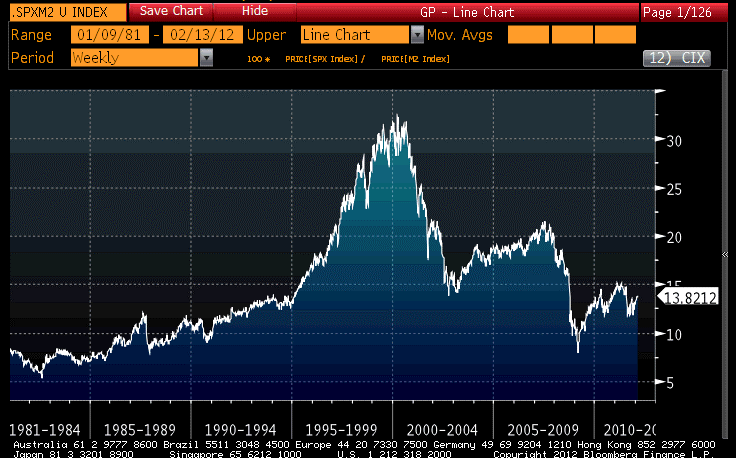
So perhaps that means that stocks are cheap, although to me it looks at best like they are back in real, raw price terms to where they were in 1996 or so and that’s not necessarily an endorsement unless 1996 was cheap. That’s a topic for a different letter, but consider what it means about the 2002-2007 market rally: the S&P in price terms made it back to the old highs, but only because of the Fed’s serious easing over that period. Relative to the amount of cash in the system, stocks recovered only 1/3 or so of the real value lost in the 2000-2002 bear market.
Of course, the picture looks similar but less dramatic if you use the Consumer Price Index. In terms of the number of “consumption baskets” a given equity investment will buy, the 2002-2007 rally restored 68% of the wealth destroyed in 2000-2002 (see Chart, source Bloomberg, of SPX divided by the NSA CPI price index, monthly).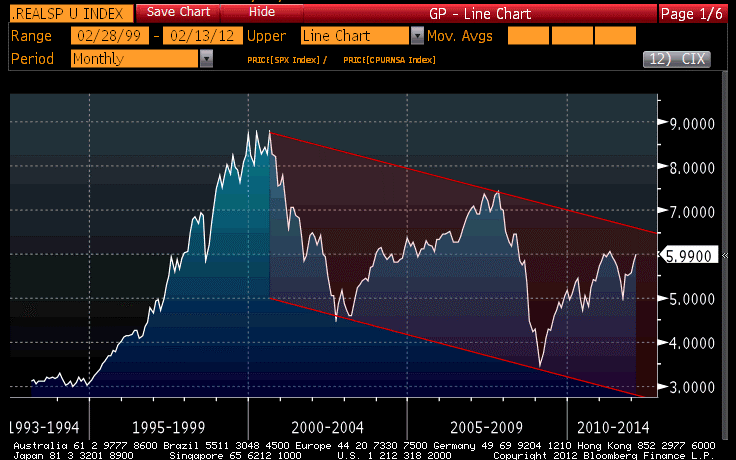
However, I like the SPX/M2 version because it highlights just how much our wealth has been diluted by something directly caused by the Federal Reserve. Certain purists, like Jim Grant of Grant’s Interest Rate Observer, hold that the increase in money is the only measure of inflation that matters. I don’t fully agree, but looking at it in these terms does abstract from changes in money velocity. If velocity is mean-reverting over some long time frame, then the second chart is the one that matters most. M2 money velocity is currently at the lowest level on record (see Chart, source Bloomberg), which is the only reason that the extended period of M2 money growth greater than 10% per annum hasn’t caused more inflation than we’ve already seen. However, the same share of the stock market buys a much smaller share of the money in circulation – in a real sense, that is why we feel poorer with stocks near recent highs. I wonder whether the current declining trading volume is consistent with a 1995 attitude about stocks, and if so…if we have finally returned to the old normal.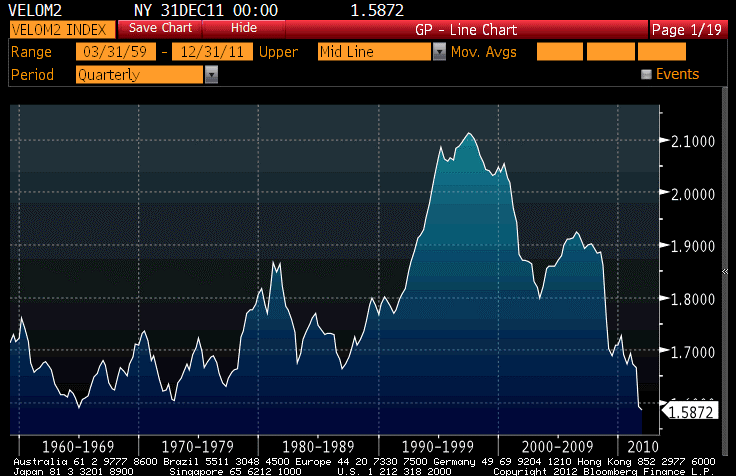
Aside from such abstract musings: the ratings agencies have been busy over the last couple of days. S&P downgraded 34 Italian banks on Friday and 15 Spanish banks today. Santander dropped to A+ from AA-, but is actually above the sovereign A rating of Spain. I can understand why an industrial conglomerate might trade above its sovereign rating, but a large bank? That seems odd to me. Moody’s, the laggard agency who still has France at AAA, begrudgingly put that country on outlook negative today while downgrading Italy, Portugal, Spain, Malta, Slovakia, and Slovenia. Moody’s also put UK and Austria on watch for a downgrade from their current AAA ratings.
On Tuesday, the beginning of a heavy tide of economic data sweeps into town when January Retail Sales (Consensus: +0.8%/+0.5% ex-autos) is released at 8:30ET. Regional FRB Presidents Plosser and Lockhart are speaking on the economic outlook, but that’s not likely to garner much attention at the moment. Wednesday, Thursday, and Friday have much more data, so enjoy your Valentine’s Day but not too much.
I remain reluctantly long equities (although long less than my neutral policy weighting), aware that on a valuation basis I have much less than the margin of comfort I normally demand. But our models at Enduring Investments continue to be quite overweight in commodity indices, and show both nominal and inflation-linked bonds as expensive (but nominal much more so), so I hold USCI and DBB on the commodity side, TBF (short 20+ year Treasuries) on the bond side, and both INFL and RINF on the long-inflation side.
Promising Isn’t The Same As Delivering
Yet another weekend appears to be poised to end without the promised big-picture agreement on Greek debt. The BBC was reporting earlier today that talks between the Greek Prime Minister and the leaders of other coalition parties had concluded without agreement to take additional austerity measures; at this hour Bloomberg is reporting that there is agreement on cuts of 1.5% of GDP although these will not be finalized until Monday. These Greek-on-Greek talks became necessary because European Union representatives demanded additional austerity measures. On Friday, a report from Radio Netherlands Worldwide said that the AAA countries demanded “that the [Greek] government implement agreed reforms and austerity measures by March at the latest. Otherwise they will withdraw the bailout funds pledged last year.”
In case you’re wondering: yes, when those bailout funds were announced last year the stock market rallied because the problem had been solved. You see, it is easy to announce the desire to help. It is harder to actually help.
I wonder if the U.S. will consider throwing in a little help now that we have had a couple of months of decent data (more on that in a moment). I think it would be a mistake, both politically and economically, but this Administration has tended to have a tin ear politically since taking office. A driving force of its foreign policy has been a desire to be loved worldwide, and it would not surprise me a bit if we started to hear about the U.S. taking a bigger role in talks. Would this be bullish or bearish for our markets? It might be bullish since it would increase the perceived chance of the immediate crisis being averted, but it might be considered bearish since it increases the chance of a crisis later. It would, though, change the equation significantly since the U.S. is the only power capable of writing a hundred-billion-dollar check alone (heck, that’s only a tenth of a trillion!). I imagine the stock market would like it but I’m pretty sure the bond market would hate it.
This wasn’t even a consideration a couple of months ago, when we had enough of our own problems to deal with. Those problems are still here, but the problems we have – high private leverage, a chastened although recovering banking system, an addiction to extremely high budget deficits with little appetite to reduce the size of government, and a dangerously loose monetary policy – are not the problems that the Administration (and the Fed) believe we have. It is true that if the economy can grow at 4% for 5-7 years, many of our problems will diminish, but policymakers seem to think the weak growth is not an effect but rather a cause of our current circumstance. And recently, the news on growth has been better.
On Friday, the Employment Report produced a new jobs figure of 243k, which was about 100k greater than expectations. The Unemployment Rate dropped to 8.263%, only a whisker away from triple-downticking. Aggregate hours worked and average hourly earnings both rose, which means that Q1 income got off to a good start.
The January report is a little quirky, partly because of the usual seasonal adjustment issues around year-end and partly because benchmark revisions take place in this month. I’m not terribly uncomfortable with the overall reading of mild strength, because it’s consistent with most other labor market indicators showing the same thing. (In my mind, the question is more about sustainability of this mild strength if Europe holds to current trends.) The Unemployment Rate plunge was on the quirky side because the Household Survey from which it is derived incorporated the annual adjustment to population.[1] According to the BLS, the adjustment “increased the estimated size of the of the civilian noninstitutional population in December by 1,510,000, the civilian labor force by 258,000, employment by 216,000, unemployment by 42,000, and persons not in the labor force by 1,252,000.” Overall, however, the civilian labor force grew by 508k and employment by 847k, which means that the addition from other than the population adjustment was 250k to the civilian labor force and 631k to employment. That’s quite a large number, and won’t do anything to soothe those who think that every number is a government conspiracy. But, as I said, it’s not inconsistent with other signs of decent employment growth.
On the unfortunate side, the participation rate plunged to 63.7%, the lowest since 1983 (see Chart, source Bloomberg). The BLS explained this by saying “This was because the population increase was primarily among persons 55 and older and, to a lesser degree, persons 16 to 24 years of age. Both these age groups have lower levels of labor force participation than the general population.” However, notice that while this explains the sudden drop, what it means is that the prior ratio was overstated, not that the current ratio is understated. So this is something less than encouraging.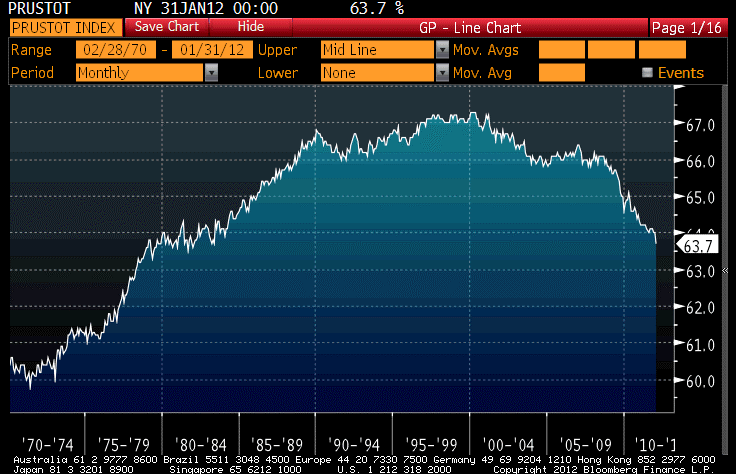
On this point, Julia Coronado at BNP (whose analysis of economic releases is generally among the more clear-eyed reads) made a great summary observation. She said “It is becoming increasingly likely that the path toward lower unemployment rates will mainly be through fewer workers rather than an acceleration in job growth.” Since economic output is workers times hours worked times productivity, this means the path to a full recovery in economic output is either going to be longer hours or an acceleration in productivity. That’s really the path we’re going to be on for a long time hence, now that the baby boom generation is beginning to be of retirement age. And if I may say so, it is a prime argument for allocating more GDP to the private sector, where productivity enhancements are generally developed, and less to the public sector. The government can keep redistributing the pie, but it would be better to grow the pie and government has had an abysmal record at doing so for roughly the last eight thousand years. We could hope for a better result in the future, but to do so would seem audacious.
Another growth sign from Friday were good as well. Non-manufacturing ISM reached an 11-month high at 56.8, far above estimates. All of this news helped push stock prices 1.5% higher, commodities prices 0.8% higher (despite a 1.1% fall in Precious Metals), and 10-year yields 10bps higher to 1.92%. Even TIPS yields rose, finally, by 8bps at the 10-year point.
In other inflation-bond-related news, Japan is reportedly considering a re-start of its inflation-linked debt market. As I illustrated recently, Japan’s inflation rate has been rising since early 2010, and as the tsunami effects finish passing through the system the core rate will likely rise to above zero and end the nation’s deflationary period. The last Japanese inflation-linked bond was issued in June 2008 when year-on-year core CPI was +0.2% but large investor losses in illiquid Japanese inflation markets in late 2008 combined with a plunge of core inflation to -1.6% in early 2010 meant the Ministry of Finance feared there would be scant demand for the bonds, which unlike those in other countries never carried a ‘par floor’ (so, in the case of persistent deflation, you could get back less than you invested in nominal terms).
That structure detail annoyed bond salesmen, but it is the right treatment. Otherwise, investors get a free option on deflation that means their real return will rise in a deflationary environment although it is constant at any positive level of inflation. That turns out to be painful to model, and awkward to trade, as asset-swappers learned to their/our chagrin in 2008. Having said all of that, I expect there will be a strong sentiment to add such a floor to the JGBi when and if the program re-starts.
On Monday, most of the day in the U.S. will be occupied with discussing the Super Bowl. But be aware that St. Louis Fed President Bullard will be speaking in Chicago at 8:55ET on the topic of inflation targeting. Listen carefully for any intimation that the Fed is trying to generate support for a policy of price level targeting as opposed to inflation rate targeting. I wrote way back in December 2010 about the Fed Chairman’s affection for inflation targeting, some of his prior words on the subject, and of the (better) arguments of KC Fed economist George Kahn. It’s worth a review if the topic comes up again. In the current context, whipping up a fresh discussion of price-level targeting would be another excuse to let inflation keep accelerating for a while. Under a price-level target, the Fed just promises to hit the price-level target on some future date, implying an average level of inflation between now and then. So, if for example the Fed wanted to run inflation a little faster right now, it could do so and pretend that this didn’t impair their credibility as long as they eventually hit that target.
I think the FOMC is looking carefully for ways to let inflation run faster without the bond market charging higher rates for that policy. If they can somehow convince investors that the 10-year average inflation will be 2%, even if it happens to be 3-4% over the next, say, 3-4 years, then 10-year nominal rates would stay down and real rates very negative despite an inflationary policy. I doubt they can pull it off, because I don’t think they have much credibility as it is. And, as Kahn pointed out in 2009, “[central banks] have no modern practical experience with such targets.”
The lack of practical experience, however, has never stopped this Fed before. I continue to marvel that investors are willing to be long rates here. You see, it is easy to announce the desire to price-level target. It is harder to actually price-level target.
[1] The BLS recognizes that the nation adds these citizens over the course of the year, but rather than make monthly estimates of labor force growth it adds them all at once in January. This year, the jump is large partly because it reflects the results of the decennial Census, which marks the actual population to the estimated population as of 2010.
No Pushing In The Default Line, Please
Europe continues to smolder, but it is about to burst into outright flame. The ‘private sector initiative’ (PSI) discussions, which were supposed to be completed the Friday before last, continue. The leaks of an imminent deal continue, and eventually I am certain that a deal will be announced because eventually we will be down to just one bondholder still represented by the IIF. It is pretty clear by now – or it should be – that the PSI is no panacea. The only ray of hope to that process is that the approval of a ‘haircut’ (in the same way that Hannibal Lecter gave haircuts) would give the EU a fig leaf to approve a deal to send good money after bad, if it could overlook the failure to implement austerity measures that currently has German Finance Minister Schaeuble in a tizzy.
It would be a colossal mistake to agree to another €130bln bailout, even if the chances of it actually being disbursed would be slim (after all, remember the PSI process is necessary for the disbursement of the past-due tranche of the current bailout). And, honestly, I think the only reason they are continuing the charade is to give themselves more time to ready the Plan B default and/or Euro exit.
However, the market may not give them the time. Today Portugal’s 10-year rate rose nearly 200bps (see Chart, source Bloomberg), likely triggered in part by a headline saying “ECB cuts off bond buying as pressure mounts.” 
It didn’t actually cut off bond buying, but it bought very little last week. It seems fairly clear that the limits of the ECB’s ability to sterilize the transaction are nearby, if they have not already been reached, and no doubt some cooler heads have pointed out that failing to have enough buyers for a 7-day ECB tender would be much worse than allowing bond yields to reach free-market levels. After all, what’s the difference to Portugal of 15% or 17% on 10-year notes? Neither level makes Portugal’s situation even vaguely sustainable.
Now, I still think that U.S. equities rally once Greece formally announces it is defaulting, after a knee-jerk selloff. That’s a harder call now than it was when I first made it October 4th with the S&P at 1124, though, and investors need to be aware that if Greece also leaves the Euro at that time (as is likely) then that creates a chance of the ‘unzipping’ trade I talked about here. However, back in October the VIX was also at 41, and it’s now at 19.4. I think buying medium-term out-of-the-money calls on equities, especially with all central banks working the inflationary bellows, is a viable strategy here (and that’s coming from someone who has spent most of the last decade either out of the market, or short, to good effect).
In the near-term, be aware that Portugal is scheduled to sell 105-day and 168-day bills on Wednesday. The LTRO makes that operation basically risk-free for many banks, so the auctions will go fine (look at the Bloomberg chart below for one of the weirdest yield curves you have seen in your life, except for the fact that it’s becoming normal in much of Europe). And when the auction goes fine, the headlines will trumpet the fact that Portugal raised money around 5% or wherever and is doing just fine, thank you. You shouldn’t believe it, but some investors will use that as an excuse to relax.
Back in the U.S., our economy continues to do reasonably well. Personal Income beat expectations slightly with a +0.5% rise. The core PCE deflator (remember, that’s what the Fed targets) rose from 1.7% year-on-year to 1.8%. This was a surprise, as the consensus forecasts prior to the number were for the number to be unchanged at 1.7%. At 8:32ET or so, Bloomberg re-published the consensus as 1.8%. Wow, those economists are pretty good once they have the number. You can see below the chart (Source: Bloomberg) of the core PCE Y/Y (which is now just another inflation index that the Fed thinks is “contained”), which has just risen to three-year highs.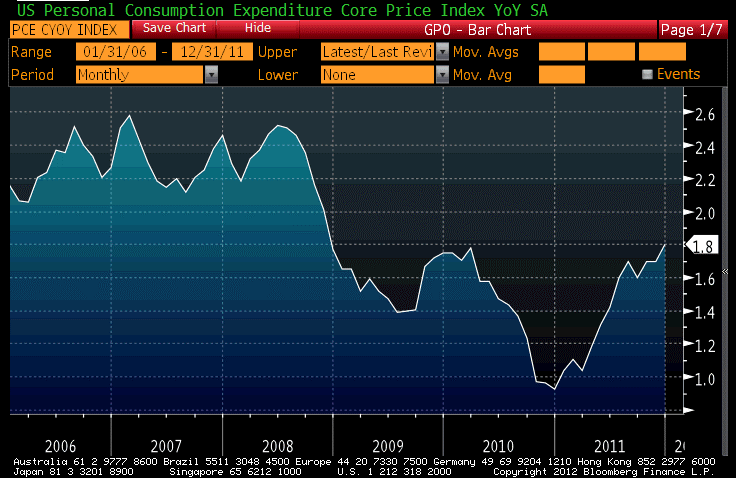
Today was a ‘risk-off’ day (I am so tired of that phrase), and so commodities suffered along with equities with the DJ-UBS down 1.1% with every category (softs, precious, industrials, etc) down. The dollar was up slightly. And yet, TIPS rallied yet again, with the new 10y TIPS down to -0.26%. Nominal rates continue to trade in my face, with the 10y falling to 1.85%, but absent an unzipping I am happy to remain short in an unlevered way (TBF) and to be long inflation through commodities (primarily USCI) and breakevens (via new ETFs INFL and RINF).
Tuesday’s data includes the Employment Cost Index for Q4 (Consensus: +0.4% from +0.3%) along with the Case-Shiller Home Price Index, the Chicago Purchasing Managers’ Report from January (Consensus: 63.0 from 62.2), and January Consumer Confidence (Consensus: 68.0 from 64.5). I expect to see the Chicago PM express some strength but would not be surprised to see the Consumer Confidence figure, which has risen rapidly over the last few months, fall short of expectations. Obviously, European actions are in the immediate picture more important once again.
