Archive
This Is Not A Market Trembling With Fear
Today’s will be a very short comment, and there will be no column for the next couple of days as I will be traveling on a consulting assignment.
Stocks shot higher overnight, catapulted again by the continuing expectation that Fed quantitative easing will be good for equities. Not only do I wonder at the power of this notion, I am also suspicious of the fact that the movement in the market is out-of-line with the change in the “delta” of the chance of QE2. More-simply put, how many times can the market discount the same program of quantitative easing? Does moving the probability from 0.85 to 0.90, as a reading of the FOMC minutes yesterday might do, really impact the value of the market that much?
The credulity is increasingly disturbing. For all the talk about how investors are fleeing the market, never to return, the market certainly doesn’t behave that way. JP Morgan today reported earnings of $1.01/share compared to expectations of $0.88/share, on revenues of $23.82bln versus $24.28bln estimated. This was taken as good news in the market, but higher earnings on lower revenues? How did that happen? Well, JPM also announced that it decreased loan loss reserves by $1.5bln.
Note that the Morgan isn’t saying that losses on loans fell by $1.5bln, but that they reduced reserves for losses by $1.5bln. When a reserve account is increased, it lowers current earnings; when the reserve account is decreased, it increases current earnings. This is one trick that companies, especially financial companies, use to smooth their earnings. In this case, the $1.5bln decrease in loss reserves adds roughly $0.38/share to earnings.
Now, I don’t know whether the consensus earnings estimates included an expectation that JPM would meaningfully slash loan loss reserves, but it certainly would seem odd to expect that when the delinquency rate on loans is still basically at recorded-history highs (see Chart below).
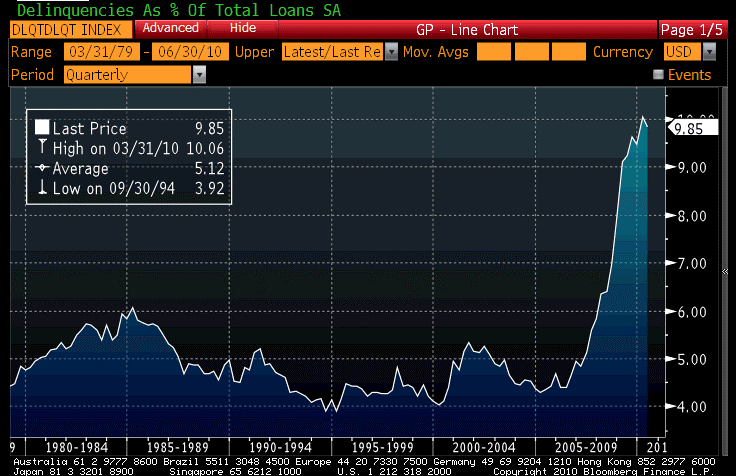
Delinquencies don't seem to be arguing for lower loan loss reserves, do they?
To be fair, JPM as of noon was roughly unchanged (I am writing early because I have to catch a flight later), so perhaps investors in that particular stock “get it.” But the NASDAQ Bank Index was up 1.1%, and the broader market up 0.9%. Money is still flooding in. This is not a market where investors are predisposed to flee.
And that, of course, is what makes me want to flee. The range of potential outcomes for the economy is still very wide and there are many unanswered questions about European sovereigns and domestic fiscal policy, to mention just two concerns. It isn’t clear to me that QE2 solves all of these problems; indeed, as I have written recently it isn’t clear that QE2 can solve many of them at all. I am not going to completely exit the market, but feel it’s time to cede much of the field to the true believers.
The Root Of The Problem
Your view of something often depends on the position from which you view it. I don’t mean this in the Theory-Of-Relativity sense that a moving observer perceives time differently from the stationary observer, although it is true there too of course. I mean it in the more prosaic sense that a tightrope seems higher when you are standing on it than when you are looking at it from below.
As observers of the economy, our initial position – our ‘null hypothesis,’ as I sometimes refer to it – will very much drive our response to economic data; our market position may, if we are not very careful about it, affect our view of the likely future direction of the market.
The Federal Reserve today released the minutes of their most-recent meeting, and it looks to me as if their perspective about the necessity of quantitative easing is more biased than we had previously believed. While the minutes reflected (as they often have, especially over the last two years) a diversity of opinion, the following notation grabbed my attention:
Several members noted that unless the pace of economic recovery strengthened or underlying inflation moved back toward a level consistent with the Committee’s mandate, they would consider it appropriate to take action soon.
Notice the subtle difference between this and what actually was agreed to be released as the FOMC’s statement for that meeting:
Measures of underlying inflation are currently at levels somewhat below those the Committee judges most consistent, over the longer run, with its mandate to promote maximum employment and price stability.
“Longer run” in the second phrase seems to conflict with “soon” in the first phrase, making it appear that the official statement was a compromise with at least several members pushing for action “soon.” But that cadre also sets the bar quite low. They aren’t saying the Fed should ease further if things get worse, but that they should ease if things don’t get better quickly enough.
That’s a very activist slant. While this group appears to be in the minority, we know from the various speeches that it isn’t a minority of one. QE certainly appears more likely every day that we don’t get positive blow-out economic news.
What is the justification for easing on the basis of a too-slow improvement? I imagine much of this concerns a fairly obscure debate about whether economic growth is “unit root” or not.
Stay with me here. This sounds esoteric, but it matters.
It isn’t important to understand the mathematics behind determining whether a time series is generated by a process with a unit root; if you’re interested, you can read the Wikipedia article on ‘unit root.’ For our purposes, what it important to understand is this: if economic output is not unit root but is rather trend-stationary, then over time the economy will tend to return to the trend level of output. If economic output is unit root, then a shock to the economy such as we have experienced will not naturally be followed by a return to the prior level of output. Actually, the Wikipedia chart is pretty helpful at understanding this – see below.

This picture taken from the Wikipedia article on "unit root" (see above for link)
So, the red line is what we have experienced the last few years (stylistically, not literally). If growth is “unit root” then the trend basically picks up from where output is in the immediate aftermath of the shock; if growth is trend-stationary then the recovery should see a period of faster-than-trend growth to get output back to the prior trend level.
Note that in both cases, we are assuming no specific contribution from monetary policy. If you believe that growth is trend-stationary, then monetary policy merely serves to get growth back to trend more quickly, thereby minimizing the welfare loss from the output gap (schematically, the area between the dotted line and the “actual” red/blue line). Thereafter, monetary policy takes the pedal off the metal and lets growth converge with trend. If, on the other hand, you believe that growth is unit root, then monetary policy is either trying to arrest the decline in the red line to put the economy back on the green line, or it is (dangerously) trying to accelerate growth back to a “trend” that is not really a trend. I expect this is the substance of Hoenig’s objection – if we’re back near the green line, and output is unit root, then goosing the economy more “will lead to future imbalances that undermine stable long-run growth” (the phrase from the FOMC statement where Hoenig’s dissent was noted).
Clearly, most of the Committee doesn’t believe that output is unit root, because if it did then it would tend to be more suspicious of the ability of Fed policy to reduce that welfare loss. It is true that it is difficult to reject the unit root hypothesis for many economic time series – the ratio of noise to signal in economic data means it tends to be pretty hard to reject many hypotheses that are in the ballpark of being reasonable. But it matters.
Problems like this, where the downside to being incorrect are possibly quite large compared to the upside to being right, argue against dramatic Fed action. However, the sense of heroism inculcated in us at a young age by Superman’s exploits argue in favor of heroic measures. Most of us, though, aren’t actually bulletproof.
I will make one final observation about this that throws another wrench in the works. What if we don’t know where the dotted line in the picture above actually lies? Long-term economic growth has changed over time as the economy has matured, as population growth changed, and for other reasons. Suppose the unobservable dotted line actually intersects the right-end of the red line? In that case, the current debate takes a totally different patina. If trend growth has actually slowed down in the last decade, then arguably the economic and financial crisis may just have been returning us down to the real trend. In that case, further aggressive Fed action would be essentially trying to restore those dangerous imbalances. This, too, could be part of Hoenig’s argument. And this possibility, too, argues for conservative policy actions.
In economics, unfortunately, we don’t have a map we can look at where a bright red dot indicates You Are Here. But wherever we are, it seems that an increasingly influential minority at the Fed wants to be somewhere else. They are likely to get their wish.
The markets responded to all of this today in sleepy fashion, with one exception. The VIX plunged, dropping not only below 20 for the first time since April but also dropping below 19. The degree of confidence being expressed by the stock market here, heading into earnings season followed by a difficult holiday sales season, is chilling. It is hard to let go of suddenly-performing equities, but I am making sales here of some of my lower-yielding and less-conservative equity holdings.
Other than some import price data tomorrow, there is little on the calendar. Chairman Bernanke is giving a speech on business innovation, but be alert for Q&A.
Hunkering Down
This was a depressing way to start the Columbus Day weekend.
The Employment Report made for dismal reading. It tells a story about job-seekers hunkering down and hints at the beginning of the fiscal contraction to come.
Private payrolls rose 64k, not far from the 75k consensus. This relatively positive news was blunted by the net -15k revisions to the prior two months and the announcement that the March-09 to March-10 benchmark revisions resulted in a downward adjustment to payrolls of -366k (data from March 2010 is not strictly relevant today, of course, but it is downbeat news nonetheless).
Moreover, while we have been ignoring government jobs lost because most of those were Census jobs (which is the reason we are focusing on private payrolls), it would be imprudent to do so with today’s report. Government shed 159k jobs in September, but only 77k of those were Census workers. In other words state, local, and federal authorities (ex-Census) dropped 82k jobs last month. This was a forehead-slapping moment for me. Of course we ought to have expected this; we know that state and local governments are anticipating the loss of federal deficit-plugging contributions for this fiscal year, and it should be no surprise that they are shedding jobs as they feel the pinch.
We exclude Census workers because those jobs were always going to be temporary, so we ignored them when they were adding to Employment and we ignore them now that they are subtracting from Employment. But those other government jobs are real jobs. The real measure of jobs market health this month should be taken by comparing the sum of these government jobs and the private payrolls to the estimate for private payrolls. By that measure, employment contracted (64k-82k=-18k) against expectations for a 75k increase in payrolls. That’s not an encouraging number.
The Unemployment Rate continued to behave in a strange way, due to odd quirks in the Household survey; the ‘Rate actually declined to 9.579%, which still rounds to 9.6% of course but actually suggests strengthening. There is a reason that we round off the Unemployment Rate to 1 decimal place…it’s not as precise as the three-digit estimate!
Average Hourly Earnings were +0.0%, which ought to have taken a little steam out of TIPS because it weakens the wage-inflation threat. As it happens, it looks like there are still some shorts being run out of the TIPS market and yields fell again while inflation breakevens rose. Curious.
Let’s look at two other measures of labor force utilization. The U-6 measure, which includes part-time and marginally-attached workers and has gotten a lot of attention over the last year since we have lots of both, rose to 17.1% – actually higher than a year ago (see Chart).

U-6 Unemployment Rate
Another way to take the temperature of the job market is to look at employee behaviors to indicate confidence in the underlying picture. One way to do that is to look at what proportion of the unemployed have become so voluntarily. Clearly, workers are hunkering down: “Job Leavers” as a percentage of the unemployed fell to an all-time low of only 5.4% (see Chart).

Workers have never been more reticent to quit.
There is little doubt about it: this Payrolls report was weak, and conveys a message of a battered populace that is hunkering down, clinging to what jobs there are, and digging in with their fingernails. This is not a good backdrop for consumer spending, or any other spending for that matter. The indefatigable confidence of the American consumer is fatigued. The stink of defeat surrounds the kitchen table where spending decisions are being made. This data supports the Consumer Confidence and ABC Confidence figures, both which float not much above the lows. It flies in the face of the NBER determination that the recession is ended, and is bad news for political incumbents as well. Most unemployed people, and a fair number of those who fear they may be unemployed soon, are likely to vote for a change. Today’s data, in short, also supports the polling data.
As expected, stocks enjoyed the rotten news, as did bonds, TIPS, and commodities (especially grains – wheat up 9%, Beans up 6.5%, Corn up 6%). The VIX dropped to the lowest level seen since early May; part of that is the passage of a key economic report and the fact that a 3-day weekend is upon us and part of it reflects investor confidence that the Fed now essentially has a Bernanke Put in place.
They may not be wrong, at that. But we are in earnings season, and I expect that whether earnings disappoint or not we are more likely to get downward guidance given the trajectory of these last few months. That is clearly not incorporated into expectations and market pricing. I am not short, but it is getting harder and harder to get long anything.
The market is closed on Monday and the only data on Tuesday is the release of the Sep 21 FOMC meeting. It is equity earnings, and to some extent Fed speeches and mid-term election polls, that will bully markets in the near-term.
The Storm Before The Quiet
Yesterday’s flailings in the inflation markets were not repeated today. Breakevens and inflation swaps settled back a few basis points in a comparatively quiet retracement. Bonds rallied a couple of basis points (except for the very long end, which weakened) and stocks were roughly unchanged. With the Employment report due tomorrow, such quiescence isn’t abnormal, but coming a day after the TIPS market was shot out of a cannon the abrupt transition to peace from war was jarring.
The Fed speakers today sounded a dissonant note to the recent chorus of QE2-supportive commentary from other officials. It was no surprise that Kansas City Fed President Hoenig opposes further easing; he has been the hawkish dissenter for some time. At the last meeting, he dissented to the plan to roll proceeds from maturing/prepaying securities and buy more securities so that monetary policy would not become restrictive. Today, he said he is “horrified” at talk that the Fed might consider raising the inflation target in order to provoke lower real interest rates. Prepare to be horrified some more, sir! Hoenig went so far as to suggest that the Fed needs to promise it will move rates “off zero” in the future. Promising future tightening seems an odd approach, and completely at odds with the main body of the FOMC. We can safely assume that when it is Hoenig’s time to speak, the other members of the committee will take the opportunity for a restroom break or to replenish the ice in their glasses.
Dallas Fed President Fisher commands somewhat more respect, and his comments today serve to add a small dollop of risk to the possibility that QE2 will be announced in November. He claims that “markets have drawn too quick a conclusion,” and that easing further is “not a done deal.” I am not so sure about that, although I am sure that Fisher would like to think that his trip to Washington isn’t merely to rubber-stamp a decision that appears to have mostly been made by now.
Way back in August, when economic data was in the middle of a run of weakness, I suggested that the Fed would likely conduct the next leg of quantitative easing in November or December, and only if it became clear that Congress was not going to do much to avert the huge fiscal drag that will hit in the new year. The data, fortunately, leveled off from what appeared to be the beginnings of another dive, but that was never the strongest argument for QE. The strongest argument was, and is, related to the visible fiscal drag that is just ahead and the political reality that Congress is unlikely to be able or willing to counter that drag. If you oppose further QE, you must believe one of the following: (a) Congress will be able to avert the fiscal drag, (b) a huge jump in taxes will not affect growth, or (c) QE will not do anything for growth and the Fed can avoid being blamed for doing nothing. I don’t believe (a) or (b). While I think there is a good argument to be made for the first clause of (c), the reality is that if the Fed does nothing – whether or not they have a good reason for, um, not doing it – they will be drawing a bright red bull’s-eye on the building at the corner of 20th and Constitution.
Now, if the Democrats hold onto Congress, it is probably the worst thing that can happen to their party and the best outcome for the Fed. Then, the bright red bull’s-eye will be moved back to Congress. If the party which holds the Legislative and Executive branches extends the Bush tax rates, they’ll be assailed as blowing up the deficit; if they do nothing, they’ll be accused of not caring. In that case, the Fed would be well-advised to hold off on QE until and unless there are signs of deflation, of which there aren’t any right now. If the Republicans win, however, they can plausibly do nothing (or a half-measure) since, after all, they are winning on a platform of fiscal conservatism – whether or not you actually believe they will be fiscally conservative! Knowing the Republicans, they will then proceed to squander that advantage.
But all of that is next month.
The consensus for the last Employment report prior to the election and the FOMC is for a gain of 75k private jobs net of Census workers. Last month, +67k led to a big selloff in bonds, but despite weak signs from ADP economists are calling for an improvement, albeit a small one, in the labor market.
Such a gain in payrolls would not be sufficient to maintain the Unemployment Rate at its current level, so economists are expecting a rise to 9.7%. This isn’t a very big jump, actually; last month’s unrounded ‘Rate was 9.642% so the real surprise is if the ‘Rate stays at 9.6% with that level of jobs. It would not take much to print a 9.8%. (Such a number may actually be bullish for equities since many people would assume it cinches QE2. As regular readers know, I think QE2 is a silly reason to buy stocks, which typically do poorly when inflation accelerates, but conventional wisdom holds otherwise.)
Average Hourly Earnings isn’t usually a market-mover, but last month AHE surprised by rising 0.3% against expectations for 0.1%. The consensus for tomorrow is 0.2%, but another upside surprise would raise another objection to QE2 from people who believe that wage-led inflation is more just a scary story that economists tell their children. I am not one of those people, so I am all for higher wages, but if we get another 0.3% then brace yourself for the march of hawkish economists.
As I said before, I don’t think any of this economic data is likely to have an impact on the Fed’s decision next month unless there are some real outliers, but the market may not be so sanguine. Ironically, evidence of stronger growth may be a negative for equity and bond markets if in investors’ eyes it reduces the likelihood of the Fed pumping more liquidity into the economy. But I don’t think anyone is very sure, and I suspect we will have an hour of whippy trading and then liquidity will start to thin before the three-day weekend.
Norway Or The Highway
Who says that inflation instruments are boring? Today TIPS and inflation swaps went on a wild ride, with yields more than 20bps lower early in the day before a selloff in nominal markets finally served to pull inflation-linked ones back down to earth (comparatively). This often happens in inflation markets; the big players (on the client side) have a larger share of the total volume than in the nominal Treasury markets, so when a few investors start to move at the same time the moves can be dramatic. Right now, with real yields negative over a significant part of the curve, many investors are short (or short their benchmarks), believing the inflation-linked bond (ILB) world doesn’t offer value.
This is arguably correct, but as I showed yesterday the risk-lessening advantage of explicitly indexed bonds is substantial enough that it is hard to find an alternative that adds enough reward to compensate for the risk…at least, that’s true these days when most asset classes are threateningly priced. Personally, I am considering selling some of my longer-dated TIPS, acquired at yields near 4% in early 2009, and buying short TIPS with significantly negative real yields but less exposure to a spike higher in real rates. I haven’t decided yet whether to do so, because transactions costs for retail investors in TIPS are sufficient to discourage moves that are not made with full conviction.
(As an aside, I am not worried much about the negative real yields; sure, July-13 TIPS are at -0.67% but with 3y Treasuries at +0.57%, I am still better off if inflation is as low as 1.25% per year for three years. Since oil and grains prices have both been on the rise lately and my model for core inflation just for 2011 is around 1.6%, this seems a decent bet…and I get the “tail” if inflation gets out of hand in 2012).
The 5y TIPS yield ended “only” 11bps lower, but short inflation swaps rose around 25bps. I say “around” because dealer and broker marks in this kind of move are best viewed with some kind of skepticism. But on the chart I showed yesterday, with the 1y inflation swaps spot, 1y and 2y forward, the latest points are around 1.14%, 1.46%, and 1.96%, which means that since Friday the spot 1y is up 25bps, the 1y, 1y forward is up 17bps, and the 1y, 2y forward is up 24bps.

And, while the inflation market didn’t react yesterday to the increasing drumbeat of QE2 in the U.S., I wonder if it is a coincidence that the reaction came after the Norwegian central bank essentially cut the interest paid on excess reserves. Thanks BN for pointing this out – the article on Reuters is here. Although the terminology is a little different than what the Fed uses, and their policy rates are not yet constrained by the zero bound, the statement made clear that they understand the importance of the interest paid on excess reserves. “This will enhance,” they said, “the redistribution of liquidity in the interbank market.”[emphasis mine] That is exactly the argument I have been making about IOER: if you want the QE2 (and QE1!) liquidity to be distributed into the economy more broadly, to increase M2 and the more-important aggregates, then you need to stop paying the banks to keep the money out of circulation. It is that simple. At least in Norway, they seem to think that it is important that the liquidity moves into the broader economy! This is encouraging, because central bankers do after all attend the same conferences and they do talk.
The economic news today, represented by a somewhat weak ADP figure (-39k versus expectations for +20k, albeit with a 20k upward revision to last month), highlights the fact that will probably be reinforced on Friday: it is, in fact, important that the liquidity moves into the broader economy!
However, I think it’s also important that we keep in mind what quantitative easing can and cannot accomplish.
Recall that MV≡PQ is the monetarist identity. In words, it says that the amount of money in the economy, times the frequency per year that each dollar is spent, equals the price level times the real output. Or, in even simpler terms, the total amount of money spent each year equals the amount of stuff people bought times the price they paid for the stuff. You can see why this is considered to be an identity. It simply must be true. And it follows that %ΔM+%ΔV=%ΔP+%ΔQ … the growth rate of money, plus the growth rate of velocity, equals the sum of the growth rate of prices (that is, inflation) and the real growth rate of the economy.
This is why I don’t worry about deflation. If we assume that velocity is reasonably stable, then an increase in the rate of money growth must result in an increase in prices or an increase in economic growth, or both. If you print enough money, then unless the velocity of money perversely contracts at exactly the same rate you’re expanding the money supply, you will get an increase in nominal output.
But this is both the strength and the limitation of quantitative easing. When the money supply is goosed, the central bank cannot control whether it results in increasing prices or increasing output. And there are good reasons to think it will be primarily the former. When the amount of money in the economy increases, it is easy to see how that results in inflation. Pure supply and demand logic dictates that as the amount of money increases relative to the amount of stuff to buy, the exchange rate of money to stuff increases. That is, prices rise. Why would output rise? Well, with more money in the system, and therefore in each consumer’s pocket, consumers may feel wealthier and therefore spend more, triggering growth.
But this additional wealth is, of course, illusory. If I personally own 1/200 millionth of the money in circulation, and the value of all accounts is doubled, all my dollar bills exchanged for two-dollar bills, all my $5 become $10, my $10 become $20, and so on, then I still have 1/200 millionth of the money in circulation. I have twice as much money, but each dollar buys me half as much of the economy’s output as it did before. If I spend a higher proportion of my income now because I feel wealthier – if I continue to save $1,000 every month rather than doubling that amount – then I am being tricked into consuming. We call this “money illusion,” and there has been vigorous debate about the existence and potency of this illusion for a very long time. But note that if there is no money illusion, and the money is distributed equally, then my behaviors shouldn’t change in real terms – I’ll just double the amount I spend on everything, and since the same amount of stuff is available but twice as much money is being spent on it, the price of stuff will simply double. No deflation, but then again no real growth.
Well, I don’t know how powerful the money illusion is. At low levels of money growth it may be important, but I suspect that as the level of printing increases the illusion weakens.
So here we go: QE2, if it is combined with an elimination of interest-on-excess-reserves, will probably cause at least some inflation. It is a good instrument with which to avert deflation, but it is a blunt instrument with which to cause growth. Since core inflation (ex-housing) has been around 2-3% over the last year and food and energy are both rising as well, it isn’t clear to me that QE2 is needed to avert deflation. Moreover, it isn’t clear to me that it will do much to spur growth, although Evans yesterday and several other speakers recently seem to be leaning on the argument that the Fed needs to “do more” to bring down unemployment.
The question for an investor, though, isn’t whether QE2 should happen, but whether it will happen, and it is sounding more and more like it will. The political reality is that Congress and the Administration are out of bullets and that “someone” needs to do “something.” The only someone and something left is the Fed and QE2, so that’s what will get done.
Tomorrow, in the last pre-Employment data gasp, Initial Claims (Consensus: 455k vs 453k last) will be released at 8:30ET. Dallas Fed President Fisher speaks at 1:20ET in Minneapolis. Fisher is well-known to believe that gold is an important inflation indicator, so if he comes down on the side of QE2 then you can pretty much mark it down as done. Speaking at 1:30ET, in Nebraska, is Kansas City Fed President Hoenig, but the meeting is closed and it isn’t clear how much information we will get about that speech.
Watch inflation indicators: TIPS, commodities, and the dollar. These markets are starting to get rather exciting.
The Fed Huffs And It Puffs And…
The world’s central bankers seem to be aware, suddenly, that the global economy isn’t doing great. Where they’ve been for the last year is hard to tell, but abruptly they seem to be getting religion on the topic of sluggish economic growth. It is ironic that this happens right after the NBER declared the end of the recession, but better late than never I suppose.
This comes as signs of an imminent second dip (if you want to call it that), that were epidemic early in August, have faded. If I were inclined to be generous, I might suppose that the recent acceleration in talk about further monetary stimulus is related to the fact that it has only recently become apparent that not only is no fiscal stimulus is riding to the rescue any time soon, there is also a chilling wind of fiscal restraint starting to blow.
The tenor of comments has recently begun to tilt decidedly in favor of further monetary action, to the point where it almost seems as if the intervening data over the next month or two won’t matter unless it is really, really strong. Last night, minutes after I posted my commentary, the Nikkei reported that the Bank of Japan is considering buying securities backed by small business lending, and increase purchases of government bonds. I have said before that Japan’s experience with persistent deflation is more to a lack of will than to a lack of a solution (see my comment here). Maybe they’ve decided to step up the dosage.
At the same time, we are getting increasingly convergent comments from Fed speakers. Today Chicago Fed President Evans, in an interview with the Wall Street Journal (link) said that unemployment is not falling “as quickly as it should” and the Fed should deploy “much more” monetary accommodation. Evans’ argument, by now becoming familiar, is that the Fed needs to push inflation expectations higher so that real rates can be lower than zero while nominal rates are bounded by zero. (The Fisher equation says nominal rates ≈ real rates + expected inflation, so if nominal rates are at zero the only way for real rates to become more negative is to raise expected inflation.) Now, ideally the Fed could push inflation expectations higher without actually pushing inflation higher, but because the Fed is transparent and investors (and consumers) can read, they stand no chance of fooling the market by simply talking up expectations. They need to take concrete steps to force inflation higher; this will also raise inflation expectations.
Ordinarily, the Fed would have difficulty doing this because pushing inflation higher is normally against one of the Fed’s mandates-in-twain. When the Fed pushes, growth goes higher but inflation goes higher; when the Fed pulls, growth and inflation go lower. But in this case, with inflation lower than the level the Fed considers is consistent with “stable prices,” they can pursue an accommodative policy single-mindedly without worrying that one of their mandates is being sacrificed to the other. (To be sure, this is mostly semantics. The FOMC would love to overshoot the 1.5%-2.0% target right now, but if inflation gets away a little bit it must appear to be accidental).
Unfortunately, buying more securities in QE2 is unlikely to push prices much higher as the program is currently constructed, because the continuation of payment of interest on excess reserves (IOER) will cause the reserves to mostly stay on the balance sheets of banks and Fed speakers have barely mentioned IOER. At the margin, some money will flow into the economy, but this delta is indeterminate and surely a small fraction of the amount of the purchases.
Still, the inflation risks are clearly to the upside, especially since (aside from housing) prices are already rising at a 2-3% pace, and forewarned is forearmed. Inflation markets themselves do not yet fully believe it, but the trend is improving. The chart below (Source: Enduring Investments) shows the front of the inflation swaps curve, where we would expect QE to be most effective. The inflation swap curve has been steadily upward sloping, so over the last year the lowest projected inflation has been for the ensuing year, with slightly higher inflation in year 2 and inflation higher still (but still low!) in year 3).

Inflation expectations are rising, but not exactly spiking.
You can see that the recent talk about QE2 has lent a weak bid to the inflation market, but even 2-3 years out – the top line covers inflation from October 2012-October 2013 and is only a smidge above 1.5%. While longer-dated inflation has risen a bit (10y CPI swaps are 30bps above their lows), this is evidently not coming as much from the front end as I would expect, and that means it isn’t a pure response to the reasonably quick-hitting nature of QE2. Perhaps investors are seeking to add inflation duration while they still can do so at reasonable prices.
Now, if you’re a retail investor you can’t invest in inflation swaps and so add pure inflation duration. At this time, the universe of financial products – especially retail financial products – that can be plausibly claimed to be inflation-linked is scandalously small. After a number of TIPS mutual funds (around 40 by my count), most of the other products can best be described, and generously at that, as somewhat inflation-related. Included in this latter list are physical commodity ETFs, commodity indices, residential real estate, commercial real estate, REITs, Timber, and infrastructure, as well as some products in the mutual fund space that are generally mostly equities: HAP, GDX, MOO, and so on.
Here is why it matters. Let’s suppose that you want to invest in a floating-rate note tied to LIBOR, on the theory that short rates are highly correlated with inflation (as they are, in fact) and so should provide some inflation protection. The chart below shows the results of a little simulation I did to illustrate this point. I simulated a path for inflation and a path for LIBOR consistent with a correlation of 0.8 between LIBOR and CPI and several other assumptions that aren’t strictly important for understanding the result. For each of 250 simulations, I calculated the IRR of a 10-year floating-rate bond that pays L+100 and the IRR of a 10-year TIPS-style bond that has a 1.5% real coupon. The chart below shows the scatterplot of inflation-linked bond returns (ILB IRR) versus LIBOR-based bond returns (LIBOR Bond IRR), along with the R2 of 0.6 which confirms that the resultant correlation is approximately 0.8 (the square root of 0.6 being about 0.77). This would seem to suggest that a LIBOR-based bond is a reasonable substitute for an inflation-linked bond if the correlation between short rates and inflation is reasonably high.

However, this would not be entirely correct! The nominal return is not, strictly speaking, what I care about as an investor. I want to maximize my real return, not my nominal return. And performing the same exercise with real IRRs gives a very different picture. In real space, the volatility of the real return of a held-to-maturity TIPS-style bond is approximately zero, as you earn the stated yield (in this case, the 1.5% coupon on the original par) regardless of the inflation outcome. But the ex-post real return of the LIBOR-based bond is still quite variable as long as the correlation between inflation and LIBOR is not 1.0.

The implication is that investments which merely proxy for inflation and do not explicitly return CPI like inflation-linked bonds and swaps do will provide significantly more real volatility than do inflation-linked bonds and, consequently, must offer significantly more prospective yield to be viable alternatives.
This doesn’t mean that TIPS at -0.5% real yield are a great investment, but it means we need to be cognizant that the extra risk we are adding when we go to an investment that isn’t explicitly indexed is a lot higher than we might think, if we just look at nominal correlations.
And this takes us to equities, commodities, and all of the other supposedly inflation-related markets that blasted off today (along with TIPS) given the appearance of central bank synchronicity around the issue of quantitative easing. Stocks ripped 2.1% higher, on improved volume for a change. Crude oil, corn, sugar, gold, silver, coffee, beans, and wheat were all up more than 1.5%. The dollar was weaker, even against the yen. This latter point makes little sense: inflation which is idiosyncratically ours, or profligate monetary policy executed by our central bank compared to other central banks, ought to weaken the dollar. But concerted profligacy or broad global inflation shouldn’t affect the unit, should it? The dollar, especially, looks like a knee-jerk response, and other markets are probably also overreacting.
.
In other news, following up on Friday’s comment: the Treasury today reported that while they made a cool $1bln on the Citi sale, they expect to lose money on the housing programs and auto rescues within TARP but expect net TARP losses to be about $50bln. The table below, from page two of the Treasury’s report gives the breakdown.
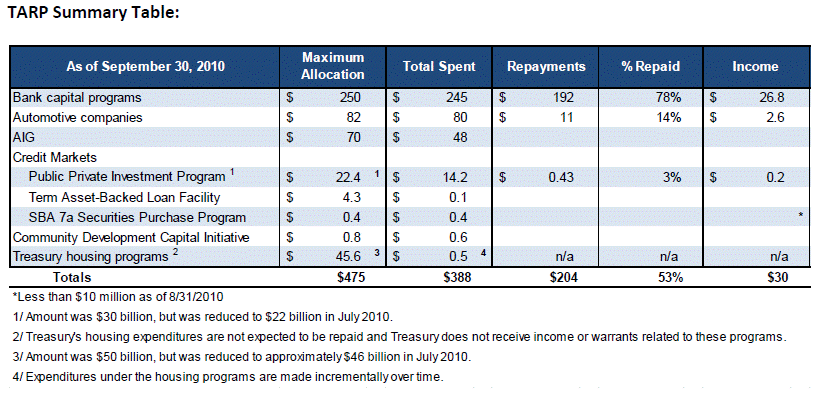
Now, the Treasury also goes on to say that they expect “substantial losses” on Fannie Mae and Freddie Mac, although those stem from decisions made before the conservatorship rather than after. The report attempts to offset this against the “substantial gains” made by the Fed from their purchase of $200bln mortgage securities; of course, those gains (how much is of course highly variable and dependent on continued low rates and a downside surprise in default experience) are only gains if the securities are marked at the current market price rather than their expected sale price! But the bottom, bottom line remains: the government will have bled away hundreds of billions of dollars to keep the unemployment rate down around 10%.
In economic news, the Non-Manufacturing ISM today came out roughly on expectations. The Prices subcomponent was roughly unchanged from the prior month, around 60, in contrast to the sharp rise in the ISM Prices subindex. So, the jump in the latter is either something particular to manufacturing, or it is largely spurious. I expect the latter.
And finally, lest you think that you have problems: Jerome Kerviel, the “trader” who circumvented internal controls at Soc Gen to run huge (and money-losing) positions, was ordered by a French court to repay the bank €4.9 billion. It will be hard for him to earn the money during the next three years, as he will be in prison. I’ll bet Kerviel is thankful for low rates, since even at a 1% interest rate he would be on the hook for €49mm in interest every year.
Tomorrow, the ADP Employment Index (Consensus: 20k vs -10k) is expected to show a tiny uptick in jobs. Because of the Census additions and now subtractions, this report has gotten less and less airtime but it is worth keeping an eye on – the market will react to outliers.
This Ain’t Pismo Beach!
Stocks edged back -0.8% today, on (do we even need to say it?) light volume. Some observers feel the pullback evinces concern about the earnings season, which semi-officially gets underway Thursday when Alcoa reports, but if there is concern it isn’t a deep and abiding concern: the market bounced off the June and August range highs and the breakout…although it is a pretty weak breakout so far…remains inviolate.
It isn’t that surprising to see investors taking some gains when the market has rallied into earnings season and the Employment report also looms. The pullback isn’t much to be concerned about, yet; the 10y note at 2.48% is also near its 2010 highs (low yields) and remains in a gentle but unmistakable uptrend. I am more likely to be bearish on equities than to fade bonds at this point in the year, but I need some catalyst to take action in either case.
NY Fed Markets Group boss Brian Sack didn’t give any reason to be bearish on assets in the near-term during his talk today. Of course, Mr. Sack is not going to be the mouthpiece that signals quantitative easing, but he did convey the message that the Fed views the recovery as “relatively tepid” and believes that “further expansion [of the securities portfolio] would likely provide additional accommodation” for the economy. This is far from assured, and anyway the bang for the first $1.7 trillion bucks was, if I may say so, “relatively tepid.” I think adding more liquidity by buying bonds makes little sense if the Fed doesn’t also lower the interest on excess reserves, but more and more this seems to be beating a dead horse (which may be fun, but is not effective – gosh, maybe it’s the Fed who is getting ready to beat a dead horse with QE2?).
Wall Street observers are gradually coming to the view that QE2 will be announced at the November meeting. I still don’t think so, but so far the Fed has done little to discourage that view. In the context of the “new” openness at the Fed, the failure to guide the market away from the wrong idea may be considered tacit approval of that idea. The Fed isn’t meeting today, and doesn’t need to decide today, but within a couple of weeks if QE2 isn’t on the way they’ll probably want to signal that.
Whether they will need to will, of course, depend on the data. If the Employment report and other data bespeak a rosy-cheeked recovery, the Street will change its mind without help. But if the reports come in as-expected (that is, weak) then the expectations of QE2 will continue to gain currency – ironically, since it can be expected to hurt our currency. Tomorrow’s release of the September Non-Manufacturing ISM (Consensus: 52.0 from 51.5), though, is not a big mover of policymaker opinion, and thus is unlikely to be a big mover of markets.
.
I mentioned last week that I attended an inflation conference and I planned to give some impressions and thoughts that the conference provoked.
The first thing I will observe is that I have been going to these conferences for a while. The first ones tended to be all about TIPS: who is buying them, how they work, why the Treasury should keep selling them, how they work, why other countries should follow suit, how they work, etcetera. To be honest, it grew fairly monotonous, which is one reason that the flow of inflation conferences has been reduced to a trickle in the last year or two.
By the same token, less-frequent conferences allow us to see the market change in sharper relief. I can observe that market participants on the dealer side seem to have much more of a clue than they did just a few years ago. Dealers are still making a few mistakes, but the bad mistakes seem to be fewer in number and there are many more dealers who are capable. The difference between the top dealer and the bottom dealer, in short, has shrunk.
Clients, too, have generally gotten more sophisticated. No one needs to be told how TIPS work these days. And in some cases they have passed their dealers, or at least can see through the hype. At one presentation, the (dealer) presenter was arguing that TIPS these days don’t offer as much diversification as they used to; that investors in TIPS have gotten more volatility than they would have by being invested in Treasuries, but not significantly more return, and with a high correlation to nominal rates. Someone in the audience nailed him by asking “what is your risk-free investment? Cash?” When the presenter said yes, the questioner observed that investors don’t care about maximizing (nominal) return subject to (nominal) risk, but rather real return subject to real risk. This is something that few people understood as recently as five years ago. Institutional investors, furthermore, care about the increase in the real surplus (assets minus liabilities) subject to the variance in the surplus. This is much more sophisticated than the questions of 2005.
One other observation, though, that follows. There is an increasing stratification of comprehension of these markets. That is, the folks who have been doing this a while are pushing the boundaries further along and are more sophisticated, but the people who merely dabble in inflation markets are further behind as a result. (This is one reason that I have been offering consulting on inflation markets). These latter investors are much more likely to lose when they face a sophisticated counterparty than they would have been five years ago, when both sides of the trade were almost equally-likely to be missing something.
There was a very entertaining keynote speech from Dennis Gartman, of the famous Gartman Letter. Mr. Gartman gave a very long-wave view of price pressures in developed versus developing economies. He made one little error, which is the type of error that is often made by people dabbling in inflation. He said that in coming decades wages will deflate in the U.S. and inflate in China and in India. I believe that is very likely to be incorrect. Relative wages will converge, to be sure, but wages in the U.S. are quite unlikely to fall outright. Far more likely is that wages in the U.S. will inflate at a slower pace
But the whole question of international wage convergence is by its very nature a complex subject. If a Chinese worker makes 1/20th what an American worker does, but the same basket of goods costs 1/40th as much, then in real terms he is making twice what the domestic worker is. Of course, this isn’t the case at the moment, but my point is that the wages of the workforce need to be looked at in real terms in the local markets, not in converted-to-dollars-at-the-official-exchange-rate terms. And to do that, we need consistent inflation baskets. But is the relevant basket the basket of goods consumed in China, or the basket of goods consumed in the U.S.? They will be very different, even if the standards of living converge. Still, I think we all know that the GDP/worker will continue to grow faster in emerging economies than in the developed ones, and if the proportion of GDP allocated to wages is constant and the size of the workforce is constant this implies real wages should be rising faster in emerging markets. Note, however, that the second “if” is a bigger if. The size of the workforce in truly developing countries also tends to grow as improving living standards tends to allow more women to enter the workforce.
This all gives me a headache, whereupon I move to an unrelated observation.
There was talk in several of the presentations about the notion of inflation targeting. David Greenlaw of Morgan Stanley made a good point that Chairman Bernanke literally wrote the book on inflation targeting (see the book here) and the recent retirement of Donald Kohn as Fed Vice-Chairman may free Dr. Bernanke to pursue more aggressively an explicit inflation target.
Personally, I think that setting an inflation target, or a price level target that some have proposed as a superior alternative, is a great idea if you can hit the target. There is, unfortunately, much greater confidence among academics of the ability of the Fed to hit the target than there is evidence to suggest they can get anywhere near it. The forecasting record of the Federal Reserve is abysmal, even worse than that of private economists (who aren’t very good themselves). If we don’t know where they are going, they can always plausibly claim to have arrived; however, if they claim to be going to Pismo Beach but show up in a cave instead then we will know they have turned left instead of right at Albuquerque. I suspect that we are not right now, economically speaking, where they wanted to be…but I can only suspect that they missed the mark.
Now, the very announcement of an inflation target will probably hurt TIPS, even if the targeted level is above the current level of breakeven inflation. This is because the breakeven incorporates more than the mere expectation of the inflation level; it incorporates what is essentially an option value since the higher inflation goes, the more TIPS are worth (relative to their nominal cousins) but in a deflation they are worth essentially the same (since they both pay off par in that case). Consequently, if the Fed makes explicit that they intend to truncate the tail of this implicit option, the fair value of the breakeven will decline and this will probably be reflected in a rise in TIPS yields.
There are lots of reasons at the moment to be wary of TIPS yields, to be sure, with real yields negative out to 5 years. I would say, though, that there is no reason to be more wary of them than of nominal Treasuries. While I wouldn’t necessarily allocate from, say, commodity indices into TIPS, to the extent that I plan to hold Treasury paper anyway I would prefer to own TIPS. This is unlikely to change until nominal yields go substantially higher…that is, no time soon!
How To Make $1bln And Not Pay Taxes
I did not write a comment yesterday because I was attending a conference for inflation-linked markets geeks, co-sponsored by Credit Suisse, BNP, Deutsche Bank, Morgan Stanley, Nomura, and UBS. It was very well-done, one of the better inflation conferences I have been to in a while, and it was nice to catch up with former colleagues and counterparties. I will have a little more to say about the conference later, but in case you missed me…
Speaking of inflation, today we got an interesting reading on one indicator that I rarely pay much attention to. The ISM Prices Paid subindex, which jumped this month to 70.5 from 59.0, is ordinarily just a lagged expression of the price of oil (or gasoline) relative to recent averages. The first chart below shows a 10-year time-series of the response to the “prices paid” subindex of the ISM (formerly NAPM) survey.

There is clearly some relationship between oil and Prices Paid!
Not surprisingly, most manufacturing purchasing managers react to changes in energy prices with great speed. The strength of the relationship is illustrated further in the next chart, showing a scatterplot of Prices Paid as a function of the deviation of oil from its recent average level.

Latest point is definitely high.
The latest point is not without precedent, but it is somewhat unusual to be sure. Oil has basically been doing nothing important for the last year, and yet purchasing managers are suddenly saying that the prices they are paying have been rising.
There are several possible explanations for this. The simplest is that this may simply be spurious, and not indicative of anything important. Or it could be that commodity inputs other than energy have been rising…however, it is hard to find another commodity input that is as important to manufacturing and might cause such a spike.
Could this be the result of increases in rents, which some surveys show as increasing lately? Doubtful; again, many manufacturers don’t explicitly pay rent…or, anyway, not enough of them do to cause such a move. A final candidate which sounds to me plausible is that insurance costs may have risen recently as insurance companies anticipate the new costs of the health care bill. However, I do not know where to find current data on insurance rates and cannot verify this.
I will say again that I do not generally pay much attention to the ISM Prices Paid subindex. Today it just sort of jumped out at me because it seems at odds with recent price trends (which are, basically, trendless). I doubt the Fed looks at it either, but to the extent they do then it can’t help the QE2 possibility. No deflation threat, no QE2, right?
The market didn’t care about the Prices Paid figure, nor any other data released today; stocks ended the day with a small gain (+0.4%), probably still driven by the possibility of further quantitative easing (or Large Scale Asset Purchases, LSAP). The notion gained a bit more currency today (ironically) as both Chicago Fed President Evans and New York Fed President Dudley came down on the side of further purchases. I continue to be amazed that we aren’t hearing about removing the interest paid on excess reserves. It would hurt the money fund industry; okay, I get that. But LSAP is not likely to have much of an impact on anything but asset prices unless the reserves are released, and they’re not going to be released while it is advantageous for banks to hold them. Would you rather let money funds close or the economy go into deflation? If you really think the latter is possible – and Fed speakers seem to believe it firmly – then I don’t think it’s a contest. Sorry, money funds, but I am sure you’ll be back when rates rise again someday.
Now, perhaps monetary authorities are growing concerned about banks again, and want to make sure there are plenty of reserves sloshing about and not necessarily in the real economy. After all, the estimates of the costs of bailing out Anglo-Irish Bank continue to rise and the numbers are getting somewhat disturbing. But while I think the FOMC think of themselves as solid citizens of the world, I doubt they’re bolstering our own banking sector because they are afraid of the fallout from Ireland. I could be wrong on this.
After all, in the U.S. we are making money on the bailouts! Well, sort of…the Treasury is booking a $1bln “profit” on the sale of 5% of Citigroup. They realized an average price of $3.93/share in selling the stake, and it was originally seized bought for $3.25/share. The other way to look at the sale – and the way a trader would look at it, from the prospects not the results – is that taxpayers risked $3.25/share to make $0.68/share. That’s not a risk/reward trade you want to make very often. And let’s remember, that $3.25 really was at risk. It isn’t like they could have dumped the shares at $3.00 if it didn’t work out.
But anyway, we all have parts of our portfolio we can point to and say “look at the great trade I made.” Counting only the winners, as we all know, isn’t quite fair. I seriously doubt that the government’s aggregate ledger shows a gain when we ultimately include the accounting for the $1.7 trillion in securities bought previously by the Fed, the Maiden Lane structures acquired in the Bear Stearns shotgun wedding bailout, and other TARP investments whose performance no one has seen fit to tell us about. Never mind the value destroyed by the government when they intruded into private enterprise to tell companies how to run themselves (and by propping up GM, make no mistake, you hurt Ford and Chrysler!). However, at least Geithner has one great trade to boast about at cocktails.
I will write next week a little about the inflation conference I attended yesterday. On Monday, only Pending Home Sales and Factory Orders are due out – definitely low second-tier reports especially with Employment due on Friday – and Brian Sack, the head of the Fed’s Markets Group (aka ‘the Desk’) is scheduled to speak at 11:30ET in California. Mr. Sack has given some very clearly-worded speeches in the past detailing the mechanics of withdrawing stimulus (I was never convinced in his assertion that the securities portfolio could be unwound into the market without significant impact, but they were very good speeches and information-packed), and since that’s not exactly the concern today it will be interesting to see if he focuses more on the mechanics of increasing the securities portfolio through LSAP.
