Archive
Eur-eversals
Bonds traded poorly on Thursday, with 10-year yields rising 7bps in both nominal and real space. Commodities traded solidly, with contributions from every sector (energy, precious metals, industrial metals, etc).
Equities got hammered overnight, but then rallied into the open and (aside from a brief profit-taking dip right after the open) kept rallying throughout the day. The S&P added 1.9%.
The Greek situation got less clear, and equity investors seemed to figure that was an improvement. There were rumors that Papandreou would resign (which seems to have been incorrect) and that the referendum would be canceled. The market regards this latter rumor as fact, and it is factually accurate, but Papandreou still faces a confidence vote which will now end up being effectively a vote on whether to accept the deal or not. I am amazed that the referendum, which seemed like a masterstroke from Papandreou, was canceled – and I can’t imagine that normal people in Greece are particularly pleased about having a voice in the matter snatched away by the Eurozone elites. It reminds me of when Texas Governor (and now Presidential candidate) Rick Perry refused federal stimulus funds because of the many very-sticky strings that came attached. Mr. Perry took a lot of heat from people within the state for not taking what many citizens considered ‘free money,’ and had to make the case to the citizenry that they were better off without it. In this case, the strings are far more obvious, however.
There continue also to be mixed signals from the EU itself, with new ECB President Mario Draghi saying that exit from the Euro was “not in the treaty” but Angela Merkel saying that Greece’s referendum needed to be whether or not to stay in the Euro. I continue to think that there’s a strong case to be made that Greece is better off outside of the Euro, and just today TF Market Advisors made the case very clearly. I am going to take the unusual step of quoting a large section of their analysis here (with permission from TF Market Advisors, of course). They make the case that the argument of whether or not to be in the Eurozone could conceivably be framed as “debt slavery” versus “freedom.” I find their description of what could conceivably happen if Greece left the Eurozone particularly compelling and hopeful, and phrased as a campaign argument for the referendum:
No Eurozone as Freedom and Sustainable Economic Growth (An analysis by TF Market Advisors)
The No vote needs a credible plan. Let’s start with repudiating all existing debt. Merkozy says we are with them or against them; well, let’s go for it. Not accepting your horrific bailout means we have to leave the Euro, then we are going to do this right. Greece will not make another payment on any existing debt. Debt to GDP is now 0. There are GREECE bonds and GGB bonds. The GREECE bonds may have some rights to fight this, as they are under English law, but the GGB bondholders are probably completely out of luck since they were done under Greek law. Not sure if you have looked, but the documentation on sovereign debt is pretty slim to begin with and very little is devoted to bondholder rights, since they have none. So step 1 is to stop paying on existing debt and we think it will work. Not only has our debt to GDP ratio dropped to zero, but our annual budget deficit problem just got a lot smaller. With an average coupon of 4% on 350 billion of debt, the savings would be 14 billion euro per annum. That looks to be about 75% of the annual shortfall.
It is true that this will wipe out our banks. We cannot make special consideration for our banks. They made mistakes and have to be punished (but “wink wink” the banks have shifted so much risk to the ECB that it is really a problem for the ECB and we have no interest in making the ECB’s problems smaller, since they are part of what we are leaving). Once the losses have gone through the system we will then nationalize the banks. All depositor accounts will be protected. Not a single cent held in a bank account will be lost. Yes this is a cost to the government and we will need some money for this, but rest assured, no bank accounts will experience a loss.
The nationalized banks will function and ensure the economy runs smoothly and will have a much more concentrated focus on Greece. You may hear some noise from the bankers that they won’t work for nationalized banks, but that is all it is: noise. The computers will still run, and tellers can be replaced if they really want to quit, and frankly the senior management is what got us into the problem, so they may not be asked to stay anyways.
The pension system will also be hurt. We will be making a one-time contribution to the pension funds to make some of their losses, but it will be contingent on changes. Defaulting on our existing debt doesn’t solve all the problems. Some of the austerity programs will have to be implemented and the citizens of Greece will share part of the burden of achieving sustainable economic growth. The cuts will not be as severe as those demanded by the EU, but more importantly, you, the people of Greece, are making these sacrifices for yourself and for future generations of proud Greek citizens.
So, we will need some money to nationalize the banks, cover all depositors, to reduce the damage to the pension system, and to pay bills until we are able to run without an annual deficit. To this end, we have our friends from the EU to thank. In their effort to strip us of our wealth many supported the “Eureca” plan. We realize that it was an attempt to strip us of our heritage and to enrich themselves at our expense, but not all of the ideas are bad. We will be auctioning off minority stakes in some of the entities. The winners will be required to not only pay for the minority stakes, but will participate in our new Drachma bond offering. We have already been approached by several potential investors. It seems that although the EU may be fair weather friends, many other nations are private investors are happy to support the new Greece. Sovereign wealth funds in particular are excited to be part of the new Greece and are comfortable that with our incredibly small debtload, so not only will the new Drachma bonds trade well, there is little expectation of inflation. We have no need to “print” money like other central banks, because our debt to GDP ratio will only be 20% after the asset sales and new bond issues. With such low debt, many of the growth countries in the world will find it a valuable addition to their investment portfolio. We expect to have enhanced trade agreements with many of these countries shortly as well, in an effort to replace what the EU has decided to deny us.
There will be claims that this cannot work, yet look at Korea, Russia, Argentina, Iceland, to see countries that either defaulted or were on the precipice that made tough decisions, played hardball, and went on to unprecedented periods of prosperity.
Say no to the Eurozone and usher in a brand new era where we control our own destiny and have no debt problems, with a real possibility of having surpluses and reserves in the future. The new Drachma will be a solid currency backed by hard assets, a strong government, dedicated citizens, and little debt. Do not listen to the alarmists, they have everything to gain from keeping us bound to the eurozone debt shackles and everything to lose by us taking back our freedom.
The main takeaway here is that it is probably not the case that leaving the Eurozone leads to a new Ice Age. The standard of living of the average Greek will not recover to pre-crisis levels for some time, but that is true no matter what choice is made.
Market-wise: now that there is near-unanimity that Greece is going to accept the bailout after some whining, there is no longer upside to that uncertainty. Let us remember that before Greece started making noises about not liking the deal, lots of other observers gave the deal little chance of making any meaningful change in the ultimate probability of Greek default. Greek 2-year yields rose 95% today…which is an improvement over where they were earlier in the day, but still not exactly a ringing endorsement about the Grand Bargain for Greece. I am less than completely confident that when Monday comes we will still think Greece’s problems are all solved.
Back to the new guy at the ECB. I am sure that many in the EU are saying “see what happens when we put an Italian in charge of the central bank?” No sooner did Mario Draghi take the helm at the ECB than the bank reversed the prior policy and cut interest rates unexpectedly. To be sure, Trichet’s policy to tighten into a recession and sovereign/banking crisis was absurd, but no one expected a turnabout so quickly. However, we can now say that no major central bank can even plausibly claim to be tight. (The ECB with its bond purchases had already looked like it was pursuing easy money even while maintaining the façade of holding the line on inflation, but now their position is clear). Two central banks are literally printing money to try and weaken their currencies. Several are buying assets of all kinds. And incredibly, the fear of inflation is ebbing. Commodities’ rally today was the right direction, but I fear they were moving in sympathy in stocks rather than because it makes all kinds of sense to be long real assets right now.
.
On Friday, we finally get the Employment Report, with economists looking for a print around 100k on Payrolls and an unchanged 9.1% Unemployment Rate. Certainly all labor indicators right now seem to be suggesting such a status-quo-maintaining number. I suspect the markets will react more strongly to a weak number than to a strong number, simply because today made the ‘strong economy’ investments more expensive and it is also fairly easy to imagine profit-taking into the weekend anyway.
Tug-Of-War Tie? Unlikely.
Markets always have opinions; it’s just that the opinions aren’t always consistent. This is a far cry from saying they’re right, and in fact I think they’re often wrong. But I am always interested in opinions (I have collected so many I need to give them away quite often – so that I don’t get too much inventory). I am interested today with the fact that Greek bond yields shot higher again. The 5y Greek bond rose 420bps to 31.2% and the 2-year, according to Bloomberg rose in yield by 1,328bps to 83.5%. I know that market is very thin right now, but it is amazing that the 2-year has a price of 36.8 if anyone thinks they’re going to get something worth 50! I have heard a fair amount of back-and-forth analysis about whether the Greek referendum will endorse the EU solution or reject it, but the market is clearly expecting it to be rejected.
U.S. bond yields, though, were essentially unchanged, as were the dollar and commodities. For a day, it was as if the dollar market actually stopped to think about what the Fed might be doing on the day of a Fed meeting. Yet, TIPS rallied with the 10-year TIPS yield down another 4bps and breakevens wider by that same amount. Yes, the dollar market is definitely thinking about what the Fed, and other central banks, are doing.
The Fed in fact didn’t do much except reduce the hurdles for further quantitative easing. I hadn’t expected any big change in the statement, and we didn’t get much change. There were nonetheless two details worth noting. The first is that Chicago Fed President Evans dissented from the decision in favor of more monetary accommodation. This marked the first time since 2007 that a FOMC dissent has been recorded in favor of more easing, believe it or not. There is very clearly a bifurcation of the Committee between those who think the Fed should use monetary policy to lower the unemployment rate, like Evans, and those who think the Fed should use monetary policy to address the price level, like Fisher. This is the same battle being fought by economists across the land. The philosophical fissure is pretty wide.
But the second detail worth noting is that all members of the FOMC clearly still believe in the ultimate efficacy of monetary policy to solve whatever problems there are, and they are all very sanguine about the probable outcomes. With the statement, the FOMC also released the economic projections of the FRB Board and Bank Presidents, and the most remarkable thing is that while there is a huge gap between the beliefs of one wing of the Committee and the other, you can barely fit a piece of paper between their economic projections. The Unemployment Rate for 2012 is expected to be between 8.5% and 8.7% (with low and high estimates of 8.1% and 8.9%), and it is the adjustment of this from the prior estimate of 7.8%-8.2% (7.5%, 8.7%) that got the most headlines. But the full range of projections for Core PCE inflation is 1.3%-2.1% in 2012, 1.4%-2.1% in 2013, and 1.4%-2.2% in 2014. That is, the most-worried FOMC member sees core PCE inflation no higherthan 2.2% over the next three years. The core PCE these days is fairly close to CPI but slightly more volatile in general because it has a lower weight on housing, which tends to make core CPI slightly more ponderous (see Chart).

Core CPI vs Core PCE. Note that the upturn in inflation in 2004...
It is incredible to me, with core PCE around 1.6%, that the least-optimistic policymaker sees no higher than 2.2% over the next three years. By comparison, it was higher than that wayyyyback three years ago, in September 2008, and was mostly higher than 2.2% in 2004, 2005, 2006, 2007, and 2008. It hardly needs to be pointed out that the Fed and other central banks around the world weren’t engaged in massive asset purchases and other monetary easing arrangements back then. However, in 2001, 2002, 2003, and the first half of 2004 they were (see Chart). Gee, I don’t see any connection, do you?
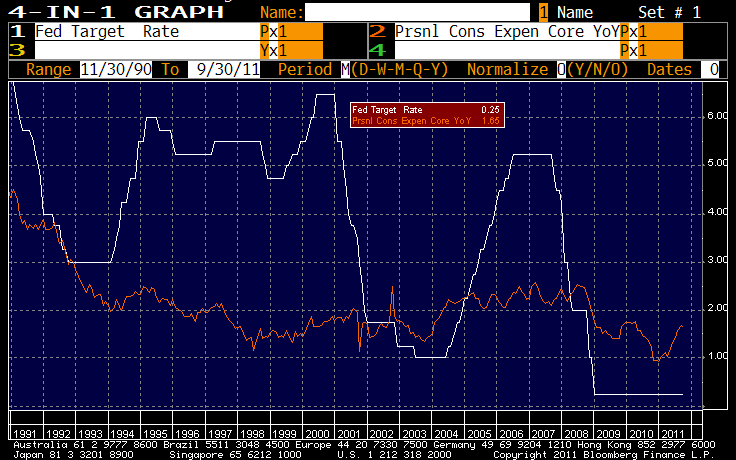
...followed easing in 2001, 2002, and 2003.
Interesting, isn’t it, that in each case inflation began to accelerate after the third year of aggressive easing? The difference is that in 2004-05, the Fed began to tighten, while in 2011 they are promising low rates for at least two years more, and other central banks are creating currency in the billions and trillions. I am not saying that I am 100% certain I am right – only Bernanke is that sure. What I am saying is that it is remarkable that not a single member of the FOMC will forecast any meaningful reaction from the stimulus already in the pipeline and the additional amount guaranteed over the next two years. In the past, one could rationalize the Pollyanna projections by saying the forecasters assumed the Fed would act in order to effect those outcomes. But in this case, the Fed has pledged not to do so. The true dynamism of the economy unfettered, forecasters expect…a comfortable stasis. That’s nuts. It’s like looking at a tug-of-war contest and declaring that the outcome is most likely to be a tie. Actually, that’s the one thing you’re pretty sure will not happen. In this case, I can make a plausible argument for inflation or deflation, but it is much harder to make a plausible argument that nothing happens (absent a policymaker response) given the dramatic policymaker actions to date!
Tomorrow’s economic data includes Initial Claims (Consensus: 400k), which is still trying to break below 400k convincingly, as well as data on Nonfarm Productivity (Consensus: 3.0%) and Unit Labor Costs (Consensus: -1.0%), and the ISM Non-Manufacturing Index (Consensus: 53.5 from 53.0). The item with the largest chance to contribute to market movement is actually Claims; if a sub-400k figure is combined with today’s above-100k ADP number the growth bulls will start to get excited again and the market will try to price a Friday Employment surprise. I think the bigger issue, with the weekend coming, is going to be some risk-off action ahead of that data and the possibility/probability of more EU news over the weekend.
Raspberry
The Grand Bargain on Greece that was struck last week provoked a skeptical (if not a downright queasy) reaction in many quarters. I wrote about my own misgivings on Thursday. Over the weekend, I saw George Soros was giving the deal “one day to three months” before it failed. What was remarkable, in fact, was how widespread the skepticism was. Who says investors don’t learn? They just learn slowly! The first “rescue package” announcements were greeted with genuine, warm huzzahs. The next wave was welcomed with generous applause. The next round got a smattering of polite applause, and some audience members shifted nervously in their seats. The GBG provoked loud raspberries and the hurling of rotten fruit.
As it turns out, some of those critiques was from the Greeks themselves. On Monday, Greek Prime Minister Papandreou called a public vote to ratify or reject the deal. This offended the rest of Europe, and in particular the politicians who had just run roughshod over the will of their own electorate, who seemed to think Papandreou’s move as analogous to the group of children on Christmas who gather together to discuss whether to return their gifts as being not sufficiently generous. In this case, though, the children are being asked to have a painful surgery before they get some pretty meager gifts, so it isn’t that surprising to me. As many people have pointed out, a 50% reduction in the NPV of debt held by one group of creditors amounts to very little. (It is important to note that the deal probably does not reduce the face amount of debt. If you’re not in fixed-income, that may sound like a niggling detail, and that’s what the politicians were counting on. But for example, if you reschedule a $1 payment due in 1 year to occur instead in 8 years, and the interest rate you apply is 10%, then the first payment is worth 1/(1+.1)^1 = $0.91 and the second is worth 1/(1+0.1)^8 = $0.47, and you’ve cut the present value of the payment almost in half. And it should be noted that no investor is currently willing to lend to Greece at anything close to 10%, which is why the Greek 5-year still yields 27% after the GBG.)
So incensed was French President Sarkozy that he said something truly ridiculous. He said “The plan adopted unanimously by the 17 members of the euro area last Thursday is the only possible way to resolve the problem of Greek debt.” I don’t know about you, but I can think of at least one other way, and I’ll bet the Greeks can as well. “Monsieur, suppose we decide not to pay you? Then it seems to me that resolves our problem. For you, however, this is not so good.” Is Sarkozy trying to provoke Greece with such silliness? If this were the National Football League, President Sarkozy’s comments would be considered “bulletin board material,” meant to inflame his opposition.
Other commentators can tell you better what the odds are that the referendum gives a thumbs-down. But I take issue with the ones who think this is just posturing by Papandreou. That doesn’t make any sense at all to me. For what purpose would the Prime Minister be posturing? He is very likely about to be cast out of the government by his own party. If the referendum is a thumbs-up, he has exactly the same deal he already had without the referendum. If the referendum is thumbs-down, he will be booted out of the government. I think it makes much more sense to recognize that Papandreou is likely going to be booted from his perch no matter what the outcome (it will just change who does the booting), and by putting the measure to a vote a thumbs-up enables him to say that at the end he was only doing what responsible Greeks wanted him to do, while a thumbs-down allows the voters to express their will and not, therefore, vent their rage on the soon-to-be-ex Prime Minister.
Just last week, I was commenting to a colleague that what I found most amazing about this entire saga was that none of these ordinary people who are negotiating these things has actually broken under the strain and done something silly. Merkel, Sarkozy, Papandreou, and others do represent their people but they are also individuals who can say dumb things, make bad deals, and occasionally have a public tantrum that damages the whole process (like, for example, Sarkozy’s tantrum today). Papandreou called for a referendum as a complete surprise to just about everyone – and that’s also the action of an individual; whether it turns out to be a rational one or not depends on Papandreou’s personal preferences and we can’t see those. But an announcement sprung on the world is the sort of stochastic event that can cause a big avalanche, but can’t be proactively planned for.
Well, the other part of the GBG was the structuring of the deal to get around any notion that it qualified as a default under a CDS contract. On Bloomberg TV yesterday, some analyst (I didn’t get his name) made the observation that Pete Tchir has also made recently: if sovereign CDS are no longer protection, then the rational thing to do if you are hedging bonds with CDS is to sell both the protection, and the bonds. One result has been that Italian yields have shot up above 6% at the 5-year point, which represents the highs for the crisis (see Chart).

Destroy the CDS market and investors can only sell the bonds themselves.
As we all know by now, the bankruptcy of MF Global on Monday was provoked, in part, by bad positions on peripheral European sovereign bonds, including Italy. In other words, we can draw a plausible connection between the Grand Bargain on Greece and the failure of MF Global. How come even when Europe screws up, it’s a US firm that fails?!
The MF Global saga initially sounded like another Bear Stearns. A firm with a concentrated position in a particular part of the market (Bear because mortgages was what they did well; MF because Corzine felt like playing in Italy today) took a large hit to capital and lost credit lines and cash quickly. But today we heard that MF Global was not in compliance with customer segregation requirements. This is an incredibly basic rule that is an important part of how a prime broker operates. My money and Fred’s money are kept separate, and separate from the bank’s money (as recently as the mid-2000s, some non-US banks did not segregate customer funds, but I haven’t seen prime brokerage documents recently. Folks, it’s worth checking). My questions here are the same as everyone else’s. (1) Where is the money now? (2) Where the heck were the regulators, since this is a very easy thing to check! And (3) who is going to jail?
I have been a vociferous defender of the part of Wall Street that is run efficiently, that serves an important capital markets function, and that treats customers with honesty and respect. I must admit, that argument gets more difficult to advance and more implausible on its face every time I look around. I know there are good people there, because I’ve worked with them. I just hope those people aren’t thrown out with the bathwater.
Oh yes, market reaction. This week has had a bad start for stocks, while the bond market rally has shredded my short position. While CNBC was busy talking today about a “perfect storm for commodities,” stocks on Monday and Tuesday merely retraced 38% of the entire October rally. Yes, commodity indices were off some 1.5% today…but stocks were down 2.8%. (Yes, this is the channel that refers to a one-tick bounce by saying “stocks are off the lows,” but a 20% drop from the highs of the day is “stocks remain near the highs,” so the misdirection isn’t very surprising.)
The dollar’s strength contributed to some weakness in commodities, but the dollar strength was partly flight-to-quality but no small part the result of massive intervention by the Bank of Japan, who sold roughly ¥8 trillion (roughly $100bln) to restrain the yen. This is where commodities and inflation-linked bond investors will want to pay attention. That sort of intervention size makes it unlikely, although not impossible, that the BOJ will sterilize the sale of yen by selling bonds in the open market (by selling bonds, the central bank absorbs currency that they put into circulation through foreign-exchange intervention). If they do not, then this is akin to what the Swiss National Bank did back in August when they promised to print unlimited amounts of CHF to stem its appreciation. That’s flooding the market with currency, and that’s printing money pure and simple.
This is why TIPS rallied 10bps today versus 12bps for nominal bonds. This says that the decline in nominal yields was 10/12 due to a decline in growth expectations (represented by real rates) and only 2/12 by a decline in inflation expectations. We have TIPS representing good value against nominal bonds, but negative real yields indicate that they are only good value against something like nominal bonds that are even more overvalued. Low real yields (not to mention a broadening roster of money-printing central banks) continue to argue for hefty weights in commodity indices.
Speaking of the growing roster of money-printing central banks, the Federal Reserve started their meeting today in the middle of all of this and tomorrow around 12:30ET will release the carefully-crafted statement that Bernanke will moot when he speaks at 2:15ET.
There is some faint noise about the Federal Reserve giving a nod to the so-called “Evans Rule,” which essentially adds a ‘growth/inflation balance preference’ variable to Taylor-Rule prescriptions when considering the optimal policy rate. It is very unlikely that they do so, mostly because it is far too academic to be included in any kind of statement and far too formulaic for the Fed to consider it a useful policy tool. The FOMC would first have to debate on what the value of the variable should be: how much should policy be tilted towards growth, as opposed to restraining inflation? (And this ignores the main problem, which is that monetary policy doesn’t really affect growth very much unless consumers and investors are subject to money illusion, so monetary policy can only really affect one variable). There is a remote chance of a coarse version of the Evans Rule being implemented, one which says “the Fed will keep rates at zero and tolerate 3% (or 4%) annual inflation until unemployment is down to 7% (or 6%?).” One might argue that the current construction of the statement (promising ‘2 years of zero’) is a step in that direction. But I think it’s the only step they’re likely to take.
If they do take such a step, though, it is an unmitigated disaster for monetary policy and a sign to grab every real investment in sight. Because allowing 3% or 4% inflation has nothing to do with the Unemployment Rate, and moreover there is no sign that the Fed has anything like the kind of power they would need to lock the inflation rate at any particular level. Such a statement would mark a surrender against inflation in order to make a Quixotic charge on unemployment. If the world’s largest central bank goes that route, then bill-printers of the world unite! You have nothing to lose but your change.
