Archive
Not Again
Once again, dawn broke on Thursday with great excitement. A Greek deal was at hand! Stocks were higher, although not very much higher, and commodities were bid as well as disaster was at last averted.
Now, this next part probably won’t surprise you as much this time as it did the first two dozen times: the deal was something less-than-advertised.
Yes, there was a Greek deal. But the deal in question was a deal among the leaders of the various parties in Greece about how to promise austerity. That deal must then be discussed with and approved by the Troika (ECB, EU, IMF). Oh, and this has nothing to do with the private sector initiative (PSI) discussions, which are still not done. So this great deal that we waited breathlessly for was pretty much the first stages of an agreement that would be meaningful even if doomed to failure.
You probably also won’t be so surprised when I tell you that the deal the Greeks agreed to among themselves did not pass muster with the rest of Europe, who are the ones who are supposed to put up the money for Greece. “In short: no disbursement without implementation,” said Jean-Claude Juncker, in summary of the EU policymakers’ meetings. According to the Bloomberg story, “he set another extraordinary meeting for Feb 15.” I wonder how many extraordinary meetings you can have, before they become ordinary? Apparently the Greeks left a little wiggle room, in that their parliament needs to vote on this new deal in a vote that the finance minister says is tantamount to a vote on membership in the EZ. This is all supposed to be done by February 15th. Don’t these guys have any respect for Valentine’s Day?
Love is definitely not what is in the air at the ECB. The central bank held policy steady today, but ECB President Mario Draghi said as his press conference that he no longer sees substantial downside economic risks. (And yet, like the Fed, inflation should stay above 2% for “several months” and then decline, I guess because that would be convenient to him.) Whatever is in the air at the ECB, they should pass it around.
Let’s try and work through the logic here:
- There is no substantial downside economic risk.
- For Greece to default or to leave the Euro would mean the end of life as we know it.
therefore There is no substantial risk that Greece is going to either default or leave the Euro.
I think I have the syllogism (oh, that word comes from Greek) right, although it’s probably not important that I do so since neither 1 nor 2 is correct.
From logic to mathematics we travel: Draghi did say generously that the ECB is willing to give up its “profits” on Greek bonds in order to help the solution, as long as they don’t sell at a loss since that would involve monetary financing of governments. In what la-la land are these guys living that buying bonds at $50 and selling them at $25 produces a profit? It would make my job a lot easier if I could use Draghian math. Unless the ECB bought bonds at $50 and then marked them at par, or carried them at cost rather than marketing them at all and is counting as “profit” the coupon income, this is nonsensical. So I conclude that the ECB is in fact doing one of those two things, either of which would get them jailed as a private investor.
Maybe I am too cynical (also a word that comes from Greek and means literally “doglike, currish”), but if this is how they steer ships in Italy then…oh, too soon?
Meanwhile in other central bank follies, the Bank of England tossed another £50bln log on the fire, bringing the QE total to £325bln. You know, core inflation in England is only at 3%ish, so it’s important to guard against incipient deflation!
In the U.S., Initial Claims was again a little lower-than-expected at 358k. We can probably at this point reject the null hypothesis that the underlying rate of claims is still around 400k, where it was until the second week of December; until now, the error bars around the estimate prevented such a conclusion at least in a statistical sense. Is the level now 375k or are Claims still improving? It’s too early to say. I expect that it is still improving, but I also expect it’s not going to continue that way.
Bigger news was that the Justice Department reached a settlement with Wells Fargo, Citigroup, Bank of America, Ally, and JP Morgan over the ‘robo signing’ flap. Those firms are on the hook for $26bln between them. JPM fell -1.2%, Citigroup dropped -1.7%, Wells was -0.2%, and Bank of America, which took the biggest hit, of course rose 0.6%. I do not understand the fascination of buying financial dinosaurs now that there are big dinosaur hunters around, but investors are delighted to jump into BofA at an 0.5% dividend yield. I’ve been saying it since 2008, and it hasn’t changed yet: the business of large trading banks has fundamentally changed, I think forever. Return on Equity is going to be much lower in the future in the past because (a) volumes of all products are lower, (b) balance sheet leverage is lower, and (c) margins have not widened, and if anything are under further pressure as most products move to exchanges. Banks sell the product with the most elastic demand curve in the world: money. If your bid for the five year note is 100-04+ and the market is 100-05/5+, you will print essentially zero business. (This is why banks love highly-structured product for which a price is not readily available many times.) You cannot count on margins going up, ever. And those three parts, (a), (b), and (c), are the three parts of RoE. Bank stocks may be great trading vehicles, and some banks may gain at the expense of other banks, but as a whole the industry is dead money, in my opinion.
The Treasury today announced that they will auction 30-year TIPS next week. The auction size was only $9bln, compared to expectations generally of $10bln, but the roll still opened quite wide (implying that you get more yield to roll forward to the new issue than you ‘should.’ The Street is either quite concerned about trying to auction 30-year inflation-linked bonds at a real yield of 0.75%, and they probably should be, or dealer risk budgets have been so desiccated that the limited number of bona fide TIPS dealers aren’t sure they can underwrite the issue at something close to the current price. In any event, after the announcement the long end of the TIPS curve was crushed, before bouncing and ending only 4bps higher in yield on the day. The nominal 10-year note sold off 5bps to 2.04%, and 10-year breakevens were down 2bps.
Commodity indices gained 0.5% despite a very soft performance from grains and softs. The energy group rose 1.2%, industrial metals put on 1.5% (now up 10% over the last month), and precious metals rose 0.6% (+8.2% over month ago).
The only data of note on Friday is the University of Michigan confidence number for February (Consensus: 74.8 vs 75.0). I predict that we will head into the weekend expecting a deal to come out of Europe over the weekend, as we will be told it is “imminent.” Why not try that old chestnut again?
Deal Or No Deal? Yes.
Although it didn’t happen until after the U.S. market had closed – funny how that happens – there is yet another delay in the Greece-Euro deal. The Greek leaders, who were discussing the austerity measures, “agreed on all the points of the program with the exception of one which requires further elaboration and discussion” with the Troika. The ‘discussion’ seems to be brought about because Greece was told it needs to cut pensions, and the socialist party said they won’t agree to such a thing. I wonder how they’ll discuss that thing out.
Equities managed another small gain before that news came out, on still-ephemeral volume. After the close, stocks slipped, but not terribly. We will see what the morning brings.
I have been ‘bullish’ on equities for a few weeks. I put the word in quotes because although I believe stocks have a better chance to rise than to fall while the Fed and ECB (and everyone else) are pumping away, I recognize that equities are still richly valued and I am not completely sure that being long is worth the risk. I must say that for all the consistency of the advance in the S&P since mid-December (see Bloomberg chart below), the steady step higher on tiny volume scares me. It scares me because of the old market maxim that “the stock market goes up on the staircase and down on the escalator.”

I am also frightened by comments today from Blackrock Chairman and CEO Larry Fink. He suggested that investors should have 100% in equities. According to Mr. Fink, “I don’t have a view that the world is going to fall apart, so you need to take on more risk. You need to overcome all this noise. When you look at dividend returns on equities vs. bond yields, to me it’s a pretty easy decision to be heavily in equities.” It doesn’t scare me because it’s a unique thought: the talking heads on CNBC often advocate ridiculous concentrations to equities and don’t care about the price. It doesn’t scare me because he’s wrong to look at relative valuations of dividend yields versus bond yields when making a call on future performance of either asset class – the absolute level of both of them augurs poorly for future returns. Although the Chairman of a firm that supposedly has quant DNA should know better than to say something that wrong, in his role he’s really chief marketing officer and he’s trying to sell product. No, what scares me (perhaps “saddens me” is more accurate) is that anyone in a position of authority who might be listened to would actually be so cavalier as to advocate a 100% investment in anything, especially given the huge list of global risks, and especially in a market that isn’t exactly priced with a margin of safety. By contrast, Enduring Investments’ asset-allocation model currently has 3-4% in equities.
But all of that aside, the stock market isn’t going up because of heavy buying. It is going up because there is rotten liquidity and so any buying pressure pushes prices higher, and there are plenty of people who see the money spigots open and reflexively buy real assets. I don’t mind that for a trade, and I admit to being long some stocks myself just in case I am wrong and Fink is right. And I suppose that is the point. I feel I need to protect against the possibility that I am wrong. Fink doesn’t feel the same need.
One thing I am not worried about is the price of gasoline. This is not to say that I am excited about the fact that gasoline futures are right about at $3 and retail unleaded gas is nearing $3.50. If this is a demand-side phenomenon, then it could actually be good news. However, as far as I can tell, domestic gasoline demand is actually down, not up, according to the Department of Energy (see Chart below, source Bloomberg).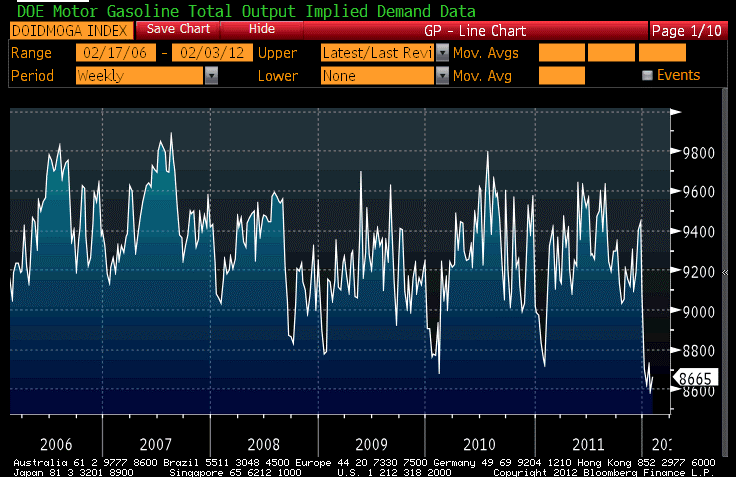
Demand in Europe can’t be strong right now, and the large emerging economies are struggling as well. This is all bad news, because collectively it takes away the demand-side explanation. But the answer isn’t necessarily supply-side (that is, peak oil, Hormuz fear, or low inventory levels). I think at least some of the answer is monetary-policy side. The chart below (source: Bloomberg) shows retail gasoline versus the stock market for the last five years. Some of the correlation, for example in 2008, is clearly demand-related. But the equity run-up into and through QE2, from mid-2010 into early-2011, I think we all know was mostly inspired by cheap money. Gasoline responded in the same way at that time, as did of course most commodities.
I think the gasoline and equity rallies right now are occurring for the same reason. It wouldn’t be my first guess – my first guess would be demand-side, but that argument is clearly flat. I think loose monetary policy is at least part of the story here.
And speaking of loose monetary policy, I must share the following exchange with you. Bloomberg published a provocatively-titled article (“Bernanke Economy Proves Critics Clueless on Fed”) that was so lopsided the article is either a plant or the author’s kids just broke Chairman Bernanke’s window and she’s trying to make it up to him. Quoting John Lonski (Moody’s…how have they done with forecasting?) and Mark Gertler, the article bashes a number of fairly successful forecasters (such as Paul Kasriel of Northern Trust, who is consistently one of the nation’s top forecasters) by essentially saying that the failure of inflation to immediately surge following aggressive Fed easing meant that all of those forecasters were “clueless.”
One of those economists, Stephen Stanley of Pierpont Securities, took umbrage at being called “clueless” and fired back a broadside that is fantastic in that it points out clearly many of the weaknesses in the reasoning of the “I heart Bernanke” lobby (readers of this column will be familiar with many of these arguments). I have not always agreed with Stanley’s perspective on the economy – no honest economist always agrees with anyone – but he hits the nail on the head here and I will quote a large part of his response. He first points out that the article attacks a straw man because no reputable economist forecast a huge immediate surge in inflation just because of a surge in bank reserves. He then notes:
… And keep in mind that the inflation rate accelerated in 2011 by roughly a full percentage point for both headline and core. That is in fact a pretty “rapid” pickup in inflation that would get us into trouble if it persisted.
Importantly, this acceleration in inflation in 2011 was absolutely not predicted by the Fed or its apologists. The Phillips Curve model that dominates the FOMC’s thinking (and evidently Lonski’s and Gertler’s) does not even allow for the acceleration in inflation seen in 2011. In fact, the Fed models are unambiguous that inflation should be falling substantially now (because there is a lot of slack in labor markets), which is a main reason that Fed officials had such unwarranted concerns about deflation in recent years and why they now so confidently predict that inflation will decelerate from here, even as growth improves and “slack” diminishes. And herein lies the problem. We have a central bank that apparently believes that inflation is driven by wages which are in turn driven by the degree of slack in labor markets (i.e. the unemployment rate). I had thought that this dusty old Phillips Curve framework was thrown in the dustbin of history after the disaster of the 1970s, but clearly (like some bad 1950s horror film) a new generation of academic economists has dug it out of the trash, cleaned it off, and attempted to dress it in new clothes and sell it as the unquestioned consensus of the economics community. When the central bank does not allow for an important role of money in the determination of inflation, an acceleration in prices is a clear and present danger.
… The problem with the Fed is not so much that inflation is currently way too high, it is that the reaction function from economic and inflation data to policy is radically easier than it has been at any time in the Fed’s history. I do not disagree that policy should be accommodative, but there is no credible framework to defend the notion that it needs to be as or more accommodative in late 2014 than it is now. This is a train wreck waiting to happen, but it is a train wreck that will play out over years, not minutes. Happily, this means that much of the damage is preventable/reversible if the proper course correction is taken soon enough. If not, the latter part of this decade may look a lot like the 1970s.
As I say, he makes some powerful points that you have read in this space before. Economists who say we don’t need to worry about inflation because of slack growth (the Phillips Curve argument) need to explain away several data points that don’t fit that model. For example, the 1970s. They also need to explain why prices haven’t fallen over the last few years (outside of energy) despite immense slack in the economy. And he absolutely nails the vulnerability now, which is less that the transactional money supply is growing at a steady 10% rate (although it is) and more that there is no reason at all to expect that the Fed is about to take drastic actions to trim its balance sheet and begin to restrain the money supply. Indeed, quite the opposite is true.
We will get money supply tomorrow, and next week CPI. But no matter what those numbers say, some of us will still be called clueless. I guess I don’t mind being clueless, as long as I’m right.
Super Bowl Hangover
Wow, people really did spend the day on Monday talking about the Super Bowl. Volume on the NYSE was only 644 million shares: the slowest day of the year. This is not part of a secular decline; this is a much more-abrupt falloff if it continues this way. For reference: last year, the slowest day of the year prior to the Christmas season was 655 million shares. That includes all pre- and post-holiday trading sessions. The only days in 2011 that were slower than today’s total were the day after Thanksgiving and the 23rd-30th of December.
Then again, the Giants didn’t win the Super Bowl in 2011, so maybe that’s part of it.
Still, it is remarkable. If the market can respond to all of the news that circulated today about Greece without much trading, then I think that means that investors have reached their conclusions about the outcome. Think of what happens to an option price when the underlying market moves. If the option is “near the money”, meaning that it isn’t very clear whether it will end up in the money or out of the money, the option value is quite large and the probability of eventual exercise (the delta, approximately) is quite variable. But if the option is either deep in-the-money or far out-of-the-money, movements in the underlying market don’t change the probability of exercise very much. The delta is near 0, or it is near 1. The gamma, which explains how much the delta changes with movements in the underlying market, is very low.
If markets are no longer moving much when another weekend comes and goes with no deal on Greek funding, when Euro officials say (as Merkel did today) that they can’t understand what the Greeks could possibly need with another couple of days because “time is running out,” when the big unions in Greece declare strikes and threaten violence; if this doesn’t cause any ripple in the market, then I tell you that the delta has set. In principle, we don’t know whether investors are assuming there will be no default or whether it is guaranteed there will be a default, but the latter case seems more likely to me. If that is the case, it also means that there will never be any less risk in the markets on a default than there is right now. Everyone is as comfortable with his strategy as he is going to be, and now everyone is just waiting to ring the bell for the actual event.
.
St. Louis Fed President Bullard spoke today and tried hard to justify the “Bull” in his name. In his prepared speech, which I thought might actually talk about inflation targeting, he made it clear that he considers the new statement of longer-term Federal Reserve objectives to constitute “inflation targeting” because it describes 2% PCE inflation as a “goal.” That’s inflation targeting in the same way that a rifleman is targeting when he talks about wanting to shoot well this afternoon. It’s a target, but targeting is a process. Moreover, it’s a target that has been operative for many years informally so stating it doesn’t change much (like the rifleman going from just wanting to shoot well to saying that he wants to shoot well). The Fed would be inflation targeting if they named a long-run inflation or price level target and described how they would adjust policy in response to being off-target in a particular period. For example, if the Fed said “the inflation target is a compounded annual inflation rate of 2%±¼% between 2012 and 2022 and our expected policy path will adjust so that target will be hit, that would be an inflation target.
While it’s not necessary that the inflation target be expressed as a number rather than as a function of aggregate growth over that period, True inflation targeting makes a growth agenda strictly second-importance at best.[1]
In his Q&A, Bullard made some remarkable statements. He said that the “European situation has calmed down substantially.” Is that really what the Fed believes? If so, then they’re more out-of-touch than I would have expected. Greece is discussing default and it could happen as early as sometime in the next six weeks. Portugal’s 10-year bonds yield 13%; Hungary’s 8.5%, Ireland’s 6.9%, and Italy’s 5.6%. France has been downgraded and scores of banks are only solvent because they are receiving infusions of LTRO and carrying assets at par that should be fractions of par. That is “calmed down substantially?” Bullard’s forecast for 3% GDP growth in 2012 and better than 3% growth in 2013 is also pretty generous, although achievable if nothing bad happens in Europe. He remarked that the Fed must be careful to avert “a lot of inflation.” Um, what about a moderate amount of inflation?
Let’s just hope he was up late watching the Giants, and not on his game. Otherwise, I would have to say something uncharitable.
.
Several friends sent me the article “Huggies Cut Shows Why Bond Market Backs QE3” for my comments, so I thought I would share them generally. The article explains that Procter & Gamble just rolled back prices after a recent 8% increase caused them to lose 7 points of market share. The article argues that P&G found it couldn’t raise prices “because wage growth remains stunted.”
That’s a great story, but compensation growth if anything follows inflation – it certainly doesn’t lead it. The chart below shows the quarterly Employment Cost Index, which includes both wages and the value of nonmonetary benefits, compared with headline inflation. (The source of the data is Economagic.com and Bloomberg; the old ECI series was discontinued in 2005 so this chart contains the new series starting in 2001).
It is difficult from this chart to make the claim that wages lead inflation; in fact, there are several clear examples where inflation led wages. The real question is, if wages aren’t rising then why did Procter & Gamble feel the need to raise prices? Margins generally (although I can’t speak to P&G directly) are at the highest levels in a generation, so I doubt they were just trying to pad margins in a competitive industry like consumer products. Clearly, there are price pressures these manufacturers are feeling; it’s just that this company (and the restaurants that the article also discusses) are in highly-competitive businesses where it is difficult to yank prices up 8% without a demand response.
There is no guarantee that inflation will continue to rise, but I find it remarkable how much ink is spilled these days talking about how it’s almost fait accompli that it will fall.
On Tuesday, Chairman Bernanke testifies before the Senate Budget Committee. The testimony is scheduled for 10:00ET.
[1] In principle, the inflation target could be expressed as a function of compounded growth, but this gets (a) confusing and (b) complex. Should higher-than-expected growth imply higher-than-expected inflation is acceptable, reflecting the economic orthodoxy that rapid growth fuels inflation? If so, then what about the current situation, in which the Fed would like to run faster growth even at a cost of higher inflation? So the growth variable would have to be phrased in terms of the output gap…which no one agrees how to measure.
Promising Isn’t The Same As Delivering
Yet another weekend appears to be poised to end without the promised big-picture agreement on Greek debt. The BBC was reporting earlier today that talks between the Greek Prime Minister and the leaders of other coalition parties had concluded without agreement to take additional austerity measures; at this hour Bloomberg is reporting that there is agreement on cuts of 1.5% of GDP although these will not be finalized until Monday. These Greek-on-Greek talks became necessary because European Union representatives demanded additional austerity measures. On Friday, a report from Radio Netherlands Worldwide said that the AAA countries demanded “that the [Greek] government implement agreed reforms and austerity measures by March at the latest. Otherwise they will withdraw the bailout funds pledged last year.”
In case you’re wondering: yes, when those bailout funds were announced last year the stock market rallied because the problem had been solved. You see, it is easy to announce the desire to help. It is harder to actually help.
I wonder if the U.S. will consider throwing in a little help now that we have had a couple of months of decent data (more on that in a moment). I think it would be a mistake, both politically and economically, but this Administration has tended to have a tin ear politically since taking office. A driving force of its foreign policy has been a desire to be loved worldwide, and it would not surprise me a bit if we started to hear about the U.S. taking a bigger role in talks. Would this be bullish or bearish for our markets? It might be bullish since it would increase the perceived chance of the immediate crisis being averted, but it might be considered bearish since it increases the chance of a crisis later. It would, though, change the equation significantly since the U.S. is the only power capable of writing a hundred-billion-dollar check alone (heck, that’s only a tenth of a trillion!). I imagine the stock market would like it but I’m pretty sure the bond market would hate it.
This wasn’t even a consideration a couple of months ago, when we had enough of our own problems to deal with. Those problems are still here, but the problems we have – high private leverage, a chastened although recovering banking system, an addiction to extremely high budget deficits with little appetite to reduce the size of government, and a dangerously loose monetary policy – are not the problems that the Administration (and the Fed) believe we have. It is true that if the economy can grow at 4% for 5-7 years, many of our problems will diminish, but policymakers seem to think the weak growth is not an effect but rather a cause of our current circumstance. And recently, the news on growth has been better.
On Friday, the Employment Report produced a new jobs figure of 243k, which was about 100k greater than expectations. The Unemployment Rate dropped to 8.263%, only a whisker away from triple-downticking. Aggregate hours worked and average hourly earnings both rose, which means that Q1 income got off to a good start.
The January report is a little quirky, partly because of the usual seasonal adjustment issues around year-end and partly because benchmark revisions take place in this month. I’m not terribly uncomfortable with the overall reading of mild strength, because it’s consistent with most other labor market indicators showing the same thing. (In my mind, the question is more about sustainability of this mild strength if Europe holds to current trends.) The Unemployment Rate plunge was on the quirky side because the Household Survey from which it is derived incorporated the annual adjustment to population.[1] According to the BLS, the adjustment “increased the estimated size of the of the civilian noninstitutional population in December by 1,510,000, the civilian labor force by 258,000, employment by 216,000, unemployment by 42,000, and persons not in the labor force by 1,252,000.” Overall, however, the civilian labor force grew by 508k and employment by 847k, which means that the addition from other than the population adjustment was 250k to the civilian labor force and 631k to employment. That’s quite a large number, and won’t do anything to soothe those who think that every number is a government conspiracy. But, as I said, it’s not inconsistent with other signs of decent employment growth.
On the unfortunate side, the participation rate plunged to 63.7%, the lowest since 1983 (see Chart, source Bloomberg). The BLS explained this by saying “This was because the population increase was primarily among persons 55 and older and, to a lesser degree, persons 16 to 24 years of age. Both these age groups have lower levels of labor force participation than the general population.” However, notice that while this explains the sudden drop, what it means is that the prior ratio was overstated, not that the current ratio is understated. So this is something less than encouraging.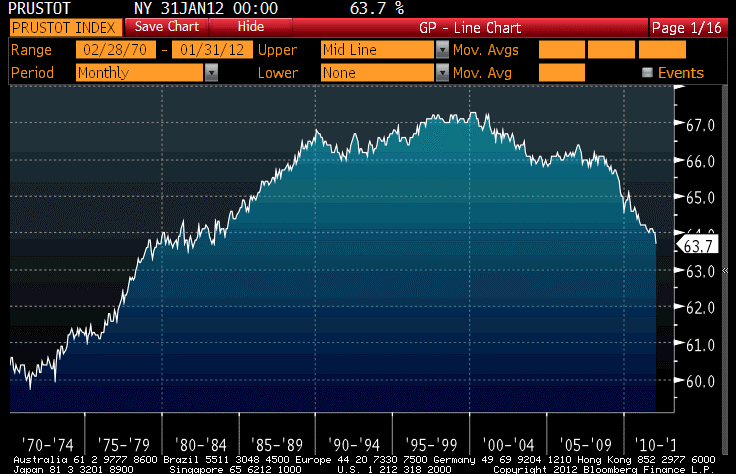
On this point, Julia Coronado at BNP (whose analysis of economic releases is generally among the more clear-eyed reads) made a great summary observation. She said “It is becoming increasingly likely that the path toward lower unemployment rates will mainly be through fewer workers rather than an acceleration in job growth.” Since economic output is workers times hours worked times productivity, this means the path to a full recovery in economic output is either going to be longer hours or an acceleration in productivity. That’s really the path we’re going to be on for a long time hence, now that the baby boom generation is beginning to be of retirement age. And if I may say so, it is a prime argument for allocating more GDP to the private sector, where productivity enhancements are generally developed, and less to the public sector. The government can keep redistributing the pie, but it would be better to grow the pie and government has had an abysmal record at doing so for roughly the last eight thousand years. We could hope for a better result in the future, but to do so would seem audacious.
Another growth sign from Friday were good as well. Non-manufacturing ISM reached an 11-month high at 56.8, far above estimates. All of this news helped push stock prices 1.5% higher, commodities prices 0.8% higher (despite a 1.1% fall in Precious Metals), and 10-year yields 10bps higher to 1.92%. Even TIPS yields rose, finally, by 8bps at the 10-year point.
In other inflation-bond-related news, Japan is reportedly considering a re-start of its inflation-linked debt market. As I illustrated recently, Japan’s inflation rate has been rising since early 2010, and as the tsunami effects finish passing through the system the core rate will likely rise to above zero and end the nation’s deflationary period. The last Japanese inflation-linked bond was issued in June 2008 when year-on-year core CPI was +0.2% but large investor losses in illiquid Japanese inflation markets in late 2008 combined with a plunge of core inflation to -1.6% in early 2010 meant the Ministry of Finance feared there would be scant demand for the bonds, which unlike those in other countries never carried a ‘par floor’ (so, in the case of persistent deflation, you could get back less than you invested in nominal terms).
That structure detail annoyed bond salesmen, but it is the right treatment. Otherwise, investors get a free option on deflation that means their real return will rise in a deflationary environment although it is constant at any positive level of inflation. That turns out to be painful to model, and awkward to trade, as asset-swappers learned to their/our chagrin in 2008. Having said all of that, I expect there will be a strong sentiment to add such a floor to the JGBi when and if the program re-starts.
On Monday, most of the day in the U.S. will be occupied with discussing the Super Bowl. But be aware that St. Louis Fed President Bullard will be speaking in Chicago at 8:55ET on the topic of inflation targeting. Listen carefully for any intimation that the Fed is trying to generate support for a policy of price level targeting as opposed to inflation rate targeting. I wrote way back in December 2010 about the Fed Chairman’s affection for inflation targeting, some of his prior words on the subject, and of the (better) arguments of KC Fed economist George Kahn. It’s worth a review if the topic comes up again. In the current context, whipping up a fresh discussion of price-level targeting would be another excuse to let inflation keep accelerating for a while. Under a price-level target, the Fed just promises to hit the price-level target on some future date, implying an average level of inflation between now and then. So, if for example the Fed wanted to run inflation a little faster right now, it could do so and pretend that this didn’t impair their credibility as long as they eventually hit that target.
I think the FOMC is looking carefully for ways to let inflation run faster without the bond market charging higher rates for that policy. If they can somehow convince investors that the 10-year average inflation will be 2%, even if it happens to be 3-4% over the next, say, 3-4 years, then 10-year nominal rates would stay down and real rates very negative despite an inflationary policy. I doubt they can pull it off, because I don’t think they have much credibility as it is. And, as Kahn pointed out in 2009, “[central banks] have no modern practical experience with such targets.”
The lack of practical experience, however, has never stopped this Fed before. I continue to marvel that investors are willing to be long rates here. You see, it is easy to announce the desire to price-level target. It is harder to actually price-level target.
[1] The BLS recognizes that the nation adds these citizens over the course of the year, but rather than make monthly estimates of labor force growth it adds them all at once in January. This year, the jump is large partly because it reflects the results of the decennial Census, which marks the actual population to the estimated population as of 2010.
Disowned
The data today were weaker-than-expected, but I can’t characterize them as weak. ADP missed expectations by 45k when revisions are included, but if we can blame the spike last month and the plunge this month on poor seasonal adjustment, the average was still 231k and that would ordinarily be considered quite acceptable for an expansion (if not for the early stages of an expansion). The average for 2004, 2005, and 2006 was 165k, so this isn’t too shabby in the grand scheme of things.
Similarly, although ISM Manufacturing fell short of expectations at 54.1, as I pointed out yesterday that’s not really falling short of where the actual expectations were. And it represents a jump from 53.1 last month. Again, 54.1 is in the ‘expansion’ zone. It’s below where it was last spring, and in the spring of 2010, but manufacturing isn’t falling apart, at least yet.
Not to be overlooked is that domestic vehicle sales for January were at a seasonally-adjusted 14.13mm units, above expectations and at the highest level (excluding the cash-for-clunkers spike) since May 2008 (see Chart, source Bloomberg).
Considered another way, sales almost reached levels that were typical of mature expansions such as those in the late 1990s and the late 1980s. They are not at levels, and probably won’t reach levels, at the 0%-financing-induced plateau of the early 2000s. It is incredible, when you think about it, that car companies were floundering through the 2000s despite record sales. This is a great example of how excessive private debt can dampen inflation: margins were tight and, rather than push up prices and margins but lose cash flow, heavily-indebted car companies had to spread their interest costs over as many cars as they could in order to make any profit at all. Now, of course, Government Motors has dramatically less debt (in 2008, the old GM had $102bln in long-term liabilities; now it has $55bln) and wiped out $50bln of a $60bln post-retirement medical care liability out when they turned it over to the UAW to run. With essentially $100bln less in debt, GM doesn’t need to sell a trillion cars to make money. (More cynically, the profit motive is somewhat less operative now as well, considering that the overlords have other metrics they are shooting for).
So, while the data are disappointing to those economists and investors who were reaching for the stars but only got the moon, it’s not that bad. I need to add the caveat ‘yet,’ because I think the economy isn’t going to be expanding all year, but we’re still chugging along.
Equities therefore had another swell day, rising 0.9%. Commodities rose, and inflation swaps jumped about 4bps as bond yields rose. Portuguese yields fell sharply as it was able to easily sell its Treasury bills, as I suggested on Monday would happen. By these bill sales Portugal thereby kicks at least some of its funding problem all the way to May and July. Whee! The country is not out of the woods yet, folks.
While we enjoy some good data here, the biggest dangers for investors remain European growth, and global inflation. Regarding the latter, a strongly-worded speech by Bundesbank president Jens Weidmann suggested that the ECB’s provision of liquidity is “too generous” and raises “higher risks for banks and thus also risks to price stability.” The old wisdom held that the ECB had “Bundesbank DNA,” but it sounds to me like it is on the verge of being disowned by Daddy.
Another back-page story to keep an eye on as it is a prime candidate for the 2012 “unintended consequences award” was the recommendation, contained in the report released yesterday from the Treasury Borrowing Advisory Committee (TBAC), that the Treasury start to allow T-Bill auctions to clear at negative yields. What happens now is that in periods of crisis, T-bills have been trading with negative yields; however, since the Treasury can’t mechanically auction them at negative yields, the auctions will be extremely well bid at a zero yield (that is, the T-Bill is issued at par and matures at par, with no interest) and then immediately trade at a negative yield in the secondary market. It’s free money to the banks who participate, and the TBAC suggests seemingly-cleverly that the auctions should be allowed to clear at negative yields so that the Treasury isn’t just throwing away money.
The problem is akin to the problem a football team faces when it sells tickets at $80 and watches them immediately be scalped for $150 to fans clamoring for tickets to the sold-out game. Why doesn’t the team just charge the going rate of $150 and cut the scalpers out, taking all the surplus to themselves? There are lots of reasons, most of which boil down to wanting to make sure they keep fans happy,[1] but one reason is that the team wants to make sure the game sells out all the time. If the game isn’t sold out, it can’t be shown in local markets. And if it can’t be shown in local markets, it means the TV revenue is lower. So by sacrificing a few bucks, the team makes sure the game is sold out.
I would suggest the Treasury ought to consider this analogy. A failure to “sell out” a T-Bill auction – for the record, this week the Treasury sold $93billion in 4-week, 3-month, and 6-month bills – would be worth far more in a negative direction than the pennies the Treasury gives up to the “scalpers.”
From a trading perspective, this creates a singular risk every time there is an auction that may clear at negative yields. Maybe everyone will show up and bid 0%, so the auction will just tail back to zero. And, maybe not. It’s a small chance, but it’s one more random thing to have to keep an eye on.
Thursday before Employment would ordinarily be a sedate trading session but we are again on Greek PSI watch. Today a headline ran (on Dow Jones, I think) predicting there would be agreement within 24 hours. Obviously, there will be a knee-jerk positive response when there is a deal announced, even though the details may not be announced right away and we certainly won’t know whether anyone will participate. Greece is not only not out of the woods, it’s tied to the tree.
Initial Claims (Consensus: 371k from 377k) is due tomorrow. Claims the day before Employment doesn’t usually deserve much attention, but in this case it’s worth watching with one eye because the seasonal volatility is diminishing and so the error bars are narrowing as well.
Be aware that both Chicago Fed President Evans (he of the ‘Evans Rule’ suggesting that rates be declared to be immobile until Unemployment falls below some stated threshold) and Chairman Bernanke are speaking tomorrow morning.
[1] By letting fans pay a floating price to a scalper, the scalper can extract the consumer surplus while the football team charges a price that most fans could pay. So a fan who can’t get into the game because the scalper is charging $150 isn’t mad at the team because the team charged $80. He’s mad at the scalper. But I digress.
