Archive
Interesting, Even In August
It was another slow day, part of what is shaping up to be a typically slow August week.
I am always fascinated during these slow weeks by the fact that the same news that ordinarily would send markets spinning one way or the other will often seem ignored altogether, as if each hair-trigger trader is waiting for someone else to make the first move which never, as a result, occurs. Other times, a possibly less-significant item will trigger a bigger move if only a few large positions try to move through the illiquidity.
What that probably reflects is that very large traders – pension funds, large hedge funds, money managers – recognize that when liquidity is low there is a larger cost to initiating any move. Therefore, it takes more certainty of the result before it makes sense to re-allocate any meaningful amount of the portfolio. (Thus, the decline in volumes we have seen this year could be seen as deriving either from a lack of confidence about market direction, or from a decline in liquidity, or both.)
Today’s news was in the form of an interview in the Wall Street Journal, later followed up by an interview on CNBC, of Boston Federal Reserve Bank President Eric Rosengren. Now, Rosengren is a known hawk, but he called out his cohorts on the Fed to “launch an aggressive, open-ended bond buying program that the central bank would continue until economic growth picks up and unemployment starts falling again.”
This is monetary idiocy. Mr. Rosengren has just become the Krugman of monetarism: it isn’t working, thinks Rosengren, because a couple of trillion just isn’t enough to make a difference. I have renewed sympathy for Chairman Bernanke, if he is forced to deal with people like this who don’t understand what they’re doing, but figure they just need to do more of it.
Let’s be clear on the theory: if the Fed increases the money supply while the velocity of money remains static, nominal GDP (PQ in the monetarist equation) will rise. But here’s where it’s important to actually understand the theory, rather than rely on an equation. Nominal GDP can grow for two different reasons: because the real economy has expanded (Q) or because the prices attached to all transactions has risen (P). Theory says that if economic actors are fully rational, they will recognize that the increase in money lowers the value of each transactional unit of money (dollar) and so the increase in M will be fully mirrored in P. If economic actors are at least somewhat stupid or naïve, and take the increase in the money in their bank account as an actual increase in wealth, they’ll spend more and the real economy will benefit.
This is called ‘money illusion’, and the evidence of the last few years is that it’s pretty weak. I suspect that’s because most people judge the balance in their checking account in two ways. First, they notice when the balance itself is increasing over time. But second, and significantly, they notice that each month the checks they write take more out of the balance than they previously did. That is, their reference point is not just the balance itself, but the interplay of balances and consumption. This makes it hard to fool them with money illusion. The Fed’s continued talk about how “inflation expectations are contained” is clearly partly intended to increase the money illusion effect and thereby increase the efficacy of monetary policy on the real economy – the ethics of that practice I will leave to others to discuss.
So if Rosengren had his way, and the Fed bought a trillion dollars of securities every month, it wouldn’t have a big effect on the real economy. But you can bet it would have a huge effect on the price level!
Now one place that I actually agree with Rosengren is on the interest paid on excess reserves (IOER). He said the Fed should reduce IOER, as I have written numerous times, and moreover that they should do it gradually so as to make sure it didn’t disrupt money market funds. Oddly, he said he didn’t want to go all the way to zero, so he’s arguing about maybe a 10-20bp ease, but since results to such a policy are likely to be non-linear it’s not unreasonable to go slowly.
Maybe it is talk like this that explains why inflation breakevens have recently been striking out higher. To be sure, another reason for the rise in inflation expectations, at least at the short end of the curve, is the 17% rise in spot gasoline prices since June 21st, but this shouldn’t cause a severe effect at the 10-year point of the inflation curve. 10-year inflation expectations as measured by inflation swaps are up 25bps over the last two weeks, and breakevens (the spread between TIPS yields and Treasury yields) has risen by a similar amount.
This is an unusual time of year for breakeven inflation to be rising. As the chart below (Source: Enduring Investments) illustrates, compared to the last ten years’ worth of data on 10-year breakevens it seems almost as if this year’s pattern has been shifted earlier by about two months.

I don’t have a great explanation for this; most likely, it’s just spurious. But it helps to illustrate that this is an abnormal behavior. In the last 13 years, 10-year breakevens have declined in the 30 days following July 25th on ten occasions, and this is also true (10 out of 13) at the 60-day horizon. The average additional “normal” decline in breakevens forward from this date, as you can see from the green line above, is about 15bps.
Now, that may mean that TIPS are overextended (relative to nominal bonds; there’s no question in my mind that they’re overextended on an absolute basis) and that breakevens are about to fall back. But it may also mean that there is something more significant happening here. I recently highlighted the unusual recent performance of commodities relative to the dollar, and this is of a piece with that observation. Our Fisher model has TIPS overextended, but also has inflation expectations lower than they ought to be, so that effectively it indicates a short position is warranted in both TIPS and nominal bonds rather than one versus the other (it first signaled this on July 31, for the record). The model signals go back to 2001, and this is the first time that we have ever had that configuration indicated.
Something interesting is happening, indeed, even if it is August.
There May Have Been Life Here Once
There’s just nothing like August in the financial markets, unless it is the barren landscape that is Mars. “I think there may have been life here, once!” one muses with wonder, scanning the bleak horizon for some sign of motion.
Well, nothing today. Maybe we’ll find something tomorrow.
Markets were nearly unchanged across the board from stocks (+0.2% S&P), bonds (-0.5bps in the 10y), and commodities (+0.1% DJUBS), and on low volume.
Gone, but not forgotten, was the robust equity rally from Friday. Regardless of what you may have heard, the rally in equities that day was not due to the Employment data, which was weak.
While Payrolls surprised on the upside, that was mainly due to rotten forecasting – one auto maker didn’t lay off workers during the seasonal re-tooling period, leaving the BLS seasonal factors to “replace” workers that hadn’t been laid off as they usually are. (By the way, this means that the seasonal factors will expect those workers to be added back next month – but since they weren’t ever laid off, the seasonal factors will bias the number lower next month). We knew this effect was there – that’s why the Initial Claims number plunged 25k in early July, only to bounce 36k and then plunge 31k again. Economists just forgot to add it.
There was nothing game-changing, in short, in the Employment report. A better-than-expected Payrolls increase was not particularly exciting once revisions to prior months and the re-tooling effect are accounted for, and the Unemployment Rate ticked up very slightly (8.254% rounded higher, but was very close to unchanged).
What had pushed the market higher was a surge of optimism about the EFSF again, because some members of Frau Merkel’s party – although pointedly not Merkel and not the Bundesbank either – expressed a vague acceptance of the ECB buying periphery bonds. But how strong is that acceptance? One speaker said German lawmakers would have ‘veto rights’ over bond purchases by the EFSF and ESM. How would that work, exactly? It sounds to me as if someone was promised something that cannot actually be delivered. Obviously not everyone can have veto rights over the bond purchases, or else they won’t make any bond purchases!
Some observers were surprised that the Knight Capital imbroglio did not meaningfully impact market direction, but market professionals generally knew better. Knight Capital’s problem was nothing like the problems experienced by Long Term Capital or a primary dealer like MF Global. All three of those entities put capital at risk on a regular basis, but here’s the fundamental difference: no one needs to have confidence in Knight to deal with them, since you don’t face their credit. You have probably faced Knight numerous times in the market but never knew it, as they are exchange market-makers. Consequently, they don’t have lots of interconnections to other firms that need to be collateralized and can be called. In this respect, the damage done by a Knight insolvency, if it had happened, would have been much more like the collapse of Amaranth, which was a hedge fund that largely dealt in futures markets. No one faced Amaranth (at least, in futures). And similarly, few institutions had exposures to Knight. So if you owned Knight shares, you were hurt badly; but the market continued to function. And over the weekend, Knight got more capital (since their fundamental business model isn’t really in question), and is back to business as usual, for the most part.
Consider this Exhibit 2,375 in favor of pushing as many instruments as possible onto exchanges.
So we move onward, but we’re left with one overarching truth: it’s August. That doesn’t mean that the markets won’t move – in fact, illiquid market conditions often produce ample moves (as Friday illustrated). It does mean that the news cycle, which in the last couple of years has been primarily Europe-driven, will probably slow to a relative crawl.
Bundespanked
Draghi’s celebrated, chest-thumping, “whatever it takes” to preserve the Euro was apparently…nothing. The ECB did nothing. Perhaps he meant the value of the Euro, not its existence, and they would preserve it like the Bundesbank wants to, by controlling its supply? Yet, in his press conference he seemed to make clear that he meant the ECB would go to bat for European union, as he said the “Euro is irreversible.”
Actually, Mario, that’s precisely the question at hand!
Also, like a true central planner, he intoned that “high yields [for peripheral countries] are unacceptable.” At least, I assume he means for the peripheral countries, although it was not so long ago that 7% was considered a sustainable yield. At some level of debt, I suppose that even 2% is unsustainable! But this isn’t the point. The point is that it isn’t up to Draghi to “accept” high yields. It isn’t his market to arrange. The market itself makes the decision about what yields are “acceptable,” given the risk. I think he means the same thing my daughter means when she stamps her 5-year-old foot and declares something “unacceptable.” What she means is, she doesn’t like it. Just like with her, the answer to Draghi is “too bad.”
The Fed’s inaction was surprising (to me), but justifiable with the ECB up the following day. The inaction of the ECB is much harder to fathom in the context of President Draghi’s boast of only a few days past. A lot of theories about future paths of policy have now been thrown somewhat into question, for the ECB appears to have been Bundespanked.
Are monetary policymakers maybe finally growing concerned about money? They haven’t been for a long time; Daniel Thornton, a senior economist at the St. Louis Fed, has been fairly in the wilderness with his publications exhorting economists to actually look at the data again. His latest piece, “Monetary Policy: Why Money Matters and Interest Rates Don’t”, likely will get no more read inside the Fed than his other pieces have, more’s the pity.
Now Draghi did say in the Q&A part of his press conference that we shouldn’t assume the ECB “will or will not sterilize” any bond purchases that happen. Since always previously the ECB has claimed it was sterilizing purchases (which means they soaked up the money that they were inserting with the purchases), this would represent a weakening of hard-money resolve…if it were actually going to happen. I rather wonder if he didn’t say that just to tweak the Bundesbank. Anyway, he says that “details [are] to come in the next weeks,” which was enough to save markets from a pure meltdown.
Strangely, the Euro weakened along with stock markets in the U.S. (S&P -0.7%) and in Europe (Eurostoxx -3.0%). The Euro ought to be strengthening if investors thought that the ECB just got monetary policy religion and so would restrict the money-printing activities everyone was assuming would happen. Unless, that is, investors are selling Euro-denominated issues because they think the union will break up due to ECB inaction.
My head hurts.
What seems clear enough is that for at least a month or two, the markets are on their own. I don’t know how that’s going to work, when Greece is due to borrow money from the ECB to pay off maturing bonds in only 3 weeks. Conventional wisdom is that the ECB will advance the money, since the ECB holds most of the debt that will be paid off, but I’m no longer so sure of anything.
I do know that we have Payrolls tomorrow morning, and expectations are justifiably low. Consensus expectations are for 100k in nonfarm payrolls and an unchanged 8.2% Unemployment Rate. Payrolls over the last three months have been, after revisions, 68k, 77k, and 80k respectively. The market likely reacts to a very weak number in a positive way, because the conventional wisdom seems to be that the Fed will surely ease at the next meeting if the data remains this weak. But what do we do with a strong number that throws the Fed’s immediate next move into doubt? My guess is that something in the high 100s (175k, 190k, etc) is taken as bearish equities, bullish bonds for this reason, while much above that it all becomes confusing because it won’t be clear whether the first three months of the year were the aberration (the operating hypothesis) or the last three months were.
The only clear investment to me remains commodities, which corrected strongly today , down around 1.25-1.50% ex Nat Gas, which plummeted nearly 8%. Gasoline, however, rallied another three cents. If the central banks abruptly started to control money supply growth and shrink central bank balance sheets – a prospect that I give about a 20% chance to – then the future returns to commodities would be less than I expect. But they’re still undervalued with respect to the current money supply, so even in this case I’d expect solidly positive 5-year real returns.
And if the Bundespanking wears off (and as a father I can tell you, they tend to wear off very quickly), the near-term returns to commodities will continue to look great as well.
Your Lead, Mario
Quite contrary to my expectations, not to mention those of a majority of investors and analysts, I think, Ben Bernanke’s Federal Reserve confronted the recent weak economic data and delivered almost exactly nothing.
The Fed didn’t even extend the “at least through” language. Changing “at least through late 2014” to “at least through mid-2015” was probably the smallest token gesture the Committee could have made. The language, originally perceived to be a ‘promise,’ has become a bit of a joke since the projections by members of the FOMC indicate that many of them don’t take the promise as representing any kind of commitment, merely a projection that they don’t all agree with. As such, it has zero policy value since buying 2-year notes on the basis of what the pointy heads suggest they think will be their policy a year from now would be just plain stupid. And yet, the Fed didn’t even incline its head with a small nod in this direction.
Wall Street Journal columnist Jon Hilsenrath must feel used. His column last week suggested strongly that Fed officials “find the current state of the economy unacceptable” and that they “appear increasingly inclined to move unless they see evidence soon that activity is picking up on its own.” Wall Street assumed that Hilsenrath wasn’t engaging in unsubstantiated guesswork about policy, but that the suggestion was being run up the flagpole.
Guess not.
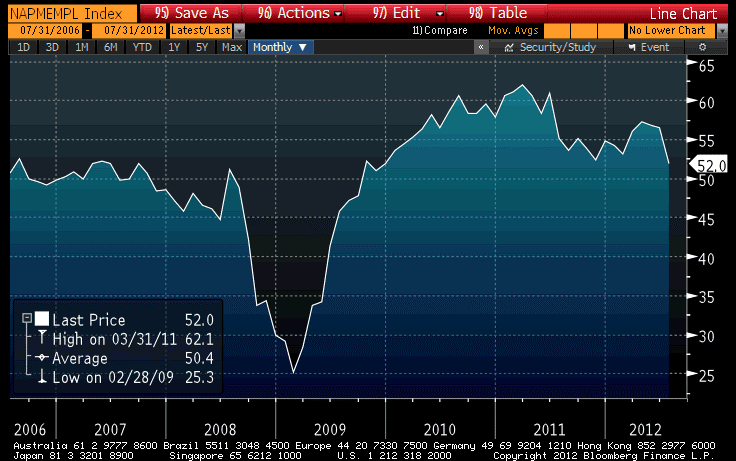
There is certainly no evidence yet that “activity is picking up on its own.” The ISM Manufacturing Index remained just barely on the shady side of 50.0, when a bounce was expected; this included a drop in the “Employment” subindex to the lowest level since the end of 2009 (see Chart below, source Bloomberg). The data will keep on coming, of course, but so far there haven’t been any signs of imminent dawn. Indeed, the Fed continues to see “significant downside risks” in the global economy.
I admit that I thought they would do something more than merely change the non-binding promise language, and I was surprised they did not. I thought they would cut the Interest on Excess Reserves (IOER) rate back to zero. That doesn’t mean, however, that I thought cutting IOER is the right thing to do. Monetary policy here is impotent with respect to growth, and while they can push inflation higher or lower with policy the move they should make is probably to start pulling back on liquidity once Europe is clear of danger. They should not wait until money velocity begins to rise again.
But that isn’t what they will do. The Fed doesn’t believe that it is impotent with respect to the Unemployment Rate, so even though they are firing blanks at a charging enemy with no apparent effect, I fully expect them to keep on firing. It’s odd, as an analyst, to try and get into the “Fed’s brain” and think intentionally wrong, but I suppose it’s what actors and actresses do when they’re getting into character. It’s just that my liberal arts education didn’t include a thespian turn.
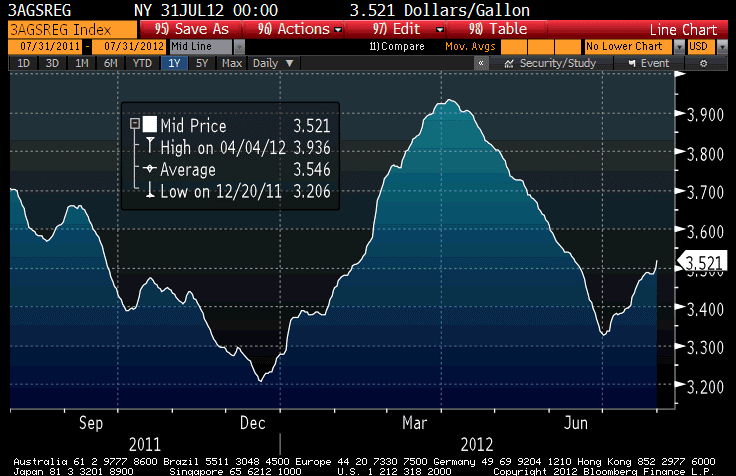
If I am in character as the Fed chairman, I’d be thinking it’s awfully dangerous to wait before firing my next blank bullet. Gasoline prices are back on the rise, with retail unleaded back above $3.50 (see Chart, source Bloomberg), joining agricultural produce. This means headline inflation, which currently appears tame, is unlikely to stay that way for very long. If the Fed wants to ease policy in late September, they may have to do it with less-accommodating price data.
It is possible that the Chairman is afraid to do anything unusual, like cutting IOER, unless he has a presser scheduled so that he can explain it to us poor benighted folk? This could be the case, but it doesn’t explain why they didn’t do anything.
Could it be that, with the ECB meeting tomorrow and that body very likely to ease more aggressively than the Fed anyway, that the Fed chief wanted to let Draghi ‘hold serve’? This seems strange, but it’s plausible.
In any event, investors seem to believe there is another monetary policy shoe to drop. While yields backed up slightly with 10-year yields +5bps (1.52%) and stocks dropped a trifle (S&P -0.3%), commodities actually rallied after the Fed announcement! Almost certainly, the market will get something from the ECB tomorrow, but I suspect stocks and bonds are clinging too desperately to that eventuality and I expect any rally on the news will be short-lived.
