Archive
Summary of My Post-CPI Tweets (March 2019)
Below is a summary of my post-CPI tweets. You can (and should!) follow me @inflation_guy. Or, sign up for email updates to my occasional articles here. Investors with interests in this area be sure to stop by Enduring Investments or Enduring Intellectual Properties. Plus…buy my book about money and inflation. The title of the book is What’s Wrong with Money? The Biggest Bubble of All; order from Amazon here.
- About 6 minutes to CPI. Consensus calls for 0.2% on core. The last few have been 0.20, 0.23, 0.18, and 0.24.
- y/y core should stay at 2.2% after rounding – We are dropping off 0.174% and it would take a really weak figure to push y/y lower and a really strong one to make it round to 2.3%.
- Last month, one of the big drivers was primary rents. Pundits saw last month’s CPI as very strong; I thought it was only slightly above expectations.
- It’s surprising to see the forecasts at 0.2% on core, actually, given the narratives about how strong that inflation figure was, and how it came from Rents that many forecasters are bearish on. I thought we’d see 0.1% forecasts.
- So we’ll watch primary rents of course, but I still think the trend in core goods is an interesting one to watch. Last month y/y core goods reached the highest level since 2013. Just barely out of deflation, but with the trade situation that’s where we want to watch.
- So, here we go. Good luck all.
- Yep, there we go. Core CPI only 0.11%, making the y/y 2.08%. Just when pundits were finally thinking inflation could be a “problem,” and stopped forecasting weakness…we get weakness!
- Last 12. You can see why people were worrying if you cover the last bar. But the uptrend was not as big as it looked. And we’re really just bumping along in the 2.1-2.3% zone on core.


- There are some interesting crosscurrents in this number. Remember how I said Rents were strong last month? They were again this month. Y/Y Primary rents rose to 3.51% from 3.43%; OER went to 3.32% from 3.21%. Lodging Away from Home another jump.
-
These guys are gonna take all the fun out of live analysis. 🙂 https://t.co/P5Sd3M0YOG
— Michael Ashton (@inflation_guy) March 12, 2019
- Other Goods and Services were +0.54% m/m, which is a big jump for a catch-all category. Worth drilling deeper. Medical Care and Recreation had big drops.
- Core Goods dropped to 0.1% y/y from 0.3%. A significant contributor there was a decline in CPI-Used Cars and Trucks, which fell to 1.1% from 1.6% y/y. That’s not as big a deal as you think. But it’s big enough to matter at the margin in core goods.

- Our model has core goods rising a bit further, and you can see that even a simple look like a correlation with core import prices suggests we should see a bit more. And with tariffs, hard to think the dip in core goods sticks.

- I mentioned Used cars and trucks fell, but New vehicles rose to 0.29% y/y from 0.04%, reversing last month’s decline. Overall, used and new together (which is 7% of CPI!) fell to 0.49% from 0.92%.
- Now let’s look at medical care. 1.73% y/y from 1.90% for the broad category. Medicinal drugs fell to -1.12% y/y from -0.36%. Again, core goods. Actually I wonder what core goods ex pharma and cars must have been doing so core goods only fell to 0.1% from 0.3% y/y!
- Now this is really interesting. Pharma as I said was negative, and is continuing an amazing trend. But think this looks amazing?

- Here’s what the pharma looks like in terms of level. Medicine prices have peaked? Is the move to biologics, which tend to be cheaper, accelerating and causing this? Or…

- …or is this just another period like 2012-2013, when we had a temporary slowdown (driven by medicare if I recall) but then caught up? FWIW, my guess is that this slowdown represents a real evolution in care, though I don’t think we’ve seen the end of pharmaceuticals.

-
That could be part of it, definitely. https://t.co/olh1fW7N2z
— Michael Ashton (@inflation_guy) March 12, 2019
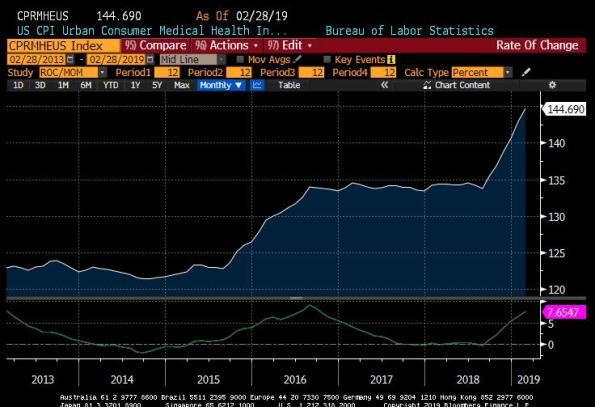
- Back to Medical Care: Professional Services fell to 0.97% from 1.16% y/y; Hospital and Related Services decelerated to 2.12% from 2.44%. This is helping hold down core services generally. But Health Insurance (which in CPI is a residual) rose smartly. Now 7.66% y/y from 6.46%.
- Here’s health insurance. Only 1.1% of CPI, which is one way you know it’s just a residual. CPI accounts for the increase in care costs mostly directly so this chart doesn’t show the full story of what’s happening in insurance. But it’s a cool chart.
- College Tuition and Fees rose to 3.13% from 2.93%. It has started to rise again partly because market returns were worse last year (60/40 was -2.4% and many other asset classes declined too).

- (When endowment returns suffer, tuitions accelerate. This is why we invented the S&P Target Tuition Inflation Index. https://us.spindices.com/indices/multi-asset/sp-target-tuition-inflation-index … )
- FWIW, Postage is +5.89% y/y. Not sure I would read a lot into that. 🙂

- Biggest declines on the month, with annualized rates of change: Car and Truck Rental (-57%), Jewelry and Watches (-34%), Leased Cars and Trucks (-18%), and Medical Care Commodities (pharma) (-11%).
- Biggest increases on the month, with annualized rates of change: Misc Personal Goods (52%), Men’s and Boys’ Apparel (50%), Infants’ and Toddlers’ Apparel (33%), Fuel Oil and Other Fuels (21%).
- This month we will again be reminded why looking at Median CPI matters. My guess at Median CPI is 0.26%, which would bring y/y back up to 2.78%. Won’t know for a few hours.
- Lest we think that inflation markets behave rationally…here are 10-year inflation swaps in red, against current median CPI. Calling for a lot of deceleration that we’re not seeing in the data yet.


- Core ex-shelter declined this month to 1.18% y/y from 1.39%. OK, so that’s one place we’re seeing deceleration. So you might say that inflation markets are betting on a serious deceleration in housing inflation.
- Well, we see a slowdown in OER, but not such a large one that long-term inflation swaps look fair.

- So for the cherry on top here are the four pieces charts. Each one is about a quarter of CPI, plus or minus, in order of least stable to most. First is Food and Energy.

- Second piece is core goods. Setback this month, but I’m not convinced that used cars and trucks are leading the way on this series at the moment.

- Core Services less Rent of Shelter. Here’s where the disinflationists need to make hay. And medical care inflation is helping them. Hard to see anything but a downtrend here at the moment.

- On the other hand, Rent of Shelter – the most stable component – continues to NOT COLLAPSE as some are expecting it to. Yes, shelter costs are outrunning wage growth. But not so much any more, thanks to accelerating wages.

- Actually, that wages/rents thing is a bit of a canard. Here is the Atlanta Fed’s Wage Growth Indicator vs Rent of Shelter. Wages have actually been keeping up fine with housing inflation. (& the increased cost of housing is one reason people are fighting for higher wages).

- In conclusion, until I think of something else: last month CPI wasn’t as strong as people thought; this month is isn’t as weak as people think. With interest rates soggy the risk of a serious inflation debacle in this stroke of the economic cycle is receding. However…
- …however, I do think that we are unlikely to see in the next recession anything like the dip we saw in the last recession. There’s a lot of good news in the figure right now. And when interest rates start to rise again, we’re going to see a higher high.
What if ‘Excess Reserves’ Aren’t Really Excess?
One intriguing recent suggestion I have heard recently is that the “Excess” reserves that currently populate the balance sheet of the Federal Reserve aren’t really excess after all. Historically, the quantity of reserves was managed so that banks had enough to support lending to the degree which the Fed wanted: when economic activity was too slow, the Fed would add reserves and banks would use these reserves to make loans; when economic activity was too fast, the Fed would pull back on the growth of reserves and so rein in the growth of bank lending. Thus, at least in theory the Open Markets Desk at the New York Fed could manage economic activity by regulating the supply of reserves in the system. Any given bank, if it discovered it had more reserves than it needed, could lend those reserves in the interbank market to a bank that was short. But there was no significant quantity of “excess” reserves, because holding excess reserves cost money (they didn’t pay interest) – if the system as a whole had “too many” reserves, banks tended to lend more and use them up. So, when the Fed wanted to stuff lots of reserves into the system in the aftermath of the financial crisis, and especially wanted the banks to hold the excess rather than lending it, they had to pay banks to do so and so they began to pay interest on reserves. Voila! Excess reserves appeared.
But there is some speculation that things are different now because in 2011, the Basel Committee on Banking Supervision recommended (and the Federal Reserve implemented, with time to comply but fully implemented as of 2015) a rule that all “Systematically Important Financial Institutions” (mainly, really big banks) be required to maintain a Liquidity Coverage Ratio (LCR) at a certain level. The LCR is calculated by dividing a bank’s High Quality Liquid Assets (HQLA) by a number that represents its stress-tested 30-day net outflows. That is, the bank’s liquidity is expressed as a function of the riskiness of its business and the quantity of high-quality assets that it holds against these risks.
In calculating the HQLA, most assets the bank holds receive big discounts. For example, if a bank holds common equities, only half of the value of those equities can be considered in calculating this numerator. But a very few types of assets get full credit: Federal Reserve bank balances and Treasury securities chief among them.[1]
So, since big banks must maintain a certain LCR, and reserves are great HQLA assets, some observers have suggested that this means the Fed can’t really drain all of those excess reserves because they are, effectively, required. They’re not required because they need to be held against lending, but because they need to be held to satisfy the liquidity requirements.
If this is true, then against all my expectations the Fed has, effectively, done what I suggested in Chapter 10, “My Prescription” of What’s Wrong with Money? (Wiley, 2016). I quote an extended section from that book, since it turns out to be potentially spot-on with what might actually be happening (and, after all, it’s my book so I hereby give myself permission to quote a lengthy chunk):
“First, the Federal Reserve should change the reserve requirement for banks. If the mountain will not come to Mohammed, then Mohammed must go to the mountain. In this case, the Fed has the power (and the authority) to, at a stroke, redefine reserves so that all of the current “excess” reserves essentially become “required” reserves, by changing the amount of reserves banks are required to hold against loans. No longer would there be a risk of banks cracking open the “boxes of currency” in their vaults to extend more loans and create more money than is healthy for an economy that seeks noninflationary growth. There would be no chance of a reversion to the mean of the money multiplier, which would be devastating to the inflation picture. And the Open Markets Desk at the Fed would immediately regain power over short-term interest rates, because when they add or subtract reserves in open market operations, banks would care.
“To be sure, this would be awful news for the banks themselves and their stock prices would likely take a hit. It would amount to a forcible deleveraging, and impair potential profitability as a result. But we should recognize that such a deleveraging has already happened, and this policy would merely recognize de jure what has already happened de facto.
“Movements in reserve requirements have historically been very rare, and this is probably why such a solution is not being considered as far as I know. The reserve requirement is considered a “blunt instrument,” and you can imagine how a movement in the requirement could under normal circumstances lead to extreme volatility as the quantity of required reserves suddenly lurched from approximate balance into significant surplus or deficit. But that is not our current problem. Our current problem cries out for a blunt instrument!
“While the Fed is making this adjustment, and as it prepares to press money growth lower, they should work to keep medium-term interest rates low, not raise them, so that money velocity does not abruptly normalize. Interest rates should be normalized slowly, letting velocity rise gradually while money growth is pushed lower simultaneously. This would cause the yield curve to flatten substantially as tighter monetary conditions cause short-term interest rates in the United States to rise.
“Of course, in time the Fed should relinquish control of term rates altogether, and should also allow its balance sheet to shrink naturally. It is possible that, as this happens, reserve requirements could be edged incrementally back to normal as well. But those decisions are years away.”
If, in fact, the implementation of the LCR is serving as a second reserve requirement that is larger than the reserve requirement that is used to compute required and “excess” reserves, then the amount of excess reserves is less than we currently believe it to be. The Fed, in fact, has made some overtures to the market that they may not fully “normalize” the balance sheet specifically because the financial system needs it to continue to supply sufficient reserves. If, in fact, the LCR requirement uses all of the reserves currently considered “excess,” then the Fed is, despite my prior beliefs, actually operating at the margin and decisions to supply more or fewer reserves could directly affect the money supply after all, because the reserve requirement has in effect been raised.
This would be a huge development, and would help ameliorate the worst fears of those of us who wondered how QE could be left un-drained without eventually causing a move to a much higher price level. The problem is that we don’t really have a way to measure how close to the margin the Fed actually is; moreover, since Treasuries are a substitute for reserves in the LCR it isn’t clear that the margin the Fed wants to operate on is itself a bright line. It is more likely a fuzzy zone, which would complicate Fed policy considerably. It actually would make the Fed prone to mistakes in both directions, both over-easing and over-tightening, as opposed to the current situation where they are mostly just chasing inflation around (since when they raise interest rates, money velocity rises and that pushes inflation higher, but raising rates doesn’t also lower money growth since they’re not limiting bank activities by reining in reserves at the margin).
I think this explanation is at least partly correct, although we don’t think the condition is as binding as the more optimistic assessments would have it. The fact that M2 has recently begun to re-accelerate, despite the reduction in the Fed balance sheet, argues that we are not yet “at the margin” even if the margin is closer than we thought it was previously.
[1] The assumption in allowing Treasuries to be used at full value seems to be that in a crisis the value of those securities would go up, not down, so no haircut is required. Of course, that doesn’t always happen, especially if the crisis were to be caused, for example, by a failure of the government to pay interest on Treasuries due to a government shutdown. The more honest reason is that if the Fed were to haircut Treasuries, banks would hold drastically fewer Treasuries and this would be destabilizing – not to mention bad for business on Capitol Hill.
