Archive
Growth-Sapping Effect of the Minimum Wage
I just saw this interesting article in Econbrowser called “New estimates of the effects of the minimum wage.” It is both good news, and bad news.
It is good news because it clarifies a debate about the effect of the minimum wage which has been raging for a long time, but without much actual data. This article summarizes a clever approach by a couple of academic economists to examine the actual effects of increasing the minimum wage. The research produces solid numbers and confirms some theories about the effects of the minimum wage.
The bad news is that the effect of the minimum wage is just what theory says it should be, but liberal politicians have insisted isn’t true in practice. And that’s a net negative effect on overall welfare, albeit divided between winners and losers. However, even that ought to be good news, because this analysis also means that we can reverse the policy and reap immediate gains in consumer welfare.
First, the theory: microeconomics tells us that an increase in the minimum wage, if it is above the equilibrium wage for some types of labor, should decrease employment while increasing the wages of those who actually retain their jobs. (The usual argument for increasing the minimum wage is that the people who earn minimum wage aren’t making enough to live on, and supporters tend to forget that if people lose their jobs because the minimum wage is raised, then those people are making even less.) We often say things are “Econ 101,” but this really is Econ 101 in the sense that it is taught in every introductory economics class. There is no excuse not to know this:
 In the chart above, the supply of labor is S and the demand for labor is D. In the absence of a floor (minimum wage), the clearing wage and quantity of jobs is at the intersection; at a minimum wage of a, however, there is a shortage of jobs equal to c-b. If the minimum wage is raised to a’, then the shortage of jobs increases to c’-b’. The question for society is whether the increase in joblessness is an acceptable cost to accept, in order to increase the minimum wage from a to a’. (Of course, the political calculation might also include the fact that people who become unemployed will be supported by the welfare state, and potentially vote to preserve and expand those public institutions that constitute it).
The problem for those who argue against the minimum wage, or for it being increased, is that they can point out this economic truism until they are blue in the face, while the other side simply says “nuh-uh” and denies it is true with the same fervor that they insist that Obamacare has actually lowered premiums and deductibles. The façade only cracks, maybe, when actual data is presented that shows the argument to be bankrupt.
This academic study does that cleverly, by examining changes in employment and wages in states where the federal minimum wage was binding (because the state minimum wage was lower, or non-existent) and states where it was not binding (because the state minimum wage was higher, so the federal minimum wage didn’t matter). Their conclusion:
“Over the late 2000s, the average effective minimum wage rose by 30 percent across the United States. We estimate that these minimum wage increases reduced the national employment-to-population ratio by 0.7 percentage point.”
That’s the sterile conclusion. Now let’s count the cost. Between July 2007 and December 2009, the national employment-to-population ratio (which is similar to, but not the same as, the labor force participation rate) declined from 62.7% to 58.3%; it has since risen to 59.2%. As the chart below (source: Bloomberg) shows, the labor force participation rate (in yellow) shows a more gradual decline but no recovery – as has been well-documented.

Now, some numbers. In November, the Civilian noninstitutional population (the denominator for the employment-to-population rate) was reported by the Bureau of Labor Statistics (BLS) to be 248,844,000. That means that if the authors are correct, the minimum wage has boosted the wages of unemployed workers at the bottom of the scale at the cost of about 1.74 million jobs (0.007 * 248,844,000).
Imagine what having another 1.74 million workers would do for GDP? Do you think it could make a difference for one of the worst recoveries on record?
It probably isn’t fair to assume that all of those 1.74 million workers is currently “unemployed” by the BLS definition. Many of them are likely not looking for work, in which case they would not be counted as unemployed. It is interesting to note, although surely spurious, that the series “Not in Labor Force, Want a Job Now” is about 1.7 million higher than would be expected given the unemployment rate (see chart, source BLS).
 Alternatively, we could consider what it would mean to the Unemployment Rate if those 1.74 million workers were employed. This means they would also be in the Civilian Labor Force, so the participation rate (see above) would be 63.5% rather than 62.8%. If instead of coming from the “Not in Labor Force, Want a Job Now” group they came from the “Unemployed” group, the Unemployment Rate would be 4.7% instead of 5.8%. (Personally, I think that most of them are probably in the former category, as the Unemployment Rate has declined at approximately the rate we would expect from past recoveries, despite tepid GDP growth.) That is not inconsistent, of course, if GDP growth is lower because the labor force is simply smaller than it should be – and that is exactly the implication of this bit of research.
Again, the good news is that we can help the country and the downtrodden “structurally” unemployed with the same simple policy: reverse all increases in the Minimum Wage that have happened since 2007.
Make Hay While the Sun Doesn’t Shine
Today new Fed Chairman Janet Yellen jumped on the bandwagon in blaming the recent growth slowdown on the weather.
Here’s what I have to say about the news and the weather.
First, although it’s becoming quite passé to point this out, the weather should account for a slowdown in economic activity – but, since economists were aware of the weather (presumably), it is less clear that it should account for a surprise in the amount of slowdown we are seeing. The chart below (source: Bloomberg) shows the Citibank economic surprise index, which measures how much recent data have exceeded (positive) or fallen short (negative) of expectations. It is not a measure of growth, per se, but merely of the direction in which economists are missing. I have plotted both the US index and the Eurozone index.
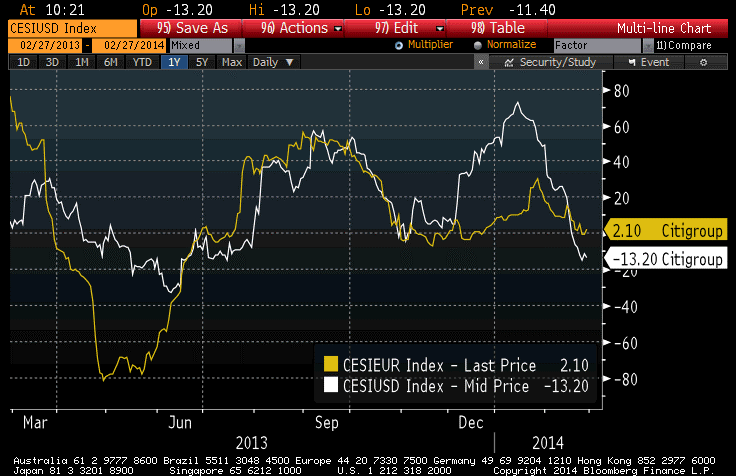
Obviously, economists were far too pessimistic about the numbers in December and January (reflecting data from October to December, and data kept exceeding their estimates. But now they are over-exuberant. So it isn’t that the numbers are falling short; it’s that they’re falling short of where economists (who can presumably recognize snow) thought they would be incorporating the known weather drags. That could simply mean the weather had a worse impact on real people than the bow-tied set thought it would. Or it could mean data is weaker than it ought to be.
Second point: just because the weather was bad should not be taken as carte blanche for the economy to collapse. If the economy was really as strong as equity investors seem to think, should weather be able to derail it so easily? Yes, weather makes it harder to detect the natural rhythm of what is going on, but it wasn’t as if that was easy to begin with. The danger is, as I suggested a week and a half ago, when all news can only be neutral or good. That’s a bad sign for once the weather normalizes again and it gets impossible to shrug off bad news as easily.
Third point: was the weather as bad in Europe? Because, as you can see from the chart above, economists have also been missing on the optimistic side for European figures. To be sure, they’ve been missing by less, and the numbers surprised less on the positive side over the last couple of months, but I don’t know that the Polar Vortex ought to be affecting Italy as seriously as it is affecting Chicago.
All of which is simply to say that the weather isn’t going to be bad forever, so … make hay while the sun doesn’t shine, I guess. Stocks are flat on the year, the hard way (but commodities are +6.5%, measured by the DJ-UBS index; according to our valuation estimates, that should be the normal case over the next few years rather than the rarity it has been over the last few).
It is interesting, too, that as bad as the weather effect has been on the construction industry and sales it hasn’t really impacted the price dynamics at all. The chart below (source: Bloomberg) shows Existing Home Sales in white, and the year/year change in median sales prices of existing single-family homes. Sales are 14% off their highs (seasonally-adjusted, which you should take with a grain of salt due to the unseasonal weather, but notice that the decline started in August when the snow was appreciably lighter), yet prices are still rising at nearly 11% year/year.

Now, a housing bull will say that these are the opposite faces of the same coin. They would say, “because there is so little inventory available – according to the NAR, only 1.9mm homes are for sale, which is higher than last winter but otherwise the lowest since 2002 – prices are rising and fewer are being sold because of the shortage of supply.” This is certainly possible, although I wonder at where all of the ‘shadow supply’ and bank REO property got off to so quickly, especially since the pace of existing home sales (and new home sales) remain at such low fractions of the pace prior to 2007 (existing home sales is currently 64% of the peak rate in 2005; new home sales are at 34% of the 2005 peak). How do you get rid of inventory without selling it?
The housing market continues to be a conundrum, but without a doubt prices are rising. And, also without a doubt, rising home prices are beginning to push rents higher. More economists are raising their forecasts for core inflation looking forward over the next year. Of course, readers of this column know that this is old news here. Speaking of which, Enduring Investments’ Quarterly Inflation Outlook for Q1 has been published. Institutional investors and others interested in our services can register for this private report on our website by filling out the contact form and requesting access to the blog.
Finally, I want to make one observation about the complete impotence of the Republicans to respond to the Democrats’ push for a higher minimum wage. It is terribly distressing to see such bad economics from one party (in this case, the Democrats) and such utter lack of common sense responses to bad economics from the other party (in this case, the Republicans). Here is the only question that needs to be answered: if raising the minimum wage has only salutatory effects on the economy and on the working class, then why not raise it to $1000/hour? Why not $10,000 per hour? Surely, if raising the minimum wage is good, then raising it more can’t be bad. Republicans should be amending the bill to make the minimum wage $10,000/hour.
The obvious answer is that if the minimum wage was $10,000/hour, no one would hire anybody – and we all know that, and even Democrats know that, and we all know why: because there is almost no one in the country who can produce enough goods or services to be worth $10,000/hour. If you are hiring people, you have to decide whether you will get enough out of them to afford their labor and still stay in business. The answer is obvious at $10,000. But it’s the same question at $10: can this group of workers produce enough so that I can afford to pay them all $10? If not, they will not be earning $10/hour but $0/hour (or at least some of them will be). We know exactly what would happen with a $10,000/hour minimum wage, and it’s easy to demonstrate it. But the Republicans are absolutely inarticulate on this point, and on most points, and that is why they keep losing arguments where they have the stronger position.
Housekeeping Note: earlier this week I published an article on the Mt. Gox/bitcoin fiasco. If you didn’t see the note (it didn’t get out on all of the syndication channels), you can find it here.
