Archive
Royally Skewed
Although commodities do occasionally crash, in general commodity prices are positively kurtotic (fat-tailed) and positively skewed. This is in contradistinction to equity prices, which are positively kurtotic but negatively skewed. In English, that means that both stock prices and commodity prices crash more than we would expect them to if price changes were random, but while stocks tend to crash down, commodities tend to crash up.
The reason for this is simple: commodity supply curves become very inelastic (steeper) when the level of actual, current inventory is fully allocated. There are only so many soybeans available right now. But at low levels of demand and lower prices, the supply curve gets more and more elastic (flatter), which means large declines in demand don’t drop prices as sharply as large increases in demand can increase them at the other end of the curve.
The practical import of this observation is this: one must be more careful shorting commodities than shorting stocks, because while a bull market in stocks can grind you to death, a bull move in commodities can rip you to suddenly to shreds (the fact that in a limit up market there is literally no price at which you are allowed to cover, while this situation rarely exists in equities, means that market infrastructure contributes to the danger).
Today, this lesson was made painfully when energy markets jumped about 6%. This was no ‘dead-cat bounce,’ which often follows a sharp move down. Last Thursday and Friday, NYMEX Unleaded dropped about 23 cents. Today, it rallied back 20 cents. The reason? Well, there was a rumor that NATO was bombing Libya, but that can hardly be surprising can it?
The bounce in Silver was more like 7%, but in the context of the 1/3 decline over the last week or so that really may be a ‘dead cat’ bounce. Silver really had gone too far too fast, and while I think at the current levels it is probably a reasonable wager I wouldn’t expect (or want) it to rally sharply back to the highs. As I said last week, commodities are generally in bull trends over the last year because of the oversupply of dollars in the market relative to “stuff.” But that is both a reason to rally and a speed limit. If the amount of money in circulation goes up 10%, commodity prices shouldn’t be doubling. I continue to be a commodity bull (although I invest through indices where there is some expectation of positive returns from rebalancing effects, rather than directly into specific commodities), but a patient one.
.
Skewness and kurtosis, in addition to being great cocktail-party words, are also important concepts for investors to understand. More specifically, it is important for investors to think carefully about the difference of the “higher moments” (as skewness and kurtosis are sometimes collectively called) between asset classes and particular investments. Given a choice between two investments with the same expected return and variance, a long-only investor should always choose the one with ‘fat tails’ on the upside rather than the one with ‘fat tails’ on the downside. This is true for two reasons. First, the marginal pleasure of a gain, for most investors, is lower than the marginal pain of a loss, and this is increasingly true for large gains and losses. Second, a large gain increases the bankroll, but a large loss can be a portfolio-ending experience. All of the rules about long-term investing are based on the assumption that the long term can be reached – or, as Warren Buffett has said, one “-100%” really messes up any series of portfolio returns.
Recently, in a great customer letter called “Five fallacies about inflation (and why global policy rates are too low),” Markus Heider, Jerome Saragoussi, and Francis Yared of Deutsche Bank made some very adroit observations about the risks of inflation going forward. The quick summary is that they see inflation as the greater risk than deflation because 1. The output gap is smaller than suggested by the high unemployment rate; 2. A negative output gap does not imply declining inflation [frequent readers know I harp on this a lot]; 3. EM countries are exporting inflation rather than disinflation; 4. Commodity price inflation is becoming structural and is exacerbated by low global real policy rates; and 5. Central banks’ credibility is at risk of being eroded.
But the single best part of the report, in my opinion, is the chart they created to summarize the effect of their views on the distribution of possible inflation outcomes going forward. That chart is below (reprinted with permission):

Deutsche Bank's chart showing their assessment of how the distribution of inflation outcomes has probably changed. Used with permission.
In short, the higher expected value, flatter distribution, and fat upper tail combine to make long-inflation bets worthwhile even if they are somewhat expensive right now. This is one reason that TIPS are seemingly egregiously priced. It’s all about the skew. If we don’t get inflation, we probably bounce around between 1% and 3% inflation for a while. If we do get inflation, it could get ugly. Therefore, it makes sense to give up some current return to ‘buy the tail option.’ I agree, and think their picture is truly worth a thousand words. (I still think that TIPS are too expensive for my taste even with this fact, but it is the reason I was willing to be long them when 10-year real yields were as low as 1%. It’s just a harder call at 0.65%!).
I highly recommend you contact your Deutsche Bank contact to get a copy of this report (from April 1). Honestly, while the overall state of inflation research is clearly better now than it was, just a few years ago, these guys at DB seem to me to have some of the most consistently high-quality research in the space.
.
The rally in equities (0.5%) and commodities comes with the caveat of occurring on low volume. I am clearly less sanguine about the former rally continuing than I am about the latter rally. Bonds also rallied slightly again today, with the 10-year yield falling to 3.14%. That is the rally that is a serious head-scratcher to me right now. I guess it is part and parcel with the current optimism that the Fed has engineered a recovery – at least, a modest one – without serious signs of widespread inflation in the sticky prices. But if I think about ways that optimistic assessment is likely to prove to be inaccurate, it seems to me that it is far more likely that the outcome is going to be much worse (in terms of the growth and inflation mix) than investors/economists currently expect, rather than much better.
In other words…I think we’re skewed.
Three-Theme Monty
Friday saw development of all three major themes the markets are struggling with: domestic economic conditions, the commodity rally/rout, and the Euro sovereign crisis.
In the U.S., the Employment data was not terribly encouraging overall. Payrolls exceeded expectations, with a reported 244,000 new jobs, but the Unemployment Rate rose to 8.960% from 8.828% (so reported as 9.0% vs 8.8%). Some of the “internals” that had previously been concerning remain so. The labor force participation rate again failed to improve and remained at 27-year lows (64.2%); one metric I watch, shown in the chart below, is the number of respondents who are “Not In Labor Force, Want A Job Now.” Remember, you’re not in the labor force if you haven’t recently looked for work, so these are people who aren’t technically in the labor force but would quickly get to that point if there was a sign that there was a suitable job available for them. That number is still rising:

It is hard to perceive this as a serious recovery until the "want a job now" numbers drop a lot!
So the employment report wasn’t exactly a strong number. However, the market had seemingly braced for a very weak print after Initial Claims and the somewhat soft ADP earlier in the week, and this wasn’t a bad figure at that.
The resulting trade was obvious: stocks rallied strongly, bonds dipped, and commodities were recovering. NYMEX Crude, which had dipped below $95 in the morning, traded briefly above $102.
Then a well-timed rumor circulated that Greece would call an emergency meeting this weekend and leave the Euro, and … the dollar started to rally, stocks rolled over, bonds shot higher, and commodities faded. How very fortunate for the wrong-footed on Friday that rumor started when it did! The rumor was ostensibly related to a Der Spiegel report that Greece is considering withdrawing from the union. Well, of course they’re considering that, and no doubt have been considering that for months; only fools wouldn’t have thought of that as a possibility especially since the rest of the Eurozone is being fairly unhelpful (hiking interest rates, for example). But there’s no way that they’re very close to that decision, because the issue hasn’t yet been forced.
Like most “successful” rumors, this one had some seemingly-confirming facts. The euro-area finance ministers did in fact call a meeting for Friday, and there was no doubt that Greece would be on the menu. After the meeting, the group’s chairman Jean-Claude Juncker said “We think that Greece does need a further adjustment program…We’re not discussing the exit of Greece from the Euro area. This is a stupid idea – no way.” They might “require” (translation: ask nicely) collateral from Greece for further aid. This is an interesting thought. What status does “collateral” pledge by a sovereign nation to another body have, really? Suppose Greece pledged collateral, and then decided to default. Someone from the EU calls up and says “we’re foreclosing on the Acropolis.” How exactly are they going to enforce that? Send troops?
Greece is surely mulling how an eventual exit from the Euro would work, but they won’t do it with EU approval, unless it’s presented as a fait accompli (we’re resigning, so you ought to make it look like you agreed). To let Greece “voluntarily” leave the EU would destroy one of the main pieces of EU rhetoric: that the union is irreversible. Now, I think that Greece leaving will eventually happen (although I’m not sure why it would necessarily weaken the Euro), but not until they’ve tried a couple of other things. And in the meantime, the implicit threat is a great bargaining chip. From the same story linked to above, the budget spokesman for German Chancellor Merkel’s party said “We’ll just have to bite the bullet. We need to help Greece help itself. What’s the alternative? We don’t want to be pushed over the edge into restructuring.”
Nice negotiating tactic there, sir. Be sure to tell them they hold all the cards!
In any event, although the weekend has subsequently shown the folly of the rumor, it was enough on Friday to rally the dollar index about 1% and drop Crude from the $102 level back to $97.18. Bonds ended up slightly on the sunny side of unchanged (3.15% on the 10y note). Stocks touched unchanged but eked out an 0.4% gain to end a rotten week.
Now that we know the rumor was false it will be interesting to see what Monday brings. I find it fascinating that after one day of serious commodity correction on Thursday – and a few more days of the unwind of the silver bubble, the “I told you so” columns started flying thick and fast on Friday. Personally, the lesson I think commentators should have gleaned from the Flash Crash one year ago was this: if you’re going to say I told you so, you ought to wait and see if the drop lasts at least a week!
And perhaps it will. The technical damage done to the commodity indices over the last couple of days is pretty ugly. But the commodity indices, unlike stock indices, are pretty heterogeneous, as I discussed back in April. I wonder if I’d rely as much on technical analysis for an index that is an amalgamation of disparate elements. I think sellers here have the fundamentals wrong, because the commodity rally isn’t a supply/demand thing but a supply-of-paper-currency thing; nevertheless, I’d be cautious about increasing positions until some sign of ebbing downward momentum occurs.
One of the biggest arguments for being in commodities right now remains: as protection against inflation, there are not many attractive alternatives. With TIPS around 2%, it’s a different story; with 10y TIPS at 0.66%, I’m willing to accept some possible commodities downside rather than accept the almost-certain (mark-to-market) downside of TIPS.
There is no economic data scheduled for Monday, so the main thrust of the session will be sorting through what didn’t happen this weekend. Indeed, there isn’t a lot of data-driven excitement until Thursday’s Initial Claims and Friday’s CPI report, so keep an eye on the commodity and currency markets from whence the headlines (both real and imagined) will flow for the first part of this week.
I find myself modestly bearish on stocks (what else is new?) but not concomitantly bullish on bonds. I feel like bonds have come a long way since the 3.60% of early April and I don’t expect the data to weaken as severely as bond buyers seem to expect. Along with that we must keep in mind that the biggest buyer is preparing to exit the stage, and while the Fed is sanguine about that eventuality I don’t think that seems rational. I’ve watched bond markets fall apart with a lot less selling than the trillions the Treasury will be offering without a pre-packaged buyer waiting with bids in hand.
Piñata Markets
The fast money giveth, and the fast money taketh away.
A surprisingly weak Initial Claims figure today – although partially explained by the Labor Department as being affected by the “New York spring break holiday,” a new emergency benefits program in Oregon, and auto shutdowns downstream from the Japan disaster – unleashed the hounds on the inflation markets (especially) today. Economists (who ought to be able to incorporate known holiday, legislative, and production calendars into their forecasts, but I suppose that’s asking too much) had seen a decline to 410k, but the actual print was 474k.
In an extremely rare show of maturity, equities declined but investors there seemed to understand this for what it is: not good news, of course, but with ADP just behind and Employment just ahead, and the number buffeted by unusual factors, probably not something to overreact to. Yes, growth appears to be slowing and economists’ ebullient 2011 estimates are likely going to have to come down (but this has always been fairly obvious). But no, this one number is not the sign that the double-dip is upon us. Yet. (Stocks, though, are valued such that they have plenty of room to decline even with good news, so I’m not saying I’m bullish on them!) The S&P was down only 0.9% on the day.
Bonds rallied with a little more fervor, with the 10y yield down 6bps to 3.16%, but it was the commodities markets that speculators immediately started treating like a Cinco de Mayo piñata. Silver has been beaten up for days now, and that certainly didn’t change (it was down another 11%), but today Crude also fell 11% to drop below $100/bbl and Gasoline dropped 8.5%. Grains and Softs were “only” down 2.5%; the DJUBS Livestock index was actually roughly unchanged. It was, in short, the larger and more-liquid contracts that saw the most pressure, a possible hallmark of leveraged players selling.
These movements in commodities are clearly growth-scare reactions, and the speed and severity of them suggest that they had considerable hot money in them. There is every reason for a growth scare – but that is not a great reason to hate commodities here. Gold is not where it is because of industrial demand, nor is Silver. Those are the clearest examples, but for commodities of all kinds it is the case that they aren’t elevated because of robust global growth or prospects of the same.
Investors often make the mistake of looking at commodities in nominal terms. Well, they make that mistake about all assets, but particularly in the case of commodities it is plain wrong to do so. Commodities are not valued like financial assets, as the present value of future cash flows. There are no cash flows. Commodities are “stuff,” and part of their movement is due to the continually-changing exchange rate between money and real stuff…that is, the depreciation of the value of the currency (aka inflation, technically). When real variables – demand and supply – change, then the real clearing price of a commodity changes. But the nominal value may not.
Consider this contrived example. Suppose that the demand for oil drops 20% against unchanged supply, but the value of the dollar drops 90%. In that case, the nominal price of oil is most assuredly going to rise in terms of dollars, even though it will fall once that price change is adjusted for the change in the buck’s value. Now, practically speaking this becomes a little circular, because I don’t mean the dollar’s value in foreign exchange markets, but the dollar’s intrinsic value against stuff. However, this is meant to be illustrative: as I have said for a couple of years now, if you want to reduce mortgage defaults, add a zero to the currency and the nominal price of houses will skyrocket. It won’t change real values at all, but it will change nominal values.
This is a very important distinction because commodities aren’t at these levels simply because of the demand/supply dynamic. That’s part of it, of course, but the nominal price is where it is mostly because there are so very many more dollars out there. Again, measuring the intrinsic value of a commodity is problematic and circular, but there can be no doubt about the direction. The unanimity of the commodities market rally after the late August announcement of QE2 was not due to growth expectations. It was due to an understanding of what that program would do to the supply of currency compared to the supply of stuff.
So, technicians see the commodity rally as overextended, and to some degree they’re certainly right. The fact that there is so much fast money coming out right now is an indication of how much of it was in! But the fundamental underpinnings of the commodity rally have very little to do with growth. Even if we were still in recession, commodities would still be much higher today than they were 2 years ago.
My biggest fears about commodities are that the Fed might actually get religion and start draining the money in the way they keep warning us they will. While I think that’s fairly unlikely, it would definitely make commodities look less attractive relative to currency. However, weak numbers like we have seen recently actually tend to delay any such occurrence, because the Fed is not going to start pulling back on liquidity when Initial Claims are rapidly rising, no matter what the reason for that rise. Ironically, I think that today’s numbers if anything tend to defer the day of reckoning for commodities.
That doesn’t change the fact that the technical charts abruptly look poor, so that fast money is going to now do an about-face and sell to the real money guys. The thing is, the real money guys will keep buying because other asset classes don’t offer anything worthwhile in either outright or relative value, and eventually the long-term real money guys will win.
This is less true in TIPS, because they are about to lose the Fed as a buyer and that could change the price dynamics even though real money are steady long-term buyers. Today, however, even with nominal bonds up, TIPS declined. This again is consistent with some fast-money exit as well as the notion of a growth scare. The front of the curve got smoked, with Jan 12s selling off 37bps, Apr 12s 20bps, Jul 12s 16bps, and Apr 13s 9bps. Remember, this was with nominal Treasuries rallying, so the blood was running in the streets especially in the front of the curve. This isn’t wholly surprising; in mid-March I pointed out that the short end of the TIPS curve was incorporating somewhat aggressive expectations of core inflation and longs there were likely to be eventually disappointed. TIPS trading being what it is, the disappointment tends to be meted out in great big dollops rather than trickling in.
The TIPS curve, however, is still mighty rich, with 10y real yields at 0.68%. The only value there is if your alternative is to hold nominal 10y Treasuries at 3.16%. Sheesh. The inflation swaps curve got trashed (the necessary residual of a rallying nominal market and a sliding linker market), with 3y inflation -13bps to 2.48%, 5y -11bps to 2.57%, and 10y -6bps to 2.78%. Those are not at all outrageously expensive levels given the distribution of possible inflation outcomes in the future – I will have more to say about that distribution (probably on Monday).
The shape of the swaps curve and normal seasonal patterns imply calendar year inflation of 3.7% in 2011, 1.8% in 2012, and 2.5% in 2013 before rising to 3% in 2018 and leveling out after that. That seems to me to be too sanguine about 2012, surely!
.
After a very exciting Thursday, what can Friday possibly offer? Well, how about the Employment Report? The consensus for Payrolls is down to 185k (vs. 216k last), with unchanged Hours Worked and an unchanged Unemployment Rate at 8.8%. Forecasting the Unemployment Rate recently has been the killer for prognosticators; while the Rate is usually the steadier of the two numbers this has not recently been the case.
All I know is that, given the rally in bonds today, there is a lot more potential downside than upside. No one took off their long duration risk today! It either means that Employment doesn’t matter to investors at this stage, which is possible given the geopolitical situation but inconsistent with the massive beating administered to growth plays recently, or it means that the market is betting on weaker data. To the extent that is true, the best play is to lean the other way despite the technical break to lower yields today.
Banks For The Memories
Trading continues to be lethargic. This isn’t just true of this week – Employment weeks can be notoriously quiet – but of markets generally over some period of time. NYSE Composite total volumes haven’t exceeded 1bln shares this quarter, the longest streak of failing to do so in many years. One reason that the VIX (equities), the MOVE (Treasuries), and other volatility indices are so low is not complacency – although there is some of that as well – but the fact that the realized moves have been so small for so long that it is just too hard for an options trader to keep a long position subject to the drip, drip, drip of time decay. When I first got into the markets and was trained as a technical analyst, we considered this ‘coiling’ and a sign that a big move was near. That may no longer be true. It may simply be that the market has lost enough liquidity, due to Dodd-Frank, rules about naked shorting, and capital constraints, that volumes and volatility are moving to a lower equilibrium.
This is, of course, bad news for the banks. We have noted this week how banks are being forcibly under-levered because of the excess reserves in the banking system. That’s one element of the DuPont model. Lower volumes are a second component. Unless banks can charge much fatter margins (and the chance of that is the only thing that’s fat), earnings are doomed to decline. This has been apparent for a long time, but for a while these companies can keep hitting targets by drawing down reserve accounts (evidence the trend over the last year to sharply reduce credit reserves, supposedly because of improved default experience). The mathematics in the long run are powerful, however, and this is a big reason that while the S&P has recovered 75% of its 2007-2009 decline, the NASDAQ Bank Index has recovered only 28% of its dive (see Chart).

For all the tender mercies of the central banks, the non-central banks are still weak.
No one cries for the banks. But healthy banks matter. I present the chart above not to bury the banks but to point out how poorly they’ve done even with the Fed, ECB, and other monetary authorities working very hard to engineer a very steep yield curve – historically, the way that banks have gotten healthy again after bad periods. It isn’t American banks only that remain weak (and by weak, I don’t mean so much the balance sheet. The balance sheets have definitely improved, but the long-term growth rate of the company is what allows them to bear up in a crisis and recover after it. It’s the economic strength, not the accounting strength, I’m talking about here). European banks have similar issues, and that matters because they’re also all stuffed with dicey sovereign debt that is allowed to be carried at par. We are, indeed, much closer to a second banking crisis than we would like to think, and this is the significance of comments like those last week from ECB Executive Board member José Manuel González Paramo. In discussing the possibility of simply restructuring Greece’s sovereign debt – never mind default – he said “Any debt restructuring would imply the breach of legal obligations, which most likely would have a more negative systemic effect than the Lehman catastrophe.” One reason for this is that the banks and the ECB both own lots of Greek paper considered legally to be worth par. And there’s no way it’s really worth par. To a strong banking system, a Greek default or restructuring would be damaging but survivable. In the banking system’s current state? Paramo may not be far wrong.
It would help banks to strengthen, of course, if the economy were to continue to strengthen (it would also help them if inflation rose, because that would increase the value of loan collateral, such as housing, that currently provides insufficient coverage for loan exposures). Today’s economic data in isolation are not encouraging on that score. The ADP number was soft, although close enough to expectations at 179k (198k was expected). More surprising was the Non-Manufacturing ISM report, which printed 52.8 versus expectations for 57.5. The Non-Man ISM is not usually a market-mover, but this big of a miss had some market repercussions. I was right that the markets had more downside than upside: stocks lost 0.7% while 10y notes only rallied 3bp to 3.22%.
A time-series chart of the Non-Man ISM is below. The number returned essentially to last February’s level, mainly because of a sharp decline in the New Orders subcomponent to 52.7 from 64.1
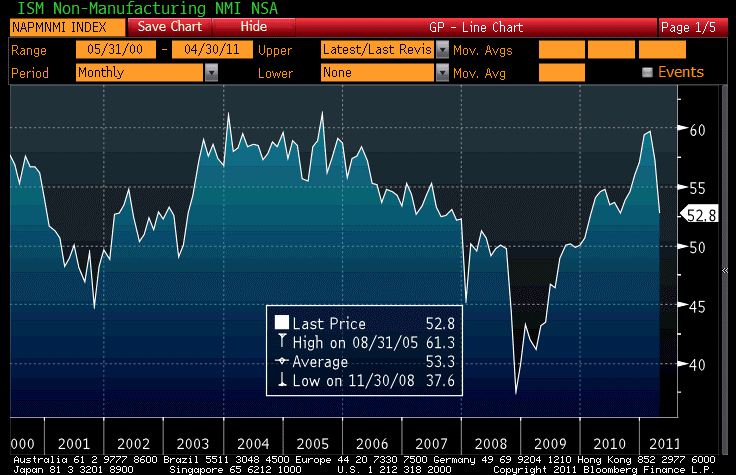
Bad drop, but it's probably not the start of a second leg down. We hope.
Now, keep in mind that this is a relative-change measure, not an absolute measure. That is, the fact that it is at the level of Feb 2010 doesn’t imply activity is at the level of a year ago, but that the economy is improving as fast as it was in February last year – which is to say, it’s not improving very much at all at the moment. That beats getting worse, but with the Fed about to stop its bond-buying program and with “issues” still to solve in Europe it would help to have the economy starting to kick into high gear right about now. And it ain’t. (Hey, but thanks for that $1.5 trillion. It really did a lot, didn’t it?)
These are only two minor reports, although in general the disappointments have been on the downside for a while now (as I showed on Monday). A cheerful Initial Claims report tomorrow (Consensus: 410k from 429k) and a strong Payrolls number on Friday would go a long way to dispelling concerns raised from these minor reports. But Claims has actually been part of the problem. Economists were initially encouraged last November when Claims finally moved consistently below 440k. With some chop, they continued to decline until February and March, when for the most part Claims were below 400k. recently, though, they’ve risen again – to 416k, 404k, and 429k the last three weeks – and after revisions Claims have exceeded the consensus expectations for eight consecutive weeks (actually, on April 1st they matched expectations exactly).
Also due out tomorrow is Non-Farm Productivity and Unit Labor Costs for Q1. It isn’t an important number although if ULC exceeds the +0.8% forecast by very much it will get some of the wage-push inflation guys excited.
Bonds continue to do very well despite the poor seasonal pattern for this time of year, but gains below 3.20% yields on the 10y note will get increasingly difficult without a really bad Employment report on Friday. I would expect some duration risk to be taken off the table on Thursday. Commodities have gotten smacked around for a couple of days. Initially it was a Silver thing, then a precious metals thing; today Grains, Livestock, Softs, Precious and Industrial Metals all fell. But with the dollar weak and real interest rates so low, I don’t think commodities are going to take a serious hit.
Frank, Further
As if the Federal Reserve didn’t have enough problems, what with a mandate which conflicts with itself and an army of academics trying to wrestle real-world problems into their models, they also have to deal with Barney Frank. Today Congressman Frank introduced legislation that would take away the power of regional Fed Presidents to have a vote on the Federal Open Market Committee (FOMC).
Now, there should be no illusions about the actual power that regional presidents have. While they technically vote, and can (and often do) dissent, there is virtually no chance of a regional Fed President, or for that matter any of the other (appointed) members of the FOMC, leading a coup and actually out-voting the Chairman. I should take away the “virtually” in that sentence – it’s just not going to happen. No Chairman has ever even recorded a close vote, much less lost a vote. For all intents and purposes, there is only one vote that matters, and that’s the Chairman’s vote.
While that is true, however, the technical formal power of the other FOMC members ensures that the Chairman cannot just ram through whatever policy he wants without at least some discussion, negotiation, compromise, and cajoling. Having input from members who are closer to the actual business of the country is an important feedback mechanism, if it isn’t really a very good check on the power of the Chairman.
And Frank’s objection is, in fact, that these people are businesspeople and appointed by other businesspeople, rather than being entirely political creatures appointed by the President and approved by Congress, as the permanent members of the FOMC are. To Mr. Frank, this means that they can’t be trusted because they haven’t been “vetted” by the noble servants of the people. More realistically, his objection is that because these members haven’t been put through the confirmation process, politicians haven’t had a chance to extract their tithe and can’t control the Fed by packing it with like-minded (read: always dovish) people. Like most of what Frank has done and has always tried to do, this is another attempt to centralize more power in the hands of the Congress. It is a very bad idea (as if you needed me to tell you that!).
But then again, the Fed is such a mess perhaps making it a puppet of the branch that votes the budget will just make the whole arrangement more explicit: you print, we spend. So maybe we just reach the denouement more quickly this way.
The Frank news did not have a discernable effect; nor did the news this afternoon that Portugal agreed on a $116bln bailout package and associated austerity measures. This latter isn’t terribly big news; the “agreement” is between Prime Minister Jose Socrates and EU officials and still must be agreed to by other political parties in Portugal as well as all of the member EU nations. This is only a start. Wake me when the Finns have to vote.
The stock market endured a small decline on the day, while bonds rallied slightly. The real action again was in commodities, where Silver continued to decline. The 2-day drop is now around 12.5%. Today Crude oil also dropped by 2%; front Crude is now “only” $111 even as retail gasoline price increases continue. The AAA retail gasoline price today was $3.967, only a shiny dime and a shiny nickel away from the July-2008 highs. This is one reason the President’s popularity bounce from getting Osama will be short-lived. “Glad you got him, sir…now tell me how I can fill up my Range Rover.” As I mentioned yesterday, removing Osama bin Laden is a nice symbolic result, but oil prices are not high from terrorism but from unrest and geopolitical risk in the MENA region. That remains today (and I can’t imagine it will get better if Obama shows pictures of Osama’s remains, as is the current crazy plan).
.
One quick addendum to yesterday’s note, which I hope you read if you haven’t already. I should have mentioned that another reason excess reserves are being used to deploy loans only very slowly is that the Fed continues to pay Interest on Excess Reserves. The 25bp interest rate seems very low, but it still tends to keep the cash on the books. As I have said before, “pay for excess reserves and you get excess reserves.” This is not shocking, and since at the moment we really don’t want that $1.5 trillion to be flushed into the system it isn’t even a bad thing although it does raise the question of why the Fed injected $1.5 trillion in the first place. Hearkening back to yesterday: this would be a very good way to decrease velocity on purpose, if that is what you want to do. Force reserves into the system, and then give banks a reason to sit on them.
.
The ramp-up to Friday’s Employment number starts tomorrow with the monthly ADP report (Consensus: 198k vs 201k last). The last three prints have been 190k, 208k, and 201k, so the consensus is right on the average. That’s a cop-out. If the economy is improving, it needs to be adding more jobs than that. If it’s rolling over, then it’ll surprise on the downside. Take a stand! The entire range of estimates reported on Bloomberg is 164k to 240k with a standard deviation of 19k. The last time the variance was that low, in January, ADP missed by 200k from the consensus. That’s not causal, of course; it just helps to illustrate the clustering effect. The monthly standard deviation of the number is around 75k over the last year.
The question, of course, is which kind of miss will have a bigger effect? On bonds, which have recently rallied to near the highest levels since November (the 10y yield is 3.25% on today’s close), a stronger-than-expected number seems to me to have the most potential for adverse market reaction, but stocks certainly don’t seem to have a sufficient short base to give much liftoff in the event of such an outcome. In other words, I guess I’m saying that for choice I’d be short both stocks and bonds tomorrow, because a reaction to the downside is in my view likely to be the more-virulent in each case. That being said, ADP is still ADP and while the recent string of steady numbers (and the last two, actually pretty close to the Payrolls figure itself) will tend to increase focus on the data, it is still not the week’s main event!
One Less Thing To Worry About, And One More
News overnight that terrorist idol Osama bin Laden had been slain by American soldiers triggered a rare Presidential press conference outside of normal business hours as well as, predictably, a knee-jerk lift to risky assets. Treasuries declined, stocks rallied, and oil prices dropped sharply in what seemed like the obvious trades at the time.
Let this be a lesson to young traders: it does not usually pay to make the trades that are obvious at the time!
In the long run, perhaps the removal of Osama from the top of the evil-instigator food chain is good for risky assets. But I think that is giving him far too much credit. Some people believe that bin Laden had been marginalized in recent years due to continuing pressure of the manhunt; whether that is true or not, it is certainly the case that the major geopolitical risks at the present time are from political unrest and uprisings in MENA rather than from terrorist machinations. Osama’s death, while pleasing to the spirit of the average American investor, should have very little real impact on matters.
The equity market seized on the news as an excuse to rally mainly because it was running out of other excuses. The chart below shows the S&P against the Citi US Economic Surprise Index. I suggested back in early February that the surprises were ripe to start coming on the downside, and I was right…but the market has continued to power higher anyway.

Economists have been unpleasantly surprised. When will that happen to equity investors?
The divergence is pretty stark, but over the long run the relationship isn’t super-tight. My main point here is to illustrate that one of the key arguments used by bulls to explain why stocks should rally from September on – the economic data were improving – is no longer true. The other main argument, that the Fed is adding enormous liquidity and that supports all assets, will shortly be untrue as well. I don’t call tops and bottoms, generally, but it is fair to point out that the market is valued richly enough (23.6x Shiller earnings) that it would be helpful for the bulls to have a new theme.
On the commodity side, Silver futures tumbled nearly 10%. The decline wasn’t matched in other precious metals (Gold dropped 0.6% or so); for silver, the excuse was a small increase in spec margins at the CME. A 13% increase in margins, after a prior 200% increase in margins over the last year, is a pretty thin excuse for a 10% drop in the market, but when a market is overextended all of the excuses need to start being on the same side to keep the rally going. A small excuse to sell is still an excuse to sell!
In equities the buying excuse didn’t end up lasting very long, and stocks ended the day down slightly (0.2%) while bonds rallied around 1bp to 3.28%. Osama needs to keep dying to help the equity bulls here!
***
The unsurprising results of the FOMC meeting last week and the Bernanke press conference/victory lap (as it certainly seemed to be) have many investors thinking that the inflation battle has actually been won. But the victory lap is, I think, premature.
The lags between changes in the money supply and changes in the price level are long. The current level of core inflation is consistent with what has actually happened so far to the important monetary aggregates (e.g., M2, some time ago), but the surprising thing to many worrywarts like myself has been how the massive creation of reserves has caused very little movement in M2. The year-on-year change in M2 is now about 5.6% and still rising, but that’s a far cry from what has been done to reserves. If the current $2.5 trillion monetary base was being translated into M2 at the “old normal” multiplier of around 8.5 (see my comment here), then instead of M2 being $8.9 trillion as it currently is, it would be $21.3 trillion. And that would be inflationary.
So we scratch our heads and wonder, “why is this happening?” Because while the Fed might express great confidence that they know exactly what they are doing, so far it appears that they have gotten the result they wanted but not for the reasons they professed to expect it.
I’ve been mulling this over for a while, and after a number of conversations with friends populating bank treasury functions I have a curious – but I think useful – hypothesis. I have noticed in my conversations that bank managers seem to have little interest in raising money through CD issuance or by attracting deposits. More than once, treasurers have told me “we have more money than we know what to do with,” largely as a consequence of there being a huge volume of reserves in the system. Any given bank can try to lend its excess reserves, but no bank will pay anything for them and they have to sit somewhere.
A bank that can’t jettison its excess reserves is paying too much for capital. It is under-levered. This is why banks have always strived to get rid of low-yielding reserves at the Fed. Typically the excess reserves were managed to as close to zero as was feasible. But now, that isn’t possible because no other bank wants the money either. The bank still needs to get rid of excess reserves, and there are two ways to do this: (1) The bank can greatly increase its business by making huge amounts of loans, so that the reserves it actually has end up being appropriate. Obviously, this is problematic because the bank needs to be concerned about the creditworthiness of the borrower, and there is a shortage of creditworthy borrowers at interest rates that banks are allowed to charge. Also, the pace of origination that would require is outlandish. More probably, (2) The bank can shed customer deposits by paying lower and lower rates on savings accounts and charging higher and higher fees on those accounts. This has happened, but with interest rates so low there is only so much you can “disincentivize” savers (especially since high fees raise the ire of policymakers/legislators). Banks can also de-lever passively, by (for example) not rolling longer bond issuances when they mature. In fact, we have seen this phenomenon as well: most of the ‘de-levering’ you hear about has been in the category of “domestic financial institutions” category while private borrowers in general haven’t de-levered that much. (See Chart below, which I have run before).
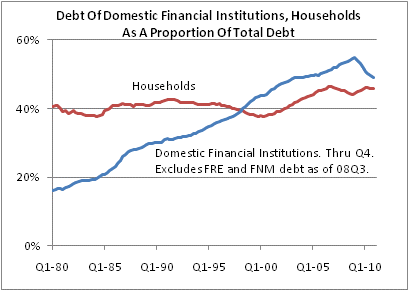
What de-levering there has been has been predominantly domestic financials.
So if this is the case – banks with too many reserves de-lever because they don’t need the money – then the story of the last few years until current-day might run something like this:
- During the crisis, the Fed adds lots of reserves to counter the plunging money velocity it fears (since MV≡PQ, if V falls it can be compensated for by a large enough increase in M).
- In the short run, this works by giving banks the cushion of comfort that they need, obviating the need for them to constrict lending as aggressively as they might otherwise have done.
- But in the longer run, the mammoth amount of excess reserves lowers the need for debt and ironically contributes to the de-levering. Because leverage and velocity are related concepts, this means (also ironically) that the volume of reserves might have contributed to the slowdown in money velocity that it was originally designed to offset.
- If this is true – and there’s certainly no guarantee of that, although this rings plausible to the people I’ve run it by – then when the Fed stops adding reserves, velocity will probably recover slowly (as banks lend more but don’t need to raise more capital to do so, they will re-lever on the asset side)
- …and if the Fed drains reserves, it could also perversely increase velocity at the same time because banks will need to issue their own debt again.
We all know that base money hasn’t translated into M2, and that’s a big reason we haven’t seen inflation. But the other side of it is that money velocity fell in the aftermath of the crisis, although much less than many of us expected. If this actually happened because the Fed’s actions affected both the quantity of money and its velocity – something that theorists generally assume they cannot control – then it has interesting implications for monetary policy. Points (3) and (5) above suggest that for large changes in reserves, monetary policy becomes less and less effective! And what is more, adding scads of reserves isn’t the inflationary part because while you’re increasing money you’re decreasing money velocity; the inflationary part might follow the stopping!
(Even more serious effects might ensue with the draining of liquidity. One treasury pro I know thought that money rates might skyrocket once the Fed pulls back on the liquidity and the “easy money” evaporates, especially since banks have higher liquidity thresholds thanks to Basel III – in his view, they will aggressively pay up for deposits and issue debt if they can’t raise the deposits; the higher rates will reinforce and accelerate market inflation expectations).
Again, I have to stress that the main point is that we don’t know how the monetary system reacts to actions and stresses like this, because no matter what the models say we’ve never actually tried anything like this. So while Bernanke is “100% certain” that he knows what’s going on, I can think of all kinds of ways that it might work differently in practice. And some of this, we are actually seeing in practice.
One thing we know for certain is that the monetary dynamics are about to change again, severely. It is hard to believe that the Fed can aggressively add trillions in liquidity, stop, and eventually reverse, with no important effect on inflation. It is time to think of the outside-the-box ways that this could all make sense, and this is one of them.
