Archive
Don’t Count Bill Gross Out Yet
This is why I am hesitant to fade Bill Gross (aside from the statistical likelihood of doing so successfully). Days like today, in which bonds sell off 11bps (¾ point in the 10y futures contract) on essentially nothing more than the failure to appreciably bust through 3%, seem to me to be foreshadowing the day when the 11bps is just the start of something.
The catalyst couldn’t have been Retail Sales. Retail Sales was right on the estimates when the revisions to the prior month are included, and frankly this isn’t a data point that demands pinpoint accuracy since the misses can be quite large. Retail Sales ex-autos rose 0.3%, which was still the worst performance since last July. And yet the rains came in bonds.
Now, some people might be excited about the good news implied by the recent bounce in the Citi Economic Surprise index, which I mentioned here and which subsequently fell to -117.2, the lowest ever realized except for in the immediate aftermath of the Lehman crisis. The bounce to -95.4, however, is entirely a product of old data falling out of the 3-month window of the data (it’s not a smoothed average). In mid-March, bad surprises on Claims and on Michigan, as well as Trade, really started the downward surprises. In the next couple of days, a rotten Housing Starts figure will roll off. In short, it is going to be difficult for the index to not bounce a fair amount, especially since economists by now are surely compensating for the trajectory they now realize is in place.
Maybe bond guys just realize that if all of this bad news is in place, and not many folks are expecting a cheerful resolution from the Greek crisis, there are few reasons for Treasuries to rally further. I also wonder if it is time to be short TIPS. While inflation is going to continue to gradually accelerate (tomorrow’ CPI data is expected to bring the year-on-year core rate to 1.4%, reasonably close to the lower end of the 1.6%-1.8% range I expect it to inhabit at year-end), TIPS have benefitted more than Treasuries from a scarcity effect while the Fed was buying all of the net supply over the last six months at the same time that such a policy ignited a desire among investors to buy inflation protection. The 10y TIPS yield at 0.77% is very low, both on an outright basis and even as a proportion. Ten-year real yields are 25% of 10-year nominal yields; the more-normal proportion is 35-50% in non-crisis times. That suggests 10-year TIPS might be 30bps or more rich, only nine days away from a 30-year TIPS auction that will be held without the agreeable background of Fed buying.
To be sure, there are plenty of buyers of inflation protection and not much worth buying as all forms of direct protection are expensive. I first wrote about the exchange-traded inflation-linked bond issued by Sallie Mae, symbol OSM, in May 2010 when it was trading at 16 and priced to yield CPI+10%. Now it’s around 23, priced to yield CPI+4%, and that means it is approximately fair given the credit spread of Sallie Mae. I am entirely out of my position, because now the possible credit exposure in a period of tight spreads outweighs (for me) the marginally higher coupon. It’s fair relative to TIPS, that is, and TIPS are expensive so…
There are also signs of ebbing inflation concerns at the margin. Five-year inflation swaps are 35bps cheaper, even after widening about 5bps today, than they were at the beginning of May. If core CPI is soft tomorrow, it might not be safe to be around TIPS.
So what are the prospects for that outcome? Well, last month’s unrounded rise in core CPI was +0.185%, with the market consensus looking for another 0.2% this month. The good news was that shelter inflation did slow its rise (as I’d thought it would, given the housing overhang); the bad news was that Medical Care, Other, and Apparel all rose when they had previously been quiescent. If those were one-off wiggles, then tomorrow could surprise on the low side. I think it will be difficult for it to surprise us with an 0.3%; that’s a big rise and would constitute a shocking number as well as probably near-instant vindication for one Bill Gross. And in that case, you might still win being short TIPS.
This sounds rather strange, but it is because of different time-frames involved. A small miss lower on CPI will not change the fact that the overall trend is upward, but it would serve to reduce the fear premium currently embedded in TIPS. A miss higher would keep that fear premium stable or even increase it a little bit, but that would probably be in the context of rapidly rising rates overall. Your overall short position does better in the latter case, probably, because the whole yield structure would be moving to higher yields rather than just the incremental spread between TIPS and nominals. I think you’re risking 5-10bps to make 25-30bps.
Investors will also see Empire Manufacturing (Consensus: 12.00 from 11.88) and Industrial Production/Capacity Utilization (Consensus: +0.2%/77.0%). The data mill is finally grinding again.
Disclosure: I do not have a position, either long or short, in TIPS but our main long-only quantitative strategy has a significant underweight in inflation-linked bonds.
Bucks For Beignets
After my last post, two readers asked me what I thought about this article at Zerohedge, and about some of its claims. The answer was going to be very long, so I decided to make it a separate post. Since there is not much economic data due today, this may be my Monday post. Below are three questions/statements made by the article in one way or the other (and there are other sub-questions answered within), and my responses. Afterwards, I have a couple of remarks about the current situation.
1. QE was meant to stimulate the economy by provoking banks to make loans.
I know that this was the stated goal, but I don’t think there is much evidence that this is really the case. If the Fed wanted to actually get money into the hands of domestic consumers (rather than saying that it was pursuing QE to help the economy, which after all is the only statement that would fly politically), it would not have offered to pay banks to continue to hold them as excess reserves. The caption I like to have on the chart below is “Pay For Excess Reserves, Get Excess Reserves.” If the Fed wanted that money to flow into the transactional money supply, they would not only not pay Interest On Excess Reserves (IOER) but would instead charge a penaltyrate on excess reserves. That would flush the money into the system within days. Of course, that would cause other (big) problems, but it isn’t like there’s a big mystery about how to get the quantitative easing money to actually become transactional money.
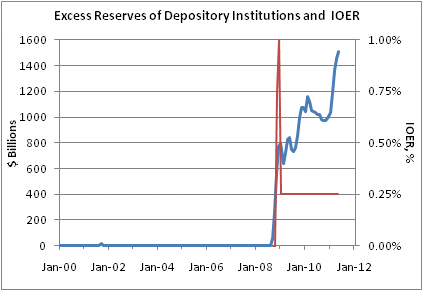
Pay for reserves, get reserves.
2. The Fed was trying to prop up foreign banks, which received the bulk of its largesse.
If the Fed was not flooding the banks with money to stimulate the economy, which it evidently was not, then what was it doing? Clearly, a big part of what it was doing was trying to help the banks re-liquify. But there is no evidence to me that they were targeting foreign banks. The primary dealers, many of which are banks based overseas, all got to participate in the programs such as the Primary Dealer Credit Facility. The Fed cannot, unless it wants to dismantle the primary dealer system, discriminate among those dealers. As it is, there are few advantages to being a primary dealer, and large costs (for example, you must bid on every auction, and you must win some bonds with reasonable frequency whether you want them or not). So BNP gets to participate just as much as Jefferies.
And once the banks have the money, how could you prevent them from using the capital to shore up the home office? After all, capital is fungible. I worked at a domestic branch of a foreign bank (not one of the primary dealers) during the crisis, and in our case the capital usually flowed the other way – from home office to domestic branch – and usually at the last moment and at usurious interest rates. Banks go to where the cheapest capital is available, and transfer the capital between units. They do this all the time. And this is a key point: delivering cheap capital to where it is most needed is in fact one of the critical functions of the banking system!
The Fed wasn’t bailing out foreign banks. They released nearly-free capital in order to shore up the weakest banks. The money, as it turns out, flowed to the weakest banks – they just happen to be mostly in Europe. Surprise, surprise (although John Mauldin’s recent piece presented evidence from the BIS that U.S. banks may be heavily exposed to the European sovereign debt crisis as sellers of credit default swaps. That will be a kick in the pants, if after thinking our banks were relatively free of this particular morass it turns out they managed to find their way into it).
Now, in the ‘old days’ the Fed would have been working very hard to make sure that the major central banks were all on the same page so that one central bank wasn’t providing all of the liquidity. During the crisis, that worked. They had all of the major central banks running with spigots wide open. Right now, though, the ECB is seemingly trying to drain liquidity while the Fed is providing it, so it isn’t surprising to see money flowing from U.S. to Europe. But if I were the Chairman of the Fed, I would be burning up the phone lines to Trichet and suggesting that perhaps instead of poking more holes in the bottom of the boat he could help bail.
But while we’re on the subject of helping foreign banks, let’s ask “why not?” I think it should be fairly obvious why the Fed is okay with helping Barclays and Deutsche and Nomura survive even though those banks are the primary responsibilities of the BOE, the ECB, and the BOJ respectively. They are also institutions that are far more integrated in the global financial system than was, say, Lehman Brothers. They are truly global banks that operate in virtually all markets. If there are any banks that are too big to fail, it is the main primary dealers.
The Fed’s plan since the beginning has clearly been to extend the game as long as possible, keep the yield curve as steep as possible, and hope that global economic growth would re-capitalize these banks before the piper was called. For a while it looked like they would be able to do so. Now, not so much and I am frankly terrified at the prospect of what happens next.
3. What do you make of the dollars being accumulated by overseas banks?
I don’t worry about it. Dollars being held as dollars are an interest-free loan that institution has extended to the U.S. government. That’s terrific! And the dollars after all will return to the economy – a dollar can only buy dollar-denominated assets, goods, or services, or be exchanged for another currency in which case the buyer of the dollars can only buy dollar-denominated assets, goods, or services.
And that means that if (not when) the Fed ever chooses to sop up those dollars, they will be able to. The author of that Zerohedge post seems to think that the dollars being accumulated by overseas banks must somehow remain dollars. Of course not. Euros will do just as well. If the Fed starts to suck the dollars back out of the market by selling off its bond portfolio, it means dollar-based capital will become more dear. Banks will simply exchange dollars for Euros because there will be a bid for the dollars from folks who want to buy those bonds. It can’t really happen any other way – it isn’t like when the Fed sells some of its bonds, and has sucked up all the cash except for the money in Europe, we’ll all be walking around with nothing in our pockets. No, when that happens we’ll go to the ATM and pull out more U.S. currency, and the bank will deliver some of its dollars and replace them with cheaper capital from somewhere else.
The fungibility of currency works both ways. Don’t worry about it.
Now, what this means is that if the Fed starts to drain in earnest it will tend to increase the value of the dollar. No question about it. Given the crisis in Europe, the only reason the dollar is so weak in the first place is that there are so darn many of them. If they become scarcer relative to Euros, they will become more expensive. That’s how the FX market works!
***
Bad times are coming, as they usually do when Europe is at war. It is an economic war, to be sure, but it is a war. Germany’s parliament on Friday declared that more funds for Greece should only be disbursed if debt holders agree to roll/extend the debt (and thus shoulder ‘part of the costs’). But the ECB has declared that it will absolutely not do so. This is a throw-down, friends. If the ECB refuses to roll its debt, then Germany will not back a rescue and that means, no rescue. If the ECB does agree to roll its debt, then it will constitute a default, the ECB and many banks will be insolvent, and Greece will eventually default anyway.
I don’t see any path that does not lead to Greece defaulting, eventually leaving the Euro, and another major banking crisis. Frankly, I haven’t ever seen a path that didn’t lead that way, but as we get closer to a resolution it is beginning to dawn on more and more people that … hey, it isn’t that we couldn’t see the way forward, it’s that there isn’t a way forward.
In this circumstance, it is a fair question to ask what the Fed could do differently or could have done differently to avert this sorry pass. As I made clear in my book, I think the answer goes back to the last Fed. The answer is similar to the answer to the question of what we could do if we suddenly discovered an asteroid on a collision course with Earth. What can we do about it? If given sufficient warning, say 10 years, then steps can be taken to avert disaster. After some point, however, there is nothing that can be done because the collision is too close. If we find the rock bearing down on us only one month before the impact, all we can do is prepare for it and hope it doesn’t hit us directly. I am not suggesting that the developing sovereign/banking crisis will end life on the planet as we know it, but unless something miraculous happens it’s going to happen and it’s not going to be pretty. And I think, given the fact of global financial interconnectedness, the hope that it will somehow pass us by is going to be dashed.
The central banks are doing everything they can to delay the day of reckoning, and they’ve managed to do it so far. It is very hard to figure out exactly how long the game can be extended, and as I’ve written many times in the past the institutional survival meme is very strong – it is hard to bet on calamity because everyone has an incentive to avoid calamity. Despite all of the predictions that the 1980s would end in a nuclear holocaust, it didn’t happen, and that’s a hopeful note. I worry about the fact that the issue is being framed as “big banks versus the little guy,” because that tends to divide us whereas in the 1960s-80s we all knew we were in the same boat with respect to the exchange of nuclear weapons. The current circumstance is not unlike “the big ship versus the passenger.” Like it or not, we little people depend on the financial infrastructure that the big banks are a part of. We need to restructure so that the system rests on smaller banks, but we can’t do that by cheering for the failure of the big banks and pontificating about greed and other easy targets.
What do I like as an investment in this situation? My models are still heavily into commodity indices as the best of a poor set of choices: commodities and cash in preference to inflation-linked bonds and equities. I think that’s probably right, although I do worry about a knee-jerk correction to commodities on a growth scare that confuses real variables and nominal variables (that is, oil drops because consumption of it is expected to decline, but if the real value of the currency halves then the price of oil should rise regardless).
Trichet At War
NOTE – I don’t know how this failed to go out Thursday night…I guess this will be my Friday comment, even though there is more to say about Friday. Sorry about that!
***
Incredibly, the ECB is now officially on track to hike interest rates again in July – even as the European Union crumbles around them. When Trichet told the world that “strong vigilance [on inflation] is warranted,” it was a code that everyone had been looking for in advance. The ECB is planning to tighten.
I am almost speechless.
The ECB is virtually at war with EU member states. Trichet also said “It is certainly not our intention” to roll over the ECB’s holdings of Greek sovereign bonds. Remember that the plan currently being discussed is to persuade creditors to ‘voluntarily’ roll over their maturing bonds so as to not force Greece into a default (although the ratings agencies are uncharacteristically making things difficult on the politicos by suggesting that a ‘voluntary’ rollover might not be really voluntary if the alternative is default). If the ECB isn’t going to play that game, then the game is all but over. Now, Trichet left the door slightly ajar by saying “We would say it’s an enormous mistake to embark on a decision that would trigger a credit event,” which creates the wiggle room to reverse if it is made very clear by the agencies that this would not be considered a credit event. So he’s saying “we won’t roll our bonds because we’d hate to cause a credit event,” which is a bit crazy because without rolling the bonds there really aren’t many good solutions that don’t lead to a credit event!
But then, Trichet seems to be crazy. This is all somewhat reminiscent of something from Law & Order, where the criminal declares that he had to burn down the house to save his family from the devil. And it is a good reminder (Bernanke, are you listening?) of why central bankers should stay away from the microphone.
It tells you how worrisome the sovereign debt crisis is in Europe that, even with the ECB tightening and the Chairman of the Fed making every possible noise that there’s not even a reason to meet to discuss hiking rates until sometime in 2012, the dollar hasn’t broken lower. By rights it should be in free fall with a hawkish central bank on one side and a dovish central bank on the other side, right? And yet today, the dollar rallied slightly.
The economic data didn’t suddenly get better: Initial Claims were approximately on target but a smidge high at 427k with an upward revision to the prior week. The Trade figures for April showed a surprising narrowing, but that was mainly due to oil. Ex-petroleum, the Trade Balance worsened slightly. So really, economically speaking nothing much changed this week (and I can say that since there is no economic data due tomorrow).
The Fed also released the quarterly Flow-of-Funds report today, though, and while it doesn’t have immediate implications for trading today the way Payrolls or Claims does, the Z.1 always has interesting nuggets. A lot will be made of the fact that household debt has now declined for twelve consecutive quarters, but to me that isn’t the interesting story. The continuing story is that the mainflow of funds is the deleveraging of domestic financial institutions, offset by the increasing public debt. I’ve shown the chart below previously, and it is updated through Q1. Incidentally, in this one I haven’t moved Fannie and Freddie debt to the Federal side of the ledger, because I’m not sure if they’re included in “Domestic Financials” or “Business.”

Gov't continues to expand its share of the debt, and domestic financials to shrink theirs.
So, while households have shed a little bit of debt…a grand total of a 4.3% decline from three years ago – the proportion of total debt that is held by households has actually risen since then because almost all of the net deleveraging is coming from domestic financial institutions. It’s a beautiful, closed loop. Treasury has effectively assumed the debt of the domestic financial institutions, who in turn buy the Treasury’s debt. It’s symbiosis (or incest: your call).
.
This week I got a note from my insurance company about my health insurance. They are raising rates for my plan by 18% one year after I first took out the policy. But that isn’t the whole story, because in fact the plan is changing subtly. The operators at the company didn’t even mention the modifications, because they seem minor, but they are a big reason the price is changing:
| Section | Prior Benefit | New Benefit |
| Practitioner visits for illness or injury | $25 copayment per visit with a $1,500 maximum benefit per calendar year | $25 copayment per visit/no annual maximum |
| Wellness Benefit | 100% coverage up to a $750 maximum benefit per calendar year | 100% coverage/no annual maximum |
| Prescription drugs received while not confined in a hospital | $15 copay for generic and 50% coinsurance for brand-named drugs up to $1,000 maximum benefit per calendar year | $20 copay for generic drugs and a $500 deductible then 50% coinsurance for brand named drugs / no annual maximum |
| Home Health Care | 50% coinsurance up to a $3,000 maximum benefit per calendar year | 50% coinsurance/no annual maximum |
Now, these changes are occurring “in order to comply with the new Federal requirements under Health Care Reform.” They clearly increase the value (and the cost to the insurance company) of the plan, on average, because “no maximum” means the tail value is very large. Options traders know that a big part of the value of any option is in the value of the very-unlikely (but really high value) outcomes, so when you make the insurance company offer those tails the cost goes up quickly.
But I don’t want those tails. I have no need for a “no annual maximum” benefit for practitioner visits, because I will go to the doctor when I need it. I’m not worried about home health care. And yet, the law can’t allow me to opt out because if only the people who need this care pay for it, then the cost is incredibly high since it would be spread over only a few people. This is typical of most government programs, which tend to spread the costs and focus the benefits because the ones who receive the narrow benefits actually change their votes while the ones paying the diffuse costs tend not to change theirs. At least, this was the way it generally works, until the people paying the diffuse costs are paying so many of them that they start to notice.
More pertinent to my discussion today, though, is the effect this has on inflation metrics compared to the perception of inflation.[1] If the increased price of the insurance policy, in aggregate, summed to approximately the aggregate value received by the small minority who receive them, then the effect on CPI would be nil: the improvement to the average welfare is equal to the rise in the average cost, so while your costs went up so did your welfare on average. If we calculated a price index for every person, it would register a rise for most people (who don’t actually receive any new benefits because they don’t use the new features, but are paying higher prices) and a massive, massive deflation for the people who are paying 18% higher costs but receiving 10x the benefits they did previously.
And here is the wedge (or anyway, one of them) between measured inflation and perceived inflation. Because the person who is receiving that huge benefit does not see it as deflation. In all likelihood, that person still perceives that there was 18% inflation, even though their standard of living improved demonstrably and dramatically. But the ‘losers’ (like me) who pay the extra 18% and receive nothing useful in return most definitely perceive the 18% as inflation. In this case, the perception is that medical care inflation was up 18% while, by construction, quality-adjusted prices on average did not rise at all.
Additionally, it hardly needs to be said, the ‘uncapping’ of these benefits creates incentives for people to consume more medical care, which by itself will tend to raise the real price of medical care over time. And that really is inflation.
[1] All of the following discussion abstracts from the fact that medical care inflation is not measured this way in the CPI. The BLS takes a higher-level view of counting the price and volume changes of medical care actually delivered by providers and paid for whether by insurance or consumers directly. The point is still valid but it is easier to illustrate the diffuse-cost, focused-benefit problem this way.
Conflict Abounds
Energy prices jumped today on news that OPEC was unable to reach consensus on an increase in the output ceiling. This would be much more important – and NYMEX Crude prices would have risen more than 1.7% – if OPEC wasn’t already exceeding the quotas by 2mbpd, as I pointed out yesterday. Moreover, there is no real reason, other than political posturing, to raise the quotas in order to lower prices. The world can already take pretty much everything that OPEC can pump right now. When is a cartel unnecessary? When prices don’t need to be jacked up!
Still, equities and bonds hardly needed anything that might be construed as bad news. The S&P dropped -0.4%, while the 10y note rallied 6bps. Now, notice that the Dow fell only -0.2%, and the NASDAQ dropped -1.0%. That is a subtle “flight to quality” into bigger stocks while maintaining exposure to the market, and is consistent with investors’ fear that growth is hitting a rocky patch longer than one month in duration. The old maxim was that in a bull market everything goes up and in a bear market everything goes down, so if you’re bearish you should just get out of the market. But many, many investors these days aren’t motivated by absolute return. Active equity managers are still equitymanagers. Pension funds have policy weights that are adjusted infrequently and don’t usually vary a ton anyway. So much of the money flow isn’t in and out any more, but up and down (in size and quality). CDS spreads have also been widening, with the Markit Investment Grade 5y (June) index up to about 98 from 89 last Tuesday (although as the chart below, of the June14 basket, shows that’s not entirely surprising. Actually, I also throw the VIX on here – the VIX and CDX are inverted – and you can see these are all virtually the same charts. You can buy equity risk in equities, in vol, or in corporate bonds. It’s all the same risk).

CDX, VIX, SPX. Source: Bloomberg. Note the VIX and CDX are inverted.
This is a good old fashioned growth scare budding. And yet, I am amazed at how much I am reading about inflation. Really, with housing prices dipping again and 10-year inflation swaps 20-25bps off their highs (see Chart below – in fact, since early May the decline in inflation accounts for all of the decline in nominal rates since real rates are approximately unchanged over that period while nominal 10y rates have fallen 20bps or so), you would think that inflation chatter would be ebbing.

10y US CPI swaps are 25bps or so off their recent highs.
But just today, the NY Fed blog had a piece called “Will ‘Quantitative Easing’ Trigger Inflation” from old friend Ken Garbade, who was once the chief bond strategist at Bankers Trust. Ken is a very sharp guy and his 1996 book “Fixed Income Analytics
Anyway, Garbade in that blog article gives the best and simplest explanation I have seen about why the Fed’s payment of Interest on Excess Reserves (IOER) is crucially important in keeping QE1 and QE2 from flowing out into the market and affecting economic activity. Of course, it begs the question what the hell is QE doing if it isn’t supposed to affect economic activity! And there are added questions around the policy, such as whether the Fed is really prepared to continue to pay higher and higher IOER in order to keep that money out of the economy, and also whether they can really calibrate policy so finely. Garbade highlights the issues well.
But that isn’t the only recent piece on inflation from Fed sources. Last week there was this one from the Atlanta Fed’s blog [my comment: inflation traders have long known that the core and headline inflation converge over a period of roughly 15-18 months, so this isn’t exactly innovation but the interesting point is that they’re discussing inflation]. The same day, the NY Fed blog had another piece, by Eggertsson, entitled “Commodity Prices and the Mistake of 1937: Would Modern Economists Make the Same Mistake?” Here is a teaser:
“The Mistake of 1937 was to relinquish the benefits of reflation and to set all policy levers in reverse. The Fed and key administration officials hinted at interest rate hikes and endorsed austerity in fiscal policy; the key concern now was containing inflation rather than sustaining recovery.”
Just yesterday there was another NY Fed blog piece called “A Closer Look at the Recent Pickup in Inflation,” which made the surprising argument (coming from the Fed, anyway) that
“the recent pickup in inflation is indeed quite widespread across a broad swath of CPI goods and services, but no one item has registered inflation increases that are clearly outside the norm of the last decade, not even among the volatile food and energy categories.”
…although they somehow take a benign message out of that when prospective monetary policy is considered. And, finally, last month the Chicago Fed Letter was on the topic “What are the implications of rising commodity prices for inflation and monetary policy?”
This flurry – this is just over a period of a week or two – is noteworthy since the behavior at the top (i.e., Bernanke) is so boringly stable right now. As QE2 winds down and growth is weakening, there is an increasingly wide range of plausible arguments. While Dr. Bernanke has made clear a number of times that he has no concerns at all about making an error (which implies that either the path forward is clear, or that it doesn’t matter), plainly not everyone in the Federal Reserve System is as sanguine. So on the one hand some observers would consider QE2a, reinvesting the maturing bond proceeds ad infinitum, others would wind down the balance sheet over time and still others would start winding it down aggressively. The response of inflation to these actions, indeed the response of inflation to actions already taken, is open for debate.
But while debate is good for the soul, too much of it can be bad for organizations since it tends to produce wishy-washy decisions that displease the fewest number of decision-makers. And in the case of the Fed, too much of it in public is especially bad. The Chairman is trying to appear calm and placid, but his minions are anything but. There is conflict and disagreement around.
And this makes more obvious the fact that the path forward is fraught with risks. And that, in turn, should increase the discount afforded risky assets (actually, the notion of a discount for risky assets is kinda quaint, since most of them are trading with hefty premiums).
.
Tomorrow is Initial Claims (Consensus: 419k from 422k), the only important data of the week. Look out if the number actually rises, rather than shrinks. That shouldn’t be a terrible surprise at this point, since the context has changed quite meaningfully since April when the series first started to rise. We now know the economy is weakening, so a 430k or 435k shouldn’t change many minds. But there is still disagreement about whether this period of weakness is a ripple or a wave, and every piece of weak data increases the odds that it is a wave.
Buzzkill
Another quiet day, this one started out optimistically as equities rose on reports that OPEC will raise its official output targets in order to make up for lost Libyan oil production. This pressured energy quotes, but not as much as you might think. The problem in the oil markets, after all, isn’t that the members of OPEC have restrained themselves from selling too much oil and caused a shortage. The members of OPEC are already producing 2mbpd (million barrels per day) above the official output quotas. The problem in the oil markets is that oil producers globally are near the practical output ceiling, especially if – as many believe – the Saudis’ assertions that they have substantial unutilized capacity turns out to be untrue.
The pressure on oil markets thus wasn’t particularly strong, since “sources” are saying OPEC’s quotas will rise about 1.5mbpd…less, in other words, than they are already evidently producing.
More significant, but less specific to today, is a growing constituency of policymakers that are arguing for a three percent “surcharge” on bank capital ratios. You can tell that there is a growing sense that this is bluster, because the NASDAQ Bank Index outperformed the market today by rising 0.3%. An increase in the required capital ratios of three percent is just another dagger in the future profitability of banks, if it happens. It lowers leverage, which is one element of the DuPont model of ROE. It is also going to make it even harder for the economy to recover. Jamie Dimon of JPM put it well yesterday when he said “Why would we own mortgages if you can own them at 7% capital and I have to own them at 10%?” Fewer owners of mortgages means higher rates for mortgages, folks.
So the market was doing well until late in the day when Chairman Bernanke expressed his opinion, in a speech in Atlanta, that the Fed should maintain stimulus in continued support of a “frustratingly slow” recovery. With the Unemployment Rate rising recently, the Chairman pointed to it again and said “until we see a sustained period of stronger job creation, we cannot consider the recovery to be truly established.”
This is literally chapter and verse. He said exactly the same thing in February to the National Press Club and again in March in testimony to Congress. The difference this time, if there is any, is that QE2 is just about done, whereas at the time of those last comments there were still many billions to come. Also, the economy at the time of those earlier quotes was improving, while now it is softening.
So what does it mean when you have shot all your bullets and there are just as many of the enemy standing there? To some people, it means it is time to reload. To others, it means it is time to try something different (like, maybe, running). But the market took Bernanke’s comments to mean he prefers to stand there and wait to see if the enemy starts to fall down dead of its own accord, and managed to turn a positive day into a slightly negative one.
It isn’t that everyone was expecting a QE3, and expects the third time will be the charm. In fact, I think most professional investors understand that a QE3 is quite unlikely absent another huge debacle (and in that case, it isn’t even clear that the Fed would be gung-ho for QE3 since such an event would likely help Ron Paul’s campaign to end the Fed as being ineffectual and a QE3 would be just begging for trouble). But in this context, investors would like to see the Chairman exuding confidence that the plan is working and that we don’t need QE3. He doesn’t have to say that; he just needs to use more positive language and people will feel better.
Now, if the plan is to make sure that the coming inflation remains unanticipated (if you missed it then see yesterday’s comment, which didn’t get redistributed on some of the usual channels), he’s going about it the right way.
His arguments were uncharacteristically lame. He spent part of his speech explaining how headline inflation will ebb if commodity prices just stop going up – but policymakers aren’t supposed to care about headline inflation, so it is odd to be focusing cheerfully on it when core inflation is rising steadily. He disputed that the profligate monetary policy is causing the dollar’s weakness (and perforce the correlated strength in commodities), with the logically-vacuous observation that “many factors other than monetary policy affect the value of the dollar.” This is true. It is also true that many factors other than the season of the year affect how warm it is outside, but that doesn’t imply that “summer” doesn’t matter.
Bernanke is smarter than that. He’s not infallible as he seems to think he is, but he’s smart enough not to make weak arguments when stronger arguments are available. Maybe he’s just bored and can’t be bothered to sharpen his rhetoric. Or maybe he’s just mailing it in – he only has two and a half more years as Chairman, after all!
Wednesday is another day with sparse scheduled data. The Beige Book is due at 2:00ET, but this is unlikely to move markets. Watch the dollar, which is around 1 point on the DXY away from the post-2008 low set just a month ago. Former buyers of that bounce will become sellers of the break.
The Beatings Will Continue Until Morale Improves
There was no new growth-related news today, but the markets continued to adjust to last week’s news. After getting smacked twice last week on the same news, markets seem to be shrinking from contact. Oil prices fell 1.5%, and other commodities besides metals (notably Softs and Grains, each down about 3%) were weak. Stocks dropped 1.1% and seem anxious to re-test the lows for the year which lie a mere 3% away and coincide with the 200-day moving average on the S&P.
Nominal and inflation-indexed bonds were both essentially unchanged, and volumes overall were light.
News off the Continent was also anti-climactic, but stocks in Peru dropped 12.5% on the victory of Hugo-Chavez-Facebook-Buddy (and former rebel) Ollanta Humala won a runoff election. This would seem like a one-off affecting only Peru, and perhaps it should be. Indeed other emerging markets ignored the first 9% or so but ended up closing lower. From a practical standpoint the vehicle for contagion is the fact that investors often participate in EM via funds and those funds will take a (small) hit because of Peruvian investments. To the extent that investors scale back EM positions as a result, it will affect many related (perhaps I should say “associated”) markets. Fortunately, Peru’s weight in the indices is pretty small, so even the 18% fall from the highs of last month will have only a small direct impact and the bigger effect is likely to be emotional. But this bears watching.
In a week with little in the way of scheduled economic news, it isn’t surprising to see previously-established trends following through. There is no economic data due tomorrow either, so I expect the beatings to continue.
.
I read an article recently entitled “Inflation as a Redistribution Shock: Effects on Aggregates and Welfare” that is interesting because of the non-intuitive conclusions it draws. Although the paper is five years old, it comes from the respectable NBER and one of its authors was in the Federal Reserve System when the article was written.[1]
The paper concerns the effects of unanticipated inflation. We all know that unanticipated inflation transfers wealth from lenders to borrowers (although anticipated inflation does not – if the inflation is anticipated, it is reflected in the nominal interest rate), and that also implies that unanticipated inflation causes medium-wealth households – who tend to be borrowers – to gain at the expense of higher-wealth households, and for domestic households as a group to gain at the expense of foreign (nominal) bondholders. The authors also found several redistributive effects among age cohorts, and overall; for example, even though unanticipated inflation has a ‘persistent negative effect on output,’ it surprisingly improves the weighted welfare of domestic households. From the paper,
“Despite the fact that inflation-induced wealth changes sum to zero across agents, the responses of winners (net borrowers) and losers (net lenders) do not cancel out. Among households, the key asymmetry is that net borrowers tend to be younger than net lenders.”
This leads to various effects on the supply and demand of labor and of savings that flow from the fact that a windfall received by the young causes different behavior changes than the (opposite) effect of a negative wealth shock paid by the aged.
But the really interesting part of the result is that most of the losers in a period of unintended inflation can be compensated fairly easily from the windfall that the government experiences (since the government of course is a huge lender). Again, from the paper:
“Thus, while the poor as a group experience a negative direct redistribution effect, this loss turns out to be easy to compensate, precisely because it does not take much in terms of transfers to improve the well-being of the poor.
“From a political economy perspective, these findings lead us to conclude that the government can adopt simple fiscal policies in reaction to an inflation shock which imply that the shock benefits a majority. Thus, policymakers may be tempted to inflate the economy not just because they take some direct interest in the fiscal position of the government, but also because such a policy may actually have wide support if the losers from inflation receive some compensation. It is intriguing to observe that the U.S. inflation episode in the 1970s started right after Social Security was first indexed to inflation in 1972. While this policy change is unlikely to have been the main cause of the episode, it certainly lowered the political cost of inflation…” [emphasis added]
And in their conclusion:
“Our findings therefore lead to some doubts regarding the conventional wisdom that low inflation is always in the best interest of the domestic population. There is a sizeable fraction of the U.S. population which would stand to gain if another inflation episode such as the one in the 1970s were to occur…
“One of our key findings is that the cohort welfare effects are highly sensitive with respect to the fiscal policy regime followed by the government…If the windfall is used to raise pensions, …the poor as well as the old middle class are compensated for all their losses, and most groups, apart from the very rich, stand to gain from inflation.”
Well, oh my as my sainted aunt might have said. This is an interesting thought process, because the conventional wisdom (and what the Fed has said many times through many different mouthpieces) and research generally holds that aggregate social effects of an inflationary period are negative, at least partly because of economic frictions created by rapidly-changing prices. But these authors illustrate that isn’t necessarily true when one considers the different effects that inflation has on different economic actors, and the way government can respond.
It isn’t like the Fed needed any more ammunition to risk an inflationary debacle; they’re doing that already. But it is worth thinking about whether we might have it all wrong, and that all the talk is mainly meant to ensure that the inflation remains unanticipated. What if the Fed was actually trying to cause a general inflation? Especially if you’re one of the “very rich” who would be sacrificed in that situation, it is worth considering that possibility!
[1] Although in itself this isn’t particularly noteworthy. The Federal Reserve System is far and away the most popular single U.S. destination for economics PhDs.
The Monetary Tsunami Is Dragging Us Back Out To Sea
It is not an impressive accomplishment to be surprised twice by the same news. Such a thing happens to three-year-olds, but grown-ups are supposed to adjust to incoming information. Nevertheless, that feat was accomplished on Friday when weak Employment data that was in-line with the ADP report and a number of other indicators of the employment situation.
The economy generated 54,000 new jobs in May, with a net downward revision of -39k to the prior two months. For reasons that are unclear, after ADP had printed 38k on Wednesday the bow-tied set was still expecting around 120k (judging only from those who changed their forecast; the Bloomberg survey average was still 165k due to stragglers who didn’t change their forecast, either because they couldn’t be bothered or because they thought their 200k+ forecasts were still good).
Forecasters had also expected, inexplicably, the Unemployment rate to decline to 8.9% from 9.0%, even with weak job growth. In the event, the rate rose from 9.0% (actually 8.960%) to 9.1% (actually 9.053%) and has now risen in consecutive months for the first time this year. In a humorous note, the press release from the BLS described the unemployment rate as “essentially unchanged.” I am not sure how a rise of almost 0.1%, especially in the context of a presumed declining trend, can be construed as “essentially unchanged” unless you’re just rounding to whole numbers.
There were both positive and negative internals so it’s hard to say the underlying particulars belied the weakness. On the one hand, the number of people “Not in the Labor Force, Want A Job Now,” which is one measure of the “unemployed inventory” (see my comment here for a chart of the measure last month), fell fairly sharply (4.8%). That’s good news. On the other hand, the average duration of unemployment rose to anotherall-time record of 39.7 weeks (see Chart, source Bloomberg) and really shows no sign of even leveling off although it surely will soon.

Average Unemployment Duration shows no sign of flattening out. Actually it looks more like an Apollo mission.
The Citi Economic Surprise Index plunged still further, to -117.2 in what now ranks as the second-worst trough ever. Indeed, the record dip in late 2008 covered 214.2 points, from 73.6 to -140.6 in three months from September 4th to December 5th; this decline is almost exactly equivalent from 97.5 on March 4th to -117.2 on June 3rd (214.7 points).
The reaction to this news was in a sense unusual because ordinarily after one surprise such as ADP it is often easier to be surprised back in the other direction. In a more conventional sense, it wasn’t at all shocking that stocks fell (-1.0%) to the lowest close since March as it becomes clearer and clearer that, whether it’s an effect of the Japanese tsunami or of the ebbing of the monetary tsunami, economic conditions are worsening with surprising alacrity.
Bonds rallied, again no surprise, with the 10y yield poking back below 3% to 2.99%. Interestingly, inflation swaps were close to unchanged and commodities rose slightly. The dollar dropped again; these last few points seem to hint that some investors are hoping/worrying about the next QE (even though I continue to believe there is almost no chance of QE3 absent a Lehman-like debacle).
The movement of the ‘Economic Surprise Index’ shows you that this economic turn of events has completely surprised economists (not to mention policymakers), but it also means that the conditions are starting to be in place to force economists (and investors) to start lowering their expectations. Once they lower expectations sufficiently, upside surprises can occur and the market can potentially swing back in the other direction. So far, I don’t see much evidence that opinions are changing. There is just an amazing degree of confidence in policymakers (again, among economists and professional investors) on both the fiscal and monetary sides to pull the right levers. Confidence, as well as lack of imagination. The current distinct lack of inflation fear (indeed, ebbing fear as demonstrated by recent weakening in inflation swaps) derives from the weakening economy. We all learned in school that output gaps cause disinflation, and there are large output gaps in every major economy. Now, it isn’t actually the case that output gaps dampen inflation, but we all have that belief ingrained in us. Despite the fact that there is almost no other way out of the long-term debt predicament besides monetization and at least partial abrogation of non-contractual inflation-linked promises such as Medicare, investors are not at all anxious to protect against what seems almost assured to happen.
The lack of creativity is almost breathtaking. It took 24 years for the price level to double, from 1986 to 2010 as the CPI index moved from 110 to 220. The inflation swap market institutionalizes the market belief that there will be another doubling of the price level occurring over…almost exactly 24 years, from 2010 to 2034. The difference is that in 1986, the Federal Reserve was actively trying to disinflate and under Greenspan pursued a policy of “opportunistic disinflation,” but in 2011 the Federal Reserve is still trying desperately to inflate (the economy, if not the price level…the problem is, monetary policy has little effect on the real economy and almost exclusively affects the price level).
Bill Gross and the currency markets have it right. It’s a good time to get a long-term fixed rate mortgage, if you can. It’s a bad time to be buying long-term Treasuries, at least for the long term. 4.2% 30-year bonds are going to seem mighty stupid in a few years.
U-G-L-Y, It Ain’t Got No Alibi
Well, it’s the first day of the new month and suddenly, all of those investors who really loved stocks between 3:55 and 4:00 yesterday decided they really hate them today. Stocks belly-flopped (I’m saving “plunged” for something more than 2.5%), back into last week’s consolidation range. So much for the short-covering rally on the Greece news!
Incidentally, Greece was downgraded to Caa1 today from B1 by Moody’s with a continuing negative outlook. Since there is not much between here and “D,” which indicates an issuer is actually in default, the Moody’s outlook is essentially a warning that they at least are not yet convinced that Greece can avoid default – whatever the politicos are saying today. The ‘plan’ being readied involves (and I’m being serious here) asking investors to invest in new debt when their existing bonds mature. They’re also examining “the feasibility of voluntary rescheduling,” which unlike a restructuring would not be a technical default. Seriously. The main problem this alcoholic says he has, apparently, is access to booze so would you all please take a turn tending bar?
But today for a change really was about the economic data, which was clear and uncontroverted: it sucked. The ADP employment measure came in at 38k, missing expectations by 137k. Honestly the direction shouldn’t be very surprising, as I pointed out yesterday, but the degree of the miss was pretty bad.
None of this data is a measurement of reality, though, but just an experiment. If the ADP report had occurred in a vacuum, we might not be eager to reject a null hypothesis that the true underlying run rate hadn’t changed very much. After all, if 175k per month is the real level, then occasionally you’ll get a clunker and occasionally a moon shot. That’s just the nature of a random variable. But in this case the ADP result is consonant with what we are seeing in other employment indicators. Initial Claims have been weak recently and the Consumer Confidence “Jobs Hard to Get” indicator just ticked up. This all argues for a weak Payrolls number on Friday, and economists’ estimates are dropping. The average forecast on Bloomberg of the 16 economists who changed their forecasts today is 138k. The average forecast for the 31 economists still showing a forecast from before ADP is 210k. Obviously, the former is easier to beat than the latter, but I will note that the current low estimate is 75k from Ian Shepherdson of High Frequency Economics, and he’s one of the sharpest guys out there. Tell him I sent you.
I’d also warned that there was downside risk to ISM, and indeed it printed at 53.5 versus 62.7 last month and expectations for 58.2. That’s a big miss in a slow-moving indicator. The subcomponents were uniformly bad. Order Backlogs fell to 50.5 from 61.0, Production dropped to 54.0 from 63.8, Employment skittered to 58.2 from 62.7, and New Orders skated to 51.0 from 61.7. Overall, the Manufacturing ISM report was the weakest since 2009 (see Chart).
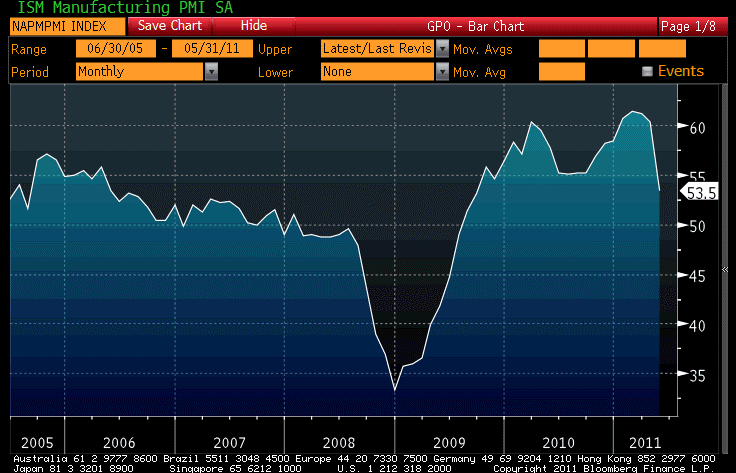
Things just stopped getting better.
And did I mention car sales yesterday as well? To make it a clean sweep, Total Vehicle Sales (expected to be 12.44mm vs 13.14mm last month) dipped to 11.76mm, the worst reading of the year and a level that we have only seen previously in recessions (see Chart). Remember, these are car sales, not assemblies, so we’re looking at demand and not a tsunami effect.

Charts like this are why most people (not economists) feel like we're still in recession.
The Dow dropped 279 points, and the S&P -2.3%. (Volumes were still low, only 1.1bln, although that was the highest total since March triple-witching except for yesterday’s month-end spike). The 10y note yield dropped 12bps to 2.94%, and the 10y TIPS to 0.69%. 10y inflation swaps fell 3-4bps, but the front end fared worse with NYMEX Unleaded down more than 5%. Commodities ex-energy, however, were only -0.5%. The weaker the data get, the more chatter there will be about QE3. I think QE3 is very unlikely unless the economy simply falls off a cliff or hubris reaches new heights at the Federal Reserve and they come to believe their copy about being able to easily reverse extraordinary liquidity measures. There seems to be enough disagreement about that already, though, that I think QE3 will not happen.
However, remember that inflation is a global phenomenon that depends on global factors. Around two-thirds of U.S. inflation is sourced from the “global inflation process,” which means that inflation-phobes must worry about more than QE3. We also have to worry about whether the ECB will retract its absurd tightening move, and/or pursue more explicit liquidity-adding measures as it attempts to rescue more passengers than are supposed to be trying to fit in the lifeboat at once. Despite the fact that the ECB has Bundesbank DNA, it is easier for me to imagine the ECB interceding to save the many European banks that are in trouble than it is for me to see the Fed tying another one on at the moment.
And make no mistake, many European banks are in trouble. How bad is it? Well, we won’t really know for a while, as word came today that the release of results of the current round of ‘stress tests’ that were supposed to be completed in June will be delayed until July. According to the article in the Wall Street Journal, the newer tests (which are supposed to be less make-believe than the ones from last year) produced somewhat implausible results.
“…the banks generally seemed excessively upbeat about how they would fare in a new downturn compared to how they weathered past recessions. The EBA’s specific concerns relate to certain assumptions banks are making about default rates for some customers and how their funding bases would hold up in a crisis…”
The “default rates for customers” here mentioned doesn’t mean sovereigns. The European Banking Authority is requiring banks to report their holdings of sovereign debt, but “the tests won’t examine banks’ abilities to absorb losses on their holdings of struggling countries’ sovereign bonds.” Fortunately, no bank has more than a few tens of billions of Euros invested in those bonds, rediscounted at the ECB and carried at par. (In a story last year, the WSJ estimated the exposure of German and French banks to Greek borrowers alone at $119bln and more than $900bln to Greece, Portugal, Ireland, and Spain but who knows where that exposure sits now.)
So, as growth continues to surprise on the downside – the Citi Economic Surprise index now stands at -91.3, a level exceeded on the downside only in the aftermath of the Bear Stearns crisis and the late-2008 crunch – the situation is growing uglier. It is not terribly surprising that investors are slipping into Treasuries despite the low yields, and others are wondering whether they can get out of the high yield door before everyone else tries to. It is not shaping up to be a very fun summer.
Tomorrow is a holding pattern, however. Initial Claims (Consensus: 417k from 424k) is the important indicator to watch; a significant upside surprise could break some eggs as investors get off the bus before Employment. There are other releases, such as the final Q1 Productivity and Cost figures, but labor is the theme of the week. Be careful out there.
