Archive
QEnull – What’s The Point?
I feel guilty when I have not much to add atop someone else’s words, but for the second time in a fairly short period of time, that humble explanation applies to an article that Stephen Stanley, chief economist at Pierpont Securities, wrote in response to an article in the Wall Street Journal today by Jon Hilsenrath that discussed a ‘new option’ that the Fed could conceivably deploy when QE3 takes place. While Wall Street was actually quite preoccupied today with cutting risks down ahead of the Greek invocation of the collective action clause (CACs) tomorrow – which seems far and away the most-likely event, since some 58% or so of Greek bond holders have come out in favor of the tender while enough have been opposed to ensure that the 95% hurdle for non-invocation will not be reached – there was plenty of discussion about this article, especially in inflation circles.
The article concerns the actions that the Fed could conceivably take if they decide to implement a third Quantitative Easing program (QE3). Recently, there has been little suggestion that any such possibility was forefront in the minds of Fed officials, but the appearance of such an article from Hilsenrath constitutes a “running it up the flagpole” event since he is the columnist assumed to be most-associated with “official leaks” these days (justified or not).
The article noted a third approach the Fed could conceivably take towards QE3:
Under the third approach, the Fed would create new money as it buys long-term bonds. But then it would effectively lock up the money rather than letting it loose in the broader economy. The Fed would do this by borrowing the money back from investors for short periods—say, 28 days—in exchange for some low interest rate it would pay investors.
Now, at some level there is nothing new about this. For decades, the Fed’s Open Market Desk has done reverse repos when it needed to temporarily drain reserves from the system. What is new is that this would be conducted on an extremely large scale, so that the Fed can buy longer-term securities (which adds reserves) and then ‘immunize’ them by draining the liquidity from the market at the same time. My initial reactions were “big deal – this isn’t new,” but Stephen Stanley’s take was much more insightful and I recommend that you read it in full. But at least, you can read these two snippets, which by themselves are devastating observations:
Do we need stimulus or not? The first and most obvious objection to “sterilized QE” is to ask why it needs to be sterilized. Does the economy need stimulus or not? If it does, just do QE3. If it doesn’t, then, for goodness sake, put the shovel down and stop digging.
That’s so insightful that I am embarrassed that it didn’t occur to me when I first read the Hilsenrath article. But golly, it’s right. We’ve become so accustomed to the idea of massive QE that doesn’t lead immediately to inflation because the added funds are sequestered on the central bank’s balance sheet (as happened with QE1, QE2, LTRO1, and it appears LTRO2), that I didn’t think to ask why you’d target that outcome! I believe I correctly asked that question leading up to QE2: why do QE2 when QE1 was still sitting in reserves? But my thought process has obviously been co-opted as well, embarrassingly. Here is another Stanley snippet:
In the article, the sources that Hilsenrath cites go to great pains to argue that Fed officials (at least the majority of them) think that these concerns about inflation are entirely misguided. The implication is that sterilizing QE is really about placating the irrational inflation fearers, not because there is a true need to protect against a future acceleration in price hikes. This is unbelievably weak. Either there is an inflation threat or there isn’t…If these inflation fearers are as misinformed as Fed officials seem to suggest, then they should be easily disabused of their erroneous inflation fears by some reasoned discourse from Chairman Bernanke and others on the FOMC.
Again, Stanley nails the hypocrisy here in a way I simply missed the first time around. Stephen Stanley is the first economist I think I have ever cited twice at length. The fundamental points he raises are devastating because they are so simple: either QE is needed or not; if it is needed, then there’s no reason to sterilize, if it’s not then there’s no reason to do it, q.e.d..
What’s amazing it that this topic even comes up while the stock market is near 4-year highs, bond yields are near all-time lows, and economic data have been consistently surprising on the positive side (according to the Citi Economic Surprise Index) since October. No, I’m not a bull on the economy, and yes I think Greece’s invocation of CACs will precede by only a short time the exit from the Eurozone of Greece and Portugal at least, but … I’m also not the one sitting around saying that everything is working, and I’m extensively on record as pointing out that monetary policy only works in the presence of money illusion and its main effect is to raise price levels. So why is Hilsenrath even penning this column?
Incredibly, I think the right answer is that the Fed feels it needs to be doing something, and at some level may fear for the future of the institution if a conservative government is put in place in November. I don’t think that the Fed would really be dissolved (it’s always easier to shout about change from the back bench than to actually implement it), but there’s no question that the Fed has all of its chips in the ‘interventionist’ camp right now so doubling-down may not be a crazy strategy from an institutional-imperative standpoint. As amazing, and discouraging, as that is to write…
On Thursday, you can fairly ignore Initial Claims (Consensus: unchanged at 351k) with Employment on Friday and, more importantly, the deadline for the PSI tender at 10pm Athens time (3pm ET). We may not know the official result of the tender until after the close, and will probably not hear about the CAC invocation until Friday. And then, as they say, the real game begins.
Whether we skate past the March 20th deadline or not is currently the market’s preoccupation. It is likely that on Thursday we will find out that enough tenders exist to allow the PSI to proceed with CAC-invocation, which will probably be perceived as a positive. Some chance exists of a complete failure, but most likely now is that there will merely be a technical default and some wrangling to get Greece past March 20th. All that really does, in my view, is give the country time to prepare for the inevitable withdrawal from currency union in a more-graceful way, but the markets may well regard this as a wonderful development – and worth selling into, frankly. Good luck.
Not That Surprising
As the Thursday deadline for the Greek PSI deal approaches, some trepidation is apparently developing. Stocks and commodities dropped 1.5%, while Treasuries rallied (although less than one would expect in a ‘flight to quality’ trade). Inflation swaps dropped 2-3bps and TIPS underperformed nominal bonds. This isn’t terribly surprising; the markets have been pricing a high probability that the Greek chapter of the crisis ended with the PSI ‘invitation’ and LTRO2, and it would have been very hard (and out of character for this entire episode) for the chapter to close smoothly without some doubt creeping in. I’m not very confident that the PSI exchange will be completed as scheduled, but I was very confident that it wouldn’t be a slam-dunk.
The only surprising thing about Tuesday’s selloff was that the commodities market was approximately 100% correlated with equities. I understand that investors have been trained to focus on real demand and real supply and to project the result on nominal prices, because that’s generally the same thing when inflation is very low (and incorrect if inflation is higher). But while crisis in Europe and the possible default of Greece could conceivably cause a decline in energy prices and industrial metals prices, I am unsure how a weak global economy will affect the price of Soybean Oil, Wheat, Sugar, or (certainly) Coffee.
If the dollar had powered higher today (it rallied, but not dramatically), then the fact that many of these commodities are denominated in dollars could have contributed to the 1.7% decline in the DJ-UBS index. I suspect that the more-likely explanation is that investors flushed commodity exposures wholesale in a risk-reduction move.
Since I don’t usually point out particular turning-point days, I have to take credit when I occasionally call one right. So far, my observations on February 27th about the parallels between stocks in the run-up after the Bernanke 2010 Jackson Hole speech, into QE2, and the run-up into LTRO2 have worked out (although so far the bond selloff hasn’t materialized – there’s time, though). The good news is that the parallel would shave only another 20 points off of the S&P and then knock it around for a bit before the next up-leg began. I am not going to call zig-zags, though! I think risk here remains acutely to the downside in equities, and since so far the indications are that the PSI may not be as well-received as hoped, I am maintaining my short bias.
.
I suppose it had to happen. Someone has introduced a smartphone app that allows you to track your own personal inflation. Now, be forewarned that it doesn’t help you correctly weight your purchases relative to your total consumption, or make corrections for changes in the size of the packaging (e.g., for something as simple as an electric bill) or the frequency of purchase (e.g., that new computer – what do we compare that to?), or the change in item quality (Hyundai to Jaguar). But it appears that it will allow you to at least track frequent purchases, and some people will find that very interesting. The link to a discussion of the app “Sticker Shock” is here.
What I really want, though, is a U.S. version of the on-line application you can find here. This site allows you to see how your personal inflation rate may differ from the norm on the basis of your different consumption patterns. You simply set your own consumption habits, and it will show you your personal CPI based on those weights. I love it. Unfortunately, it isn’t available as far I know for U.S. consumers, which is a pity. Still, you can get some idea how different consumption patterns produce different inflation experiences.
.
On Wednesday, the market will digest the last rumors and threats about the PSI bond exchange, whose deadline is Thursday. Also, while it will not likely affect markets significantly, the results of the Super Tuesday primary battles will provide entertaining water cooler discussion fodder. In economic news, ADP will release its report of employment (Consensus: 215k vs 170k, with higher whispers due to good weather) as well as revisions to seasonal factors and certain other estimates that are used in computing the monthly data. I don’t expect much net change in the level of ADP’s figures, but it will add some noise. Indeed, the easy prediction for Wednesday is just this: sound and fury…but at least, signifying something.
Dueling Prophets
What promises to be a fairly interesting week started slowly. I expected that over the weekend we would have started to hear about private holders of Greek debt that would announce plans to tender their bonds in the PSI.
And we did not.
Surely, prior to releasing the details of the PSI, Greece and the Troika had orchestrated such announcements, in order to create a sense of momentum, of fait accompli? To fail to do so is just another gross incompetence, another terrible mistake on something it is easy to get right. Behavior matters; perception matters. Make those planning to hold out feel some pressure early…but they didn’t, which creates the opposite impression – “hey, they don’t have the votes!” And so today, we finally heard from holders that the IIF represented, and we learned that group only amounts to about a third of the bonds outstanding. That’s it?
Meanwhile, hedge funds account for about ¼ of the bonds. Now, I am not one of those who think it’s automatic that evil hedge funds will hold out (although if they’re exploiting the dummies who put this together, I almost need to cheer), since hedge funds understand that their continued existence is subject to the whims of regulators. Hedge funds, while motivated by lucre, are generally motivated by long-term lucre. On the other hand, it’s probably also fair to surmise that the ones who didn’t want to be involved in what is likely to cast their firms in a negative light have already sold their bonds and that therefore most of the ones remaining are not planning to tender.
Since Greece needs 2/3 of the bonds to tender and 1/3 has said yes while ¼ is likely to say no, it follows that about 80% of the remaining bonds need to be tendered or the PSI will fail. I think that’s a possibility, but in any event the success of the PSI certainly isn’t the sure thing that has been factored into the market in the days since the deal was announced.
So will the default, if it happens, and the likely exit of Greece from the Eurozone, end all multi-cellular life[1] on the planet?
One answer to that question was carefully leaked today by the IIF, the organization which was responsible for negotiating the surrender Private Sector Initiative. It falls squarely in the camp of “a disaster of epic proportions,” and predicts that certainly every possible pestilence will befall the planet (with the possible exception of dogs and cats living together).
The other side of the argument was presented by Jonathan Tepper in an “Outside the Box” guest column in John Mauldin’s e-letter. He cites UC-Berkeley Professor of International Business Andrew K. Rose, who has done a study of 130 countries spanning 1946-2005 which exited currency areas or saw currency unions break up. His conclusion (cited by Tepper):
“I find that countries leaving currency unions tend to be larger, richer, and more democratic; they also tend to experience somewhat higher inflation. Most strikingly, there is remarkably little macroeconomic volatility around the time of currency union dissolutions, and only a poor linkage between monetary and political independence.”
In other words, while the Troika has surely made a bad situation worse by destroying the Greek economy rather than allow default and devaluation (which would cause the losses to fall more squarely on the rest of Europe), that doesn’t mean it needs to keep making it worse. Exiting the union would not necessarily be a disaster, if properly prepared for. Then again, if the authorities can’t prepare for the PSI deal by quickly producing enthusiastic tenders, it isn’t necessarily unreasonable to think they’ll botch this.
The difference between the two perspectives, besides the predicted outcome, is that one is based on data and historical analysis while the other seems to draw heavily on the Book of Revelation. The IIF memo also made simple logical errors, such as attributing the costs that Portugal will have to bear if Greece defaults to the Greek default; this only makes sense if a Greek non-default will make Portugal all better, and that’s ridiculous. For example, from the article cited above:
“If, by way of illustration, it is assumed that Portugal is unable to access markets through 2016, then official lenders would be required to:
- Provide €16 billion annually in financing to the government from 2013 through 2016, or €65 billion in total
- Help assure that €77 billion of term funding is available through 2016, or about €15 billion a year from 2012 through 2016, together with the refinancing for some €86 billion in short-term credit to fulfill the obligations of Portuguese banks and corporates to foreign lenders
- Help assure financing sufficient to manage some €330 billion in debt owed by Portuguese corporates and households to domestic banks, 7 percent of which are nonperforming, and some €220 billion owed by Portuguese banks and corporate to foreign lenders. (Relative to GDP, these exposures amount to 194 percent and 129 percent, respectively.)”
Well, actually, no. If Portugal is unable to access the markets through 2016, official lenders won’t be required to do anything. If they do not, Portugal will be forced to run a balanced budget, banks will default, and a number of corporate entities will fail. That’s not unlikely to happen anyway, regardless of whether Greece defaults this month, so the question in my mind is mostly just about the order of defaults and the timing of Euro exit.
So this is what we will deal with this week, along with tomorrow’s Super Tuesday slate of primaries. Equities are not handling the stress extremely well, although they managed to rally and close with only an -0.4% loss on the day. Stocks also had to deal with the statement by China’s premier, Wen Jiabao, who announced that the government had set a GDP target for this year of only 7.5% (the first time since 2004 that it hasn’t been at least 8%). I don’t think that was the main consideration of those lightening up on equities, because Treasuries also sold off (with the 10-year note back to 2.01%, up 4bps). It may have been the main reason that industrial metals dropped 1.6%. However, whether China says they’ll grow at 7% or 12%, the more important factor here is (a) does Greece defer default for a little longer, or default and exit rapidly, and (b) which side of the argument above between Tepper and the IIF is correct.
In any event, a safe stance is warranted. And keep in mind that for most investors, it isn’t Thursday that matters: long before there is an announcement that the PSI has succeeded (or more likely, that CACs will be invoked or the deal fails altogether), the market will be trading the information because some people will know well before you and I will.
[1] By which I mean complex forms of life, not people with more than one cell phone. Although, come to think of it, these may be mutually exclusive.
Inflation Stable, But Only In Passing
It’s a busy day for me, with month-end just past (and month-end was a busy day for many, with the first pan-billion-share day on the NYSE this year), but there is just too much to talk about to skip a comment today. But I will make it brief.
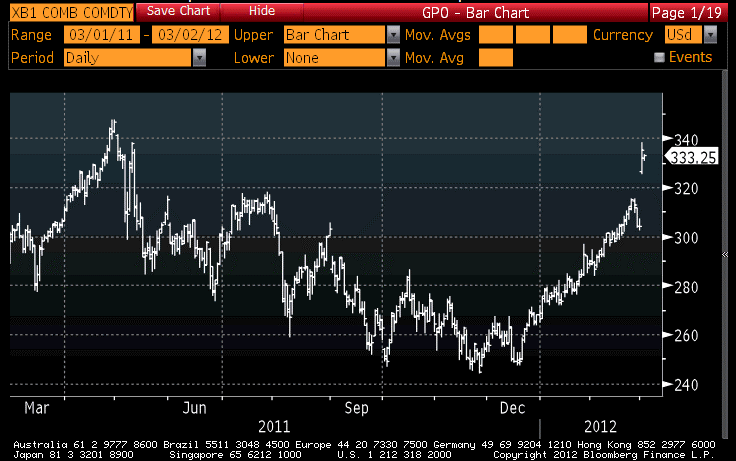
Front and center must be the huge rise in Crude Oil and Gasoline futures. Crude rose over $3 with NYMEX Crude topping $110. Some of this was due to rumors that a Saudi pipeline had been attacked and damaged, but a good portion of the run-up occurred before the rumor went around, and after the Saudis denied the rumor prices only fell back somewhat. The chart below (Source: Bloomberg) exaggerates the move in gasoline somewhat due to the fact that the front month rolled (the April contract rallied 9.45 cents/gallon, but March expired as the front month on Wednesday at $3.04 and April is now at $3.35), but however you want to look at it, this is a very high price for March 1st – in fact, the highest ever – and retail gasoline prices were already up to $3.74/gallon before this spike.
Meanwhile, the core PCE price index for January was reported this morning. While the month-on-month change didn’t round higher, the number was just enough higher-than-expected that the year-on-year number became 1.9% while economists were expecting 1.8%. Recall that core PCE is what the Fed is targeting to keep at 2.0%, and they were busy saying that the inflation dynamic had cooled (more on that later).
The Fed had previously assiduously avoided acknowledging the 15-consecutive-month acceleration in core CPI by saying that headline inflation (which they don’t normally care about) was ebbing, but now with energy prices rallying again they can’t retreat to that platitude. Core PCE is clearly still rising, and headline inflation is going to re-accelerate. I suppose Bernanke will have to focus on Nat Gas prices…that’s about the only price that’s actually falling.
Oh yes, Bernanke. Today’s second day of the Monetary Policy Report to the Congress (neé Humphrey-Hawkins) brought humor to an otherwise dry day. The Chairman was called on to defend the Fed’s extraordinary actions during the crisis (which honestly, isn’t really fair if you were busy cheering him on when they were happening, as most in Congressional oversight roles were). His defense was that (1) “we’ve had about 2.5 million jobs created,” which it turns out are the same 2.5 million jobs that the Congress and the Obama Administration say were due to their policies, (2) “We’ve seen big gains in stock prices, improvement in credit markets,” which is odd considering that he has previously claimed QE2 didn’t pump up asset markets, and (3) the actions helped produce a “more stable inflation environment.” In honor of baseball’s spring training: strike three, you’re out! I suppose a snapshot of a vase falling off a table looks stable too, as long as you don’t wait until it hits. Inflation happens to be near 2%, but that’s a coincidence of timing. It’s around 2%, on the way to someplace not particularly near 2%.
And it’s not just me who is saying so. Yesterday, Plosser was predicting the Fed could tighten policy this year and I noted a St. Louis Fed economist highlighting inflation risks; today FRB Atlanta President Lockhart predicted that if the Fed started QE3 it could cause inflation while not spurring lending. However, do not fear tighter policy yet; Lockhart considers that things have only just begun to show positive effects and just wants to ride the loan volume increase and inflationary increases for a while longer.
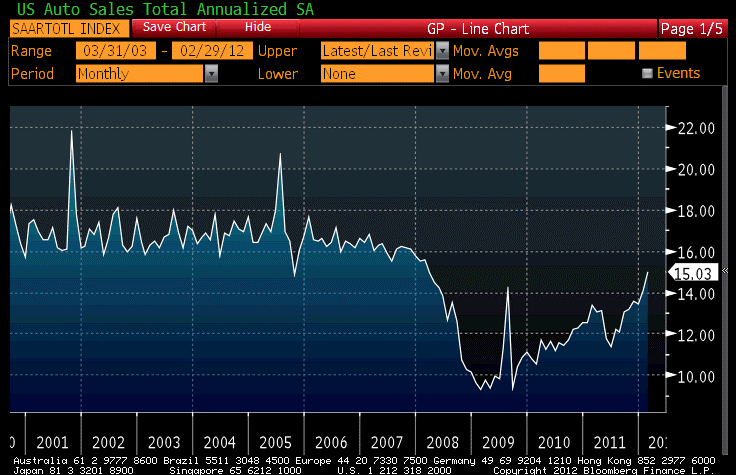
There are positive economic signs, but I fear these may be the best we see for a while. Auto sales, which have long languished at weak levels, surprised in February to post the strongest annualized sales pace since 2008 (see Chart, source Bloomberg). The level is almost back to the record levels where the car companies were bleeding losses back in the mid-2000s! The worst seems to be past for the automakers, although there is some suspicion that balmy weather (for February) helped the comparisons for the month. Still, the trend seems to be clear, for now.
Claims are improving, auto sales are improving, manufacturing is doing generally well (although ISM was weaker-than-expected today). As I’ve said for a while, the economy has been improving slowly, and at this point continues to improve steadily. However, the stock market has priced in a robust recovery, and with all of the great economic news out there we also have sharply rising energy prices and other tax increases (such as the expiry of the increased depreciation allowance, which may have helped provoke the weak Durables number this week). We also have Western Europe (and the less said about that right now, the better). There is plenty of time to bask in the good news by being short bonds (the 10y yield rose above 2%, again, today), hoping that I’m wrong about the disappointments we are going to begin to see, I think, this month.
