Archive
The Value of Balance
First, thanks to all of those readers who took time to respond to the poll attached to yesterday’s comment. The early results are interesting, but the polls are still open! Please take a minute to respond, if you have not already done so.
Data over the last two days has been pretty discouraging. ADP yesterday printed the lowest reading since September, giving credence to the theory that a mild winter contributed to the sense of recovery. I think there’s something to that theory, but I also think there was some actual recovery. The truth is that the economy was improving, but it wasn’t improving as fast as it seemed to.
Today’s data reinforced that sense, as the ISM non-manufacturing index declined to the lowest level since December. The 53.5 reading was a surprise on the low side, but still in expansion territory. Again, there’s some weak growth there but not as much as the weather made it seem. Initial Claims (365k versus expectations for 379k) was a bright ray of sunshine, but ‘Claims have still not improved since January or February and are likely still running around 370-380k on average.
One economic release you don’t generally hear much about is the ICSC Chain Store Sales (ex-Walmart) figure. You don’t hear much about it because it is pretty volatile as the chart below (Source: Bloomberg) shows.
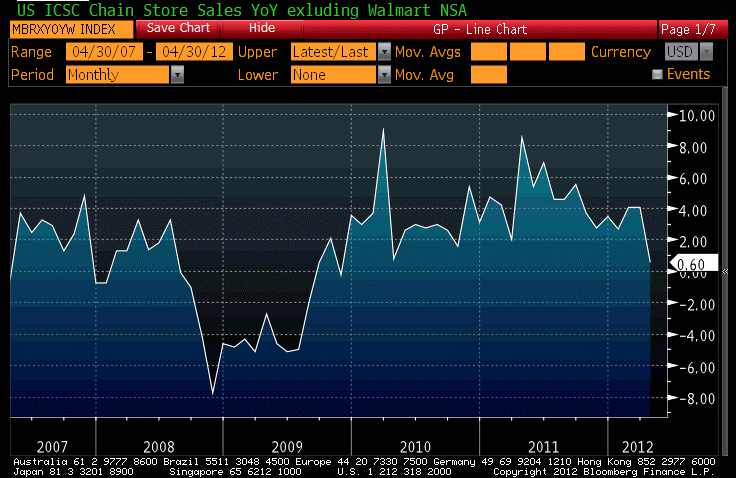
As the chart also shows, today’s y/y figure was the weakest since 2009. Now, with this much volatility in the series we can’t reject the hypothesis that the real underlying rate is about what it was before; but in the context of broadly softening data it does seem to echo the storyline.
The storyline will likely get a further echo tomorrow, with the release of Nonfarm Payrolls for April (Consensus: 160k vs 120k, Unemployment Rate 8.2% – unchanged). The consensus seems high, but most markets also seem to be bracing for somewhat bad news (except, as always, the equity market). While stocks closed lower today by -0.8%, it was just Tuesday when the talking heads were applauding a new high in the Dow. But nominal interest rates are at the lowest level since February (1.93% in the 10y), and real interest rates are essentially at the lowest levels ever.
Worst, though, are commodities, which have been getting burned since late April…of 2011. If you want to find a market where the bad news is already heavily discounted, it is in the commodity indices. The chart below (Source: Bloomberg) shows Non-farm Payrolls (in red), Initial Claims (inverted, in yellow), and the DJ-UBS commodity index (in white). You can see that while commodities generally moved up with the initial improvement in the economy, since May of last year they have been weakening despite stable-to-improving metrics of job growth.
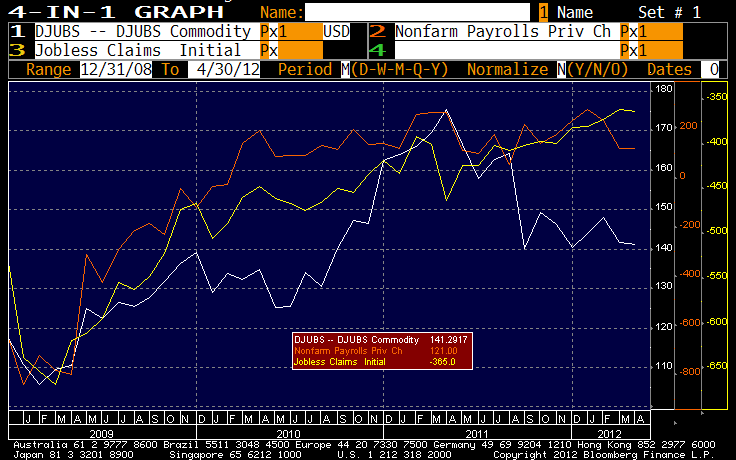
Of course, it also goes without saying that the decline in commodities over the last year also stands in contrast to the rise in core inflation from 1.3% last April to 2.3% now.
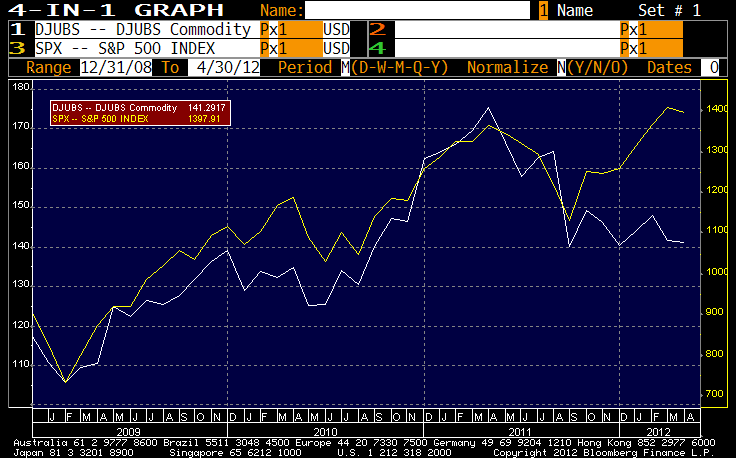
In short, commodities never got the benefit of the QE3 hype that helped keep other markets frothy, and didn’t get the benefit of continued recovery over the last year (see for example the chart below, source Bloomberg, showing the recent wide gulf in performance that has opened up between stocks (in yellow) and commodities (in white) after a long period of high correlation). I’ve recently mentioned that according to our metrics, commodity indices are at rarely-exceeded levels of cheapness. So it doesn’t seem quite fair that the sentiment against commodities is so negative.
Not that markets need to be fair, of course! But I think many investors just don’t understand the appeal of commodity indices. Even fairly experienced investors like Warren Buffett have made clear that they don’t care for commodities. To be fair, Buffett and others were generally talking about the owning of individual commodities, like Berkshire’s ill-fated holding of huge amounts of silver early in the last decade, and which don’t have a natural source of non-zero real return, while I am generally speaking of commodity indices, which do have ample sources of real return. One of those sources of return, and one that is seriously underappreciated, is rebalancing.
The reason that rebalancing adds returns is that rebalancing to neutral weights is a systematic method by which you are selling what goes up and buying what goes down. That’s one way to buy low and sell high! In order to have significant returns to a rebalancing strategy, however, several things need to be true: the assets need to have reasonably high volatility as well as a low correlation between them. If all of the assets are moving together, there is obviously no important benefit from switching between them.
I did an experiment recently to illustrate how rebalancing can affect one’s returns. The chart below (Source: Enduring Investments) shows a total return index for two strategies involving a portfolio of four assets: Crude oil, Copper, Coffee, and Sugar. This is obviously a fairly diverse group of commodities. One strategy produces just the price return from the front futures contract (I didn’t adjust for the rolls; the absolute return isn’t important, only the relative return of one strategy versus the other), assuming an initial investment of 25% in each asset and no rebalancing. That produces the red line. If the portfolio is rebalanced monthly, then we get the result shown in blue. Rebalancing produced a return of about 3.5% per year in this case.

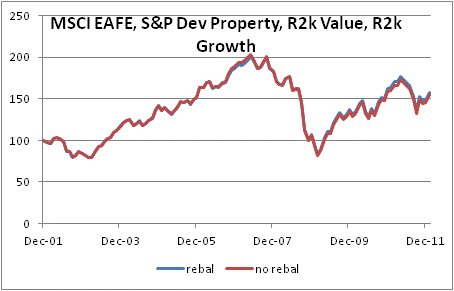
By contrast, the next chart (Source: Enduring Investments) shows an analogous experiment with four equity indices: the MSCI EAFE index, the S&P Developed Property Index, the Russell 2000 Value Index, and the Russell 2000 Growth Index. The rebalancing return here is worth a mere 0.23% per year.
Now, if you have a portfolio of individual equities, rather than indices, then you have a better chance of realizing some rebalancing return. However, even in that case it is important to realize that most of an equity’s return is a market return: that is, in a bull market almost all stocks rise and in a bear market almost all stocks fall.
None of this will tell you anything about tomorrow’s return, but for the rebalancing return and the relative value I continue to prefer commodity indices, and our models are tilted heavily in that direction (partly because of the paucity of alternatives). Honestly, as long as our investors remain patient we believe that taking the long view is the right way to wring profits from these markets.
Speaking of patient, we will see this weekend whether French citizens are inclined to further patience with Sarkozy or if they feel it is time to change horses. Polls indicate a close race but with Hollande the likely victor; although this is the expected outcome there may be some market volatility associated with that result. On the other hand, if Sarkozy wins, it is likely Euro-positive and I would expect equity and bond markets in Europe to rally. Personally, I don’t think it makes much difference who wins, because the Euro’s fate is being determined by imbalances far larger than voting blocs.
Float On
It is Golden Week in Asia, and the May Day holiday in Europe. In other words, it has been a slow couple of days in the markets.
The world still keeps producing news, though, whether or not anyone feels like trading it. Late last week, Japan extended its asset-purchase program by one-third in amount (¥40 trln from ¥30 trln) and one-half in maturity (from 3 years to 2 years). Last night, the Reserve Bank of Australia surprised markets by cutting interest rates 50bps to 3.75%, against general expectations for 25bps. The RBA had made its initial rate cut in December, so now they’re officially closer to the 2009 bottom in the cash rate target (3.00%) than to the 2011 highs (4.75%). Join the crowd, Australia!
The Chicago Purchasing Managers’ Report released on Monday was weak, in fact the weakest since 2009. Fortunately, the market didn’t worry too much about that, since today the equivalent national index (the ISM) rose to its highest level since last summer although well off the highs of last spring. Remember that these are relative-change indices, so that a higher print means growth accelerated a little bit from one month to the next. With an election coming up, and the federal government in effective control of the automotive industry, don’t expect a sharp slowdown in manufacturing any time soon! More interesting will be the non-Manufacturing ISM, released on Thursday, but it will be in any event overshadowed by tomorrow’s ADP report (Consensus: 170k vs 209k last) and Friday’s Employment Report (Consensus: 161k vs 120k).
Richmond Fed President Lacker said that the Fed may have to raise interest rates in mid-2013, even if the Unemployment Rate is above 7% and even though it has previously promised to keep rates on hold until mid-2014.[1] Now, Lacker has been a hawkish dissenter for some time, so this isn’t a particularly shocking revelation. It was interesting though that according to Bloomberg he said “It is ‘really tricky’ for the Fed to find ‘that time when interest rates need to rise to prevent inflation pressures from emerging, before you see them emerge, before you see inflation move up steadily.’” I am not sure what constitutes “inflation moving up steadily” if 16 out of 17 months of acceleration in year-on-year core inflation doesn’t qualify!
.
Interest rates are near or at all-time lows, with long-term rates considerably below expected inflation (1.94% on 10-year Treasuries; 2.61% on 10-year inflation swaps). So what is a country to do, if it needs to borrow trillions of dollars for the next couple of decades?
Apparently, the answer is ‘issue floating rate debt!’
As Tim Geithner looks to sew up the “worst Treasury Secretary ever” award,[2] apparently the U.S. Treasury is considering issuing floating-rate debt. Why? The Treasury needs to raise enormous amounts of money, but would like to raise it on the part of the curve where rates are effectively zero. However, it already issues so many TBills that the risk of a failure in that market isn’t zero, if there grew any concern about the size of the government’s debt. So it wants to issue longer. That part seems smart: reduce ‘rollover’ risk by issuing long but having rates pegged to short-term rates. I don’t have any issue with the desire to issue longer-dated debt; in fact, I’d advise the Treasury to issue perpetual notes or, as Robert Shiller has suggested, notes linked to GDP that are effectively equity in the United States.
But if you’ve decided to replace uncertain bill rollovers with longer-dated notes, that doesn’t resolve the question of whether to issue fixed-rate or floating-rate notes. That’s a wholly different question. Consider this analogy: you’ve bought a house, and you need to choose whether to take out a one-year balloon mortgage at a great, low rate or a 30-year mortgage. Clearly, the one-year balloon mortgage represents way too much rollover risk, because if you’re unable to roll it over you’ll default on the mortgage. But does that mean you should take out an adjustable-rate mortgage? Well, no – that’s a false choice. You can take out a 30-year ARM, or a 30-year fixed-rate mortgage. Your choice between those two depends on several factors, but they are equally acceptable alternatives along the maturity dimension.
What the Treasury is really trying to do is to raise money at low rates, so as to keep the current interest bill low and help the deficit numbers. (And who cares, really, if rates go up during the next Administration, which anyway is unlikely to be Obama’s and if it is then there will be plenty of time to fix this?) But that puts the government in exactly the same position as the homebuyer who in 2006 took out a 3y/1y ARM relying on the low teaser rate to qualify for more home than he could otherwise afford. We have more government than we can afford, to be sure! I suppose Geithner assumes/hopes that no one will foreclose on the U.S. government.
Incidentally, you may perhaps be thinking “well, a floating-rate note will be inflation-protected, because short rates are correlated with inflation.” This is true (at least, when the Fed isn’t lashing itself to the mast), and there are some money managers who in fact sell products based on the idea that floating-rate notes are an inflation-protected asset class. To be sure, floating-rate notes are more inflation-protected than fixed-rate notes, but unless the maturity is extremely long, the investor still has ample inflation exposure. This is because while the coupons are roughly inflation-protected (because they go up and down with a high correlation to inflation), the principal is not.
If you invest $100 in a 5-year floating rate note, in five years you will get back $100. Along the way you will have received floating coupons that provide inflation protection – but only if the part of the coupon that represents inflation protection of the principal is re-invested in more notes of the same type. In other words, you had better have more than $100 of principal at the end of the deal, or you’ve lost real principal. And on a 5-year note, at these yields, something like 96% of the value of the bond is the present value of the return of principal. Even for a 10-year note, 82% of the value of the note reflects the value of principal, and on a 30-year note 40% of the note’s value still derives from the principal payback. So, in a nutshell, unless you’re carefully reinvesting your coupons in the same security, your real return is not assured with a floating rate note. I would steer clear of any such Treasury issues unless they trade extremely cheap. If you want floating-rate inflation protection in a bond form, a superior investment (although still one I’d avoid at these real yields) is to buy TIPS so that your principal is also explicitly protected against inflation.
And speaking of protecting against inflation, I’d appreciate your help with a one-question poll. We are trying to determine how protected investors feel they are, today, with respect to inflation (whether naturally or because of steps they have taken). The poll appears below. Now, there’s likely to be quite a bit of bias in the results considering that if you’re reading this you surely already have more awareness of the inflation threat than the average investor, so feel free to point others to the poll via the “Share This” link at the bottom of the poll. Thanks in advance.
[1] There is ongoing discussion about whether the Fed saying “at least” mid-2014 constitutes a promise, but I stick with my original analysis: either it was meant to be a promise, in which case the institution’s credibility should be damaged if they don’t hold to it, or it was meant to be a forecast in which case it was pointless since there’s no reason the Fed’s forecast ought to have any impact on rates – especially since they are demonstrably worse at forecasting than private-sector economists. Or, what is most likely, it was originally meant to be a promise because the Fed wanted to force rates lower, but now they want it to be considered just a forecast because they think they may no longer want rates that low for that long and they don’t want to lose credibility.
[2] Stop! Stop! We’ll concede the point! Please take a vacation until January!
