Archive
Where Can I Buy Global Economic Health Insurance?
For a few hours, Americans actually paid attention to news from the United States this morning. It wasn’t the continued weakness in Initial Claims (386k this week, with last week revised up to 392k) that involved investors in domestic affairs for a change, but rather the drama of the Supreme Court’s decision on Obamacare. Just after 10am, the Supreme Court handed down the eagerly-awaited/dreaded decision, and it contained a surprise for just about every observer. The Court upheld the vast majority of the law, including the individual mandate that had so agitated conservatives. But the majority actually held that the law would have been unconstitutional under the commerce clause of the Constitution, which was the argument of those who wanted the law struck down. The interesting twist is that they also ruled the mechanism still worked because it can be construed to be a tax, rather than a ‘penalty.’
In other words, if the law said that you must take an insurance policy or else you’re guilty of a crime, it would have been unconstitutional per se. But the law offers a choice, however bad, that allows you to evade the requirement of the law: you can just pay a rather stiff fine. According to the Supreme Court, that makes it a tax and since it doesn’t force anyone to enter the stream of commerce – it merely persuades them financially that they ought to – it doesn’t run afoul of the Constitution. Bad law, perhaps, but not unconstitutional.
It’s an interesting and depressing ruling. Since there is no limit on the amount of money the government is permitted to levy in taxes, there would be no difference in principle if the Congress had made the “opt-out tax”, say, $100 million, completely bankrupting anyone who refused to comply. It strikes me as a plausible ruling (not that I am a Constitutional lawyer), though I’m not pleased with the result, and anyway it’s the law of the land. But the implication is that your ‘inalienable rights’ are not life, liberty, and property (aka ‘pursuit of happiness’), but life and one of liberty or property. You can give up your property to keep your liberty, or give up your liberty and keep your property. Thanks, Congress.
The stock market reacted instantly, driving lower. Actually the damage was not as severe as I expected it would be, but that’s probably because Europe was still lurking with headlines to come. But in a weird way, the implications for the stock market are in my mind somewhat positive. Hear me out: I think this is the worst possible outcome for Obama, because this decision will energize the right and those who are not on the right but oppose the health care bill (54% of Americans still favor repeal, the same percentage as right after it initially passed two years ago), and American elections are about turnout. As they did four years ago, the Republicans have nominated a dull, milquetoast candidate; but four years ago the citizens who self-identify as Republicans were tired of spending eight years of having defended Bush and by contrast, those same voters are now energized to get out and vote. A Gallup study earlier this year found that since 2008 the number of states that were either “Solid Democratic” or “Lean Democratic” fell from 36 to 19, while the number of states that were either “Solid Republican” or “Lean Republican” rose from 5 to 17, based on professed party affiliation. There were 15 “Competitive” states, and that’s where the suddenly-energized anti-Obamacare voters can tip the balance. Included in that list are states like Pennsylvania, Ohio, and Florida, where the Presidential election has been won or lost in recent years. Oh, and by the way: older Americans (think: Florida) like Obamacare even less than younger Americans who don’t use as much health care.
So, had the Supreme Court struck down parts of the law, both parties could have engaged with voters on what they would do to fix the law. But now the Democrats are forced into defending a piece of legislation that a majority of Americans say they want repealed, and Republicans are saying they will repeal it. That’s a much tougher landscape for the Democrats, and that’s good for equities.
However, the election is still a long four months away, and in the meantime we have a lot of Europe to get through.
As I noted above, the stock and bond markets had flattened out and quieted down – with the S&P down about 10-15 points and bond yields down a handful of basis points – within an hour or so of the ruling. Ironically, Europe provided bullish news when Herman Van Rompuy (the first, and perhaps the last, EU President) declared that the EU had agreed on a new growth pact. Stocks shot higher in moments, almost finishing the day with gains but in any event with slim losses. Unfortunately, it proved a mirage – apparently they “agreed” on a relatively small €120bln deal, but hadn’t completed the details. To me, that means they haven’t agreed on the pact, but perhaps agreement means something else in Brussels. Apparently, though, Spain and Italy were upset at hearing there was a deal even though their concerns – namely, a desperate plea for short-term measures to support their bond markets – hadn’t been addressed, and as of this writing those two countries are blocking the deal (although Van Rompuy said he “wouldn’t say there is a blockage, discussions are ongoing”). So we will see what dinner brings, but if the best that comes out is a mere 120bln-euro deal then it is fair to say that nothing really happened and the Treasury selloff can be delayed somewhat longer!
.
I promised yesterday some words on oil and TIPS. Several people recently have forwarded this article to me, by a Harvard professor, asking for my opinion; it is purported to debunk the “peak oil” hypothesis.
I suppose that the insights in the article are somewhat useful, but it doesn’t really have anything to do with the real theory of “peak oil.” The peak oil hypothesis holds that since production in any given oil field tends to rise, peak, and then sharply decline, and since most of the mega-fields are fully mature and the pace of discoveries of new fields has declined, the global production of oil will eventually decline.
But the hypothesis of course isn’t about the absolute impossibility of producing more oil – we could always assemble molecules by hand in a lab – but involves two different and hard-to-dispute facets: (1) If traditional oil fields grow, mature, and die, and we don’t discover more oil fields, then the amount of oil produced from traditional oil fields must eventually decline. (2) The theory doesn’t say that no alternative fuel will be developed; it isn’t called the “peak energy” hypothesis but the “peak oil” hypothesis! Arguably, oil that is produced from shale or with other advanced technology is an alternative fuel in the sense contemplated by the original Peak Oil hypothesis. But the availability of these alternative fuel sources, or alternative methods of extracting oil, is clearly related to the price of the fuel that is being displaced/replaced. “Peak oil” is a phenomenon that holds ceteris paribus, in particular at unchanged prices.
The price that was extant when “Peak Oil” theories first developed was far lower than it is now. And, for a long time, supply acted more or less as Peak Oil predicted it should, because production is constrained in the short run. But higher prices elicit a higher quantity of supplies, in the long run, of virtually any good. This paper provides proof that (a) this works in the long run but (b) there’s a long lead-time – the author declares the surge in spending on R&D began around 2003, and as long as there isn’t a major decline in prices before 2015, his predictions should come to pass.
The ‘prediction’ of a collapse in crude prices has drawn a lot of attention, but the author makes such a collapse contingent mostly on demand-side events:
“In particular, a new worldwide recession, a drastic retraction of the Chinese economy, or a sudden resolution of the major political tensions affecting a big oil producer could trigger a major downturn or even a collapse of the price of oil, i.e. a fall of oil prices below $70 per barrel (Brent crude)…
“Coupled with global market instability, these features of the current oil market will make it highly volatile until 2015, with significant probabilities of an oil price fall due to the fundamentals of supply and demand, and possible new spikes due to geopolitical tensions. This will make difficult for financial investors to devise a sound investment strategy and allocate capital on oil and gas companies.
So the main shock conclusion is that higher prices for oil beginning in the 2000s led to more R&D and ultimately more production, which could eventually lead to lower prices if demand doesn’t keep up. Wow, give that guy a Nobel prize! I’m actually more interested in the author’s conclusions about the distribution of energy production; he basically suggests that these new technological developments will greatly democratize the production of oil and remove much of the specialness of the Middle Eastern oil patch. That would be welcome, surely.
A surge in energy production is great news, of course, and I would love to believe that the real price of oil will decline (the nominal price will not, if the price level advances sufficiently – so keep in mind we’re talking about the real price) since the developed world really needs a break.
But TIPS are taking the idea of a collapse in oil prices too far. The first two TIPS issues (after the July-2012s which mature in two weeks) are the April-2013s and the July-2013s. At today’s close, they yielded 0.46% and -0.44%, respectively. Let’s first think about the April 2013s. April 2013 nominal Treasuries sport a yield of 0.20%, which means that the April TIPS are implying an outright decline in prices (aka deflation) between now and January and February of next year, when the final payment will be set for that issue. While gasoline futures are significantly backwardated, implying that traders expect energy prices to continue to decline, there’s nowhere near enough drag to imply a decline in the aggregate CPI over the next eight months. We think the gasoline market is implying CPI ought to rise about 0.8% over the next eight months, which means those TIPS are substantially cheap. The same applies to the July 2013s, actually slightly more so since the seasonal inflation pattern is more accommodating for that issue. So, if you’re buying short-dated Treasuries, I suspect you will be much better off buying those TIPS instead – they are far too negative on inflation, and remember: you get the “Middle Eastern crisis” option as well.
Getting Chippy In The EU
Things are getting a little chippy in the EU, and I don’t mean on the soccer pitch. While in the U.S., the economic data continues weak (with Consumer Confidence and core Durable Goods the latest numbers to fall short of expectations, although not terribly so), the important drama is still on the continent.
Temperatures are rising, at the EU summit meeting and outside of it. George Soros has started the Countdown to Disaster; the three days he declared Europe had left to act to avoid a “fiasco” ends tomorrow (generously, let’s give him until the end of the week). But years from now, we may look back on the behind-closed-doors, but widely-reported, declaration by German Chancellor Angela Merkel that Eurobonds and other forms of pan-European debt sharing would not happen “as long as I live” as being the moment of clarity. If it were just Merkel saying this, it would mean little. But Merkel’s position has not been softening with time, but hardening; she is, in short, moving to a position more in tune with her electorate. Germany is not going to agree to Eurobonds. Europe better hope that the EFSF and ESM are enough, because that seems to be about the extent of what it is willing (or able) to give.
Some observers think this is just a hard bargaining line, and that Germany will agree to union as long as it’s a German-dominated union. I don’t think it is a bargaining line, but for a minute let’s suppose it is and let’s ignore the touchy question about whether the other creditworthy Eurozone entities – Finland springs to mind – will blithely hand the checkbook over to Germany. If such a fiscal and political union actually happened, it might defer the Euro crash for years or even a decade or two. But European union will not work in the long run if one country is put in the driver’s seat. Because what happens when Germany’s time to be ascendant is over? Can you imagine if the EU was led today by Italy? Well, between 300BC and 300AD, Rome was the unquestioned seat of European power. Spain was also a world power once, as was Portugal, and of course France during Napoleon’s time. The only way that a confederacy works, such as the one that includes such different populations as Texas and California, is if none of them is in charge.
In other words, the best chance that Germany has to remain the unquestioned leader of continental Europe is for it to remain independent, not for it to accept vassal states. To me, it looks like that nation is gradually figuring out that its interests are not in fact shared sufficiently with its neighbors to continue down an irrevocable path. I suspect Greece is as well, for the opposite reason.
Meanwhile, although U.S. growth indicators have been surprising on the downside (the Citi Economic Surprise Index for the U.S. is at -60.9, but it was as low as -117.2 one year ago), European indicators are significantly worse. The Citi Economic Surprise Index for Europe is at -90.5, just about as bad as in the months following the Japanese disaster last year and otherwise the worst levels it has seen since 2009 (see Chart, source Bloomberg).

The chart doesn’t illustrate the level of economic activity, but rather the severity and frequency and degree of the miss of the actual data relative to expectations. A big negative number means things are getting worse faster than economists predicted (or it could mean, in a different context, that they’re not getting better as fast as they had predicted). In that context, consider the next story, which ran on Bloomberg today: “Draghi May Enter Twilight Zone Where Bernanke Fears to Tread.” The article suggests the ECB is considering cutting interest rates to zero in fairly short order, and might even make ECB deposit rates negative as a spur to get banks to take money out of the ECB vaults and lend it. Gee, what a fine idea – I wonder where I’ve heard that before?
The Fed doesn’t want to lower the overnight deposit rate below 0.25% because they are afraid of damaging the money market industry irreparably. The lack of confidence that the Fed has in capitalism to figure out a way that the money market can survive and/or regenerate once rates rise again is appalling. Sure, I know that the government is doing everything it can to destroy the finance industry so that it can never regenerate, but I think Fidelity would figure something out if money market interest rates were negative. For example, it could design a money market fund that wasn’t guaranteed at a buck. See? That wasn’t hard.
Yes, doing this would hurt the credit quality of the European banks. Golly, that was hard to even write with a straight face. Look, the sovereigns will end up bailing out many or most of the banks anyway. So what if they make some negative-expectation loans? Isn’t that whole point of forcing negative real rates anyway?
.
I have some comments on oil and TIPS but I will save them for tomorrow. I want to make sure I say congratulations and welcome to a professor (and good friend) of mine who recently posted his first on-line article here. Dr. Huston is an outstanding economist, a very creative thinker, a fine nurturer of student minds, and an enthusiastic lecturer. His article points out the current status of the “Fed model,” and illustrates the point that stocks are quite cheap relative to bonds on that model (although it’s a bad model for trading decisions!). I agree that stocks will probably outperform nominal bonds over the next ten years, although neither return series will be very exciting and inflation-linked bonds stand a chance of beating both of them depending on how much margins compress and multiples fall when inflation first rises. Congratulations on your first post, John. (By the way, he and co-author Roger Spencer – both of Trinity University – wrote an outstanding quantitative history of the Federal Reserve called “The Federal Reserve And the Bull Markets: From Benjamin Strong to Alan Greenspan.” At $110 I can’t recommend you buy it, but persuade your local library to buy it so that you can check it out! Or better yet buy it, donate it to the library when you’re done, and get a tax benefit.)
Pain Everywhere Except In The Commodity Pits
Writing a column these days is challenging, because the observations are sometimes out-of-date before you finish writing. At the least, it is risky to wait a day to share observations. On Friday, I was ready to write about the incredible negativity surrounding commodities. On Thursday and Friday of last week, I was tuned into CNBC while visiting with customers, and it seemed all that anyone could mention was the decline in commodities – even though they were up, on balance, on Friday. There was some joker who said that the only way oil “can go up from here” is if there is some crisis in the Middle East. That’s just crazy talk, and I’d planned to write about the fact that when you get such crazy talk and no one is really questioning it, it’s normally a sign that just about everyone who can be short something is already short. But it was Friday, and sometimes I don’t write an article on Friday.
So of course, on Monday the DJ-UBS commodity index rallied 1.8%, while the S&P declined 1.6%.
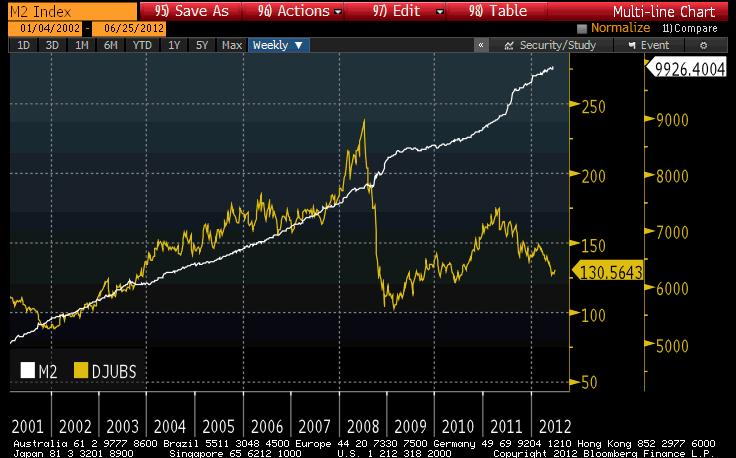
The bounce in commodities by itself is not unusual; like stocks, commodities bounce around all the time. It is somewhat more unusual, at least by the standards of the last couple of years, to see them move sharply in opposite directions. Prior to 2008, believe it or not, commodities and stocks didn’t always move together. Beginning in mid-2008, they moved together more often than not, as the chart below (Source: Bloomberg) – which shows the S&P and the DJ-UBS index, normalized to June 27, 2006 – illustrates.

It made some sense when commodities and stocks both cratered in 2008, and some sense when they began to move up together in 2009 since the extraordinary efforts the Fed was making to increase liquidity should have affected both markets. But in late 2011, the two markets became uncoupled, with the commodity market moving lower partly because of a perception that more QE was not forthcoming, and stocks moving higher because QE wasn’t needed (I’ve noted elsewhere that I think that’s erroneous analysis, but I think that characterizes the perception). Still, the basic wiggles were similar.
I wouldn’t make any huge conclusions about one day’s price action, even if this is the first time since December 11th, 2008 that the DJ-UBS rose at least 1.5% and the S&P declined at least 1.5%. That divergence was formed over a long period of time, after all. But it is worth noting. (I just wish I’d made the speculation on Friday!)
The question, of course, is whether the divergence will be resolved with commodities rallying, equities declining, both, or with the markets moving in the same directions at different speeds (for example, stocks rallying slowly while commodities rally hard). Since commodities are also out-of-whack relative to money supply, a variable to which they ought to be closely related (see Chart, source Bloomberg, below), my expectation is that commodities are more likely to catch up with stocks in the context of higher prices for commodities.
This view, as I am duty-bound to point out, has nothing to do with the fact that domestic and indeed global growth is looking worse and worse. Yes, New Home Sales today reached the highest level in two years, albeit at a shadow of the normal level of new home turnover. But Thursday’s Philly Fed index was abysmal (-16.6 vs expectations for flat). China is experiencing a slowdown. I just saw this note about India. And then there’s Europe.
On Monday both Spain and Cyprus formally requested EU aid – Cyprus saying that its direct exposure to Greece led to this sorry pass. Speaking of Greece, is it a good sign that the newly-appointed finance minister has already resigned due to illness, leading to a postponement of the Troika’s visit to Athens? Speaking of Spain, is it a good sign that a Forbes-associated blogger is taunting that country about its obviously-optimistic request for funds?
The optimists on Europe say that the obvious pain associated with a Euro breakup will ensure that the region comes together on a plan for Eurobonds or fiscal union. Aside from the unwarranted optimism that any large group of politicians could pull together a plan to make a ham sandwich by an arbitrary deadline…
Look, I understand that there are huge penalties for not putting together Eurobonds. I don’t think they’re any larger than the penalties for succeeding in putting together Eurobonds or a pan-European fiscal authority, but the timing of the failure is worse (for politicians, anyway). And I understand that European politicians are somewhat insulated from the pressure of the electorate because of the great cynicism of the masses in Europe (“Why throw them out? The new folks will do the same thing.”). But I don’t believe that democracy is dead in Europe, and if democracy means anything then it means the overwhelming opinion of the populace – as illustrated by the soccer-fan chants on Friday – might still matter. The Intrade market on the question “Any country currently using the Euro to announce intention to drop it before midnight ET 31 Dec 2012” is 27%-30% at the moment. I think that seems low.
But in any event, the volatility is still with us, and seems likely to rise further in the weeks ahead rather than to recede. Some investors will continue to flee to Treasuries (10y yields down 7bps to 1.60% today) or TIPS (10-year real yields down 5bps to -0.50%). But at these levels I don’t know why, for a flight-to-safety, I would hold those securities rather than T-bills. Or, for that matter, commodities! At this point, surely most of the bad news – and some fair bit of gratuitous sneering from bears – is in the price of commodities.
A Soft Evans Rule In Place
So in the end, we got about what I expected from the Fed. Operation Twist was extended, and actually a bit more than I thought they would be able to extend it as the program will continue through year-end.
I said that I would “look for signs that an Evans-type rule is being implemented,” and we got a hint of that as well. Remember, the “Evans Rule” is a conditional policy directive modeled after Chicago Fed President Evans’ suggestion that the FOMC should provide easy money until unemployment falls below 7% or core inflation rises above 3%. Obviously, the parameters “7%” and “3%” are where the rubber meets the road – without parameterization, the policy reduces to roughly what the Fed said in its statement:
“The Committee is prepared to take further action as appropriate to promote a stronger economic recovery and sustained improvement in labor market conditions in a context of price stability.”
Put “an unemployment rate below seven percent” in place of “sustained improvement in labor market conditions” and “core price inflation at or below three percent” in place of “price stability,” and you have exactly the Evans Rule. I doubt most of the Committee would accept 3% as an acceptable level for core inflation, but by backing into the Rule in this way the FOMC can argue later about what those parameters actually are.
Bernanke reinforced the point in his after-meeting presser, when he made clear that this didn’t mean that stability at 8.2% unemployment would be okay. He said “If we don’t see continued improvement in the labor market, we’ll be prepared to take additional steps if appropriate.” Moreover, the Fed is willing to consider further asset purchases and “still has ammunition.” (So you see – they’re relevant!)
Since I think the Unemployment Rate is fairly likely to rise, or at least not to fall, from this level, I believe the QE3 crowd got about the best that they could reasonably hope for. There was no sign leading into the meeting that policymakers were thinking seriously about another large-scale asset-purchase (LSAP) program, so it would have been a true shock if one had been delivered. If Greece had already exited the Euro, we probably would have seen it, but otherwise they will take their time to “communicate the strategy clearly” over the next month and a half. That communication will probably not take the form of outright speculation that some more LSAP is needed; with the ball teed up, all speakers need to do is lament the failure of the labor market to do better and the implications are already writ clearly.
It makes sense to go slow here. The economy is weakening, but not plunging. The crisis in Europe is less urgent, for today. The Twist has been extended, so they’re not standing idly by, and they’ve satisfied the importance of appearing relevant and concerned with their statement and promise of great things to come in the future. The ECB two weeks ago didn’t ease, and the MPC of the Bank of England narrowly voted against Chairman Mervyn King (in a true democracy, the Chairman sometimes loses), who was seeking to expand the BOE’s bond purchase program. The MPC said there was “merit in waiting” to see how things play out in the next few weeks in Europe.
To me, it sounds like July and August will see the next round of QE commence, probably from all major central banks, unless somehow the situation in Europe really does seem to be moving towards an extended period of calm and/or U.S. growth springs forward abruptly. I don’t see either of those things happening, but the benefit from waiting is that they might. In the meantime, the only thing the Fed loses is an extra couple of weeks goosing the stock market, but they can get that anyway once the communication strategy commences in earnest.
The data mill churns tomorrow after a couple of days off, with Initial Claims (Consensus: 383k from 386k) tomorrow along with Philly Fed (Consensus: 0.0 from -5.8) and Existing Home Sales (Consensus: 4.57mm from 4.62mm). The Philly Fed number is the most interesting one, as economists are expecting a significant rebound from last month’s 14-point decline. I’m not sure why I’d look for a bounce; the NY Purchasing Managers’ Index also dropped sharply in May and the Empire Manufacturing figure fell sharply in June. I wouldn’t be expecting a big jump from Philly Fed.
Can the Fed Remain Relevant?
Greece is skittering awkwardly towards temporary resolution of their crisis. Venizelos, the leader of the party Pasok (which placed third in the Greek elections) said today that the coalition may be ready tomorrow. Considering that this vote was supposedly a “referendum” on remaining in the Euro, it is surprising how long it is taking to negotiate a bare majority in the parliament. But they will, because there’s no cost right now to pretending to be unified while negotiating improved bailout terms with European authorities. If better bailout terms are not offered, there is plenty of time later to splinter the coalition, or to appear to splinter the coalition, to put pressure on the negotiators from Europe.
It bears remembering that there is nothing that can be done to save Greece and to keep her in the Eurozone absent transferring big losses onto the rest of Europe. Since most holders of Greek bonds due to mature in the next few years are official institutions – such as the ECB – it isn’t clear how the debt structure can be re-negotiated without opening a big can of worms. So will the European powers (aka “the Man”) significantly lessen the austerity measures? Will the Greek politicians who just won an election settle for anything less than significantly lessening the measures? I don’t see where these circles of interest intersect. I am sure there will be a big announcement at some point; I’m just not sure what difference it will make.
In the meantime, Greece is supposed to play Germany in the UEFA quarterfinals this Friday. Remember, wars have been fought over footy. I’m mostly kidding, but do you think Greece really wants to win this game or not?
The shortage of immediate crisis in Europe translates into a good day for stocks (+1%), adding to what is already a pretty good month; a pretty good day for commodities (+1%), adding to a positive if unimpressive month, and a weak day for bonds (10-year yields rose 4bps to 1.62%), adding to a marginally weak month. TIPS yields were higher as well, but not very much, and inflation swaps were higher by 3bps, bringing the total rise in the 10-year inflation swap rate to 5bps for the month (to 2.49%). Inflation expectations may be rising once again, and this is interesting. Consider the following two charts (Source: Bloomberg), of the 10-year Treasury (nominal) rate and the 10-year inflation swap rate, both for the same period over the last two years.


What is interesting here is that while the 10-year nominal rate keeps reaching new lows in each crisis, the 10-year inflation swaps rate keeps reaching higher lows in each crisis. The difference, of course, is the TIPS yield, which has continued to plunge faster even than nominal yields for each subsequent crisis.
In this context, we head into tomorrow’s trading session in which the day’s key event is the FOMC meeting. This is one of the more interesting meetings, in a sense, that we have had in a while because it’s the first in which there was any meaningful uncertainty about the immediate course of policy. Twist is coming to an end shortly, so many observers believe that the Committee will use this meeting to take concrete steps to either extend Twist, offer a different version of Twist, change the verbal signaling significantly, or even signal QE3. The answer will tell us something about how the Fed is looking at the current portfolio of risks in the global economy. When I think about what the Fed will or might do – admittedly, as a cynic – I break it down this way:
What the Fed can actually do about economic growth and global crisis
There’s really not much here. As the chief regulator, the Fed can help ensure that banks are adequately prepared for a possible Greek exit from the Euro. If there are key vulnerabilities in the financial sector, they can extend lines (either domestically or internationally through swap arrangements) to avert a liquidity crisis. But adding money doesn’t affect growth unless there is substantial “money illusion” such that economic actors take rising cash balances in their accounts to indicate actual improvement in their financial status and, acting on this, increase real spending. Even if there is money illusion, the actual capacity at this point for an important increase in real spending – especially in the parts of the world where it is really needed – is pretty slim.
What the Fed thinks it can do about economic growth and global crisis
This is where there has actually been a little bit of evolution recently, maybe, in the thinking of at least a few of the FOMC members who are capable of thought. Until fairly recently, the Fed’s faith in its ability to actually do something useful was absolute. The fact that trillions of dollars of stimulus later, U.S. real economic output is only 1.2% (not per annum – total) above where it was at the end of 2007 – with the economy threatening to sink into another recession, no less – has made some policymakers question whether the assumption of the omnipotence of monetary policy was correct. For example, it has long been an article of faith that one way that monetary policy such as “Operation Twist” worked was through the “portfolio balance channel.” This theory holds that by taking away lots of safe investment alternatives at the long end of the bond curve, the Fed essentially forces investors to contribute to animal spirits by owning riskier securities. While it may be the case that making U.S. Treasury bond yields truly abysmal may have contributed to the rise in corporate bond and equity prices to unhealthy levels, Fed researchers are questioning whether that actually produces any growth. St. Louis Fed Vice President Daniel Thornton (who actually is one of the voices in the wilderness arguing that runaway money growth might actually create a threat of inflation) recently wrote a paper called “Evidence on The Portfolio Balance Channel of Quantitative Easing,” and his conclusions are direct:
I present several reasons to be skeptical of the theoretical foundations of this portfolio balance channel and offer several arguments for why the effect of QE might be relatively small even if it is theoretically valid. Consistent with these arguments, an empirical analysis using a variety of interest rate variables and public debt supply measures used in the literature finds essentially no support for the portfolio balance channel.
Whoops!
What the Fed wants to be thought to be able to do
Herein lies the rub. If a hedge fund that is earning 2% on assets under management and a 20% performance fee realizes that it no longer has exceptional opportunities in which to invest its clients’ money, it should return the money to the investors, with a note saying “rather than take extraordinary risks at high fees to produce pedestrian returns, we are returning this money to you so that you can earn pedestrian returns on your own, with pedestrian risks and pedestrian fees.” However, we know from the periodic fund blowups we see that this hasn’t historically been the response. The Federal Reserve doesn’t earn 2%-and-20%, but if they ever got to the point where they no longer believed they could affect economic growth, what should they do? Their mandate says that they’re supposed to do it. If they cannot, they should say so and lobby for changes in the mandate to make them solely guardians of the real value of the currency.
Good luck with that. The Federal Reserve surely feels that whether or not it actually remains relevant, it must make sure that others think it is relevant so at least “confidence will be maintained.” They do this, I am sure, with the best of intentions.
And it is this third point where any policy changes will be born. If the Fed recognized the first bullet point, they would end Twist and work to start reducing excess reserves and reining in the money supply. That ain’t going to happen. It is the second bullet point where most observers spend time debating. What should the Fed do to help? More QE? Is Twist enough? Should they peg interest rates at a certain level, or implement an Evans-type rule that will require them to continue bond purchases until Unemployment falls or inflation gets out of hand? All of this requires one to think that the Fed thinks it can do something, and are merely discussing what they can do.
I think that many Fed officials are no longer sure of that, but they will go along with a vote promoted by the true believers because they want the Fed to seem relevant. The Fed will not do nothing. It will do something. I am not sure whether Twist will be extended (the fact that most banks are clamoring for it implies they have all told the Fed that the market expects it and will be disappointed without it, so it’ll probably be extended), but I would look for signs that an Evans-type rule is being implemented that will mechanically force something QE3-like over the balance of the year without the Fed having to explicitly decide to do it. This is also a way to side-step the whole ridiculous notion that the Fed shouldn’t do anything “near the election”: if there is a plan set in motion now, then presumably then can execute the plan when circumstances call for it.
None of this will do much besides ensure that the money supply keeps growing, enhancing the mispricing of commodity indices and increasing the risk of a bad (and difficult-to-contain) inflation outcome.
At least that would make the Fed relevant again.
A Whimper
With the whole financial world seeming bracing for the Greek elections this weekend, the results so far have seemed thankfully anticlimactic. There was talk late last week about a plan for coordinated central bank intervention in the event that the “wrong” party won in Greece. Dealers sent around lists of weekend contact numbers for back office personnel, and phone numbers for the overnight trading desk in Japan. Analysts circulated scorecards and “what-if” outcomes so that non-Greeks could tell who won, and whether the victory meant anything.
In the event, the pro-bailout party won. Believe it or not, that’s not the end of that – now, since they don’t have an outright majority, they must form a governing coalition with enough of the other parties that they have a majority of the elected representatives committed. So before anyone gets too excited, remember that that’s exactly what happened last time. Same winner, but no government. No coalition was in the offing, and so new elections were ordered. In theory, this new election was a referendum on whether to stay in the Euro or leave the Euro, or stay but with drastically renegotiated terms for the “aid” received so far. If that’s the case, then the referendum produced no clear answer. Are we expecting a government simply because everything is a little more desperate?
Forget the fuss: it isn’t clear to me what all the calm is about.
Greece will still leave the Euro. Government or no government, austerity or no austerity – the fiscal math simply doesn’t make sense unless Europe wants to pay for Greece forever. In principle, the Greeks can dig themselves out of trouble if they work harder, retire later, pay more taxes, and receive fewer government services. I do believe that people can change, and a society can change, under pressure of crisis. Remember Rosie the Riveter? But the question is whether they can change, whether they will change, do they even want to change, if the benefit of the change flows not to Greece’s people but to the behemoth European institutions that have lent money to Greece?
If a person declares bankruptcy, and the judge declares that he must pay all of his wages for the next thirty years, after deducting enough for food and shelter, to the creditors…do you think that person is going to go looking for a 60-hour workweek?
I hope they do, but I don’t see it.
Now, while we were busy ignoring economic data on Friday since Greece was so much more important, some more weak data came out. The Empire Manufacturing index fell to 2.29 from 17.09, reaching its lowest level of the year. Industrial Production fell -0.1% rather than rising +0.1% as had been expected. The University of Michigan confidence figure dropped to 74.1 from 79.3 – also the lowest level of the year. If you believe in government statistics conspiracy theories, then these government workers, and their cohorts in New York and Michigan, must really dislike Obama. The Citi Economic Surprise Index fell to its lowest level of the year, and the second-deepest trough since the 2008 crisis (last year’s Japanese-tsunami-induced plunge was quite a bit worse).
Now we wait until Wednesday’s FOMC meeting, with quite a bit of uncertainty about what the Fed may do, and cross our fingers that the Greeks will form a government. (Again, I don’t think that changes the size of the crater, just the trajectory we take before impact.) With 10-year yields at 1.57% and 10-year real yields at -0.58%, I can’t imagine what the Fed could possibly do to justify those levels. Further Twist would be limited in size by the size of the central bank’s short-end balance sheet, but a failure to extend the Twist program would be terrible for the supply/demand dynamic at the long end of the yield curve. Several dealers have pointed out that the Fed doesn’t even own many short TIPS, so the purchases of longer TIPS would be financed by sales of shorter nominal bonds, or left out of the equation entirely – which would also have the side effect of lowering inflation breakevens. Twist doesn’t really do very much for the economy, it seems, other than signal that the Fed cares. It isn’t the first time that I’ve said this, but I see more potential for higher yields than for lower yields. And, like with Greece, I don’t think there’s anything the Fed can do about it in the long run – it’s just math.
It is a tragic fact that this short column represents my 500th online post in this forum – tragic because the 499th was, I thought, one of my best. You can find that comment here. Remember that you can (and should) follow me on Twitter @inflation_guy and receive my articles as they are distributed along with occasional other tidbits. And you can contact me directly via our company website.
Side Bet With Ben?
The markets are saying pretty clearly that there will be no more business done until the results of the Greek elections are known. For the last six trading sessions, the S&P has traded mostly in a range between 1310 and 1329, having made roughly seven round-trips of that range since last Wednesday’s updraft. Ten-year nominal yields have been between 1.56% and 1.70% for the most part. Ten-year real yields have oscillated between -0.60% and -0.50%. That’s despite disappointing Retail Sales on Wednesday, disappointing Initial Claims (386k, with an upward revision to last week), and a CPI release that bond and equity bulls certainly wanted to seize hold of. Late in the day, Egan Jones downgraded France to BBB+ with a negative outlook, but this news – not really news, in a way – was overshadowed by the rumor which circulated (sourced to Reuters) that said the G20 central banks had prepared coordinated “action” in the event that the Greek election this weekend rattled markets. The S&P spiked 15 points on that story, but then came back to the high end of the range.
Headline consumer prices fell -0.3% on the month, dropping the year-on-year rate of increase to +1.7%. As I predicted, the airwaves were replete with talk about the Fed’s response to an indicator that they largely ignore. According to Bloomberg, the renewed “stimulus speculation” was responsible for the decline in Treasury prices, the rise in oil prices (“The cost of living in the U.S. fell in May by the most in more than three years, Labor Department data showed today, giving Fed policy makers more flexibility to take further action to bolster U.S. economic growth”), and the fall in the dollar, and NASDAQ chimed in suggesting that stocks were rallying on Fed stimulus hopes. So many “hopes” on such a slim reed! To be sure, these articles all mentioned the weak ‘Claims figure, but it wasn’t that far out of line. It has been running around 380k, and 386k appeared on the tape. If that’s good enough for QE, then we should be on about QE14 by now.
Outside of the decline in headline inflation, core inflation didn’t show any signs of rolling over. As I suggested yesterday, economists were looking for a “soft” 0.2% on core inflation, causing the year-on-year rate to drop to 2.2% on a rounded basis. The BLS actually reported something just barely above 0.2%, which caused y/y CPI to stay at 2.3%. Keep in mind that the only reason that a downtick was even threatened was because last May showed a +0.3% and that is now rolling out of the data. Today’s figure, annualized, would produce 2.45%. Over the next few months, the hurdle for core CPI to move higher – or at least to avoid declining – grows easier. We’re unlikely to see core CPI dipping any time soon, so if the Fed wants to do QE, they’ll need to suddenly grow interested in headline inflation. (But if they do, they run the risk of getting caught sounding stupid if there’s a Middle East flare-up, or if Natural Gas follows up on the 14% rally it had today after a very weak inventory build).
That said, there could be some signs that core CPI is flattening out. Of the eight ‘major-groups’, only Medical Care, Education & Communication, and Other saw their rates of rise accelerate (and those groups only total 18.9% of the consumption basket) while Food & Beverages, Housing, Apparel, Transportation, and Recreation (81.1%) all accelerated. However, the deceleration in Housing was entirely due to “Fuels and Utilities,” which is energy again. The Shelter subcategory accelerated a bit, and if you put that to the “accelerating” side of the ledger we end up with a 50-50 split. So perhaps this is encouraging?
The problem is that there is, as yet, no sign of deceleration in core prices overall, while money growth continues to grow apace. I spend a lot of time in this space writing about how important money growth is, and how growth doesn’t drive inflation. I recently found a simple and elegant illustration of the point, in a 1999 article from the Federal Reserve Board of Atlanta’s Economic Review entitled “Are Money Growth and Inflation Still Related?” Their conclusion is pretty straightforward:
“…substantial changes in inflation in a country are associated with changes in the growth of money relative to real income…the evidence in the charts is inconsistent with any suggestion that inflation is unrelated to the growth of money relative to real income. On the contrary, there appears to be substantial support for a positive, proportional relationship between the price level and money relative to income.”[1]
But the power of the argument was in the charts. Out of curiosity, I updated their chart of U.S. prices (the GDP deflator) versus M2 relative to income to include the last 14 years (see Chart, sources: for M2 Friedman & Schwartz, Rasche, and St. Louis Fed, and Measuring Worth for the GDP and price series). Note the chart is logarithmic on the y-axis, and the series are scaled in such a way that you can see how they parallel each other.
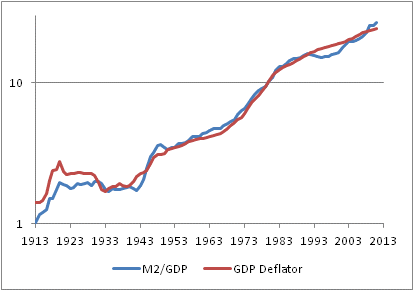
That’s a pretty impressive correlation over a long period of time starting from the year the Federal Reserve was founded. When the authors produced their version of this chart, they were addressing the question of why inflation had stayed above zero even though M2/GDP had flattened out, and they noted that after a brief transition of a couple of years the latter line had resumed growing at the same pace (because it’s a logarithmic chart, the slope tells you the percentage rate of change). Obviously, this is a question of why changes in velocity happen, since any difference in slopes implies that the assumption of unchanged velocity must not hold. We’ve talked about how leverage and velocity are related before, but an important point is that the wiggles in velocity only matter if the level of inflation is pretty low.
A related point I have made is that at low levels of inflation, it is hard to disentangle growth and money effects on inflation – an observation that Fama made about thirty years ago. But at high levels of inflation, there’s no confusion. Clearly, money is far and away the most important driver of inflation at the levels of inflation we actually care about (say, above 4%!). The article contained this chart, showing the same relationship for Brazil and Chile as in the chart updated above:

That was pretty instructive, but the authors also looked across countries to see whether 5-year changes in M2/GDP was correlated with 5-year changes in inflation (GDP deflator) for two windows. In the chart below, the cluster of points around a 45-degree line indicates that if X is the rate of increase in M2/GDP for a given 5-year period, then X is also the best guess of the rate of inflation over the same 5-year period. Moreover, the further out on the line you go, the better the fit is (they left off one point on each chart which was so far out it would have made the rest of the chart a smudge – but which in each case was right on the 45-degree line).

That’s pretty powerful evidence, apparently forgotten by the current Federal Reserve. But what does it mean for us? The chart below shows non-overlapping 5-year periods since 1951 in the U.S., ending with 2011. The arrow points to where we would be for the 5-year period ending 2012, assuming M2 continues to grow for the rest of this year at 9% and the economy is able to achieve a 2% growth rate for the year.
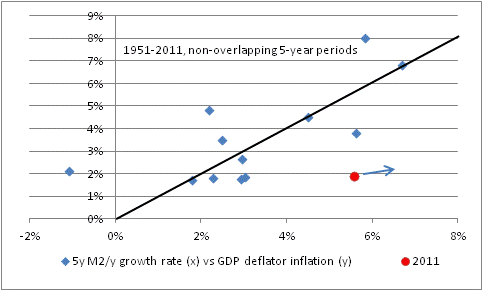
So the Fed, in short, has gotten very lucky to date that velocity really did respond as they expected – plunging in 2008-09. Had that not happened, then instead of prices rising about 10% over the last five years, they would have risen about 37%.
Are we willing to bet that this time is not only different, but permanently different, from all of the previous experience, across dozens of countries for decades, in all sorts of monetary regimes? Like it or not, that is the bet we currently have on. To be bullish on bonds over a medium-term horizon, to be bullish on equity valuations over a medium-term horizon, to be bearish on commodities over a medium-term horizon, you have to recognize that you are stacking your chips alongside Chairman Bernanke’s chips, and making a big side bet with long odds against you.
I do not expect core inflation to begin to fall any time soon.
[1] The reference of “money relative to income” comes from manipulation of the monetary identity, MV≡PQ. If V is constant, then P≡M/Q, which is money relative to real output, and real output equals income.
Sick Horses All Rounded Up And Ready To Go
Do you think that anyone who bought in the stock market updraft last Tuesday is having second thoughts?
Today’s retail sales figures were weak. Ex-autos, sales were down -0.4% versus expectations for unchanged, and revised to -0.3% versus the +0.1% originally reported last month. It’s the first consecutive negative prints since 2010, although the 2010 dip obviously didn’t lead to anything more sinister. Retail Sales, like Durable Goods, is a volatile series and one must be careful not to exaggerate the importance of any single month. That being said, it isn’t just the data but the whole backdrop: the whole package of news and data. It’s just not pretty, and it’s simply not priced in although it’s closer than it was in April.
The best news out of Europe is that there’s no one in the queue after Italy! Cyprus stepped up and asked for a bailout for its banks. Cyprus is tiny, but I am sure the timing is not entirely coincidental. “Sheesh, Spain is asking for cash? We better get in there before the money is all gone!”
The Spain bank bailout is proceeding, and seems like it will get done. But, unlike prior bailouts, no one seems to be calling this a “firewall” or claiming that this will finish off the crisis. Maybe that’s just because we have the Greek elections coming up, or maybe it’s because policymakers have finally learned to shut up and observe that old saying, “Better to remain silent and be thought a fool, than to speak and remove all doubt.”[1]
European bond yields are still not reacting well to the whole question of Spanish sovereign bond subordination. In case you’re counting, the following Eurozone credits trade over 6% at the 10-year point: Portugal (10.43%), Ireland (7.21%), Italy (6.17%), Greece (still 28.4%), and Spain (6.77%). The next-highest yield is owned by Slovakia (3.52%) (there is no 10-year Cyprus bond that I can find). So it appears that the corral holds all the sick horses and no more are running around. It’s incredible, isn’t it, that whoever coined the term “PIIGS” several years ago identified the whole group? And yet – supposedly no one saw this coming! Now the simple question is: what do we do with these horses? they won’t heal themselves, and it’ll be awfully expensive (and perhaps impossible) to nurse them all back to health. In my view, the question is whether someone opens the corral door and lets them run free for the open prairie, away from the rest of the herd, or whether one of the horses kicks a hole in the fence. I don’t think restoring them to the herd is the right solution, and it’s just a question of how they get released.
.
Along with Initial Claims (Consensus: 375k) on Thursday the BLS will also release CPI. The consensus is once again for a “soft” 0.2% rise on core inflation – that is, 0.15% through 0.19%, which would round up to 0.2% but cause the year-on-year rise in core prices to round down to +2.2%.
I think they are likely to be surprised again on the upside. There is still some lagged upward pressure on housing inflation; although this impulse is fading it is premature to expect it to begin to drag again. Medical Care services ought to continue to accelerate. Apparel is still rising, and I think that’s not an aberration but a trend.
Economists are forecasting ebbing inflationary pressures based on the idea that these things ought to correct. I don’t think there’s yet any evidence that they have.
Now, headline CPI should print negative, dropping the year-on-year figure to only 1.8%. It makes no sense to focus on headline inflation; it isn’t useful for forecasting and if anything, when it is below core it tends to indicate a more stimulative economic environment (because low energy prices are stimulative). However, you can expect many pundits to crow about how headline dropped to 2.0% or below (forecast is 1.8% y/y), and how that frees up the Fed to begin QE. While core inflation is over 2% and rising, a responsible central bank wouldn’t be considering QE…and without loss of consistency, I can say that the Fed probably will.
[1] Readers may make the obvious connection between this saying, and a certain author who has obviously not taken the advice to heart.
Not Out Of The Woods Yet (And A Book Review)
Over the weekend, the Spanish crisis was semi-resolved with the EU agreeing in principle to give money from the ESM (which isn’t operational yet) or the EFSF to the FROB (the Spanish banking entity). The €100bln will likely be senior to other Spanish government obligations, although this is not clear.
In fact, there is a fair amount that isn’t clear. Equities shot higher by 20 S&P points overnight, only to fall back to +7 before the NY open and finishing the day down 16.7 points, -1.3% on the day.
Stocks may have been taking a cue from Spanish and Italian bonds, which were smashed today. Spanish 10-year yields rose 30bps (see Chart, Source: Bloomberg) while Italian 10y BTP yields rose 12bps.
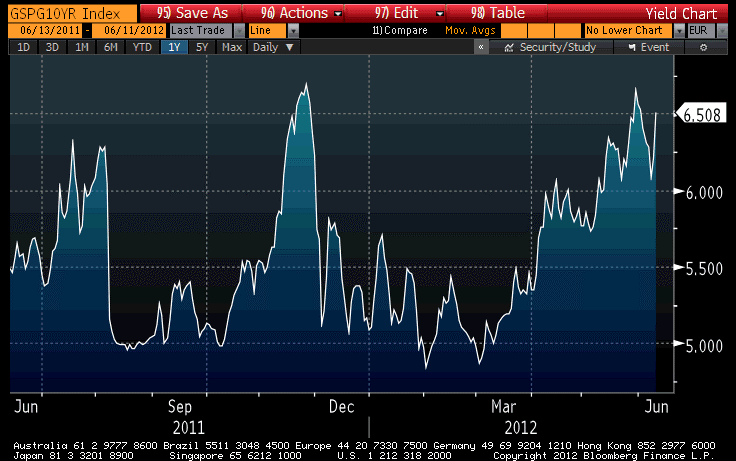
It may seem like the market is lodging a no-confidence vote, but I am not so sure that’s indeed what is happening. Yes, in general it has been a good trade over the last couple of years to bet that the grand plans will come to nothing, and quickly, but this is still the most decision-like announcement that we have yet seen come out of one of these weekend meetings. Yes, this only helps the Spanish banks, and Spain is likely to still need money while the ESM/EFSF now has €100bln less in capacity. But depending on the details, this isn’t a horrible attempt to address a very specific problem. The question, of course, is whether this is a specific problem, or a general one! (Pete Tchir had a great line; he said “Fixing Spanish banks is a bit like drowning one lawyer – a good start.”)
But the rise in Spanish government bond yields doesn’t necessarily mean investors view the announced measures as a failure. Rather, it might indicate that investors view the announced measures as a success and likely to happen – since once element of that program would be (probably) the subordination of the claims of Spanish government debt holders. It is entirely rational to mark yields higher when debt goes from a senior position in the capital structure to a junior position in the capital structure. The question is, what does it do next? That will be the real indication that the announcement quelled some of the fear that had developed…or did not.
Let’s not forget that Greece goes to the polls next weekend, so even if you thought the result of this weekend’s meeting was terrific, we still might be sitting here in a week staring down a Euro exit or breakup.
.
Book Review: Finance and the Good Society
Today’s is a short article, so I thought I would take a few paragraphs to review briefly a book I just finished reading: Bob Shiller’s Finance and the Good Society
I took up this book expecting, frankly, that it would be far too left for my personal tastes. I have great respect for Dr. Shiller, and like many other people I thoroughly enjoyed Irrational Exuberance

The reason that redistribution schemes don’t tend to work well in real economics can be illustrated with a simple, familiar example. Suppose that in a poker game, whenever a player won a pot he collected only a fraction of the pot; specifically, the larger his stack of chips already is, the smaller a share of the pot he gets and the more is distributed to the shorter stacks. Obviously, such a scheme is redistributionist, but if the measure of “good” is taken to be the Gini coefficient or some other objective measure of the evenness of the wealth distribution then this may seem to be a positive improvement to the normal way of winner-take-all from each pot. But advocates of this sort of policy tend to overlook what will happen to the game: if you are sitting on a big stack, you will tend to avoid playing most hands, since your benefit from victory is less the larger the stack you start with.[1] The economic equivalent is that in heavily-taxed societies, the wealthy do not provide as much capital to the system – and so it isn’t a priori clear if more-progressive tax rates will create a more-balanced distribution of wealth. Unless you force them to ante, via a wealth tax…but let’s not go there.
Anyhow, I’m drifting off-topic: Finance and the Good Society pleasantly surprised me. What is great about the book, and surprising I suppose, is that Dr. Shiller spends a great deal of time explaining why the practice of modern finance is mostly good. In Part I, he devotes one (short) chapter each to CEOs, Investment Managers, Bankers, Investment Bankers, Mortgage Lenders and Securitizers, Traders and Market Makers, Insurers, Market Designers and Financial Engineers, Derivatives Providers, Lawyers and Financial Advisers, Lobbyists, Regulators, Accountants and Auditors, Educators, Public Goods Financiers, Policy Makers in Charge of Stabilizing the Economy, Trustees and Nonprofit Managers, and Philanthropists. In each chapter, he explains why this particular role is necessary. Honestly, it’s worth the price of the book just to read an outstanding explanation of why Derivatives Providers, Financial Engineers, and Mortgage Securitizers aren’t inherently evil.
In Part II, Shiller dwells on the problems of modern finance. These we know all too well due to the events of the last five years: problems like “An Impulse for Risk Taking,” “Debt and Leverage,” and “Some Unfortunate Incentives to Sleaziness Inherent in Finance” among others. But unlike in his book Animal Spirits, he does detail some policy prescriptions (including how certain institutions could be redesigned to have the proper incentives). I must be very clear that I don’t agree with all of his policy prescriptions, but I tended to agree with his assessment of the problems.
All in all, this is an even-handed book that makes a distinction that has been rarely made in the post-crisis witch-hunt: hate the sin, love the sinner. The people involved in finance are, in general, good people and the structures, in general, work well most of the time. Improvements can be made, and when the serial crises are over in a few years, hopefully we can discourse intelligently on these improvements. Dr. Shiller has made a good contribution to that discourse with this book.
[1] In fact, if the proportion of the pot that you get to keep if you win is p, and the expected amount that you have to invest in the pot to win, as a share of the total pot, is y, then you will only play in a hand if your expected probability of winning the hand is at least y/p. Therefore, you will only play if you can win very large amounts of money relative to the amounts you bet, or if the odds of your winning are high. In normal poker where p=1, you will bet if your “pot odds” are better than your chance of winning. But in “taxed-winnings” poker, you need much better pot odds relative to the chances of winning.
Leftovers
Friday was a lethargic day, with gorgeous weather producing in many market participants a justification for leisure running something like this: Europe is having a conference call over the weekend about Spain and Spanish banks, and Spain is supposed to be formally requesting aid. As of the announcement on Saturday afternoon, we might have an entirely new set of rules. So why take any risk on Friday?
You have to admit, they have a point.
Not being as predisposed to such leisure, since I am an entrepreneur, I am writing an article today. Actually calling it an ‘article’ may be strong; actually, it’s a compilation of some random thoughts that didn’t make it into my articles this week.
.
- One commenter asked what the chart of the “hypothetical S&P price history” that I showed in yesterday’s article would look like in real space. He hypothesized that we are probably a long way away from a real high. Well, DougM, you’re right. The chart is below. Note that this is just the price index, so that your real total return would be essentially the price change on this chart, plus dividends…which works out, you can see, to basically dividends although if we ignore the first little dip to get us from the red line to the blue line, it works out to be something like 0.75% per annum real return (plus dividends). And yes, it will be a very long time until we party like it’s 1999.

- Earlier this week, I wrote that the “Inflation Risks [Are] More Balanced, But Not By Much.” But I wasn’t clear about what I see as the central tendency, which is to say what I think will happen to inflation “probably.” Core inflation is rising in the U.S., U.K., Europe, and Japan, and in my view there is every reason to expect that trend to continue. The driver of that inflation, which is to say hearty money growth, remains in place. It wasn’t growth that was pushing inflation higher – so the ebbing of that growth is not important to my view. I still expect core inflation to continue rising this year from the current 2.3% in the U.S.
- What should the Fed do, if it can’t reduce rates any more and is reluctant to expand the balance sheet further? Well, if I was at the Fed and I wanted to stimulate the economy, the first thing I would do before going out and buying more powder would be to ignite the powder I’ve already bought. The FOMC should simply remove the Interest on Excess Reserves (IOER), which has contributed to the huge scale of excess reserves. In fact, ideally they would penalize excess reserves. If the Fed set IOER at -3%, you would see aggressive lending from the banking sector. Yes, many of them would be non-economic loans (if the bank can lock in only a 2% loss after the inevitable defaults, it is worth doing), but you would get loans. The Fed doesn’t want to do that because they think it will crush the money market industry. Well, exactly how well is the money-market industry doing at the moment anyway? Sure, you have to choose which bad effect you want, but don’t whine about running out of tools just because you think the money market industry is more important than the proper conduct of monetary policy.
- This is an old story, but it just goes to show you that when real interest rates are below zero, any commodity becomes a good store of value. Apparently the Procter & Gamble brand of detergent Tide is being used in some neighborhoods as a medium of exchange and store of value – that is, as money. The articles pooh-pooh the stories of Tide heists, but to me that’s not the interesting question. If real interest rates were, say, 3%, or nominal interest rates were 5% or 6%, then the use of bottles of Tide as currency would make much less sense since they will always have a 0% real return over time (just like a bar of gold or a roll of copper wire) and you would lose real purchasing power by putting Tide, lumpily, under your mattress. But when real interest rates are -1%, Tide actually outperforms – as should all commodities. This is one reason why commodities normally do very well when real interest rates are low.
- Corporate bond issuance is a long-inflation bet. If corporate treasurers believed there would be deflation, they’d issue inflation-linked bonds. The complete lack of inflation-linked bonds despite incredibly low real rates represents a bet that company CFOs are making that inflation will be higher in the future than it is expected to be now, based on the difference in fixed yields compared to inflation-linked yields. Or, it might represent ignorance, since if the market-clearing price for inflation is fair then we should see a much more balanced pattern of issuance with some issuers favoring ILBs and some favoring nominal bonds. But either way, it is certainly not a strong endorsement for the deflationary view – in a deflation, the last thing you want to do is issue fixed rate bonds.
- If you own XYZ company, and the firm suddenly doubles its share count, each share of XYZ should roughly halve in price (and therefore buy half as much in exchange). We say in that case that you have been diluted. Now consider that the dollar itself is like a share of America, in that it entitles you to a certain amount of output of other people’s goods and services. What do you think should happen when your shares are “diluted” because the Fed has increased the “share count” by 27% over the last four years? Shouldn’t those shares buy less in exchange? That’s called inflation. If you don’t have 27% more dollars now than you did in June of 2008, then you have been diluted. And deluded.
Have a nice weekend.
