Archive
Model Abuse
A central bank is easing again! The only problem for U.S. market participants is that it isn’t the Fed that is easing, but the Bank of China, which last night dropped rates for the first time since 2008. This set markets up on a good tone heading into the day, and investors waited with breathless anticipation for Chairman Bernanke to echo his Jackson Hole speech and send us off to the races.
He didn’t. The Fed chief delivered what passes for moderation from the chief helicopter pilot, matching his comments somewhat obviously to ECB boss Mario Draghi’s comments from yesterday: the Fed is ready to act; long-term inflation expectations are well-anchored; but the U.S. budget trend is “clearly unsustainable” and must be put on a “sustainable path.” (Unremarked-upon was the fact that he contradicted himself when he called the so-called “fiscal cliff” at the beginning of next year “a significant threat.” Which is it? Are smaller deficits bad, or good? The answer is both – bad in the short run but really good in the long run – and the Chairman should say that. This just sounds intellectually sloppy. Then again, he is speaking to Congressmen, so using even using multisyllabic words is frowned upon.)
Any way you slice it, Bernanke did not deliver the promise of “more to come” that some investors anticipated.
Patience. Having played the stern paternal figure, Gentle Ben can now proceed to warm up the choppers. There is a growing chorus of other Fed voices in support of an ease, and in my opinion this is likely a somewhat intentional choreography in which the Chairman can appear to be persuaded by the others on the Committee to do what he wants to do. Chicago Fed President Evans today said bluntly on CNBC that “more accommodation would be good,” that he is very concerned about unemployment and doesn’t see evidence that inflation will rise (apparently he isn’t concerned with the lack of evidence that unemployment will fall due to monetary accommodation). San Francisco Fed President Yellen said yesterday at a speech in Boston that the Fed’s objective is a quick return to full employment (it seems like the Fed’s objective once contained something about price stability, didn’t it?), and that Fed action might be justified “to insure against adverse shocks,” or even if the Fed concludes that the recovery “is unlikely to proceed at a satisfactory pace.”
Really? That’s the bar now? The Fed eases if growth is merely “not satisfactory”? If that’s the answer, then get ready for an enormous amount of easing, because growth isn’t going to be “satisfactory” for quite a while even if the nation skirts a recession.
I always laugh at the assertion that “inflation expectations are well-anchored.” Yesterday I compared this phrase to the analysis that a house has “good auras” by ghost-hunters. (That’s probably not fair to ghost hunters, who may have some science to back up what they are doing as far as I know.) But the phrase also seems to mean whatever you want it to mean. We all know that short-term inflation expectations have plunged, but as I argued in a post this week that is mostly because of energy prices until quite recently. But for market-based measures of long-term inflation expectations, the measure that is popular among policymakers is the 5y, 5y forward inflation rate. Often they take this reading of “expectations” from the TIPS/Treasury breakeven curve, which is wrong, but if you’re using it to tell fortunes I guess it doesn’t matter if you use pigs’ knuckles or rat bones. However, I do think it’s worth tracking 5y, 5y forward inflation from the inflation swaps market, if only to look at what the policymakers are looking at. A chart of 5y, 5y forward inflation in the US, UK (both on the left axis) and Eurozone is shown below. (Source: Enduring Investments)
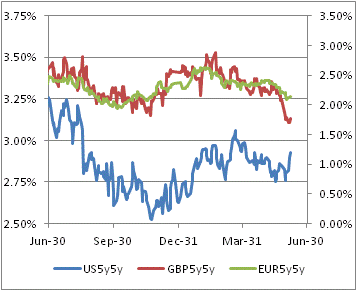
In case the point isn’t apparent, let me make it so. Euro “long-term inflation expectations” are near the lows over the last year. In the UK, that measure is plumbing new 12-month lows. But in the U.S., we’re stable if not rising. Since February 8th, 5y forward inflation is down 2bps in the U.S. but down 35bps in the UK and 49bps in Europe (which already had the lowest long-term measure of the three, near 2%, due to the prior credibility of the ECB as a Bundesbank-descended inflation fighter).
So which is “anchored?” Mario Draghi has the best argument, if this measure is useful for this purpose: Forward Euro inflation expectations are around 2% and have declined markedly recently. The UK has relatively high inflation expectations, but they’ve declined quite a bit, so that’s “anchored” to some extent…at least, there’s a drag on it. But in the U.S., forward inflation expectations are well above the Fed’s ~2.25% CPI target, and have been for quite some time. If anything, those expectations are actually rising but they’re certainly not declining. In any event, Draghi and Bernanke both call inflation expectations “anchored,” but market-based measures of this concept are showing totally different things.
.
Because I didn’t annoy enough equity bulls with my historical and quantitative observations about equity valuations and likely real returns[1] yesterday, I am going to use the tool I deployed yesterday in a manner for which it was absolutely not intended. I was reflecting on the fact that the method forecasts future 10-year returns, but it therefore takes ten years to get the scorecard back to see how things actually turned out. So why not, I thought, pretend that the future really did turn out so that the figures were perfectly accurate? What would the future history of the S&P look like in that case?
So what follows is a make-believe future price chart of the S&P 500. This is not a forecast. I am not even using rat bones.
What I did was take the 10-year real return forecast, (which as I’ve explained in the past takes the long-run real growth rate of the economy, adds dividends, and adds or subtracts most of the “pull to fair value” over the next ten years), and subtracted a 2% dividend to get the expected real index price appreciation. Then I assumed that the CPI index rose at the rate implied by the inflation swaps curve (I calculated the forward 1-month rates and accreted the CPI index by that rate each month, so roughly a 2.46% compounded rate over the whole period but around 1% in the beginning and more like 3% towards the end, as implied by the swaps curve). I took the real index price appreciation and added back inflation to get the nominal price appreciation, and voila! I have a hypothetical series which is the set of S&P index values that, if the projected real return forecast is realized and the inflation swaps curve is accurate, would occur in the future.
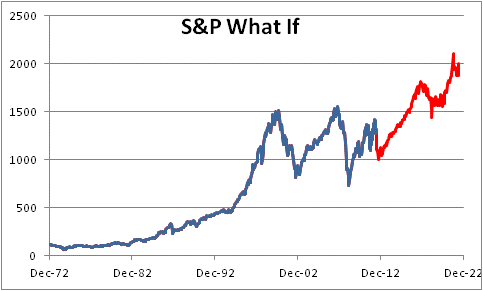
I am happy to report that based on this “method,” the S&P ought to break to new all-time highs sometime in 2016. (Please remember, this is not a forecast. It’s “for entertainment purposes only,” although the practical value of it is as a test to see if the 10-year-real-return-forecasting method produces predictions that aren’t necessarily ridiculous or overly morose. Frankly, it doesn’t seem so bad to me – the chart shows an initial 20% or so discontinuity since the current trailing 10-year return is about 2% higher than what the a priori forecast was in 2002, but then doubles over the next 10 years.
For investors that have been through a 15-year period in which the index went essentially nowhere, and actually fell appreciably in real terms, I would submit that’s not a horrible result. Yes, it’s slower than during the 1980s boom but the difference is we started that boom with stocks at very low valuations while we stand today at above-average valuations.
Let me repeat it one more time: this is not my forecast. I would certainly never forecast an actual path. It is simply the result of taking the forecasting model and essentially cranking it in reverse. And now everyone can tell me why this is stupid and implausible. Ready, go!
[1] Please do note the use of the term real return. To get the nominal return, add your expectations for inflation. But as investors, we don’t really care about the nominal return, but the returns in terms of how much additional stuff we get to consume, so I don’t normally worry about nominal returns, or look at them.
Curious Becomes Furious
The only thing that kept this from being Freaky Friday is that it wasn’t Friday. But it certainly seemed as if everything was reversed suddenly between when we went to bed last night and when we woke up this morning. U.S. equity futures were up 15 points before we woke up, and 38 points above the lows set on Sunday night. Plainly, some traders were either covering shorts or initiating longs before the ECB meeting.
But incredibly…the ECB did not cut rates. In fact, they did almost nothing (and certainly nothing that wasn’t fully expected). Putting on my monetary policymaker hat, I can’t think of any reason for not cutting rates if they actually believe what they profess to believe about economic growth and inflation. Obviously they’re not really worried about deflation, because if they were worried about that then they’d be aggressively cutting since if inflation gets to zero before rates get to zero, it means you can’t ever make real policy rates negative. And they clearly don’t really believe that inflation, using that tired policymaker phrase that Draghi produced again today, is constrained by “firmly anchored” inflation expectations,[1] because if they did then they wouldn’t have any concerns about triggering inflation through adding too much liquidity. True, cutting interest rates doesn’t provide much stimulus compared to a trillion Euros of LTRO, but it is at least a relevant signal.
On the other hand…we already know that Draghi is no Trichet. And we know that under Draghi the money supply is already growing more-briskly (although not exactly briskly) than it did under Trichet, and the current ECB President has done some distinctly non-Bundesbank sorts of things. Maybe keeping rates at 1% are just the cheapest “hawk” credentials he can buy?
I am sure I am coming across as flustered and confused – because I am. I felt like I had had a bead on what was going on, and today doesn’t fit my mental paradigm.
The overnight curious rally turned into a daylight furious rally as the market continued to melt up on light volume (760mm shares) throughout the day, despite the ECB’s relative intransigence and no other news of note. It was nothing short of a desperate grab for risk assets of all stripes as the Euro rallied, the DJ-UBS Commodity Index jumped 1.4%, European stock markets soared, benchmark financial bond spreads tightened 20-30bps despite the downgrade overnight of German and Austrian banks by Moody’s, and yield spreads of periphery bonds compressed (10bps for Spain, 7bps for Italy, 21bps for Portugal in the 10y area).
But why? I feel like the kid who keeps bleating questions until Dad throws up his hands in exasperation and says “because I said so!” Maybe there isn’t an answer, but I wonder if some investors are buying or hedge funds covering short bets just on the thought that Bernanke tomorrow might be dovish when he testifies before Congress at 10:00ET. It just seems like there’s more conviction when buyers are chasing the stock market 2.3% higher than it was yesterday, with no additional information except that the ECB is not easing as aggressively as they might have.
Now, the real equity risk premium, which we define as the expected 10-year real return of equities compared to the real return on 10-year TIPS, did advance a couple of days ago to the highest level in a couple of years. That’s significantly because TIPS yields are low, though, rather than equity returns looking particularly robust. However, I can imagine that some investors who were overweight in fixed-income might have chosen today to get into equities, thinking that the spike low in yields was not likely to persist. That seems like a rotten reason to get into a risky asset class – just because the safe asset classes don’t offer big returns – but there are definitely investors who think that way. Stock bulls, hold your water when you look at the next chart (Source: Enduring Investments).

Realize that although it appears that equities offer the best value relative to TIPS that has been seen since a brief period in early 2009, and more than has been seen for many years before that, we are looking at a period in which equities were congenitally overvalued. TIPS yields only go back to 1997, so I can’t look at the real equity premium from the early 1990s, or the 1980s. However, I can look at the expected 10-year equity real return from back then (and further), using the same methodology I use to produce the numbers in the chart above. The result is not as exciting. The chart below (Source: Enduring Investments using Shiller data) shows that the current projected forward real return of 2.8% is only interesting in the context of the last decade and a half, and only in the context of the poor range of investing alternatives. I included the actual subsequent real return, with dividends reinvested, that is associated with each point up to May 31, 2002 (which 10-year period just finished with a compounded real return of 2.01%).

With the exception of the equity bubble, which produced better-than-expected returns for cohorts starting in the late 1980s and worse-than-expected returns for cohorts starting in the late 1990s (but, you already knew that), the method has a pretty decent track record since 1972. So, while equities are a better real asset than TIPS right now, that’s not saying a whole lot!
None of that solves the conundrum of why stocks spiked today, but it makes me feel better by reminding me to keep focusing on the long-term! There will be wiggles, and my guess is that the next downward wiggle in stocks and upward wiggle in bonds won’t be long in coming. As soon as tomorrow, a bad Claims number (Consensus: 373k from 383k) could set a bad tone. Here’s a surprising statistic: since February 17th, economists’ estimates have been lower than the actual Claims figure – including subsequent revisions, that is – for every week but one. If Claims actually rise from 383k, it is bad news since we ought to be well beyond the weather give-back by now.
However, any reaction on Claims will be tempered by the fact that Bernanke’s testimony begins at 10:00ET or so. That clearly is the important event of the day, and it seems investors are quite confident that Ben will have cheerful things to say about the nearby course of monetary policy. After the ECB whiffed today, I am not so sure. While I think policymakers will respond with alacrity in the event of an actual emergency, I don’t think they are prepared to try to be pre-emptive (and anyway, if they tried to be pre-emptive and failed because Europe imploded anyway, it would look bad). So while the Chairman may be generous with his assessment that “we stand ready to help,” I don’t imagine we’ll get enough concrete promises that the market’s bounce will be validated.
[1] “Firmly anchored inflation expectations” are to monetary policymakers what “auras” are to ghost-hunters. It’s not possible to disprove that expectations are anchored, if you believe they are, because we don’t have any way to measure them one way or the other. But their existence is very important to the believers.
Inflation Risks More Balanced, But Not By Much
The G-7 finance minister/central banker call came and went today with no earth-shattering announcement. In a statement, the U.S. Treasury Department said:
The G-7 ministers and governors reviewed developments in the global economy and financial markets and the policy response under consideration, including the progress towards financial and fiscal union in Europe.
That isn’t the bombshell that some had been expecting. But there’s always the ECB’s meeting tomorrow! It is also a rare “Venus transit” of the sun, so you never know. According to that awesome repository of pure truth, the Internet, “…in general, the transit of Venus bodes well—it’s a good time to fall in love, find favorable resolution in a pending court case, or catch a much-needed break.” That’s welcome news, because Europe sure could use a break! Weirdly, few institutional economists are forecasting a rate cut from Draghi. I would be flabbergasted if the ECB did not cut rates, at least, and I wouldn’t be shocked at further policy measures although they’ll probably hold off on those until Greece actually exits the Euro.
Fed Chairman Bernanke is testifying on Thursday before Congress about the economic outlook. Between the post-ECB presser and the Bernanke testimony, I suspect we will know a lot more about how bankers are looking at the current economic environment by the time Friday rolls around. My suspicion is that they will sound a lot more dovish than they did just a month or two ago. A rotten Employment report in the largest economy and consistently bad PMI reports in the top two economies (U.S. and Europe), along with a rapidly-developing sovereign/banking crisis, will tend to do that.
Those things will also tend to dampen inflation expectations. Whatever your belief about core inflation, recessions tend to produce declines in energy prices and a consequent slowdown in headline inflation (which is what TIPS and inflation swaps are indexed to). Market prices make clear there is currently expectations of a near-term decline in the rate of increase, or even an outright fall, in headline prices. A reader sent me a link to this interesting blog where the author discusses the recent inversion of the TIPS curve. The inversion makes the recent decline in short-term inflation expectations look a lot more dramatic than it is (because short TIPS behave like gasoline futures more than bonds, essentially), but the decline in near-term inflation expectations has certainly happened. The chart below (Source: Enduring Investments) shows the inflation swaps curve currently, compared to the curve one month ago and one year ago. That’s a dramatic elbow in the curve!

And the “elbow” has been growing more pointed. Over the last month the 1-year inflation swap has dropped some 85 basis points, and since the March highs it has fallen 180 bps. However, the chart below (Source: Enduring Investments) shows that almost all of this was due to changes in energy inflation expectations. On May 29th, the core inflation implied by the 1-year swap (which was at 1.31%) was 2.16%, only about 18bps below what had been implied on March 13th. Over the last week, however, expectations for next year’s core inflation have fallen from 2.16% to 1.86%, accounting for about 70% of the decline in the 1-year zero-coupon inflation swap rate over that week. That is an actual meaningful sea change in the attitudes of inflation investors.
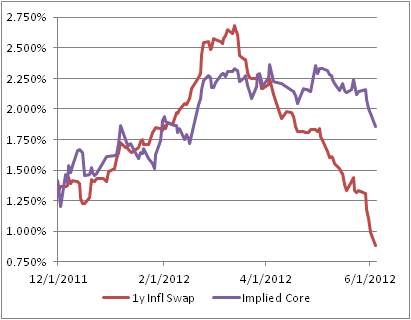
It does bear noting, though, that it is only a sea-change in near-term inflation expectations. The zero coupon inflation curve prices headline inflation over the next 12 months at 0.88%; for the next 12 months (1y, 1y forward) at 1.47%; for the 1y, 2-years forward at 2.21%; and for the 1y, 3-years forward 2.66%. As the chart below (Source: Enduring Investments) illustrates, investors are none-too-sanguine about inflation after whatever near-term correction they think is coming.

Let’s talk a bit about that correction. John Mauldin wrote recently that both deflation and inflation are coming, it’s just that the timing is uncertain. I agree with the part about the timing, but I am skeptical about the deflation.
Arguments in favor of the looming deflationary spiral, precipitating from the European implosion, must lean on expectations for a decline in the velocity of money. Recessions do not naturally cause disinflation. I’ve shown the chart below (Source: Bloomberg) before, but it is worth showing over and over! It shows real GDP (level) in 2005 dollars in white, versus the core CPI price index, in yellow, normalized to 12/31/1999=100. The upshot is that we’ve just come off the biggest recession in 80 years, and inflation barely slowed. In fact, if you remove the effects of the bubble unwind in housing, it didn’t slow at all. If growth causes inflation, and if recessions are by definition deflationary, then we should have seen a decline in core prices.

Now I agree that there’s likely a recession coming, most likely to the U.S. as well as Europe and perhaps globally. But I don’t agree that such a thing is necessarily deflationary.
However, as I said above one can rely on a money velocity argument in this case and Mauldin adeptly does so. I’ve demonstrated previously (for example, here) that money velocity is reasonably well-correlated to changes in the provision of bank credit. The updated chart from that article is below (Source: Enduring Investments), and if the quarter ended today the 2-year compounded rise in commercial bank credit would be up around 2.5%, implying that something like a 17% increase in velocity is expected (eyeballing from the chart).
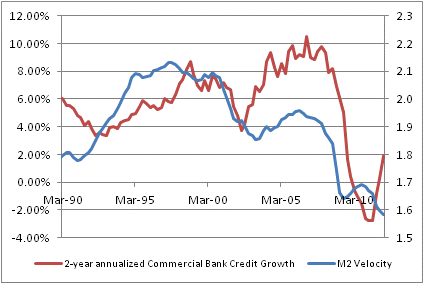
This does suggest a possibility, though, and a way that deflationists could be right. If commercial bank credit collapsed again, then I would expect velocity to keep on contracting. My argument about the upside risks to inflation – at least, the long-tail possibilities – depends on a rebound in money velocity that is not countered by aggressive tightening. We are not going to get aggressive tightening, certainly. But there is a possibility that credit could seize again, as it did in late 2008. Certainly, this is a reasonably likely outcome with European banks. The question is whether U.S. banks – which are much healthier now and currently increasing lending at a 6% clip versus 52 weeks ago – Canadian banks, Japanese banks, etcetera could pick up enough of the slack (or whether European regulators would allow or even encourage zombie banks to keep lending once they become effectively wards of the state) to offset this.
If policymakers get any inkling that credit is seizing up, then the monetary spigots will open wide once more, so in my view a deflationary outcome is very unlikely. But in fairness such a downside tail is more of a possibility than it was a year ago. Is it possible that central bankers might stand down even as velocity plunges? It’s possible, now that there is some concern about the sizes of central bank balance sheets – but I don’t think it’s very likely. So in my opinion, the possible downside “deflation” tail is short in length, short in duration, and low in likelihood; the possible upside “inflation” tail is quite long, quite long in duration, and not nearly as unlikely…in a world where monetary tightening is not viewed as feasible.
I’ll go further and say that if I had to hazard a guess, I would guess that five years from now, we will giggle when we think back and recall that we were concerned about whether our “entry point” for long-inflation trades was 2.10% or 2.40% on ten-year inflation.
It’s Not Hot Money Any More
Those rascals! While everyone was focusing on whether Greece would exit the Euro in the near-term (there’s little question they will exit the Euro eventually), over the weekend German Chancellor Merkel and German Finance Minister Schaeuble urged Spain to request a bailout so that it can reinforce the condition of its banks.
Now, we all knew that was probably coming eventually as well, but last week there had been data showing that deposits have been moved out of Spanish banks in recent weeks and so European policymakers are rightly concerned about a full-scale bank run in the absence of credible (that is, not backed by insolvent sovereign entities but by cash in a fund) deposit insurance on the Continent.
So add Spain to the “To-Do” list, and also to the list of potential arguments. While Germany suggested Spain look for help, Merkel also made clear, again, that Germany will not stand for Eurobonds. Some people seem to think that Merkel is just bluffing. For example, the Wall Street Journal ran a curious article entitled “Germany Signals Crisis Shift” which suggested that “Germany is sending strong signals that it would eventually be willing to lift its objections to ideas such as common euro-zone bonds or mutual support for European banks if other European governments were to agree to transfer further powers to [a central authority in] Europe.” I don’t see anything in what Merkel said, or what her spokesman later clarified, that suggests Merkel would support Eurobonds in almost any set of circumstances – or, at least, relevant circumstances, meaning something that might actually be useful in this crisis over the next year or two.
Merkel is not bluffing. I know this because there is no point in bluffing if you are sure you will be called anyway; in fact, the only reason to bluff is if there is a chance that you will not be called. There is certainly no chance that Merkel saying she’s opposed to Eurobonds will kill the desire in other quarters to have Eurobonds, so I can’t imagine she is trying to defuse that discussion by bluffing but will later cave in. She’s believes in her position, and Eurobonds are dead-on-arrival.
Also kicking around is the idea of a “banking union,” which essentially means that all of the drowning people will embrace and agree to help one another. Spain cannot bail out her own banks because she cannot print money to do so (that was what she tried to do by issuing bonds to Bankia that would be discounted at the ECB in exchange for cash) and doesn’t have enough assets or revenue to do so otherwise. So the idea of a banking union is that all banks would be part of a single network backstopped by Europe. Since that means in the current instance that Germany would have to bail out Spanish banks, and since there are no mechanisms in place to do this in any event, we can also put this idea to one side. It’s an idea for the distant future, one in which Europe survives as a single institution. It doesn’t help in 2012 or 2013, and the reason it is being discussed can only be because authorities think, or hope, that talk along these lines will improve depositor and consumer confidence. Good luck with that.
Stocks had sagged in the U.S. for most of the day, coming ever closer to wiping out 2012 gains for the S&P, when a story came out saying that the G7 will hold “emergency Euro Zone talks tomorrow.” This top-secret meeting was leaked because, again, policymakers are trying to get the nail hammered down without actually having to use a hammer. It won’t work, and so one hopes that the meeting will end with some useful pronouncement. Perhaps a pledge of a coordinated reduction in global swap line rates, or global LTRO, would get a brief pop out of markets. But I doubt it will calm things enough.
The problem is that the big elephant investors are moving, and/or have already gone through the trouble to have changed their country allocations and investing approach. That’s not hot money. That’s not a flow that will reverse overnight. Institutional investors have developed serious and reasonable concerns about the investing climate in Europe, and there will have to be a convincing end to the crisis – or prices low enough that the crisis is fully discounted – before these investors will come back. Investors in motion tend to stay in motion, while investors at rest tend to remain at rest. The inertia has been overcome, I think, so the time for bold-sounding meetings with no concrete results is over. Pops on news such as that will likely be increasingly short-lived.
…And From Mayday to Mayans
If you missed yesterday’s comment “From May Day to Mayday,” you can find it here.
If there were any question whether the recent weakness seen in the economic figures were a payback from a mild winter or an actual slowdown in activity, today’s numbers essentially dispelled that question. The Payrolls numbers were horrendous. The Labor Department reported that only 69,000 new jobs were created in May, but also revised down prior estimates of jobs created for the last couple of months by a net -49,000 jobs. The net of +20,000 jobs does not compare favorably with pre-data expectations of +150,000. If this is payback for the weather effect, it means the rate we are paying back from was already lower than people thought it was.
The Unemployment Rate rose to 8.206% from 8.098%. The workweek fell, but is still okay compared to last year (see Chart) although it has never stabilized at full “recovery” levels. The labor force participation rate improved, which was the only bright mote, but of course that is one reason that the Unemployment Rate rose.
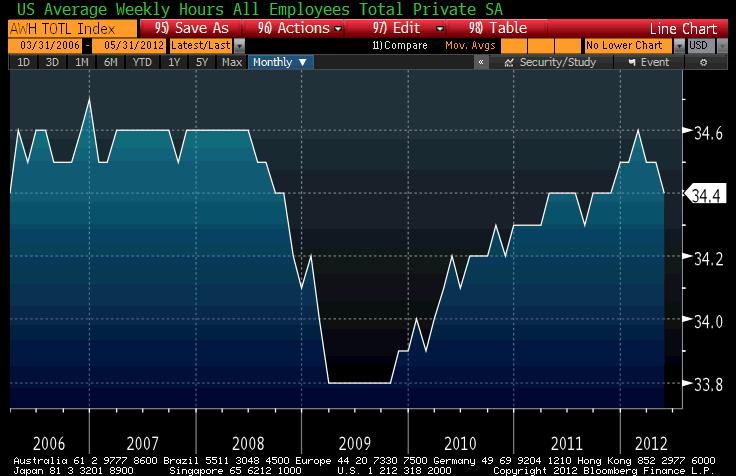
The perception of the man on the street, as indicated in various surveys, is consistent with the idea that the labor market is actually weakening (although it may also be that people are disappointed about the results compared to what has been previously promised).
Personal Income was also a smidge weak, although Consumption held up (God Bless America!). More importantly, while the year-on-year Core PCE deflator was as-expected at +1.9%, it was a soft +1.9% with the monthly change coming in flat. The deflator was 2% last month, which is the Fed’s putative target. One month is not a trend – as we have seen, since Core CPI re-accelerated to new highs after its dip – but if the Fed wants cover for a decision to increase monetary accommodation, they have a tiny bit of cover now.
The ISM Manufacturing survey was somewhat weaker-than-expected, but it remains above 50 (53.5). Meanwhile, Manufacturing PMIs in Europe have been consistently weaker and today’s releases put Spain at 42, Greece at 43.1, Italy at 44.8, France at 44.7, and Germany at 45.2.
Maybe the Mayans knew what they were doing when they said 2012 would be the end of the world? Just kidding, I think. Anyway, things would have to get substantially worse even to be the worst recession of the last five years, so let’s look on the bright side!
Stock markets were crushed on the uniformly bad news. Major European stock markets fell between 1% and 3.5% across the board. The S&P dropped 2% and couldn’t even manage a respectable dead-cat bounce – rather then continued a slow-motion slide for most of the day. Commodities also took a beating, although less than stocks; in fact, if you avoided the Energy complex (which fell 3.1%) you would have been nearly unchanged in commodity indices. Precious metals gained 3.5% with gold itself up $61. Of course bonds did well. Ten-year real yields fell to -0.62%, and 30-year real yields to 0.35%. Ten-year nominal Treasury yields dropped to 1.46%. As the picture below shows, this is so far outside of the thirty-year downtrend (note the logarithmic scale) that there’s nothing to compare the levels to.

The outlook is dim, but the sky isn’t exactly falling yet, in the U.S. anyway. Stocks are only 10% off the highs, after all, although why they were ever at those highs I haven’t figured out. They’re still up on the year. There is some chance, though, that enough of these bad eddies – European growth, Greek election, Spanish/Bankia crisis, and so on – come together to cause some real rough seas over the next couple of weeks.
But we always have the central bankers! Talk of how this makes QE3 more likely may have been the only reason stocks didn’t end up down 4% rather than -2.5% today. Recent pronouncements, however, such as by NY Fed President Dudley on Wednesday, have tended to be fairly discouraging about QE3. The question which is being continuously raised is: why bother with QE3 if interest rates are already at record lows for the whole yield curve?
There’s some merit in this question, but let me start by pointing out that before the Fed eased in October 2008, 10-year rates were already around 3.50%, and hadn’t been below 3% since the 1950s. So the argument that low rates obviate the need for easing clearly didn’t stop the Fed in 2008 and I can’t think of why it would stop them now. There’s always room to have them lower.
Let’s consider the question more formally, though. The Fed believes that monetary policy affects the economy in three ways: through the portfolio balance channel, by signaling, and by improving market functioning. The “portfolio balance channel” is just a cute way of saying that if the Fed buys all of the Treasuries, you’ll have to buy something else. And when you buy corporate bonds or equities, for example, you provide cheap capital to business which then hires and the economy expands. Yes, I can hear you say “this sounds to me like getting the rubes to pour money into risky assets at bad prices.” Precisely. But the Fed sees this as supporting business, and you can see what a wonderful expansion this has produced! Importantly, it isn’t just the level of rates that matters, but the level of rates relative to other assets. So if stock prices fall, then merely maintaining rates where they are should be supportive of a return to the previous-bubbly levels.
The signaling channel is just what it sounds like. The Fed believes that we feel better when they’re assuring everyone that rates will remain low through 2014 (even though they spent months trying to convince us that they didn’t really mean it), and that businesses will invest more confidently knowing money will be cheap for a while. I doubt this has very much importance since the Fed is not held in the esteem it once was, and because businesses and individuals who are concerned about rising rates in the future have the option to lock in rates today with longer-term loans or derivative structures. But again, the important point is that they believe it.
Finally, there is no question that adding lots of liquidity does help “market functioning.” If markets shut down, the economy will tumble. The Fed definitely needs to focus on keeping markets running smoothly. It isn’t clear how much they need to increase the amount of money in the system for that purpose as opposed to directly supporting financial institutions, but this is certainly a valid reason to have easy money.
There is a fourth reason that isn’t usually included in the list, and that’s the fact that increasing monetary liquidity pushes prices higher, and in some cases (such as when a collapsing housing bubble threatens banks as borrowers walk away from loans) it may be perfectly reasonable policy to try and push prices higher. This is the main reason the earlier QE was defensible – because core inflation was low and sagging. It doesn’t really apply in the U.S. at this time.
The biggest hurdle for more QE at this point is that the earlier QE evidently didn’t work very well. Obviously, the world economy is still in a real mess, although there’s no question QE succeeded in raising the price level. So either QE is fairly ineffectual when it comes to raising output permanently – in which case they definitely shouldn’t do more of it but moreover should reverse whatever they’ve done – or it works, but they just haven’t done enough of it yet. Regular readers of this space know that I adhere to the old theory that monetary policy affects prices but only affects growth in the presence of money illusion, which probably is not operative in a world where everyone thinks inflation is higher than it actually is.
That is, I don’t think the Fed can do anything about the economy except raise prices, or try to rein in inflation. They ought to work to keep the financial system itself working, keep banks trading with each other (but not to make trading profits, nooooooo, just to help fill customer orders), and unwinding in an orderly way the institutions that cannot survive. But I wouldn’t be voting to ease here.
But what are they going to do? Will central bankers sit by as markets and economies tumble and do nothing, simply because there’s nothing they can do that would help? One thing I believe you can be certain of is that the Fed, the ECB, the BOE, the BOJ, and other central banks are not about to call themselves ineffectual. That means they will try to “do something” at some point, and they really only have one tool: the money supply. Whether it’s through LSAP, or announcing a target 10-year rate, or eliminating the Interest on Excess Reserves, the process they use operates through the medium of the money supply. I strongly suspect that if markets continue to weaken and/or the Eurozone is sundered, the Fed and other central banks will wade back into the fray.
After all, how badly can they screw up? The Mayans say we only have six months anyway.
