Archive
Where Can I Buy Global Economic Health Insurance?
For a few hours, Americans actually paid attention to news from the United States this morning. It wasn’t the continued weakness in Initial Claims (386k this week, with last week revised up to 392k) that involved investors in domestic affairs for a change, but rather the drama of the Supreme Court’s decision on Obamacare. Just after 10am, the Supreme Court handed down the eagerly-awaited/dreaded decision, and it contained a surprise for just about every observer. The Court upheld the vast majority of the law, including the individual mandate that had so agitated conservatives. But the majority actually held that the law would have been unconstitutional under the commerce clause of the Constitution, which was the argument of those who wanted the law struck down. The interesting twist is that they also ruled the mechanism still worked because it can be construed to be a tax, rather than a ‘penalty.’
In other words, if the law said that you must take an insurance policy or else you’re guilty of a crime, it would have been unconstitutional per se. But the law offers a choice, however bad, that allows you to evade the requirement of the law: you can just pay a rather stiff fine. According to the Supreme Court, that makes it a tax and since it doesn’t force anyone to enter the stream of commerce – it merely persuades them financially that they ought to – it doesn’t run afoul of the Constitution. Bad law, perhaps, but not unconstitutional.
It’s an interesting and depressing ruling. Since there is no limit on the amount of money the government is permitted to levy in taxes, there would be no difference in principle if the Congress had made the “opt-out tax”, say, $100 million, completely bankrupting anyone who refused to comply. It strikes me as a plausible ruling (not that I am a Constitutional lawyer), though I’m not pleased with the result, and anyway it’s the law of the land. But the implication is that your ‘inalienable rights’ are not life, liberty, and property (aka ‘pursuit of happiness’), but life and one of liberty or property. You can give up your property to keep your liberty, or give up your liberty and keep your property. Thanks, Congress.
The stock market reacted instantly, driving lower. Actually the damage was not as severe as I expected it would be, but that’s probably because Europe was still lurking with headlines to come. But in a weird way, the implications for the stock market are in my mind somewhat positive. Hear me out: I think this is the worst possible outcome for Obama, because this decision will energize the right and those who are not on the right but oppose the health care bill (54% of Americans still favor repeal, the same percentage as right after it initially passed two years ago), and American elections are about turnout. As they did four years ago, the Republicans have nominated a dull, milquetoast candidate; but four years ago the citizens who self-identify as Republicans were tired of spending eight years of having defended Bush and by contrast, those same voters are now energized to get out and vote. A Gallup study earlier this year found that since 2008 the number of states that were either “Solid Democratic” or “Lean Democratic” fell from 36 to 19, while the number of states that were either “Solid Republican” or “Lean Republican” rose from 5 to 17, based on professed party affiliation. There were 15 “Competitive” states, and that’s where the suddenly-energized anti-Obamacare voters can tip the balance. Included in that list are states like Pennsylvania, Ohio, and Florida, where the Presidential election has been won or lost in recent years. Oh, and by the way: older Americans (think: Florida) like Obamacare even less than younger Americans who don’t use as much health care.
So, had the Supreme Court struck down parts of the law, both parties could have engaged with voters on what they would do to fix the law. But now the Democrats are forced into defending a piece of legislation that a majority of Americans say they want repealed, and Republicans are saying they will repeal it. That’s a much tougher landscape for the Democrats, and that’s good for equities.
However, the election is still a long four months away, and in the meantime we have a lot of Europe to get through.
As I noted above, the stock and bond markets had flattened out and quieted down – with the S&P down about 10-15 points and bond yields down a handful of basis points – within an hour or so of the ruling. Ironically, Europe provided bullish news when Herman Van Rompuy (the first, and perhaps the last, EU President) declared that the EU had agreed on a new growth pact. Stocks shot higher in moments, almost finishing the day with gains but in any event with slim losses. Unfortunately, it proved a mirage – apparently they “agreed” on a relatively small €120bln deal, but hadn’t completed the details. To me, that means they haven’t agreed on the pact, but perhaps agreement means something else in Brussels. Apparently, though, Spain and Italy were upset at hearing there was a deal even though their concerns – namely, a desperate plea for short-term measures to support their bond markets – hadn’t been addressed, and as of this writing those two countries are blocking the deal (although Van Rompuy said he “wouldn’t say there is a blockage, discussions are ongoing”). So we will see what dinner brings, but if the best that comes out is a mere 120bln-euro deal then it is fair to say that nothing really happened and the Treasury selloff can be delayed somewhat longer!
.
I promised yesterday some words on oil and TIPS. Several people recently have forwarded this article to me, by a Harvard professor, asking for my opinion; it is purported to debunk the “peak oil” hypothesis.
I suppose that the insights in the article are somewhat useful, but it doesn’t really have anything to do with the real theory of “peak oil.” The peak oil hypothesis holds that since production in any given oil field tends to rise, peak, and then sharply decline, and since most of the mega-fields are fully mature and the pace of discoveries of new fields has declined, the global production of oil will eventually decline.
But the hypothesis of course isn’t about the absolute impossibility of producing more oil – we could always assemble molecules by hand in a lab – but involves two different and hard-to-dispute facets: (1) If traditional oil fields grow, mature, and die, and we don’t discover more oil fields, then the amount of oil produced from traditional oil fields must eventually decline. (2) The theory doesn’t say that no alternative fuel will be developed; it isn’t called the “peak energy” hypothesis but the “peak oil” hypothesis! Arguably, oil that is produced from shale or with other advanced technology is an alternative fuel in the sense contemplated by the original Peak Oil hypothesis. But the availability of these alternative fuel sources, or alternative methods of extracting oil, is clearly related to the price of the fuel that is being displaced/replaced. “Peak oil” is a phenomenon that holds ceteris paribus, in particular at unchanged prices.
The price that was extant when “Peak Oil” theories first developed was far lower than it is now. And, for a long time, supply acted more or less as Peak Oil predicted it should, because production is constrained in the short run. But higher prices elicit a higher quantity of supplies, in the long run, of virtually any good. This paper provides proof that (a) this works in the long run but (b) there’s a long lead-time – the author declares the surge in spending on R&D began around 2003, and as long as there isn’t a major decline in prices before 2015, his predictions should come to pass.
The ‘prediction’ of a collapse in crude prices has drawn a lot of attention, but the author makes such a collapse contingent mostly on demand-side events:
“In particular, a new worldwide recession, a drastic retraction of the Chinese economy, or a sudden resolution of the major political tensions affecting a big oil producer could trigger a major downturn or even a collapse of the price of oil, i.e. a fall of oil prices below $70 per barrel (Brent crude)…
“Coupled with global market instability, these features of the current oil market will make it highly volatile until 2015, with significant probabilities of an oil price fall due to the fundamentals of supply and demand, and possible new spikes due to geopolitical tensions. This will make difficult for financial investors to devise a sound investment strategy and allocate capital on oil and gas companies.
So the main shock conclusion is that higher prices for oil beginning in the 2000s led to more R&D and ultimately more production, which could eventually lead to lower prices if demand doesn’t keep up. Wow, give that guy a Nobel prize! I’m actually more interested in the author’s conclusions about the distribution of energy production; he basically suggests that these new technological developments will greatly democratize the production of oil and remove much of the specialness of the Middle Eastern oil patch. That would be welcome, surely.
A surge in energy production is great news, of course, and I would love to believe that the real price of oil will decline (the nominal price will not, if the price level advances sufficiently – so keep in mind we’re talking about the real price) since the developed world really needs a break.
But TIPS are taking the idea of a collapse in oil prices too far. The first two TIPS issues (after the July-2012s which mature in two weeks) are the April-2013s and the July-2013s. At today’s close, they yielded 0.46% and -0.44%, respectively. Let’s first think about the April 2013s. April 2013 nominal Treasuries sport a yield of 0.20%, which means that the April TIPS are implying an outright decline in prices (aka deflation) between now and January and February of next year, when the final payment will be set for that issue. While gasoline futures are significantly backwardated, implying that traders expect energy prices to continue to decline, there’s nowhere near enough drag to imply a decline in the aggregate CPI over the next eight months. We think the gasoline market is implying CPI ought to rise about 0.8% over the next eight months, which means those TIPS are substantially cheap. The same applies to the July 2013s, actually slightly more so since the seasonal inflation pattern is more accommodating for that issue. So, if you’re buying short-dated Treasuries, I suspect you will be much better off buying those TIPS instead – they are far too negative on inflation, and remember: you get the “Middle Eastern crisis” option as well.
Price-A-Palooza
The monthly price-a-palooza from the Bureau of Labor Statistics, coinciding with the auction of $15bln in new 10-year TIPS, also shared the day with Housing Starts and Initial Claims. Dispensing with those two details first: Housing Starts was 657k, which was a disappointing shortfall after the strong NAHB number on Wednesday. Initial Claims looked strong, at 352k, but this comes with two caveats that are really the same caveat. The first is that the prior week’s claims were over 400k; the second is that year-end seasonal adjustment to these figures makes them nearly useless. It is probably most-useful (which is to say, only barely useful at all) to think of the last two weeks together and figure that the current pace of Claims is “about” 375k, right in the middle. This would coincidentally be consistent with the level of claims prior to the year-end volatility (see Chart, Source Bloomberg).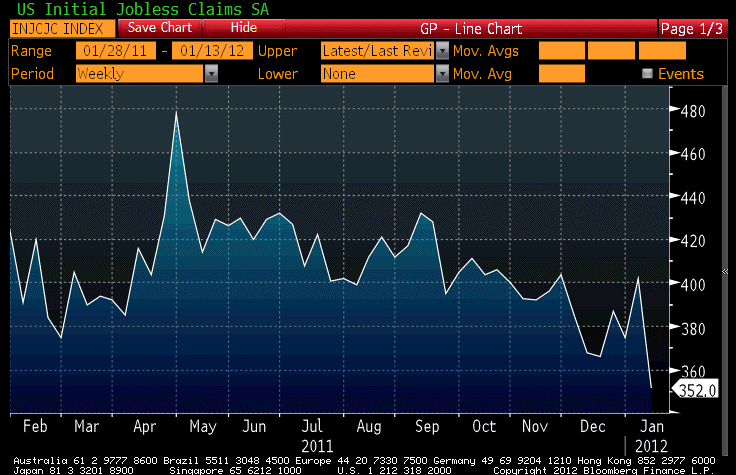
Also out was CPI, of course. Headline CPI was unchanged on a seasonally-adjusted basis, but Core CPI came in as-expected at +0.1% keeping the year-on-year rate at 2.2%. “Stabilization!” screamed the pundits, but it isn’t yet so. Core CPI was actually up 0.145% before rounding, which means we were a mere 0.005% from what would have been considered a surprise for the cheerleaders on CNBC. The year-on-year figure, too, rose nearly a tenth, from 2.153% for the year ended in November to 2.230% for the year ended in December. Rounding giveth and rounding taketh away! Yes, a rise in the year/year pace of only 0.08% represents a modest slowing, but that would still add a full percent to core CPI over the next year were it to persist.
It probably will not persist, because housing is going to begin to act like ballast on the number over the next few weeks, but core ex-housing is already at 2.46% and I see few reasons to expect it to not continue its rise.
In any event, we should remember that the 1.6% rise in core inflation over the last 14 months is the fastest such rise since 1984. A little respect, please, for the inflation process. I know it doesn’t always act like an instant-gratification video game, but looking at the chart of 14-month changes, below, can you tell me that this advance is so shaky that stabilization is automatic from here? I didn’t think so.
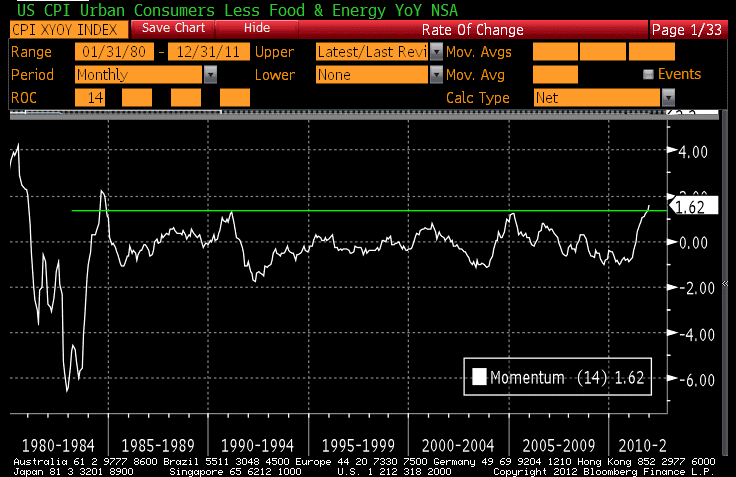
Rolling 14-mo absolute change in core CPI
.
A chart of the current y/y changes and the previous y/y changes is shown below.
| Weights | y/y change | prev y/y change | |
| All items |
100.0% |
2.962% |
3.394% |
| Food and beverages |
14.8% |
4.452% |
4.373% |
| Housing |
41.5% |
1.874% |
1.918% |
| Apparel |
3.6% |
4.573% |
4.763% |
| Transportation |
17.3% |
5.197% |
8.024% |
| Medical care |
6.6% |
3.491% |
3.370% |
| Recreation |
6.3% |
1.027% |
0.348% |
| Educ & Communication |
6.4% |
1.670% |
1.418% |
| Other goods and services |
3.5% |
1.701% |
1.858% |
As you can see, Food & Beverages, Medical Care, Recreation, and Education & Communication, which collectively represent 34.1% of the basket, are still accelerating. Transportation (mostly because of energy), Apparel, and Other (24.4%) are decelerating. Housing looks like it is a wash, but it isn’t really, yet:
| Weights | y/y change | prev y/y change | |
| Housing |
41.5% |
1.874% |
1.918% |
| Shelter |
31.96% |
1.905% |
1.839% |
| Fuels and utilities |
5.10% |
2.432% |
3.423% |
| Household furnishings & operations |
4.41% |
1.000% |
0.767% |
As you can see, most of the apparent slowdown in Housing is also in the energy sector, while Shelter is still rising. If we put 32.4% as “accelerating” and 5.1% as “decelerating”, then we still have 2/3rds of the basket accelerating. Again, that won’t be the case for long, but it is early to call the end of the inflation rise. Note also that the Median CPI put out by the Cleveland Fed actually ticked up to 2.3%, so it is above core CPI (although for all intents and purposes, tied).
There is a reason that many models are calling for a flattening out of core “soon.” The most-honest reason is that some models establish an important role for “anchored” inflation expectations. I am familiar with the literature on inflation anchoring, and I find it completely unpersuasive. I also do not believe in poltergeists. Both theories seem to explain certain phenomena, but neither has compelling empirical data to back them up. While it does seem that poll respondents “anchor” their responses (and it seems they anchor them to the most-recently-released figure that all media trumpet), there is not any evidence that consumers and producers actually change their behavior at all because of that “anchoring.” However, if it’s in your model, it’s one reason you might think that core inflation above 2% ought to begin reining itself in.
The sneakier reason that some economists are calling for a flattening out of core inflation is that we all can see the conditions in the rental markets, and that follows the recent renewed downturn in housing prices which is due to the inventory overhang. So it’s easy to say “Core won’t reach 3% soon.” It would be remarkable if it did. Indeed, it’s remarkable it’s already this high given that it has the unwind of an epic bubble to deal with. The current 2.23% core rate is above what our models expected to see realized for 2011, because shelter inflation rose more than we expected. What’s more interesting is to forecast what is going to happen to core ex-shelter, which is already above the Fed’s target and rising.
Our models take note of the fact that 52-week M2 money growth is now at 10.71%, just slightly high of a one week peak above that level in January 2009. Before that, and a dramatic one-week spike in September 2001 (wonder what that could have been?), you have to go back all the way to 1982 to find faster year/year money growth. Unlike last year, too, it’s not all going into the vault – corporate credit growth over the last year is now up over 3% and still rising. So in my opinion, is probably too early to send the hawks back to the eyrie.
Remarkably, my measure of the spread of perceived inflation over actual measured inflation – I think of it as sort of an ‘angst’ index – reached an all-time low (going back 12 years) this month. The index is driven by, among other things, the volatility of price changes and the dispersion of price changes. In other words, inflation has been rising in a comparatively stealthy, orderly way, which tends to diminish our sensitivity to it. Not unlike a frog being cooked in water that is being brought slowly to boil, come to think of it.
And yet, with everyone telling us not to worry about inflation, with 10-year real yields negative, with dealer risk-appetites still low, and with headline inflation tumbling back down to only 3%, the Treasury today sold $15bln 10-year TIPS 3bps better through the screens at the bidding deadline. Dealer demand was strong, as was the overall bid:cover. Someone wants inflation protection here!
On Friday, Existing Home Sales (Consensus: 4.65mm vs 4.42mm last) is the only data. I think we are also supposed to hear about the private-sector cram-down from Greece. The word was that there was supposed to be an agreement “by the end of the week,” but come to think of it I guess maybe they didn’t say which week! In any event, conditions look good for a return of the 10-year yield above 2% (closed today at 1.97%). While calamity can strike at any time, a fair amount of calamity is already priced into Treasuries. Moreover, it’s only calamity of a deflationary kind, not a calamity of an inflationary kind…and it isn’t at all clear that that is the most likely kind of calamity here.
Scrooge Businesses
Stocks rallied today, as did commodities, in thin year-end trading (I am very tired of this latter phrase, which it seems we could have accurately used since October). The putative reason for the rally was that Initial Claims remained low (364k) rather than bouncing to 380k as the consensus estimate had predicted. The quality of the Initial Claims data will deteriorate rather sharply over the next couple of weeks and for the first few weeks of January, but it does seem likely that we have moved out of the old range of 400k-425k and into a new lower range. This is consonant with a general improvement in the overall data (and in the mood in the country!).
M2 money supply leapt $32bln last week. So much for the possibility I mentioned a few weeks ago that the pace of money growth might be slowing. The 52-week rise in M2 is back up to 9.8%. One of the restraints on inflation, despite this money growth, has been the slower rise in transactional money in Europe, where the year-on-year rate of rise in M2 as of the end of October was only 2.1%. This is soon to change, however, thanks to the ECB’s new operation. As a blog post from The Economist pointed out yesterday, ECB President Mario Draghi has stopped the stern denials about the ECB engaging in quantitative easing.
“Each jurisdiction has not only its own rules, but also its own vocabulary. We call them non-standard measures. They are certainly unprecedented. But the reliance on the banking channel falls squarely in our mandate.” (The source of the quote is an interview with the Financial Times here, but the Economist article makes for better reading.)
The ‘news’ of the day being thus dispensed with, I can proceed directly into a belated observation or two about the Fed’s Z.1 “Flow of Funds” release that was posted in early December. The Z.1 is a rich source of bauxite with just a little alumina within it, but one does occasionally find something valuable and/or interesting. I like to plot the debt numbers in various ways, because the Fed helpfully slices up the debtors into convenient categories (although they seem to still include Fannie Mae and Freddie Mac debt in “private” domestic financial institutions, which is a ridiculous fiction. More on the impact of that fiction in a moment).
I have published charts with roughly quarterly regularity simply to provide a concrete reminder that the popular story about household deleveraging is largely a myth. The chart below shows it very clearly: most of the deleveraging has come from domestic financial institutions. This will continue, as the Fed moves to implement substantially all of the Basel III recommendations and demands an extra layer of “protection” in the form of capital from systemically important institutions. Households have de-levered somewhat as well, but not really very much in the grand scheme of things. It just feelslike deleveraging compared to the wild leveraging behavior seen prior to 2008. Relative to income, consumers are carrying less debt, and it is the first decline in a generation, true. But it isn’t very much.
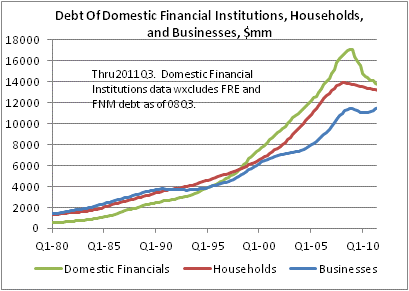
Businesses are adding debt!
But here’s the interesting thing in the chart above. Businesses are re-levering. Okay, technically they are not re-levering, but they are adding debt. This also spears a popular story, that of the cash-hoarding trolls that run businesses in America today. We are told that if businesspeople would only have confidence (those lousy one percenters!) the economy would be healed. Well, it’s a wonderful story, except for the fact that ‘taint so. Business owners are behaving like Scrooge, all right, but it’s Scrooge after the visitation by Marley’s ghost.
It is true that there is more cash on corporate balance sheets than there was five years ago. In some cases, it looks as if companies are issuing debt to hold cash! But that may not be far from the truth. After credit lines evaporated in 2008 and 2009, a prudent business will need to keep lots more cash on hand as an insurance measure. It is a good sign that business debt is growing, and it means this measure confirms the recent expansion in commercial bank credit that I mentioned and illustrated in a comment last week.
The second interesting chart is shown below. It computes the total federal, state, and local government debt as a proportion of GDP. The ratio currently stands at 86.6%.
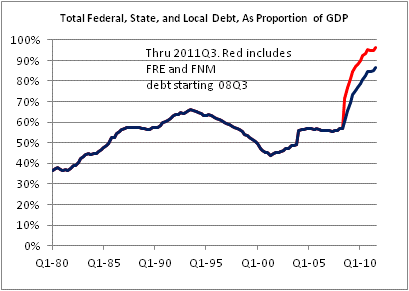
U.S. public debt is approaching 100% of GDP.
That would not be a big story in itself, but the red line is. The red line is the ratio if you simply recognize that Fannie Mae and Freddie Mac debt are de facto obligations of the Federal government. And that ratio is at 96.1%, and will almost certainly exceed the magical 100% level by the middle of next year.
[Of course, you could plausibly argue that if you include Social Security and Medicare obligations, the obligation ratio is wayyyyy over 100%. But there are two differences with those obligations. One is that the government can decide to stop paying those benefits and it would not constitute a default. An abrogation of the social contract, yes; a default, no. The other difference is that Social Security and Medicare are inflation-linked, so the government can’t inflate out of them. Therefore, the existence of those obligations shouldn’t influence whether or not a calculated decision is made to spur inflation to reduce the real burden of the debt.]
Have a very Merry Christmas, a Happy Hanukkah, or be otherwise jolly no matter what your religious or secular persuasion. There will be one more article before the new year – but not this week!
