Archive
The Marie Antoinette Rule
The biggest surprise of the day on Tuesday did not come from new Fed Chairman Janet Yellen, nor from the fact that she didn’t offer dovish surprises. Many observers had expected that after a mildly weak recent equity market and slightly soft Employment data, Yellen (who has historically been, admittedly, quite a dove) would hold out the chance that the “taper” may be delayed. But actually, she seemed to suggest that nothing has changed about the plan to incrementally taper Fed purchases of Treasuries and mortgages. I had thought that would be the likely outcome, and said so yesterday when I supposed “she will be reluctant to be a dove right out of the gate.”
The surprise came in the market reaction. Since there had been no other major (equity) bullish influences over the last week, I assumed that the stock market rally had been predicated on the presumption that Yellen would give some solace to the bulls. When she did not, I thought stocks would have difficulty – and on that, I was utterly wrong. Now, whether that means the market thinks Yellen is lying, or whether there is some other reason stocks are rallying, or whether they are rallying for no reason whatsoever, I haven’t a clue.
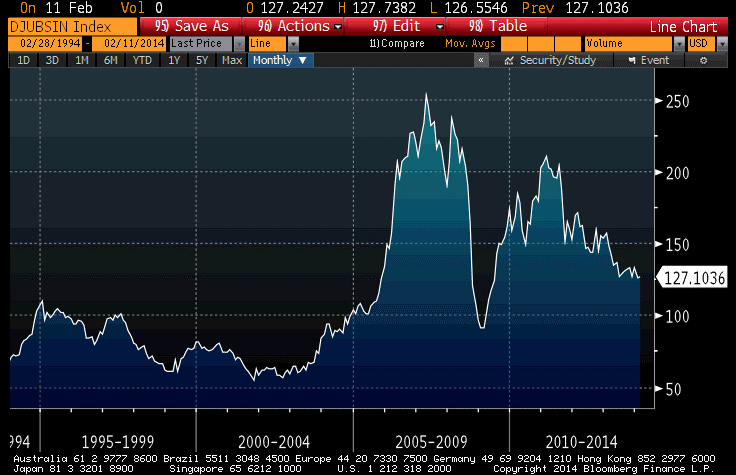
I do know though that the DJ-UBS commodity index reached its highest closing level in five months, and that commodities are still comfortably ahead of stocks in 2014 even with this latest equity rally. This rally has been driven by energy and livestock, with some precious metals improvements thrown in. So, lest we be tempted to say that the rally in commodities is confirming some underlying economic strength, reflect that industrial metals remain near 5-year lows (see chart, source Bloomberg, of the DJUBS Industrial Metals Subindex).
One of the reasons I write these articles is to get feedback from readers, who forward me all sorts of articles and observations related to inflation. Even though I have access to many of these same sources, I don’t always see every article, so it’s helpful to get a heads up this way. A case in point is the article that was on Business Insider yesterday, detailing another quirky inflation-related report from Goldman Sachs.http://www.businessinsider.com/goldman-fed-should-target-wage-growth-2014-2
Now, I really like much of what Jan Hatzius does, but on inflation the economics team at Goldman is basically adrift. It may be that the author of this article doesn’t have the correct story, but if he does then here is the basic argument from Goldman: the Fed shouldn’t target inflation or employment, but rather on wage growth, because wage growth is a better measure of the “employment gap” and will tie unemployment and inflation together better.
The reason the economists need to make this argument is because “price inflation is not very responsive to the employment gap at low levels of inflation,” which is a point I have made often and most recently in my December “re-blog” series.
But, as has happened so often with Goldman’s economists when it comes to inflation, they take a perfectly reasonable observation and draw a nonsensical conclusion from it. The obvious conclusion, given the absolute failure of the “employment gap” to forecast core price inflation over the last five years, is that the employment gap and price inflation are not particularly related. The experimental evidence of that period makes the argument that they are – which is a perversion of Phillips’ original argument, which related wages and unemployment – extremely difficult to support. Hatzius et. al. clearly now recognize this, but they draw the wrong conclusion.
There is no need to tie unemployment and inflation together …unless you are a member of the bow-tied set, and really need to calibrate parameters for the Taylor Rule. So it isn’t at all a concern that they aren’t, unless you really want your employment gap models to spit out useful forecasts. Okay, so if you can’t forecast prices, then use the same models and call it a wage forecast!
But the absurdity goes a bit farther. By suggesting that the Fed set policy on the basis of wage inflation, these economists are proposing a truly abhorrent policy of raising interest rates simply because people are making more money. Wage inflation is a good thing; end product price inflation is a bad thing. Under the Goldman rule, if wages were rising smartly but price inflation was subdued, then the Fed should tighten. But why tighten just because real wages are increasing at a solid pace? That is, after all, one of society’s goals! If the real wage increase came about because of an increase in productivity, or because of a decrease in labor supply, then it does not call for a tightening of monetary policy. In such cases, it is eminently reasonable that laborers take home a larger share of the real gains from manufacture and trade.
On the other hand, if low nominal wage growth was coupled with high price inflation, the Goldman rule would call for an easing of monetary policy…even though that would tend to increase price inflation while doing nothing for wages. In short, the Goldman rule should probably be called the Marie Antoinette rule. It will tend to beat down wage earners.
Whether or not the Goldman rule is an improvement over the Taylor Rule is not necessarily the right question either, because the Taylor Rule is not the right policy rule to begin with. Returning to the prior point: the employment gap has not demonstrated any useful predictive ability regarding inflation. Moreover, monetary policy has demonstrated almost no ability to make any impact on the unemployment rate. The correct conclusion here is a policy rule should not have an employment gap term. The Federal Reserve should be driven by prospective changes in the aggregate price level, which are in turn driven in the long run almost entirely by changes in the supply of money. So it isn’t surprising that the Goldman rule can improve on the Taylor rule – there are a huge number of rules that would do so.
A Soft Evans Rule In Place
So in the end, we got about what I expected from the Fed. Operation Twist was extended, and actually a bit more than I thought they would be able to extend it as the program will continue through year-end.
I said that I would “look for signs that an Evans-type rule is being implemented,” and we got a hint of that as well. Remember, the “Evans Rule” is a conditional policy directive modeled after Chicago Fed President Evans’ suggestion that the FOMC should provide easy money until unemployment falls below 7% or core inflation rises above 3%. Obviously, the parameters “7%” and “3%” are where the rubber meets the road – without parameterization, the policy reduces to roughly what the Fed said in its statement:
“The Committee is prepared to take further action as appropriate to promote a stronger economic recovery and sustained improvement in labor market conditions in a context of price stability.”
Put “an unemployment rate below seven percent” in place of “sustained improvement in labor market conditions” and “core price inflation at or below three percent” in place of “price stability,” and you have exactly the Evans Rule. I doubt most of the Committee would accept 3% as an acceptable level for core inflation, but by backing into the Rule in this way the FOMC can argue later about what those parameters actually are.
Bernanke reinforced the point in his after-meeting presser, when he made clear that this didn’t mean that stability at 8.2% unemployment would be okay. He said “If we don’t see continued improvement in the labor market, we’ll be prepared to take additional steps if appropriate.” Moreover, the Fed is willing to consider further asset purchases and “still has ammunition.” (So you see – they’re relevant!)
Since I think the Unemployment Rate is fairly likely to rise, or at least not to fall, from this level, I believe the QE3 crowd got about the best that they could reasonably hope for. There was no sign leading into the meeting that policymakers were thinking seriously about another large-scale asset-purchase (LSAP) program, so it would have been a true shock if one had been delivered. If Greece had already exited the Euro, we probably would have seen it, but otherwise they will take their time to “communicate the strategy clearly” over the next month and a half. That communication will probably not take the form of outright speculation that some more LSAP is needed; with the ball teed up, all speakers need to do is lament the failure of the labor market to do better and the implications are already writ clearly.
It makes sense to go slow here. The economy is weakening, but not plunging. The crisis in Europe is less urgent, for today. The Twist has been extended, so they’re not standing idly by, and they’ve satisfied the importance of appearing relevant and concerned with their statement and promise of great things to come in the future. The ECB two weeks ago didn’t ease, and the MPC of the Bank of England narrowly voted against Chairman Mervyn King (in a true democracy, the Chairman sometimes loses), who was seeking to expand the BOE’s bond purchase program. The MPC said there was “merit in waiting” to see how things play out in the next few weeks in Europe.
To me, it sounds like July and August will see the next round of QE commence, probably from all major central banks, unless somehow the situation in Europe really does seem to be moving towards an extended period of calm and/or U.S. growth springs forward abruptly. I don’t see either of those things happening, but the benefit from waiting is that they might. In the meantime, the only thing the Fed loses is an extra couple of weeks goosing the stock market, but they can get that anyway once the communication strategy commences in earnest.
The data mill churns tomorrow after a couple of days off, with Initial Claims (Consensus: 383k from 386k) tomorrow along with Philly Fed (Consensus: 0.0 from -5.8) and Existing Home Sales (Consensus: 4.57mm from 4.62mm). The Philly Fed number is the most interesting one, as economists are expecting a significant rebound from last month’s 14-point decline. I’m not sure why I’d look for a bounce; the NY Purchasing Managers’ Index also dropped sharply in May and the Empire Manufacturing figure fell sharply in June. I wouldn’t be expecting a big jump from Philly Fed.
Model vs. Reality: Reality Wins
The bond market ended Thursday nearly unchanged, although short TIPS did very well because energy markets continued to trend higher. Gasoline rose 0.8% to $3.1136/gallon and NYMEX Crude added 1.5% to $107.83. Precious Metals were also higher. Stocks gained 0.4%. It is hard to believe this can merely be enthusiasm over growth and a “risk on” trade associated with the purported resolution of Greece’s troubles. In fact, I will say that with the almost unanimous acceptance of the notion that “the crisis is over” among the mainstream media makes me very nervous. Apple has recovered its losses from last Thursday, although on a fraction of the volume it had on the selloff, but I am accumulating equity hedges. Implied vols are at a 7-month low, but I don’t think risk is.
That is all I am going to say about market action today, because I want to mention a research publication that crossed my desk today and discuss what it means to a trader who is also an econometrician.
Goldman Sachs Global Economics, Commodities and Strategy Research today produced a piece called “The Top-Down Logic for Our Inflation Forecast.” In it, the economics team explains why they are calling for core inflation to fall to 1.5% in 2012, and 1.3% next year. Their reasoning is the “the combination of labor market slack and anchored inflation expectations should reassert itself in lower core price inflation over time.”
Frequent readers of this column will know that I have rebut the labor market slack hypothesis a number of times, and while I haven’t explicitly rebut the ‘anchored inflation expectations’ argument (mainly because modeling this requires complicated regime-shifting models that make it hard to refute null hypotheses) I am highly critical of them since the evidence in support of the notion that inflation expectations matter is based on measures of inflation expectations that demonstrably fail to measure inflation expectations.
So, you would think that these few paragraphs would be criticizing the forecast of Goldman Sachs. But that’s not really my point. Really, I want to point out the really hysterical part of the note, and observe why sell-side economic analysis is so useless (although some economists at Goldman, to be fair, are quite good). Goldman says “Although the model failed to capture the sharp pick-up in inflation in 2011, our bottom-up analysis suggests that this deviation was chiefly driven by special factors outside of the scope of the model, including pass-through from surging commodity prices and a spike in auto prices.”
Yes, that’s right: if there’s a discrepancy between reality and the model, then obviously it is reality at fault and not the model!
To make the hilarity of this point clear I reproduce below the chart from their piece:
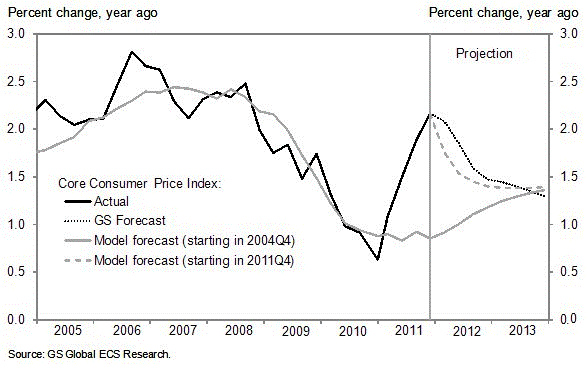
So all the model failed to do is to pick up the most-dramatic rise in core inflation in the last 35 years or so.
To make this fair, here’s my own model (now Enduring Investments’ model) covering the same period. Note that the model forecasts are actually finalized about 12 months ahead.
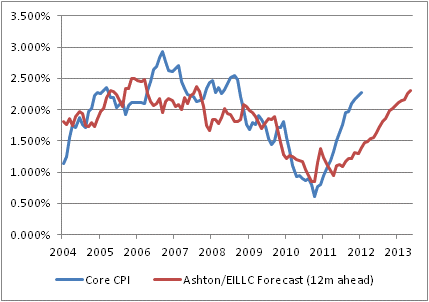
As I’ve said frequently, the current surge in inflation has not been fully captured by our model (although if we distributed the lags, rather than doing a simple lag, it would probably have done better, as the strange spike in late 2011 suggests). But at least it got the direction right, and began to rise at the right time, and for the right reasons. And, unlike Goldman, I think the reason for the difference is that our model isn’t quite right and is missing or underestimating some effect – so I expect our model will catch up with reality, rather than the other way around as Goldman does.
If an economist is highly confident in the model, then it can be reasonable to expect minor deviations to be mean-reverting. But it’s the model that’s mean-reverting, not reality (it is a model, after all – it isn’t supposed to capture all the nuance of reality). And if there is a significant deviation in reality from the model, then it can make sense for an economist to hew to the model if he’s 100% confident in the model. But then, if he’s 100% confident in a model, he’s an idiot. Which reminds me of this:
Bernanke: Well, this fear of inflation, I think is way overstated. We’ve looked at it very, very carefully. We’ve analyzed it every which way…We’ve been very, very clear that we will not allow inflation to rise above 2% or less…We could raise interest rates in 15 minutes if we have to. So, there really is no problem with raising rates, tightening monetary policy, slowing the economy, reducing inflation, at the appropriate time…
Pelley: You have what degree of confidence in your ability to control this?
Bernanke: One hundred percent.
Aside from the irony that we’re already above 2% (although not in core PCE, which he will claim should be understood), the other commonality (besides utter confidence in the model) between Goldman’s economists and this Princeton economist is that they’re absolutely confident that they have the right model: labor slack and inflation expectations. So far, we have seen from neither one of these sets of economists any deep introspection about whether maybe, perhaps, labor slack and inflation expectations don’t really matter, but things like money supply do.
Incidentally, while our model’s forecast for year-end is 2.10%, if we’re right on the trend but wrong on the starting level (that is, if the effect we missed was around the bottom and isn’t something persistent) then the more-relevant figure is the 0.8% acceleration in y/y core CPI our model expects in 2012. That would put core inflation at a cool 3%. Interestingly, if we remove the dampening effect the high level of private debt has in our model – that is, if we simply hypothesize that the ratio of private/public debt has a discontinuous effect so it either dampens (at high private/public ratios) or does not dampen (at moderate or low private/public ratios), then we also get 3%. That hypothesis, obviously, is difficult to test, which is why it’s important to not be 100% confident or reliant on your model, and to always be skeptical that you may be missing a key dynamic. Life is not linear. The reason that these economists don’t know that is that they’ve never tried to trade a model! If you are an investor who relies on models, a healthy – and continuous – skepticism is your best defense against reality diverging from your model.
I suspect something in between our model’s forecast (2.1%) and our model’s forecast for acceleration (implying 0.8% acceleration) is right, and so 2.7%-2.8% is our official forecast. By the way…not that it matters, if labor slack and inflation expectations are all that matters…but M2 rose $27.9 billion in the latest week and continues to grow at a better-than-10% pace year/year. It first hit that pace exactly half a year ago.
On Friday, New Home Sales for January (Consensus: 315k from 307k) is due out at 10:00ET. More interesting is that a number of regional Fed Presidents are in NY to speak at a conference on monetary policy. The conference begins at 9:00ET, so be prepared for tape bombs all day from San Francisco Fed Williams, St. Louis Fed President Bullard, Philly Fed President Plosser, and NY Fed President Dudley – a former Goldman Sachs economist, by the way. It will be interesting to hear if any of them is interesting in examining his model, or if they all expect reality to conform to the model.
It being Friday, we are supposed to have some rumors about a Greek deal over the weekend, but I am not sure how to play that since we supposedly have a Greek deal already. Perhaps this means that there won’t be such great expectations, and we can all enjoy the weekend for a change.
