Archive
Not Out Of The Woods Yet (And A Book Review)
Over the weekend, the Spanish crisis was semi-resolved with the EU agreeing in principle to give money from the ESM (which isn’t operational yet) or the EFSF to the FROB (the Spanish banking entity). The €100bln will likely be senior to other Spanish government obligations, although this is not clear.
In fact, there is a fair amount that isn’t clear. Equities shot higher by 20 S&P points overnight, only to fall back to +7 before the NY open and finishing the day down 16.7 points, -1.3% on the day.
Stocks may have been taking a cue from Spanish and Italian bonds, which were smashed today. Spanish 10-year yields rose 30bps (see Chart, Source: Bloomberg) while Italian 10y BTP yields rose 12bps.
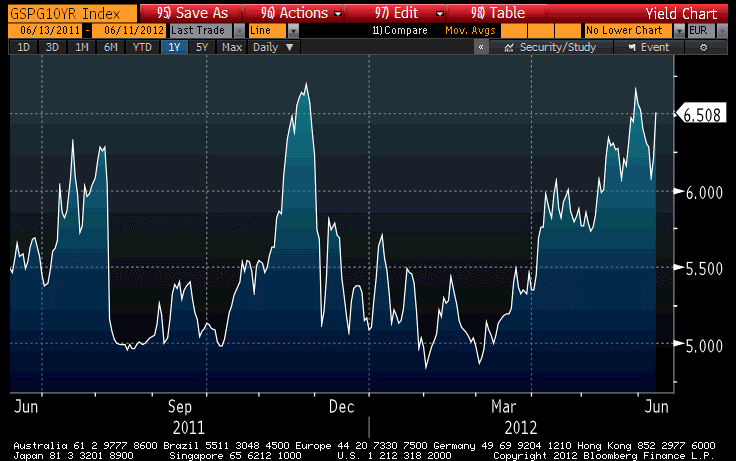
It may seem like the market is lodging a no-confidence vote, but I am not so sure that’s indeed what is happening. Yes, in general it has been a good trade over the last couple of years to bet that the grand plans will come to nothing, and quickly, but this is still the most decision-like announcement that we have yet seen come out of one of these weekend meetings. Yes, this only helps the Spanish banks, and Spain is likely to still need money while the ESM/EFSF now has €100bln less in capacity. But depending on the details, this isn’t a horrible attempt to address a very specific problem. The question, of course, is whether this is a specific problem, or a general one! (Pete Tchir had a great line; he said “Fixing Spanish banks is a bit like drowning one lawyer – a good start.”)
But the rise in Spanish government bond yields doesn’t necessarily mean investors view the announced measures as a failure. Rather, it might indicate that investors view the announced measures as a success and likely to happen – since once element of that program would be (probably) the subordination of the claims of Spanish government debt holders. It is entirely rational to mark yields higher when debt goes from a senior position in the capital structure to a junior position in the capital structure. The question is, what does it do next? That will be the real indication that the announcement quelled some of the fear that had developed…or did not.
Let’s not forget that Greece goes to the polls next weekend, so even if you thought the result of this weekend’s meeting was terrific, we still might be sitting here in a week staring down a Euro exit or breakup.
.
Book Review: Finance and the Good Society
Today’s is a short article, so I thought I would take a few paragraphs to review briefly a book I just finished reading: Bob Shiller’s Finance and the Good Society
I took up this book expecting, frankly, that it would be far too left for my personal tastes. I have great respect for Dr. Shiller, and like many other people I thoroughly enjoyed Irrational Exuberance

The reason that redistribution schemes don’t tend to work well in real economics can be illustrated with a simple, familiar example. Suppose that in a poker game, whenever a player won a pot he collected only a fraction of the pot; specifically, the larger his stack of chips already is, the smaller a share of the pot he gets and the more is distributed to the shorter stacks. Obviously, such a scheme is redistributionist, but if the measure of “good” is taken to be the Gini coefficient or some other objective measure of the evenness of the wealth distribution then this may seem to be a positive improvement to the normal way of winner-take-all from each pot. But advocates of this sort of policy tend to overlook what will happen to the game: if you are sitting on a big stack, you will tend to avoid playing most hands, since your benefit from victory is less the larger the stack you start with.[1] The economic equivalent is that in heavily-taxed societies, the wealthy do not provide as much capital to the system – and so it isn’t a priori clear if more-progressive tax rates will create a more-balanced distribution of wealth. Unless you force them to ante, via a wealth tax…but let’s not go there.
Anyhow, I’m drifting off-topic: Finance and the Good Society pleasantly surprised me. What is great about the book, and surprising I suppose, is that Dr. Shiller spends a great deal of time explaining why the practice of modern finance is mostly good. In Part I, he devotes one (short) chapter each to CEOs, Investment Managers, Bankers, Investment Bankers, Mortgage Lenders and Securitizers, Traders and Market Makers, Insurers, Market Designers and Financial Engineers, Derivatives Providers, Lawyers and Financial Advisers, Lobbyists, Regulators, Accountants and Auditors, Educators, Public Goods Financiers, Policy Makers in Charge of Stabilizing the Economy, Trustees and Nonprofit Managers, and Philanthropists. In each chapter, he explains why this particular role is necessary. Honestly, it’s worth the price of the book just to read an outstanding explanation of why Derivatives Providers, Financial Engineers, and Mortgage Securitizers aren’t inherently evil.
In Part II, Shiller dwells on the problems of modern finance. These we know all too well due to the events of the last five years: problems like “An Impulse for Risk Taking,” “Debt and Leverage,” and “Some Unfortunate Incentives to Sleaziness Inherent in Finance” among others. But unlike in his book Animal Spirits, he does detail some policy prescriptions (including how certain institutions could be redesigned to have the proper incentives). I must be very clear that I don’t agree with all of his policy prescriptions, but I tended to agree with his assessment of the problems.
All in all, this is an even-handed book that makes a distinction that has been rarely made in the post-crisis witch-hunt: hate the sin, love the sinner. The people involved in finance are, in general, good people and the structures, in general, work well most of the time. Improvements can be made, and when the serial crises are over in a few years, hopefully we can discourse intelligently on these improvements. Dr. Shiller has made a good contribution to that discourse with this book.
[1] In fact, if the proportion of the pot that you get to keep if you win is p, and the expected amount that you have to invest in the pot to win, as a share of the total pot, is y, then you will only play in a hand if your expected probability of winning the hand is at least y/p. Therefore, you will only play if you can win very large amounts of money relative to the amounts you bet, or if the odds of your winning are high. In normal poker where p=1, you will bet if your “pot odds” are better than your chance of winning. But in “taxed-winnings” poker, you need much better pot odds relative to the chances of winning.
Maybe Silence Really Is Golden
It wasn’t the slowest day of the year so far, but that is only because of the extraordinarily weak start we have had to the year in terms of market volumes. I will have a little more to say about that, later, but for comparison today’s volume was lower than any day in the first three full weeks of December!
I thought, and I gather that others thought, that today might have been more interesting. The Greek PSI talks, which were supposed to be finished on Friday, were suspended temporarily and, while they have now resumed they have apparently done so with lines drawn in the sand. There is no way to construe the current state of that discussion in a positive way – even if agreement is ultimately reached, it probably is the last such agreement and it isn’t going to be enough anyway.
Those talks were supposed to be done before a meeting of EU ministers today, at which Germany suggested combining the ESM and the EFSF or letting them both operate at the same time. Until now, the plan has been for ESM to replace the EFSF; if both are kept open then it means the new guarantees associated with the ESM become additive to those guarantees still “untapped” in the EFSF, rather than replacing them. It’s not clear to me why other nations contributing to the ESM, who were told the ESM was a replacement for EFSF, would go along automatically with what amounts to an additional coerced contribution, but it’s today’s ‘happy thought’ from the Euro politicians.
The EU over the weekend also determined that indeed there will be an embargo of Iranian oil – they have heretofore dithered – starting in the summer. This helped energy markets, and commodities rallied again, with the DJ-UBS index up 1.62% as the dollar fell 0.5%. Natural Gas spiked more than 10% as Chesapeake Energy (the second-largest domestic producer of nat gas) said it will “cut output, idle drilling rigs and reduce spending in gas fields by 70 percent” according to Bloomberg. The combination of less supply and more demand if there is shifting away from oil at least among dual-source consumers turned out to be helpful for gas.
The stock market ended the day nearly unchanged after trying both a rally and a selloff and deciding that neither direction provoked activity from investors. Treasuries sagged again, with the 10-year up to 2.06% and near the highest yields since October. I think there is more coming to that selloff, but we might some modest support near this level. 10-year real yields are also at their highest levels in a while, back up to 0% although 13bps of that is the roll to the new TIPS issue (that is, the old guy is at -0.13%). TIPS yields also I expect to rise, although less so than for nominal bonds. Breakeven inflation remains quite inexpensive.
The VIX has fallen all the way back down to 18.7, a level it hasn’t been at since July. It is very hard to maintain options implied volatilities if the actual payoff to delta-hedging is virtually nil, and that’s partly what is happening. At these levels, it starts to make sense again to add equity exposure through options rather than through outright positions.
I didn’t say whether the position I would take here is a bullish one or a bearish one. I continue to be modestly optimistic that the economy can avoid a recession as long as Europe doesn’t implode; the problem is that is still looking quite likely. And equity prices are high, measured in reasonable ways, even if you don’t assume that margins will return to long-run means.
However, it occurs to me that one way to look at the current volume lull – an admittedly rose-colored glasses view, but perhaps not indefensible – is that this could represent the first stage of revulsion/exhaustion among investors. After more than a decade of putrid returns and plenty of volatility, it would not be surprising to see America’s love affair with the stock market finally tarnish. Frankly, it’s something that many long-term bears have been expecting for years. (I can’t claim credit for being one of those who declared that investors need to hate equities before we can have a long-term rally. But I thought they needed to stop loving the market irrespective of price.) For me, the connection with price is still important: loathing would be nice, but loathing ought to be accompanied by cheap prices before the low-risk “high margin of safety” opportunities are legion. I don’t think we’re there yet, so I don’t think the current rally is the beginning of a long-term upswing. But the next big selloff we get – say, at least 20% – might produce the revulsion that keeps markets down for a while, and sows the seeds of great opportunity.
As I say, that’s an optimistic view of the awful volumes so far this year. The more-pessimistic view is that this is a natural result of the legislative and regulatory assault on market makers. Darrell Duffie took this view in a recent paper called “Market Making Under the Proposed Volcker Rule,” in which he says:
The Agencies’ proposed implementation of the Volcker Rule would reduce the quality and capacity of market making services that banks provide to U.S. investors. Investors and issuers of securities would find it more costly to borrow, raise capital, invest, hedge risks, and obtain liquidity for their existing positions. Eventually, non-bank providers of market-making services would fill some or all of the lost market making capacity, but with an unpredictable and potentially adverse impact on the safety and soundness of the financial system. These near-term and longer-run impacts should be considered carefully in the Agencies’ cost-benefit analysis of their final proposed rule.
It is a very good paper, and worth reading in its entirety. I admit bias in that Duffie discusses the subject and reaches conclusions similar to those conclusions I jumped to initially (see for example my comments on the Volcker Rule proposals in May 2010 and September 2010), but he applies more thorough reasoning and more rigor. I doubt very much it will matter, since I suspect most Members of Congress can’t read.
And maybe Congressional revulsion is part of the process as well. Lower prices are a reward to long-term investors to provide liquidity when short-term buyers and market-makers are reluctant to – so perhaps this is all part of the process. The bad news is that I don’t think the process is complete yet, but at least it has (perhaps) started.
Yee-Haw News And Ho-Hum Trading
Tuesday was another day of ho-hum trading following yee-haw news.
Anyone expecting a bloodbath following the ratings downgrades clearly has not been paying attention as the market sleepwalks through 2012. Stocks gained 0.4%, 10-year note yields ended virtually unchanged at 1.86%, and TIPS yields fell 2.5bps despite the proximity of a $15bln 10-year auction, now only 2 days away with 10-year TIPS yields at -0.22%.
The dollar slid somewhat, and commodities rallied. Indeed, the only market with a reasonable level of excitement was the Nat Gas market, where prices fell to levels not seen since 2002 (see Chart, Source Bloomberg). It is useful to remember that a significant part of commodities futures returns comes not from movements in the spot price, but from collateral return, normal backwardation, expectational variance, and a couple of other sources.

Natural Gas front contract. Spot gas has gone basically nowhere in a decade as supply responded to price.
Of course, Nat Gas also had the worst fundamentals of any commodity. Coming into the month, the mild winter and the added supply from frackers had combined to make NG the fourth-most-contango commodity (a commodity in contango is one which has deferred contracts at higher prices than nearby contracts, implying a negative roll return), with the worst momentum, among the universe of normal commodities. That combination means that it was not selected this month to be one of the commodities in the USCI basket. And that, in turn, means that USCI has appreciated by 3.79% this month while DJP, an ETN that tracks the DJ-UBS Commodity Index, is up only 0.02%.
European bonds closed mixed, with small gains in Greece, Portugal, Ireland, and Italy on the back of successful sales of short bills in Spain, Hungary, Belgium, and by the EFSF. But it isn’t very surprising that these sales of 3-month to 18-month bills were well-received, considering that the ECB has made hundreds of billions of Euros available virtually free to banks, which can earn an easy spread in this way. Let me know when Spain sells a 5-year note. Portugal also bounced a little today because the huge move yesterday was caused by Citi removing the country from its European Bond Index after its downgrade. Some investors who systematically wait for these “forced” moves to take the opposite side of figured to be getting a mild bargain. For a little while, anyway!
Fitch tried to grab the headlines back from S&P by saying that Greece is insolvent and will default. Really, though, at this point it’s about the over/under on when, not if, Greece defaults. Markets did not react to this news, nor to S&P’s statement that it will take ratings actions on European banks and insurers within the next month, some as early as the next week. This is potentially a bigger deal than the original downgrade itself. While a sovereign rating is a strange beast – since many investors will treat the sovereign as the closest thing there is to a risk-free investment in a particular country, no matter what its rating – ratings of financial companies affect actual contracts, collateral covenants under a CSA (collateral support annex to an ISDA), and credit lines. It was a downgrade to AIG that triggered one of the big failures in 2008, when the additional margin demanded by CSA agreements could not be met by the firm. And the problem for investors is that unless you’re the guy holding the CSA that has the rating trigger in it, you won’t know about the problem until it’s too late. Not that investors need any more reason to avoid financials than that their business model is irremediably destroyed and ROE will be permanently lower in the future, but the silent-but-violent nature of the blowup events means the only person holding the credit that is about to go under will be the person who is the last to hear about margin calls.
.
By now, I suppose we all recognize that one of the precipitating factors for this crisis, if not the precipitating factor, was the rise in leverage and in particular private leverage. There has been a lot of ink spent about the ‘deleveraging’ that is going on; as I have written several times before (most recently in “Scrooge Businesses”) the data say this is largely a myth. Domestic financials are deleveraging; Households are deleveraging slightly; Businesses are now re-leveraging. And of course, this is all occurring with the backdrop of the great increase of leverage that the federal government is generously taking on our behalf. I think that many of us feel that society must be deleveraged broadly in order to build the foundation for robust future growth. I want to take a quick moment here to talk about the difficulty of actually reducing overall leverage.
John Mauldin recently wrote (and he has written many times before on this topic, as have others):
“…a country cannot reduce private-sector leverage, reduce public-sector leverage and deficits (balance its budget), and run a trade deficit all at the same time…ultimately, there must be a trade surplus if leverage and debt are to be reduced.”
The statement is true from any given country’s perspective; Mauldin’s argument is that we can’t all run trade surpluses. That’s not quite true: emerging market countries are in general drastically less-leveraged than are the developed countries, so if we could just persuade them all to run large trade deficits to the developed world, we could shift our indebtedness to them. Let’s assume for the sake of argument that isn’t a serious alternative. What, if anything, do we need to do to reduce ALL debt and leverage?
It may seem easy. Each of us needs to save, pay down credit cards, and so on. We all know people who are doing this. And yet, the numbers say that in aggregate, it’s not happening. That’s because when Person A sells his house to person B, one is delevering but the other one is levering. When Person A defaults, he delevers but the bank who lent him the money increases its leverage. If Person A defaults and the government injects capital into the bank, then the government is taking on Person A’s leverage.
What the numbers tell us (see the charts in ‘Scrooge Businesses’ referred to above) is that the government’s increase in leverage is simply balancing out the decrease in the banks’ leverage, and households and businesses are just trading around leverage and not doing much. Is there anything we can do, absent borrowing lots of money from EM?
It turns out that there is one thing we can do, and you may be able to guess what it is by the fact that it has been the last refuge of heavily-indebted governments for many generations. Leverage is, notionally, the dollar value of debt divided by the dollar value of assets. Back in the 1970s and 1980s, one reason that overall leverage wasn’t growing too fast is that the real value of debt evaporated pretty quickly. That is, you paid off your mortgage with dollars that were worth a lot less than when you took out the mortgage, and the house was worth a lot more. This happened because the value of a mortgage is a fixed number of dollars. Inflation helped keep leverage in check by eroding those claims. As a society, we became used to this effect, and when inflation went away in the 1990s and 2000s, we continued to draw as much debt as we had been (and more) but when we went to pay it back, it was still a lot of money! Much more debt got rolled and refinanced, and the debt numbers climbed.
The solution to the debt/assets ratio is inflation, unfortunately. While many assets will not keep pace with inflation, some will. Below is a chart (Source: Enduring Investments) that I use in presentations in a different context – illustrating how a corporation’s capital structure drifts (to non-optimal levels) over time if debt is nominal. But the chart has meaning in the context of this discussion. The curves show how rapidly your leverage decreases under different inflation assumptions, assuming that you start at 100% leveraged, your assets keep pace with inflation and your debt is nominal. So for example, if inflation is 1%, after 10 years your leverage is down to 78% or so; if inflation is 7%, then your leverage is down to 45%.
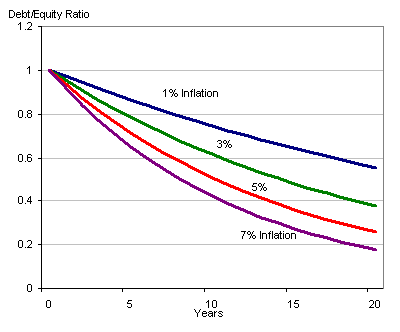
Inflation isn't all bad. If you're a debtor. And aren't we all?
Note that this has nothing to do with amortizing the loan. We are assuming no amortization here. So all you do is pay the interest, and in 10 years your leverage drops 150% more (55% instead of 22%, roughly) with 7% inflation.
So, do you still think the Fed is neutral on inflation? Do you still think the Committee really wants inflation pegged at 2%? At the very least, the FOMC wants inflation to be at the upper end of the band that allows it to retain its credibility. And, if push came to shove, I suspect they might allow an “oops” to happen if they thought a little more inflation might help delever society.
And it might. It just might.
.
Speaking of inflation, the next two days see PPI (Consensus: +0.1%/+0.1% ex-food-and-energy), which isn’t important, and CPI (Consensus: +0.1%/+0.1%), which is. I’ll have more to say on CPI tomorrow.
Rolling, Rolling, Rolling…Keep Them Lenders Rolling
Either the strategy of releasing downgrade announcements for Europe at 4:30 ET paid off, or sovereign ratings have become largely irrelevant. On Monday, albeit a market holiday in the U.S., bond markets ignored the downgrades and equity markets rallied in the U.S. (via futures) and in Europe.
Except for Portugal. Portuguese 5-year note yields rose 193bps to 16.13%; 10-year note yields rose 125bps to 13.17% (see Chart, source Bloomberg).

Portugal seems to be saying 'we got next.'
Why Portugal? Why not Spain, or France? It’s understandable why Greece, which everyone already assumes will default, didn’t sell off further; Portugal, it seems, is considered next in line. I still would have expected the other countries in the queue to have moved up as well, since they are getting closer to the front of the line (and, as I said on Saturday, there is always a chance that the dominos all fall at once in a big unzipping).
Volumes were lighter, of course, with most U.S. traders out for the day, and we may see more of a reaction on Tuesday, but honestly I don’t expect much of one. We did get a tiny bit of additional information on Monday, and that was that the European Financial Stability Facility (EFSF) also, unsurprisingly, had its rating cut from AAA to AA+ as a direct consequence of the downgrading of many of the constituent members. This downgrading happened even though the EFSF is technically ultimately backstopped by only the AAA members…the problem is that those AAA guarantees are only worth €271bln now rather than €451bln. There will be an immediate test of the new rating, although a mild one, as the EFSF goes to market tomorrow to sell 6-month bills (because, you know, 3 months might not be enough to completely solve the crisis I guess).
Speaking of tests of a rating, here’s your scary chart of the day. Looking back to the U.S., where Treasury yields are below expected inflation for 10 years, the distribution of US debt looks like this:
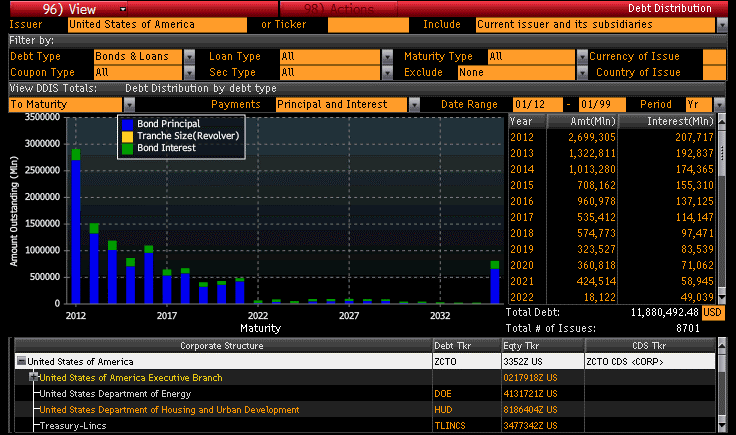
Ouch! The employees of the Treasury are certainly earning their pay these days.
Yes, that’s $2.7 trillion the Treasury needs to roll this year, not including the new money to cover this year’s deficit. About $1.9 trillion of that is in the first half of the year ($1.3 trillion of which are Treasury Bills). I sure hope we can keep rolling a trillion or so T-Bills every quarter! What could go wrong?
Now, the Treasury had a similar, if somewhat smaller, problem last year. But last year, the Federal Reserve was generously vacuuming up hundreds of billions of dollars of the issuance. Right now, investors fleeing Europe are filling in for the Fed. What happens if the crisis in Europe really does recede?
All of these things are hopelessly intertwined. Like two trees which have grown together, the banking and sovereign crises in both Europe and the U.S. may have become inseparable – saving one may imply killing the other. It may be that only way that the U.S. can fund itself is if money continues to flee Europe!
The Treasury will sell $56bln in T-Bills tomorrow, and $15bln in new 10-year TIPS on Thursday. There shouldn’t be any problem with these auctions, yet. Empire Manufacturing (Consensus: 11.00 from 9.53) for January is also due out, along with revisions, but shouldn’t move markets. We will instead react carefully to news out of Europe, and more particularly our markets will respond on the basis of how their markets are responding. The reviews from Monday suggest our bonds could lose some flight-to-quality sponsorship, but it’s early yet.
