Archive
Mercedes Ben
On Wednesday, Fox News was showing live video of police in Los Angeles chasing bank robbers escaping in an SUV. The bank robbers began to throw cash out the window (see picture below), apparently hoping to have the streets behind them blocked by the scores of people scooping up free money.

It didn’t work, and the robbers were apprehended. Of course it didn’t work – that money isn’t worth what it used to be, and anyway the Federal Reserve today was on schedule to throw a heck of a lot more money than that out the window.
And throw they did – in fact, in recognition of the similarity between the money-flinging bandits and the Federal Reserve chief, I move that we retire “Helicopter Ben” as a moniker in favor of “Mercedes Ben,” which anyway has a better ring to it (and a built-in song). Interestingly, despite all indications – quite deafening indications to anyone who has listened to Fedspeak for any length of time – that the Fed was planning another dose of QE, a surprising number of investors were evidently surprised. There were no bad bets from the long side today: stocks launched higher on the news, gaining 1.6% to four-and-a-half-year highs. The DJ-UBS commodity index rose 0.7% to a one-year high (up 18% since mid-June). Treasuries gained (although it is hard to fathom exactly why, since the Fed will be buying mortgages, not Treasuries), with the 10-year note rallying 4bps to 1.72%; but TIPS launched higher with 10-year yields falling 13bps (to an all-time low of -0.76%) and the 5-year TIPS dropping 16.5bps to -1.62%. This sent breakevens sharply wider, with 10-year breakevens up 9bps on the day to 2.48%, the highest since last May. The all-time high for 10-year breakevens is around 2.78%, which is still a fair bit away; but, by the same token, 10-year breakevens touched 0% in late 2008, had lows of 1.52% in 2010 and 1.71% in 2011, and are up 41bps since July 26th (see Chart, source Bloomberg).
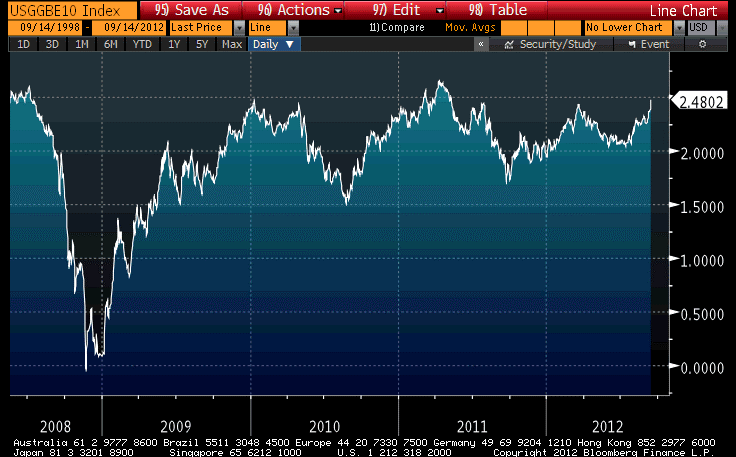
Meanwhile, 5y inflation, 5 years forward, extracted from inflation swaps quotes (which is the proper way to do it, rather than looking at a pair of idiosyncratic bond breakevens), is at 2.98%, threatening to break the 3% level for the first time (other than during a quick spike in March) since last year. And that’s as the Fed starts QE3.
One thing is sure, and that’s that at least one investor out there is very, very unhappy today. That’s because over the last few days someone bought at least $2 billion in 0% zero coupon inflation floors, in 5-year and 10-year tenors, in the interbank market over the last few days (and who knows if more traded directly on a dealer-to-dealer basis). A 5-year 0% zero coupon inflation floor will pay off only if there is net deflation over the next 5 years; for the 10-year 0% floor, the deflation will have to persist for a full decade. These floors are analogous to what is found in TIPS themselves, so there is a chance that the dealer buying these floors is preparing a TIPS-like inflation-linked bond issuance buying them on behalf of a punter (these days, since banks can’t engage in proprietary trading, it is very unlikely this is a bank bet). The interbank market is anonymous except to the actual counterparties who consummate a trade (and regulators, of course), so we are left to wonder whether there is some plan here or whether some investor just made a very big bet at exactly the wrong time.
So what was so surprising about the Fed throwing money out the window? The FOMC statement said, in relevant part:
“The Committee is concerned that, without further policy accommodation, economic growth might not be strong enough to generate sustained improvement in labor market conditions. Furthermore, strains in global financial markets continue to pose significant downside risks to the economic outlook. The Committee also anticipates that inflation over the medium term likely would run at or below its 2 percent objective.
“To support a stronger economic recovery and to help ensure that inflation, over time, is at the rate most consistent with its dual mandate, the Committee agreed today to increase policy accommodation by purchasing additional agency mortgage-backed securities at a pace of $40 billion per month. The Committee also will continue through the end of the year its program to extend the average maturity of its holdings of securities as announced in June, and it is maintaining its existing policy of reinvesting principal payments from its holdings of agency debt and agency mortgage-backed securities in agency mortgage-backed securities. These actions, which together will increase the Committee’s holdings of longer-term securities by about $85 billion each month through the end of the year, should put downward pressure on longer-term interest rates, support mortgage markets, and help to make broader financial conditions more accommodative.
“The Committee will closely monitor incoming information on economic and financial developments in coming months. If the outlook for the labor market does not improve substantially, the Committee will continue its purchases of agency mortgage-backed securities, undertake additional asset purchases, and employ its other policy tools as appropriate until such improvement is achieved in a context of price stability.”
The Evans Rule is no longer soft, as it has been since June. It is still non-parametric, but it is explicit. The Fed will keep easing (in MBS, “additional asset purchases,” and using “other policy tools”) until “the outlook for the labor market” improves “in a context of price stability.”
Bernanke said in his post-meeting presser that the Fed will be following a “qualitative” approach to easing, and said that if the economy becomes weaker, “we’ll provide more support.” More support? More support? They’re going to run out of things to buy. He said the Fed won’t be “premature” in removing accommodation (translation: they’ll keep programs in place too long, rather than risk being too brief), a determination echoed elsewhere in the statement:
“To support continued progress toward maximum employment and price stability, the Committee expects that a highly accommodative stance of monetary policy will remain appropriate for a considerable time after the economic recovery strengthens.”
Have no fear, however: Mercedes Ben said comfortingly that the Fed has the “tools and the willpower” to keep inflation low. Because, you know, if you just have enough willpower everything will work out just fine!
The purchase of mortgages as opposed to Treasuries is most likely not primarily driven by a desire to lower mortgage rates, which are already absurdly low anyway. I suspect that, in a rare moment of thinking ahead, the Fed realized that since there is already something of a concern about a shortage of Treasury collateral with which to margin derivatives trades, leading to a new Wall Street business “transforming” collateral, it will be less disruptive on market function to buy non-Treasury collateral.
I had expected, as I wrote back at the end of August, that the Fed would do QE “perhaps in mortgages instead of or in addition to Treasuries,” and might change the formulation of the ‘extended low rates’ promise (which was extended to 2015, but that doesn’t mean much now) to be a hard formulation of the Evans Rule. We didn’t get the hard formulation of the Evans Rule, but as I say, it’s explicit.
It appears that we have not yet gotten a cut in the Interest on Excess Reserves (IOER), which would probably be the most-potent easing measure. The IOER is technically not decided by the full Federal Open Market Committee (FOMC), but by the Board of Governors only – that is, excluding the regional Federal Reserve Presidents. However, politically speaking, if the BOG were to cut IOER without the tacit agreement of the rest of the FOMC, it would make the next meeting a mite testy (plus, there is the risk of running out of alphabet letters).
So, lump the IOER cut into the “other policy tools” bucket.
The positive response in markets to what was a fairly obvious policy move – although evidently not obvious to all – suggests that more is ahead. That is less clear with equities, which have to face considerably headwinds of European volatility yet, but I would expect breakevens and commodities to continue to do quite well going forward.
.
Tomorrow, the CPI will be released. The consensus call is for a +0.6% rise in headline prices and +0.2% on core inflation. That will take the year/year change in headline CPI from 1.4% up to 1.7%. Core inflation is expected to fall from 2.1% to 2.0% y/y, which indicates that Street economists are expecting a “soft” 0.2% (one that rounds up to that figure) of 0.16% or 0.18%, since anything higher than that would cause the y/y change to round up to 2.1% and appear unchanged. If we do not get the round-down to 2.0%, we probably aren’t going to see it for a while. The next four months that will slide off the year-on-year comparison for core inflation are all +0.17% or less. Thus, August is likely to be a local low, although given the big downside surprise (for quirky reasons) last month, and given that the median CPI is still at 2.3%, I frankly think there’s a good chance that core inflation y/y stays at 2.1%.
The next year will be very interesting for inflation. Adding QE3 when core inflation is already at 2% is gutsy, or foolhardy (depending). At some point, surely the water overtops the dam – no matter how much “willpower” is applied to stop it. It isn’t as if inflation hasn’t been rising already!
Also tomorrow we’ll get Retail Sales (Consensus: +0.8%/+0.7% ex-autos). It seems incongruous to me, given the economic weakness of late, that economists are looking for a second straight strong print from core Retail Sales. Also out tomorrow are Industrial Production/Capacity Utilization and the University of Michigan Confidence survey, neither of which matter much.
Is Inflation Flowering?
To know that you’re standing before a cherry tree, you needn’t have cherries; cherry blossoms suffice. The seasons are long, so if you want to be able to harvest the fruit you need to look early for the signs.
So it is with inflation, and some would say it is with markets in general. We look for the early hints (a less-poetic scribe might call them ‘green shoots’) that signal when the season has turned. With inflation, indeed, the season has turned long ago, when core inflation bottomed in Europe, the U.S., and Japan in 2010 (and in the UK even earlier). But as we have seen, markets have not yet internalized this turning, or in some cases (as with nominal yields) have begun the recognition and then reversed it.
Consider now the humble 7.5% gain this month in the DJ-UBS commodity index (and comparably large moves in many other indices). It isn’t the size of the move, or its consistency, that is interesting to me; rather, it is that the movement has come partnered with a break of commodities’ relationship to the dollar.
Since commodities for the most part are priced in dollars, it is natural that they tend to move in the opposite direction from the greenback. When the dollar strengthens, then commodities are more expensive to non-dollar consumers, and they demand less. Yes, of course there are other factors, but when there are no stronger underlying currents then commodity indices tend to move inversely to the dollar. The chart below (Source: Bloomberg) illustrates the strong coupling of the dollar index (here inverted) and the DJ-UBS Commodity Index in yellow, both normalized to August 1st, 2011.
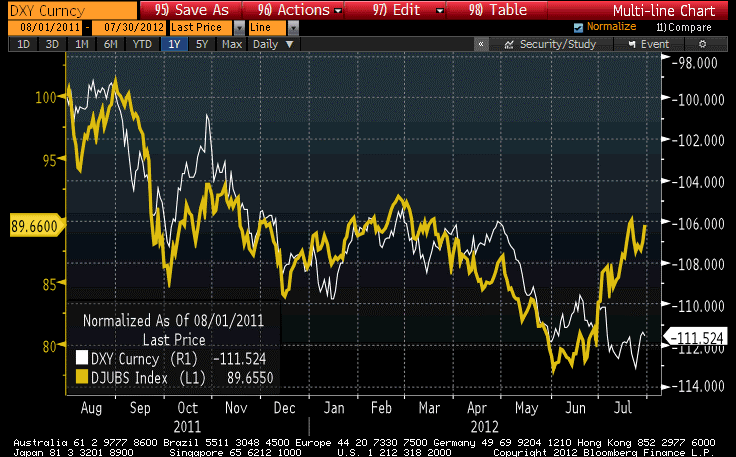
But note that this recent movement in commodities has come not in conjunction with a weakening in the dollar, but in spite of a strengthening (albeit a modest one) of the unit. This, I think, may be the first blossoms of spring in commodity-land.
Some may object that the rise in commodity prices is primarily driven by grains, but this is not the source of this divergence. The chart below (Source: Bloomberg) shows the dollar index again (and again inverted) against the DJ-UBS ex-Agriculture Commodity Index.

I am not a disinterested observer of the Commodity Spring, as readers well know; our models have for some time now indicated that commodities were the only outright-cheap major asset class and our main strategy has been heavily overweight them for quite a while. So perhaps I will be accused of seeing blossoms where none have yet bloomed. But as commodity indices approach their highs of the year, they are still only 14-15% off their lows, and far below their highs of a few years back. They remain the cheap asset class.
.
Moving to inflation more-broadly, it seems the market is growing comfortable with the notion that core inflation may have topped since it hasn’t risen appreciably in a few months. It is certainly useful for those expecting QE3 – as am I – if that perception gains currency (no irony intended) since de-fanging the hawks on the Federal Reserve Board would seem to be a sine qua non for loosening policy appreciably. But I believe that comfort is ill-placed.
I had been expecting, based on the lagged effect of the large inventory of unsold homes last year, for the housing portion of core inflation to ebb from its recent pace. It has merely flattened out, and while inventories are coming down those declines shouldn’t begin to push shelter CPI up for another quarter or two. But long-lag relationships are inherently difficult since the lags can shift over time. So let’s look at a shorter-lag relationship.
The housing component of CPI is driven by rents, both for consumers who rent their residence (“Primary Rents”) and for the consumption value of owner-occupied housing (“Owners’ Equivalent Rent” or OER). The chart below shows the relationship between OER and the CBRE index of rents on multifamily property, lagged 2 quarters (the red dot marks the last OER point). The goodness of fit of this relationship, shown for the period 2001-present in the Chart below (Source: Bloomberg and BLS), is quite reasonable[1] but interestingly, the recent rises in rents suggests that OER is significantly understated.

The number for the rental series ending in Q1 suggests that OER, which was last at 2.03% year-on-year in June, should be more like 3.4%. Since OER has a 23.5% weight in CPI and a 30.7% weight in core CPI, if OER were to converge it would be worth 0.4% on core inflation. And rental increases do not yet show much sign of ebbing. In short, the flattening out of core inflation over the last few months may represent the extent of what we can get out of housing at this point.
.
The last piece of evidence is really more corroboration of a speculation I’ve previously mentioned here. The sudden revival in apparel pricing this year has caught many analysts by surprise, and most have been expecting for the series to relapse soon (the price of cotton is often blamed, as if cotton hasn’t had any previous spikes in the last twenty years). My speculation was that the flattening and declining of apparel prices beginning in the early 1990s could plausibly be related to the opening of the U.S. textile industry to global competition, but if that is true then there must eventually come a time when the globalization has run its course and there are no more gains to be had from the declining domestic labor content in apparel. Thereafter, the rise in prices going forward should reflect rising wages in the source economies, without the dilution of changing composition.
Now Morgan Stanley has published a piece, by Joachim Fels et. al., called “Margin Call” (July 25, 2012). The authors illustrate that the U.S. margins of Chinese exporters have shrunk by 20-30% between 2004 and 2010, and argue among other things that “Price increases for Chinese imports and the spillover effects these are likely to generate may contribute to meaningful upward pressure on inflation.” This is not inconsistent with my speculation above, but adds a separate potential cause for the rise in apparel prices and other China-sourced prices (significant among them, incidentally, resin prices).
.
All in all, these pieces of evidence contribute to my belief that as consumers we ought to take time to smell the flowers, because the harvest of cherries is likely to follow in train. And in this case, that would be the pits.
[1] The R2 should be taken with a grain of salt, however, since these are overlapping observations.
Don’t Surrender the CAPE
The linear uptrend in stocks this quarter, which has only recently stuttered for a week or two around S&P 1400, has lifted that index at a 46% annualized pace (11.58% for the quarter-to-date). It seems unlikely that the last day of the quarter will see a further rally just because of ‘window-dressing’ (or the more-slimy tradition in which hedge funds push up thinly-traded names to get better marks for the quarter), but it may well see a further rally because, well, it’s just another day of easy money and few compelling investment alternatives.
Oddly, that same argument works much better for commodities, which tend to have a high inflation ‘beta’ and have historically had strong performances when real interest rates are low (as they are now), and yet after today’s agriculture and energy-led selloff the DJ-UBS commodity index is actually -0.52% on the year. The forward performance gulf continues to grow, while those of us who have favored hard commodities over soft hopes that equities can continue to grow to the sky are left gasping in the dust pounded up by the stampeding equity bulls.
I often look at the cyclically-adjusted P/E ratio (CAPE), which compares the inflation-adjusted price of the market (in this case, the S&P) against the 10-year average of the inflation-adjusted earnings per share. That ratio is currently at 22.4, against a long-term average of 16 (the long-term average is more like 15 if the 1999 bubble is removed). This measure echoes the indications of Tobin’s Q: they both say that the equity market is woefully overvalued not with respect to the current interest rate – comparing to see which bubble is less, and going long that bubble, doesn’t seem a winning strategy to me – but with respect to historical cycles of value.
However, I believe in questioning assumptions so I recently began to wonder whether the fact that we have had two deep recessions in the last ten years might have biased this number higher; if so, then as the first of those recessions rolls out of the 10-year window the CAPE ought to slip gently back to earth without a price effect, and the market might arguably not be as overvalued as this indicator suggests.
While the recession of the early 1990s did not cause a big decline in after-tax earnings according to the Federal Reserve’s Flow-of-Funds report, it did cause something of a dip in reported earnings per share (see Chart), and this is what the CAPE calculation uses. So, there is at least some argument to be made that CAPE may be exaggerated a little bit because it includes two sizeable recessions, when a normal 10-year window is unlikely to have more than one.

The counter-argument, though, ought to be considered. The counter-argument would be that looking at reported earnings, whose quality has probably never been worse (more manipulated) in history, is a convenient measure but perhaps not the best measure. It could be argued that the profits measure from the flow-of-funds report would make more sense.
I am not here to propagate that argument, but while I have the data for corporate profits out you should consider another argument from the bears. Investors who feel the stock market is likely to perform poorly in the future (among them the august Jeremy Grantham) point out that the level of profits as a share of national income is near extreme levels (see Chart).

So, investors who expect good returns from stocks going forward need to have one of these things happen: (1) profits as a share of national income stay near record levels, or (2) a rise in national income, rather than a fall in profits, causes the reversion to the mean. I suppose it could also happen that profits fall, but P/E ratios rise; this, however, seems to me to be wistful thinking akin to assuming that “prices will stay high somehow.” Personally, it doesn’t appear that the populism sweeping the nation in the form of the “99%” supposedly represented by the Occupy Wall Street crowd, the “Buffett taxers”, and other phenomena represent fertile soil for continued robust corporate profits in the face of weak personal income growth.
.
There is also the possibility that the recession that is rolling out of the 10-year data window could be replaced by another recession. So far, there is no sign of that, but it also appears that the strong recent data may owe some credit to the warm winter weather in January and February. Today’s Initial Claims (359k) was the lowest in a long time, but only because the lower figures in February were revised sharply higher in a benchmark revision process. The labor market seems to still be improving, but it doesn’t look like the engine has fully caught yet.
For my part, I remain leery of both stocks and TIPS and am actively avoiding (or shorting) nominal bonds. I see commodity indices as the only undervalued asset class. While they will surely get pummeled unfairly if nominal growth slows, the fundamentals for commodity price increases remain in place, and I remain heavily committed to that market.
Yee-Haw News And Ho-Hum Trading
Tuesday was another day of ho-hum trading following yee-haw news.
Anyone expecting a bloodbath following the ratings downgrades clearly has not been paying attention as the market sleepwalks through 2012. Stocks gained 0.4%, 10-year note yields ended virtually unchanged at 1.86%, and TIPS yields fell 2.5bps despite the proximity of a $15bln 10-year auction, now only 2 days away with 10-year TIPS yields at -0.22%.
The dollar slid somewhat, and commodities rallied. Indeed, the only market with a reasonable level of excitement was the Nat Gas market, where prices fell to levels not seen since 2002 (see Chart, Source Bloomberg). It is useful to remember that a significant part of commodities futures returns comes not from movements in the spot price, but from collateral return, normal backwardation, expectational variance, and a couple of other sources.

Natural Gas front contract. Spot gas has gone basically nowhere in a decade as supply responded to price.
Of course, Nat Gas also had the worst fundamentals of any commodity. Coming into the month, the mild winter and the added supply from frackers had combined to make NG the fourth-most-contango commodity (a commodity in contango is one which has deferred contracts at higher prices than nearby contracts, implying a negative roll return), with the worst momentum, among the universe of normal commodities. That combination means that it was not selected this month to be one of the commodities in the USCI basket. And that, in turn, means that USCI has appreciated by 3.79% this month while DJP, an ETN that tracks the DJ-UBS Commodity Index, is up only 0.02%.
European bonds closed mixed, with small gains in Greece, Portugal, Ireland, and Italy on the back of successful sales of short bills in Spain, Hungary, Belgium, and by the EFSF. But it isn’t very surprising that these sales of 3-month to 18-month bills were well-received, considering that the ECB has made hundreds of billions of Euros available virtually free to banks, which can earn an easy spread in this way. Let me know when Spain sells a 5-year note. Portugal also bounced a little today because the huge move yesterday was caused by Citi removing the country from its European Bond Index after its downgrade. Some investors who systematically wait for these “forced” moves to take the opposite side of figured to be getting a mild bargain. For a little while, anyway!
Fitch tried to grab the headlines back from S&P by saying that Greece is insolvent and will default. Really, though, at this point it’s about the over/under on when, not if, Greece defaults. Markets did not react to this news, nor to S&P’s statement that it will take ratings actions on European banks and insurers within the next month, some as early as the next week. This is potentially a bigger deal than the original downgrade itself. While a sovereign rating is a strange beast – since many investors will treat the sovereign as the closest thing there is to a risk-free investment in a particular country, no matter what its rating – ratings of financial companies affect actual contracts, collateral covenants under a CSA (collateral support annex to an ISDA), and credit lines. It was a downgrade to AIG that triggered one of the big failures in 2008, when the additional margin demanded by CSA agreements could not be met by the firm. And the problem for investors is that unless you’re the guy holding the CSA that has the rating trigger in it, you won’t know about the problem until it’s too late. Not that investors need any more reason to avoid financials than that their business model is irremediably destroyed and ROE will be permanently lower in the future, but the silent-but-violent nature of the blowup events means the only person holding the credit that is about to go under will be the person who is the last to hear about margin calls.
.
By now, I suppose we all recognize that one of the precipitating factors for this crisis, if not the precipitating factor, was the rise in leverage and in particular private leverage. There has been a lot of ink spent about the ‘deleveraging’ that is going on; as I have written several times before (most recently in “Scrooge Businesses”) the data say this is largely a myth. Domestic financials are deleveraging; Households are deleveraging slightly; Businesses are now re-leveraging. And of course, this is all occurring with the backdrop of the great increase of leverage that the federal government is generously taking on our behalf. I think that many of us feel that society must be deleveraged broadly in order to build the foundation for robust future growth. I want to take a quick moment here to talk about the difficulty of actually reducing overall leverage.
John Mauldin recently wrote (and he has written many times before on this topic, as have others):
“…a country cannot reduce private-sector leverage, reduce public-sector leverage and deficits (balance its budget), and run a trade deficit all at the same time…ultimately, there must be a trade surplus if leverage and debt are to be reduced.”
The statement is true from any given country’s perspective; Mauldin’s argument is that we can’t all run trade surpluses. That’s not quite true: emerging market countries are in general drastically less-leveraged than are the developed countries, so if we could just persuade them all to run large trade deficits to the developed world, we could shift our indebtedness to them. Let’s assume for the sake of argument that isn’t a serious alternative. What, if anything, do we need to do to reduce ALL debt and leverage?
It may seem easy. Each of us needs to save, pay down credit cards, and so on. We all know people who are doing this. And yet, the numbers say that in aggregate, it’s not happening. That’s because when Person A sells his house to person B, one is delevering but the other one is levering. When Person A defaults, he delevers but the bank who lent him the money increases its leverage. If Person A defaults and the government injects capital into the bank, then the government is taking on Person A’s leverage.
What the numbers tell us (see the charts in ‘Scrooge Businesses’ referred to above) is that the government’s increase in leverage is simply balancing out the decrease in the banks’ leverage, and households and businesses are just trading around leverage and not doing much. Is there anything we can do, absent borrowing lots of money from EM?
It turns out that there is one thing we can do, and you may be able to guess what it is by the fact that it has been the last refuge of heavily-indebted governments for many generations. Leverage is, notionally, the dollar value of debt divided by the dollar value of assets. Back in the 1970s and 1980s, one reason that overall leverage wasn’t growing too fast is that the real value of debt evaporated pretty quickly. That is, you paid off your mortgage with dollars that were worth a lot less than when you took out the mortgage, and the house was worth a lot more. This happened because the value of a mortgage is a fixed number of dollars. Inflation helped keep leverage in check by eroding those claims. As a society, we became used to this effect, and when inflation went away in the 1990s and 2000s, we continued to draw as much debt as we had been (and more) but when we went to pay it back, it was still a lot of money! Much more debt got rolled and refinanced, and the debt numbers climbed.
The solution to the debt/assets ratio is inflation, unfortunately. While many assets will not keep pace with inflation, some will. Below is a chart (Source: Enduring Investments) that I use in presentations in a different context – illustrating how a corporation’s capital structure drifts (to non-optimal levels) over time if debt is nominal. But the chart has meaning in the context of this discussion. The curves show how rapidly your leverage decreases under different inflation assumptions, assuming that you start at 100% leveraged, your assets keep pace with inflation and your debt is nominal. So for example, if inflation is 1%, after 10 years your leverage is down to 78% or so; if inflation is 7%, then your leverage is down to 45%.
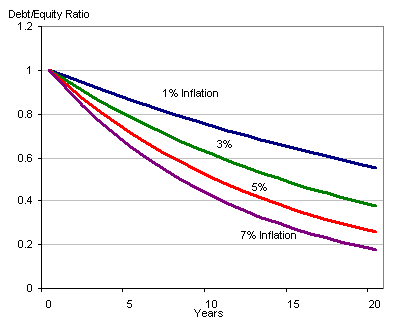
Inflation isn't all bad. If you're a debtor. And aren't we all?
Note that this has nothing to do with amortizing the loan. We are assuming no amortization here. So all you do is pay the interest, and in 10 years your leverage drops 150% more (55% instead of 22%, roughly) with 7% inflation.
So, do you still think the Fed is neutral on inflation? Do you still think the Committee really wants inflation pegged at 2%? At the very least, the FOMC wants inflation to be at the upper end of the band that allows it to retain its credibility. And, if push came to shove, I suspect they might allow an “oops” to happen if they thought a little more inflation might help delever society.
And it might. It just might.
.
Speaking of inflation, the next two days see PPI (Consensus: +0.1%/+0.1% ex-food-and-energy), which isn’t important, and CPI (Consensus: +0.1%/+0.1%), which is. I’ll have more to say on CPI tomorrow.
Autopilot Through the Andes
Tuesday’s bright start to equities was tarnished by selling in the last couple of hours. Overnight, the market had moved higher on the usual reasoning about how the market is oversold, undervalued, unloved, and that everyone is too bearish even though most people are telling the bullish story. Sunshine disinfects, though, and the highs for the day were set during the optimistic first half-hour.
Neither stocks nor bonds responded to the modest shortfall in Retail Sales from expectations. The print of +0.2%, +0.2% ex-auto, was the second-weakest reading of the year, and a mild surprise; however, as has been true for some time economic data was ignored. The focus was ostensibly on the Fed and a result that few thought would be surprising. That’s why it was curious to see currency markets trading rather sharply. The dollar index rose to nearly the highest level of the year, with the Euro off nearly four big figures since Friday. What is more, despite the dollar strength and equity weakness, commodities rallied. This is an unusual combination. In fact, the last time that the S&P fell at least as much as it did today (-0.9%), the dollar index rallied at least as much as it did today (+1.0%), and the DJ-UBS Commodity index rallied at least as much as it did today (+0.6%) was in February 2009.
There was some speculation that the odd mid-day timing of the Euro breakdown might have had something to do with the S&P downgrade announcements, which are due any day now. Apparently, under the new rules controlling rating agency behavior in Europe, they are required to report ratings changes to regulators twelve hours before formally announcing the change (I hadn’t known this), and there was suspicion that there was a leak. We’re all pretty sure which direction the changes will be in, but the actual report will still cause some ripples in an illiquid year-end market.
As of this writing, S&P has made no announcement, but we have all night.
I think this is a more likely explanation for the market action than attributing the moves to the FOMC announcement. There were no surprises in the statement or lack of action. Personally, it seems to me like the Fed is trying to coast on autopilot through the Andes Mountains, but no one was seriously expecting any change in policy; at most, some people expected a statement about how the communications policy will change going forward. So I don’t think that’s why the markets were moving (besides, the bond market rally was at 1pm, and nominally charged to a strong 10-year note auction, while the Fed statement wasn’t until after 2pm).
Equity volume was a bit higher than recent standards, but liquidity is going to be an issue if there are any surprises over the next couple of weeks – for example, if Italy’s auction on Wednesday is not well-received or if S&P downgrades France the full two notches rather than only one. This is mostly a year-end issue, but as I have pointed out all year, equity volumes this year have been consistently lower than in prior years. The following chart shows cumulative NYSE Composite Volume through the first 240 trading days of the year. The volumes leading up to and since the Volcker Rule assault on dealer market-making abilities (aka “proprietary risk taking”) have been demonstrably lower than in the four years prior. I am sure there are other secular pressures on equity volumes, but in any event it seems obvious that we are in an era of less volume and diminishing market liquidity. (This should by the way favor small investment managers, who have lower market-impact costs of trading…which is another trend I see continuing.)
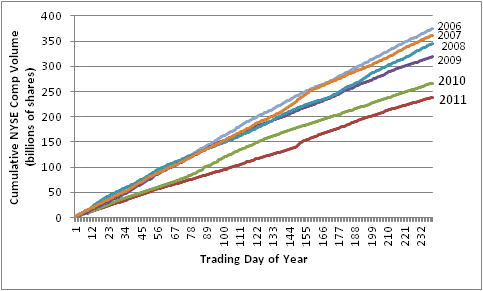
Source: Bloomberg. Equity volumes have been consistently weak all year.
10-year real yields are at their lowest levels ever (-0.087%), save for a spike down back in August. And that’s happening despite the fact that a TIPS auction is only two days away and we would ordinarily expect prices to be backing up (especially with year-end liquidity!). But the chart below explains part of the dynamic. As European inflation-indexed bonds are being beaten up because of credit issues, TIPS are clearly deriving some support. Actually, although French real yields around 1.5% are not exactly cheap, they’re pretty cheap if France is only downgraded one notch to match the U.S. rating. A few days ago they were over 2%. Once the French downgrade announcement is actually made, that is one place I would look to add exposures. I would, however, continue to avoid Italy at 6% real yields. Greek 2025 inflation-linked bonds at a 21.5% real yield and a price of around 20…if the prices on Bloomberg mean anything…actually might be worth buying for the negative miracle.

Source: Enduring Investments. 1.5% real yields in Europe doesn't sound so bad, especially for a US investor who doesn't currency-hedge.
The economic calendar on Wednesday is thin, so keep an ear out for pings from S&P and otherwise, enjoy the seasonal cashews.
