Archive
Titanic Decisions
There is something very striking going on in the inflation markets, and among investors. It only recently struck me, after attending an inflation conference last week and then today participating in two discussions: one with the CIO of a large insurance company and one with a group of senior people at a large asset management firm.
If it were only that the senior people at the large asset management firm were reporting that “people are not concerned with inflation right now,” I would dismiss it. There are lots of things that investors and consumers are concerned about that the senior people at large asset management firms have no idea about. The anecdotal reports from the inflation dealers at the inflation conference carry more weight, because they’re at least focused on having that specific conversation with their clients. But the clincher was the discussion with an insurance company CIO, who reports they are definitely going to be putting on some small inflation hedges because they hedge possibilities, not probabilities, but that they actually think deflation is more of a threat here than inflation.
I want to first show a chart of rolling 10-year inflation in the Federal Reserve era (source: Enduring Investments), compared with the current level of 10-year inflation breakevens. With the exception of the Great Depression, when the Fed tightened policy as money velocity declined in a manifest error, inflation has almost never been below the current level on a compounded 10-year basis. And it has never, with that singular exception, been very far below the current level. Ergo, inflation insurance is very cheap, even though 10-year breakevens are not far from all-time highs (since TIPS began, in 1997).
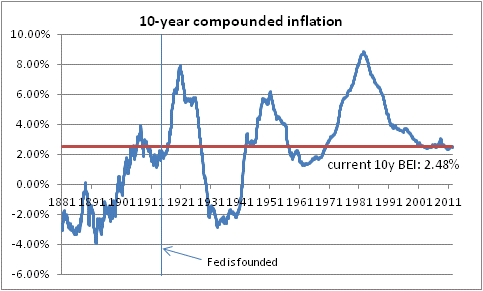
The refrain is that “we might get inflation in a few years, and we’ll look to hedge then,” but I don’t see how that makes any sense if the cost to insure now is so all-fired low. It isn’t as if you’re giving up lots of high-yielding opportunities to buy this insurance. If the opportunities to increase return are very poor, shouldn’t one take advantage of cheap opportunities to reduce risk? It seems odd to me.
I am also flummoxed at this perspective in the context of both business risk and career risk. I alluded to this issue yesterday. Sure, maybe “we all know” that even though M2 has until recently been growing at rates that have only been associated with post-disaster Fed accommodations (after 9/11) or inflationary periods (1980s, 1970s), inflation won’t rise because Europe is a mess, but let’s briefly consider the alternative future history. Suppose that in five years, you are an investor or asset manager and sitting with a spouse or a client or a boss, and the price level has increased 50% from here. And the spouse/client/boss says “you know, Fred, we’re wondering why you didn’t load up on cheap inflation protection. I understand why you didn’t do it in 2009, but once the Fed started unlimited QE and every central bank in the world was doing similar things, didn’t you think it made sense to put on some protection? I mean, there’s always inflation when there’s too much money in the system.” What possible defense does Fred have? Is “our economists didn’t think that was going to happen” going to be a valid defense?
Now obviously, by no means is this sense universal, but it seems insanely widespread. It seems as if the intelligentsia has been persuaded that since all of the proletariat is concerned about inflation, but the smart people at the Fed are not, then they ought to bet with the Fed. I have news for these folks: the man on the street is far better at forecasting employment, and certainly no worse at forecasting inflation, than the bow-tied, blue-chip economist at a Wall Street firm or large insurance company – especially when that inflation view is adjusted for common perceptual errors that we can roughly quantify.
It’s generally true that today’s generation of investors thinks “bad inflation” is 3% and is frequently unconcerned. But in 2009 and 2010 and 2011, there were certainly investors who were beginning to get worried, which is why TIPS yields are way down here at -0.86% in the 10-year part of the curve. Nowadays, the refrain seems to be “we may need product for our retail clients,” but otherwise “remain calm, all is well.”
But I think that’s also what they told the people on board the Titanic. At some point, regardless of what the authorities are forecasting, investors need to grab for their life jackets or to head for the stairs anyway (and if I sound frustrated, it’s because we’re trying to hand people life preservers and they keep going back belowdecks). The worst thing that can happen if you’re wrong is that you’re feeling foolish, standing freezing on the deck of the ship and all really is well. The “Titanic Decision” matrix is below. I can tell you one thing: there is a single box there that I am pretty sure I want to avoid. What about you?

It’s Okay to Fight Fed Intentions, Just Not Fed Actions
Today there was a glimmer of good news today from the economic front. The national PMI (formerly known as NAPM, now ISM) rose to 51.5 from 49.6 last month. Expectations had been weak, especially since Friday’s Chicago Purchasing Manager’s report printed a contractionary 49.7, the lowest reading since 2009 (see Chart, source Bloomberg).
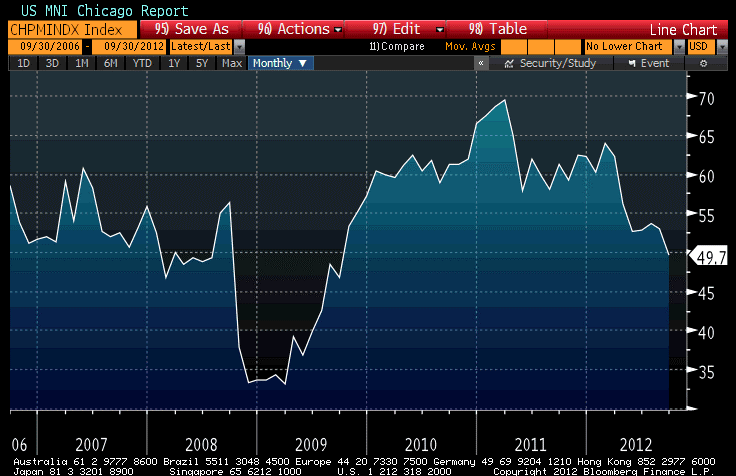
That wasn’t the only bad news last week. On that side of the ledger you have to also put Thursday’s Durable Goods report, which was awful. The headline was -13.2%, which made headlines since it was the worst since a single -14.3% print in January 2009. But that is obviously significantly due to aircraft. Ex-transportation, though, the number was also weak, at -1.6% coupled with a downward revision of -0.9% to July’s report. That’s three consecutive negative months, which hasn’t happened since late 2008. New orders, ex-transportation, have now declined on a year/year basis. The chart below (Source Bloomberg) shows that declining core Durables Orders doesn’t usually happen, except at the margin, outside of recessions. The recessions of the early 1980s, the early 1990s, and the two of the 2000s are all clearly visible on the chart.

Now, -1.1% is still marginal, and there have been cases where such a print didn’t happen in the context of a recession (such as in 1998). But the next two months bring difficult comparisons, since September of 2011 was +1.9% and October 2011 was +2.0%. It will be pretty easy for this indicator to drop another few percentage points, and if it does then it will be hard to argue we are not beginning another recession.
Perhaps the inkling of this result is the reason that bond yields and breakevens have both recently been soft. Readers of this column know that growth doesn’t cause inflation nor recession cause disinflation, but 95% of investors still believe that. This creates, in my view, a wonderful opportunity to buy inflation insurance at a time when by rights it should be egregiously priced. When we look back at this period, right after the Fed began open-ended QE promising to continue until inflation rose or unemployment (or the republic) fell, I can assure you that everyone will remember that ‘everyone knew’ what would happen. Certainly, our clients will think so, and will wonder why we didn’t.[1]
Personally, I think Dr. Bernanke must be looking at the retracement in breakevens and the developing view that inflation is no threat and saying to himself “I can’t believe they bought it!”
As an example of that credulity, Bloomberg reported today that “TIPS Show Inflation Alarm Fading as Options Give Fed Time.” In this article, the journalist noted that “Demand to protect against higher long-term bond yields over the next six months has been static since Fed Chairman Ben S. Bernanke announced a third round of quantitative easing…” I thought it might be helpful here to point out that even if you think the Fed is going to fail to keep inflation down, buying puts on bonds is probably not the right way to play that view. Buying puts on nominal bonds is a direct bet that the Fed will fail to keep longer interest rates down. Since the Fed has both explicitly and implicitly pledged to do so, and is currently buying long-term Treasuries (and now mortgages) in a direct effort to lower long-term rates, investors who buy puts on nominal bonds are simply going head-to-head with the Fed. As Dennis Gartman pointed out to a gathering at an inflation conference last Thursday (at which I also spoke), “the Fed’s margin account is second in size only to God’s,” and it doesn’t make sense to bet against them directly.
However, while the Fed may succeed in markets there is certainly no guarantee that the Fed will succeed in the macroeconomy. History is replete with examples of Fed mistakes, and yet many investors seem to have forgotten this history. It seems to me that investors today think “don’t fight the Fed” means the Fed will actually succeed in the macroeconomic effects of what they are trying to do. But that’s not what “don’t fight the Fed” means. It means: don’t sell what the Fed is buying, don’t buy what the Fed is trying to push lower. Don’t bet on higher rates when the Fed is pledging to hold them down forever with actual purchases in the cash bond market. It isn’t, in short, surprising that options are ‘giving the Fed time;’ it’s just that many more people are willing to bet the Fed is going to succeed in keeping rates down, than are willing to bet their huge margin account will be tapped out.
But that doesn’t mean you have to bet that the Fed is going to be able to avoid the usual macroeconomic effects of loose money. When the Fed says “we intend to keep rates low,” they can put effect to that intention. But when the Fed says “we intend to keep inflation low,” they have no way to cause this to happen absent pursuing a tight monetary policy, which they most assuredly are not…and even then, they’re not actively transacting in inflation but in asset markets. If inflation follows profligate monetary policy much as night follows day, then the way you invest for that possibility is to buy inflation, not to sell nominal rates. That is, be long breakevens, or inflation swaps, or inflation options.
How quickly to do this? Honestly, I am amazed that we still have the opportunity to do it, so perhaps this means there is no hurry. A weak Employment report this week may give another opportunity, and as recessionary signs accumulate then inflation expectations (not to say inflation itself) may decline. The re-developing European debacle might give us a chance to buy inflation cheap. We may in fact have months to put on long inflation trades.
But maybe not, too. And I would hate to have to explain to clients, or my spouse, why I had nothing on when “everyone saw this coming.” The regret function suggests to me that this is a prime case for averaging into inflation protection, if you haven’t yet begun to.
[1] Of course I am using the ‘royal we’ here: our company has been loudly clanging the gong on this for a while and no one will think we didn’t see it coming.
