Archive
Summary (and Extension) of My Post-CPI Tweets
Below is a summary of my post-CPI tweets. You can (and should!) follow me @inflation_guy or sign up for email updates to my occasional articles here. Investors with interests in this area be sure to stop by Enduring Investments. Plus…buy my book about money and inflation, published in March 2016. The title of the book is What’s Wrong with Money? The Biggest Bubble of All; order from Amazon here.
- 5 minutes to CPI. Consensus is for core to barely round to 0.2%, and for y/y core to remain at a soft 2.3%
- I have the “over” there, but the “under” against my friend who thinks it’s gonna be 0.24%.
- Core CPI +0.09%, y/y drops to 2.20%.
- Waiting for the breakdown to dig deeper. Housing accelerated y/y, as did Medical care, but Apparel, Rec, Educ/comm all lower.
- …Housing and Medical care are the big longer-term concerns so the internals might not be as weak as the headline. Taking a look now.
- Meanwhile Dudley on the tape saying “probably don’t have to do a lot of tightening over time.” Echoes Williams. When doves cry.
- At the same time Dudley says rate hike is possible in September. Sure, anything is possible. But not with core printing 0.1% m/m.
- ..in Housing, Primary Rents fell to 3.77% from 3.81% y/y. OER rose to 3.26% vs 3.25%, continuing flat patterns.
- Those are the biggest parts of housing. Lodging away from home plunged y/y. Where did the rise in housing come from? Household energy.
- HH energy -1.37% y/y vs -3.02%. That’s 3.8% of the CPI, but not in core obviously. So housing ex-energy was basically flat.
- Overall Medical Care category rose to 3.99% from 3.65% and 3.17% the month before that. Jumps in every category:
- Drugs 3.77% (vs 3.40%). Equipment/supplies 0.1% (-0.62%). Prof Svcs 2.86% (2.60%). Hospital 4.41% (4.12%). Health Ins 7.78% (7.10%)
- Large jumps everywhere in Medical Care. *Discuss.*
- Apparel still rising y/y, at 0.35%, but won’t really take off until the dollar declines.
- Overall, core services +3.1% (was 3.2%) and core goods -0.6% (unch).
- Popular number is core ex-housing. 1.36% y/y vs 1.37%.
- So overall, despite the weak m/m core number, the big trends remain in place. Housing flat to higher. Medical Care starting to ramp up.
- A broad array of volatile components dragged m/m CPI down. But 59% of the basket is still accelerating faster than 3%.
- Biggest monthly falls: motor fuel, car and truck rental, public transp, lodging away from home, and misc pers goods. All <-20% m/m
- Only category over 20% annualized m/m increase was Infants and toddler’s apparel.
- These last few facts mean that MEDIAN inflation, a better measure of inflation, will be up 0.24% or so m/m. 2.48% y/y.
- Ugly pic #1: Health Insurance y/y

- Ugly picture #2: medicinal drugs y/y.

- ugly picture the worst: Medical Care overall, y/y

- Owners’ Equiv Rent, largest part of CPI. Certainly high and stable. Maybe tapering? But at 3.3%! Ugly or no?
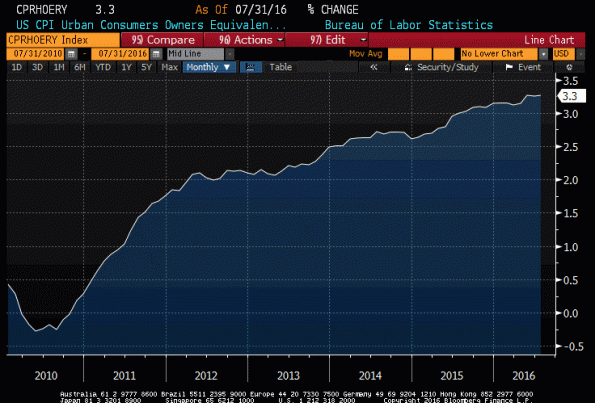
- FWIW our forecast is for OER to rise a little bit further, but less dramatically unless core ex-housing starts to move.
- I’m not sure it’s comforting to have rents up “only” 3-4% in context of rising med care. In any event: core ain’t falling soon.
- note that in August 2015, core was +0.12% m/m. So we’ll see some re-acceleration (and possible catch-up) next month.
- I actually think there’s a chance for an 0.3% print next month. which would make the FOMC more interesting.
- Right now, it’s not interesting. With m/m core at 0.09% and 3 quarters of 1% GDP, Fed not tightening in Sept.
- Thanks for all the new follows and the re-tweets. Good time to mention a couple of things:
- I’m thrilled to be on “What’d You Miss?” on Bloomberg TV at 3:30ET today. With @scarletfu @thestalwart and @OJRenick
- Here’s my book: What’s Wrong With Money? The Biggest Bubble of All
- My company, Enduring Investments, is raising a small amount of capital in the management co. Details here: https://www.crowdfunder.com/enduring-investments-llc/
So, while PPI is not usually much of a predictor of CPI, in this case it gave early warning that we were about to see a weak print from the more-important indicator. But that weakness came from a couple of smaller categories. I have shown this chart a number of times before, but I think it’s especially instructive this time. Compare the distribution of price changes in categories (by the weight in the category) this month…

To the same distribution from last October.

Note that the left tail, which holds the laggards, has more weight this time. There is not quite as much weight in the deep deflation tail, but there are more 0% and 0.5% categories. Yes, there is also one really big increase on the right although it still doesn’t add up to much. The biggest piece of the upper tail is Health Insurance – which as you can tell from the chart above is fairly persistent. In short, I think there’s a better chance of the lower tail reverting to the mode of the distribution than there is of the upper tail doing the same. (This is why Median CPI is a better measure).
The bottom line for markets in the near-term is that nothing about this number scares policymakers. While Dudley says that September is still on the table for an FOMC tightening, the reality is that the data will present them with no urgency – even if, as I think likely, next month’s core CPI corrects for this month’s weakness. And Williams’ ridiculous paper gives them academic cover to ignore the fact that median CPI is at 2.5% and likely will continue to rise. Moreover, LIBOR has been rising because of changes in money market regulations, so FOMC members can argue that financial conditions are tightening automatically. In short, it is very unlikely in my opinion that the Fed hikes rates in September. Or November. Or December.
The IMF Tries to Cause Japanese Unemployment
It is rare that I write early on a Monday morning, but today there is this. A story on Bloomberg highlighted the pressure that the IMF is putting on Japan to institute an “incomes policy” designed to nudge (and force, if necessary) companies to increase wages. IMF mission chief for Japan told reporters a couple of weeks ago that “we need policies to support wage increases in Japan;” the Bloomberg article also names a former IMF chief economist and the current president of the Peterson Institute for International Economics as proposing an immediate boost of salaries of 5-10% for unionized workers.
It is truly appalling that global economic policymakers are essentially illiterate when it comes to economic history. The IMF suggestion to institute wage hikes as part of triggering inflation is not a question of misunderstanding macroeconomic models (although it manages to do this as well, since wages follow prices and thus increasing wages won’t cause inflation unless other conditions obtain). At some level, it is a question of ignorance of history. After the stock market crash in 1929, President Hoover persuaded major industrial firms (such as GM, U.S. Steel, and the like) to hold wages constant or raise them. Since prices were falling generally, this had the effect of raising the real cost of production, which of course worsened the subsequent Depression. According to one analysis, this single decision caused GDP loss in the Great Depression to be triple what it otherwise would have been if wages were allowed to adjust (because, again, wages follow prices and are the main mechanism by which a surplus or shortage of labor is cleared). It wasn’t just Hoover, of course: later, FDR established the National Recovery Administration to administer codes of “fair competition” for every industry that established minimum wages and prices. The NRA was struck down in large part by the Supreme Court, but the notion of arresting deflation by adjusting wages was quickly reintroduced in the National Labor Relations Act of 1935.
There is wide agreement, although I am sure it is not universal, that preventing markets from adjusting is a big part of what made the Great Depression so Great. And this isn’t theory…it’s history. There is no excuse, other than ignorance, for policymakers to whiff on this one.
Deflation can be bad, but it doesn’t need to come with massive unemployment. In Japan, it has not: the unemployment rate is 3.1%, the lowest it has been since 1995. But push wages higher artificially, and Japan can have the massive unemployment as well. Thanks, IMF.
August, Productivity, and Prices
I really don’t like August. It’s nothing about the weather, or the fact that the kids are really ready to be back in school (but aren’t). I just really can’t stand the monkey business. August is, after December, probably the month in which liquidity is the thinnest; in a world with thousands of hedge funds this means that if there is any new information the market tends to have dramatic swings. More to the point, it means that if there is not any new information, the speculators make their own swings. A case in point today was the massive 5% rally in energy futures from their lows of the day back to the recent highs. There was no news of note – the IEA said that demand will balance the oil market later this year, but they have said that in each of the last couple of months too. And the move was linear, as if there had been news.
Don’t get me wrong, I don’t care if traders monkey around with prices in the short run. They can’t change the underlying supply and demand imbalance and so it’s just noise trading for noise trading’s sake. What bothers me is that I have to take time out of my day to go and try to find out whether there is news that I should know. And that’s annoying.
But my whining is not the main reason for this column today. I am overdue to write about some of the inflation-related developments that bear comment. I’ll address one of them today. (Next week, I will probably tackle another – but Tuesday is also CPI day, so I’ll post my usual tweet summary. Incidentally, I’m scheduled to be on What Did You Miss? on Bloomberg TV at 4pm ET on Tuesday – check your local listings).
I don’t spend a lot of time worrying about productivity (other than my own, and that of my employees). We are so bad at measuring productivity that the official data are revised for many years after their release. For example, the “productivity miracle” of the late 1990s, which drove the Internet bubble and the equity boom into the end of the century, was eventually revised away almost completely. It never happened.
The problem that a lot of people have with thinking about productivity is that they confuse the level of productivity with its pace of increase. So someone will say “of course the Internet changed everything and we got more productive,” when the real question is whether the pace of productivity increase accelerated. We are always getting more productive over time. There are always new innovations. What we need to know is whether those innovations and cost savings are happening more quickly than they used to, or more slowly. And, since the national accounts are exquisitely bad at picking up new forms of economic activity, and at measuring things like intellectual property development, it is always almost impossible to reject in real time the hypothesis that “nothing is changing about the rate of productivity growth.” Therefore, I don’t spend much time worrying about it.
But, that being said, we should realize that if there is a change in the rate of productivity growth it has implications for growth, but also for inflation. And recent productivity numbers, combined with the a priori predictions in some quarters that the global economy is entering a slow-productivity phase, have started to draw attention.
Most of that attention is focused on the fact that poor productivity growth lowers overall real output. The mechanism there is straightforward: productivity growth plus population growth equals real economic output growth. (Technically, more than just population growth it is working-age population growth times labor force participation, but the point is that it’s an increase in the number of workers, compounded by the increase in each worker’s productivity, that increases real output). Especially if a populist backlash in the US against immigration causes labor force growth to slow, a slower rate of productivity growth would compound the problem of how to grow real economic growth at anything like the rate necessary to support equity markets or, for that matter, the national debt.
But there hasn’t been as much focus on the other problem of low productivity growth, if indeed we are entering into that sort of era. The other problem is that low productivity growth causes higher prices, all else equal. That mechanism is also straightforward. We know that money growth plus the change in money velocity equals real output growth plus an increase in prices: that is, MV≡PQ. If velocity is mean-reverting, then the decline in real growth precipitated by a decline in labor productivity, in the context of an unchanged rate of increase in the money supply, implies higher prices. That is, if ΔM is constant and ΔV is zero and ΔQ declines, then ΔP must increase.
One partial offset to this is the fact that a permanent decline in productivity growth rates would lower the equilibrium real interest rate, which would lower the equilibrium money velocity. But that is a one-time shift while the change in trend output would be lasting.
In fact, it wouldn’t be unreasonable to suppose that the change in interest rates we have seen in the last few years is mostly cyclical but may also be partly secular. This would imply a lower equilibrium level of interest rates (although I don’t mean to imply that anything is near equilibrium these days), and a lower equilibrium level of monetary velocity. But there are a lot of “ifs” in that statement.
The biggest “if” of all, of course, is whether there really is a permanent or semi-permanent down-shift in long-term productivity growth. I don’t have a strong opinion on that, although I suspect it’s more likely true that the current angst over low productivity growth rates is just the flip side of the 1990s ebullience about productivity. We’ll know for sure…in about a decade.
Shooting Blanks
Almost eight years after the bankruptcy filing of Lehman Brothers and the first of many central bank quantitative easing programs, it appears the expansion – the weakest on record by several measures – is petering out. The Q2 growth rate of GDP was 1.2% annualized, meaning that the last three quarters were +0.9%, +0.8%, +1.2%. That’s not a recession, but it’s also not an expansion to write home about.
But why? Why after all of the quantitative easing? Is the effectiveness waning? Is it time for more?
I read recently about how many economists are expecting the Bank of England to increase asset purchases (QE) this Thursday in an attempt to counteract the depressing effects of Brexit on growth. Some think the increase will be as much as £150 billion. That’s impressive, but will it help?
I also read recently about how the Bank of Japan “disappointed investors” by not increasing asset purchases except incrementally. The analysts said this was disappointing because the BOJ’s action was “not enough to cause growth.”
That’s because no amount of money printing is enough to cause growth. No amount.
It seems like people get confused with this concept, including many economists, because we use units of currency. So let’s try illustrating the point a different way. Suppose I pay you in candy bars for the widgets you produce. Suppose I pay you 10 candy bars, each of which is 10 ounces, for each widget. Now, if I start paying you 11 candy bars instead of 10, then the price has risen and you want to produce more widgets, right? This, indirectly, is what economists are thinking when they think about the effect of monetary policy.
But suppose that I pay you 11 candy bars, but now each candy bar is 9.1 ounces instead of 10 ounces? I suspect you will not be fooled into producing more widgets. You will realize that I am still paying you 100 ounces of candy per widget. You are not fooled by the fact that the unit of account changed in intrinsic value.
Now, when the central bank adds to the money supply, but doesn’t change the amount of stuff the economy produces (they don’t have the power to direct production!), then all that changes is the size of the unit of account – the candy bar, or in this case the dollar – and the number of dollars you need to buy a widget goes up. That’s called inflation. And the only way that printing more money can cause production to increase is if you don’t notice that the value of any given unit of currency has declined. That is, only if I say I’m paying you 11 candy bars – but you haven’t noticed they are smaller – will you respond to the change in terms. This is called “money illusion,” and it is why money printing does not cause growth in theory…and, as it turns out, in practice.[1]
There is nothing terribly strange or unpredictable about what is going on in global growth in terms of the response to monetary policy. The only thing strange is that eight years on, with numerous observations on which to evaluate the efficacy of quantitative easing, the conclusion appears to be that it might not be quite as effective as policymakers had thought. And therefore, we need to do lots more of it, the thought process seems to go. But anything times zero is zero. Central banks are not shooting an inaccurate, awkward weapon in the fight to stimulate growth, which just needs to be fired a lot more so that something eventually hits. They are shooting blanks. And no amount of shooting blanks will bring down the bad guy.
[1] I address this aspect of money, and other aspects that affect inflation, in my book What’s Wrong With Money: The Biggest Bubble of All.
