Archive
The Right Clearance for the Bumpy Road Ahead
There are many reasons to be scared of the financial system in Europe. The interweaving of sovereign risk and inter-sovereign risk with bank guarantees and the symbiosis in which countries guarantee (implicitly or implicitly) banks which then buy sovereign paper that is not considered a risk asset is enough to make anyone who looks closely pretty queasy. If Portuguese banks fail, what effect does that have on Spanish banks, or on the Europe-wide guarantee facilities? Is anyone even somewhat confident that they know?
However, with all of the reasons to fear a resurgence of the European banking crisis, the manufactured “underfunding” story is not one of them. According to the Financial Times, “Europe’s biggest banks will have to cut €661bn of assets and generate €47bn of fresh capital over the next five years to comply with forthcoming regulations aimed at reducing the likelihood of another taxpayer funded bailout.”
Those are big numbers, and scary, but … what do they mean? Do they mean that banks are underfunded by that amount?
Well, the numbers only mean that if somehow the Basel III requirement is magically the “right” number. And even then, I am not sure what it means to have the “right” number. If you have trouble driving your Cadillac on a country road, and it leads you to design a car with a higher clearance, how do you know you have the “right” clearance? It sort of depends on the road, doesn’t it? If the road is smooth, then you’ll be too high, but if the road is too rough, your higher clearance might not be high enough. Without seeing the road, all you can do is guess at the trade-off between the cost of the higher clearance, and the benefits of the higher clearance.
And we have no idea what the road ahead looks like in Europe, or anywhere else for that matter. So declaring a certain “clearance” as being the “right” clearance is presumptuous. Sure, we now know that roads can get bumpy even when central banks are trying to smooth them (and in some cases because they are trying to smooth them), so we think we need more clearance…but how much more? Never mind the fact that this isn’t as straightforward as measuring a car’s undercarriage clearance – if a rule can be written into Basel III, it can be engineered around by a bank. (That’s why we didn’t stop at Basel I.)
In general, I am skeptical that the right answer is reached by central banks, or even worse an international committee of central banks such as the BIS, sitting around in a room with a lot of smart economists counting angels on the head of a pin. Not that Jamie Dimon showed great risk acumen in allowing the London Whale to lose six billion bucks, but at least he makes decisions on risk on a regular basis instead of at annual banker meetings where there are presentations on how to tell a CDS from a CMO.
We clearly need to consider how to increase incentives for bank management and shareholders to capitalize banks correctly, where “correctly” means that the shareholders and stakeholders are taking the amount of risk they feel comfortable with, and that there are no unpriced externalities. It is this latter problem that is the issue, of course; a free government guarantee is simply value that bank management seized for themselves. It allows any bank to take more risk than they would if it was their own money. But limiting risk, or raising the “insurance” premium, just raises the clearance of the car. What we need, if banks are large enough to pose systemic risks, is a way to make the costs of poor risk decisions assessable in retrospect rather than in prospect. That is, remove the corporate veil for banking licenses. Require all banks to have a general partner or partnership group which has unlimited liability.
Here is what would happen in such a case. Small banks would have a general partner who would secure liability insurance (possibly paid for by the bank shareholders). Larger banks would find it more difficult and expensive to secure that insurance in amounts that completely covered the possible losses for the general partner, which would mean that the biggest banks would likely choose to break into smaller banks. And what is wrong with that? One of the solutions that has been put forth is to have banks sell off assets. Splintering into a number of smaller banks is the same as selling off all of the assets.
And then, you wouldn’t need implicit or explicit government guarantees (although deposit insurance might best be provided by, or backstopped by, a government entity). There’s already someone to go to in order to cover the losses: the general partner, or the insurer, or the reinsurer. Together with derivative clearing arrangements, a system built from smaller and redundant parts would likely be much more resilient than one built with just a few critical “TBTF” parts.
As We Snooze, We All Lose
Monday was another day of feeble volume in the markets, but at least today there was the excuse that there wasn’t any important economic data due out until Alcoa’s earnings announcement after the close (as expected, they lost money for the quarter but on better-than-expected sales). NYSE volume matched Friday’s paltry sum of around 675mm shares.
As the weak volume trend continues, it is growing more remarkable. It implies a lack of conviction, or indecision. How is this likely to resolve? Is it likely to resolve into conviction, and buying, or alarm/concern, and selling? My suspicion is that in the absence of a positive exogenous event, we are more likely to see weak longs get weak-kneed and equities to head lower.
But my personal conviction level on that topic is low. Volumes in other markets are also weak, so applying the same logic as I have just applied to equities would suggest all markets should head lower. While that is possible, it seems unlikely. It may simply be that we are moving to a ‘new normal’ (pardon the misappropriation of the expression) of lower volume and thinner market conditions. One market participant opined to me that the Fed’s recent announcement that it would substantially adopt the Basel III recommendations for bank regulations – it was expected that they would adopt some, but not all, of the restrictive regulations – has caused many banks to re-think the scale and scope of their U.S.-based operations and, in some cases, to pull back from business and market-making. This is not terribly shocking, except that the degree of this effect would be surprising if the current desiccation of volume continues.
Lower liquidity implies lower prices (there is a reason that they call it a ‘liquidity discount’), although probably not substantially in any particular asset class. But lower liquidity represents a loss of societal wealth and efficiency. Does this affect a retail investor? Yes, since it implies lower prices overall, but in terms of a noticeable effect on day-to-day trading, not much. But it will affect the retail investor through the return drag that larger mutual funds (for example) will experience. Large institutions already have complicated algorithms to efficiently enter and exit positions while minimizing market impact; less liquidity implies more market impact (which is a cost, although it shows up as return drag rather than a customer fee). None of this will cause retail investors to march on Washington, which is why it is being enacted even though society bears a cost for it.
Again, I don’t want to read too much into a few days of low-volume trading, but these are my thoughts as more of these days get strung together.
Heading into a potential crisis, by the way, is a bad time to be sucking liquidity (in the sense of transactional liquidity, not monetary liquidity) out of the market. Today Germany sold €3.9bln of 6-month TBills at a negative yield (-0.0122%); recall that happened in the U.S. in late 2008, so it’s not unprecedented. It is even rational: investors are taking a certain loss instead of some unknown probability of a substantial loss they might realize on bank deposits if a bank goes bust, especially if it goes bust in conjunction with a sovereign bankruptcy. The classic argument is that yields cannot be negative because cash has a zero yield, so the worst case is you hold cash. This works for you and me, but not Siemens or another huge company that doesn’t want to take hundreds of millions or billions of Euro notes. If such a company sees a 0.5% chance of losing 20% of the money they have on deposit, then they would happily own a German bill that yields as little as -0.10%. Or, if a company sees a 10% chance of losing 1% simply because their cash deposits are tied up in a bankruptcy and not accessible (or earning a return) for a while, the same reasoning applies. So it is not unthinkable that yields can be negative. It is, however, a harsh indictment on the state of the banking sector.
Speaking of Germany, a Barclays analyst appeared on CNBC today actually talking about the fact that inflation expectations are rising in Germany. He pointed to 5- and 10-year inflation breakevens and noted the chance of a ‘break higher’ in expectations. I don’t necessarily read this this chart (see below, source Bloomberg) quite as bullishly as he did, but it’s surprising to hear anyone talking about inflation in Europe these days, and no doubt inflation is not expensive, pretty much anywhere.
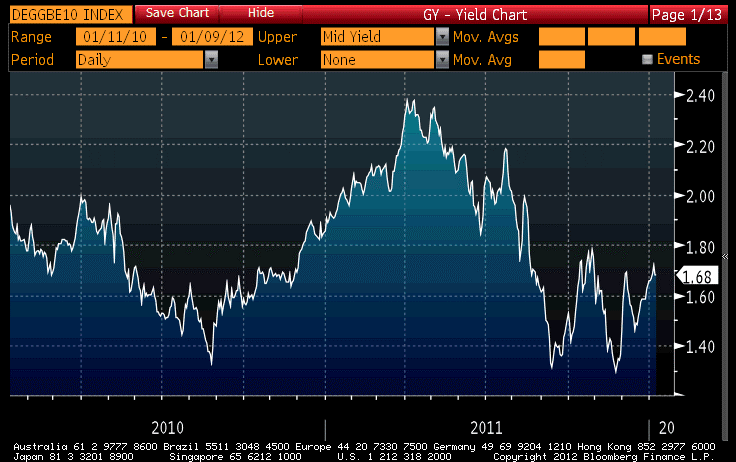
German 10-year breakevens. Certainly not expensive given the ECB's stance.
That’s not to say that I don’t think investors should be thinking and bracing for possible inflation. If there is a trade out there that looks relatively easy to me, it is being long breakevens. As I wrote last week,
It is incredible to me that with monetary conditions as accommodative, globally, as they have been in decades, inflation swaps are still nearly as cheap as they have ever been. That’s truly striking. What is the 10-year downside to a long inflation position from these levels? One-half percent per annum? Seventy-five basis points per annum? How low can inflation be over the next 10 years, especially with central banks apparently willing (and even anxious) to produce as much liquidity as is needed?
Commodities are still holding in, and that is one way to be long inflation. Commodity indices tend to have a high beta when inflation first begins to rise. However, one can also be long inflation expectations themselves. Institutional investors can do this through inflation swaps or breakevens, but retail investors can do this as well. On Wednesday, I will discuss a new exchange-traded security that allows investors to bet directly on inflation breakevens.
If you have not already done so, would you please help me gather some market information by taking a single-question anonymous poll, about your interest and/or willingness to buy certain kinds of hypothetical inflation-linked bonds linked to different things? The poll will take no more than two or three minutes, and I would really appreciate it. I’d also appreciate it if you would forward the poll link to your social networks and ask them to participate as well, since a bigger sample is usually better! The poll is here. Thank you very much!
