Archive
Dreams and Nightmares of Debt
The stock market fell, fairly hard. The S&P ended the day down 1.9%, just a smidge above the lows from late Feb although the actual close was the lowest since the end of January. The similarity of the last couple of weeks of price action to that which we saw in November is probably lost on no one (but just in case, see the two charts below). The only difference of note so far is that in November, right before the next stage of the rocket higher, the market tested the range lows but managed to close well above them while in this case, we’re closing right at the bottom of the range. In any event I wouldn’t take the November experience to be a roadmap of any sort, but the similarities are at once eerie and encouraging given what ensued after November.

The S&P in November.

The S&P, recently.
With our quota of encouraging anecdotes fulfilled for the day, we may continue. 10y note yields also reached the lowest levels seen since January. However, 10y TIPS yields fell to 0.88%, as low as they have been since early December. 10-year inflation swaps, however, are just a bit off their highs for the year. Indeed, over the last month nominal yields are down about 34bps at the 10y point, but TIPS yields are -49bps while 10y breakevens are +15bps.
The combination of these two details – a decline in nominal rates that is almost entirely the product of a decline in real rates rather than of a decline in inflation expectations, plus softening equity markets – would lead the market detective in me to suspect that a change in growth expectations is in the air. On this point we get some confirmation from a general softening in commodities. Crude was down -1.8% and gasoline -0.5% despite news that Saudi police had opened fire on protestors today, one day ahead of the ‘Day of Rage’ scheduled for tomorrow. But Grains were -1.4%, Livestock -0.2%, Softs -4.3% (mostly Coffee and Sugar), and Precious Metals -1.6% (the source for all of these summary numbers is the one-day change in the relevant DJ-UBS Spot commodity subindex).
Some observers saw the decline in nominal yields and in stock prices as indicative of a flight to quality, perhaps because Spain was downgraded one notch by Moody’s today with a continuing negative outlook or on the Saudi police-shooting-of-protestors news. But if that were the case, I would have expected to see a bigger move in bonds of the periphery countries (10y Spanish yields were up a whopping 1bp while Greek bonds rallied) or a rise in oil prices. And yet, neither of those things happened. This might be just a plain old re-assessment of growth dynamics.
Why that reassessment would happen today is a little beyond me. Sure, Initial Claims were worse-than-expected at 397k, but that series still appears to be trending lower overall (the big miss, though, means that volatility is still a big problem for analysts trying to evaluate the series). And yet, that still seems to be the cleanest explanation.
The quarterly Flow-of-Funds (Z.1) report was released by the Fed today, showing – and this is what leads the news – that household net worth rose $2.1 trillion on the quarter due mostly to gains in the equity markets. That sounds like a big number, and would make us feel pretty good if we didn’t all know by now just how ephemeral those stock gains are. And, in fact, other parts of the Z.1 help remind us of that fact. With this report in hand, we can update Tobin’s Q to the end of the year and find that the ratio of market value to replacement cost is about 1.1, which is roughly 45% above the average since 1952.That means we can now officially say that with the exception of the equity bubble, stocks have not been as richly priced on Tobin’s Q as they are now in the entire post-war period (see Chart).

Tobin's Q (shown as a ratio to the average Q)
The Z.1 also allows us to update a couple of other goodies. The first chart below shows the public debt (state, local, and federal, plus Fannie Mae and Freddie Mac as of 2008), private debt, and total debt as a percentage of GDP. It is pretty clear what is going on here. The federal government has essentially stepped in to try and make up for the deleveraging in the private sector.

Uncle Sam is helping us keep levered as a society. Thanks, Sam!
Total public sector debt outstanding as a proportion of GDP rose in Q4 from 88.7% to 90.6%. As recently as 2008Q2, it was 52.4%. Overall debt is 340% of GDP, down from 341% last quarter and 363% in the first quarter of 2009. But before getting too excited about this deleveraging, reflect that as of June 2008, total debt was 340% of GDP. In other words, all the credit crisis has done is to shift the debt from the private side of the ledger to the public side of the ledger. I’ve noted in the past that the division of debt between public and private is important for the inflation dynamic. Societies with heavy burdens of private debt tend to disinflation; societies with heavy burdens of public debt tend to inflation. As the next chart shows, before the crisis the total private debt had reached a level about 5.5x the size of the state and local debt. Since mid-2008, the ratio has fallen back to 2.75x.
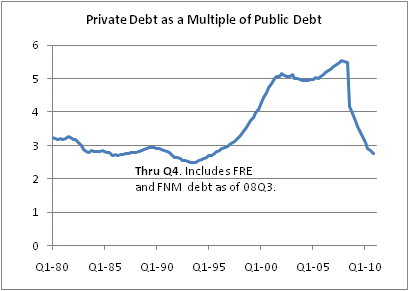
Okay, we're back. Now stop the big deficits. Come on, stop. Please?
Can you see any place in this chart where we might expect to see a leverage-induced bubble in asset markets? The good news is that the current level of 2.75x was a fairly normal division prior to 1997 or so. The bad news is that there is no sign that the ratio is going to stop falling any time soon.
Another way to look at the debt dynamic is in the chart below. Abstracting from the absolute level of debt, which sectors have been adding to it and subtracting from it?

It isn't households doing most of the deleveraging. It's financials near-term and businesses long-term.
Can you see any place in this chart where we might be unsurprised to see an increase in overleveraged financial institutions? Another interesting aspect of the chart is the slow decline in the share of debt outstanding that the business sector represents.

Okay, I got a little carried away on charts today.
Yes! Businesses are getting less levered. Is this good, or bad? Well, the good news is that a company with less financial leverage is safer, in a business sense. Credits, overall, have been strengthening in the last couple of years (duh!) and in general businesses are less levered than they were in the 1980s and in the first half of the 1990s (of course, I’m not considering here operating leverage, which has definitely increased with computers and improved mechanization and which also increases the volatility of earnings by increasing the fixed:variable costs ratio). The bad news is that declining leverage implies a decline in ROE if all else is equal, since return on equity is just Profits/Sales * Sales/Assets * Assets/Equity (the DuPont equation) and this last term is leverage.
And you might reflect on another possible implication of the fact that businesses are trimming debt relative to equity. It suggests that, even with the miniscule level of interest rates, businesses perceive equity as being cheaper than debt as a place to raise money. In other words, they are happy to sell you more equity at the prices you’re paying.
The High And Flighty
Wednesday was another day without any scheduled economic releases of note; it was not, though, a day which needed it since there were some interesting news items that led to market action today and/or may produce market action tomorrow.
The most interesting news, and the most interesting market response, was to the leaked news that PIMCO’s Total Return fund (a mere bauble in the treasure chest of Bill Gross, at a hardly-worth-discussing $237bln of assets under management) has completely divested itself of all government-related securities including Treasuries as well as agencies. If true, this is remarkable not because of direction (it isn’t clear to me why anyone would hold 10-year Treasuries at 3.50% when they can hold 10y TIPS at 1%. I am not saying that a 1% real yield is great but compared to 3.50% nominal you’re unlikely to sharply underperform and might fairly dramatically outperform) but because of the extremity of the position. The fund doesn’t have a low weight, like 10% or 5% or even 1%. It has precisely a zero weight assuming the stories are true. That’s a strong call.
The interesting market response is that bonds rallied with the 10y yield down 8bps to 3.475%. Some of this was due to a good Treasury auction but I think most of it is related to the idea that with PIMCO no longer selling, but the Fed still buying, the supply and demand balance just tilted in favor of nominal rates declining. It was always somewhat surprising to see bond yields rising when the Fed was buying huge amounts of Treasuries. One of the explanations that made sense was that some holders of Treasuries could use the liquidity provided by the bottomless bid to lighten their own positions without the market effects that would usually be associated with selling tens of billions of bonds. I would have guessed the Chinese or other central banks as the likely sellers, but Gross is essentially running another sovereign wealth fund so this fits.
I don’t think the rally is a lasting thing, however, at least on this basis. The Fed will stop buying in a few months, and well before then the markets will need to shift from expecting a balance in the actions of the Treasury (seller) and the Fed (buyer) to expecting a much more-lopsided supply equation (and potentially, if monetary policymakers are serious about their hawkish words, additional supply from the central bank itself). But for a day, the Bond King caused a rally by not doing something.
The other interesting news item occurred late and so isn’t reflected in the closing quotes that had Crude oil down 1%. The news came late today that a pipeline connecting Iraq and Turkey, which carries about a quarter of Iraq’s exports, was shut down when it was damaged by a bomb attack. Exports will fall by around 590,000 barrels/day during the shutdown.
The shutdown is only expected to last a few days, but it highlights an important point about the importance of the revolution in Libya and the loss of those exports. That loss doesn’t only mean that the absolute level of oil supplies will be lower (although our oil right now is being supplied by ships that were already on the water so the cessation in Libyan exports hasn’t directly affected supplies yet), but also that oil supplies are more sensitive to disruption.
This is actually not unusual. There is quite a bit of research that supports the notion that the volatility of a commodity’s price is positively related to the level of the price (see Deaton & Laroque 1989, Fama & French 1987, Geman & Nguyen 2002). The mechanism is just this: inventories provide a buffer against supply disruptions, so when inventories are low and the available supply is essentially fixed, a small shift in demand operates on a near-vertical part of the supply curve, producing amplified effects. Of course, lower inventories are also associated with higher prices; ergo, higher prices and higher volatility tend to occur together.
Accordingly, watch oil prices tomorrow. A large increase (especially in Brent) will suggest that market participants are not completely sanguine about whether the Saudis or strategic reserves can provide a sufficient buffer against supply disruptions.
Initial Claims (Consensus: 376k) provides us the first real data of the week. Last week’s 368k print was the lowest in several years, and with the week-to-week volatility finally ebbing the real question is whether Claims have shifted to a lower equilibrium (and if so, where?) or are in the process of trending lower. I suspect this is a real downtrend, but a slow one.
Also due out are the Trade Balance for January (Consensus: -$41.5bln vs -40.6bln previous) and the February budget statement (Consensus: -$225.2bln vs -220.9bln). Yes, folks, those are monthly deficits at a level we once thought was a particularly bad year for the budget. And it’s happening during an expansion!
General Versus Specific
Stocks jumped 0.9% in what has become a rather normal response to a decline: an aggressive, almost in-your-face rally with (often) little provocation other than the general sense that stocks are going up. This is a key difference at the moment between equity bulls and equity bears: the bears have specificity on their side while the bulls rely on generality.
The fact that equity bears can point to lots of specific reasons to be concerned about the level of equity market valuation does not necessarily mean that that argument will triumph over the general retort that an improving economy will salve all wounds, but I think it’s an apt characterization. As a personal exercise, try and name something specific about the equity market or global geopolitics that is more positive than what is already priced. I can’t think of anything; whatever positive facet I reflect on seems to be fully understood and have scant room for improvement over the expectation. For example, it may be true that mortgage defaults are declining, but this isn’t a mystery to anyone and it isn’t clear how that surprises on the positive side: are defaults going to plunge? I suppose that’s possible, but I can’t think of why that would be the case.
Certainly the specific news today shouldn’t have been particularly accommodating for stocks. Crude oil (WTI) dropped -0.6% along with grains (-1.6%), but that’s a pretty small set-back and inflation breakevens nevertheless rose 3-5bps. Meanwhile, Greek 10y bond yields rose 46bps and Irish bonds 15bps (in a generally down market: yields in the rest of Europe rose 3-10bps). Some of this was in response to hawkish comments from Bundesbank President Weber which seemed to support Trichet’s comments from last week and hints from a NY-based consultant that some FOMC members are getting antsy about the open-ended commitment to low rates. If everyone is getting hawkish, that can’t be good for stocks can it? I seem to remember an old Marty Zweig commercial: “If you can spot meaningful changes, not just zig-zags, in interest rates and momentum, you’ll be mostly in stocks before major advances and out before major declines.”
Well, the hawkish talk also ought to have been bearish for bonds, but the bond market dropped only 2-3bps and the 10y is at 3.546%. I suspect that most observers are justifiably skeptical that the world’s central banks are about to replicate the classic monetary policy error of the 1970s and tighten into an energy spike. I doubt that they would do that even with banks not on the ropes and sovereign balance sheets creaking under the strain of massive deficits that can be repaired much more easily with robust economic growth (and if that growth happens with a pinch of money illusion through inflation, so much the better). The consultant suggested that Fed officials may make some change to the language of the statement at one of the next couple of meetings to guard the “extended period” promise. Gee, what a shock that would be…not. However, treating that as equivalent to, or even a precursor to, an actual tightening of policy sometime this year? Very unlikely. If the economy begins to really boom, perhaps a token shot will be fired off at some point, but I wouldn’t hold my breath for it.
The Bundesbank and the ECB are also not particularly credible, although perhaps 1% more credible since Weber said that “99% of the time, we have gone the right way” in the context of financial stability measures, while Bernanke in early December told “60 Minutes” that he was “one hundred percent” certain that he could control inflation from rising above “two percent or less.” So Weber is 1% less crazy than Bernanke…actually, probably moreso since Bernanke was talking about the future while in principle it could be the case that the ECB was right about 99% of the measures they took. They weren’t, but at least in principle it’s possible while it is not possible for a sane man to be 100% confident about anything (especially having to do with the financial markets). And I am 100% certain about that.
Anyway, I am not sitting up nights worrying if the world’s central banks are going to tighten tomorrow. At some point they will, but the market will discount it about four times before it happens (remember that at the beginning of 2010, December Fed Funds futures were trading below 99.00); does that mean that it might be worth selling December 2011 Fed Funds for a trade when they’re trading 99.70? Sure, on the expectation that at some point this year they’ll probably trade below 99.50 with very little chance of first going to 99.90. But I think they’ll settle closer to the latter point than to the former.
Where Is The Breaking Point?
A small aftershock is rippling through EU bond markets these days. Today Moody’s downgraded Greece 3 notches to B1, citing lagging tax collections and “implementation risks” that are increasing odds of a default event. In general, I am not a big fan of ratings agencies and I think they tend to be considerably behind the curve when it comes to ratings changes (and sometimes, in the wrong direction), but this serves to highlight the fact that not everyone thinks the European sovereign bond crisis is over. While it is no surprise that Greek 10y bonds did poorly on the news, you may not be aware that Irish and Portuguese 10y government bonds are also both at long-term highs today as well (see Chart).

Greek, Irish, and Portuguese bonds are all near their highs in yield although no where near their highs in angst.
Oil was up again today; although it backed off to end up only 1% or so, WTI is above $105 now. RBOB Gasoline declined 4 cents but is still over $3.
The stock market dashed out of the gate, and then subsequently dashed itself upon the rocks. The S&P ended 0.8% lower but had been toying with last week’s lows around mid-day. The VIX moved back above 20. Volume was again right around 1bln shares.
Bonds, despite the decline in stocks, also fell slightly with the 10y yield up to 3.503%.
The movement of stocks and bonds are consistent with markets that are working off over-bought and over-sold conditions and just chopping around in the meantime. That is more than likely what is going on. But the movement of European bonds is less hopeful. The movement to lower volatility but a consistent slip higher in yields could be a sign that pressure is slowly being released, that these markets were being artificially supported by the ECB and are gradually being allowed to slide back to their true equilibrium levels. If this is true, it is just a water torture being visited on the banking institutions that hold so much of this risk, building pressure there.
Alternatively, the steady move to higher yields could be a sign that banks are releasing their bonds steadily into a market that keeps backing up bids. In that case, the pressure is being released from the banks but building on the market itself. At some point, either the banks will finish selling and the bond market will stabilize, or – and this is the bad case – the bids will decide they’ve had enough, the market will evaporate, and a sharp break will occur. Given the size of the exposures that many European banks have to periphery sovereigns, I’m not super optimistic that homes can be found for all the paper at yields that allow the sovereigns themselves to continue to access the capital markets and thereby service the bonds.
But notice that if either of these are true (and it may be that neither is true, and that these are just markets adrift with no one participating or having much exposure – but I doubt that), the formula is that steady pressure is being applied either to banks’ economic capital (although not regulatory capital since sovereigns can be treated as being worth par at maturity) or to the bond markets themselves.
Perhaps I’m just thinking in this way because today I have been musing about nonlinear effects in financial markets as I am working on building a model of inflation expectations in which expectations are anchored within a range defined by the way people think about inflation (“low”, “medium”, or “high” for example) and remain in a range as pressure builds until abruptly there is a regime shift to another equilibrium. So, for example, perhaps people perceive inflation as “low,” and will persist in that belief for a while even if inflation outturns are “medium” for a while. But eventually, I think, the herd shifts to the new equilibrium in what is probably a non-linear break.
Lots of ink has been spilled on the issue of non-linear dynamics in complex systems. Some of my favorites are Ubiquity: Why Catastrophes Happen

(Don’t quibble about the finer points of my definition – it was after all a very brief summary).
Applied to the European periphery, the “transition” could come when suddenly bank credits adjust, or it could come (in the other case) when the bond markets collapse. Of course, neither transition is assured, and the system might return to a stable equilibrium.
Applied to the economy, growth might do just fine with oil at $95, $105, or $115/bbl, but then the economy abruptly rolls over at $118.21.
Applied to inflation, CPI might move gently from 1.0% to 2.0% to 3.0%, and then snap suddenly to 6.0% (this sort of outcome is more likely if expectations serve some sort of anchoring function/feedback mechanism, which I am not confident of).
I am not predicting, mind you, any of these things. My point is only to highlight that markets are generally in equilibrium but it need not be a stable equilibrium. Markets that are at extremes are prime candidates for ones that are nearing transition points, which is why we watch breakouts.
Core Inflation And Hard-Core Unemployment
The Employment data released today are relatively clearer than the data we have seen over the last couple of months. When we’re discussing economic data, “clarity” is only a relative term and given the almost complete opacity of the last few reports, that is a low hurdle.
The Payrolls number produced +192k new jobs, which was about as-expected, with 58k net upward revisions to the prior two months. That is close enough to be a neutral report, and if the market hadn’t been set up to expect a surprise I don’t think this number would have caused a bond market rally or a stock market decline. But people wanted more after +36k last month. The underlying trend is in the low 100s, and investors really want to believe the economy is healed and growing strongly again. We aren’t there yet. But at least we have a fairly steady, slow climb in Employment (if you smooth out the Census bubble) – see the Chart below. The Unemployment Rate dropped to 8.9%, rather than bouncing higher to 9.1% as was expected. This is cheery news, although the participation rate is still a sore spot that takes the shine off this improvement.
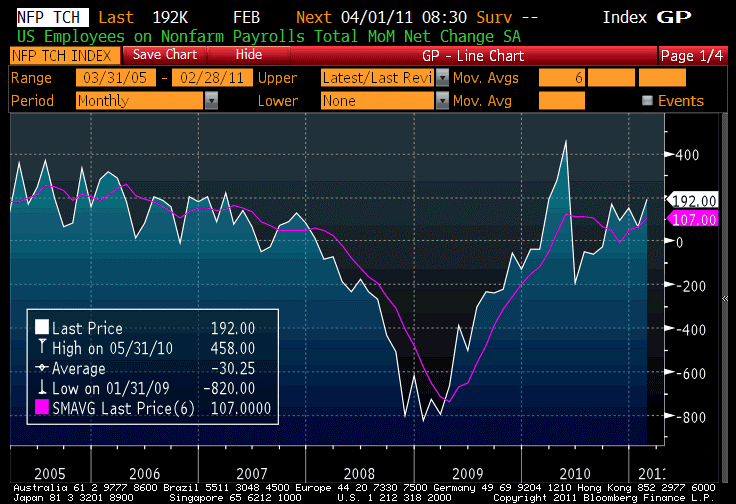
Smooth out the Census bubble and we have a steady, albeit slow, rise in jobs growth.
Now the bad news. Wages growth was essentially flat, and this combined with a lack of the expected improvement in Average Weekly Hours means that income growth was weaker than expected. Remember that wage growth lags inflation, and we are seeing that first-hand. With food and energy prices increasing rapidly, this pinches consumers and reduces discretionary income growth. As long as the economy continues to grow, this isn’t a big problem, but it shows the vulnerability of the economy to an oil shock. The absolute number of jobs must continue to rise and the pace must accelerate for the economy to be able to shrug off $120+ oil.
There is also a small incongruity in the Duration of Unemployment, which rose to 37.1 weeks (see Chart). The earlier rise might arguably attributed to the generous unemployment benefit period, but now the economy is improving so this is strange. It implies that the people who are getting jobs are being taken from the ranks of the not-unemployed-for-long.

Odd that the average duration of unemployment is still rising.
Does this mean that a meaningful amount of the recent unemployment has become structural? If so, it implies a higher NAIRU, a possibility anticipated in a San Francisco Fed Economic Letter from earlier this month.l Of course, I’ve also pointed out in the past that wage inflation doesn’t cause price inflation, so the value of NAIRU is more in my mind in terms of defining the relationship between scarce labor and scarce capital, which two camps get to split the economic honey-pot (well, after Government takes her share). But for some economists, NAIRU drives the inflation model.
The combination of a moderate-but-not-great Employment report and Crude oil making a run at $105 (WTI) or $116 (Brent) pushed stocks down sharply and booted bonds higher. The Dow was down 180 points until the last half-hour, when the selloff failed at the day’s lows for the third time and apparently prompted some short-covering into the close. 10y nominal yields fell 7bps to 3.486% and remain in limbo. TIPS rallied, and breakevens were slightly narrower except at the front of the curve where the oil spike is making people really nervous.
I suspect that people are a bit too nervous about inflation at the front of the curve. We all remember $140 oil and we associate it with 5%+ inflation, but that is unlikely (though not impossible) to happen in the near-term. When headline inflation was that high in 2008, the Shelter component was 2.5% or so (and core CPI was also around 2.5%). Moreover, the rise in oil prices happened much more abruptly than it has (so far) happened here.
One-year inflation swaps are now around 2.50%. That seems low, considering how far energy has risen. But the real way to look at the 1y inflation swap is that it is now pricing in that headline inflation over the next year will be 1.5% higher than current core inflation.
There are three ways that can happen. First, food-and-energy inflation might add 1.5% on top of core; second, core inflation may rise further (and indeed I expect this); third, some combination of these may happen.
The first thing to realize is that although “Food and beverages” carries a higher weight than energy into the CPI, what is included is the end product. So if food commodities rise 50%, a much smaller price increase passes through into headline inflation (partly because the producers absorb the price hike but also because many of them also hedge their costs in some way). Accordingly, the majority of the volatility of the difference between core and headline comes from energy, which tends to be consumed in something much closer to its elemental form (say, in retail gasoline).
Using our knowledge of what the ‘normal’ pass-through is from raw energy price movements to changes in the price of retail consumption of energy, we can work out an estimate of the “core-headline spread” in the future.
For example, in the case of the 1y CPI swap, and incorporating the usual lags, the expected difference between core and headline inflation over the next 1 year can be reasonably inferred by the difference between December 2011 RBOB Gasoline futures and the spot level of gasoline in early January 2011. This is important to realize: the rally in gasoline futures from, say $1.82 (where XBZ0 was in August) to $2.43/gallon is essentially already in the price level. So, looking forward one year, you’re only interested in the rise above $2.43. And with the December 2011 futures at $2.8135, the market expects that gasoline prices will rise around 16% year/year during the relevant period. That works out to be about an 0.5% expected spread between core and headline inflation one year from now.
With core currently at 1%, and the 1y inflation swap at 2.5%, this means core inflation is expected to be at 2.0% one year from now. The problem is that it is fairly unusual for core inflation to move as much as 1% in a year (see Chart), so this is already pricing in quite a big move in core inflation.
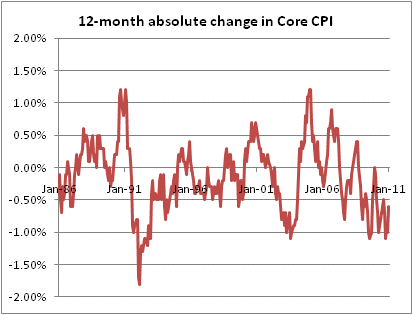
Core inflation rarely moves more than 1% year-on-year.
“But,” you might object, “gasoline is not at $2.81, but at $3.04, and may rise further.” It is true that spot gasoline is already above where December 2011 futures imply it will be then – that is, the futures are in backwardation – and I agree that there is some reasonable likelihood that gasoline prices may yet rise further. But if you think that gasoline will be at $3.40 in December, there is an easier way to play that view than to buy an inflation swap or do a 1-year breakeven trade where energy is already being priced in at about that level: just buy December gasoline at $2.81!
All of this is to say that the short end of the inflation curve is getting rather frothy (the Chart below shows a time series of year-ahead core inflation extracted from 1y CPI swaps and energy futures). While I understand and agree with the notion that inflation is heading higher, and probably substantially higher, it seems to me that if I wanted to make that bet I would now want to move further out the curve where a secular rise in core inflation could be the driving force rather than making increasingly expensive bets on how much energy prices are going to spike.

To get the 1y CPI swap rate up, buyers are either betting on much higher core or paying too much for an energy spike.
There is no economic data on Monday…or Tuesday…or Wednesday. Thursday has Initial Claims and the Trade Balance, but the first and only significant data of the week is the Retail Sales data on Friday.
More Silliness
Just when it seems that the market is getting ready for a return to rationality, unchecked optimism (or, more likely, fear of missing a Big Bull Market) bobs to the surface. It is turning out to be amazingly hard to keep this inner-tube submerged…but just wait until there is a hole in it.
Late in the day, the headline from Bloomberg said “Stocks rally on oil’s decline.” An editor, perhaps doing some rudimentary fact-checking, noticed that Crude was down a whopping 32 cents and added “…and initial claims drop.” This later changed to the vague “Stocks Rise Most This Year on Economy”, apparently in a concession to the fact that S&P futures had gained 14 of the session’s 24 points before Initial Claims – or any data – had been released.
The ISM Non-Manufacturing Report was as-expected at 59.7, but there is no doubt that Initial Claims was positive as it came in at a multi-year low print of 368k. The volatility continues – or is this genuine improvement? Economists will seize on this as confirming their null hypothesis (improving trend), and it is sure that it doesn’t disprove it while it nearly disproves my null (that a new lower equilibrium was in force in the low 400s). The only reason these numbers don’t already disprove my hypothesis is that we can’t yet distinguish between trend and volatility because the numbers are jumping around so much. Still, ‘jobs hard to get’ and other employment indicators are improving so it seems more likely that the jumbled mass of economists are right and I’m wrong. The chart of Claims (see below) certainly suggests a downtrend, but until the last couple of weeks the improvement from 460k to 425k was the only thing that looked reasonably conclusive (after all, in January we still had two prints above 440k) and the “false breakout” in August that ironically helped produce QE2 was what made the trend look optically trend-like prematurely. Imagine that: for a change, humans’ (and even economists’) tendency to try and see patterns in the data actually worked in our favor, rather than leading us astray!
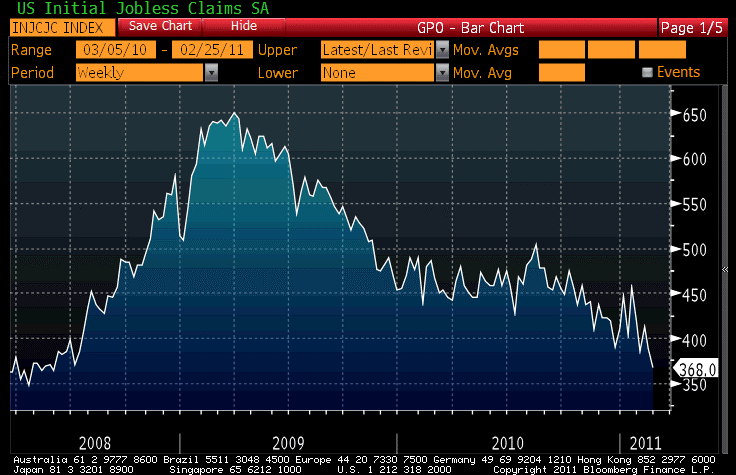
The downtrend isn't as clear statistically as it looks to your eye - but it seems to be real.
But while an Initial Claims reading that looks pretty good probably helped hold up the stock market as investors who would otherwise be reducing risk before Employment, it doesn’t explain the biggest gain of the year (although on barely 1bln shares).
It is easier to explain the bond market’s performance. The 10y note contract was only down 7/32nds until Claims, and it ended the day down 28.5/32nds with the 10y yield back up to 3.57%. In addition to strongish economic data, there was hawkish talk from the ECB.
Although the ECB bravely decided to keep rates unchanged, President Trichet made some statements in the post-decision presser that scared bond folks. The Bloomberg headline was “Trichet Says ECB May Raise Rates, Show ‘Strong Vigilance’”.
The editors can be excused this time for missing nuance and irony. What he actually said was that an “increase of interest rates in the next meeting is possible. Strong vigilance is warranted.” Sure, anything’s possible. PIIGS might fly. Trichet then added that such a move would not necessarily start a “series” of hikes. I’m not sure how one token tightening could be considered “strong vigilance,” and that incongruity (taken together with the fact that the energy shock will slow European economies, at a time when Ireland and Greece and probably Portugal and Spain and maybe the EU itself cannot endure very much of a slowdown) means that his comments should not be taken at face value. It is very easy to sound tough about inflation. Wake me when the first tightenings happen in a year or two. (Let me apply a small caveat. I can actually imagine a one-off tightening just to look tough, but even that is tantamount to yelling fire in a crowded theater: since no one would know that only one tightening was planned, the markets would get predictably crushed).
The currency guys loved the Trichet strong-man routine, however, and bid up the Euro. This sent the dollar to its lowest level since November and threatening 2010 lows as well as the uptrend-line from 2008-2010 (see Chart).
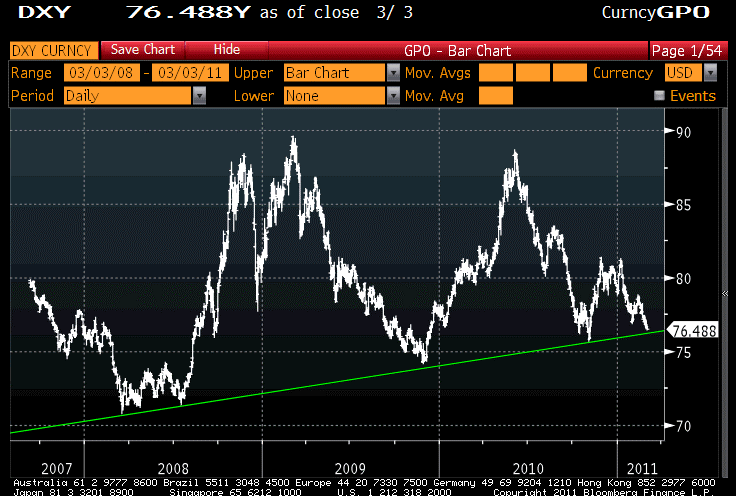
Weak dollar tends to increase inflation risks. With a big lag, of course.
This helped push inflation swaps to their highest levels of the year; 5y inflation swaps are at their highest levels (2.53%) since the inflation spike of 2008 and 10y swaps are essentially equal to the 2009 and 2010 highs around 2.85%. 5y inflation, 5y forward, which the Fed watches, is still “contained” at around 3.18% but neither 2.53%, 2.85%, nor 3.18% sounds like expectations the Fed is trying to target. Watch for the language to start to emphasize “relatively” contained.
The Employment release scheduled for tomorrow ought to be interesting. Clearly there is some emotional defensiveness about the report given that last month’s 36k was clearly impacted by the weather – but one dealer last month said the effect was 40k while another said 150k-200k. The numbers were just a mess overall. The Unemployment Rate had plunged for the second month in a row to 9.0%, partly because of changes in the aggregate level of employment and the labor force in the Establishment Survey’s benchmark revision. As I said last month,
“Essentially, the numbers are saying “we were a little high on the count of total jobs, but it turns out that was because we thought the whole country was bigger than it was, so even though there’s fewer jobs there are also fewer jobless.”
Ordinarily, when the stock market rallies and the bond market sells off headed into Employment on the basis of, or anyway supported by, Initial Claims (or if the circumstances are exactly reversed), I tend to want to fade the move. It is hard to believe that there are lots more investors to pour into stocks on a good number, because it doesn’t look like many investors pared their risk today. But I don’t trust that reasoning this month, because the numbers were so funky last month it isn’t really obvious what would be a big surprise. I guess it will be easier to identify a very weak number than a very strong number, because we all expect some weather snap-back and something around, say, 100k on Payrolls would be disappointing. The Consensus is +196k.
The other reason that I don’t see a lower-risk pre-number position is that it isn’t entirely clear whether a very strong number would be good for equities or whether a bad number would be necessarily negative for the market. Chairman Bernanke has recently tied QE2 and the Fed’s easy stance to the employment picture, saying that without a substantial improvement in employment it will be hard to say the recovery is on firm legs. Well, suppose we get a substantial improvement in employment. Does that imply a less-accommodating Fed? (Or, more to the point I guess, does it imply that investors will expect a less-accommodative Fed?) Would I be shocked to see the market trade lower on a strong report, the day after Trichet sounded hawkish (at least to the credulous)? Not a bit. And I wouldn’t be surprised if the market rallied on somewhat weak data.
Now, with bonds it’s a little easier. Strong data is doubly bad for bonds because it implies a less accommodative Fed and is seen to increase the chances of appreciable inflation. Weak data implies that the Fed continues to play Santa Claus and lessens the perceived chances of inflation: doubly good. With the selloff today, it is a harder call but I’d tend to prefer the short side. That meshes with my sense of the secular trend, but the market seems not to be in a trending mode at the moment.
The Unemployment Rate is expected to rise to 9.1% from 9.0%. Last month, the expectation was for a bounce to 9.5% from 9.4% and instead the Rate fell to 9.0%. But a lot of that fall was the result of the benchmark revision and should not be naturally expected to be reversed. But when the participation rate rises – someday – there will be some upward pressure on the rate (people returning to the labor force because they’re looking for jobs will initially be jobless).
At least we are finally out of the worst of the seasonal adjustments and the weather issues. The tea leaves ought to become somewhat clearer. But that doesn’t mean the market will stop being silly.
Rates are the Sight: Money is the Real Target
A relatively quiet trading session for equities on Wednesday probably represents the reluctance to make big bets prior to Employment on Friday more than anything else. There was news to trade. Oil prices rallied another 2.4% with WTI over $102 on reports that Libya’s strongman had come close to bombing oil facilities in the part of the country that rebels control. Even when it became apparent that he had missed (presumably intentionally since if he manages to win he would want to have those facilities, wouldn’t he?) oil prices refused to retreat. The tension will not soon break, I expect.
The ADP report was a little better than expected at 217k (expectations were for 180k), but that’s easily within the normal error. Since last month saw a severe weather impact on Payrolls but not on ADP, it isn’t clear what implication the stronger ADP this month has for Friday’s data.
Higher energy prices and better data (the Beige Book was also perceived as being upbeat) helped drive nominal yields 7bps higher today, putting the 10y at 3.46%. That marked the biggest close-to-close decline, such as it was, in more than three weeks.
.
I have mentioned many times before that one of the reasons I have been writing a comment like this for many years is because of the valuable insight and feedback I receive from readers around the world. Strategists, investors, and traders spend lots of time going around looking for information, and separating the useful information from the useless information. To the extent that I can reverse that flow so that the information comes to me, it is arguably worthwhile to write a commentary (the other reason to do so is to clarify my own thoughts by forcing myself to put them into prose, but I needn’t do that publicly of course).
For example, one reader today drew my attention to an article published late last year by George Kahn of the Kansas City Fed. Dr. Kahn is a well-respected Fed economist (just based on sheer numbers, there ought to be some well-respected economists at the Fed); I wrote about some of his arguments on inflation targeting in a column in December. The article he wrote in 2010Q4 was entitled “Monetary Policy under a Corridor Operating Framework” and was published in the Kansas City Federal Reserve’s quarterly Economic Review.
The article is a good, readable explanation of how a “corridor operating framework” employed by a central bank works. In such a framework, the central bank essentially stands ready to lend all that banks need to borrow at a certain spread above the intended policy rate and to borrow (and pay interest on) all that banks want to lend at a certain spread below the intended policy rate. By doing so, the bank creates a “corridor” outside of which the market overnight rate (the Fed funds rate in the case of the Fed) should rarely trade.
This is not a new idea; I first remember encountering this concept quite a long time ago in the form of the Bundesbank’s discount rate/Lombard rate duo and there are a number of other central banks that employ these concepts. What is new is that once the Fed began to pay interest on reserves (and Kahn provides a brief but interesting history of reserves policy in the United States as well) they essentially had established a corridor system as well. The Fed will supply any amount of reserves through the discount window, and will pay interest on any amount of reserves through their policy of interest on reserves. So Kahn is examining the implications of this new set-up, which seems a worthy endeavor.
The purpose of having such a system, rather than having a single policy rate that the NY Fed attempts to maintain through open market operations, is that “In theory, a corridor system could limit volatility in the policy rate and isolate interest rate policy from the size of the balance sheet.”
Kahn demonstrates how this allows the central bank to control the level of short-term interest rates and the level of reserves separately (or to operate in an environment with no reserves at all). I have only one quibble with the article.
“The corridor system and, in particular, the corridor floor, allow the central bank to separate interest rate policy from liquidity policy. This separation can be important in a liquidity crisis when the central bank might need to pump an unusually large quantity of reserves into the banking system. Without the interest rate floor established by the corridor, such an injection of reserves could push the policy rate well below its target.”
But as my collegiate rhetoric teacher would have said, “so what?” What Kahn never addresses is why that is important. He never explains why there is a need to control the target rate at all.
Remember, controlling the rate was a substitute for controlling the money supply directly. The Fed tried to do that in the so-called “monetarist experiment,” and found that it couldn’t do so very effectively. Accordingly, the institution called a tactical retreat and began to target what they could target reasonably successfully: the short-term interest rate. If the supply and demand functions for reserve balances are known or can be reasonably inferred, the Fed can adjust the supply of reserves so that the amount of reserves supplied and demanded is able to clear at the target rate. If the Fed raises the target interest rate, it supplies fewer reserves so that the market clears at the higher interest rate.
But the rate in that case is just a proxy for the amount of reserves the Fed wants in the system. Interest rates don’t cause inflation and grease the wheels of growth; money does. MV≡PQ. There’s nothing there about the overnight interest rate.[1] For the Fed, the overnight rate isn’t the target; it’s the gun sight.
In any event, though, the Kahn article is useful and reasonably quick reading. I really like the clarity with which he writes. The policy significance of the article is less in this case than with the inflation-targeting article, because the policy-corridor approach is not exactly untried and untested but merely a new approach for the Fed.
.
On Thursday the data calendar lists Initial Claims (Consensus: 395k from 391k) and the final revision to the Nonfarm Productivity and Unit Labor Cost figures for Q4. At 10:00ET the Non-Manufacturing ISM (Consensus: 59.3 from 59.4) is due out. Of these, Initial Claims is probably the most important, since as the volatility of the weekly data begins to diminish the confidence we can have in establishing where the new equilibrium level of Claims is will increase. Many analysts don’t think that there is an “equilibrium” level right now but that rather Claims are on a steadily-improving trend. I have been reluctant to embrace that view, partly because the initial proclamations of the downtrend were triggered by the illusion caused by the spike higher in August. But the fact that the initial proclamations happened for the wrong reason doesn’t mean that they were themselves wrong. If ‘Claims drips towards 380k in the next couple of weeks I will have to revise my opinion.
The main event data-wise, though, is plainly on Friday with the Employment Report. I don’t think that necessarily means we are in for a quiet day, because there are many non-data crosscurrents to keep tabs on. But it does tend to increase the probability of a quiet day.
[1] I don’t want to make it sound with this argument that I think interest rates generally don’t matter; I am talking here about the overnight rate. Clearly the term structure of rates has implications for how capital is deployed and subsequent growth rates, but the Fed doesn’t control the term structure. What is fairly unimportant in my view is the overnight interest rate as a policy tool. Money, money, money makes the world…go…‘round.
The Market’s Pot Odds
Stocks got rocked (-1.6%) and bonds (after starting the day weak) ended with marginal gains. Why is that interesting? Well, after rallying for two days and erasing much of the selloff from Tuesday through Thursday of last week, it sure looked yesterday like another setup in which panicky buyers, afraid of missing the boat, would take the market to new highs.
Another 1.6% decline was really not in the playbook.
The economic data was solid, with ISM coming in at 61.4, slightly above the consensus expectations for 61.0 but probably slightly below the upward revisions that economists made after Chicago PM was strong.
But energy prices rallied again, with Crude futures +3.4% and front Unleaded up a whopping 9.2%. (Yesterday I suggested tongue-in-cheek that the Iraqi refinery outage which happened over the weekend would be traded on Wednesday. I underestimated energy traders as it only took until Tuesday!) The gasoline spike takes the front contract over $3/gallon. It is hard to believe that back in 2008, the peak was only at $3.631 – we have come a long way back! As a reminder, back then the year-on-year rise in headline CPI got to 5.6%, although to be sure that was with housing also contributing 2.5% instead of one-fifth of that.
The weird part of all of this is that today’s geopolitical events should only be surprising if you were living in a fantasy world in which only what you saw on TV was reality. But the existence of “reality TV” doesn’t imply that everything not on TV is not real, does it? Investors acted with surprise when an Egyptian paper reported that the Saudis were sending tanks to help quell riots in Bahrain. Really? Is it shocking that Bahrain would ask for materiel, or that the Saudis would supply it?
Investors seem surprised that the U.S. and Britain are considering establishing a no-fly zone in Libya to support the anti-government forces. It seems that the market’s tacit assumption up until now was that the Middle Eastern turmoil wouldn’t directly affect western nations except indirectly through the oil price (and our leaders pooh-poohed the loss of Libyan oil, so what is there to worry about?). Really? It’s not exactly a new idea that a wider conflict in that region could draw in western allies. I think the idea is a bit more than 900 years old. I even think Nostradamus suggested obliquely that WW3 would start this way. Speaking of world wars, don’t forget that some of WW2 was fought on the sand as well: Rommel’s first offensive in 1941 started in Libya. So…I’m not predicting a world war; I’m just observing that it shouldn’t be terribly shocking that the First World is being sucked in, since that intersection has been busy for the last millennium or so…
In theory, all of the likely and somewhat-likely events are supposed to be already discounted in the market. Stocks and bonds at these levels should fully discount the fairly high likelihood that conflicts in Tunisia, Egypt, Bahrain, Libya, Yemen, and other countries will not pass away with no impact. Asset prices should incorporate the somewhat-likely possibility that American machines and marines will end up being involved in some way. I’m not sure that these things are in fact being discounted. In fact, I would suggest that they are very likely not being so.
Last June, I wrote what I thought was a very useful piece about how to think about sizing trading bets under crisis situations. Quoting from that piece which said, in the context of the 2008 crisis:
“The relevance here is as follows: when a crisis hits, two things are happening to you as an equity investor. First, you are becoming more confident that the market will reward you for buying when everyone else is selling, because (as noted above) unless the world actuallydoes end you are likely to be getting a good price. Second, though, you need to recognize that the increasing chance of debacle implies a worse payoff. In April of 2008, the chances of losing everything the next day were pretty slim. In mid-September 2008, the chances were appreciable that a bunch of your portfolio might be in trouble. So your edge (confidence in winning, if the bet was repeated a bunch of times) was growing, but your odds (payoff if you win, relative to your loss if you don’t) were worsening.”
The relevance today is that while your odds are worsening, because the chance of a debacle is growing (by the way, the VIX shot back up to 21 today), your edge has not improved. Your edge improves when prices decline. Taking a shot on buying the market when there is a crisis is defensible and even smart, if the market has fallen enough to improve your edge sufficiently. But buying the market when there is a crisis developing but the market isn’t yet providing you good pot odds is not a good play. It is always possible, in other words, to hit an inside straight on the river, but if your payoff is only 2:1 if you make your hand, folding is still the right thing to do. This market is not offering good pot odds on the bet that the Middle Eastern crisis will pass away without impact on our economies.
In all of this I haven’t mentioned Chairman Bernanke. A thoughtful comment posted to yesterday’s article observed that the market may also be reacting today to the fact that Bernanke in his seminannual testimony gave no hint about a possible QE3. That’s a good point, but again it makes me scratch my head and ask “is that a surprise to investors?” The Fed right now thinks they’ve won, and their biggest problem (they think) is no longer deflation but the question of how to unwind the portfolio cleanly. Many Fed officials have been openly questioning the need to fully implement QE2 (make no mistake, however, they will finish QE2), and Ron Paul is going to make any consideration of QE3 extremely painful for the Fed. So should it be a surprise that QE3 is not likely in train unless something really bad happens?
Maybe the reason I find all of this hard to figure out is that I don’t watch CNBC. Maybe they’ve been downplaying the significance of having all of the bad population-pyramid countries bursting into flames in unison. I don’t mean to blame CNBC. They’re not paid to see around corners, to anticipate problems and to assess the likelihood of improbable events. They’re paid to provide entertainment. It’s we investors who are paid to evaluate investment returns and risks. And if we’re doing it badly, it can’t be CNBC’s fault. (Well, not entirely their fault).
Tomorrow brings another uptick in the tempo of economic data as the ADP report (Consensus: 180k from 187k) is released at 8:15ET. Remember that the Fed has made quite an issue of the weakness in employment as a reason for continuing to add so much liquidity. In my mind, this makes it somewhat hard to figure out whether a higher-than-expected number from ADP is bullish for equities or not. On the one hand, it (perhaps) indicates a stronger economy; on the other, it may lessen the monetary support for the asset markets. I can make a plausible argument to fade equity strength following any upside ADP surprise.
Bernanke also repeats, tomorrow, his semiannual testimony – this time to the House Financial Services Committee. Ordinarily, the second round is much less interesting than the first round in the other chamber (since the text of the speech is the same), but in this case it is the Republicans’ first crack at Bernanke’s semiannual talk since they took over the Committee. I predict there will be some entertaining Q&A.
Ten-year Treasuries at 3.40% are right back in the prior consolidation zone. The roundtrip from 3.40% to 3.75% to 3.40% took almost exactly one month. At this level, the market ought to be fairly balanced, and a neutral outlook is appropriate. On the bullish side are the geopolitical developments; on the bearish side is the fact that the end of the Fed’s buying program is one day nearer every day, and the economic data is strengthening (albeit slowly). I suspect rates will resolve higher, but there is no urgent time-frame for them to do so.
