Archive
Donuts To Dollars
As expected, the news event du jour was Chairman Bernanke’s semiannual Monetary Policy Report to the Congress (neé Humphrey-Hawkins). Before we get into the market’s reaction, let’s take a look at some portions of the report:
The economic expansion that began in the middle of last year is proceeding at a moderate pace, supported by stimulative monetary and fiscal policies. Although fiscal policy and inventory restocking will likely be providing less impetus to the recovery than they have in recent quarters, rising demand from households and businesses should help sustain growth…
An important drag on household spending is the slow recovery in the labor market and the attendant uncertainty about job prospects…
My colleagues on the Federal Open Market Committee (FOMC) and I expect continued moderate growth, a gradual decline in the unemployment rate, and subdued inflation over the next several years…The forecasts are qualitatively similar to those we released in February and May, although progress in reducing unemployment is now expected to be somewhat slower than we previously projected, and near-term inflation now looks likely to be a little lower…
Notably, concerns about the ability of Greece and a number of other euro-area countries to manage their sizable budget deficits and high levels of public debt spurred a broad-based withdrawal from risk-taking in global financial markets in the spring, resulting in lower stock prices and wider risk spreads in the United States. In response to these fiscal pressures, European leaders put in place a number of strong measures, including an assistance package for Greece and €500 billion of funding to backstop the near-term financing needs of euro-area countries…
Oh, whoops, sorry about that. That’s from the July 2010 MPC, not today’s. Guess I clicked the wrong link.
Anyway, it is comforting to see just what hath Ben wrought. By his own estimation in today’s presentation, the Fed’s $600bln purchase of Treasury securities managed to lower long-term interest rates a whopping 10 to 30 basis points. So I suppose it shouldn’t be surprising that, a year later, things are just about where they were a year ago. Oh, sure, the economy is two or three percent larger overall, and we’re no longer confronting deflation (although even last summer we knew that prices were going to bottom in Q4, so it wasn’t QE2 that did that).
The stock market leapt when the text of the Chairman’s remarks was released. Investors seized on the statement that the Federal Reserve is “prepared to respond” if stimulus is needed. This was breathlessly, if inaccurately, reported by CNBC (rarely the place to go for accurate news) as a promise that the Fed would supply more stimulus if needed. That wasn’t at all what he said. Here is what he said, verbatim:
“Once the temporary shocks that have been holding down economic activity pass, we expect to again see the effects of policy accommodation reflected in stronger economic activity and job creation. However, given the range of uncertainties about the strength of the recovery and prospects for inflation over the medium term, the Federal Reserve remains prepared to respond should economic developments indicate that an adjustment in the stance of monetary policy would be appropriate.”
That seems reflexive to me: we will make an adjustment if we decide that we should make an adjustment, since the clause “remains prepared to respond” relies on “[if] economic developments indicate that [a change in policy] would be appropriate.” Well, I certainly hope that they are prepared to ease if easing is called for. And I hope that they are prepared to tighten if tightening is called for. Incidentally, he said that too, but you didn’t hear that reported quite as breathlessly.
The Chairman said the Fed could ease by buying more securities or by extending their commitment to low rates. There are two problems with those two approaches. Buying securities didn’t seem to work (oh, sorry, 10-30bps), and the market already is pricing in low rates for 3-5 years with the 3yr note yielding 0.62%. Do you have anything else in that bag of tricks, Felix?
“…The Federal Reserve could also reduce the 25 basis point rate of interest it pays to banks on their reserves, thereby putting downward pressure on short-term rates more generally. Of course, our experience with these policies remains relatively limited, and employing them would entail potential risks and costs.”
So, here’s a confession. I screwed up in yesterday’s article. I talked about changing the reserve requirement, but a much more-direct way to ease further is through reducing or eliminating the Interest On Excess Reserves. That would actually be a much smarter move, because it’s almost guaranteed to release reserves (as I pointed out when I first noted that the “multiplier mystery” wasn’t a mystery at all, in September and Octoberfor example). It certainly makes more sense to do this than to buy more assets. All the money used to purchase assets is going into reserves, where they do nothing but scare us about the potential for reversing the “Dollars to Donuts” saying.[1] So purchasing more assets would be absurd.

Ouch, that's going to leave a mark! Or a Euro.
U.S. yields were unchanged, but commodities jumped 1.6% led by Grains (+3.2%) and Precious Metals (+2.8%). Silver was up over 7%. The dollar was down 0.8%. I am impressed – talk about more quantitative easing ended up having limited effect on stocks and a strongly positive effect on real goods. That’s almost as if investors realize that inflation is always and everywhere a monetary phenomenon! The donuts-to-dollars move is on its way.
Also be aware that the Treasury will announce the details of the upcoming 10-year TIPS issue, scheduled for auction next Thursday. A whole week to set up seems like a luxury, and the issue size of roughly $13bln doesn’t seem likely to pose much of a problem although the coupon (which would be 0.5% if the auction was held today) may cause some shudders. Those shudders didn’t hurt the 5y TIPS auction very much when in April the Treasury sold $14bln with a 0.125% coupon. Once everyone feels better about Italy, it will be harder for the Treasury to sell TIPS here, but in the meantime the ILB (inflation-linked bond) market is threatening to become more concentrated and most indexed investors will be hard-pressed to pass (although it bears noting that Italian ILBs rallied today).
.
[1] I am told that the phrase “I’ll bet you dollars to donuts” has its roots in the 19th and early 20th century when donuts cost a penny or two – so the person uttering this phrase was saying that he considered the proposition a sure thing. Nowadays, however, this is close to an even-odds bet and doesn’t carry quite the same sting. With just a bit of inflation, it will be appropriate to reverse the phrase.
Please Help Us Rate This Ad
Hi –
I appreciate you stopping by to take this poll. It concerns the following ‘advertisement’ which Enduring Investments, together with our advisors, have put together, and we’re trying to get outside opinion about its quality. The poll is below the advertisement. Please be honest. Your responses are anonymous! Feel free to re-Tweet, etc, and thanks!

(More) Silence Would Be Golden
Most of the New York trading day on Tuesday was sedate, if you could overlook the fact that equity futures had a 25-point range overnight. Futures made almost a full round-trip, with the September S&P futures dropping as low as 1295.30 (from the 1318.60 close on Monday) before rebounding to a loss of only 2-3 points by the time traders walked in States-side. The IMF’s new chief was the provocateur; Mme LaGarde said testily that the institution “is not just a cash machine” and that the Fund and EU are not ready to discuss the details of the next Greek bailout. Recall that the recent Greek vote was to release a small tranche of the last bailout, so that the country could make it the few weeks until the next bailout was prepared. If there is no next bailout (and probably even if there is), a default is a certainty. Remarkably, this still comes as a surprise to some investors, who took it hard.
But other investors stepped up to provide the needed liquidity to those who were anxious to exit, and stock and sovereign bond markets rallied at the expense of the dollar (which had been soaring in the middle of the night) and Treasuries. By the morning, a quiet cease-fire seemed to have settled over the market, and T-Note futures chopped in a 12-tick range while the S&P meandered between 1316 and 1323. Commodities, which had started the day somewhat weak, rallied to finish +1.2%, led by Grains.
Equity bulls thought they saw a chance to force short-covering when the FOMC minutes were released. Bloomberg had two headlines to make sure that everyone knew that the Fed hadn’t “ruled out” QE3 and that “Fed Officials [are] Divided on Further Stimulus If Economic Outlook Remains Weak.”
That’s technically true; there are a couple of Fed officials who would continue to beat a dead horse for the sheer enjoyment of it. And look, I’d be the first person to point out the stupidity it would show if they did rule anything completely out (“One Hundred Percent” confidence is just as bad in reverse!). But the hard majority of the Committee has been very clear about how they feel about that issue, and moreover there is no sign that monetary policy since the crisis has done anything except support interbank liquidity and sown the seeds of potential inflation. I wrote yesterday about the fact that elements within the Fed still are searching for “what went wrong,” but most of them at least know that something went wrong with very many zeroes attached.
There will be no QE3 unless banks start to shudder again like in QE1 – but mere economic weakness is not going to trigger more large-scale asset purchases (LSAP). Frankly, I think the next lever to be pulled would be a lowering of the reserve requirement, and that could be done without more LSAP.
But if the only way you get more QE is with a lot of economic weakness, I am not sure why I’d want to pile into stocks, which are certainly not priced for economic weakness…as the overnight performance helped illustrate.
After spiking on the release of the Fed minutes, in a feeble attempt to run the shorts, stocks rolled back over and ended the day on the lows albeit with a mere -0.4% loss. The problem is that the people selling overnight were probably not setting shorts, but rather getting out of longs.
Late in the day, Moody’s downgraded Ireland to junk and kept her on negative credit watch. This shouldn’t really be news, but it seems worth pointing out and it did snuff out a weak attempt to hold the market unchanged on the day.
.
Now, one interesting thing did come out of the FOMC minutes. Some might argue there were two, as the Fed laid out a detailed but very flexible road map about how a future normalization of monetary policy would be carried out. I suppose it is useful to know that the Committee isn’t even going to try to sell any of their bonds until they’ve already begun to raise interest rates, and that sometime thereafter they’d begin selling assets very slowly over a three-to-five-year period, but frankly all of that has a big ol’ asterisk by it: “*that is, if we feel like it and circumstances permit and the next Chairman doesn’t have a different idea.” We’ll see how that pans out.
However, I was surprised and a little impressed that the Fed issued guidelines on public statements by Fed officials, and formally instituted a “blackout” period that for many years existed informally until Greenspan broke it one year and no one paid much attention thereafter. The blackout period is a period from Tuesday the week before an FOMC meeting until Thursday the week after the meeting; during that time Fed officials may not offer their views on monetary policy or economic conditions. The Fed said the guidelines on public statements are aimed at making the central bank “more transparent,” but that’s a red herring. Limiting speech can’t possibly give more information. The new policy is meant to get the policymakers back in the ranks, and marching more in-step. That’s not more-transparent. It may be clearer, in the sense that (as was the case in the Greenspan Fed) dissenting opinions will get less airtime so that it will be more obvious where the consensus lies, but it is indubitably more opaque.
Long-time readers will know that I applaud any move to make the Fed more opaque, even though it will seem as if this policy results in the Fed giving clearer signals. What will happen is that shifts in the Fed’s view will happen out-of-sight and appear suddenly, and so we won’t get a sense for the evolution of the argument and whether one side is gaining momentum until it actually happens. And frankly, that’s where familial arguments should happen – behind closed doors.
Since the Chairman of the Fed right now is ridiculously over-confident, the policy is probably also aimed at making himself look better and at consolidating his hold over policymaking – and if true, that’s definitely a bad thing. But it isn’t clear that good ideas necessarily triumph with this guy, so I doubt that changes much.
Speaking of Bernanke, he will appear tomorrow to deliver the semi-annual Monetary Policy Report to the Congress. Day one is House testimony. The headlines will hit at around 10:00, but I wouldn’t expect many surprises from his prepared remarks. However, given what has happened to the economy since his last testimony, despite QE2, I would expect some tart questioning in the Q&A period and I look forward to that.
Stocks are vulnerable and I believe will shortly test at least the overnight lows from last night. The 10y Treasury at 2.88% is likely to run to new highs (low yields) on the year as well, and as I wrote yesterday TIPS, as crazy as it is for the 10y real yield to be at 0.52%, are going to be trading well as long as Italy trades poorly. In my view, commodity indices remain the place to be.
Warning: Flabbergasting Area
These days I find myself alternately flabbergasted and outraged, with very little else.
And sometimes, I am both. Exhibit ‘A’ is the bill that my company received over the weekend, from the New Jersey Department of Labor and Workforce Development. I can do no better than quote their explanation of the assessment:
“The New Jersey Department of Labor and Workforce Development (Department) was required to borrow funds from the United States Treasury in order to pay Unemployment Insurance benefits. Payment of the interest on the outstanding loan balance starting January 1, 2011 is due September 30, 2011.
“As required by N.J.S.A. 43:21-14.3, the Department must assess all employers for the interest due…
“The calculation of your Federal Loan Interest Assessment for 2011 is shown below. Payment is due 30 days from the mailing date of this notice. After 30 days, interest will accrue at the statutory rate of 15% per year.”
I am speechless. Business owners are being assessed, in a way completely unpredictable to a business owner, for a loan the state took out to pay obligations the state incurred on behalf of the citizens of the state. And if the business owner doesn’t pay within 30 days, it’s actually better for the state because the state will make 15% on that assessment and assuredly isn’t being billed 15% by the Treasury. This is both flabbergasting and outrageous, and probably part of why hiring is slack!
Less incredible, except for the fact that it took this long, is the news from Europe that leaders on that continent are “…prepared to accept that Athens should default on some of its bonds as part of a new bail-out plan for Greece… It also marks the possible abandonment of a French-backed plan for banks to roll-over their Greek debt.” This was only one of the headlines over the week hinting that the “French bank deal” might have hit a snag and that leaders are now thinking about how bad default might be. Another story noted off-handedly (cited here) that “at least five” banks were asked by the ECB to apply to act as advisers in the event of a sovereign default in the Euro area. And Germany’s ruling party seems to understand that they can try to keep the Euro together, or they can try to maintain their capacity to govern Germany, but probably not both: Chancellor Merkel told Italy that it needs more “frugality’ and her finance minister said that Germany would not give the bail-out fund the ability to engage in price-keeping operations in the Italian and Spanish bond markets.
This seems eminently reasonable, since when the ECB tried buying Greek bonds to control the slide into oblivion all it did was delay the crisis a few months. Holders of PIIGS debt, who were evidently counting on having that door to exit through, decided to get out before the door shuts completely. Greek yields…well, never mind. Portuguese yields rose 42bps to 12.51%. Irish yields jumped 28bps to 12.65%. Spanish yields leapt 33bps to 5.98%. And Italian yields sprang 42bps higher to 5.67%, a level that one story said was enough to threaten the viability of the Italian budget. Seriously, if you can only finance your country if interest rates are below 5.7%, then it was doomed to eventually end anyway – for how many years, out of the last 300, have Italian yields been below 5.7%?
Italy is an interesting case because she issues inflation-linked bonds. So does Greece, but Greece only had a handful of small issues whereas Italy is the fourth-largest issuer of ILBs in the world behind the US ($723bln), the UK ($442bln), and France ($255bln). Italy has $158bln outstanding in 10 inflation-linked issues. The real yield on Italy’s current 10y inflation-indexed bond rose 54bps today to 3.905%.
This could perversely benefit the U.S. and U.K. inflation-linked bond markets, because a severe worsening of Italy’s prospects and rating would have a much more-serious effect on the size of the inflation-linked bond market than it would have on the nominal market. There are many substitutes for Italian government bond issues. There are not very many substitutes for Italian BTPis and BTPeis – the corporate linker markets are far too small and illiquid, and the major sovereign markets are those I’ve just listed. So you can’t go from Italy to Germany in linkers: Italy is $158bln in size; Germany is $72bln. Indeed, the world sovereign inflation-linked bond index ex-US, France, Italy, and UK is only $242bln. So, while I was very bullish on TIPS when the Fed was buying all of the visible supply, and then turned bearish (the 10y TIPS yield is only 0.55%, after all), I can’t imagine wanting to sell them, though, if there’s going to be another $158bln looking for a home in the inflation-linked world.
Back to flabbergasted: a Bloomberg story entitled “Fed Data Cruncher Finding No New Normal Unemployment Nationwide” discussed the work of some Fed researchers who are “scouring data, examining models and gleaning anecdotes to determine why the jobless rate has remained stuck around 9 percent or more since April 2009.” This is borderline crazy. Here is a quick summary of the article: Why didn’t it work? Is it because of structural unemployment? No? Then is it because we mismeasured the natural rate of unemployment? No? Then obviously what we’re doing will eventually work and we should keep doing more of it.
Shouldn’t they also ask the question about whether the world doesn’t work according to their models, at least if you get outside the normal range of activity on which those models were based? Maybe it didn’t work because it isn’t supposed to work. These are, after all, only theoretical models and they rely heavily on the notion that money illusion is a strong force. Continuing to do more of the same, if the thing you’re doing is completely ineffective – and the evidence suggests the effect of LSAP was well-nigh zero once you take away the complimentary short-term effects of fiscal stimulus and the natural tendency of the economy to cycle anyway – is just plain stupid. Well, perhaps “stupid” is strong; “uncreative” would be more charitable. Maybe, just maybe, the world doesn’t work the way they thought it did.
And that’s just one of the many reasons that Bernanke’s famous “one hundred percent” expression of confidence on “20/20” was so ridiculous. You can’t even be that sure that the model you’re using is right. Heck, I’m not even 100 percent sure that gravity is a universal constant, but at least we’ve spent more time testing that hypothesis.
It is hard to be long risky assets when there are so many things that regularly flabbergast or outrage you, and today we had another ‘risk off’ or ‘growth off’ sort of trade as equities dropped 1.8%, bonds rallied 11bps to 2.92%, and commodities declined 0.5%. But the commodity beating wasn’t uniform, as Livestock rallied and industrials and agriculture fell. The dollar rallied again, and once again the dollar index is threatening the 76.00 level above which things get interesting. I am not sure it will hold, this time, as bad as our domestic problems seem to be.
Tomorrow, we get to see the minutes from the June FOMC meeting. There shouldn’t be any major surprises there, but those investors who still can’t bring themselves to understand why QE3 hasn’t been announced yet will scour the minutes for evidence that it may yet happen.
And who knows? I am certain that there is more flabbergasting ahead.
“No, Mister Bond, I Expect You to Die!”
Warning: excessively long post. And I apologize about the many different fonts on the various charts!
That was not the Payrolls number I was expecting, nor the number the market was expecting. The economy created only 18k new jobs in June; combined with a net downward revision of -44k to the prior two months, the net was negative. That wasn’t the only bad news. The Unemployment Rate went back to 9.2%, up from 9.1%. That means it is 0.4% above the lows set in March, and here’s why that’s scary: when the Unemployment Rate rises 0.5%from a low, at least since the 1960s it always has gone at least another 1% higher or more after that.
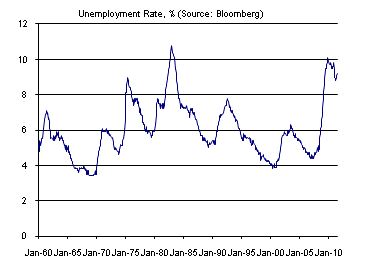
Once the Unemployment Rate starts to rise, it usually keeps rising for a while.
Past may not be prologue here, since there aren’t many examples of the Unemployment Rate descending a lot and then bouncing back at least 0.5%…but, by the same token, there aren’t many examples of the government spending trillions to push the Unemployment Rate down artificially without having organic growth recover. More on that later.
The report is rotten clear to the core. The Labor Force Participation Rate fell to 64.1%, another multi-decade low (see Chart).
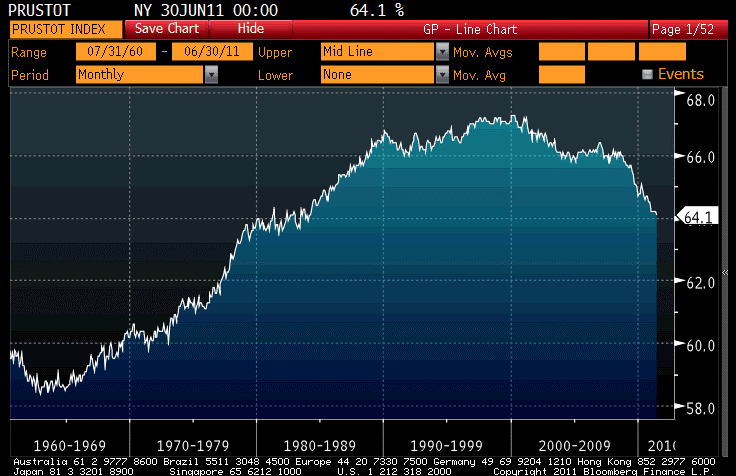
Labor Force Participation Rate continues to dive.
One more Employment-related chart: this is one of my favorite charts of labor underutilization. It shows the number of people (in thousands) that are not technically in the labor force, but nevertheless want a job now and would take one if it was offered. To be “not in the labor force,” you can neither have a job nor be looking for one. This includes students and retired people, as well as people who have given up looking for work. This indicator went to new all-time highs – again. More than six and a half million people aren’t even looking for work, but wouldtake a job if one was available. That’s 1.5mm more than normal, and in my opinion at least those extra 1.5mm ought to be considered as part of the unemployed. (The effect on the Unemployment Rate itself, in case you’re curious, would be to push the ‘Rate to about 10.1%).

This is a very evocative series - people who aren't even looking, but would take a job if one was available.
So this is pretty ugly all around. And the curious thing is that there wasn’t any obvious sign of this coming. ADP didn’t show the same weakness, and although Initial Claims is rising it didn’t suggest weakness this profound. For the time being, we need to regard this as an aberration from the presumed underlying trend of 100k or so. Note that that’s a pretty weak trend, and not enough to keep the Unemployment Rate from rising, but it’s better than outright contraction. So in my opinion we can reject the null hypothesis that the jobs situation in this country is improving, but we can’t reject a null that the jobs situation is treading water.
As an aside, I wonder at the size of another effect that I am sure is operative but presumably is pretty small right now. I wonder by how much jobs are underreported simply because more people are working off the books due to the health care law and other onerous government requirements? As if we need another reason to repeal Obamacare (and polls continue to indicate that a majority of Americans favor repeal) there is this one: if the law pushes more economic activity off the books, it is activity that the government can’t tax. See: “Greece.”
Now, some people are saying that the weak Jobs figure puts pressure on the Fed to roll out QE3. I cannot think why that would be the case. It seems more reasonably to be evidence supporting the notion that QE2 didn’t do very much…isn’t it? Agreed, it is going to put pressure on the Committee to “do something,” but it would seem to me the last thing they’d want to do is something which has already failed. The definition of madness is to do something over and over again and expect a different result, right?
Some folks also think that the current spate of weakness means that the Congress ought to stop talking about serious deficit reduction. Most of those people are Keynesians (e.g., Krugman, who on Friday said “The situation cries out for aggressively expansionary monetary and fiscal policy,” which makes you wonder how the actions of the last few years don’t qualify as – at least – aggressive) who have never questioned the efficacy of excessive government spending despite copious prior evidence that it doesn’t have a lasting effect (See: FDR, George W. Bush). They are not likely to put any more weight on the most recent experience, which at best showed that massive deficit spending has a short-term effect, and seems not to have the ‘kick-start’ effect that most proponents considered almost automatic. And we haven’t yet seen the other side of the coin which must come, when the deficits must be cut and the short-term effects run the other way. Or perhaps we have begun to see this – as state and local governments continue to lay off workers, that is certainly contributing to the rise in the Unemployment Rate. Push it down with trillions, watch it rise back when the trillions are gone…
But I think Congress will continue to talk about deficit reduction, and will reach an agreement to cut the deficit by at least 1-2 trillion over the next decade as part of an agreement to raise the debt ceiling. Do you know why I think that? Because the debt ceiling once raised will not come back down, but the budget cuts can easily be rescinded whenever they like. Like, for example, if there were “economic emergencies” that demanded the cuts be restored. Since no deal the two sides make today will have anything to do with next year’s budget, they’ll reach some sort of agreement or I’ll eat my hat.
.
In Thursday’s article, I noted the recent rise in the M2 money supply rates of change to post-2009 highs. I meant to say a little more about that. I should have added that the latest week of data was for June 27th, so some of the most-recent surge may be quarter-end. The Fed may also have wanted to let the market get a little extra liquid with Greece in the backdrop – that explanation is somewhat more pleasing since the jump in M2 rates of change isn’t a one-week phenomenon but the rates of change have been edging higher for a few weeks now.
But there’s a problem with that explanation, and that’s the fact that the Fed doesn’t control M2. In fact, the relationship between M0 and M2 – the money multiplier – has been unstable since the wall of money was first unleashed a few years ago. And that leads to the real fear, which is that the wall of money in M0 is finally starting to pass into M2. That is, the fear is that the money multiplier is recovering.
Until now, if the Fed added more reserves through LSAP it manifested in higher M0 and a lower multiplier. That is, M2 didn’t really show much effect. The multiplier I first discussed here is down to 3.5 now that QE3 is complete. With the monetary base at $2.6 trillion, if the old 8.5 multiple were to suddenly re-appear tomorrow (and I am not saying I expect that) then M2 would rise from $9.1 trillion to $22.1 trillion. That rise in transactional money would almost certainly be extremely inflationary! The point is that if the multiplier, which collapsed mainly because the Fed was paying banks to hold reserves, were to suddenly start rising again, it becomes a clear and present danger requiring aggressive and determined response from the central bank – which, with the Unemployment Rate rising, would be ticklish to say the least.
Now, I wrote Tuesday about the conversion of Ron Paul and the implications of his plan for explicit monetization of the debt (effected, in his plan, by having the Fed “tear up” the bonds it has bought) on the risks for inflation. And now I’ve just written about the acceleration in money supply growth and the risk that the multiplier could rebound for reasons we may not correctly anticipate (or more to the point, the central bankers may not correctly anticipate). But what about the implications for the bond market, and other markets, generally?
Both of these things are potentially ‘tail events,’ but they are both strongly inflationary. We’re not talking here about a rise in core inflation to 2%, which is roughly where my models have it going over the next year-plus based on historical relationships with the money supply, the dollar, private debt, and so on. The risk is that it goes much higher, and surprisingly quickly. Not since the early 1980s have we seen Core CPI accelerate more than about 1% in a year, but from February 1978 to June 1980, Core CPI rose from 6.2% to 13.6% and from August 1973 to Feb 1975 Core CPI went from 3.2% to 11.7%. Remember, this is core inflation so the OPEC embargos are not the cause (in the 1973-75 example, the removal of wage and price controls probably contributed as official prices rose to match black market prices). So an acceleration of 5% or more in a single year is not impossible…and back then, while monetary policy was irresponsible the Fed was not purchasing trillions of dollars’ worth of bonds and then (if Congressman Paul has his way) ripping them up.
I think it’s important here to point out that I am not talking about probabilities. I am not predicting 7% core inflation next year. My point forecast is 2.1% for 2012. But the distribution is extremely skewed to higher outcomes, and has fat tails in that direction as well. I am talking about possibilities, and they’re worth talking about since they’re no longer hundred-to-one long shots but maybe five-to-one or ten-to-one. Since 7% or 13% core inflation would pretty much destroy most plans based on assumptions derived from the last twenty years, it’s not a bad idea to ask how your plan might fare in such a case. Here’s a quick cut giving my basic thoughts; if you want more color then ask me about becoming a client!
Equities
For starters – even if you think that equities are an inflation hedge, you should be aware of this fact: since 1881, when inflation has been between 1% and 2% the average Cyclically-Adjusted P/E (CAPE) has been 19.97; when inflation has been between 2% and 4% the average CAPE has been 17.95; when it has been over 8%, the average CAPE has been 10.12 (Source for those numbers is Robert Shiller, via http://www.irrationalexuberance.com/). So let’s assume that prices rise 10%, and corporate earnings rise 12% (certainly, corporate earnings cannot rise much faster than inflation overall, although there certainly would be winners and losers). Then we would expect the market to fall precipitously. Let’s suppose that cyclically-adjusted earnings are $10 in year 0:
Market index in Year 0: 17.95 x $10 = 179.50
Market index in Year 1: 10.12 x ($10 * 1.12) = 113.34
As long as you’re willing to wait for a while, your ‘inflation hedge’ will end up doing okay, but “a while” might be 20 years. In the meantime, you’re staring at a 37% loss in year 1. It is much better to be underweight stocks when conditions (in particular, interest rates and inflation) are perfect, because they don’t do very well in the transition to less-than-perfect!
Commodities
There are a lot of people getting this wrong right now. Gary Shilling, who I think is terrific, in a recent note made the same mistake so many people make: he says that coming recession in China, and weak growth elsewhere, will tip the supply/demand balance and trigger much lower commodity prices. As far as that thought process goes, in a ceteris paribus way, it is surely right. But the much bigger effect is the effect on the money:stuff exchange rate. The error being made here is analogous to the one made by investors in stocks who think equities are inflation-protected: they are right about one effect, but they miss a much bigger effect. In the case of stocks, they are missing the reduction in the multiple that is associated with higher inflation outcomes, and that effect dominates the rise in nominal earnings that goes along with higher prices. In the case of commodities, the two effects are ordinarily unrelated so normally the main thing you have to worry about – and surely the most important thing for a short-term investment in a single commodity – is the supply/demand balance. More acreage planted and higher yields in corn will assuredly push prices lower.
But prices are denominated in dollars, and if the supply of dollars relative to the supply of corn rises, then the relative price of corn may rise even if there is more corn this year than there was last year. The mistake we make is that we think of dollars as being some fixed thing, when it is more accurate to think of them as a counter with no intrinsic value of their own. If you’re up $50 in a casino, you flip the dealer two bucks. If you’re up $5000, you slide him a hundred-dollar chip. Why? Because in the latter case, dollars are less scarce.
If the money supply rises 4% next year, then the supply and demand of commodities will dominate. But if the money supply rises 50%, the supply and demand simply won’t matter – all prices will rise. And that is potentially a much larger effect, although one reason I like commodities is really that there are two ways to win: you can win the supply/demand game, or if there is another recession and a QE3, you can win on the too-many-dollars game.
Bonds
Obviously, a huge rise in inflation will absolutely kill nominal bonds (and also any TIPS other than very short-dated ones, although in TIPS’ case their return will catch up over time while that will not happen with nominal bonds), and that is all I need to say about that! But I think bonds are in trouble anyway. The chart below is one I’ve run before; it shows the 10-year Treasury yield on a logarithmic scale through the entire multi-generational bull market.

Logarithmic scale - the secular bull market in bonds technically is still in place.
I am on record as saying that the bull market is already over, and that yields are slowly working their way to the top of this channel and through it (as of this month the top channel line is at 4.27% although there is a secondary one that comes through essentially at this year’s high yields). We are right now roughly in the middle of the channel and technically speaking rates have done nothing “wrong” yet. A weak economy would seem to keep a lid on rates, but that is true only if the Fed and the Treasury can resist throwing more fuel on the fire by rolling out more stimulus. I don’t think they’ll be able to resist for very long.
What is concerning is not the eventual move from 3% to 4% (which, incidentally, I expect we will not see until early next year unless the rise in M2 is really the beginning of something big). The risk is that somewhat higher interest rates will make the government’s fiscal position that much less tenable. The interest on the Federal debt is $242bln in the President’s Fiscal 2012 budget, and already is expected to grow to $494bln by 2015 (because of a larger debt but also because of the interest rate assumptions: 91-day T-Bills are expected to rise to 4% and 10-year notes to 5%). Suppose rates instead went to 7% and 8%? We have seen recently how uptrends in yields in Greece, Ireland, and Portugal helped precipitate crises at the same time as they were telegraphing the crisis. My concern is not so much that bond yields go to 5%, or even higher. My concern is that they go high enough to start the death spiral.
Now, that’s a strategic view: nominal bonds are going to get crushed. Tactically, though, let me return to what I said earlier. Congress and the Administration are going to come to an agreement on a big deficit reduction measure, with high confidence, in the next couple of weeks. When that is announced with much fanfare, bond prices are going to rally, the ratings agencies are going to take the U.S. off negative watch, and everyone is going to make snide comments about Bill Gross. But when that is done, we’re going to see bond yields start to slip higher and it will be the beginning of the end.
Wounded Worrier
The stock market continues to power ahead, with the S&P up another 1.1% today and about 7% over the last 8 trading sessions. For those keeping track that’s roughly a 220% annualized growth rate, but the bulls don’t seem to care about such trifles. And, indeed, the optimists clearly have the upper hand as the indices power to a seemingly unavoidable rendezvous with the destiny of the year’s highs. Today, the market was launched higher following a rate hike in Europe (and hints that more, incredibly, are yet to come) and a slightly stronger number from a second-tier jobs report, and sustained their gains in the face of a 4.1% rise in gasoline prices.
You can call this a “risk-on” trade if you like; commodities broadly were up 1.5% and Treasury yields rose to 3.14%. But you could also term it a “growth” trade. A recovery that is about to gain steam suddenly would leave the same market footprint: higher commodities prices, especially energy commodities, rising interest rates, and rising stocks.
I personally am short stocks, but fortunately through the medium of options. Having bought options at low vol, I am losing on delta but not losing doubly by watching vols drop further. Indeed, it is somewhat incongruous but implied volatilities have not been declining over the last few sessions despite much higher equity prices.
However, a worrier doesn’t have to look very far to find worries (and a bull doesn’t have to look very far to find a wall to climb). Rate hikes into a sovereign debt crisis would be a good place to start, although at the same time the ECB suspended its minimum credit-rating requirements for Portugal so it is strangely being both tight and loose at the same time.
The general loss of ECB credibility could be a worry, although to me the whole institutionalized crazy routine makes me think more of the scene in Blazing Saddles where the sheriff pretends to be taken hostage by his own split personality, in order to manipulate the crowd. I don’t think the manipulation routine in this case is working very well, but I just prefer to believe that over the alternative that Trichet has simply gone mad. Today he insisted that the Irish government, which recently has threatened to force senior bondholders in the country’s banks to take losses as a way of ‘sharing the burden,’ should instead respect prior agreements. “All the plan, nothing but the plan including all what has been said at the time of the approval of the plan,” quoth Trichet expansively, apparently numb to the dramatic irony of demanding utter fidelity to precedent on one hand while rewriting collateral guidelines with the other hand.
The growth camp got a mild boost from the ADP figure, which was stronger-than-expected at 157k (versus 70k expected). That got people excited, or perhaps I might even say overwrought with joy, about tomorrow’s Employment data. Initial Claims came down to 418k, which is still high although down from 432k last week. It seems weird, though, to get very excited about beating expectations when that happened mainly because the expectations were stupid. The ADP number was actually right on the regression line (see Chart below) – it was last month’s number that appears to be the aberration. Economists were just too morose. Oh joy!

Economists shouldn't have been so surprised by ADP, which was right where it should have been given Claims.
The ADP figure suggests Payrolls should be around 162k on the coarse regression I use, but even though expectations for that number rose today, they’re still well below that number (Bloomberg reports 105k but that includes people who didn’t change their numbers on the new information). There is a good chance of a high-side surprise in Employment tomorrow, although it shouldn’t be a surprise especially after today’s data. A 150k jobs gain is no reason to set off fireworks, folks, and the stock market is already priced as if it is known that job growth will shortly triple from that level. But if (probably when) we get that surprise, the market will leap higher, especially if the Unemployment Rate falls from 9.1% – it is expected to be unchanged. Personally, I will use that opportunity to add to my put position, although I will not do so if stocks blast through the year’s highs.
.
There was again news today about the notion of changing the cost-of-living adjustment in Social Security so that it uses chained CPI rather than the current “standard” CPI. Note this is not a change to CPI, and will not affect TIPS (which were unchanged today versus a declining nominal market), but rather is a change to the index to which Social Security will be statutorily indexed to.
There is a lot of debate about whether or not this is a “tax increase” or a “benefit cut,” but that misses the point. If you want to call this a tax increase on the old, to keep the young from having to pay back in the future the money that we have to borrow today to pay those benefits, then fine – although calling it a “tax” just makes the political deal-making that much more difficult, the description I just used at least captures the notion of what is really happening: this is a question of a transfer more than a tax.
And, as someone who doesn’t yet receive Social Security, doesn’t ever expect to, and yet will be paying for it throughout my entire life, I would say – isn’t it about time? The transfers have run the other direction for decades: young people have pledged trillions of dollars far into the future to pay the Medicare and Social Security entitlements. When there was some chance those young people might eventually receive similar future entitlements, that arrangement was arguably fair – an intergenerational transfer that could be thought of as a low-interest savings program. I am paying extra money now so that my future-self can receive money. But because it was never built as an actual savings program, that intergenerational transfer turned into a Fountain of Youth that politicians could bathe in by pledging more benefits to politically-active retirees. Now that those programs are clearly not viable – Medicare especially: in principle Social Security could be made temporarily viable with changes to entitlement age etc – the time is probably right to ask, “why shouldn’t there be an intergenerational transfer back to the young from the old?” The answer, of course, is that no one will ask that question in the right way, and explaining it won’t fit in a sound bite. I fear for my country, and this is one reason why.
.
One additional worry just cropped up today with the release of the weekly money supply numbers. There was a very large increase in the latest week, which brings the annualized 13-week growth rate to 11.1% (highest since March 2009), the 26-week growth rate to 7.0% (highest since June 2009), and the 52-week growth rate to 6.1% (highest since November 2009) – see Chart.
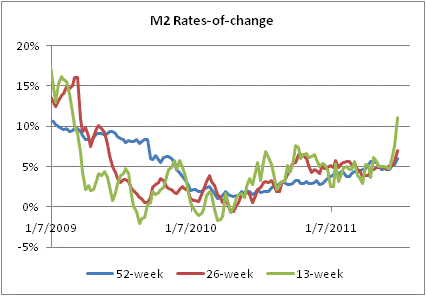
I start this graph in 2009 so the crazy spikes from 2008 don't distract us. M2 is jumping.
While I am trying not to get alarmed yet, it is interesting to reflect on this chart in conjunction with the resurgence in equities and the sudden (and largely unexpected) recovery in commodities. Commercial bank credit, which has been contracting on a year-on-year basis since early 2009, is essentially flat (-0.1%) over the last 52 weeks (see Chart).

Bank credit is still technically contracting year-over-year, but only by a hair.
So, perhaps the stock market has it right, and the ECB is right to begin tightening. I am skeptical about that possibility, especially since the European crisis is far from over. And yet, that set of facts is consistent with the dollar being stronger than one would expect given 11% dollar M2 growth and an ECB tightening, and with the U.S. 10-year rate being at 3.14% instead of at 5%.
It is a set of facts and hypotheticals that I am not comfortable with, and indeed I think this optimism will prove to have been premature. Moreover, the stock market has already priced in the money-stimulated recovery – that’s what the rally from last August was theoretically about (or so we were told) – and I am always reluctant to pay for the same item twice. But there is certainly a chance that the market is right this time.
Go Long Egg Cups
Now that Greece has avoided the immediate default by promising whatever was necessary to get the latest tranche of aid, the real game has begun as the various players consider how to provide a longer-term Greek solution.
The ratings agencies have begun to break their studied silence and to express opinions on the “French” restructuring plans. Recall that a key point here is that if the ECB is to continue to accept Greek bonds as collateral, they cannot be defaulted. This is very important, because borrowing against those bonds is virtually the only source of funding for Greek banks. (I think, but am not sure, that they are also a source of cheap funding for other banks. If the bonds can be carried at par, are they discounted at the ECB at par? If so, then it would mean you can buy a bond trading at 60€ and use it to borrow 100€. I don’t know the answer here, and I assume that game isn’t allowed, but I mention it because one of my readers will surely know the right answer).
It seems incredible that there was any question that the plans would be considered to be anything but default, since the whole point is that Greece needs a way to pay back less than it would otherwise be obligated to. The ‘voluntariness’ is a bit of a red herring since any bond holder is going to ‘voluntarily’ take a deal that does not result in the meltdown of the global financial markets, which some analysts have threatened as the possible result if Greece defaults (I don’t think the result would be so dire, although it would be bad). Any agreement is therefore suspect as being less-than-fully-voluntary, although there is lots of gray area to play with here.
S&P, on Monday, said that the Greek plan as currently formulated would probably be a default, and Fitch agreed. Moody’s has not yet expressed a firm opinion. Quickly moving to isolate Moody’s, a senior finance official at the ECB told the Financial Times that the central bank will continue to accept Greek debt as collateral for loans unless all of the ratings agencies declare it to be in default. The reasoning is that their “standards” allow them to consider the highest rating among the big three ratings agencies. But the real reason is that this helps to put a wedge between the ratings agencies. Each of them now needs to fear whether one of the others could be bought, and whether they should instead sell out first when there is still an advantage to doing so. Perhaps that sounds cynical, although of course I don’t mean explicitly bought, but it is much easier to bring pressure to bear on the individual members of a cartel than to bring pressure on the cartel generally.
Meanwhile, adding to the creepy unreality of all of this was the report from ISDA (the International Swap Dealers’ Association, which is the main arbiter for the question of whether a standard CDS event has been recorded) that the French plan probably wouldn’t constitute a default in the meaning of a CDS contract. This bizarre conclusion raises the possibility that banks and hedge funds which owned the debt with CDS protection are going to get killed on both sides of the plan, with the debt going into recovery and the CDS protection being worthless. Some credit arb funds will get crushed as a result (one hopes that they have strict risk limits that contain the damage from one such event); arguably, credit arb as a strategy class in the hedge fund world just took a big hit as a concept, if at least two of the major agencies can declare a default and it doesn’t trigger a CDS contract. Supposedly, the reasoning is that the “period of selective default” might be short enough to essentially be ignored.
Really? If so, that’s a very slippery slope. What counts as default, then? Five days in default? Ten? Thirty? Or does it depend on how important the issuer is? I am no expert on CDS, but this seems crazy to me.
Stocks and bonds were both comparatively quiet, retracing small amounts of last week’s moves. Bonds did better and stocks set back a bit when Moody’s this afternoon cut Portugal’s debt to junk. Right, Portugal: forgot all about them, didn’t we? Of course, if there’s no such thing as default, who cares about a rating that tells you how likely a default is?
Commodities prices, though, were fairly active, with the DJ-UBS spot index climbing 1.6%. Energy, Grains, Livestock, Softs, Precious and Industrial Metals all rose, despite the fact that the dollar also rose. The chart damage is far from undone, but our asset allocation models continue to be heavily weighted towards commodities and cash.
But no matter how you get your inflation protection, get your inflation protection. A clearer signal on this point there couldn’t be, than the fact that Congressman (and Presidential Candidate) Ron Paul – the ultimate hard-money advocate – is advocating monetization of the debt by having the Fed tear up the IOUs that they hold from the Treasury. That is, the Fed issued $1.6 trillion in electronic money to buy Treasuries; now, rip up the Treasuries. This is no different from if the Fed had simply printed $1.6 trillion and given it to the Treasury to buy goods and services or transfer directly to individuals through the tax system. And the fact that the idea is coming from Ron Paul, of all people, should be chilling. Even people who want ‘hard’ money are thinking it may not be feasible without a little monetization/debasing first!
The author of that article suggests that the Fed could sop up the liquidity it would otherwise have drained when it sold its portfolio of Treasuries by something simple like raising the reserve requirement for banks. This would probably work, although it is a blunt measure with lots of uncertainty about its effects since no important change in the reserve requirement has been made in around 30 years. But that would of course be devastating for bank earnings in the long run since it would forcibly reduce financial leverage (although see my note back in May about excess reserves and the unintentional reduction of leverage at banks).
In a month…no, a year…no, an era of crazy ideas, chalk up another. But do take note of my point that when even the chickens start to vote for boiled eggs, it may be time to invest in an egg cup because breakfast is on its way.
