Archive
The Vampire Strikes Back
Friday was a relatively quiet day. Indeed, equity volumes dropped one-third from Thursday’s volume and back to what would have been considered for most of this year a very busy day but not catastrophe-like volume. Overnight into Friday, the S&P traded as much as 22 points lower before recovering; once the New York session opened, stocks traded in a comparatively sedate 19-point range on the S&P. Bonds rallied to finish out the week. The nominal 10-year yield fell 8bps to 2.26% while the 10-year TIPS rate fell 6bps to -0.02%. Commodities were roughly unchanged, along with the dollar.
That is not to say there wasn’t news, but traders just seemed unwilling to make large incremental position changes right before the weekend. Retail Sales for July was slightly stronger-than-expected at +0.5% and +0.5% ex-auto; there was also a small upward revision to June’s number. More dramatic was the swoon in Michigan Sentiment to 54.9 versus expectations for 62.0. Remember, this isn’t a series that spans 0-100 with a breakeven at 50. This is a series where 54.9 represents the lowest figure seen since Jimmy Carter – lower, even, than at the absolute nadir of the 2008 credit crisis (see Chart).
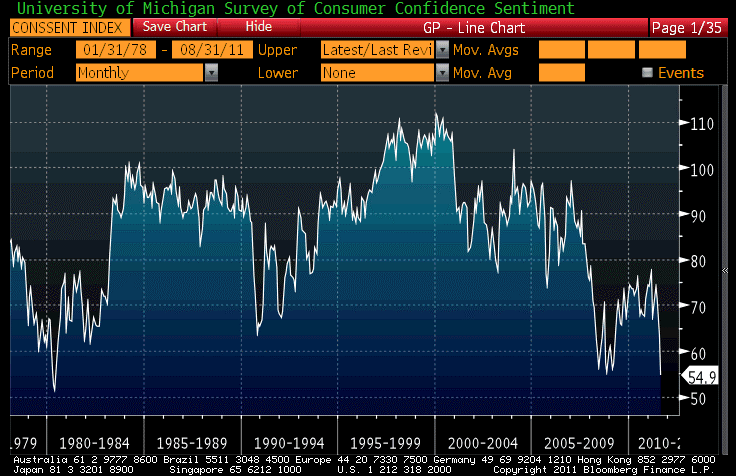
The Vampire Strikes Back - this really sucks.
This number is subject to a revision later in the month, but as it stands now only two months in April and May 1980 recorded lower readings. What happened then? Well, in late April 1980 eight U.S. soldiers were killed in a mid-air collision during an aborted commando mission to rescue the American hostages in Iran. In May, Mount St. Helens erupted. Headline inflation had crested at 14.8% in March, but we didn’t know that yet. The Unemployment Rate rose in April 1980 to 6.9% from 6.3%, and then leapt again to 7.5% in May as 1980Q2 clocked a GDP of -7.9% annualized. It certainly seemed like the American century was ending prematurely.[1]
I report those things for context, not for comparison. This level of consumer upset is incredible, and associated with quite literally some of the worst of times of the last forty years. In a sense, that should be encouraging, except for the fact that there are so many shoes which are yet to drop and almost assured of doing so: the European crisis is almost surely going to get worse before it gets better, equities remain generously priced, and inflation is low but unlikely to stay there. On the plus side, I’d like to believe that our politicians have started to notice that Americans want their government to live within its means, and that the deficit committee will generate real reform that shows other nations the way forward. I am skeptical of that possibility, but in 1980 almost everyone was also skeptical about almost everything. At some point, as bad as things are, something good will happen despite us and the vicious cycle will reverse – unless Americans are so beaten-down that they no longer can harness the optimism that has historically been their birthright. That wasn’t true in 1980, however, and I don’t think it’s true yet in 2011. After all, look where equities are priced with an entire continent ready to implode!
.
Also on Friday, Minnesota Fed President Kocherlakota issued a statement about his reason for dissenting at Tuesday’s FOMC meeting (so much for the blackout period, eh?). What is interesting about the statement (other than the fact that the statement was made at all) is this snippet:
In its August 9 meeting, the Committee changed this “extended period” language to say instead that it “currently anticipates economic conditions … are likely to warrant extraordinarily low levels of the federal funds rate through mid-2013.” This statement is designed to let the public know that the fed funds rate is likely to stay between 0 and 25 basis points over the next two years, not just over the next three to six months. Hence, the new language is intended to provide more monetary accommodation than before.
I don’t much care why Kocherlakota thought that much accommodation wasn’t warranted. I can do my own economic analysis and I could care less what the Fed thinks is the likely course of growth and inflation. They have, after all, been almost perfectly wrong for a very long period of time. What I care about is the great precision with which President Kocherlakota describes the new Fed policy. There is no wiggle room here about “extraordinarily low” meaning anything below, say, 1%. Extraordinarily low means, according to Kocherlakota, 0%-0.25%, period. He does still say “likely,” and we’re left with the conflict between the precise dating (two years – actually the FOMC said “at least” two years) and the hedge-word “likely.” But at least one Fed official viewed the FOMC statement as being pretty close to a promise to keep rates low.
And, as M2 surges, this could well present a problem. Now, in 2008-09 money supply expanded dramatically as the Fed pumped everything they could into the system. They did that because they anticipated – as we all did – that a sharp drop in leverage would parallel a decline in money velocity, necessitating a rise in money to offset it lest nominal output collapse (because MV=PQ). Indeed, had leverage really collapsed as much as many of us expected it to, the amount of money needed would have been vastly more. In the event, the leverage of domestic financial institutions really didn’t decline too much (and it took a while) and household debt not at all, so it worked out.
But in the current circumstance, money supply is surging without the disaster having hit. So we wait, and if there is a collapse in confidence sufficient to halt spending, or a sovereign default, or a major bank collapse, then we will be glad that money is already gushing into the economy. But if not, there is nothing the Fed can do about it. They can drain all the excess reserves, or at least until short rates start to rise, but that is all. They are pledged not to hike rates!
There is another hopeful possibility, and that is that the jump in M2 is temporary. Back when it started at the end of June, I raised my eyebrows but expressed that hope. So far, it hasn’t been the case, but there is one marginally promising sign: while M2 has been surging, the quantity of excess reserves has not been declining. That is, this surge is not due, apparently, to the flushing of excess reserves into transactional money. The water is still all behind the dam, and that’s encouraging. Maybe it’s just rain leading to the flood, not a dam bursting. If the money is sloshing into M2 because it’s fleeing European banks (although European M2 is not declining), then it’s likely low-velocity money and might not go into prices.
My models don’t make such a fine distinction, but the analysts’ job is to look behind the model and attach the appropriate caveats. Right now, I think the risks of significantly higher inflation completely overwhelm the risks of lower inflation, but the biggest risk – that excess reserves would suddenly flush into M2 – appears not yet to have come to pass.
This is something to keep in mind this week as we have CPI being reported on Thursday (on Monday, Empire Manufacturing for August (Consensus: 0.00 from -3.76) is the main release). Markets will still react more to European events than they will to economic data, but CPI is one point that the bond market at least will pay attention to.
[1] On the plus side, both Pac-Man and The Empire Strikes Back were released that May. But those took a few months to turn the mood in the country around.
Money, Money Everywhere (And Not A Drop Of Liquidity)
For the time being, the oscillations have resolved in favor of the bulls as stocks soared 4.6% today (and it was well more than 5% until profit-taking at the close shaved the gain). Liquidity, as it has been all week, was poor and that clearly is contributing to the severity of the swings.
The rally was not a response to news. That’s not really surprising; I cannot imagine what kind of news could be dropped into the current cycle to warrant a 5% move in equities. It certainly wasn’t Initial Claims, despite Bloomberg’s headline – on their TOP news page all day – that “Stocks in U.S. Rebound, Treasuries Fall on Decline in Unemployment Claims.” That’s just stupid. It is true that there was an improvement in Initial Claims (to 395k versus expectations for 405k), and it is true that stocks rallied, but there is no relationship between those two statements. I can state authoritatively that a 10k miss in Claims does not, and will never, cause a three-quarters-of-a-trillion-dollar rally in the stock market. If you have an equity fund manager who bought stocks up 4% “because Claims were better than expected,” change funds.
Now, as the chart below shows, Claims isn’t doing too badly. While 400k per week is not great, it’s also not a disaster (unless, after a multi-year recession, there aren’t many as many people to lay off).
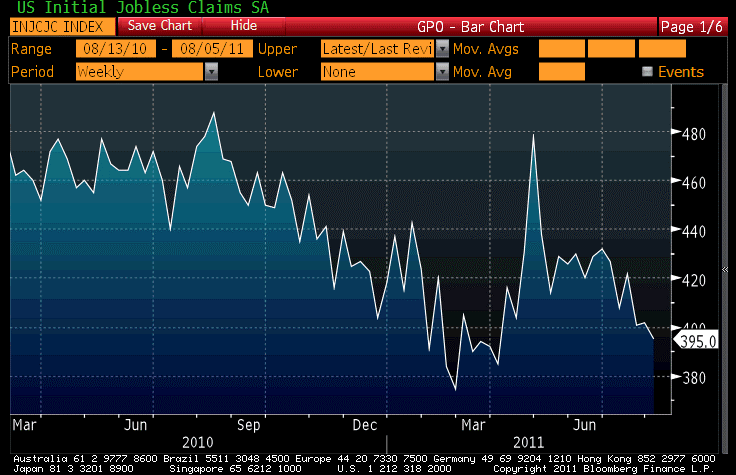
Initial Claims are improving, modestly. Worth 5% on stocks? Probably not.
Employment lags the economy anyway, and there’s nothing in this chart that excites me about either expansion or recession. Move along.
The market moves are about European news or the lack of it. Today, that news is that the European Securities and Markets Authority is considering recommending a short-sale ban in Europe. After all, the ban against selling financials short, and then an ever-widening list of stocks, worked so well in late 2008! There are many examples of this sort of nonsense, and they almost uniformly produce a rally (as short-sellers cover) followed by a decline which is sometimes made more precipitous since the longs who want out have no one to sell to now. Even given our own Administration’s penchant for over-regulation, it would surprise me to see such a ban instituted when we haven’t even seen stocks decline 20% from the highs yet – but traders know that if it’s instituted in Europe and European stocks rally 8% over a day or two as a result, our market will rally in sympathy. Late in the day, France, Spain, Belgium, and Italy instituted short-selling bans.
I suspect that is a big part of what is behind this rally, although there are also plenty of investors who simply think stocks are cheap and are buying so as to make sure they don’t miss the bottom. Volume was much worse than it has been for the last few days even though the point swing was huge, but volume was still far better than it has been for most of the year.
There may be some people who are buying because the situation in European sovereign debt appears to be improving, with Italian and Spanish yields dipping below 5% today. But what did it take to get them there? Authorities have shown repeatedly that they can produce the illusion of a solution with relative ease. The question is whether they can produce an actual solution, and I’ve not seen any sign of it yet. What will happen is that in a few short days or weeks, just as with Greece, natural sellers will unload Spanish and Italian bonds at the new, gift price, and prices will go back down. The only way the EU can keep that from happening is if they persuade the longs (not the shorts!) that the current price is fair, or even cheap, so that the owners of the bonds want to continue to hold them. I seriously doubt that any of the banks currently stuffed to the gills with sovereign paper are having meetings today saying “hey, I like our Italian bond exposure now. Let’s add to the position!”
In contrast to Italian and Spanish debt, U.S. bonds fell sharply today. TIPS yields jumped 20bps and the nominal 10y rose 22bps to 0.02% and 2.33% respectively. Dealers who bought the long bond at auction today are wearing losses, and those are big basis points. Inflation swaps were tighter in the short and middle part of the curve, and roughly unchanged at 10 years.
Commodities rallied sharply, with the exception of precious metals. Gold fell $32.80, for a change. The COMEX increased margin requirements for gold last night. When it did the same thing for silver a couple of months back, that contract was crushed; in this case, gold barely noticed. All of the other commodity complexes rallied. Crude oil rose back over $85. Grains were +2.8%, Livestock +1.6%, Softs +1.3%, and Industrial Metals +2.4%. All of this is with the dollar unchanged. I think commodities investors are thinking back to the Jackson Hole conference last year, and the blast-off that ensued when Chairman Bernanke pre-announced QE2.
Many analysts are thinking that past may be prologue and that Bernanke may kick off QE3 with a speech at Jackson Hole again. I am not one of those analysts, but I understand the thought.
However, I think the Fed has done about all that it plans to do for a while. And I’ve come up with another way to think about the “Fed Pledge” that gives the Fed a little more credit (though not much). I think it’s plain that the Fed would be content with a little bit of inflation. That’s probably been the case since 2009. Many of the problems we have would be easier to tackle if the economy produced 3-4% inflation for a few years instead of 1-2%. Well, it is easy for a central bank to create inflation: just multiply the money supply by 10x and you will get inflation. The problem is that it is very difficult to create responsible inflation. And more than that, the Fed can’t tacitly let inflation rise without response, lest it lose credibility for abandoning the inflation part of the mandate.
And this is the generous interpretation of the Fed Pledge. By tying their hands, they allow higher inflation to happen without being duty-bound to fight it. The Committee clearly doesn’t believe that there is any chance of a long tail in inflation. They believe – as every FOMC has always believed – that they can rein in inflation whenever they want. So they’re willing to take the risk that inflation rises to 3-4% over the next two years. They’d actually like that, in a way.
I am uncomfortable attributing great cleverness (as distinct from intelligence) to the current Fed Chairman. It may simply be a colossal blunder from the Fed. But if he is clever, then this could be the reason the Fed chose to beat its sword into a plowshare.
This might turn out, cleverness or not, to be a bad idea. Today’s money supply numbers were jaw-dropping. M1 was up $100bln on increases in demand deposits. M2 was up an incredible $159bln. In addition to the rise in M1, savings deposits at commercial banks rose $59bln. As the chart below shows, this takes the annual, semiannual, and quarterly rates of change up to levels last seen near the very peak of the response to the 2008 crisis.
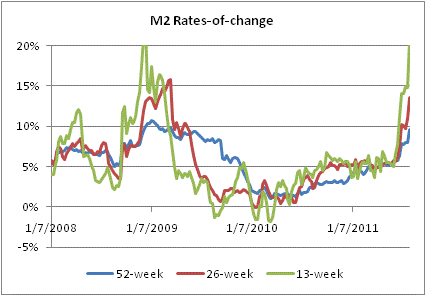
Holy smokes! Transactional money is growing at the fastest rate since 2008.
Now, I am sure someone is going to tell me why I shouldn’t worry about all that money heading into savings accounts and checking accounts. And yet, I do worry. I insist on it. That money is eventually going to be spent on something. It is in the system. In a week, in a single week, a dollar sitting in a checking account became 1.7% less rare. I know the economy didn’t grow 1.7% last week, so there is 1.7% more money to buy the same amount of goods and services. That’s how prices rise.
I think stocks are setting up here for another leg lower, but I will change that view if the S&P can reach 1200. Some people will interpret the surge in M2 as good for stocks. I don’t, but I know that if stocks get to that level I won’t be buying stocks – I will be selling bonds.
Tomorrow’s Retail Sales (Consensus: +0.5%/+0.3% ex-auto) and August Michigan Confidence figures (Consensus: 62.5 from 63.7) are unlikely to have much impact on the market. The question for me is what markets do heading into the weekend. I assume there will be some element of ‘risk on’ if there are no big headlines tomorrow, since it will have been a couple of days since something bad happened. But I wouldn’t bank on it.
.
Follow me on Twitter (and get the comment there): @inflation_guy
Recriminations And Repercussions
It’s the Europeans!
It’s the shorts!
It’s the short Europeans!
I suppose it isn’t surprising that the angry recriminations have already begun. But it is always so distasteful to me to watch investors who were over-extended, operating without a margin of safety, in an over-valued market, try to blame their losses on some capricious deus ex machina. It was always going to be hard for all of us to hit the exits at the same time and actually make it through the door. We should remember this the next time we want to keep riding momentum when value has deserted.
Early today, when the stock market was clearly going to have a bad day, the financial networks (the big one, in particular) started to play the blame game. The market was being driven down by “rumor mongers” or by “Europeans who are scared” or worse. A rumor circulated early in the day – a rehash of a rumor from several days ago – that “one or two” French banks were in trouble. Of course they are. All European banks are in trouble; it’s just not clear exactly how much trouble. Some of the rumors highlighted Soc Gen, reported to have big exposures to sovereign debt. And this, we are supposed to believe, is the reason stocks were down 3% or 4% in the early going.
CNBC stated unequivocally that “speculative attacks” are happening on Soc Gen and other stocks. Really? Who in the world these days has enough capital to engage in a speculative attack? That’s a risky endeavor. And who would do that on a company that is fundamentally sound? That sounds to me like a recipe to lose a lot of money. The head of Soc Gen called into CNBC late today to call the sellers “idiots” and generally to sound like an arrogant CEO (if not an arrogant SOB) to the people listening.
The comparison of the Soc Gen or BOA downtrade with Lehman, often made today, doesn’t sound the right note. The short-sellers on Lehman turned out to be right – the firm wasn’t only illiquid, but insolvent, and probably un-salvageable. The Fed didn’t have to let it collapse on its own, but it wasn’t a question of shooing away the speculators. The firm had to be wound down. It wasn’t that the bear raiders caused Lehman to collapse! They didn’t need any help with that.
I really should keep CNBC off during the day. Another journalist speculated that “maybe the computers are causing the volatility,” and that theme reappeared regularly throughout the day as well. Huh? Most of the computers are off. You can look at the screens and see there’s no liquidity. Markets that used to be 500×500 are now 50×50 with twice the bid-offer spread. In the e-mini, the market for 1000 contracts is probably 2 points wide at least rather than 0.25. I am sure that people are using computers to make trades, and to arbitrage cash and futures markets by transacting quickly, but the high-frequency trading they’re talking about isn’t a big participant here I don’t think. It just doesn’t work well in illiquid environments. I’d be interested to hear from someone associated with a HFT firm who can confirm or refute my suspicion.
The carnage on the day managed to reverse the entirety of yesterday’s rally. On Monday, the S&P closed at 1119.46; today it closed at 1120.76. The Dow closed lower today than it did on Monday. Bonds rallied further, with the 10y yield down 16bps to 2.09%. The 10-year TIPS bond out-rallied its nominal counterpart again – a real rarity in a seriously rallying market – as yields fell 22bps to -0.18%. There is now no TIPS bond that yields as much as 1% real yield, even at 30 years. The net of the two rallies implied higher inflation expectations, and 10-year inflation swaps are back up to 2.75%.
The DJ-UBS Commodity Index rose 1.3%, with energy up 3%-4% on sharp draws in crude, gasoline, and products. Also rising were grains, softs, and (of course) precious metals. Gold crested above $1800/oz today, closing slightly below.
The VIX is back up, albeit shy of the Monday highs. Volume remains very heavy, although today’s volume was a bit short of yesterday’s.
.
I want to clarify something I said in yesterday’s article when I discussed the Fed. Several people have pointed out that technically, what the Fed said in their statement was:
“The Committee currently anticipates that economic conditions–including low rates of resource utilization and a subdued outlook for inflation over the medium run–are likely to warrant exceptionally low levels for the federal funds rate at least through mid-2013.”
Is this a guarantee? That is the question.
Linguistically, it’s a mess. They said “likely to,” which is a statement of probability, but then “at least,” which is an absolute limitation. An English teacher would annotate in the margin something like “which is it? Is it ‘at least’ or may it change?”
For our purposes, we don’t need to grade the English. Fortunately, no one does that when I write! But we can make a couple of observations. First of all, from the perspective of equities it doesn’t really matter which they meant. If they meant the statement to be their estimate, then there was no content at all other than their forecast (and since when was the Fed forecast particularly useful?), and in particular no easing at all when the market was desperately seeking it. If they meant the statement to be a promise, then they bound themselves as I noted yesterday, and will stand idly by if their forecasts prove incorrect (as is quite likely). The second observation to make is that analysts very clearly interpreted the statement to be a promise. The Fed is usually very precise with its language, although it has become less so as the years have passed.[1] It has not previously mentioned a specific period of time in the statement, and moreover for the last couple of months Fed speakers have discussed a “promise to keep rates down for a defined period” as a possible policy gesture. There is little ambiguity here, even if there is ample imprecision.
.
And in other inflation-related news, let’s not forget the Swiss National Bank, which today said that it would “significantly increase” the supply of liquidity to banks and to the money market. The SNB believes its currency is “massively” overvalued, and is fighting back by increasing the supply of Swiss Francs (CHF). Euroswiss contracts from September 2011 to June 2013 closed above 100, indicating that the market is clearing at negative interest rates for Swiss Francs for nine months.
This is a sign of the demand for CHF against all of the debt-ridden currencies. Investors are willing to take a guaranteed nominal loss to hold CHF in preference to other currencies. I can hear the textbooks being re-written as we speak. This is a rational decision in an international financial system as long as you believe the CHF will appreciate against other currencies, since even though you’ll have nominally less Swissy when your deposit matures it may exchange back into weaker dollars (for example) or Euro. But it’s weird, because many of the models written to value options and other things tend to assume that rates are bounded by zero. (For example, Black Scholes lognormal volatility is useless if the distribution can be negative, since there’s no such thing as the log of a negative number). There are lots of theoretical pricing problems with the current models if you have to take into account negative interest rates!
But the significance for investors fearful of inflation is the same as I pointed out the other day: the currency wars are beginning.
.
On Thursday we will get more economic data, including Initial Claims (Consensus: 405k from 400k) and the money supply figures after the close. These are not expected to have a market impact. With liquidity even thinner than is normal in August, position flows will have a big impact on where we trade throughout the day. I will, as I mentioned the other day, buy a teensy bit of stocks as the market continues to decline. When I last ran my “Bargain Basement Stocks” equity screen (that tries to emulate the Value Line criteria), there were only a handful of names on the list. When I ran it today, there were two hundred. Most of them are not bargains at all, but at least there are starting to be names to choose from that may not be complete disasters from day 1.
[1] When I entered the market, the Fed was still saying things like “somewhat greater reserve restraint would, or slightly lesser reserve restraint might, be acceptable in the intermeeting period.” This had a very precise meaning: by using “would” or “might” and “somewhat” or “slightly,” the Fed gave very clear parameters about where they wanted the Fed funds rate to trade, without actually saying so. You had to speak the language, but the language was very precise.
It Won’t Go UP Forever, Either!
Stocks traded higher overnight and held those levels into the open, with bonds under pressure. Clearly, there was more than a little whiff that today’s announcement from the Fed would include some kind of policy concession to the weak economy. Many Street strategists expected an outright declaration of further asset purchases. Such a feeling probably should be categorized as an occupational hazard of working in institutions (both buy side and sell side) that have been built to sell products, which is clearly easier when markets are rising. Strategists tend to think that what matters more than anything to them – rising markets – must also be equally important to policymakers.
But this Federal Reserve, while it has been more explicit than any other about how the “wealth effect” makes life easier for them, at least deserves credit for recognizing that there are other considerations. For example, it was worth thinking about whether QE2 had any lasting impact, added anything to growth (although the Fed claims the same 2 million jobs saved that the Administration does for its fiscal policies), or was the most efficient way to accomplish its aims. Honestly, I too doubted whether the Committee would be able to resist what the Street was clamoring for, but at least we can say they did that.
So what, exactly, did they do?
The Federal Reserve committed to keep interest rates “exceptionally low” until at least mid-2013. That was just what the market was already pricing, so it’s not exactly a market shock to bond guys. The explicit nature of the promise is interesting, because it means that even if inflation starts up, the Fed cannot move rates for two years (unless it wants to permanently lose this as a tool, since if it reneges after one year and hikes rates, no one will ever trust them at their word again). Some wiseacres noted that they could tighten a little and it would still be “exceptionally low,” but this is like debating the meaning of “is.” We all know what they mean – rates can go down, but not up, for two years.
The folks on financial news kept using words like “the Fed gave us a very grown-up sounding statement,” and that’s very sad if clearing that hurdle was a surprise! But it’s also wrong. What grown-up would ever say to a child “I promise that I will not miss any of your soccer games for two years”? Really, Dad? You mean if I get on a traveling team and play around the country, and you have a presentation to the President of the United States, you’ll skip that for my soccer game? Gee, that’s great.
That’s not grown-up at all. It’s selling an option. If it works, then the Fed has gained very little – the market was already pricing that probable outcome anyway. If it fails, it could fail spectacularly with the Fed having to choose between inflation at 5% (or more) or reneging on their promise!
Since the result was drastically less in immediate liquidity than many investors assumed they would get, the stock market initially dove while bonds rallied suddenly and dramatically. I think some bond investors didn’t initially realize that the market was already priced for this result, but there were probably also some mortgage-hedging-related flows into a very illiquid market! Bonds settled back by the end of the day, with 10-year yields finishing down 8bps at 2.24% (basically where they had been just after the Fed announcement) and 10y TIPS down 10bps at 0.05% (they traded at negative yields all the way out to 10 years, briefly!). Yes, folks, TIPS out-rallied nominal bonds, which makes sense when the Fed has intentionally disarmed itself in the fight against inflation.
Even if the town is really calm, the sheriff isn’t helping anyone if he disposes of his side arm…is he?
Curiously, stocks rallied, hard, after turning negative for a few minutes and then waffling for a bit. The cause of the rally is likely due to one of three things: (1) Fed Model people saw drastically lower yields, and listened to CNBC chirping about the “dramatic rally in Treasuries” long after the rally had rolled over and returned to the starting line, and assumed that the equilibrium level for equities should be higher. I sort of doubt this, but it’s possible. (2) Shorts were forced to cover. Well, maybe, but I would be surprised if there were many weak-hands that went short into an FOMC meeting that was supposed to produce QE3. I may be wrong. (3) Some analysts seemed to think that this was a “down payment” and makes QE3 more likely at future meetings. I think that’s just plain wrong. There were three dissents even to this mildly-dovish decision: Kocherlakota, Fisher, and Plosser. That doesn’t mean that QE3 is impossible but the hurdle is much higher than investors think!
In any event, 4.7% on the S&P is a nice rally. Is it sustainable? I doubt it, but as I wrote yesterday the market wasn’t going to go down in a straight line. I believe we will see new lows – although probably not tomorrow!
The dollar set back, which seems strange when you consider the Fed did less in terms of pumping liquidity than had been expected. But I think the currency is reacting to the central bank’s unconditional surrender to whatever happens with inflation.
Many commodity markets were closed or nearly closed when the Fed action took place, so we will have to wait and see how they open tomorrow. Crude ended up below $80, and now that it’s falling the Fed cares about it. But precious metals, industrial metals, and softs rallied, leaving the indices basically unchanged on the day.
Gold had a wild ride, swinging in a $60 range before closing up about $30 (+1.7%). Silver, on the other hand, dropped nearly 4%! It is rare to see two precious metals move so far in opposite directions.
Gold right now – well, some would say always – is in its own world. I am being asked almost daily for my opinions about the gold market. (Incidentally, I can tell you from experience that whatever I say, after this point, will irritate the gold bugs even if I come out as extremely bullish the yellow metal.) I usually respond with approximately the same thing: Gold, like any commodity, will experience a ~0% real yield over time. Right now, that’s not at all a disadvantage since real yields on bonds are zero or worse for ten years, but it is equally true for gold and for other commodities. I prefer to diversify into lots of commodities, even if there is one I happen to think is the “best,” in exactly the same way that I wouldn’t invest in just one stock even if I thought it was a great stock.
But the argument from gold advocates goes that gold is fundamentally different from other commodities, in that it has been and still is used as hard currency itself, so it benefits from being a hard currency and also a superior store of value. Corn doesn’t do this. Then the gold advocate usually says “that means that if the world economy collapses and we go into deflation, it will do well; if we enter a spiraling inflation, then it will also do well.”
As someone trained in economics and finance, I am automatically suspicious of win-win propositions. If I win in all circumstances, then the price of the game should move to reflect that. In the simplest circumstance, if I toss a coin and pay you $1 if it comes up heads and $1 if it comes up tails, how much will you pay to play the game? You’ll pay very close to $1 (especially if you are bidding against someone else). In finance, win-win situations also manifest with a hidden “lose” situation. For example, in this case it could be the case hypothetically that if we entered neither inflation nor deflation, but took a middle road, you would lose a whole lot.
I am not claiming that is the case, but my point is that we need to resolve the whole win-win thing in a rational market context. But I think I have a creative way to look at the value of gold that preserves the gold advocates’ argument but also demonstrates that it isn’t a sure path to a riskless investment.
Suppose I offer you a call and a put, both struck at $374 (today’s closing price) on Apple Inc (AAPL), and I charge you nothing for that straddle. You like that bet, because it is a free win-win, and you accept. If the price of Apple goes to $400, you will win $26 because the call is ‘in-the-money’; if the price of Apple goes to $350, you will win $24 because the put is ‘in-the-money’, and so on.
Now, let’s fast forward a few months. Suppose Apple is now trading at $500. Do you still have the straddle? Yes. Is it still a win-win situation if Apple goes up or down?
No.
No, now you clearly want the stock to keep going up, because while you will eventually win on the put if Apple plummets, you will first lose all that you have made on the call.
This is, I think, analogous to the situation with gold. If it is trading at $400 (for example), then I am much more willing to believe it is win-win. But right now, it is a deep in-the-money call option on inflation and an out-of-the-money put option that is nearly worthless. For the deflation-floor value to be realized, gold prices will need to fall a long ways.
The charts below illustrate what I am talking about. The first chart (Source: Bloomberg, Enduring Investments) shows the 10-year forward price level implied by inflation swaps (projected from the the then-current price level), plotted against the gold price. As you can see, when forward expectations rise then the gold price also rises and vice-versa; moreover, over time both of these charts should march more or less to the upper-right as long as the price level (think of it as the CPI index value, currently around 226) continues to rise. At times, the relationship is tighter than at other times, but overall it is surprisingly tight I think.
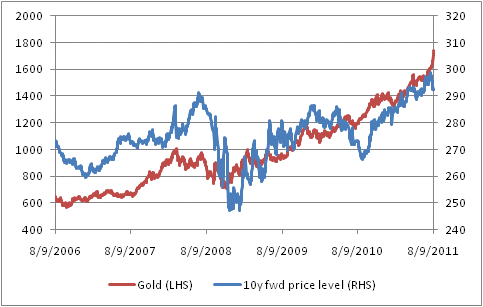
Gold tends to move with the forward price level through time (but with a beta above 1).
The next chart (Source: Bloomberg, Enduring Investments) shows the same time period but as a scatter plot. The forward price level is on the bottom and the gold price is on the left. I have fitted it with a 2nd-order polynomial curve, and I would suggest to you that it looks a lot like the stylized hockey-stick of a call option.
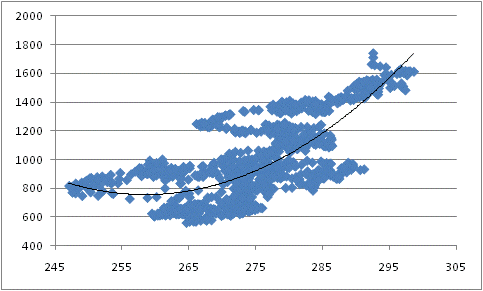
By golly, this DOES look a little like a call option.
Let’s rewind to 2008, when deflation fears were palpable. If the deflation put value of gold had been “in-the-money”, then gold should have been rising in price when the forward price level was falling. It didn’t. However, it did remain surprisingly stable, suggesting perhaps that we were near the “strike” where the call and put had similar ‘deltas.’
I think there may well be something to what the gold advocates say, in other words, about gold having a dual nature as store-of-value as well as inflation-hedge. However, with gold prices as high as they are, they are almost entirely a bet on inflation…at least, until they’ve fallen maybe $1000 first!
Now, I am an advocate for commodities in general, so I don’t mind having just the call option. I think that the case for higher inflation became stronger today when the Fed promised not to fight it for two years even though core inflation ex-housing is already on track to be at 3% by the end of the year. There is a reason that TIPS, as rich as they seem, still outperformed nominal bonds today. The “tail outcome” of much higher inflation, that depended on a blunder from the Fed to really have much value, just became much more plausible because we’ve gotten just exactly that blunder.
I want to sell bonds, but I am not so foolish as to do it yet. Within a few days, perhaps, but I don’t need to hit the high tick. I never got a chance to buy my small weight in equities today – the market never showed the weakness I needed. So I remain very long commodities and cash, and very little position in anything else.
It Won’t Go Down Forever
The worst possible thing that could happen to the stock market right now is a rapid bounce. A strong bounce would show that investors still don’t “get it” and are thinking the stock market is seriously undervalued and a quick buck can be made. In many ways, a quick bounce that would set up a worse decline later would be more damaging than another, bigger washout tomorrow that cleaned out everyone who was buying for a trade.
I covered the last of my put options this morning, and if the market trades lower tomorrow I will be buying. I will not be buying very much, because I don’t see the market as cheap. According to the model I use, the 10-year expected real return for stocks based on the current valuation is around 3.35%. That’s still pretty weak, except for the fact that real returns available other markets are even worse (10-year TIPS yield 0.15%). But at 3.35% real per annum, I’m not taking all the risk for no return as I was only a couple of weeks ago. Again, I will not be buying very much. I will probably buy one third of the allocation I consider personally neutral.
But there’s no hurry, and I may wait if the market looks like it has no bottom to it. I am acutely aware that the S&P fell 6.7% today, on higher volume still, two days after falling 4.8%. And any student of history will be acutely aware that the 20% stock market crash in 1987 didn’t come completely out of the blue but rather happened after the S&P had first fallen 3%, 2.4%, and 5.2% in the days before Black Monday. And the cumulative fall from the high, prior to the crash, was 14%. Right now, the S&P is down 16.9% from its high. I seriously doubt history will repeat that event, but I would be silly to be aggressively lifting offers while others still doubt less than I do.
And if I buy and there’s a quick bounce, I will probably sell. These valuations are not “attractive” in any historical sense of the word, especially with inflation coming. I believe we will get lower equity prices still, although not necessarily right away.
By the same token, I will not be rushing to sell bonds, although when this crisis has the first whiff of having passed, I will. Bonds are not only at levels not seen since the 2008 crisis, they are also at yields below the bottom of the long term bull market yield chart (see Chart – note this is on a monthly-close basis so technically there has been no violation yet) – even though I have long thought bonds had begun the next bear market. As I will argue below, there is nothing to suggest that bond yields have an equilibrium value anywhere near here, when inflation is heading higher and likely to accelerate. I continue to advocate commodity index positions as well, for similar reasons. They have less of an advantage today over equities than they did a few weeks ago, but with real yields this low commodities have historically been strong performers.
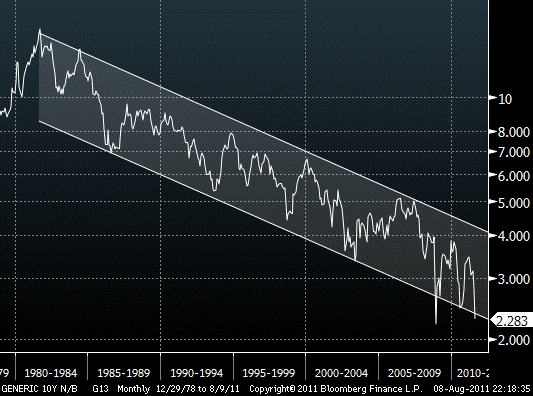
Long-term, logarithmic channel in 10-year note yields (monthly). Note last point is today.
Now, that’s what I have to say about strategy. I’ve put it first in this comment even though I usually leave it for last, because I suspect many readers may want to cut to the chase. But I guess the overriding message should be: be patient. This has been coming for a long time, and there is a lot of bearish work to do. At the same time, don’t crawl into a shell. Lower prices are great for long-term investors with cash. It’s okay to average in. You want to participate in the future growth of the economy, if you can do it at a fair price. If you’re a day trader? Well, buckle your seat belt, I guess. There is lots of volatility to come.
And that’s because this has only just begun.
Let’s be clear: the equity market selloff had nothing to do with the downgrade of the US credit rating. Bonds themselves rallied. The credit rating cut is not going to affect any haircuts, it seems – at least, various authorities that enforce haircuts (such as the FDIC) have come out and said as much. That was the big immediate risk from the downgrade. There are others, which I’ll mention later, but the market was not reacting to them.
This is somewhat tongue-in-cheek: Treasury Secretary Geithner told the Obama Administration over the weekend that he decided to stay on. Considering he is easily the worst Treasury Secretary since Paul O’Neill (the first secretary under George W Bush; he served two blessedly short years), that cannot be good for the market. As I said, that’s a little tongue-in-cheek. But just a little.
The troubles in Europe remain far more important to the market. Rumors have started to swirl about just which banks will fail. I don’t know which will fail. Maybe none of them will fail. (But many of them are insolvent, and we already knew that.) Meanwhile, it cannot build confidence, although it was meant to, that the ECB bought massive quantities of Italian and Spanish government bonds today, causing yields to fall on the order of 80bps. Nice trading, guys. When someone lifts every offer in sight rather than wait to see where the market clears, it’s not an economic buy. And it’s a sign of weakness. If there was real commitment behind the buying, the ECB would buy all the bonds offered at 6% (for example), then move the bid to 5.95% and buy all the bonds there, and so on – taking the time to make sure that the selling pressure at that level was exhausted first. By making a sloppy purchase, they’re trying to intimidate shorts. That almost never works. If you watch the equity tape, and you see the market go from 1100.20-.30 to 1101 bid with nothing trading in between, and then rapidly move up to 1103, it either means that someone entered a large market order stupidly or someone said “buy two thousand and make it sloppy.” Usually, the market comes back to test the buyer’s resolve. And I think that will happen this time, because putting the yields down doesn’t solve the fundamental problems that got the yields up in the first place.
And there is a more-fundamental question here to be asked of the ECB. If we’re not supposed to worry about Italy and Spain, why are you worried about Italy and Spain?
Commodities got smoked, with energy markets off 4-6%, Grains -2.4%, Livestock -1.2%, Softs -2.3%, and Industrial Metals -3.3%. Note that in each case, you’d still have rather held commodities than stocks! And, thanks to the sterling performance of the precious metals (+3.6%), the DJ-UBS Commodity index fell only 2%.
There’s clearly fear, and some optimistic bulls who bought on Friday were clearly being flushed today. I think this qualifies as panic (which doesn’t mean it is over, but that is a precondition to it being over). And at this hour, S&P futures are down another 26 points. A triple-digit S&P is not all that far away.
Tomorrow is the FOMC meeting, and not a moment too soon. I have held for some time that no QE3 was coming, and on the basis of the economy I think that’s the right read. However, the importance that Bernanke has attributed to the stock market’s level does make one wonder. But consider that the last two weeks’ trading, while it increases the calls in some quarters for QE3, also helps demonstrate the uselessness of QE2. The chart below demonstrates quite clearly that QE2 had essentially no lasting effecton stock market prices.
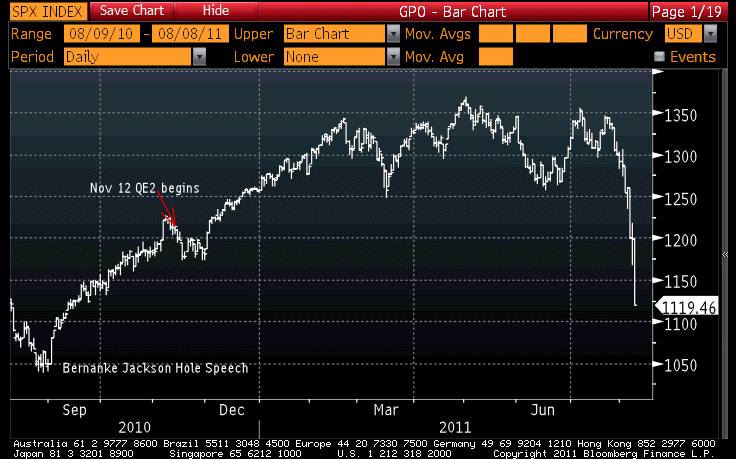
QE2 did basically nothing for equity prices. QED.
At the same time, commodity indices are still up 18-19% since the end of August (albeit roughly unchanged from November 12th). So QE2 either pushed prices higher, or had no lasting effect, on commodities prices too.
That proposition sounds amazing, until you remember that most of QE2 is still sitting in bank reserves and only a little bit has made it into transactional money, until recently. It isn’t supposed to affect anything while it is sitting in reserves, except bank funding ratios. This is why, if the Fed does anything – and let’s face it, if they do nothing the market will puke – I think the most aggressive action they are likely to take would be to eliminate the payment of Interest On Excess Reserves (IOER). Frankly, I’d advocate making it negative, but reducing it to get QE2 actually into circulation would be a reasonable first step. This is not to say that I am confident the Fed won’t announce another trillion in bond buys – only that such an announcement would be stupid.
Now, let’s talk about inflation. Commodities have recently suffered on growth concerns. TIPS are doing very well, though that’s partly because they are US government bonds. If the Fed wishes, they can talk themselves into believing that the slow growth we are experiencing could press inflation lower. It certainly will have that effect with headline inflation because of the decline in energy prices. It won’t affect core inflation, but the Fed models suggest it will (of course, the augmented Phillips Curve model and other models like the “threshold” model discussed here in a recent New York Fed piece http://www.newyorkfed.org/research/current_issues/ci17-3.pdf also predict that core should still be declining, so they’ve sort of seriously failed, but…) In any event, if the Fed wants to figure out how to ease, they’re not going to let core inflation below 2% impede them, regardless of whether it is currently rising or not. I will be interested to hear their new ideas.
But whether or not the Fed pursues QE3 or some other form of liquidity provision, it is now obvious that every other central bank will be adding liquidity. And the currency wars are about to begin. Here’s why: all politicians know the Keynesian equation C+I+G+(X-M). They all “know” that if they’re going to cut government spending (G) through austerity, then they must increase net exports (X-M). To do that, each country needs to weaken its currency, which is why Trichet last week made the comment about how a strong US dollar was in the world’s (except the US) best interest. The currency wars are going to have to happen. Now, economists should know that C+I+G+(X-M) is a static equilibrium for a single country, and not a prescription for the world’s nations collectively. Since my X is your M, global GDP is C+I+G. (And, frankly, that also is not a prescription since this period’s G affects future periods C+I, but let’s not worry about that wrinkle). However, and this is key, politicians are not re-elected by the world, and central bankers do not serve the world. They’re re-elected locally (or appointed, in the case of central bankers), and we’re going to have currency/devaluation wars.
And that means global inflation is going to be going up further. The way one weakens one’s currency is to print a lot of it, so there are plenty of Euros (for example) relative to dollars. Or yen. But the best way to fight back is for the producers of dollars, or yen, or whatever to print more of their currency, and so on. The only winners here are debtors and commodities producers.
Is it the only way out? Must we have currency wars? Of course not; I just think it is the most-likely future path over the next year or two. And I could well be wrong. But inflation is already rising and I don’t see it stopping; and this is the reason I’ll look to finally sell bonds soon.
Now, while we’re still worrying about Europe, and the FOMC, and currency wars, there are some concerns related to the US credit downgrade that we need to keep in mind. Yes, no one will sell US Treasuries because of the downgrade. But Fannie Mae and Freddie Mac were downgraded by S&P today, since they were only AAA because of the government’s backing. This is actually defensible, since there is no law saying the Treasury must backstop these entities. Will investors sell agency paper that is no longer AAA? What about munis, which will also presumably have trouble maintaining top ratings higher than the sovereign rating? That’s where you could get some pretty ugly performance.
Ironically, that would be salutary for Treasuries themselves, since the obvious trade is from agencies back into Treasuries. What else are you going to buy? Bank paper?
There are worse times ahead – for the global economy. The 2008 crisis was not allowed to serve its function by purging the imbalances, and now there is further purging to come. But the good news for domestic investors is that US banks are relatively less-exposed than they were prior to 2008. The global financial markets are interconnected, to be sure, but the banking system is now adequately liquefied (if not necessarily adequately capitalized for an event of this magnitude), and the Federal Reserve if nothing else learned in 2008 what sorts of policies actually help and which do not. Just as soldiers are readier for their second battle than for their first, the Fed is more-prepared to do something useful if the crisis starts lapping more seriously here (and I don’t mean stocks going down, I mean financial stability). There isn’t a lot of market-related competence at the Fed, but even they learn. We have a period of slow growth and inflation ahead of us, but I don’t think the financial system is seriously at risk this time.
Still, if you are a CFO and your company has credit lines that are not guaranteed, consider drawing them down. Paying a little bit of interest to preserve that liquidity beats the heck out of seeing them pulled in a repeat of 2008, right?
Fear and Longing
Stocks avoided diving further on Friday – but at the same time, there was no overnight bounce to speak of going into the day. That was pretty chilling after the waterfall decline on Thursday, and really speaks to how much fear is growing. Ordinarily, after such a decline the “bargain hunters” will swoop in and push prices up at least a little bit, but there wasn’t much of that going on.
The Employment number helped a little (or at least it didn’t throw fuel on the fire). Payrolls came in ahead of expectations, which I thought would happen. The number was 117k new jobs with upward revisions of 56k to the prior two months, which means we essentially had double the jobs that were expected. The Unemployment Rate dropped to 9.1%, which I didn’texpect, but that happened because the jobless continue to leave the labor force. The Labor Force Participation Rate fell 0.2% to 63.9% (see Chart), easily the most-depressing part of the whole report. One economist calculated that if the participation rate hadn’t declined, the Unemployment Rate would have risen to 9.3% even with the upward surprise in the Payrolls number.

I'm sorry to run this chart every month, but it's an amazingly negative secular trend...as well as being somewhat hypnotic.
On the other hand, average hourly earnings rose more briskly, at +0.4% compared to expectations of +0.2%. Since wages don’t push inflation, this is better thought of as an increase in real income (although there will be plenty of people who worry more about inflation because of this figure. There are reasons to worry about inflation; I just don’t think this is one of them). It is only one month’s worth of data, though, and it’s hard to get that excited about it.
The data surprisingly didn’t do much to bonds, which were already somewhat weak, but helped equities. Stocks bounced higher on the open, for about five minutes before the rout was on again. I had thought that people would sell into the bounce, and indeed they did. Until noon, the prospects for the market were looking ugly. By lunchtime the Dow was down another 200 points and looking somewhat sickly. Bonds, surprisingly, were not rallying on the further equity decline.
And then, finally, there was a pulse. In fact, the market came all the way back and actually traded higher until, with both buyers and sellers exhausted, stocks closed basically unchanged. Bonds, however, never recovered from the beating they took in the morning and upon the stock market’s rebound. The 10y yield rose 14bps to 2.55% with the 10y TIPS yield +11bps to 0.31%.
I say there was fear, rather than panic. While the blood pressures were certainly rising when stocks were skidding (this is one of the only reasons I’ll turn on financial news networks during the day: to assess how stressed the reporters and guests are), no one was pleading for calm. Instead, they were admonishing investors to buy. That’s very different. In a crash, you will hear authorities telling people to relax but you will never hear them telling people to plunge into the market. Instead, there were people like Barton Biggs, who calling into CNBC said “I can’t get bearish here.” He pointed out that a collapse of the global economy is unlikely, about which point I agree. But he errs when he supposes that the alternative is a bull market. Stocks are priced for strong growth at record margins, and if we merely get weak growth or margin compression, they are overpriced.
This is an error that many analysts are making right now. When you hear people say that stocks are cheap, they are typically using some form of the Fed model, or an understanding of market pricing based on similar philosophy. The Fed model basically says this: because stocks are more or less perpetual bonds with small coupons (dividends) that rise over time, when interest rates are low it implies a higher fair value for stocks just like low interest rates imply higher bond prices.
As far as it goes, that is true. Low interest rates are explanatory for the level of the stock market. But as Cliff Asness pointed out a long time ago (and so did I, but I wasn’t running tens of billions of dollars for AQR), explaining the current level of the stock market and saying it is fair relative to interest rates is not the same as forecasting an average future return to equities.
Stocks, in fact, work much like bonds in this respect. When interest rates are very low, are bonds overvalued or undervalued relative to interest rates? Well, by definition (since the price of a bond is merely the known future coupons discounted at the yield to maturity), bonds are always “fair” relative to interest rates. But that’s trivial! The question is, when are bonds likely to have a higher future return – when interest rates are at 10%, or when interest rates are at 2%? Obviously, it is when interest rates are high, partly because the income stream is larger but also partly because when interest rates are high, it is more likely that they will fall than when interest rates are low already.
And so it is with equities. When interest rates are low, then naïvely you can say “they’re valued fairly.” But that’s answering the wrong question. We don’t really want to know how stocks are going to perform relative to bonds, but whether stocks are going to perform well outright. And it turns out that the answer is very clear: when interest rates and inflation are low, stocks tend to have higher valuations (as the Fed model suggests they should). But this also means that the expected future returns to equities are very poor when the starting point is a period of low interest rates.
Are stocks fair with interest rates at 2.5%? Well, maybe; they might even be cheap to where stocks typically are given those interest rates. So as long as interest rates stay very low, stocks might be fair or cheap. But if interest rates move to 4.5%, they are expensive, and quite so. And frankly, without another credit crisis I think it is far more likely that interest rates move to 4.5% or higher than that they will stay this low.
Now, technically speaking it isn’t a huge win that the stock market finished unchanged, because volume was extremely heavy. More than 2.1 billion shares changed hands on the NYSE, and even though the S&P was unchanged the declining stocks outnumbered advancing stocks by a 2:1 margin. You want to see selling pressure ebb if you think we are reaching an extreme, but building volume at this level implies price acceptance – that is, both buyers and sellers are content with this price, and that suggests a big rebound is not soon in the cards. On the other hand, the VIX didn’t decline at all despite the fact that the Employment data is now past, so there is still plenty of fear. It’s just not panic.
It seems clear that we have now entered a new phase of the crisis, although if you like you can call this a new crisis. To me, the sovereign debt crisis has its seeds in the stresses of 2007-09, but it’s an academic point. One way that this new crisis is less-threatening than the last is that there is less leverage in the system now than there was. To be sure, there isn’t dramatically less leverage, because the Federal Reserve worked very hard to keep leverage from declining markedly in the financial markets and households haven’t had the wherewithal to reduce leverage. But there is somewhat less leverage and probably significantly less that is off-balance-sheet.
On the other hand, one way that this new crisis is more threatening is that trigger fingers are faster this time. In 2008, it took a long drumbeat of bad news before institutions went into their shells and the real panic part of the crisis began. But the 2008 crisis started, after all, in 2007 when the mortgage market began to fall apart. It claimed a major firm in March of 2008. But it wasn’t in full-fledged panic mode until the summer of 2008 – no one really believed that such a thing was possible, and no one had seen it. But now, bank risk managers are much more likely to take cataclysmic outcomes into consideration, and that will affect risk budgets…and, in turn, market liquidity. That liquidity could vanish far more quickly this time. (On the third hand, regulators are much more attuned to that possibility and I am sure are working the phones much more diligently this time around to head off any market seize-up).
But make no mistake, we have entered a new phase of this crisis, and one which could claim a major bank and has a fair chance of sundering the Euro before it is all over. Traders have suddenly come to grips with the possibility that nominal interest rates are starting to become negative (as Wells Fargo is now charging interest to hold deposits), and the trade du jour on Friday was 100,000 June Eurodollar 100.00 strike calls. Those options will only be in the money if Libor on the settlement date is negative. After buying 100k of these calls (that’s $100bln of notional), the buyer bid for another 500,000 but ended up pulling the bid when he found no interest. I am not at all amazed that someone was willing to buy these calls. I am amazed that someone would sell them. The upside for the seller is ¼ of 1 basis point, or $625,000 for the entire hundred-billion-dollar notional. What’s the downside? 25bps? 50bps? Who knows where rates could go once they start to trade negative. That’s a dumb risk to take.
Friday’s trading also saw the dollar index trade back 1% or so, and commodities slide -0.7%. Gasoline actually rallied 2.4%, but industrial metals fell -3.7% and precious metals were off -1.1% as well. As the crisis spreads, I would not be surprised to see commodities fall further but I will be a buyer on weakness…eventually!
But the best was yet to come when we went home on Friday. The good people at S&P chose to announce their downgrade of the United States’ long-term credit rating (to AA+ from AAA: a single notch) at around 8pm on Friday. That is borderline criminal – to make such a huge announcement when market participants cannot react to it is likely to make the initial reaction worse. I still don’t think the downgrade is particularly important, and shouldn’t change the function of the Treasury market at all. But it was clearly released in a manner designed to get the most attention from the weekend news cycle.
Ironically, if the market doesn’t overreact to the news, it may give some investors a reason to hope and a little more courage to buy. This was clearly a Sword of Damocles over the market’s head, and it is now released. If investors act like grownups who understand the significance of the downgrade (essentially, none), then it might help the market slide sideways to higher over coming days. However, it is hard to declare that we’ve seen the worst from the market when there has not yet been a panicky washout. In my view, the best approach here is to husband one’s resources. There is no reason to worry about “missing the rally back.” It’s more important to try to miss the schuss lower.
Same Song, Second Verse…A Little Bit Louder And…
Well, needless to say there is a lot to cover today.
The overnight session held a lot of intrigue. Japan intervened in its currency markets to push down the yen. It seems like everyone wants their currency lower! Trichet even said (at his press conference, of which more in a minute) that a strong dollar is in the world’s best interest. Well, perhaps it is in the interest of the world-ex-US, since it helps all those other countries export to the U.S., but it doesn’t make sense to say that having any single currency strong is in the world’s collective best interest. Currencies are just a way of trading real goods, and they are zero sum. If the supplier wins, then the buyer loses, and vice-versa.
One way to have a weak currency is to flood the world with that currency. That’s what the Swiss National Bank started to try to do the other day, after all. Of course, if everyone starts trying to do it, then there’s no telling what will happen to relative currency values. That will depend on who “wins” the currency war. What we do know is that consumers worldwide will lose, as will lenders at the expense of debtors, when the increased stock of money is worth less in terms of real goods.
The Bank of England and the ECB both kept rates unchanged at their policy meetings today, which was no surprise. But ECB über-banker Trichet said that the ECB will conduct liquidity-providing LTROs (“Longer-Term Refinancing Operations”) for 6 month terms and MROs (“Main Refinancing Operations”) “as long as needed.” In a nutshell: they’re adding more liquidity. They’re easing. According to Trichet, they are going to keep monitoring inflation “very closely” since the risks to the inflation outlook “remain on the upside.” Well, that’s very prudent, Jean-Claude. Oh, and in the meantime the ECB said they’d be buying bonds, and immediately started buying Irish and Portuguese bonds.
U.S. stocks rallied on that news, which turned out to be one of the worst trading decisions, for those buyers, of the year. And it didn’t make sense, either: flushing cash into the system, causing inflation to solve otherwise-catastrophic problems, isn’t inherently bullish! Nor is buying the bonds of already-bailed-out countries when there are others at risk!
Trichet also continued his recent crazy-man routine by saying that “banks with limited market access must boost capital.” Uh, what? How do you boost capital if you can’t get to the market? Steal it?
Irish bonds did great, rallying 23bps on the day. Portuguese bonds were unchanged. Italian bonds fell, pushing 10-year yields to new highs. Spanish bonds fell too, despite the fact that Italian and Spanish central bankers were buying their own bonds. However, these markets are too big for the ECB to do much with at the moment, so Irish and Portuguese bonds will just have to do!
Speaking of bond purchases, the Wall Street Journal had a story quoting “former top Fed officials” (Kohn, Reinhart, and Madigan) as suggesting the Fed ought to consider QE3. But the headline didn’t quite get the spirit of the story, which in any case was citing former Fed officials. Here is Kohn, from the article:
Mr. Kohn, who rose to become Fed Board vice chairman before retiring from the central bank in September 2010, said its options to support the economy are “kind of limited.” But if inflation comes down and the economy doesn’t pick up, he said he would give “very serious consideration” to a new round of bond purchases.
So a couple of guys said that if inflation comes down and the economy doesn’t pick up, the Fed should consider QE3. I suppose I can’t disagree with the proposition that the Fed should consider alternatives. Of course, inflation is not going to come down; rising core inflation is baked in the cake for quite a while ahead now. And considering QE3 (in light of the fact that QE2 didn’t work) shouldn’t take long. The only reasons to pursue QE3 are political: that is, the Fed needs to be seen to be doing something even if there’s nothing useful to do. Now, if I were around the table and wanted to help, the first thing I would do before adding another trillion in reserves that has no impact on anything would be to lower IOER and get the existing reserves into M2! I understand why they don’t want to do that, but it’s madness to buy more bonds when the money you injected the first time is still sitting in bank vaults because you’re paying banks to keep them there. Madness, I say.
The reason the Fed doesn’t want to lower the interest they pay on excess reserves (IOER) is that they believe (and have said so publicly) that it would seriously hurt the money fund industry. But I can’t figure out why the government should subsidize higher real rates for savers when in fact you want deeply negative real rates for the economy (in theory, anyway). If the government will support a +0.25% rate when -0.75% is the appropriate rate for the economy, for example, then why wouldn’t they in an analogous situation try to hold money market yields at 5% when the market wants them at 4%? It’s the same difference. It isn’t like the money fund industry would vanish if IOER went to zero. They’d adapt. I can easily think of a couple of alternative money fund structures that would work even if there wasn’t a ~25bps floor on rates. Trust markets. Look, some banks are starting to pay negative interest rates on savings, as this story about BNY-Mellon illustrates. IOER is too high.
So the market hung on after trading a little bit up overnight, then a little bit down, then up on the ECB press conference and the as-expected Initial Claims data. Then it went down, and kept going down, even when some investors made sloppy purchases in size to try and scare the shorts a couple of times during the day. But it didn’t work, because the selling wasn’t coming from new shorts but rather from old longs.
Volume on the day was huge – the biggest non-expiration day since the flash crash, I think. The S&P ended the day down -4.8%, closing at 1200.07. The Dow lost 513 points. Where is the guy who was on my case for being bearish and wrong on the S&P since 1100 last year? I hope he got out a couple weeks ago. This is what I have been saying the whole time – it isn’t that the market must go down; it’s just that the risks of this sort of event made being long a dangerous gamble. The odds were against you, if you were long at high valuations in a rickety global economy; that didn’t mean the market couldn’t keep rallying but it meant there was always a chance that you’d roll snake-eyes.
Bonds rallied, hard. The 10y yield plunged 20bps to 2.42%, only a few basis points shy of last October’s low yield. TIPS were offered early, but recovered and actually did quite well. The 10-year TIPS yield fell 14bps to 0.21%, another all-time low. If you want to think about how bad the current situation is, don’t look at nominal bond yields. They got lower during the financial crisis of 2008 (as distinct from the financial crisis of 2011), but that was when inflation was in the process of coming down and there was reason to expect it to do so. Inflation now is going up, so longer-term real yields– which represent the cost of money – are much lower now. The chart below shows that 10-year real rates (abstracting from the absolute teeth of the crisis when TIPS were treated like corporate structured notes instead of US Treasuries) are much lower now than they were back then.

Real yields are much lower than they were in the first crisis. This shows increasing fear about the future growth rate.
So investors see the long-term outlook as dim for the economy, and in fact are more morose than they were at the equity market’s bottom in 2009. In that context, equities today are still pricing in much more robust long-term growth than the bond market is seeing. Both of these markets are probably too high.
Because TIPS mostly kept pace with nominal bonds, measures of long-term inflation expectations fell only a little bit. And that makes perfect sense, when the world’s central banks are now all printing in unison. TIPS are too expensive, but relative to nominal bonds? They’re actually probably a better deal!
The short end of the TIPS curve, on the other hand, was savaged. For some while, the 1-year inflation swap has been under pressure. When it was pricing nearly 3% and energy markets were forecasting very little energy inflation, it was plainly too high. As of today, 1-year inflation swaps are marked at 0.88% (plus or minus…it was a dicey close), and since energy markets are pricing in mild declines in prices over the next year, that equates to a core CPI rate over the next year of about 1% (see Chart). But core CPI is currently 1.6% and rising – so 1-year CPI swaps are too low (or forward gasoline prices, too high).

The sharp drop in implied inflation at the front of the curve is overdone, or at least ahead of the energy markets.
Personally, I am thinking swaps are low rather than gasoline prices too high. Although commodities fell today (about 2.8% overall, energies much worse), and the headline read “Commodities erase gain for 2011 as faltering economy may curb consumption,” there are two points I would make. (1) A declining stock market is not a faltering economy. Yes, the economy is faltering but it’s not plunging. Some amount of what we’re seeing in stocks is just them coming back to more-rational valuations especially considering the economic landscape as it already is. (2) Regular readers of this column know that the supply/demand argument takes a back seat if the world is awash in cash. In that case, the exchange rate between stuff and money is far more important than the equilibrium supply and demand for a particular good. Why did commodities rally in the second part of last year? Was it because the economy was booming? Well, no…the economy wasn’t booming, and we knew that. Commodities rallied last year because the amount of money in circulation was rising and was expected to continue to do so for a while.
What are the prospects for that happening again? Well, M2 was released today and showed another hefty gain. The 52-week rise is now +8.1%; the pace is +11% annualized over the last 26 weeks. If deltaM+deltaV≡deltaP+deltaQ (the first-difference form of the crude quantity of money equation), and deltaM is +8% while deltaQ is +2% (to be generous), then we had better hope velocity is declining or…prices are going up.
.
While I thought (and still think) that stocks were (and are) overvalued relative to historical earnings as well as considering the economic prospects, the move today is clearly a (market) liquidity event. The fact that commodities declined even though the actions of central banks would argue for a movement in the other direction is one clue. The fact that it is August is another clue. The VIX rose to a post-flash-crash high, but is not near the flash-crash highs nor anywhere near the 2008 highs, so it is hard to say we have reached a crescendo of selling as gut-wrenching as today’s action was. There may, in fact, not ever be a crescendo. But with liquidity poor the possibility is there, and the question is whether you want to allocate your liquidity – the cash balances you have been holding in reserve for so long – to equities or commodities or whatever investment you love – at these levels or wait for a true panicky wash-out. Buying those assets now is catching a falling knife and it’s a much better strategy to wait until the knife hits and then pick it up off the floor. It would show great courage to buy stocks here. Leave the courage to the other guy. The first guy through the door is the one who is most likely to get shot.
With vols rising so dramatically and the price action so extreme, I covered all but 20% of my equity puts in the last 20 minutes of trading today. The prices hadn’t quite made it to my target but the uncertainty is too great and the implied vols are now high enough that it is no longer an efficient way to take that position. I am not sure what will come tomorrow, but if stocks decline just a little bit, or certainly if they rally, volatilities may drop quickly and so I have too many ways to lose. I should have covered the entire position, for while I am still bearish the odds are obviously no longer as much in my favor now. That was an error that fortunately can no longer cost me too much.
.
Tomorrow is actually Employment Friday, the most volatile day of the month (ha!). The consensus estimates have Payrolls at +85k versus only +18k last month, and the unemployment rate steady at 9.2%. I think there is room for upside on the Unemployment Rate, but the Payrolls guesses seem conservative enough especially since the +18k last month was likely an aberration that I expect to see revised a little higher. The markets could use an upbeat surprise on Employment, although I think it wouldn’t have a lasting impact since there are plenty of trapped longs who will probably sell into a rally. I suspect they may get a mild surprise in that way. But the risk is still skewed to lower equity prices and probably still-higher bond prices until the Fed bats down the notion of QE3. However if, Heaven forbid, a negative Payrolls number prints, this “second verse” could get a little louder and, as the old song goes, a whole lot worse.
Let’s hope not. As a young-middle-aged investor, I want lower prices during my accumulation years and higher prices later, when I am divesting – but I don’t want them lower all at once!
Reprieve…’Til Dawn
The Bank of England meets tomorrow morning, with rates already sitting at 0.50%. The ECB also meets, with the policy rate at 1.50%. Today, the Swiss National Bank got a jump on both of those bodies by cutting the National Bank Libor target from 0.25% to “as close to zero as possible” (sub-zero rates are possible, but policymakers usually ignore the messy reality that conflicts with theory), and also increased the amount of reserves independently from the rate move.
This move was undertaken partially to weaken the Swiss Franc, which as a safe-haven currency has been screaming higher against both the Euro and the dollar. It worked – slightly. What’s 25bps compared to the prospect of losing everything? So the Swissy bounced, but as the chart below shows it was less than impressive.
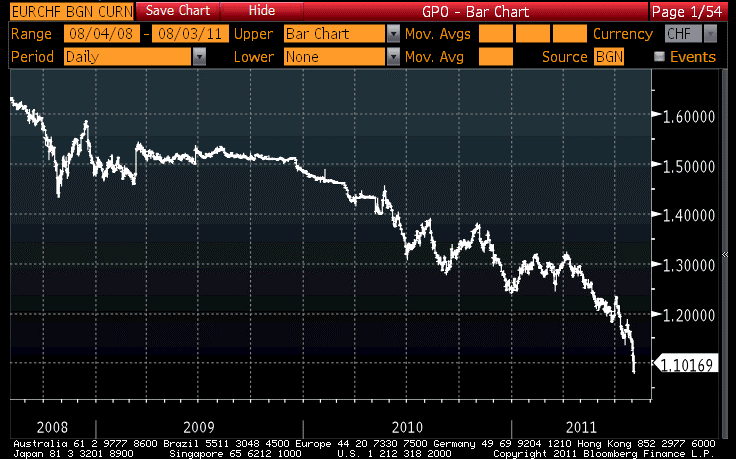
The Swiss National Bank ease caused a tiny bounce in Euro/Swiss.
Incidentally, I wasn’t kidding about sub-zero rates. When the alternative is a large capital loss, investors will willingly accept negative rates. In the credit crisis, T-Bill rates went negative partly because large investors who were not covered by FDIC insurance preferred to own bills at negative rates rather than risk losing money in bank depository accounts. The SNB could offer negative interest rates (you pay us to keep your money here) and money would still flow into the franc. And it should do so.
It’s hard to believe that the ECB has recently been in tightening mode, but indeed at the very last meeting that august body (which probably had a very different feel from the body this August) actually hiked rates. I screamed and kicked my feet in July when they did so, protesting (in one of my favorite recent passages):
“However, a worrier doesn’t have to look very far to find worries (and a bull doesn’t have to look very far to find a wall to climb). Rate hikes into a sovereign debt crisis would be a good place to start, although at the same time the ECB suspended its minimum credit-rating requirements for Portugal so it is strangely being both tight and loose at the same time.
“The general loss of ECB credibility could be a worry, although to me the whole institutionalized crazy routine makes me think more of the scene in Blazing Saddles where the sheriff pretends to be taken hostage by his own split personality, in order to manipulate the crowd. I don’t think the manipulation routine in this case is working very well, but I just prefer to believe that over the alternative that Trichet has simply gone mad. Today he insisted that the Irish government, which recently has threatened to force senior bondholders in the country’s banks to take losses as a way of ‘sharing the burden,’ should instead respect prior agreements. “All the plan, nothing but the plan including all what has been said at the time of the approval of the plan,” quoth Trichet expansively, apparently numb to the dramatic irony of demanding utter fidelity to precedent on one hand while rewriting collateral guidelines with the other hand.”
I can hardly imagine that the ECB would seriously consider hiking rates again, although it is true that they can raise rates all they want if they splash the world with liquidity at the same time. But the ECB has already demonstrated a certain … how do you say … sangfroid? A misplaced and dangerous sangfroid, indeed, but style counts for something, right?
Assuming that the ECB joins the SNB, BOJ, BOE, and Fed back in the easy-money fold, it has implications for inflation even if it has scant implications for the deferral of the crisis. Inflation, after all, doesn’t just come from the Fed. It comes significantly from the existence of too much money globally. Much of domestic inflation in the U.S., the U.K., Europe, or any of the major connected countries is sourced from these global factors. Only the ECB hasn’t been blatantly easing recently (and even there I guess it is hard to argue it is being terribly tight since after all it is lending money against Greek debt and baseball card collections).
Here’s an interesting note for U.S. readers who may have been myopically focused on the debt ceiling negotiations. Notes from dealers in Europe today described in various ways the “extreme risk aversion” that is starting to take place. I can’t describe anything we have seen here in the U.S. as “extreme risk aversion” (a 7% equity selloff, even concentrated in 2 weeks, doesn’t exactly qualify as “extreme” anything). On these shores, at least for those of us not working directly for a Wall Street bank, we don’t yet get the growing sense of panic over there.
But it is beginning to be felt. The chart below shows 1-month LIBOR marks. Notice that the scale tends to exaggerate the move, which has only been so far a couple of basis points – but it is a turn higher and something to keep an eye on.
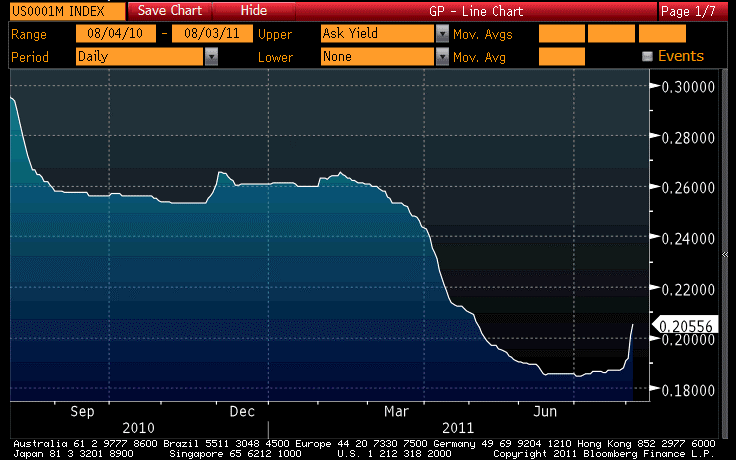
One-month LIBOR may be on the move, signaling funding pressure growing in the U.S.
Volume is also sometimes a measure of stress. Today’s equity volume was again heavy (by 2011 standards). Actually, it was heavier than yesterday’s, although that is largely because of the trading before lunchtime when the S&P had broken through important support on a surge in volume. Equities managed an 0.50% gain, and nominal bonds were unchanged.
There was talk that equities rallied because the Fed might be considering QE3. But TIPS and commodities were both weaker, TIPS significantly so as 2-year TIPS yields rose 18bps and 10-year TIPS yields rose 9bps to 0.35%. Thus, the talk that the market rallied because the Fed might do QE3 sounds hollow to me – if investors thought the Fed was readying QE3, wouldn’t commodities and TIPS improve? So I’m skeptical (quite aside from the improbability of a meaningful QE3). I think the equity bounce is just that: a bounce.
The data today, in fact, was less than a disaster. It wasn’t great, to be sure, but the ADP figure was a teensy bit above expectations at +114k and while the ISM Non-Manufacturing number slipped to 52.7 from 53.3, that wasn’t nearly as bad as the Manufacturing ISM on Monday. It’s not like we’re out of the woods, but after doing significant technical damage this morning on heavy volume it isn’t a shock to me to see a lower-volume bounce.
But the technical damage is significant. While I covered about 40% of my short positions (long put options) today, I expect to see lower equity prices in the near future. A weak Initial Claims figure tomorrow (Consensus: 405k from 398k) could be the catalyst, since traders tend to exaggerate the Claims figure that comes out right before Employment. But the piper is still calling the tune from Europe, and with two monetary policymaker meetings scheduled the tone for trading is more likely to be set before the New York open.
A Slightly Longer Fuse
I think it was Billy Joel who said something like “you can’t trade trashy until you spend a lot of money.”
Today, the Congress finished inserting a longer fuse into the bomb, and it seems that whatever relief rally we were due on the deal was experienced during a five-minute period on Monday. Coming into today, stocks were a little weak in the U.S. and abroad, but bonds continued to be very strong. There is something more going on here than the debt-ceiling deal, and it is the increasingly-sketchy funding markets in Europe.
As I noted yesterday, as attention moves away from the debt-ceiling debate it moves back towards Europe, and the news there is not good. Italian yields reached new highs again today, along with 10bp selloffs in Spain, Greece, Portugal, and Hungary. Spain’s 10-year yield is about to join Italy’s at new highs above the July spike highs. Another ECB meeting is scheduled for Thursday, but no one expects anything out of the European central bank other than (hopefully) a decision to stop tightening into an economic crisis. When the history of the European Union experiment is written some day, I hope there is a whole chapter on the flaky behavior of the ECB.
Global growth is simply slowing everywhere, even as inflation fears rise. The latest reminder of that in the U.S. was today’s Personal Income and Spending data, which surprised on the downside. Spending contracted in June for the first time since early 2009 (with the exception of a brief spike-and-reverse around the cash-for-clunkers program). A small bounce higher in auto sales, which were released throughout the day today, lessened the impact of that discouraging news but the tenor of the data continues to depress. The chart below shows the Citigroup Economic Surprise Index. What is amazing about this chart is not the level of the index, which shows that there has been a long run of significantly negative surprises – the worst such run since 2008 – but the amount of time the index has stayed low. Ordinarily, after data comes in lower than forecast for a while economists tend to overadjust and to be surprised the other way. The fact that this index has hardly bounced at all signifies that either economists are staying uncharacteristically un-dismal (perhaps because they attribute the misses to the Japanese tsunami or some other passing factor) or that the data is getting worse faster than economists can get dismal.
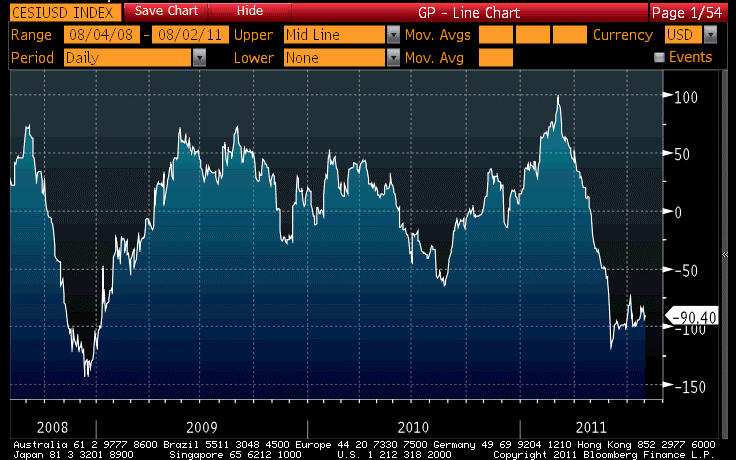
Economists have been too optimistic for quite a while now.
Bonds are receiving inflows from money market investors who have been hearing that their funds are invested in European bank paper. They are receiving inflows from global investors seeking safety from the implosion in Europe or by bond managers who are benchmarked against global indices and trying to underweight the sick countries (which admittedly is a shades-of-gray exercise at the moment). They are receiving inflows from momentum investors, from fundamental investors who are tracking the downward revisions in growth expectations (TIPS yields fell again today, although only 6bps at the 10y point to 0.26%). And they are receiving inflows from equity investors.
Stocks plummeted today, erasing the balance of the year’s gains (the S&P was -2.56%) and posting the lowest closing level of the year at 1254.05. The S&P pierced the 200-day moving average and the long uptrend-line convincingly (if you didn’t see yesterday’s comment with the S&P charts in it, you can find it here. If you want to get the comment in your email every day, when it is first posted rather than when it is syndicated, be sure to sign up on that site). The market broke the “neckline” of the widely-watched “head and shoulders” pattern, and fell below the June low. There’s really only one important support level left, and that’s the year’s low prints at 1249 – a mere 5 points away.
Volume was heavy, by 2011 standards, clocking the heaviest numbers (other than at a month-end or triple-witching, when there is a lot of artificial volume) since March. Declining stocks on the NYSE outnumbered advancers by a disturbing 14.8:1.
The only rallies of the day happened when investors began to talk about “what the Fed might do.” For example, Bloomberg ran a story entitled, “Fed May Weigh More Stimulus on Flagging Recovery Signs.” That’s amazing. Are we so accustomed to the Fed riding to the rescue that we expect them to add additional stimulus just because growth is a little slow and stocks are unchanged on the year? (Especially since the last stimulus was ineffective except for increasing prices?) If stocks mount a rally on that chimera, then selling into the FOMC meeting will be very easy. There is nothing more coming from the Fed, folks, unless a systemically-important bank fails or some other huge calamity threatens.
But frankly, I don’t think the market will be able to mount a rally on that.
I must admit, with shame, that on days like today I turn on CNBC just for the entertainment value of watching the pundits explain the market action without using the terms “overvalued,” “recession,” or “bear market.” The lunch hour is especially enjoyable because they get lots of people on the program to talk about how they’re “playing” the market. I was tickled today when a strategist from Raymond James called stocks “deeply oversold.” That’s deeply oversold, seven trading days from being near 1350 and close to the year’s highs. If he means oversold on a day-trading time frame, then I guess he might be right but retail investors watching the show probably shouldn’t care. If he means oversold on a medium-term time frame, then he’s just crazy.
One of the CNBC guys said “I am buying. Being a bit of a contrarian here.” Again we have some linguistic imprecision. I suspect he thinks that buying when the market is going down makes him a contrarian, but if he means what he says in the true sense of being a contrarian – buying when everyone else is bearish – then he is simply delusional. Equity markets are not falling because everyone is bearish, but rather because almost no one was bearish, and now some of those people are deciding they should pull in their bull horns. When everyone is bearish, the market will also be cheap and not sporting a Shiller P/E of 21.2!
Of course, maybe the market is going down for the reason that Bill Griffeth, I assume in jest, suggested. “Maybe,” said Bill, “Wall Street is sending a message to Washington.” Does he really think Wall Street has that kind of power? Does he really think that Wall Street would evaporate billions of dollars of wealth to “send a message?” Hey, this is America. When Wall Street wants to send a message to Washington, they write a check and put the message in the “memo” field.
All in good fun. I recognize that it is hard to fill the programming day with good content, which is why I am going to reach out to my old media contacts soon and see if they want some good content.
Not all of the news today was bad. (In fact, the market reaction was really out of step with the amount of bad news there was, out of Europe and in the Personal Income report. I think it is an overstretched rubber band that is just pulling back). After the debt-limit deal was signed, Fitch expressed the opinion that, essentially, this represents a good first step and if further cuts follow in the near future there may not be a downgrade of the U.S. credit. Two weeks ago, that would have been worth a 200-Dow-point rally.
On Wednesday, the ADP number (Consensus: 100k from 157k) and the ISM Non-Manufacturing Report (Consensus: 53.5 from 53.3) are both due to be released. Last month, the 157k figure from ADP was viewed as a high surprise, but there’s a decent chance of another surprise in that direction. The current level of Claims, while a very coarse indicator, would be consistent with a 160-175k print. To be sure, there are lots of other indications that the jobs market is weak, and just two months ago ADP showed a +36k, but I think we may start the day with some sunny news
I just don’t think it will be enough.
No Engine Left
The overnight equity-market rally lasted a full three minutes into the trading day before investors began the sell-the-news trade following the generally-expected pop on news that a debt ceiling deal was virtually passed. Although at this hour the bill has still not passed either house of Congress, but it seems likely that this bill (which no one seems to really want) will be making the trip to the White House for the President’s signature shortly. The three minutes of rah-rah seemed sufficient, and stocks were already back to nearly unchanged – and bonds, rallying again – when the ISM Manufacturing figure printed 50.9, rather substantially below the 54.5 expectation and the lowest number since 2009.
The manufacturing sector is clearly at “stall speed;” the current level of the ISM index (see Chart) is roughly where the index was in 2007 and early 2008 just before the early stages of the recession helped trigger the mortgage/credit crisis. (The ISM itself says 41.2 is the dividing line between growth and recession, but that’s not the same thing. An economy limping along at 1% growth is vulnerable to a shock.) Past is not prologue necessarily, but there is no doubt that the economy is just barely limping along trillions of dollars later.
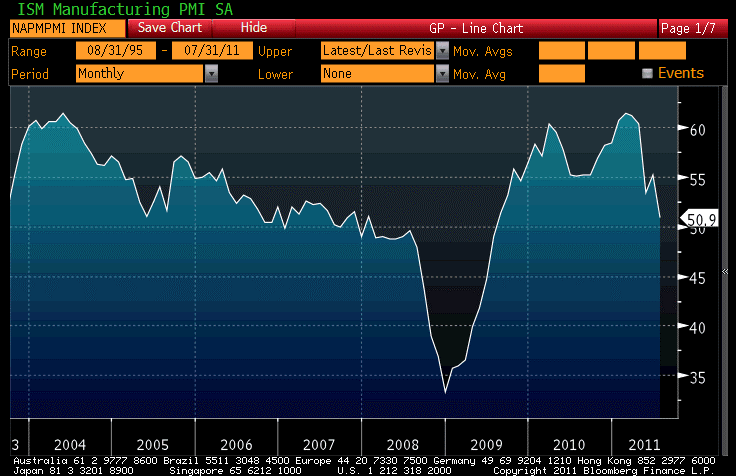
Stall speed.
The breakdown of the ISM was no more promising than the headline number. Every activity component fell: New Orders to 49.2 from 51.6, Production to 52.3 from 54.5, Inventories to 49.3 from 54.1, Order Backlogs to 45.0 from 49.0, and the important Employment subindex slipped to 53.5 from 59.9. This last point, combined with the continued buoyancy of the “Jobs Hard To Get” subindex of Consumer Confidence, suggests strongly that the Unemployment Rate might rise still further from the 9.2% reported last month.
There was not much further news, but volume was actually decent by 2011 standards. The VIX index slipped, although it remained fairly high. Stocks, which had spiked lower after ISM and then bled to new lows, bounced off a long trendline (see Chart) and staged an afternoon rally. The agenda of buyers was fairly clear – the 200-day moving average (also shown on the chart, currently at 1285.41) is a widely-followed indicator and a close of the S&P below that level would trigger a flip in some of the momentum crowd. So stocks rallied back above the 200-day moving average, then sunk back to it with three minutes to go before the close. The equity market in short is very finely balanced at the moment on a knife’s edge.
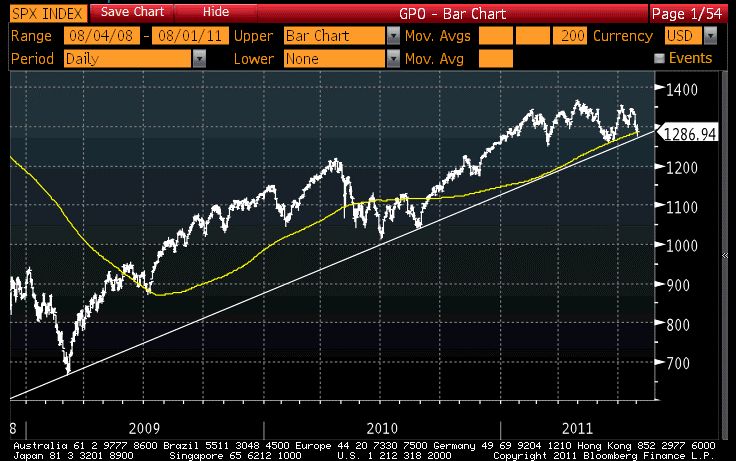
200-day moving average and the uptrend-line are both being challenged.
This chart is probably important enough to look at a close-up of the last year or so (see Chart below). There are a ton of support levels in play: the 200-day moving average and the uptrend-line; the June lows at 1258, the March lows at 1249, and some people are watching the trend-line off those two lows, which comes in at 1262, as the ‘neckline’ of a big head-and-shoulders pattern that projects to, um, 1147.

Maybe you don't WANT to look at this too close-up.
There is a lot of hurt to be visited on the equity market if the bears get the ball rolling. Frankly, there is enough support that I wouldn’t worry about it if equities were cheap. But where they are valued currently, and with the chance of a new recession which is clearly not priced, I think these support levels don’t seem so formidable after all.
Soon to be noticed, after the debt ceiling deal is passed, is that Italian 10-year yields just went to new highs at 5.99%, and the 2-year is just below its recent highs (presently at 4.45%). Weakness in Italian debt markets is the circumstance that really causes investors to shudder. Observe the effect that Greece’s problems had on the world’s markets, and then reflect on the fact that Italy’s GDP in 2009 was about six-and-a-half times as large as Greece’s (an even larger multiple would apply currently, of course, thanks to Greek austerity measures) and a debt in 2010 of 5.5x (according to Eurostat, although presumably this doesn’t include the ‘hidden’ Greek debt). Italy’s economy is roughly the size of the UK. It is rated A+ by S&P, and so it is widely owned. A 6% rate is not a level at which panic should set in, especially when the curve is still sloped positively between 2-years and 10-years, but it is disturbing that these yields are going to new highs. “Too big to save” is the operative term here. And, as the recent U.S. data demonstrates, the global economy is sputtering. There is no engine left to pull the train up even a modest incline.
And that’s the message from bonds. As nominal yields continue to decline, real yields are moving right in step. The 10-year inflation swap rate is at 2.78%, not appreciably off the post-2008 highs of 2.89%. But 10-year TIPS yields are at 0.33%, an all-time low. And that means the ratio of real yields is also at an all-time low of 11.7%. In other words, when you buy a 10-year nominal Treasury bond, only 12% of your return is compensation for the use of your money. The rest of the return is compensation for the decline in the valueof your money. A more normal ratio is 40-70% (see Chart). But look at the dip at the end of 2007 into the beginning of 2008, before the teeth of the crisis had set in. What we are seeing now is bad news.
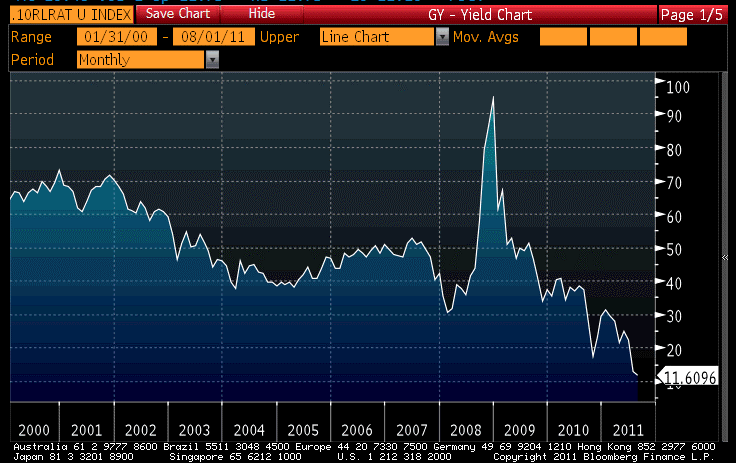
TIPS yields as a percentage of nominal bond yields, 10-year maturity
Tomorrow – assuming that the debt ceiling does in fact get passed and signed into law tonight; if not, then the economic data will be irrelevant for trading tomorrow – the data calendar includes Personal Income (Consensus: +0.2% from +0.3%) and Spending (Consensus: +0.1% from +0.0%), and the Core PCE Deflator (Consensus: +0.2% m/m vs +0.3% last, raising y/y to +1.4%). Car sales will be released throughout the day; they have recently taken a dive and until now the excuse has been the Japanese tsunami and channel effects from that disaster. The tsunami happened in March. At some point, either we need to upgrade our assessment of the long-term effects of the tsunami or acknowledge that some of the weakness may be exogenous. Maybe the tsunami is the next George W. Bush – we will keep blaming stuff on it for the next several years?
