Archive
Same Song, Second Verse…A Little Bit Louder And…
Well, needless to say there is a lot to cover today.
The overnight session held a lot of intrigue. Japan intervened in its currency markets to push down the yen. It seems like everyone wants their currency lower! Trichet even said (at his press conference, of which more in a minute) that a strong dollar is in the world’s best interest. Well, perhaps it is in the interest of the world-ex-US, since it helps all those other countries export to the U.S., but it doesn’t make sense to say that having any single currency strong is in the world’s collective best interest. Currencies are just a way of trading real goods, and they are zero sum. If the supplier wins, then the buyer loses, and vice-versa.
One way to have a weak currency is to flood the world with that currency. That’s what the Swiss National Bank started to try to do the other day, after all. Of course, if everyone starts trying to do it, then there’s no telling what will happen to relative currency values. That will depend on who “wins” the currency war. What we do know is that consumers worldwide will lose, as will lenders at the expense of debtors, when the increased stock of money is worth less in terms of real goods.
The Bank of England and the ECB both kept rates unchanged at their policy meetings today, which was no surprise. But ECB über-banker Trichet said that the ECB will conduct liquidity-providing LTROs (“Longer-Term Refinancing Operations”) for 6 month terms and MROs (“Main Refinancing Operations”) “as long as needed.” In a nutshell: they’re adding more liquidity. They’re easing. According to Trichet, they are going to keep monitoring inflation “very closely” since the risks to the inflation outlook “remain on the upside.” Well, that’s very prudent, Jean-Claude. Oh, and in the meantime the ECB said they’d be buying bonds, and immediately started buying Irish and Portuguese bonds.
U.S. stocks rallied on that news, which turned out to be one of the worst trading decisions, for those buyers, of the year. And it didn’t make sense, either: flushing cash into the system, causing inflation to solve otherwise-catastrophic problems, isn’t inherently bullish! Nor is buying the bonds of already-bailed-out countries when there are others at risk!
Trichet also continued his recent crazy-man routine by saying that “banks with limited market access must boost capital.” Uh, what? How do you boost capital if you can’t get to the market? Steal it?
Irish bonds did great, rallying 23bps on the day. Portuguese bonds were unchanged. Italian bonds fell, pushing 10-year yields to new highs. Spanish bonds fell too, despite the fact that Italian and Spanish central bankers were buying their own bonds. However, these markets are too big for the ECB to do much with at the moment, so Irish and Portuguese bonds will just have to do!
Speaking of bond purchases, the Wall Street Journal had a story quoting “former top Fed officials” (Kohn, Reinhart, and Madigan) as suggesting the Fed ought to consider QE3. But the headline didn’t quite get the spirit of the story, which in any case was citing former Fed officials. Here is Kohn, from the article:
Mr. Kohn, who rose to become Fed Board vice chairman before retiring from the central bank in September 2010, said its options to support the economy are “kind of limited.” But if inflation comes down and the economy doesn’t pick up, he said he would give “very serious consideration” to a new round of bond purchases.
So a couple of guys said that if inflation comes down and the economy doesn’t pick up, the Fed should consider QE3. I suppose I can’t disagree with the proposition that the Fed should consider alternatives. Of course, inflation is not going to come down; rising core inflation is baked in the cake for quite a while ahead now. And considering QE3 (in light of the fact that QE2 didn’t work) shouldn’t take long. The only reasons to pursue QE3 are political: that is, the Fed needs to be seen to be doing something even if there’s nothing useful to do. Now, if I were around the table and wanted to help, the first thing I would do before adding another trillion in reserves that has no impact on anything would be to lower IOER and get the existing reserves into M2! I understand why they don’t want to do that, but it’s madness to buy more bonds when the money you injected the first time is still sitting in bank vaults because you’re paying banks to keep them there. Madness, I say.
The reason the Fed doesn’t want to lower the interest they pay on excess reserves (IOER) is that they believe (and have said so publicly) that it would seriously hurt the money fund industry. But I can’t figure out why the government should subsidize higher real rates for savers when in fact you want deeply negative real rates for the economy (in theory, anyway). If the government will support a +0.25% rate when -0.75% is the appropriate rate for the economy, for example, then why wouldn’t they in an analogous situation try to hold money market yields at 5% when the market wants them at 4%? It’s the same difference. It isn’t like the money fund industry would vanish if IOER went to zero. They’d adapt. I can easily think of a couple of alternative money fund structures that would work even if there wasn’t a ~25bps floor on rates. Trust markets. Look, some banks are starting to pay negative interest rates on savings, as this story about BNY-Mellon illustrates. IOER is too high.
So the market hung on after trading a little bit up overnight, then a little bit down, then up on the ECB press conference and the as-expected Initial Claims data. Then it went down, and kept going down, even when some investors made sloppy purchases in size to try and scare the shorts a couple of times during the day. But it didn’t work, because the selling wasn’t coming from new shorts but rather from old longs.
Volume on the day was huge – the biggest non-expiration day since the flash crash, I think. The S&P ended the day down -4.8%, closing at 1200.07. The Dow lost 513 points. Where is the guy who was on my case for being bearish and wrong on the S&P since 1100 last year? I hope he got out a couple weeks ago. This is what I have been saying the whole time – it isn’t that the market must go down; it’s just that the risks of this sort of event made being long a dangerous gamble. The odds were against you, if you were long at high valuations in a rickety global economy; that didn’t mean the market couldn’t keep rallying but it meant there was always a chance that you’d roll snake-eyes.
Bonds rallied, hard. The 10y yield plunged 20bps to 2.42%, only a few basis points shy of last October’s low yield. TIPS were offered early, but recovered and actually did quite well. The 10-year TIPS yield fell 14bps to 0.21%, another all-time low. If you want to think about how bad the current situation is, don’t look at nominal bond yields. They got lower during the financial crisis of 2008 (as distinct from the financial crisis of 2011), but that was when inflation was in the process of coming down and there was reason to expect it to do so. Inflation now is going up, so longer-term real yields– which represent the cost of money – are much lower now. The chart below shows that 10-year real rates (abstracting from the absolute teeth of the crisis when TIPS were treated like corporate structured notes instead of US Treasuries) are much lower now than they were back then.

Real yields are much lower than they were in the first crisis. This shows increasing fear about the future growth rate.
So investors see the long-term outlook as dim for the economy, and in fact are more morose than they were at the equity market’s bottom in 2009. In that context, equities today are still pricing in much more robust long-term growth than the bond market is seeing. Both of these markets are probably too high.
Because TIPS mostly kept pace with nominal bonds, measures of long-term inflation expectations fell only a little bit. And that makes perfect sense, when the world’s central banks are now all printing in unison. TIPS are too expensive, but relative to nominal bonds? They’re actually probably a better deal!
The short end of the TIPS curve, on the other hand, was savaged. For some while, the 1-year inflation swap has been under pressure. When it was pricing nearly 3% and energy markets were forecasting very little energy inflation, it was plainly too high. As of today, 1-year inflation swaps are marked at 0.88% (plus or minus…it was a dicey close), and since energy markets are pricing in mild declines in prices over the next year, that equates to a core CPI rate over the next year of about 1% (see Chart). But core CPI is currently 1.6% and rising – so 1-year CPI swaps are too low (or forward gasoline prices, too high).

The sharp drop in implied inflation at the front of the curve is overdone, or at least ahead of the energy markets.
Personally, I am thinking swaps are low rather than gasoline prices too high. Although commodities fell today (about 2.8% overall, energies much worse), and the headline read “Commodities erase gain for 2011 as faltering economy may curb consumption,” there are two points I would make. (1) A declining stock market is not a faltering economy. Yes, the economy is faltering but it’s not plunging. Some amount of what we’re seeing in stocks is just them coming back to more-rational valuations especially considering the economic landscape as it already is. (2) Regular readers of this column know that the supply/demand argument takes a back seat if the world is awash in cash. In that case, the exchange rate between stuff and money is far more important than the equilibrium supply and demand for a particular good. Why did commodities rally in the second part of last year? Was it because the economy was booming? Well, no…the economy wasn’t booming, and we knew that. Commodities rallied last year because the amount of money in circulation was rising and was expected to continue to do so for a while.
What are the prospects for that happening again? Well, M2 was released today and showed another hefty gain. The 52-week rise is now +8.1%; the pace is +11% annualized over the last 26 weeks. If deltaM+deltaV≡deltaP+deltaQ (the first-difference form of the crude quantity of money equation), and deltaM is +8% while deltaQ is +2% (to be generous), then we had better hope velocity is declining or…prices are going up.
.
While I thought (and still think) that stocks were (and are) overvalued relative to historical earnings as well as considering the economic prospects, the move today is clearly a (market) liquidity event. The fact that commodities declined even though the actions of central banks would argue for a movement in the other direction is one clue. The fact that it is August is another clue. The VIX rose to a post-flash-crash high, but is not near the flash-crash highs nor anywhere near the 2008 highs, so it is hard to say we have reached a crescendo of selling as gut-wrenching as today’s action was. There may, in fact, not ever be a crescendo. But with liquidity poor the possibility is there, and the question is whether you want to allocate your liquidity – the cash balances you have been holding in reserve for so long – to equities or commodities or whatever investment you love – at these levels or wait for a true panicky wash-out. Buying those assets now is catching a falling knife and it’s a much better strategy to wait until the knife hits and then pick it up off the floor. It would show great courage to buy stocks here. Leave the courage to the other guy. The first guy through the door is the one who is most likely to get shot.
With vols rising so dramatically and the price action so extreme, I covered all but 20% of my equity puts in the last 20 minutes of trading today. The prices hadn’t quite made it to my target but the uncertainty is too great and the implied vols are now high enough that it is no longer an efficient way to take that position. I am not sure what will come tomorrow, but if stocks decline just a little bit, or certainly if they rally, volatilities may drop quickly and so I have too many ways to lose. I should have covered the entire position, for while I am still bearish the odds are obviously no longer as much in my favor now. That was an error that fortunately can no longer cost me too much.
.
Tomorrow is actually Employment Friday, the most volatile day of the month (ha!). The consensus estimates have Payrolls at +85k versus only +18k last month, and the unemployment rate steady at 9.2%. I think there is room for upside on the Unemployment Rate, but the Payrolls guesses seem conservative enough especially since the +18k last month was likely an aberration that I expect to see revised a little higher. The markets could use an upbeat surprise on Employment, although I think it wouldn’t have a lasting impact since there are plenty of trapped longs who will probably sell into a rally. I suspect they may get a mild surprise in that way. But the risk is still skewed to lower equity prices and probably still-higher bond prices until the Fed bats down the notion of QE3. However if, Heaven forbid, a negative Payrolls number prints, this “second verse” could get a little louder and, as the old song goes, a whole lot worse.
Let’s hope not. As a young-middle-aged investor, I want lower prices during my accumulation years and higher prices later, when I am divesting – but I don’t want them lower all at once!
Dicey (And Slicey!) Markets
If you like trading, as opposed to investing, then these are markets for you. Commodities markets dropped sharply last week, recovered, and then a number of them dropped again today. NYMEX Crude, which had been flirting with $105 yesterday, pierced through $98 today before closing at $99. NYMEX Unleaded had recovered almost all of its loss from last week before plunging nearly 25 cents today.
Attempts to explain these moves as the natural product of any rational process are bound to be frustrated. Of course, we try. Bloomberg tried by stating (early in the day) that “Commodities fell for the first time in three days, led by gasoline and silver…as reports on inflation from London to Beijing boosted expectations for higher interest rates.” While there was definitely discussion of the i-word in both of those capitols, it is a bit of a leap to suggest that commodities markets are starting to price hawkish central bank policy when the very interest rate markets are not. I guess you gotta write something! After the weekly inventory numbers came out, showing a higher-than-expected build for Crude and Gasoline (but a draw for Distillates), the stories changed to attribute the plunge to the “surprising rise in supplies.”
A 7% move in Gasoline doesn’t happen because of a surprising weekly build. It’s a weekly number and it bounces around some, like Initial Claims. More importantly, this hypothesis doesn’t explain why Silver dropped 8.4% again today, or why Sugar was off 4.25%. And it doesn’t explain why stocks dropped 1.1%, or 10y notes rallied 5-6bps (to 3.16%).
Blame it, if you wish, on a sudden “risk-off” trade. At least that is consistent with the movement in the markets (although I always wonder why TIPS are considered “risky” instruments since they are considerably safer than Treasuries if held to maturity). But now we have just pushed the explanation back one layer. What has triggered the “risk-off” trade? Bombing in Libya? The fact that Greece is in trouble? The rising temperature of unrest in Syria? Hey, I can agree that all of these things make me nervous, but none of them is particularly new. Besides, as of this morning the Wall Street Journal was running a piece saying that a new deal for Greece is expected…by Greece…by June.
The dollar rallied today, to its highest level in a month. It isn’t clear to me if this is effect (another ‘risk-off’ reaction) or cause. You can make a plausible argument that it is the latter. Perhaps traders are covering short-dollar bets because the Fed is nearing an end of QE2 and, whether they now start selling out the portfolio or not, the transition to at least not buyingis effectively a tightening of policy and arguably could strengthen the dollar. This would tend to weaken commodities, and to the extent that monies are coming back into dollars it would tend to support fixed-income. If this is really the root cause, then it’s probably mostly out of gas…unless the buck breaks above big resistance at 76 on the dollar index (see Chart below).
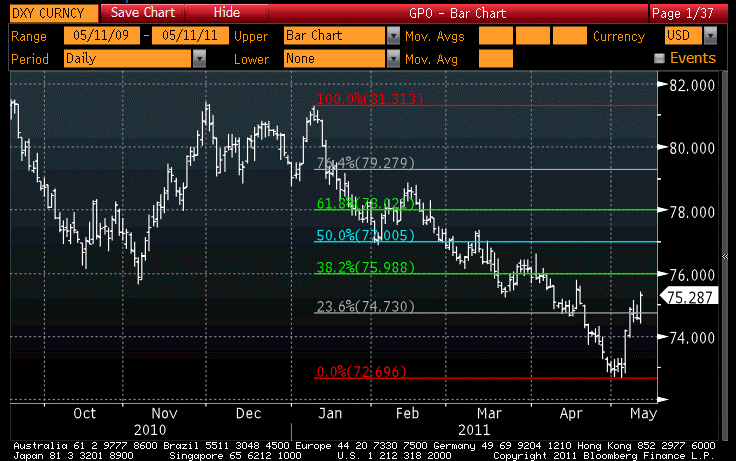
Nice dollar bounce, but the going is about to get tough.
If that happens, then there may be more near-term downside to commodities and stocks and upside to bonds. I don’t expect it, but the recent volatility sure makes it seem a dicier proposition than I thought it was a couple of days ago. Several commodities are at supports, the 10y Treasury note is back testing its recent highs, and stocks are re-testing the February and April highs, which they pierced through late last month. The proximity of so many critical points makes the situation inherently less stable. And yet…the VIX is still way down at 17. The MOVE is still near multi-year lows (see Chart below). Protection is quite cheap.
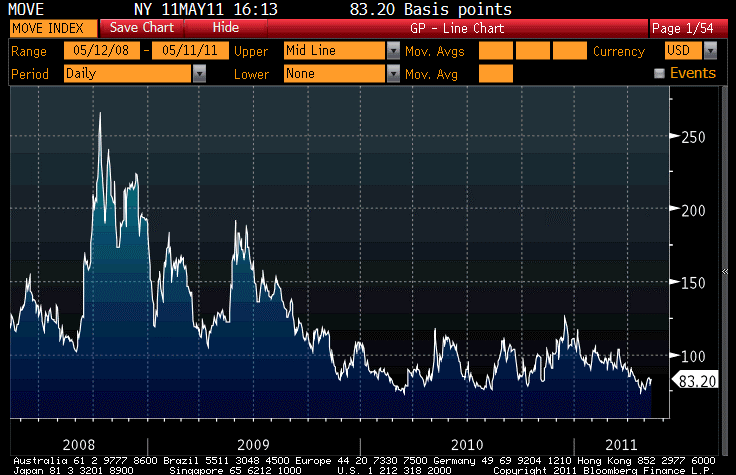
MOVE index of fixed-income volatility is near multi-year lows as well.
But inflation protection is still not cheap. While 10y TIPS sold off to 0.72% today, that remains a very expensive level. How then does one protect against inflation in this environment?
I continue to be a fan of commodity indices, but institutional investors should consider high-strike payer swaptions here. Some readers will remark that this is not a fresh idea, since that has been the default strategy for many institutions for a while. So let me be clear: while that has been a default strategy for a while, it hasn’t been the right strategy for a while. Here’s why. When you buy an interest rate option (for the uninitiated, a ‘payer’ swaption gives you the right to pay a fixed rate on a swap at some point in the future, so it is analogous to a bond put), you’re paying for protection against increases in both real rates and in inflation. Remember, Fisher told us that
Nominal rates ≈ Real rates + expected inflation (+ risk premium)
So when you buy an option that pays off if nominal rates rise, you win if real rates rise, if inflation compensation rises, or if they both rise. And you’re paying for all of those possibilities.
But when this strategy was first being proposed, in mid-2009, real rates were much higher (especially on a forward basis). So nominal rates were not very likely to rise because real rates were rising; they were going to rise, if at all, because expected inflation rose. But you were paying for both pieces of that option. In the event, expected inflation rose and real rates plunged, so you’re further out-of-the-money now than you were then. Moreover, implied volatilities were very high.
Now, by contrast, implied volatilities are very low and so are real yields. It is unlikely that, if inflation starts to rise, real yields will fall much further than the 0.72% where they already sit. So you’re paying less, and getting more. Now, even if what you want is protection from inflation and not from nominal rates, at least you’re more likely to have the moving pieces going in your favor, rather than against you.
The same reasoning applies if you are a retail investor, except that there are not many options for the retail investor who wants to buy a long-term option on inflation, or nominal rates, or almost anything for that matter.
.
On Thursday, we get another volatile weekly supply number. This one is the supply of new jobless, also known as Initial Claims (Consensus: 430k). Recall that last week saw a spike to 474k, which even though it had some reasonable explanations attached to it was still shocking for many observers. If that figure doesn’t drop substantially, bonds are going to go straight up and stocks and commodities straight down.
Retail Sales (Consensus: +0.6%/+0.6% ex-autos) is also an 8:30ET number. Be careful here as well. Anecdotal reports seem to suggest a chance of weakness to what has been a consistently strong number for almost a year now. Unusually, this is probably less important than Claims in the mind of the investor right now, but weakness here and in Claims is where to look for market risk tomorrow.
Also out is PPI (Consensus: +0.6%/+0.2% ex-food-and-energy). Core PPI is expected to rise to 2.1% year/year and the headline to 6.5%. PPI doesn’t matter, and especially since it is sharing the 8:30ET time slot with Claims and Retail Sales it will be mostly ignored.
.
Two administrative notes:
1) If you missed my column the other day on the kurtosis and skewness of commodity indices and the importance of that fact to traders in these things – it was mis-posted in one place you may have ordinarily seen it – please have a read.
2) I finally finished an inflation-related paper that I had been working on for a long time. A few years ago I submitted it through a couple of rounds to a journal and never got it cleaned up enough to be published, but it’s cleaned up enough to put on SSRN. The paper is called TIPS, the Triple Duration, and the OPEB Liability: Hedging Medical Care Inflation in OPEB Plans. If you have a role in hedging medical care exposures in post-retirement liabilities, take a look and remember that Enduring Investments can be hired as a consultant.
Lots Of Options
Oh, year-end illiquidity is lots of fun, isn’t it?
After yesterday’s fairly high-volume selloff (the 1.5bln shares was the highest non-witching volume since July 1st), the market launched higher overnight on essentially nothing. The rally was attributed to oblique comments by ECB President Trichet that we should not underestimate Europe’s determination to resolve the current crisis, in an article in the Financial Times entitled “Trichet hints at bond purchase rethink.” The thought is that the ECB might buy more sovereign bonds.
So what? Supposedly, the ECB is sterilizing the purchases, draining the money they use to buy bonds with. So all that they’re doing is elevating sovereign bond prices above market-clearing levels. I can see how that helps the politicians who want to spend more money and not pay higher interest rates (one of the funniest things I have read in the last few days is that the 5.8% aggregate interest rate on Ireland’s package was “punitive.” Really? The market wasn’t willing to fund you at anything close to that level. How is 300bps below market rates “punitive”?), but I don’t see how it helps equity markets. Especially, U.S. equity markets.
But the 2.2% rally in stocks, to the highest level in weeks and above the 1200 level on the S&P, occurred on slightly more than $1bln shares in volume. That’s not horrible, but it’s not exactly a sign that everyone is piling into the boat before it leaves the pier. The VIX fell, but not enough to make you think risk is switched off; the dollar declined, but not so much that it looks like investors are rushing back to the continent. I expect the T-1000 isn’t done yet merely because Trichet murmurs soothing bromides to the newspapers.
The economic picture is improving on this side of the pond, no doubt, but before attributing the rally to that one should be aware that the S&P was essentially over 1200 before ADP even printed. The ADP report was in fact slightly better-than-expected, at 93k (as I noted yesterday, the risks to ADP were to the upside, and the risks to Payrolls are on the downside although less so now). The ISM report was as-expected. Car sales were a bit stronger than expected, but 9.27mm domestic car sales is not going to get anyone thinking that happy days are here again (especially since the Big Three are all still making cars). In general, these are cheerful numbers but not exactly explosive.
Bond yields, though, were explosive! The 10y note yield jumped 17bps to 2.97%, and inflation swaps widened 5-6bps. That 10y yield is the highest since late July, and with the strong autumnal seasonal pattern fully past the bond market looks on fragile ground. Before the ECB ramps up their own purchase program, they should reflect on the fact that the Fed’s unsterilized program has failed to keep yields from rising. The purposes of the two central banks are different, but their chosen weapons – purchases of sovereign bonds, in an effort to keep interest rates from rising or to push them lower – are the same.
If yields continue to rise, eventually duration extension of mortgage portfolios begins to become an issue. Although the mortgage securities market is slightly smaller now than it used to be, and although many mortgage securities are now held by an entity that seems to care little about its duration (the Fed), the hedging needs of mortgage portfolios may still be problematic if they occur in December. Liquidity isn’t very good in December. Moreover, the fact that the Fed doesn’t care about hedging changes in its portfolio duration doesn’t mean that changes in the behavior of its portfolio will not matter. Higher mortgage rates imply smaller prepayments, and smaller prepayments means the Fed’s need to reinvest those prepayments is also smaller. I am not a mortgage quant, so I don’t know exactly where the inflection points are that we have to worry about. But as a former rates trader, I know we should be worrying about them.
While I am mentioning delta-hedging (since that is what a mortgage hedger is doing by buying when the market is rallying and selling when the market is declining: delta-hedging the options embedded in the mortgage security), it is perhaps an opportune time to mention another concern that has been troubling me recently.
Let me first digress for just a moment to introduce quickly a couple of options-related concepts. Those of you who are intimately familiar or at least very comfortable with options concepts can skip this next section.
Quick Option Primer
The delta of an option is the sensitivity of the option’s price to a change in the price of the underlying instrument. For example, if I own a call option with a delta of 0.3 and the underlying bond rises one point, then I expect the option price to rise 0.3 points (all else being equal).
The delta of an option is intimately related to the strike price of the option (that is, the price at which the option owner can elect to buy, if it is a call option, or sell, if it is a put option). If the current price of the underlying security is below the strike price, then a call option’s delta will be less than 0.5. If the current price of the underlying security is above the strike price, then a call option’s delta will generally be above 0.5.[1] So, as the price of the underlying security goes from very far below the call option’s strike (“out of the money”) to very far above the strike (“in the money”), the delta goes from something near zero – it isn’t very sensitive at all to movements in the underlying price – to something near one – it moves in lock-step with the security it is about to become, once the option is exercised.
The way that the delta changes with respect to movements of the underlying security’s price around the strike price is called the gamma of the option. For an option with high gamma, the delta of the option changes very rapidly. The option, in other words, may go from being very insensitive to movements in the underlying security, to extremely sensitive to those movements, all in a short period of time. A crucial point is that the gamma of any vanilla option is at a maximum when the underlying instrument is at the strike price.
If you’re still with me, congratulations! Now for one more concept, and then I’ll explain my concern. An important concept in options theory (and trading) is the notion of a replicating portfolio. That sounds fancy, but all it really means is this: if I have sold you a call option, then when it expires I know that (a) if the option is in-the-money, I will have to deliver to you the underlying instrument because you will exercise the option. So I’d better have the bonds or stocks or whatever on-hand to deliver. And (b) if the option is out-of-the-money, I know you won’t exercise, so I don’t need to have any of the underlying on hand to deliver to you. In the period of time between when I sold you the option, and when you exercise that option, the “replicating portfolio” is (basically) a delta-weighted amount of the underlying instrument. In the example above, of the call with an 0.3 delta, if I sold you contracts on $1,000 worth of bonds then I need to have on hand $300 worth of bonds. If the bonds go up 1 point (1%), then I will have made $300 on my holdings of bonds, and the value of the option will also have gone up by 0.3 * $1,000 * 1% = $300. I am hedged. Under the conditions assumed in Black-Scholes, if price changes are continuous, rebalancing is costless, borrowing costs are the same as lending costs, volatility is constant and equal to the volatility priced into the option…then the fair price of the option is the cost of that hedging strategy. An option is nothing more than a pre-packaged hedging strategy.
And that hedging strategy has a cost, as you can see. If the market rises, then the delta of the option will increase as the option goes in-the-money. That means that to maintain the replicating portfolio, I need to buy more bonds as the market goes up. In reverse, as prices fall then the delta falls and I need to sell more bonds as the market falls. Even if there is no bid/offer spread, this is going to cost money because I am systematically buying high and selling low!
Back To The Story
You can also see implications for markets in this dynamic. While both option-owners and option-sellers can delta-hedge, if the hedging is done mostly by people who are short options then markets will tend to be more volatile since there will be lots of people buying into rallies and selling into selloffs. This is why the mortgage market can have such a big impact on the bond market in illiquid times. Owners of mortgage-backed securities are implicitly short options because the mortgagee (that’s you and me) tend to pay more slowly when rates are going up and pre-pay when rates are falling. Therefore, when rates are falling fairly rapidly and especially when the market is illiquid, sophisticated firms that have a lot of MBS (such as, say, the GSEs) will need to keep buying, and buying, and buying, pushing rates down faster and faster and faster. And the opposite effect occurs when rates are rising.
We haven’t had to worry much in the past about inflation options, because until the last year or so there haven’t been enough outstanding – relative to market liquidity – to worry about. And anyway, if they are randomly spread about then any effects from one hedger’s activities are diluted. But this is no longer the case. Dealers of inflation options are almost always two things: they tend to be short very low-strike options like -2% and -1% floors, which are generated when corporate treasurers issue CPI+2% or CPI+1% notes and then swap them. The corporate ILB market in the US is pretty small, so this isn’t a very large problem, but in 2008 it contributed to the complete collapse of the inflation swap quotes to deeply negative readings for the first several years (see Chart below, source Enduring Investments).

1y US CPI in the aftermath of the oil crash and gamma effects
The other, more dangerous case is that dealers are also almost always short high-strike options like 4%, 5%, and 6% caps on inflation. This is because customers in large majorities tend to be buyers of inflation protection rather than sellers (and you can tell this by the very high prices charged for inflation caps). The demand for this protection is nearly bottomless.
Now, we have never had a situation where inflation expectations rose suddenly, in the same way that they fell so abruptly when oil prices (and Lehman) crashed in late 2008. But if we were to have such an event – and it is certainly not out of the question – I wonder whether there are enough TIPS in the world, or people willing to sell inflation swaps into an obvious dynamic like this, to keep inflation measures from completely coming unglued. And what are the policy implications of this? If the Fed sees forward inflation expectations go from 2% to 3%, 4%, then 5% and 6% in rapid succession, what are they to do?
While I believe the teeth of this dynamic are far away – after all, core inflation is 0.6% – it may not be so far away as we think. Forward inflation between 5y and 10y is already well up and over 3% (see Chart below, source Enduring Investments), and when it comes to an inflation cap you care about each forward “caplet.”

CPI swaps curve
It isn’t something to worry about tomorrow, but it is something to worry about…unless you own caps and want to see forward inflation quotes fly!
Indeed, there is not much to worry about tomorrow…save your worrying for Friday’s Employment Report. On Thursday, the main releases are Initial Claims (Consensus: 424k from 407k), which are expected to show a significant bounce – watch bonds get smacked if they don’t! – and Pending Home Sales (Consensus: -1.0% vs -1.8% last month). I doubt this latter release has any traction the day before Employment. There are also several Fed speakers scheduled.
I expect that today’s prodigious leap higher in equities is not going to be sustained, but hope for solid Payrolls gains and a widening of the ECB bond-buying program might keep prices elevated for a day or two. I would be surprised at further extension, however, and think gravity will probably take over fairly soon.
[1] This is generally the case because the call delta minus the put delta will not sum to 1 but to the present value of 1. So if an option is only slightly in the money, with a long time to maturity, it will actually have a delta slightly less than 0.5. But this is a technical point not critical to the discussion here.
