Archive
Four Quick Thoughts on Fed Day
Four fairly quick observations on this Federal Reserve meeting day, not all of which have anything to do with the Fed:
1. The FOMC today announced unchanged policy for now on the overnight interest rate, on the pace of QT runoff, and on the collective expectation of the Committee for the number of rate-cuts in 2024 (three, 25bp cuts). But it beats noting that while three cuts is the median expectation, the mean expectation dropped substantially. Only one official sees four rate cuts in 2024, compared to five who saw that many or more, as of the December survey. Those four folks moved to ‘three’, and one of the ‘three’ folks moved to ‘just one.’ Nine of the nineteen dots are for fewer than three cuts this year, so we should say this is a closer call than the market seems to think.
2. The longer dot plots also show some increase in Committee members’ expectations for the neutral short-term interest rate (the so-called ‘r-star’ originally popularized, I think, by Greenspan). The significance of this for investors and traders is that the overnight rate is unlikely to go back to zero unless we get another enormous calamity; the significance for the economy is essentially nil since it is money, and not interest rates, that matter. I’ve written before about why there are good reasons to think of something like 2-2.25% as the neutral long-run real rate, and so if CPI inflation is expected to be 2.25%-2.5% then something around 4.5% is neutral long-run nominal rate. We are mighty close to that now, so there is no compelling reason to think that interest rates should decline markedly from here. At the short end of the curve, we should eventually be lower – but we need to also keep in mind the growing imbalance in the supply and demand for Treasury paper, which (in the absence of recession) will tend to keep rates on government paper higher than they otherwise would be in equilibrium – and as one consequence, by the way, credit spreads will tend to be lower than they otherwise would be for a given level of creditworthiness.
3. The Fed clearly believes that the situation in Commercial Real Estate (CRE) and its effect on the banking sector is manageable. If they didn’t think so, then they would be hastening to lower rates to ease the refinancing problems that are hitting that sector. I have been reading alarmist analyses saying that the $1 trillion in CRE mortgage maturities due this year will lead to ‘hundreds’ of bank failures. This falls into the Big Number is Bad and Scary school of analysis. One trillion is a lot of mortgages and that will cripple banking! Except…
Let’s suppose that 20% of those mortgages go into default – a number more massive than we’ve ever seen before – and that recovery is 80%. For reference, in the 2008-09 crisis CRE values fell by about 36% according to the Greenstreet Commercial Property Price Index (chart below), and that was against a backdrop of 1%ish inflation. The nominal price decline should be less in an environment where underlying inflation is 4% per year, naturally. Since the CRE peak, real values have fallen 31% but nominal values only about 21% on the basis of that index. But the drop from the peak isn’t the relevant part. Even the shorter loans now coming due were struck 3-5 years ago, and the drop from that level is only about 9%. Plus, the initial loan-to-value levels were not 100%. So (and all of this is just to cuff a rough estimate) a 20% loss when selling out the collateral on a defaulted mortgage seems conservative.

Those numbers mean the $1T in mortgage maturities could produce a loss of $40bln (1,000 * 0.2 * 0.2). That’s still a big number, but remember that it is spread over a lot of banks. Suppose that it is spread over only 2,000 banks, and that the losses have nothing to do with bank size. Then you are looking at losses per bank of $20mm. That’s bad for a small bank, but the losses at a small bank will of course be smaller because they have smaller books. Will that sink ‘hundreds of banks’? Only if they are small, fairly insignificant banks.
Will some banks fail because they lent too much against commercial real estate which has fallen in value, at too-high loan-to-value ratios, and end up owning property that they can’t sell? Almost certainly. But after negotiations and forbearances and the eventual foreclosures – in an environment where the price level is rising 4% per year – I just don’t think this is something we should worry about. To be fair, the fact that the Fed is not worried about it is something that makes me worry about it.
4. I have been befuddled recently because airfare prices in the CPI have been higher than would be anticipated given the movement in jet fuel prices. Belatedly, I think I know what is going on. The issues with Boeing planes has meant that (and I didn’t know this) Boeing has greatly reduced its deliveries to airline companies as they sort out the problems with their Max jets. I became aware of this only recently when a Bloomberg story highlighted how Southwest Airlines is cutting capacity and freezing hiring because they aren’t getting the planes they need. Steady demand and constraints on supply means higher airfares, as I also discovered this week when I was booking a flight to Chicago. Yikes! With jet fuel prices also rising again, this is something to factor into CPI forecasts going forward. It’s surely ‘transitory,’ but it takes a long time to build a plane and in the near-term this is more likely to be solved on the demand side if we have a recession, than on the supply side with a sudden influx of planes.
The Stocking Is Mostly Full
With the exception of a resolution to the budget crisis, Tuesday probably saw the best combination of possible news and expectations that we could have for the remainder of 2012. The stocking is mostly filled with all of the gifts we are likely to get this year.
It started with the announcement that Greece managed to meet its goal for the bond buyback, as it attracted some €31bln in tenders. As it turns out, they had to pay more than the absolute highest price they were supposed to pay (the closing price on November 23rd), but as I noted at the time there was little to no chance of Greece completing the buyback without paying above-market prices, unless the sellers were coerced in some way, so that wasn’t really news.
Now, according to the Bloomberg story, the Euro finance ministers get to meet on December 13th to decide whether to release the €34.4bln tranche of the rescue which was contingent on a successful buyback. But the deal is almost done. Given the interest holidays and the lengthened maturity of Greece’s debt, it is looking increasingly likely that they’ve managed to delay the day of reckoning substantially. Sure, they did that by moving all of the debt to official institutions, who will carry it at par although it will eventually be defaulted on. Sure, this creates the risk of me-too-ism from other PIIGS who would like a lengthy payment holiday and hundreds of billions of Euros in support. But the risk that Greece will need to default in the near-term is passing. Of course, so is the need for Greece to continue austerity, once they’ve gotten everything they need from the Eurozone finance ministers. Maybe they were more clever than I gave them credit for…
So Greece was good news, and we’re also cheerfully waiting for tomorrow’s FOMC meeting. The results are so widely expected as to lead one to expect the intentions of the Fed had been carefully vetted beforehand. The overwhelming consensus is that the Fed will announce that they will cease half of Operation Twist: the half that has them selling short-dated Treasuries, of which the Fed now has almost none. The consequence is that the Fed will now be outright buying about $45bln in long-dated Treasuries, over and above what they were already purchasing in QE3, per month, without end.
Obviously, equities liked this idea because we all know that the script says stocks are supposed to ramp up into QE. More surprisingly, long-dated Treasuries actually slipped a bit lower. The 10-year yield is at 1.65% and 10-year real yields at -0.89%.
Now, here’s the problem as we roll into Wednesday. There’s really no chance that the Fed is going to do more than $45bln per month in Treasuries purchases, especially with the inconvenient (albeit cosmetic) downtick in the Unemployment Rate this month. Therefore, what is priced into the stock market is pretty much the best-case for QE.
Is there any chance that the Fed might actually do less, or even defer until the next meeting the decision about whether to pursue an acceleration of QE? The chart below (Source: Bloomberg) shows the 5-year inflation breakeven, 5-years forward, taken from TIPS and Treasuries.

Clearly, while inflation expectations are “contained” in the Fed’s view, they are plainly becoming steadily less-contained. The 5y, 5y forward BEI has been rising in a trend for fourteen months now, and it is above 3%. In inflation swaps, which don’t have embedded the financing advantage of nominal Treasuries over TIPS, the 5y, 5y forward is 3.17%. In short, the market is currently pricing expectations that the Fed will fail in its mission to keep core CPI inflation around 2.25%, and that there will be a long-lasting deviation from that target.
(As an aside: we can’t tell just from the point estimate taken off the yield curve whether market expectations are for a steady miss, or whether the expectation is for something fairly close to target, but with considerably “option value” because the upward tails are a lot longer than the downward tails. It appears that both are currently contributing to the high forward breakevens because implied inflation volatilities have been rising.)
Now, like everyone else I expect that the Fed will stay on the course that has been laid out for them by the market, and endorse a QE4 plan tomorrow. And I don’t think we’ll get Evans Rule parameters tomorrow. But, as I said, all likely surprises from that expectation are negative for equity markets, and even if the Fed delivers what has been writ then I’m not sure where we get a further rally unless the fiscal cliff is averted.
Spooky Action At A Temporal Distance
The parallels of the current equity market rally to the August 2010-February 2011 rally following Chairman Bernanke’s hints about QE2 (a parallel I mentioned first about a month ago here) continue to mount. I can’t call today’s rally (a mere 0.1% on the close) a ‘cheerful’ rally except in the context of what might have been. Over the weekend, the G20 met in Mexico City, partly to discuss whether to increase the global commitment to a European solution (via funding for the IMF, which would then pitch in more than it has pledged to do so), and in very clear terms said no. That anything “in clear terms” would come out of a G20 communiqué is in fact unusual, but there seemed little doubt that further aid will not be forthcoming unless the Eurozone members themselves increase their commitment further.
Stocks were mildly irritated about this surprise in the overnight session, but only mildly, and that negativity was erased when the German parliament approved the Greek rescue package this morning. There was no doubt that it would do so, and yet there was a relief trade anyway.
Again, this reminds one of the mood in Q3 2010, when there were plenty of reasons for stocks to stay down (if not to fall further) and yet the market climbed; not only that, but it climbed inexorably. (It should be noted that core inflation bottomed in the month immediately preceding the month that QE2 was formally announced, although the precise timing is surely spurious.)
Another parallel is worth exploring here. The August 2010-February 2011 rally was actually in two parts. The first part ran from late August, when Chairman Bernanke delivered the Jackson Hole speech in which he all but promised QE2, until the week of the November FOMC meeting and the announcement of QE2. It covered 70 days and around 175 S&P points. Through the end of November 2010, while QE2 actually began, equities nevertheless declined about 50 S&P points; beginning in December and continuing through February 2011, the next leg tacked on another 175 S&P points over 79 days.
So far, this equity rally has covered 69 days and 167 S&P points. The similarity so far in pace and scope has been striking, with the main difference being the extremely weak volume on the advance. Now, there is no FOMC meeting tomorrow, and so the parallel is surely going to break down. Moreover, there seems not much chance that the Fed will announce a QE3 at the March 13th meeting. If there is a parallel, are we going to rally until the Fed actually announces QE3, or are 70 days and 175 points the measure to compare?
I suspect that the market has extended itself enough that, QEx or not, it is due for some turbulence. And, frankly, a 50-point setback wouldn’t exactly crush the bull swing any more than the 50-point correction in November 2010 did. Leveling off and correcting into the end of the quarter, or at least into late March when we will find out for sure if Greece navigated one more payment bulge, seems reasonable to me especially with the cyclically-adjusted P/E up above 22 and the S&P dividend yield down below 2% (now 1.99%) again.
The parallel in bonds is somewhat more interesting. Bonds had rallied into the 2010 Jackson Hole speech, with 10-year yields falling from 4% in April to around 2.5% when the speech took place. So the rally in fixed-income had already taken place, and little else happened in nominal yields over next couple of months (see chart, source Bloomberg). But inflation breakevens rose sharply and real yields (not shown) fell, so that while nominal yields were not moving in the aggregate, inflation swaps actually rose about 50bps and real yields fell about 50bps between August 27th and the Fed meeting in November. I first wrote about this divergence here and here.

While nominal yields were not registering anything in particular between Bernanke’s loud hints about QE2 and the formal announcement thereof, there was considerable action below the surface. With that back story, consider the history of yields and breakevens since last summer, illustrated in the chart below.
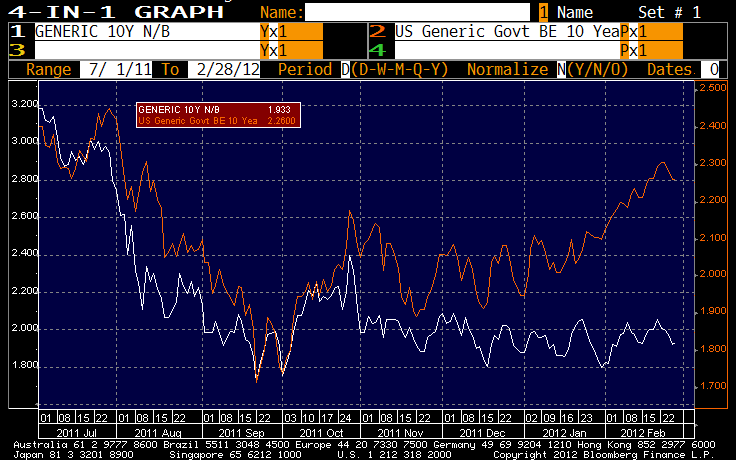
The divergence is more subtle, to be sure, but at least since the beginning of the year breakevens have been moving steadily higher while real yields steadily fell. The tale of the tape: 10-year inflation swaps since year-end, +37bps (was as much as +44); 10-year real yields -32bps (was as much as -35bps).[1]
Coincidence? I don’t think so. This rally has all the hallmarks of being money-induced, whether it’s the perceived promise of QE3 or the actual LTRO from the ECB and other monetary actions from other benevolent central banks. (Oh, how interesting. LTRO2 is the day after tomorrow, about 71 days after the beginning of the first leg.) Had this been an actual rally on strong economic fundamentals, we should have seen real yields rise.
There have been a couple of other developments worth noting in inflation-land recently. One is that the short end of the curve has risen appreciably, so that the 1-year inflation swap rate is above the 2-year swap rate – something which hasn’t happened since March and April of last year when oil prices were also on the rise (and 10-year nominal yields were about 150bps higher than they are now). Actually, the whole shape of the swap curve is different than it has been for a while (see Chart, source Enduring Investments).
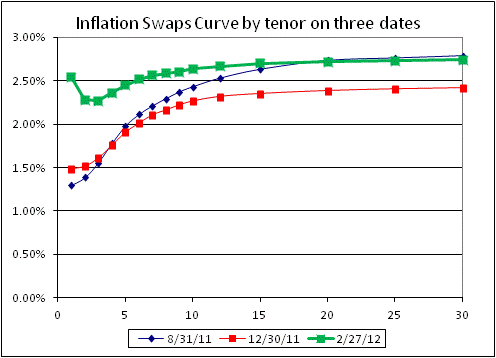
Although you can’t see it from the chart, 5y inflation 5 years forward (aka 5×10 inflation) is above 2.90% and is threatening 3%. That hasn’t happened since last August (when 10-year nominal yields were 50bps higher than they are now).
Oh, and what happened to 10-year nominal yields after the first leg of the QE2 trade, and their long period of quiescence? Between November 4, 2010 and December 15, 2010, they rose by 100bps.
Incidentally, in 22 of the last 31 years, 10-year yields have risen in the 30 days following February 27th. While 10-year note yields have fallen some 1200bps over those 31 years, they have risen, on average, about 20bps between now and early May (see Chart, source Enduring Investments).

It is, in short, an inopportune time to be long fixed-income. And, frankly, I’m not too sanguine about stocks, as I have said. Our model continues to allocate quite heavily to commodities in this environment, as do I in my personal accounts. Among ETFs, I am long USCI, GSG; long INFL and RINF as long-inflation expectations plays, and long TBF to be short nominal bonds. I also own SPY puts and FXY puts (which is unrelated to what I discuss above) in small amounts.
[1] Note that I’m correcting the 10-year real yield for the substantial roll to the new TIPS issue, as otherwise it looks like real yields have fallen less than they actually have.
