Archive
Commodities Re-Thunk
I want to talk about commodities today.
To be sure, I have talked a lot about commodities over the last year. Below I reprise one of the charts I have run in the past (source: Bloomberg), which shows that commodities are incredibly cheap compared to the GDP-adjusted quantity of money. It was a great deal, near all-time lows this last summer…until it started creating new lows.

Such an analysis makes sense. The relative prices of two items are at least somewhat related to their relative scarcities. We will trade a lot of sand for one diamond, because there’s a lot of sand and very few diamonds. But if diamonds suddenly rained down from the sky for some reason, the price of diamonds relative to sand would plummet. We would see this as a decline in the dollar price of diamonds relative to the dollar price of sand, which would presumably be stable, but the dollar in such a case plays only the role of a “unit of account” to compare these two assets. The price of diamonds falls, in dollars, because there are lots more diamonds and no change in the amount of dollars. But if the positions were reversed, and there were lots more dollars, then the price of dollars should fall relative to the price of diamonds. We call that inflation. And that’s the reasoning behind this chart: over a long period of time, nominal commodities prices should grow with as the number of dollars increases.
Obviously, this has sent a poor signal for a while, and I have been looking for some other reasonable way to compute the expected return on commodities.[1] Some time ago, I ran across an article by Erb and Harvey called The Golden Dilemma (I first mentioned it in this article). In it was a terrific chart (their Exhibit 5) which showed that the current real price of gold – simply, gold divided by the CPI price index – is a terrific predictor of the subsequent 10-year real return to gold. That chart is approximately reproduced, albeit updated, below. The data in my case spans 1975-present.

The vertical line indicates the current price of gold (I’ve normalized the whole series so that the x-axis is in 2015 dollars). And the chart indicates that over the next ten years, you can expect something like a -6% annualized real return to a long-only position in gold. Now, that might happen as a result of heavy inflation that gold doesn’t keep up with, so that the nominal return to gold might still beat other asset classes. But it would seem to indicate that it isn’t a great time to buy gold for the long-term.
This chart was so magnificent and made so much sense – essentially, this is a way to think about the “P/E ratio” for a commodity” that I wondered if it generalized to other commodities. The answer is that it does quite well, although in the case of many commodities we don’t have enough history to fill out a clean curve. No commodities work as well as does gold; I attribute this to the role that gold has historically played in investors’ minds as an inflation hedge. But for example, look at Wheat (I am using data 1970-present).

There is lots of data on agricultural commodities, because we’ve been trading them lots longer. By contrast, Comex Copper only goes back to 1988 or so:

Copper arguably is still somewhat expensive, although over the next ten years we will probably see the lower-right portion of this chart fill in (since we have traded higher prices, but only within the last ten years so we can’t plot the subsequent return).
Now the one I know you’re waiting for: Crude oil. It’s much sloppier (this is 1983-present, by the way), but encouraging in that it suggests from these prices crude oil ought to at least keep up with inflation over the next decade. But do you know anyone who is playing oil for the next decade?

For the sake of space, here is a table of 27 tradable commodities and the best-fit projection for their next 10 years of real returns. Note that most of these fit a logarithmic curve pretty reasonably; Gold is rather the exception in that the historical record is more convex (better expectation from these levels than a pure fit would indicate; see above).

I thought it was worth looking at in aggregate, so the chart below shows the average projected returns (calculated using only the data available at each point) versus the actual subsequent real returns of the S&P GSCI Excess Return index which measures only the return of the front futures contract.

The fit is probably better in reality, because the actual returns are the actual returns of the commodities which were in the index at the time, which kept changing. At the beginning of our series, for example, I am projecting returns for 20 commodities but the 10-year return compares an index that has 20 commodities in 1998 to one that has 26 in 2008. Also, I simply equal-weighted the index while the S&P GSCI is production-weighted. And so on. But the salient point is that investing in spot commodities has been basically not pretty for a while, with negative expected real returns for the spot commodities (again, note that investing in commodity indices adds a collateral return plus an estimate 3-4% rebalancing return over time to these spot returns).
Commodities are, no surprise, cheaper than they have been in a long while. But what is somewhat surprising is that, compared to the first chart in this article, commodities don’t look nearly as cheap. What does that mean?
The first chart in this article compares commodities to the quantity of money; the subsequent charts compare commodities to the price level. In short, the quantity of money is much higher than has historically been consistent with this price level. This makes commodities divided by M2 look much better than commodities divided by the price level. But it merely circles back to what we already knew – that monetary velocity is very low. If money velocity were to return to historical norms, then both of these sets of charts would show a similar story with respect to valuation. The price level would be higher, making the real price of commodities even lower unless they adjusted upwards as well. (This is, in fact, what I expect will eventually happen).
So which method would I tend to favor, to consider relative value in commodities? Probably the one I have detailed here. There is one less step involved. If it turns out that velocity reverts higher, then it is likely that commodities real returns will be better than projected by this method; but this approach ignores that question.
Even so, a projected real return now of -2% to spot commodities, plus a collateral return equal to about 1.9% (the 10-year note rate) and a rebalancing return of 3-4% produces an expected real return of 2.9%-3.9% over the next decade. This is low, and lower than I have been using as my assumption for a while, but it is far higher than the expected real returns available in equities of around 1.2% annualized, and it has upside risk if money velocity does in fact mean-revert.
I will add one final point. This column is never meant to be a “timing” column. I am a value guy, which means I am always seen to be wrong at the time (and often reviled, which goes with the territory of being a contrarian). This says absolutely nothing about what the returns to commodities will be over the next month and very little about returns over the next year. But this analysis is useful for comparing other asset classes on similar long-term horizons, and for using useful projections of expected real returns in asset allocation exercises.
[1] In what follows, I will focus on the expected return to individual spot commodities. But remember that an important part of the expected return to commodity indices is in rebalancing and collateral return. Physical commodities should have a zero (or less) real return over time, but commodity indices still have a significantly positive return.
Big Trade, Little Door
In ordinary times, the terrorist attack at the finish line of the Boston Marathon (officials are being careful not to call it “terrorism,” but I’m not an official so I can operate in the reality sphere) would absolutely trump anything that happened in the markets today and, in fact, would likely have been the cause of any market movement that actually occurred. That’s because most of the time markets echo the framework of the rest of reality: most of the universe is space, and most market activity is just empty noise.
This is the reason that traders who are continuously transacting in the markets are called “noise traders.”
But on Monday, there was plenty of market action and it had nothing to do with Boston, nor with the slightly-earlier ultimatum from North Korea to South Korea, which stated that military action would “start immediately.” (N.b.: There were many losers today, but one of them surely must be reckoned as Kim Jong-un. A tin-pot dictator makes a threat, and is almost immediately knocked off the front page of the New York Times by events in Boston. That must really annoy him.)
Before the attack in Boston, however, there was already plenty of financial pain. The carnage in the precious metals pits came right on cue after the negative sell-side reports of late last week had a chance to work on the psyches of investors. Gold fell 10%, and silver nearly 14%. This represents the worst two-day fall in gold in thirty years. And, while yesterday I pointed out that the commodity “super-cycle” certainly doesn’t look like one, I can understand how the picture of gold in real terms looks like it may be completing something big (see chart of gold expressed in December 2012 dollars using CPI, source Bloomberg).

There is considerable concern tonight that these losses may provoke selling in related markets as investors raise funds to meet margin calls. This is possible, although significant thumpings in the past in precious metals (it isn’t like this is the first time we’ve seen volatility in a commodity) didn’t provoke dramatic related-market action. To be sure, the avalanche is much more loaded now than it has been in the past, with equity markets sharply overvalued and investors already reaching a level of disgust with commodities. But I don’t think it goes too far. (Those may be my famous last words!)
What happened in gold and silver is a function of the big trade/little door syndrome, more than anything else. News outlets blamed the weak data yesterday in the U.S. and the small miss in Chinese GDP (7.7% versus 8.0% expected, but keep in mind that we all know these are made-up numbers) for setting off the wave of selling, but that’s just the latest straw. The break of technical levels on Friday, combined with the suddenly-burning desire of hedgies to not be the last one through the little door, is what led to such a dramatic move today. It may well continue until everyone who wants to get through the little door has done so. Or, it may not – but I would admonish an investor who wants to buy gold here to think like a trader rather than a playground monitor: don’t try to break up the fight. If the hedgies want to eat each other in a fight to get to the door, let them.
And, incidentally, remember that the big trade/little door syndrome is not limited to gold and silver. Think about equity exposures too. If you’re long by policy, fine. But if you’re long stocks and feeling uncomfortable about it, then “sell down to the sleeping point” at least.
The irony of the timing of the gold rout is potentially juicy, with CPI tomorrow. The decline in precious metals is happening partly because so many investors are abruptly convinced that inflation has truly been defeated. It is incredible to me that this belief is so widespread, but perhaps this is the sine qua non for the next washout in financial markets and the setup for the long-awaited up-move in commodities (for, although the “super-cycle” is evidently just now ending according to some observers, commodities prices have been in general decline for the last two years).
Growth is falling short of expectations, but that doesn’t have any implications for inflation. Tomorrow’s CPI is forecast to be flat and +0.2% on core, holding core inflation constant at 2.0%. Sentiment appears to be favoring a shortfall in those figures, but it is my belief that we are on the cusp of the next sustained move higher in core inflation, to be led by housing. Remember that the last two CPI figures haven’t exactly been soothing. Two months ago, core inflation was +0.3% when the market was expecting +0.2%. Last month, all eight major subgroups of CPI accelerated on a year-on-year basis, the first time that has ever happened since the current 8 subgroups have been in existence. I am loathe to pick the month where we’re going to see Owners’ Equivalent Rent finally break higher, because econometric lags are not written in stone. But it ought to be soon.
When it happens, expect sell-side economists and pundits of all stripes, to say nothing of the Federal Reserve, to downplay the significance of it. I wouldn’t expect a sudden rally in commodities or a rebound in breakevens (10-year breakevens are at the lows of the year, mainly because rates on the whole are declining – 10y TIPS yields are also within 3bps of the year’s low), but it might help stop the bleeding.
Gold, and Dilemmas
At the start of another Employment week, the same refrain echoes: higher equity markets, soft commodities markets (because changes in China’s policies will hurt the demand for commodities…but I suppose that it will not hurt the profitability of U.S. shares?), and continued negative news from Europe that is mostly ignored during Employment week.
Actually, maybe the news from Italy is being mostly ignored here because it is hard for Americans to truly fathom what is going on. Remember that the basic issue is that a majority of Italians voted for one or another party that favored ending austerity measures and/or leaving the Euro, but left no single party controlling both houses of parliament. Until this morning, it appeared that no single party would be able to form a government, which meant that a new election would likely be called soon. But now it appears that the Five Star Movement (Beppe Grillo’s party) is offering to stage a walk-out from the senate. Now, that sounds negative, right? Well, actually it’s progress (and Grillo’s party would have to be given some policy concessions in exchange for walking out, which sounds like “lovely parting gifts” to me) since Five Star doesn’t have enough delegates to prevent a quorum from being established if they leave (with no quorum, the body cannot conduct business) but their absence would allow a majority to be established on a lower number.
In the U.S., the approach would be different: the Senators would reach a deal and then vote on the deal, with no one having to manipulate the process in an arcane Robert’s-Rules-of-Order fashion. On the other hand, they had a senate in Rome about 2,500 years before we had one, so who are we to question their parliamentary process?! And our institutions are no less clownish at times…such as right now, since despite so many dire threats the world apparently did not end over the weekend once the budgetary sequester went into effect.
.
Since the markets were quiet today (and likely will remain relatively quiet until the Employment report on Friday, if recent patterns hold true), I thought I’d take up a topic I’ve been meaning to discuss for a while: a look at the relative value of gold and a link to an interesting new paper on gold.
First, let me say that our systematic metals and mining strategy is currently approximately neutral-weight on gold itself, overweight on industrial metals, and deeply underweight on mining stocks. But that strategy relies on metrics I am not discussing here; nothing, moreover, that I discuss here should be taken as an indication of whether Enduring Investments would suggest an investor should add or subtract to his or her particular exposure.
Disclaimer completed, let’s look at the yellow metal relative to other assets, as I first did in this space back in August of 2010 when I concluded that gold did not look particularly overvalued. Gold subsequently rallied another 60%, then slid (in case you haven’t heard!). It is currently still 30% above where it was in August of 2010. So is it overvalued?
Some observers have noted that the ‘real price of gold’ (that is, gold deflated by the current price level) has recently risen to levels not seen since the peak of the gold market in the early 1980s (see chart, source Bloomberg, which shows gold in constant December 2012 dollars).

This is true, of course, but measuring the ‘real’ price of gold is a funny concept. The gold price relative to the cost of the consumption basket is a metric that has meaning, because it tells you how much consumption you displace to buy an ounce of gold, but unless you’re evaluating the consumption of gold I am not sure that’s a relevant metric.
On the other hand, it makes more sense to me to look at investments relative to gold, since that’s what is likely to be displaced by a purchase of gold. Some of these relationships are not particularly useful analytically, though, or at least appear at first blush not to be. For example, looking at gold versus the stock market (see chart, source Bloomberg) you can’t tell very much except that gold was rich or stocks were cheap (or both) in 1980 and gold was cheap or stocks were rich (or both) in 2000. Or, so I wrote in 2010.

However, I subsequently noticed another chart that looked somewhat similar. Below (source: Enduring Investments) I have put the data from the chart above alongside a measure of the volatility of inflation expectations, as taken from the Michigan Sentiment Survey. (As I’ve written previously, surveys of sentiment are not satisfying ways to measure true inflation expectations, but they’re all we’ve got and they might nevertheless be valuable in measuring the volatility of inflation expectations, which is what we’re trying to do here).

The notion is this: when inflation expectations are becoming both lower and more stable, then stocks become more valuable and gold less so as an investment item. But, when inflation expectations are rising and/or becoming less-stable, then stocks become less valuable and gold more so as an investment item. I haven’t worked very carefully to refine this relationship, but the Michigan series begins in 1978 so that’s the main limitation. Yet, without any lags nor tweaking of period lengths, the R-squared here (on levels, not changes) is 0.745, which is firmly in the “interesting” category.
Having said that, unless we’re able to forecast the volatility of inflation this isn’t particularly helpful in assessing whether gold is rich or cheap relative to stocks (although on the regression, not shown, the ratio of gold/S&P is 1.04 but ought to be more like 1.07, so gold looks slightly cheap to stocks). The main thing we can do with this is explain why gold prices have risen relative to stock prices over the last decade, and it makes sense. In this context, the recent slide in gold/rally in stocks can be attributed to a soothing, perhaps temporary, in consumers’ concerns about inflation.
The champion relationship, although less creative, is the ratio of gold to crude. Over a long period of time, an ounce of gold has bought between 15 and 20 barrels of crude oil (West Texas Intermediate), with occasional spikes wider and at least one lengthy period between 7 and 12. The chart below (source: Bloomberg) shows this classic relationship. It makes some sense that two hard commodities, both exchange traded and having no natural real return to them, ought to broadly parallel each other over time. Again, this isn’t a very good trading relationship but it is a decent sanity check.

By this measure, gold is approximately at fair value, although an argument could be made that WTI is no longer the fair price for crude. In terms of Brent Crude, Gold is only 14.3 barrels and so arguably slightly cheap.
None of this will delight the gold bulls, but it also won’t delight the gold bears. Gold, at least the way I look at it, seems to me to be somewhere between slightly cheap to roughly fair value versus a pair of comparables. Of course, it may be that stocks and crude oil are slightly expensive, on the other hand!
Gold bulls and bears also will both find things to like and things to dislike in a paper by Erb and Harvey called “The Golden Dilemma.” Given that gold bulls tend to be more, er, passionate about the subject, they will likely be more strident in their disagreements but it is a capable attempt to tackle many of the well-known arguments for owning gold and put them to logical and empirical test.
These gentlemen (who have some serious chops in commodities research) conclude that as an inflation hedge, gold is (1) not an effective short-term hedge, (2) not an effective long-term hedge, (3) might be effective over the very, very, very long-term, and (4) probably effective in a hyperinflationary situation. Although this depends somewhat on your meaning of “hedge,” I concur that gold is not a hedge. It can, with some work, be made into a smarter hedge, which works better (especially in conjunction with other metals, and mining stocks). But they make a fairly powerful argument that if there’s even a teensy chance that hyperinflation happens, a high gold price can be rational since the tail of an option contributes quite a bit to its value.
Incidentally, a slide-show version of the paper is here and is pretty good even if you didn’t read the paper.
After All, Tomorrow Is Another Day
“I can’t think about that right now. If I do, I’ll go crazy. I’ll think about that tomorrow.” – Chancellor Merkel
Actually, that quote is from Scarlett O’Hara in Gone With The Wind, but it may as well apply to the EU leaders who announced today that the much-heralded summit meeting this weekend would be delayed until ‘no later than’ next Wednesday. The cited reason is that there are still some issues to be worked through before “final agreement” can be reached. I don’t know about you, but that sounds like the NBA labor dispute. If they knew when they were going to reach a final agreement, then they would have reached an agreement. Methinks this is more an admission that the issues aren’t so easily brushed aside as the early-week rumors of a resolution suggested. The good news is that this means we don’t have to trade down into the weekend and then up on Monday (or up into the weekend and then down on Monday) on the basis of expectations set and dashed.
Europe is still hogging the headlines. The Philly Fed index was great, printing +8.7 versus -9.4 expected (-17.5 last month), on strength in New Orders and Shipments. The Number of Employees subindex, curiously, declined. This has been a wild year for Philly Fed. In March it reached a 27-year high at 43.4; in August it reached a 3-year low at -30.7. Remember that this is a relative-strength indicator: respondents describe how conditions are relative to the prior month. The huge swings show great instability in the rate of growth, due to everything from tsunamis and nuclear meltdowns to Middle Eastern riots to large-scale government intervention. I wonder if the significance of Philly Fed right now is less about its level and more about its volatility. It must be hard to make long-term investment decisions in a business when conditions are changing so violently from one month to the next.

Philly Fed has not given much insight recently, but I wonder if the volatility implies something about visibility?
This may also be the reason behind the strong TIPS auction. While the level of real yields is awful, part of TIPS’ appeal is in the option-like character of inflation. That is, if you are wrong owning TIPS here compared to nominal bonds, then you lose a little bit (we’re not going to have -5% inflation for 30 years, and even if we did you’d get par back), but if inflation develops there’s no reason it can’t be +5% or more. So again, the uncertainty about the economy may contribute to the bid. Put another way, there may be interest from nominal bondholders who are more interested in getting a 1% real yield with certainty than some chance of a +2% real yield and some chance of a -3% real yield over the holding period of the bond.
On the flip side of inflation, copper was killed today, falling more than 5%. “Doc Copper” is 34% below its highs (see Chart) and at the lowest level in a year. I think copper doesn’t have the leading indicator character that it used to have (at least in legend), and I think that it isn’t likely to stay down with the world awash in cash (M2 is still rising at 15.2% annualized over the last 26 weeks), but it is a warning sign that should be recognized.
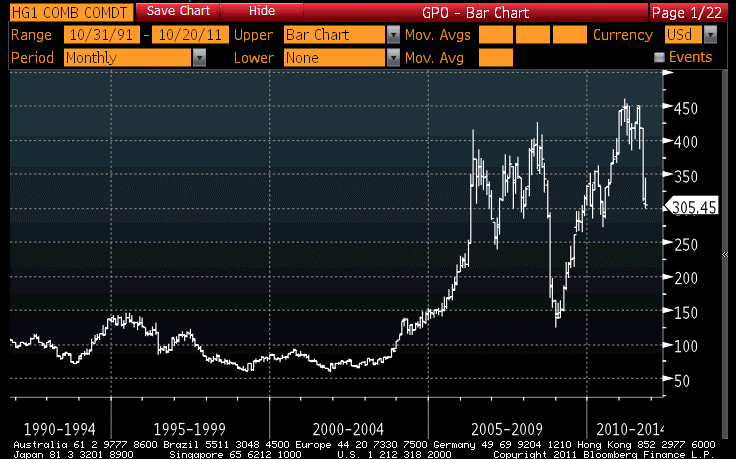
Doc Copper is feeling a little run-down himself these days.
It may seem odd, after looking at copper, to address the question, “Are Commodities In A Bubble?” True to form, perhaps, I am less interested in the answer than in a way to attack the question. Commodities are not like capital market assets such as stocks and bonds which represent an ongoing source of value and a stream of income. A bond pays a coupon or interest at maturity; a stock pays dividends or (hopefully) increases in value over time as the company retains earnings. Because these instruments have definable cashflows, even if they are speculative, they can be analyzed with tools such as net present value analysis or a dividend discount model. But commodities have no ‘yield to maturity.’ You get no dividend from Zinc. And that means we can analyze the current value of a commodity with respect to its supply and demand but otherwise relative value tools are scarce.
But wait, analyzing the current value of a commodity with respect to its supply and demand is already done through the mechanism of price discovery. In transparent markets, it is hard to argue that any particular price represents in itself a ‘bubble’ or ‘deep value.’ Unless there is some reason that prevents the market from clearing normally, the spot price will be driven by the utility of the good for the purposes of consumption.
(As an aside, the demand from commodity index funds that acquire risk through futures contracts does not, cannot, affect the spot price in a meaningful way. This is because for every long contract there is a short contract, and commodity index funds generally roll so as to never take delivery. This may affect futures prices and contangoes/backwardations, but not spot prices. On the other hand, ETFs that hold physical commodities may, by removing commodities from circulation, affect the spot price over time. But this is not a key part of what I am talking about today.)
So what should we mark commodities against? I choose: money.
Commodities, by their nature, should have a zero real return over (a long period of) time. A pile of copper remains a pile of copper. A bar of gold remains a bar of gold. Thus, if the price of a commodity changes over a long period of time, it is probably more accurate to say that it is the unit of account that is changing value. An ounce of gold doesn’t go from $500 to $1000; a dollar goes from 1/500th of an ounce of gold to 1/1000th ounce of gold. This is, of course, the argument of hard-money adherents. I don’t understand why only gold will do – and don’t want to conduct that argument – but the general point is reasonable.
So we want to compare commodities over time to money. Is the price of commodities out of line given the amount of money in circulation?
This is a harder question to answer than it sounds like. The absolute amount of M2 money has grown enormously over a long period of time. In 1959, M2 was $298bln. In 1989, M2 was $3.2trillion. In 2009, $8.5 trillion. Obviously, commodities prices have not grown anything like that amount. This is because the amount of money must grow over time to maintain a constant price level, if GDP is to keep rising. Remember MV≡PQ. If velocity is stable, and prices are stable, then M must grow with output. Of course, velocity is not stable, although M2 velocity happens now to be back in the general range it inhabited from 1960-1990. And of course, in principle, the Fed doesn’t want prices to be precisely stable, either, since a small amount of inflation is seen to have much lower costs and risks than a small amount of deflation. So if we plot M/Q, we expect to see it rise slowly over time. In fact we do, as the chart below shows (incidentally, don’t be concerned about the units on any of these costs. They are artificial; it’s the trend that matters. For example, the chart below shows how many dollars are in circulation for every dollar of output, but the axis units will be different if I use, say, 1982 dollars rather than 2005 dollars as we have here).
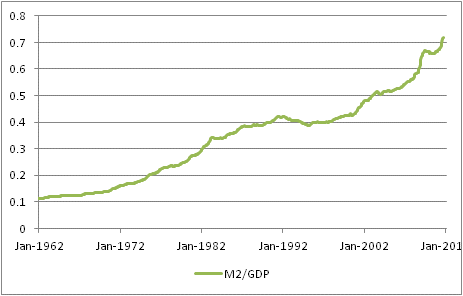
M2 compared to real GDP
So again, charts of commodities ought to look something like the chart above. There is more money in the system, but it’s really how much more money there is relatively since a larger economy needs more money just to keep prices stable.
I compare “economy-adjusted money” to commodity prices in the chart below using the CRB (which I use mainly because it has a long price history). I think a case can be made that commodities may have been ‘bubbly’ in the 1970s and perhaps in 2008 they were starting to get there, but it’s hard to look at this chart and see a big bubble now.
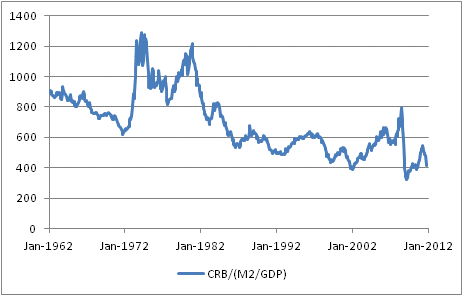
CRB compared to economy-adjusted money
Now, certain commodities might be. This is perhaps not as good a way to compare value for individual commodities because for them we also need to consider more microeconomic demand and supply and, especially, long-term changes in the supply dynamic, but we can get an idea of general trend. Live Cattle and Wheat certainly don’t look bubbly. Note that if we didn’t adjust Live Cattle, it looks very much like the M2/GDP chart: it slopes upward and to the right. Ditto Wheat, although to a lesser extent. Adjusted by “economy-adjusted money,” both of these look about fair.
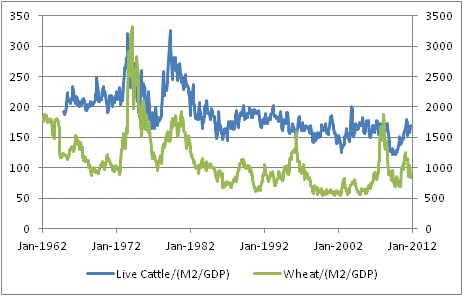
Wheat and Live Cattle (chosen for random illustration)
Crude oil between 1986 and 2003 was pretty stable, and started to look expensive thereafter. To be fair, there are some questions about long-term supply in oil (Peak Oil and all that). I won’t say anything about Gold, because whatever I say makes somebody mad. You judge. I’ve written before about how it makes some sense to think about Gold as an in-the-money straddle on inflation.

Gold and Crude Oil have more interesting stories (and they always do).
Finally, and perhaps surprisingly, I threw in two financial assets that are often thought of as inflation hedges for different reasons. The chart below shows the adjusted ratios of stock prices and median existing home sales prices to economy-adjusted money. Home prices look pretty reasonable on a long time scale; stocks less so, but of all of these charts I have the least intuition about how stocks should look through this lens.

Is this a reasonable way to 'deflate' financial assets?
So my overall perspective is that the symptom of high prices of certain commodities and of commodities in general in no way should produce a diagnosis of a bubble in commodities. Feel free to disagree and comment…I’m not saying this is the final word on the subject!
Them Thar’ Hills
The Initial Claims data this morning was a bit of a shock, coming in at 479k. The BLS said there were no special factors affecting the numbers, and explicitly said the auto-retooling distortions are probably no longer affecting the data. It’s only one week of a volatile series – and the day before Payrolls, at that – but if we get another couple of weeks like that it will begin to look like the second leg of the recession is starting earlier than expected. Equity index futures reacted negatively and the bond market opened lower while bonds rallied.
It probably had nothing to do with the day’s activity, but I also saw this headline. “Bankruptcy Filings Ticked Downward In Parts of South, But Rose 9 Percent Overall.” Despite all of the stimulus and the directed efforts to forestall filings, bankruptcies are up over the last year. They are highest in the places the real estate bubble was bubbliest, and lowest in the places where the bubble didn’t get as frothy. But overall, the fact that they are higher is sobering after so much stimulus.
Stocks eked out a moral victory but a small point loss (-0.1%), while 10y note yields fell to 2.91%. The VIX was basically unchanged; with Employment tomorrow it will likely fall again if stocks are near unchanged on Friday as the event risk passes.
That Employment report is shaping up to be fairly important. With the FOMC meeting in only a few days, it will be the last major piece of data the Committee will see. Recently, Chairman Bernanke (consciously or unconsciously) raised the importance of what is often a lagging indicator when he told Congress, “We are ready and we will act if the economy does not continue to improve, if we don’t see the kind of improvements in the labor market that we are hoping for and expecting.” Today’s Initial Claims data raises the bid even more, although as I said it is just one week.
Last month, Payrolls fell 125k, with private payrolls +83k. The Unemployment Rate unexpectedly dropped from 9.7% to 9.5%; most economists expect it to rise to 9.6% tomorrow although Daiwa and Deutsche both expect it to fall further to 9.3%. I am not sure why; it may be tactical. Last month, the ‘Rate declined mainly because the number of discouraged workers rose to a new cycle high, and as those people give up and drop out of the workforce they are not counted as unemployed. So the ‘Rate might fall if the economy is booming, or if the economy is really doing poorly. Maybe those economists want two chances to be right? For me, I’m with the consensus.
The consensus estimate for total payrolls tomorrow is for -65k, with private payrolls stronger at +90k. I am fascinated at the confidence in the continued strength of private payrolls, especially given the decline last month in average hours worked, combined with a relatively rare decline in the hourly earnings rate, and the surge in discouraged workers. Not that +90k is any great shakes, but…I’d be more worried about the first negative print since December. But all 54 of the economists surveyed expect a gain in private payrolls, from +20k to +150k. It seems more ripe for disappointment, to me.
A bad number may not necessarily be horrible for equities. I would think a decline led by selling from people who perceive bad growth as being bad for stocks might be met by buying from people who think quantitative easing Part Deux could be good for stocks. Still, given where the indices are, I don’t think I would fade a selloff.
.
So – TIPS out to 5 years have a zero real yield. What this means, curiously, is that physical commodities are now competitive in terms of return with short TIPS. Over the long term, the real return on physical commodities is, by definition, zero (you had a pile of gold; you still have a pile of gold; ergo, your return in units of gold is zero). This is why I never advocate individual commodities as investments; commodity futures indices, on the other hand, have other sources of return: the return on collateral for the contracts, the risk premium, the rebalancing return, the convenience yield, and the phenomenon of expectational variance. That’s too much to go into here, but the point is that although I have never owned an ounce of gold (or silver, copper, nor a bushel of corn), I own GSG, which is an ETF (iShares) designed to track the S&P GSCI Commodity Index.
With TIPS’ real yield around zero, however, is gold now attractive? I don’t know that I would go so far as to say “attractive,” since a 0 real yield in the long run isn’t good and you can still beat that with long TIPS, but it may also diversify a portfolio since it won’t move very much like TIPS or other assets, and that will produce a small return from rebalancing over time.
The real question, though, is whether gold is in a bubble. If it is, then you won’t get a 0 real return over time; you’ll get a negative real return once the bubble unwinds (whenever that may be). But I think there’s a cogent argument that can be made that gold isn’t in a bubble at the moment.
Let’s compare the price of gold with the price of a couple of other real assets, so we can abstract from the whole question of whether gold is a good hedge against declining greenbacks. First, let’s look at a classic relationship: the number of barrels of oil you can buy with an ounce of gold. The chart below shows the front gold contract divided by spot oil prices.
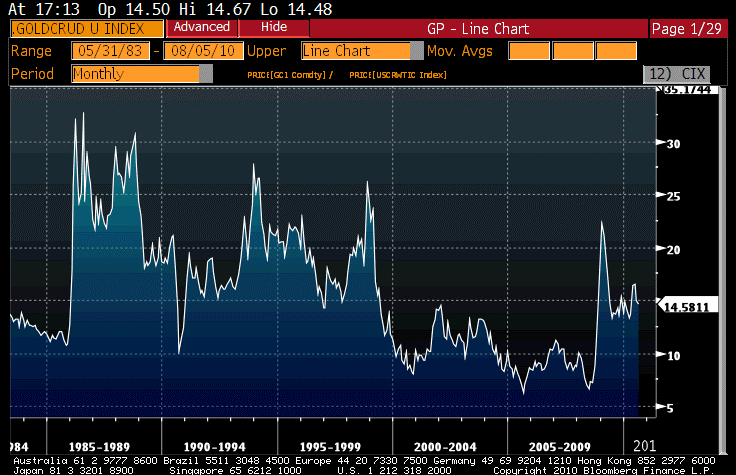
Barrels of oil an ounce of gold will buy
With two volatile series, it isn’t a big surprise that the resulting series is volatile. But it seems “fair value” here is around 15-20. You can clearly see that gold looked cheap in the early 2000s – when no one had the courage to buy it! – and remained at a fairly cheap relationship to crude as both rallied up until 2008. Then crude collapsed, too far it seems; and they are now in a comfortable relationship to one another. Either they’re both rich, both cheap, or both about right.
The next picture is gold against stocks. The picture here is less clear. Gold was clearly too expensive relative to stocks in 1980; clearly too cheap in 2000; it is hard to say that the current level for gold is outrageously high.
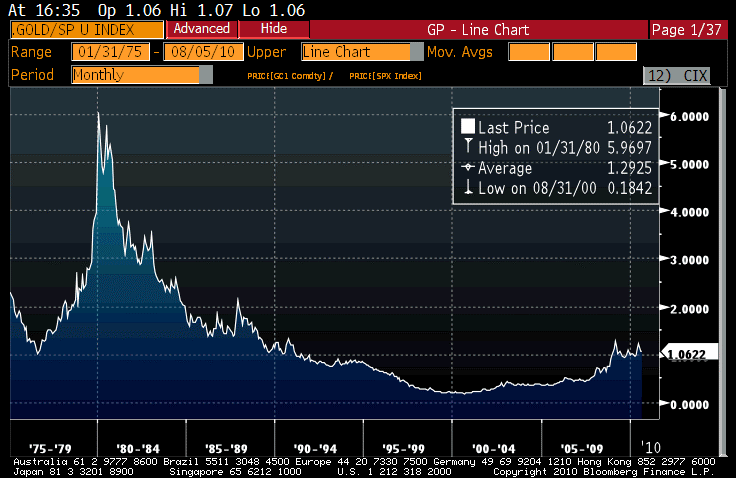
The ratio of gold to the S&P 500 index
Finally, let’s look at gold versus the median sale price of an existing home. (The axis is 1000x the actual ratio of an ounce of gold to the price of a home, because the median home price series I am using was in thousands and I figured this was more readable anyway).
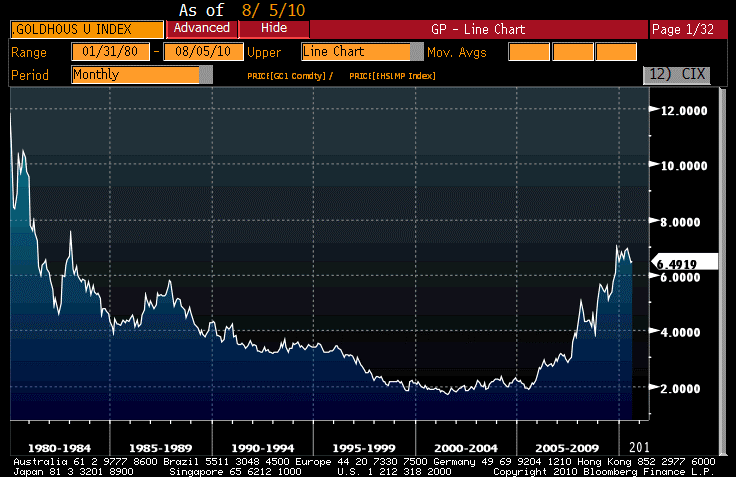
Gold/Median Existing Home Sales Prices (x 1000)
This picture is the least pleasant for gold. The long-term average looks like 4-5ish, and if you cut off the gold bubble three decades ago, it looks like gold is in uncharted territory. But I think this is the least instructive of the three. Crude is the most-similar asset: a hard commodity that trades on international exchanges. Stocks are less-similar; they pay dividends and represent heterogeneous corporate fortunes and valuations, but they are traded on international exchanges. Housing prices are least like gold. They are entirely local, and the housing stock completely changes character over time. I am not sure this last picture can tell us much about whether gold is currently overvalued or not, although it is a modest warning.
All in all, I think there are no real signs that gold is in a bubble at the moment. With real yields around zero out to the 5-year point, gold (probably through an ETF like GLD) is a defensible investment. Then again, my book also has a zero real return over time. So buy a pile of them, and sock them away in a vault with your gold. They’ll probably be worth something some day.
Just don’t let it go to your head, like in this classic episode of Gilligan’s Island!
