Archive
The Prius Economy
A bona fide growth scare is upon us.
The first inklings of the scare may have come from China, a week or two ago, or perhaps from Spain as the 10-year Spanish yield rose through 5.5% and today ended conveniently at 5.99%.
Friday’s U.S. Employment report didn’t help. In recent months, employment had been rising a lot while the Unemployment Rate fell; but on Friday’s number, Unemployment fell due to shrinkage of the Civilian Labor Force despite weak job growth. That is clearly weaker-than-expected, and disappointing to some who thought the economy was surging. To my mind, it merely continues a recent theme of slow, weak, but positive growth. Hardly a growth scare, unless you were suckered in by the equity market to think there was robust growth.
That happens a lot, especially coming out of recessions. The naturally optimistic U.S. investor, prodded by the professionally-optimistic Wall Street broker, sees rising equity prices and assumes that stocks are starting to price good times ahead. That they are, and the goal of said brokers (and Washington brokers of the power variety) is to make the perception of good times trigger the reality of good times as higher prices beget a wealth effect. If it doesn’t happen, you get a scare.
But you can’t slap a number on the side of a Prius and call it an IndyCar. We have a distinctly Prius economy at the moment (actually, it may be more of a Pinto economy in that it could burst into flames if tapped lightly).
Perhaps that’s the fundamental question at the moment: is this a Prius economy – not pretty, but it’ll get us there – or a Pinto economy – potentially disastrous, given any provocation.
TIPS voted strongly for the Pinto version, as the yield on the 10-year TIPS bond fell 7.5bps to -0.26%. That was further than the nominal yield fell: 10-year nominal Treasuries rallied only 6.5bps to 1.98% (and the reversal of the breakout to higher yields is complete). The decline in TIPS yields implies that today’s leg of the rally, anyway, was led by declining growth expectations rather than declining inflation expectations. Indeed, 10-year inflation expectations actually rose 1bp, while 1-year inflation expectations declined sharply due to a sharp fall in gasoline prices (also growth-related).
Lower long-term growth expectations and a decline in near-term inflation expectations? That sounds like the sort of cocktail that would have produced a QE3 rumor just a week ago! But equities have dropped 4.3% over the last 5 trading days, with today’s 1.7% decline the heaviest-volume day of the five. The 916mm shares traded would be feeble by any standard except that of 2012, but would you believe today was the busiest day in the stock market of the year, with the exception of the March triple-witching and the three month-ends?
Oddly, the dollar was roughly unchanged. If the growth scare is sourced from Europe but the cold is caught by the U.S., where is the safe haven? Weirdly, the answer seems to be the Yen, which represents the most over-indebted developed economy with the worst demographic issues. Go figure, but the buck has fallen from 84 Yen to 80.7 Yen over the last couple of weeks.
Personally, I think our economy is more of the Prius variety, which has been my opinion for a while. Europe continues to be a basket case, and I keep repeating my conviction that it won’t be over until it’s over over there (and, unfortunately, before it’s over the Yanks may be coming)! But the U.S. will do fine, as long as you’re not looking for a big expansion. Low growth, and possibly a mild recession, are in our future…and that’s not the worst thing that has ever happened, it just feels like it since we’ve been told to expect the equity rally to be validated by subsequent growth.
Equities remain expensive even with the mild selloff. Until a week ago, the operative analogy for me was the rally in 2010 Q3 following the Bernanke quasi-announcement of QE2 at Jackson Hole in late August. There was a pullback in that rally as well – actually a deeper one – after QE2 actually showed up, until the liquidity gusher pushed stocks higher. The problem is that although we got the anticipation of the gusher, we didn’t get the gusher. And, unless we do, I think stocks will have difficulty rallying. And if the equity market won’t rally, it very likely will decline.
If (probably when) we actually get QE, then the equity rally will resume getting over-extended and ahead of itself, thanks again to the naturally optimistic investor and the professionally-optimistic stock jockey. When that happens, it will be time to look for the Pinto moment.
Keynes, Marx, and Bernanke
These days, the glimmerings of crisis are never far away, are they? Today, the sign was a very weak government bond auction in Spain, which caused 10-year Spanish yields (Portuguese and Italian as well) to rise about 25bps. Ten-year Spanish bonds now yield 5.69%, near the calendar year’s highs although still considerably lower than the spike highs of last July and last November (see Chart).

However, during those prior episodes Spain was not merely reflecting its own fundamentals but those of its sick brethren. Compared to the German 10-year, the current spread around 400bps is just as high as it was in July of last year and only about 65-70s shy of the peak in November.
Meanwhile, in the last few days the German central bank and now the Austrian central bank have each declared that they will not accept Greek, Portuguese, or Irish bonds as collateral. Greece, remember, has been “saved” and the new bonds are supposed to be money-good; however, the yields on those bonds has risen since the exchange was made. The Feb-2023 maturity initially traded around 19% but has risen to 21.5%. If this is what healing feels like I’m sure glad we’re no longer hurting!
In the U.S., General Electric was downgraded by Moody’s to Aa3 from Aa2, and GE Capital downgraded to A1. Investors shrugged off this news, which GE claimed was due to a change in Moody’s methodology rather than a change in GE’s credit rating. That seems a risky claim, because the counterargument would be (assuming that Moody’s isn’t making their methodology worse) that GE (and more especially GECC) has been rated too highly in the past. GE stock declined in line with the broader market, although credit default swaps moved wider.
Equities dropped around 1%, largely from the news delineated above but also partially in follow-through to the “disappointment” that the Fed said exactly what they had been saying previously. However, bonds also rallied, and this wouldn’t make much sense if the main impetus for today’s movements was disappointment over the Fed’s failure to provide support for the bond market. This is why I attribute most of today’s movement to a renewed rise in the temperature of the European crisis.
Precious metals were killed, losing 4.2%, and commodities in general declined. For a change the move in commodities makes some sense, if you believe the tiny alteration of the Fed’s direction in the minutes was significant, if you think the Fed is serious, and will pull back on liquidity rather than just fail to add more, if commodities weren’t already very cheap, and if the easing of other global central banks was irrelevant. But if the decline was related to the Fed’s tilt, then at least the commodity decline is the right direction, because the adjustment in the Fed-speak (if there was an adjustment) concerned cooling the degree of monetary support; prior recent declines in commodities have come due to growth fears that I don’t think are particularly relevant right now to the outlook for commodities in the medium term.
.
I routinely deride economists who rely on the discredited notion that growth in excess of a nation’s productive capacity is what causes inflation – and, conversely, a surplus of productive capacity is what causes deflation. See, for example, here, here, and here. And that is just in the last month!
I want to point out that it isn’t that I don’t believe in microeconomics (where an increase in supply causes prices to fall and a decrease in supply causes prices to rise). I believe deeply in the supply-demand construct.
But the problem with applying these ideas to the macroeconomy is that people get confused with real and nominal quantities, and they think of the “productive frontier” of an economy as being one thing rather than a multi-dimensional construct.
When an economy reaches “productive capacity,” it isn’t because it has used up all of its resources. It is because it has used up the scarcest resource. Theory says that what should happen isn’t that all prices should rise, but that the price of the scarce resource should rise relative to the prices of other resources. For example, when labor is plentiful relative to capital, then what should happen is that real wages should stagnate while real margins increase – that is, because productivity is constrained by the scarce resource of capital, more of the economy’s gains should accrue to capital. And so Marx was right, in this sort of circumstance: the “industrial reserve army of the unemployed” should indeed increase the share of the economic spoils that go to the kapitalists.
And that is exactly what is happening now. In the banking crisis, the nation’s productive capacity declined because of a paucity of available capital, in particular because banks were forced to de-lever. Output declined, and after the shock adjustments the margins of corporate America rose sharply (which I recently illustrated here), near record levels from earlier in the decade of the 00s. And real wages stagnated. Be very clear on this point: it is real wages which are supposed to stagnate when labor is plentiful, not nominal wages.
Now, what should happen next in a free market system is that the real cost of capital should decline, or real wages should increase, or both, as labor is substituted for capital because of the shortage of capital. We indeed see that the real cost of capital is declining, because real rates are sharply negative out to 10 years and equities are trading at lusty multiples. But real wages are stagnating, going exactly nowhere over the last 36 months. Why is the adjustment only occurring on the capital side, with bull markets in bonds and stocks?
We can thank central bankers, and especially Dr. Bernanke and the Federal Reserve, for working assiduously to lower the cost of capital – also known as supporting the markets for capital. This has the effect, hopefully unintended, of lowering the level at which the convergence between real wages and the real cost of capital happens; and of course, it obviously also favors the existing owners of capital. By defending the owners of capital (and, among other things, refusing to let any of them go out of business), the Fed is actually helping to hold down real wages since there is no reason to substitute away from capital to labor!
But all of this happens in real space. One way that the real cost of capital and the real wage can stay low is to increase the price level, which is exactly what is happening. We call this inflation.
.
On the last full trading day of the week, Initial Claims (Consensus: 355k versus 359k last) represents our final chance to try and trade the Employment number before the actual number is released. ADP was right on target today, giving no clues about which way traders should lean going into Friday. I expect this means that traders will spend the afternoon trimming positions that they would be ill able to cover on Friday if there was a surprise on the Employment number. That probably means more weakness on stocks and possibly some further strength in bonds.
Inflation Stable, But Only In Passing
It’s a busy day for me, with month-end just past (and month-end was a busy day for many, with the first pan-billion-share day on the NYSE this year), but there is just too much to talk about to skip a comment today. But I will make it brief.
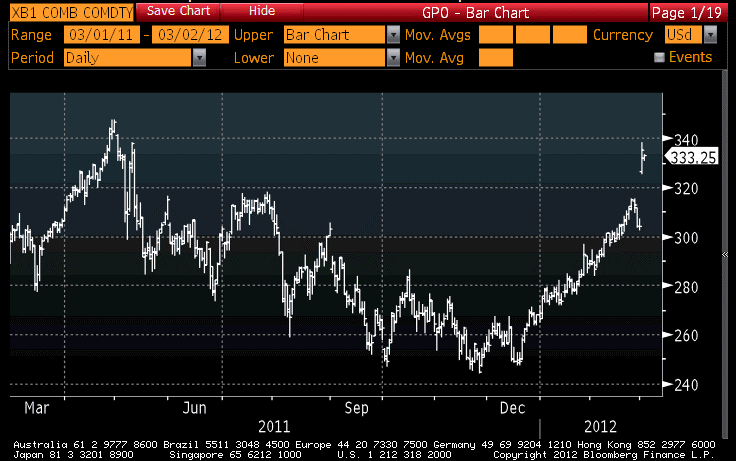
Front and center must be the huge rise in Crude Oil and Gasoline futures. Crude rose over $3 with NYMEX Crude topping $110. Some of this was due to rumors that a Saudi pipeline had been attacked and damaged, but a good portion of the run-up occurred before the rumor went around, and after the Saudis denied the rumor prices only fell back somewhat. The chart below (Source: Bloomberg) exaggerates the move in gasoline somewhat due to the fact that the front month rolled (the April contract rallied 9.45 cents/gallon, but March expired as the front month on Wednesday at $3.04 and April is now at $3.35), but however you want to look at it, this is a very high price for March 1st – in fact, the highest ever – and retail gasoline prices were already up to $3.74/gallon before this spike.
Meanwhile, the core PCE price index for January was reported this morning. While the month-on-month change didn’t round higher, the number was just enough higher-than-expected that the year-on-year number became 1.9% while economists were expecting 1.8%. Recall that core PCE is what the Fed is targeting to keep at 2.0%, and they were busy saying that the inflation dynamic had cooled (more on that later).
The Fed had previously assiduously avoided acknowledging the 15-consecutive-month acceleration in core CPI by saying that headline inflation (which they don’t normally care about) was ebbing, but now with energy prices rallying again they can’t retreat to that platitude. Core PCE is clearly still rising, and headline inflation is going to re-accelerate. I suppose Bernanke will have to focus on Nat Gas prices…that’s about the only price that’s actually falling.
Oh yes, Bernanke. Today’s second day of the Monetary Policy Report to the Congress (neé Humphrey-Hawkins) brought humor to an otherwise dry day. The Chairman was called on to defend the Fed’s extraordinary actions during the crisis (which honestly, isn’t really fair if you were busy cheering him on when they were happening, as most in Congressional oversight roles were). His defense was that (1) “we’ve had about 2.5 million jobs created,” which it turns out are the same 2.5 million jobs that the Congress and the Obama Administration say were due to their policies, (2) “We’ve seen big gains in stock prices, improvement in credit markets,” which is odd considering that he has previously claimed QE2 didn’t pump up asset markets, and (3) the actions helped produce a “more stable inflation environment.” In honor of baseball’s spring training: strike three, you’re out! I suppose a snapshot of a vase falling off a table looks stable too, as long as you don’t wait until it hits. Inflation happens to be near 2%, but that’s a coincidence of timing. It’s around 2%, on the way to someplace not particularly near 2%.
And it’s not just me who is saying so. Yesterday, Plosser was predicting the Fed could tighten policy this year and I noted a St. Louis Fed economist highlighting inflation risks; today FRB Atlanta President Lockhart predicted that if the Fed started QE3 it could cause inflation while not spurring lending. However, do not fear tighter policy yet; Lockhart considers that things have only just begun to show positive effects and just wants to ride the loan volume increase and inflationary increases for a while longer.
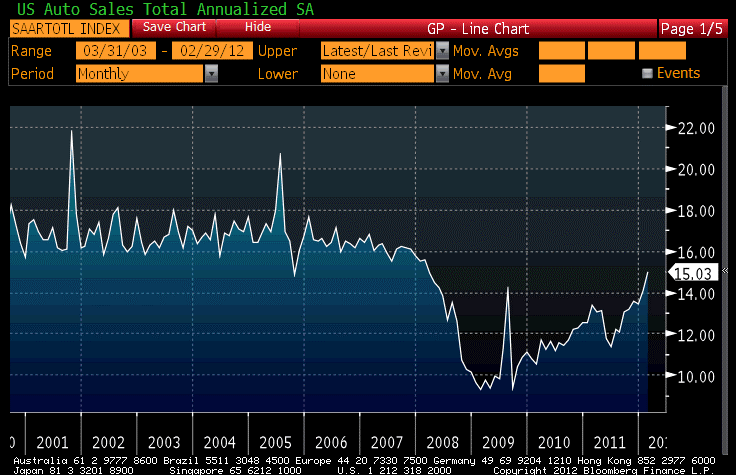
There are positive economic signs, but I fear these may be the best we see for a while. Auto sales, which have long languished at weak levels, surprised in February to post the strongest annualized sales pace since 2008 (see Chart, source Bloomberg). The level is almost back to the record levels where the car companies were bleeding losses back in the mid-2000s! The worst seems to be past for the automakers, although there is some suspicion that balmy weather (for February) helped the comparisons for the month. Still, the trend seems to be clear, for now.
Claims are improving, auto sales are improving, manufacturing is doing generally well (although ISM was weaker-than-expected today). As I’ve said for a while, the economy has been improving slowly, and at this point continues to improve steadily. However, the stock market has priced in a robust recovery, and with all of the great economic news out there we also have sharply rising energy prices and other tax increases (such as the expiry of the increased depreciation allowance, which may have helped provoke the weak Durables number this week). We also have Western Europe (and the less said about that right now, the better). There is plenty of time to bask in the good news by being short bonds (the 10y yield rose above 2%, again, today), hoping that I’m wrong about the disappointments we are going to begin to see, I think, this month.
