Archive
My December Bloomberg Radio Appearance
I’d noted in mid-December on this list that I was a guest on Bloomberg Radio on the “Bloomberg on the Economy” program with Carol Massar.
I promised to post a recording of the interview once I got it. Well, I’ve got it! Here it is, about 10 minutes. (It would be 8 minutes without my stammering. I’ll work on that.)
Thanks to the people at Bloomberg for chasing down a copy of this for me.
A Relatively Good Deal Doesn’t Mean It’s A Good Deal
I suspect that everyone has ‘default activities’ that they automatically turn to when nothing else is working. For example, when I can’t sleep and I’ve tried everything, I go downstairs and have a bowl of cereal. Some folks hit the gym when they’re frustrated. Others go shopping when they’re depressed.
And apparently, some people buy stocks when they’re not turned on by anything else.
There wasn’t any outrageously positive news today that sent the S&P +0.8% on the day. Initial Claims (371k) was slightly higher than expected (but I advocate ignoring that release in late December and most of January). The dollar dropped sharply against the Euro. I initially thought that this was because the President nominated as Treasury Secretary someone with no financial markets experience at all but a solid resumé of hard-nosed negotiations with Congress, but the Euro gained against all major currencies so it was perhaps due more to the fact that ECB President Draghi didn’t ease further at the policy meeting held today (though they were not expected to). Bloomberg blamed a better-than-expected rise in Chinese exports, but the miss was well within the usual variance for a volatile number so that seems unlikely to me.
I am not entirely kidding about the frustration that “there’s nothing else to invest in.” I was just working today on a chart for a keynote presentation I have been asked to give at the Inside Indexing conference in Boston in April (See the link here, although most of the information on the site is still the 2012 data). I have previously run this chart, showing Enduring Investments’ projected 10-year annualized real returns and risks (this is as of year-end 2012).
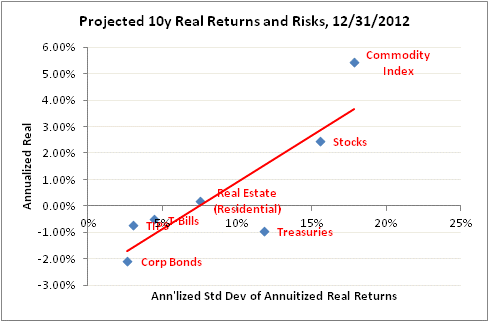
The slope of that line indicates that the current tradeoff of risk for return is 2.7:1. That is, for a 1% higher expected annualized real return, you will have to accept a 2.7% increase in the annualized standard deviation of annuitized real returns (the “right” measure of risk, as it measures the variance in the long-term real purchasing power of the investment). Now, here’s the chart as of April 23, 2003, using all the same methodology:
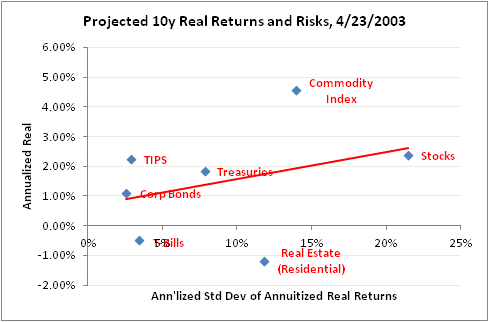
The slope of the line back then was 9.1:1. That is, in 2003 you needed to take more than three times as much risk to add 1% in expected real return to your portfolio.
But notice something else also that is very important. The change in the slope of the line didn’t come because expected equity or commodity index returns got better. Indeed, those two asset classes have roughly the same forward expected returns as they did back then, although slightly different risks the way we figure it. What happened is that the expected real returns to Treasuries, TIPS, and Corporate Bonds all fell precipitously.
Of course, this comes as no surprise to anyone, because we’ve all watched the Fed push interest rates down so far that we need extra decimal places. But I think comparing these charts you can understand a fundamental verity: people are not buying stocks because they expect awesome returns going forward (hopefully, anyway, because they’re not going to get them). They’re buying stocks because there’s less reward to buying less-risky asset classes. Which is, after all, what the Fed was trying to do (this is called the “portfolio balance channel” in monetary policymaker parlance: force people to take more risk than they want, because it’s a relatively good deal even if it’s not a good deal in an absolute sense).
.
A few other notes about today’s news:
Inflation markets were abuzz today, with inflation-linked bonds outpacing their nominal counterparts in many countries, because the UK’s ONS announced that it has decided not to change the RPI that applies to Gilt linkers (inflation-linked bonds, like TIPS). The ONS (similar to our BLS) has been studying how to make certain important technical corrections to the way the RPI is calculated to make it more accurate; these changes would have had the effect of lowering the RPI significantly. As a consequence, these bonds have been trading at higher real yields, reflecting the fact that if the ONS chose to change the RPI formulation, the yield on the bond would have to be higher to compensate investors for that change if the same value was to be delivered. That is, instead of a yield of (for example) 1% added to expected inflation of 2.5%, the yield would rise to 1.5% to reflect the expectation that measured inflation would be at 2.0%. Many investors thought it was very likely that the ONS would choose one of several options for restating RPI that would have had such a deleterious effect on the bonds.
In the event, the ONS made the wise decision that it would be unfair to change the terms of the bonds retroactively by making a significant change to the RPI, so they will release a second index called the RPIJ, which will now be the benchmark index and featured in ONS releases. But they will also continue to calculate the RPI and the existing bonds will continue to track RPI.
This is a great relief to inflation-linked bondholders the world over, because it sets a very important precedent. The U.S. Treasury has long said that if the BLS made a material change to the way CPI was calculated, it would plan to continue paying on the basis of the old-formulation CPI (if it was still available) or a suitable alternative, but many investors from time to time have worried about whether they would do that in practice. It will be harder to do so with the ONS precedent.
Because investors had thought the ONS was leaning the other way, Gilt linkers rallied a bunch. For example, the UKTI 1.25%-11/2055 rallied 10 points on the day (the yield fell by about 20bps), which is an enormous move at the long end. The 5-year linker (Nov 2017) yield fell 35bps. This is likely to have a spillover effect in US TIPS, since the latter now look much better on a relative value basis than they did previously. Anyone who was long UK linkers yesterday is probably considering 30 year TIPS at a pickup of 42bps.
Finally, in Fed news Esther George, the President of the Kansas City Fed (replacing Thomas Hoenig) was on the tape today. “Fed’s George Says Low Rates Risk Stoking Inflation Surge,” said Bloomberg. No kidding? (See here for Market News’ coverage of the same speech). At the very least, said George, the asset purchases will “almost certainly increase the risk of complicating the FOMC’s exit strategy.” Neither of those statements ought to be the least bit surprising or controversial, but it’s unusual to hear a Fed official state these things so bluntly. But she may have crossed the line with this one, which might get her ostracized at the next FOMC meeting:
Like others, I am concerned about the high rate of unemployment, but I recognize that monetary policy, by contributing to financial imbalances and instability, can just as easily aggravate unemployment as heal it.
Keep speaking truth to power, Ms. George!
One Less Good Reason to Be Bearish On Inflation
If you’re bearish on U.S. inflation, I think your view boils down to one of the following arguments:
- I think growth will remain soft, or we might even slip into another (global?) recession. You can’t have inflation without too-rapid growth, so inflation isn’t going to happen.
- I think inflation expectations are well-anchored, and actual inflation only happens if people start expecting inflation and so adjust their demands for wages and/or prices.
- I perceive that wage growth is weak, and so there is no ‘cost-push’ inflation.
- Although money supply has been growing at a 7-10% pace for the last couple of years, money velocity has been declining. It is likely to continue to decline while banks and sovereigns are under structural pressure to de-leverage.
- I trust the Fed to tighten in time. I’m not sure what ‘in time’ means, but I figure they know what they’re doing.
- I think the whole darn thing is going to collapse.
You are entitled to hold any of those views, of course.
If #5 represents your view, I can’t help you. If #6 is your view, then there’s not much that can be done anyway. If #1 is your view, I won’t bore you with a recitation of the arguments I’ve presented before that suggest growth and inflation are correlated only spuriously and that the proposition that growth is the dominant consideration when forecasting inflation can be considered refuted (for example here, here, and here). #3 is more defensible, in my mind, since the evidence on leads/lags of wages versus prices is not conclusive although it seems to me that wages tend to follow prices, rather than lead them (there are some clear examples of wages following prices, and there are some times that they appear to move simultaneously, but I am not aware of any clear examples of prices following wages). #2 is not disprovable, since we don’t have a way to measure inflation expectations directly that is very useful (see here for a thorough discussion, and here for a shorter discussion). Therefore, while it may turn out to be true, I think this boils down to a question of faith, like #5.
So, to my mind, the most plausible argument that inflation is not going to be a concern – despite the fact that monetary policy stimulus is being applied around the globe to an unprecedented degree – is the supposition that money velocity is going to continue to slide for structural reasons for a long time. While U.S. banks have been growing commercial bank credit again at pre-crisis rates for the last year or so (see Chart below, source Fed Board of Governors), this may partially reflect a gain in lending market share versus European banks because the latter have been under severe pressure for the last year.

Global inflation ought to depend on global velocity as much as global money supply, which led me to write back in August that
If you want to make a case for slowing U.S. inflation, I do not believe you can look to the U.S., but rather must look to Europe. If domestic lending (and hence velocity) is rising partly because European lending (and velocity) is contracting, then some of the inflation potential is being sucked out, at least temporarily, by financial and credit strains in Europe.
In my view, the only plausible way we get appreciably lower inflation is if central banks abruptly stop quantitative easing (I don’t think there’s any measurable chance that they tighten) and the velocity of money in Europe (and Japan) drops faster than the velocity of money in the U.S. rises.
The reason I bring this up now is that one of the ‘negative tail’ outcomes became significantly less plausible yesterday after the Basel liquidity rules were delayed (for four years) and softened (by changing the definition of what assets are ‘liquid’).
Regardless of whether or not that increases the vulnerability of the banking system to another credit crisis (it surely does), it lowers the banks’ cost of funding a loan and thus, all else being equal (which it surely is not), should lead to a greater loan volume at any interest rate. In my view, this significantly reduces the likelihood that money velocity in Europe will collapse further (at least for a while) as banks hoard capital, and thus removes as I said one of the ‘negative tail’ outcomes from the list of active concerns.
Breakevens responded positively to this news, as did the equities of European bank stocks, especially ones such as Natixis and Commerzbank which have been under pressure for a long time. Commodities also rose, for a change: this year, commodities have had an awful start to the year despite the roaring of equities out of the gate. The chart below (source: Bloomberg) shows that the ratio of the S&P to the DJ-UBS index has now exceeded the highest relative valuation of the last year, and indeed the highest relative valuation of the last ten years.

By now, my suggestion should not be surprising – commodity indices are the place to position for a bad inflation event. A continuation of low and stable inflation in conjunction with a generous financing environment (if, for example, core inflation retreats gently to 1.75% or so even though central bankers continue to ease) will push this relationship further in the direction it has recently headed. The market is pricing in just such an outcome. An adverse outcome will likely cause a reversal of this relationship, implying a great outperformance of commodities relative to equities over the ensuing several years.
It’s anybody’s guess when and if that will happen, but as noted above I think one argument for the long-stocks/short-commodities trade has just receded.
Were the FOMC Minutes Really That Hawkish?
I suppose I need to say something quickly about the FOMC minutes which were released yesterday, because the markets are seemingly gyrating on a “surprisingly hawkish” reading of them. The dollar is rising strongly, and part of the reason that equities slid in the afternoon yesterday was that it was perceived the Fed wouldn’t be endlessly doing QE.
The “surprisingly hawkish” part allegedly comes from this quote:
In considering the outlook for the labor market and the broader economy, a few members expressed the view that ongoing asset purchases would likely be warranted until about the end of 2013, while a few others emphasized the need for considerable policy accommodation but did not state a specific time frame or total for purchases. Several others thought that it would probably be appropriate to slow or to stop purchases well before the end of 2013, citing concerns about financial stability or the size of the balance sheet. One member viewed any additional purchases as unwarranted.
Various reports today focused entirely on this phrase. Bloomberg, for example, said “Fed board members said they will probably end their $85 billion monthly bond purchases, known as quantitative easing, in 2013, according to minutes of their Dec. 11-12 meeting released yesterday.” Of course, they said nothing of the kind. This paragraph followed an extensive discussion about “several persistent headwinds” including the likelihood of tighter fiscal policy, and “[t]he staff viewed…the risks as skewed to the downside.” There is far more negative in these minutes than there is positive. This illustrates the danger of taking a single quote out of context.
But what is even more important is this: the Evans Rule is now parameterized. The statement about when officials think that QE will end is simply a statement about when they think the parameters will be realized. But who cares? Private forecasters are no worse than Fed forecasters! Personally, I thought that we’d breach those parameters fairly quickly, and my note on the subject was called “Objects In Mirror May Be Closer Than They Appear.” The error here seems to be that people expected QE-infinity really meant that the Fed would be easing forever, and that was incorrect a couple of weeks ago…not yesterday.
In any event, it doesn’t matter because the real question isn’t how much more water they add to the vat (that is, sterile reserves) but how (and if) they are able to remove the water that is already in the vat – which is trying very hard to get through the valve into M2. Again, I urge readers who took the end of the year off to look at my piece on this topic, “What Will the Fed Do When It’s Finally Time To Tighten?” Money supply is accelerating again, +8.25% over the last year. And European M2 in November (numbers just out recently) accelerated to the fastest y/y pace since 2009.
If this makes investors concerned about the sketchy valuations of fixed income and stocks, then good – those markets are frothy and I will welcome prices where long equity investing holds more long-term promise than it currently does. But the reaction to the minutes, in my view, is mostly a case of people failing to understand Fedspeak.
Off With A Bang
After 2012 ended with more than the usual amount of whimpering (although not from investors, who saw gains in equity as well as bond markets), 2013 has begun with a bang.
The fiscal cliff has become more of a fiscal slope, with tax increases on high-earners in the form of higher marginal rates, and on all other earners in the form of the expiration of withholding tax cuts. (Hence, the ‘middle class’ that was supposedly protected in this deal is apparently defined as the jobless.) The spending cuts were delayed for two months, so that the impact of these tax increases – as well as tax increases associated with the implementation of Obamacare – is the only part of the “fiscal cliff” that will be immediately felt.
However, in two months there will be another showdown over spending and the debt ceiling, with more uncertainty for investors and consumers.
Now, it may be that this works out to be clever. If the economy continues to gain strength, then it will be easier to cut spending in two months than it is now. And, if the economy is really booming as much as some say, the budget cutting should be aggressive (since, after all, if we can’t balance the budget during boom times, when can it be balanced?). Color me skeptical on this point, although as I said in my wrap-up comment last year I think 2013 will be a better year in terms of growth than 2012 was.
It is certainly beginning that way; or, rather, I suppose 2012 ended with some momentum. The December ADP figures showed a 215k increase in payroll jobs, and an upward revision to November’s data. The 215k number was above expectations, and the highest figure since the spring. Be a bit cautious in extrapolating that surprise to tomorrow, however, as the data suggest there has been insufficient seasonal adjustment in December for the last few years. (December usually sees lots of hiring, and January lots of firing; by adjusting for this tendency we should eliminate this tendency from the data. However, the absolute scale of the hirings/firings at this time of year is so large that seasonal adjustment is very difficult. The BLS tends to be more successful at it than ADP, so all else being equal I would be wary of the possibility that tomorrow’s Payrolls data (Consensus: 153k) falls short of the newly-raised expectations…the consensus of the 15 economists on Bloomberg who updated their forecasts today after ADP is 180k, rather than 153k.
Nevertheless, the economy is indeed expanding. I would even say that it is expanding faster than I would have hoped a couple of months ago. (That isn’t to say that the current pace is torrid, but rather that I am a congenital sourpuss, a consequence of being a bond guy who wants my money back rather than an equity guy who dreams of sugarplums).
The rotten part, from investors’ perspective, is that the stock market and the corporate bond market have already priced in great growth results, and bond markets haven’t yet. That’s how you get both bonds and stocks doing well in 2012, after all.
The question for buyers of the equity market is, how much better can companies do? The chart below (Source: Federal Reserve Z.1) shows that as of Q3, after-tax corporate profits stood at a post-war record of 12.6%. This was actually an increase over levels that were already lofty.

To be sure, this ratio can fall without corporate profits themselves declining – if, going forward, national income expands at a rate faster than profits, then this ratio will decline. Question: do you think that the market would react well to earnings growth of 1% when the economy is growing at, say, 3%? Me either.
On the fixed-income side of the ledger, interest rates have done some important technical work recently. Ten-year nominal bond yields have risen 30bps in the last month, and the 1.91% rate on 10-year Treasuries is the highest since May. Even more interesting is the fact that this movement in nominal rates has come completely from a rise in real yields (recall that nominal yields equal, approximately, the sum of real yields and a priori inflation expectations), which have also risen 30bps over the last month. Ten-year real yields (TIPS) are now the highest they have been since August, at -0.61%. Moreover, this is the first time that 10-year real yields have risen at least 30bps from a prior yield low since October 2011 (see chart, source Bloomberg).

The fact that inflation breakeven expectations, while near the highs of the last few years, have not risen further in this fixed-income selloff suggests that the selloff is being driven more by growth expectations (which most directly impact real yields) than by inflation fears. That seems consistent with the anecdotal chatter. It seems that investors, for now, are comfortable with long-term breakeven inflation around 2.5% and inflation swaps (a purer measure of inflation expectations) around 2.75% at the 10-year point. There are sellers there, for now. The discontinuity will likely be abrupt, when it happens, but at the current rates TIPS have plenty of room to weaken further and provide the majority of the nominal-yield increase.
I still think there will be an abrupt discontinuity, although the Fed continues to be very confident (as the FOMC minutes released today showed) that inflation expectations are “well-anchored.” They are until they aren’t, I guess. For their sake, I hope the anchor drags along, rather than simply snapping off.
