Archive
The Boredom Always Ends
After fairly boring trading through the first half of the month, the equity market has shot to new highs over the last few sessions. Could it be mere boredom on the part of investors, who are seeking more excitement?
Stocks have been expensive for a while, with Shiller P/Es near 25, yet the battle cry among bulls has been “but look, the trailing P/E is still low.” Although the trailing P/E recently has incorporated earnings that represented unusually high margins (see chart, source Bloomberg), the “see no evil” crowd brushed that complaint aside. But now, the trailing P/E ratio of the S&P 500 is at 17.6, and at 18.7 before the write-off of “extraordinary items” (which, while extraordinary for any given company in a given year, are not extraordinary for the index of a whole, which always has some of these write-offs).
 So it isn’t as if the equity market is now rising because earnings have been rising and prices are just catching up. The trailing P/E is now at a level slightly higher than it was prior to the 2007 top, and on par with the levels of the Go-Go Sixties prior to the malaise of the 1970s (see chart, source Bloomberg). Let us not forget that earnings quality isn’t what it once was, either. And again: I am not a fan of a 1-year trailing P/E; I am merely pointing out that even this bullish argument is going away.
 To be sure, trailing P/Es aren’t at the pre-crash levels of 1987 or 1999 – but, again, let us recall that margins are at cyclical highs, so that if we look at the S&P price/sales ratio, we again get a disturbing view that has equity valuations higher than at any time other than the 1999 bubble run-up. (See chart, source Bloomberg – note that Bloomberg history for this series only goes back to 1990.)

Now, some observers will draw exaggerated offense to the notion that stocks might be priced for somewhat poor forward returns, and insist that the recent rally in bonds means that the ratio of the “Earnings yield” to bond yields is merely being maintained. Aside from the fact that this “Fed model” is explanatory rather than predictive (that is, it helps explain why prices are high, while not suggesting they will remain high…and indeed, rather suggesting the opposite as future returns are inversely correlated with the P/E of the starting point of the holding period), we also can’t give credit for the equity rally to the bond market rally this year from 3% 10-year yields to 2.50% yields without simultaneously asking why investors didn’t sell stocks when yields rose from 1.70% to 3% last year.
Admittedly, I was probably saying roughly the same thing at this point last year. Sour grapes? No, it just concerns the question of investing rules versus trading rules. In other words: I’m not telling you how to vote; I’m telling you how to weigh. Nothing has changed valuation-wise since last year, other than the fact that the market as a whole is growing more expensive.
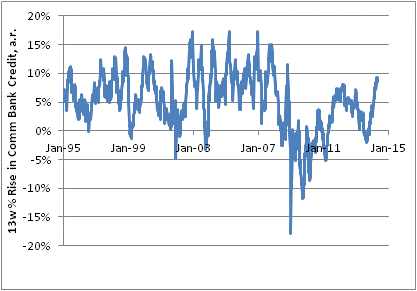
On the “good news” front, corporate credit growth has been re-accelerating again. This is somewhat of a sine qua non for faster economic growth. We had seen decent credit growth in 2011 and into 2012, but when QE3 kicked off loan activity had ebbed. But now quarterly growth in commercial credit is nearing a 10% annual rate (see chart, source Board of Governors), something that hasn’t happened since the beginning of 2008 – other than for a brief spike around the crisis itself.
While this is good news, it is not unmitigated good news considering that the Federal Reserve as yet has no viable plan for exiting QE before all of those horses leave the barn. One of the biggest concerns, in terms of a risk of unpleasant surprise, is that few seem to be giving the inflation risk much thought, either in markets where 10-year inflation swaps float in the middle of the 2.40%-2.60% range they have occupied for the last twelve months, or in policymaker circles. This is on my mind today because I was reading an article published on the BLS website entitled “One hundred years of price change: the Consumer Price Index and the American inflation experience” and ran across this passage:
“Why the return of inflation when it seemed to be guarded against and feared? One possibility is a change in the perspective of policymakers. Some have argued that inflation was tempered in the 1950s by a Federal Reserve that, believing that inflation would reduce unemployment in the short term but increase it in the long term, was willing to contract the economy to prevent inflation from growing. By the 1960s, however, the notion of the Phillips curve, a straightforward tradeoff between inflation and unemployment, ruled the day. Citing the curve, policymakers believed that unemployment could be permanently reduced by accepting higher inflation. This view led to expansionary monetary and fiscal policies that in turn led to booming growth, but also inflationary pressures. However much policymakers professed to fear inflation, the policies they pursued seemed to reflect other priorities. The federal government ran deficits throughout the 1960s, with steadily increasing deficits starting in 1966.
Aside from the dates, it strikes me that this paragraph could have been written today. The Phillips Curve, now “augmented,” is still a key tool in the Fed economist’s toolkit even as responsible control of the money supply is deemed passé. As for accepting higher inflation the FOMC changed its inflation target a couple of years ago to be 2% on the PCE, which was implicitly a bump higher from the previous 2% CPI target since PCE is normally 0.3% or so below CPI, and various officials have mooted the idea of letting price increases exceed that rate “for a time” since expectations are well-grounded. And then, of course, you have economists like Krugman arguing for a higher inflation target. Not that we ought to pay any attention to Krugman, but somebody invited him to speak at that conference and that suggests he still has credibility somewhere.
I must say that I don’t believe in an end to history, in which a permanent and pleasant equilibrium exists in capital markets and economies, which both can continue to expand at a reasonable pace with low and fairly stable inflation and interest rates and generous profit margins. If I did believe in such a thing, then I might think that we had arrived; and then perhaps I would see equity multiples and bond yields as reasonable and sustainable. But I do not, because I have already lived through three periods where the VIX was in the 10-12 range: in the 1990s, in 2005-2007, and in 2013-2014. The first two periods produced very exciting finishes. The boredom always ends, and usually abruptly.
Hot Button Issue: Rant Warning
We all have our hot button issues. It will not surprise you, probably, to learn that mine involves inflation. For the rant which follows, I apologize.
Reasonable people, smart people, learned people, can disagree on how precisely the Consumer Price Index captures the inflation in consumer prices. And indeed, over the one hundred years that the CPI has been published such disagreements have been played out among academics, politicians, labor leaders, and others. The debates have raged and many changes – some large, some small; some politically-driven, most not – have occurred in how prices have been collected and the index calculated. If you are interested, really interested, in the century-long history of the CPI, you can read a couple of histories here and here.
If someone is not interested in how CPI is calculated, in how and why changes were made in the methodological approach to calculating price change, then that’s fine. But if a person can’t spend the time to learn the very basics of this hundred-year debate, during which changes were made in the CPI with much public input, not in a smoky back room somewhere, then I wonder why such a person would spend time spewing conspiracy theories on the internet about how the CPI doesn’t include food and energy (um…it does), about how the CPI underestimates prices because it doesn’t account for changes in quality and quantity (um…it does), or about how sneaky methodological changes have caused the CPI to be understated by 7% per year for thirty years.
Recently, the CFA Institute’s monthly magazine for CFA Charterholders was duped into accepting an article that brings together some of the dumbest theories into one place. At some level, the article asks the “interesting” question about whether a consumer price index should include asset prices. Interesting, perhaps, but asked-and-answered: assets are not consumer goods but stores of value. If you are not consuming something, then why would you ever expect it to be included in a consumer price index? You might argue that we should include asset prices into some other sort of index that measures price increases. But we already do. They are called asset price indices, and you know them by names like the S&P 500, the NCREIF, and so on.
Worse, the magazine gives a great big stage to the person who has singlehandedly done more to confuse and anger people, to poison the well of knowledge about inflation, and to stir up the conspiracy theorists about inflation, than anyone else in the world – and all because he is selling an ‘analysis’ product to those people. I won’t mention his name here because I don’t want to advertise his product, but he claims that the CPI is understated by “about 7 percentage points each year.”
That this is being published in a magazine of the CFA Institute is almost enough for me to renounce my membership. It is offensively idiotic to claim that the CPI may be understated by 7% per year, and simple math (which CFA Charterholders were once required to be able to perform) can prove that. If inflation has risen at a pace of around 2.5% per year over the last 30 years, it implies the price level has risen about 110% (1.025^30-1). This seems more or less right. But if inflation had really been 9.5% per year, as claimed, then the cost of the average consumption basket would have risen about 1422% (1.095^30-1).
Can that be right? Well, Real Median Household Income, using the CPI to deflate nominal household income, has risen about 13% over the last 30 years. http://en.wikipedia.org/wiki/File:Median_US_household_income.png But if we use the 9.5%-per-year CPI number, then real median household income has actually fallen 84%. If this was true, we would be living in absolute Third-World squalor compared to how things were in the salad days of 1984. You don’t have to be an economist to know the difference between a slightly-better standard of living and one in which you can afford 1/6th of what you could previously afford. You just need a brain.

Any person who does even rudimentary research on the CPI – say, visiting http://www.inflationinfo.com and reading some of the hundreds of papers gathered there, or perusing the BLS website, or speaking with an actual inflation expert – cannot possibly think that this guy is anything other than a nut or a shill. It is a tragedy that the CFA Institute would publish such trash, and it tarnishes the CFA Institute brand. Let’s hope they publish an apologetic retraction in the next issue.
I also like to point out, when I am in rant mode over this (and, as an aside, let me thank the tolerant reader for allowing me to rant – this allows me to forever point people to this link when they bring up this guy), that if the CPI=9.5% number is right then you must also believe a bunch of other ridiculous things:
First: MIT is in on the conspiracy. The Billion Prices Project, which uses very different methodology from the BLS, figures inflation to be about the same as the BLS does. (Digressing for a bit, I think it’s also interesting that the BPP index has tracked Median CPI much better than headline CPI over the last year, when headline CPI has been dragged lower by one-off changes in medical care prices).
Second: Consumers consistently underestimate inflation, or else are serially optimistic about how it is likely to decline from 9.5% to something much lower. The University of Michigan survey of year-ahead inflation expectations – and every other consumer survey of inflation expectations – is much closer to reported inflation than to the shill’s numbers (see chart below, source Bloomberg). I’ve written elsewhere about why consumers might perceive slightly higher inflation than really occurs, but I cannot come up with a theory that explains why consumers would always say it’s much lower than what they are in fact seeing. Maybe we’re all stupid except for this guy with the website.

Third, and related to the prior point: Investors who pour money into inflation-indexed bonds must be complete morons, because they are locking up money for ten years at what is “really” -9% real yields (meaning that they are surrendering 62% of the real purchasing power of their wealth, rather than spending it immediately). We don’t see this behavior in countries where it is known that the official index is manipulated. For example, we know that in Argentina the inflation data really is rigged, and in September of last year long-dated inflation-linked bonds in Argentina were showing real yields of more than 20%. In recent months, the government of Argentina has begun to release figures that are much more realistic and real yields have plunged to around 10% as investors are giving the data more credibility. The upshot is that we have bona fide evidence that investors will base their demanded real yields on the difference between the inflation index they are being paid on and the inflation they think they are actually seeing. The fact that we don’t see TIPS real yields around 6% or 7% is evidence that investors are either really stupid, or they believe the CPI is at least approximately right.
Fourth, and related to that point: if inflation has really being running at 9.5%, then every asset is a losing proposition. There is no way to protect yourself against inflation. You’re not really getting wealthy as you ride stocks higher; you’re only losing more slowly. Since there is no asset class that has returned 10% over a long period of time, we are all doomed. The money is all going away. Especially housing, and real goods like hard commodities – there is nothing you can do that is much worse than holding real stuff, which is only going up in price a couple of percent per year over time while inflation is (apparently) ravaging everything we know and love. There is no winning strategy. Of course, the good news is that it turns out that the U.S. government is being extremely fiscally responsible, with the real deficit falling by 5% or more every year. Right.
I really should not let this bother me. It is good for me, as an investor with a brain, when mindless zombie minions follow this guy and do dumb things in the market. But I can’t help it. The Internet could be a tool for great good, allowing people access to accurate, timely information and the opportunity to learn things that they couldn’t otherwise. It allows this author to come into your mailbox, or onto your screen, to try to educate or illuminate or amuse you. But there is also so much detritus, so much rubbish, so much terribly erroneous information out there that does real harm to those who consume it. And perhaps this is why I get so exercised about this issue: I absolutely believe that people have a right to say and to believe whatever they want, no matter how stupid or dangerous. I am simply aghast, and deeply saddened, that so many people are so credulous that they believe what they read, without critical thought of their own. Everyone has a right to his/her opinion, but they are not all equally valid. There is no FDA for the Internet, so snake-oil salesmen run rampant among their eager marks.
I want my readers to think. If you all agree with me, then I know you’re not all thinking! Look, it is perfectly reasonable to suggest that some minor improvements can be made to CPI. The number has been tweaked and improved for a hundred years, and it will be tweaked and improved some more in the future. It is in my opinion not reasonable to suppose that the number is completely made up and/or drastically incorrect. And that’s my opinion.
Deflation, Indeed!
Today’s post-CPI update is later than usual (normally, on CPI day I ‘tweet’ my impressions as I have them). A prospect meeting got in the way – yes, isn’t it interesting that there is demand for creative inflation-linked solutions?
Probably, after today, this will be a trifle less surprising. Core inflation surprised on the high side. Consensus had been for the month-over-month figure to be +0.1%; instead it printed +0.236%. This pushed the year-on-year core inflation rate to 1.826%, the highest it has been in a year…and yet still the lowest it is likely to be for a very long time.
So, with the wonderful perfection of timing that is only possible from elite policymakers, the Fed has begun to chirp about deflation fears at just exactly the time that core inflation is turning higher. Do recall that core inflation never got below 1.6% – very far from “deflation” – and was only that low because of well-known effects stemming from the impact of the sequester last year on Medicare payments. Median inflation, which eliminates the influence of small outlier decreases (and increases) on the number, scraped as low as 2.0%, and now sits at 2.2%. It has not been higher than that since mid-2012. Median inflation hasn’t been higher than 2.3% since 2009, so it is fair to say that inflation is much closer to the highs of the last five years than to the lows. Deflation, indeed.
A closer view of the subcomponents do not give any less cause for concern. Of the eight major subcomponents, six (Food & Beverages, Apparel, Transportation, Medical Care, Recreation, and Education & Communication) accelerated on a year-over-year basis while only two (Housing and “Other”) decelerated.
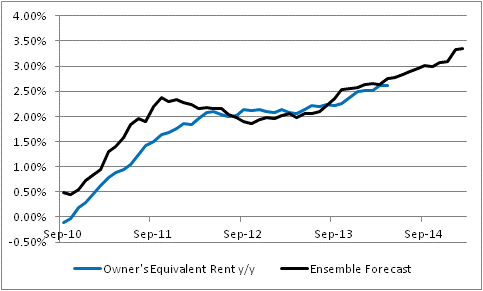
At first glance, that sounds promising. Housing inflation dropped to 2.5% from 2.8%, and those people who are worried about another housing bust right now will be quick to seize on that deceleration. Housing inflation, which is 41% of the total consumption basket, has been a primary driver of core inflation’s recovery in recent months so a deceleration would be welcome. But a closer look suggests that the number for Housing overstates the ‘deceleration’ case considerably. “Fuels and utilities,” which is 5.2% of the entire consumption basket and about 1/8th of Housing, dropped from 6.8% y/y to 4.2%. That was the entire source of the deceleration in housing. The larger pieces, which are also much more persistent, were higher: Primary rents rose from 2.88% y/y to 3.05% y/y, while Owners’ Equivalent Rent was roughly flat at 2.62% compared to 2.61%. So it is perhaps too early to panic about deflation, since the rise in OER and Primary rents is right on schedule as we have been marking it for some time (see chart below, source Enduring Investments).
Outside of housing, core inflation accelerated as well. Core ex-Shelter rose to 1.16% from 0.90%. The inflation is still significantly in services, as core commodities are still only -0.3% year/year. But that will rise soon, probably starting as soon as next month, based on our proxy measure.
As has been well advertised, the temporary depression in Medical Care inflation growth has officially ended. Now that April 2013 is out of the year/year data, the Medical Care major group saw prices rise 2.42% over the last year compared with 2.17% y/y a month ago. Medicinal drugs are at +1.70% compared with +1.44%. Medical equipment and supplies -1.39% vs -1.53%. Hospital and related services +5.55% vs 4.69%. I don’t see the deflation, do you?
This rise in CPI was broad and deep, with nearly 80% of the lower-level indices seeing increases in the y/y rate. It is hard to find any major component about which I would have to express concern, if I was a Federal Reserve official worried about deflation. The breadth of increase is itself a signal. When some prices go up, it is a change in relative prices and will be considered inflation by some people (those who are sensitive to those prices) and not so much by others. But “inflation” is really about a general rise in prices, in which most goods and services participate. As I mentioned above, not all goods prices are participating but in general most prices are rising and, if this month is any gauge, accelerating.
We should hesitate to read too much into any one month’s inflation number. There is a lot of noise in any economic data, so that it can be hard to discern the signal. I believe that there is enough underlying strength here that this is in fact more signal than noise, though, and so I continue to expect core inflation to accelerate for the balance of the year.
I have no idea how long Fed officials will continue to fret about deflation, nor how long it will take the concern to shift to inflation. I suspect it will take a long time, although the stock market today seems less certain on that point with the S&P at this writing down -1.3%. Curiously bonds, which are clearly overvalued if inflation is not contained, rallied today (although breakevens predictably widened). But I think all markets are safe for some time from the risk that central bankers will develop a concern about inflation that is acute enough to spur them to action. (Not to mention that it isn’t at all clear to me what action they could take that would have an effect on the inflation dynamic in any reasonable time frame given that excess reserves must be drained first before any tightening has teeth). This does not mean that I am sanguine about the prospects for nominal asset classes such as stocks and nominal bonds – but at some point, they won’t need the Fed’s cudgel to persuade them to re-price. When inflation is obvious enough to all, that will be sufficient.
Evaluating the New Kid
Part of the assessment of a new Federal Reserve Chairman always involves trying to figure out if the new person says particular things because they are wily, and cagey, or because they don’t really have a good idea of what they’re doing.
For example, when Chairman Bernanke said on “60 Minutes” that he was “100 percent” certain that the Fed could stop inflation from happening, some people thought he was being clever and projecting the great confidence that investors presumably needed to hear from the Fed Chairman at that time. I didn’t buy that, and rather thought that anyone associated with real-life financial markets (as opposed to models) would never attach a 100% probability to anything, and certainly not something that had never been tried. Subsequent events showed that the latter was probably closer to the truth, as the Fed went from reassuring the world that it could exit whenever it was warranted, to claiming that no exit – in the sense of needing to reduce its balance sheet – was necessary. That transition in message was largely due to the slowly-developing realization that in the real world, you can’t sell $2 trillion of securities as easily as you can buy them when the Treasury is going the same way.
We are going through a similar process of “market vetting” with Yellen. Her decision to stay the course on the taper – which is surely the right course – could be wise, or it could simply be that she doesn’t make decisions very quickly. It isn’t clear right now which of these is the case.
However, I find her recent talk about inflation to be disturbing. Yes, of course we all know that she is a dove. And, given her historical record on monetary policy topics, I don’t expect her to be as concerned as others (such as Allan Meltzer in today’s Wall Street Journal) are about the prospects for inflation – in other words, I expect her to be late and slow to respond. And that theme got no lack of support today, when Yellen remarked in testimony before the Joint Economic Committee, that “In light of the considerable degree of slack that remains in labor markets and the continuation of inflation below the Committee’s 2 percent objective, a high degree of monetary accommodation remains warranted.” Certainly, that is no surprise, and neither is her assertion (scary though it be) that “In particular, we anticipate that even after employment and inflation are near mandate-consistent levels, economic and financial conditions may, for some time, warrant keeping the target federal funds rate below levels that the Committee views as normal in the longer run.”
I’m not too keen when the Chairman basically promises to keep interest rates below neutral levels even when unemployment and inflation are at normal levels; that’s essentially a promise to raise inflation to a level higher than the Fed’s longer-term goal. Moreover, I am also unsure still whether the Chair is fully informed with respect to the current level and trajectory of inflation itself. It is soothing to hear her acknowledge that “inflation will begin to move up toward 2 percent” (headline inflation will exceed that level eight days from now, and median inflation is already above that standard so this isn’t a difficult projection for an economist) but Dr. Yellen seems to be unaware that the main reason that core PCE and CPI inflation is below 2% today is due to the fact that in April of last year, Medicare slashed prices paid to doctors due to sequester-induced cuts. Bernanke has noted this previously, and it isn’t exactly a state secret…then again, come to think of it state secrets aren’t what they used to be. But talking about persistent inflation below 2%, when there is very little chance of that, makes me wonder whether she’s really attuned to what is happening with prices. CPI and PCE are not the right indicators to be looking at right now – a point also made clearly by the deviation over the last year of PriceStats inflation from CPI inflation (see chart, source PriceStats).

If it were Bernanke talking, we would assume that he knows where the numbers actually are and is just trying to talk the market to his way of thinking. Greenspan was a notorious numbers wonk so there is no doubt that he would know the context of what he’s talking about. But with the new Chair, we don’t really know. It may be that, since she knows she’s keeping rates down for a long time regardless of what happens, she isn’t getting too fine about the details right now. Or it may be that she is alarmed and doesn’t want to let on (I doubt this). It might even be that she doesn’t really know much about inflation, and given her past remarks on the subject of LSAP and policy stimulus – linked to above – that is a possibility we cannot truly refute at this point.
The Fed is already a year or more behind schedule when it comes to removing accommodation in time to prevent an uptick in inflation. I am looking for evidence that they know that inflation will not arrest the moment they decide they are concerned, but I can’t find it. This should worry us all.
Patience is a Pain
If it seems that the frequency of my posts has diminished of late, it is no illusion. There are many reasons for that, many business-related, but there is at least one which is market-related: a three-month-long, 20bp range in real and nominal yields and a year-to-date S&P return that seems locked between +2% and -2% with the exception of the January dip offers precious little to remark upon. Along with those listless markets, we have had plenty of economic data that it was very evident the market preferred to ignore and blame on “severe weather.” And, to the Fed’s lasting credit (no pun intended), the decision to start the taper under Bernanke and thus give Yellen a few months of simply sitting in the captain’s chair with the plane on autopilot has short-circuited the usual rude welcome the markets offer to new Fed Chairmen.
These sedate markets irritate momentum traders (you can’t trade what doesn’t exist) and bore value traders – at least, when the markets are sedate at levels that offer no value. For individual investors, this is a boon if they are able to take advantage of the quiet to pull their attention away from CNBC and back to their real lives and jobs, but for professional investment managers it is frustrating since it is hard to add value when markets are becalmed.[1] Yes, successful investing – which is presumably what successful investment managers should be practicing – is very much about patience, and this is doubly or trebly true for value managers who eschew investing heavily into overvalued markets. I am sympathetic with the frustrations of great investors like Jeremy Grantham at GMO, but I will point out that his frustrations are more acute among less-legendary managers. It is, after all, much easier to pursue the patient style of a Hussman or Grantham…if you are Hussman or Grantham.
Again, I’m not whining too much about our own difficulty in securing good performance, because we’ve done well to be overweight commodities and with some of our other position preferences. I’m more whining about the difficulty of writing about these markets!
But let’s reset the picture, now.
The very weak Q1 GDP figure from last Wednesday (a mere +0.1%, albeit with strong consumption) is old news, to be sure, and investors are right to underweight this information since we already knew Q1 growth was weak. But at the same time, I would admonish investors who wish to patiently take the long view not to get too ebullient about Friday’s jobs figure. Payrolls of +288k, with solid upward revisions, sounds great, but it only keeps us on the 200k/month growth path that we have had since the recovery reached full throttle back in late 2011 (see chart, source Bloomberg).

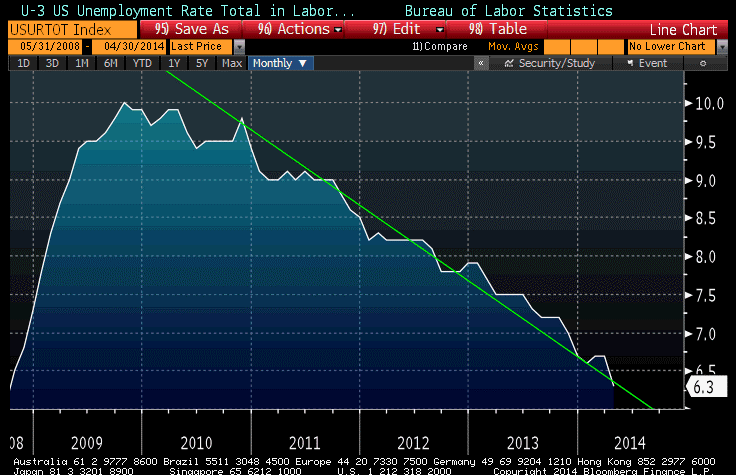
As I wrote back in August, 200k is what you can expect once the expansion is proceeding at a normal pace, and that’s exactly what you’ve gotten for a couple of years now. Similarly, if you project a simple trend on the Unemployment Rate from late 2011 (see chart, source Bloomberg) you can see that the remarkable plunge in the ‘Rate merely operated as a ‘catch-up’ from the winter bounce higher.
If you believe that inflation is caused when economies run out of slack (I don’t), then the low unemployment rate should concern you – not because it fell rapidly, because it is nearer to whatever threshold matters for inflation. If you rather think that inflation is caused by too much money chasing too few goods, then you’ve already been alarmed by the continued healthy rise in M2 and the fact that median inflation rose to 2.1% this month. So, either way, people (and policymakers) ought to be getting at least more concerned about inflation, no matter what their theoretical predilections. And, in fact, we see some evidence of that. Implied core inflation for the next 12 months (taking 1-year inflation swaps and hedging energy) has risen in the past month to about 2.25% from 1.75%. To some extent, this seems to be seasonal, as that measure has risen and peaked in the last three March/April periods. Investors tend to mistake the rise in gasoline prices that normally happens in the spring to be inflation, even though it ordinarily falls back later in the year. But right now, the implied acceleration in core inflation from the current level of 1.7% is the highest it’s been in three years (see chart, source Enduring Investments).
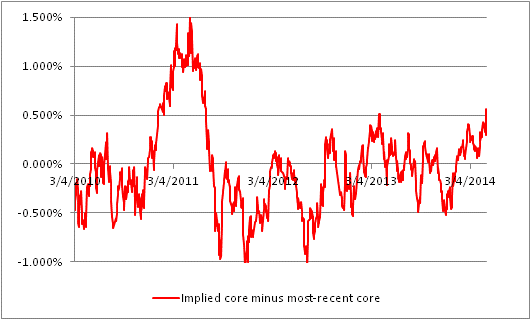
The bigger spike, on the left side of that chart, corresponds with the significant fears around the time of QE2. But what’s interesting now, of course, is that the Fed is actually tightening (providing less liquidity is the definition of tightening) rather than easing. Some of this is probably attributable to base effects, as last year’s one-off price decline in medical care services due to sequestration-induced Medicare spending cuts is about to begin passing out of the data. But some of it, I suspect, reflects a true … if modest … rising concern about the near-term inflation trajectory.
[1] Unless, that is, you are overweight commodities…which we are. The DJ-UBS is +8.9% year-to-date.
Global cc: on a Note About Inflation Confusions
I haven’t written in a couple of weeks – a combination of quiet markets, and a lack of intersection between stuff that’s interesting to write about and my having time to write – but I thought I would “global cc” everyone on something I just wrote in a private email about some common misconceptions regarding the CPI:
A friend and longtime reader (name withheld) writes:
Mike,
I thought you might find these interesting….
davidstockmanscontracorner.com/memo-to-d…
davidstockmanscontracorner.com/inside-th…
My response is below:
Thanks. Unfortunately Stockman doesn’t understand what he’s talking about. He understands better than most, but then he starts saying how the BLS asks homeowners what their homes would rent for…which they do, but only to determine weights, every couple of years, not to determine OER. It says this very clear in a paper on the BLS website called “Treatment of Owner-Occupied Housing in the CPI:”
“To obtain the expenditure weights for the market basket…Homeowners are asked the often-cited question:
If someone were to rent your home today, how much do you think it would rent for monthly, unfurnished and without utilities?
This is the only place where the answers to this question is used; in determining the share of the market basket. We do not use this question in measuring the change in the price of shelter services.”
For that purpose – calculating inflation itself – a survey of actual rents is used. I can understand how the casual observer doesn’t ‘get’ this, but there’s no excuse for Stockman not to know, especially if he is railing about the CPI…he should take some time to understand its main piece.
In short, Stockman writes a good populist screed, but he avoids the main questions:
1. Is headline inflation a better predictor of future inflation than core inflation? Answer: No, even if we can now realize that the rise in energy prices was a permanent feature of the decade ended in 2010, it tells us exactly nothing about whether those are likely to persist. The Fed uses core CPI not because they don’t think people use cars (whenever a columnist uses that silly argument, I know they’re just writing to please a certain audience), but because core CPI is persistent statistically in a way that headline is not. In fact, some Fed statisticians prefer median, or trimmed-mean, neither of which proscribes any particular category. So whining about how the Fed doesn’t include the particular brand of inflation that concerns you misunderstands how and why policymakers actually use measures of inflation in policymaking.
2. Suppose the CPI represents a miserable mis-estimation of actual inflation. Then, pray tell, why does a trillion-dollar market based on that index get priced as if it is accurate? In Argentina, where the inflation numbers are made up, the inflation-linked bonds trade very cheap because they will pay off in a number that is assumed to be too low. And the bond yields are too high by roughly the amount that inflation is assumed to be understated in the future. Markets are efficient, especially big markets. How did the Fed manage to convince at least $1T in private money to misprice the bond market?
3. If the CPI is so wrong, so manipulated, then why to measures of inflation that the government has nothing to do with, like the Billion Prices Project, come up with the same number?
It’s nice that Stockman has a following. And he’s gotten the following partly by ranting about a number people love to hate. That gets him read, but it doesn’t make him right.
