Archive
More on CPI (Not To Be Confused With Moron CPI)
I posted earlier today some thoughts that I tweeted right after the CPI figures were released this morning, and added a few ancillary thoughts as well. I figured that may be all that I would write today, since CPI is clearly the most important release of the day and because I am hard at work on our Quarterly Inflation Outlook piece.
But then I saw a number of headlines such as this:
- “Retail Sales Edge Up, Inflation Flat as Energy Prices Fall”
- “Tame Inflation, Strong Factory Data Lift Futures”
…and I realized I had to write today.
It isn’t true that core CPI was “as-expected” or that inflation was “flat.” Of the 78 economists polled by Bloomberg about the monthly change in core CPI, one called for 0.0%, eight expected +0.1%, and the balance expected +0.2%. The average works out to be 0.184%. This is consistent with poll results on the question of the year-on-year core CPI rate, which saw one economist at +2.1%, nine at +2.2%, and the rest at +2.3%. So economists generally were looking for a “soft” +0.2% print.
What we actually got was +0.242%, the third-highest print since 2008; this caused the year-on-year core rate to be 2.314%, compared to 2.255% last month. That is, last month we barely rounded up to 2.3% and this month we had to round down. This is about as big a miss as you can have, without actually printing a +0.3% and causing everyone to wig out.
(Incidentally, while it’s relevant for short-term trading of TIPS and inflation swaps, headline inflation is not a policy target. We focus on core inflation, for policy purposes, when headline is higher than core, and we focus on core inflation when headline is lower than core. Policymaker pronouncements that discuss headline inflation are potential hints that a central banker is looking for an excuse one way or the other. Today’s headline inflation is not a good predictor of next year’s headline inflation, but today’s core inflation is likely to be reasonably close to next year’s core inflation.)
Also rising on a year-on-year basis: Rent of Shelter (2.216% vs 2.104%). The bubble is now unwound, rents are rising at near the pace of other prices, and we can no longer look to housing as being a restraining force on core inflation going forward.
Services less energy services rose to 2.449% versus 2.325% (see Chart below, source Bloomberg). This is 57% of the CPI basket. Again, there is nothing to suggest “tame” inflation here. As I wrote back in February, inflation is as “contained” as an arrow from a bow.
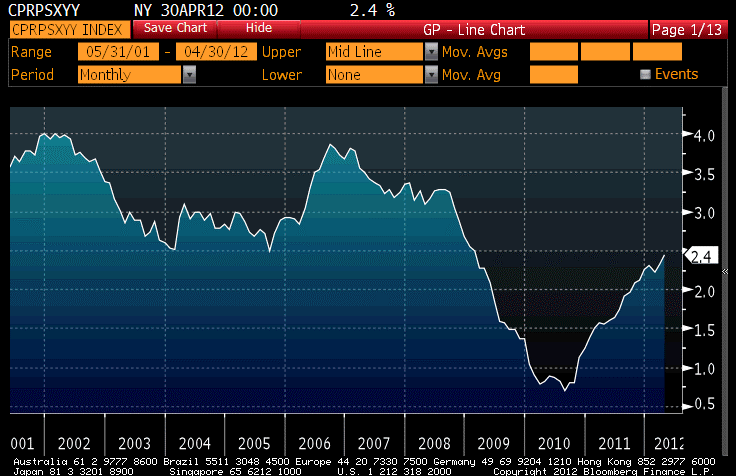
The implication of the chart above is interesting. The only reason that core inflation was as low as it was in the years leading up to 2008 was that commodities ex food-and-energy commodities (which category adds up to 19.4% of the CPI) were basically not inflating (see Chart below, source Bloomberg). This is where the “globalization” effect happens, since it’s much easier to import goods than services, but some evidence suggests that this effect has largely run its course.
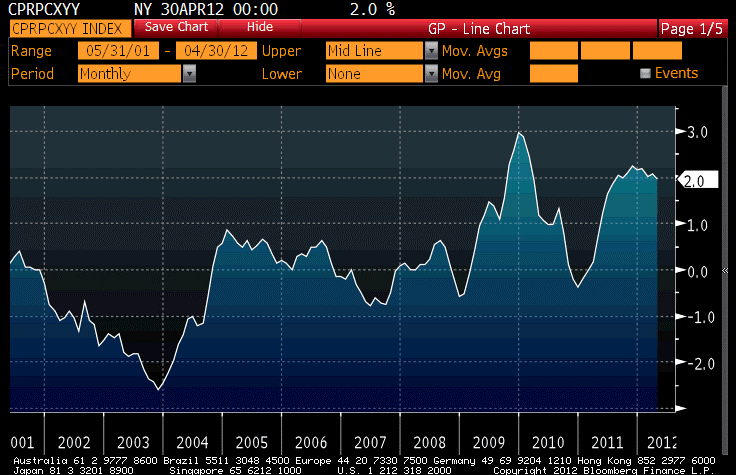
So “Commodities ex-food-and-energy commodities” is rising at 2%. What if “Services less energy services” returns to, say, 3.5%, where it happily existed in the ‘Naughts, while commodities inflation stays steady? Core inflation in that case would rise to 3.1%. Moreover, with every central bank in the world printing money (by the way, M2 growth is back to 9.2% year/year) there is no reason to think that the standard of the mid-2000s is where inflation should stop.
In this context, it would be stupid for the Fed to consider further quantitative easing at its next meeting in June. Therefore, I fully expect it!
One-year inflation swaps are around 1.50%. Two-year inflation swaps are at 1.75%. Five-year inflation swaps are at 2.2%. I think these are all very low.
So why are people suddenly so calm about inflation, whereas a couple of months ago everyone was all lathered up?
Partly, it’s because people tend to remember the stuff they buy more than they remember the services they buy. Partly, it’s because gasoline prices have receded about 20 cents in the last few weeks, so there’s a near-term reinforcement of the idea that inflation isn’t so bad. Partly, it’s because almost every economist and the Fed itself is saying that inflation isn’t a threat while global growth is in trouble. And partly, it’s because price changes over the last few months have been very regular and much less scattered. Consumers tend to encode volatile prices as rising prices; also, they tend to remember the price changes of the stuff that’s gone up better than they remember the price changes of the stuff that’s gone down. Over the last few months, both the volatility of monthly inflation rates among the many subindices the BLS calculates, and the dispersion of those rates, have been unusually low. So much so, in fact, that my measure of “inflation angst” is at an all-time low for the period over which I have calculated it (see Chart, source Enduring Investments). The chart shows the amount by which inflation feels higher than it actually is, due to these cognitive effects.

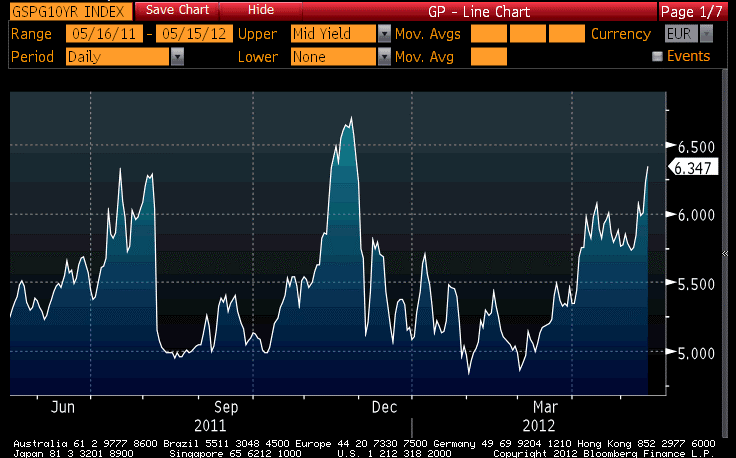
Meanwhile, Europe is getting worse again. Greece decided to pay off a bond that was covered under UK law and which hadn’t been subject to PSI – which, as you all remember, was something they swore wouldn’t happen. But the country had to scrape together lots of green stamps and supermarket coupons to make the payment, and with the country’s politics in disarray it seems the can wasn’t kicked as far down the road as everyone thought. Greece has gone from “of course they won’t leave the euro,” to “it’s impossible anyway” to “they’re not allowed to” to “see, that was no problem,” to “I wonder when they will.” And, as expected, the effect is spreading to other periphery countries. Spanish 10-year yields rose to 6.35% today, the highest level since November (see Chart, source Bloomberg).
Stock prices fell today, extending the recent mini-slump. The only reason to own stocks here, and I think the only reason prices are as high as they are, is that you want to own anything but fixed-rate bonds with the 10-year rate at 1.74%! Inflation-indexed bonds (TIPS) are better, but still are more risk than return at this point (10-year TIPS yield is -0.41%). So the argument for stocks as “anything but bonds” is a reasonable one. But it’s an even more powerful argument in favor of owning stuff that people actually consume, and yet commodities have been dripping steadily all month. The combination of low recent returns to commodity indices and continued robust money growth has our expected return models projecting 10-year real returns of 5.4% for commodity indices, compared to 2.3% for the S&P, with similar risk.
We are confident in our valuation models. But no, that doesn’t stop it from hurting right now!
A Time To Refrain From Embracing
Today’s bit of wisdom comes either from Ecclesiastes, or from The Birds (depending on your religious background): to everything there is a season, whether for casting away stones or for gathering them together, whether for embracing or for refraining from embrace.
This too is good market wisdom – and in the current circumstance, it appears it is a time to refrain from embracing. Two sovereign wealth funds have apparently stopped buying European sovereign debt, according to stories out today. One is China’s CIC (which is interesting: I suppose they figure that their pledge to the IMF is more than sufficient exposure to the region! If that is the case, then surely this falls in the category of an unintended consequence!). The other is Norway’s $610bln oil fund, which will actually divest holdings of Eurozone sovereigns. It had held 50% of its total bond holdings in Eurozone sovereigns and has cut (or maybe will cut – the story is unclear) its exposure to under 39%, according to this story on Reuters.
Frankly, if I was another sovereign wealth fund, I would read these stories and wonder whether it is time for me to cut my exposure as well, since I surely don’t want to be the last one out. As I said, perhaps this is a time to refrain from embracing.
That being said, as I wrote on Tuesday “I think it’s likely that European prices will rise at least as fast as US prices” and opined that “I think Europe is going to be catching up to the U.S. in the monetary-profligacy race.” I wrote that, and today a story appeared in Der Spiegel: “Breaking a German Taboo, Bundesbank Prepared to Accept Higher Inflation.” The ECB is already losing its “Bundesbank DNA” since being taken over by Mario Draghi. Now it looks like the Bundesbank itself is losing its singlemindedness when it comes to inflation.
This is a game-changer, obviously, when it comes to inflation in Europe (German inflation carries about a 25% weight in the calculation of Euro inflation) but also when it comes to inflation globally. I noted yesterday that Euro M2 accelerated to a 3.1% pace in the year ended March, and that that was the highest pace since September of 2009. I can’t imagine these two things – an acceptance by Germany of potentially higher inflation, and faster Euro-area money supply growth – are unrelated.
This may or may not be an error. If Germany is acceding to higher inflation because she believes that faster inflation will be a result of faster Euro-area growth, it’s an error since inflation derives from money growth, not real growth. But if Germany is allowing inflation to rise in Germany relative to the rest of the Eurozone, as a way to ‘rebalance’ her economy relative to the Eurozone, then it’s not a bad idea; the only problem is that since Germany doesn’t have a lever to pull on monetary policy that’s separate from the ECB’s lever, I don’t see how they can raise Germany’s inflation rate relative to the other nations. Between countries with flexible currencies, this adjustment happens through the money supply and currency. How do you effect such a ‘rebalancing’ in this case? I don’t know.
Speaking of errors, JP Morgan announced a whopper today after the close. About a month ago, a story circulated about a trader at JP Morgan who had amassed positions in corporate credit-related derivatives that were so large they were affecting the indices of credit risk. Today, JP Morgan revealed that the unit where the trader works (the chief investment office, which is meant to hedge firm-wide risks rather than to take positions) had lost $2bln on synthetic credit instruments. JP Morgan CEO Jamie Dimon said on a call today that the losses could ‘easily get worse,’ implying that the positions remain open for now.
There will be many questions about how the bank amassed a $2bln loss in the short time that has passed since quarter-end, especially given relatively sedate trading in the credit markets. There are both positive and negative fact sets that could apply. On the positive side, we could posit a smart risk-management officer that read those earlier stories and investigated whether the book was being marked at levels that were being affected by the trading of those instruments by the book, or whether they were fairly considering the likely loss in the event of liquidation. Discovering that they were not being marked conservatively, Risk Management and the CEO decided to disclose the loss as soon as they knew it should be. If that is what happened, it would be hard to fault the bank’s disclosure even if you could fault some of their controls. But Dimon is also a pretty crafty fellow, and I can certainly imagine a circumstance where the bank figured “if we announce the loss on the credit hedge now, then when the gain on the other side shows up in the regular earnings we might be able to persuade analysts to treat this as an ‘item.’”
So what I’d want to know if I was a regulator, or a reporter, or an investor, is whether the error here was that the chief investment office departed from its hedging function and made some bad prop trades. If the answer is yes, then I want to know how that happened in large size without senior approval. If the answer is no, then the next question is whether this loss was offset by a gain somewhere in the bank, since it must be a hedge. If the answer to that question is no, then we simply have some stupid hedging. If the answer to that last question is yes, then I want to know why an announcement was made at all because the hedge worked! Sometimes hedges lose money, after all…when the thing being hedged shows a gain.
On Friday, Dallas Fed President Fisher is speaking on the topic of “Too-Big-To-Fail.” How timely.
Also due out on Friday are Michigan Confidence (Consensus: 76.0 from 76.4) and PPI (Consensus: 0.0%/+0.2% ex-food-and-energy), neither of which is an important release. Have a nice weekend.
Now It Begins…Again
Well, there are quite a few things we have to discuss, aren’t there?
On Friday I had a couple of tweets about the Employment number (I’ve discovered that publishing a full article on Friday is seldom a useful thing to do) that I posted along with a chart of the labor force participation rate. It turns out that the participation rate was the part of the report that really stood out, and a number of commentators reflected on it. An article on Bloomberg this weekend discussed the problem of “hysteresis,” which means that after a long period of weak economic growth, a group of workers finds that their skills have deteriorated (or are assumed by employers to have deteriorated) and so they are unable to find a job – so that these people become chronically unemployed. The Bloomberg article said that this problem is a “focus” of the Bernanke Fed, and a reason to keep extraordinary stimulus in place a while longer.
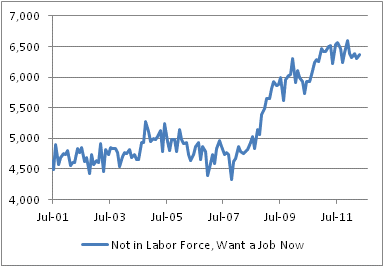
This is a real phenomenon, and it shows up partly in the series I’ve shown here previously: the strangely-named count of people who are “not in the labor force, [but] want a job now.” Since to be considered part of the labor force basically all you have to do is to look for a job, these are people who want a job but don’t consider it even worthwhile to look. As the chart (source: BLS) shows, the number of such people exploded in the crisis, and continued to climb into 2011 before leveling off. But it’s not falling. Yes, this is a concern, and it’s one reason the Unemployment Rate is as low as it is despite an employment market that is fairly described as very weak.
Over the weekend, of course, the French Presidency was ripped from Sarkozy (as was generally expected) and the Greek Parliament was completely scrambled (as was not necessarily generally expected). The effect of replacing Sarkozy with Hollande won’t be insignificant, but firebrands tend to moderate once they actually hold the key to the city so the impact of Hollande’s ascension will probably not be immediate – however, the next time there is a crisis that requires France and Germany to quickly agree to something, the fact that Sarkozy is no longer the one meeting with Chancellor Merkel (assuming she’s still around, which is not a sure thing given how her party has been doing recently) will make the process more dicey.
But the more immediate problem is Greece…again. The two parties which had previously formed a coalition government were soundly whipped, and the message from the electorate seems clear. Greece has had for some time a simple choice: leave the Euro, and someday get your country back, or stay within the Euro, and be indentured servants. The last “rescue package” actually increased the notional amount of Greek debt, and the previously-dominant parties were seen as complicit in the mortgaging of Greece’s future. Since the election, no governing coalition has been formed. Meanwhile, more debt payments are soon due, and the country has not made any movement towards fulfilling the “requirements” of the last bailout. I suspect that whether they mean to or not, Greece will be calling the bluff of the Troika. And it is unclear, given the condition of the Germany-France relationship, whether the Eurozone is ready to send more money with essentially no strings attached. For a long time I’ve said that Greece would end up leaving the EZ; after the last bailout I thought they’d pushed that off for a year or two. As it happens…probably not.
As the Continent has digested these events, Spanish and Portuguese yields (which had been healing modestly) have started to head back up, and Continental equity markets took a beating today. (It’s actually a little surprising that they hadn’t taken a beating yesterday, but markets globally were very quiet on Monday.)
And of course, pressure remains on commodities, especially energy. NYMEX Crude fell below $100/bbl (closed today at $97.35) and gasoline futures fell below $3/gallon before rebounding today after a very large draw on gasoline inventories – among the 10-20 largest in the last decade – in the weekly API report. Prices at the pump are still $3.76 nationwide, so while they have retreated some they’re not exactly plunging.
In domestic markets, the S&P broke below last month’s lows before clawing back to close with just a narrow loss. The selloff was contained by the 100-day moving average, but I don’t think it’s going to be for long. Apple (AAPL) is also back to nearly the April lows. After the ill-advised spike higher on the April 24th earnings report (you know, the one with severely negative forward guidance), the stock has drifted lower almost every day since. I wonder how all the people who chased it feel? I’d written prior to that release that the market’s ability to look past weak reports would be considered a good sign, and it was – but that was then, and we’re now looking at a skein of what are likely to be economic reports of decreasing strength for a while. For of course, we cannot avoid feeling the European recession. Bonds know this; the 10-year yield fell to 1.85% with the 10-year real yield at -0.35%.
On the monetary policy front, there was an interesting development in that year-on-year M2 money supply growth finally declined in the U.S. to under 9% (to 8.85%), the first time this has happened since last July. However, we should also note that European M2 as of the end of March (the last available data) accelerated to 3.3% year-on-year, the highest level since September of 2009.
Indeed, if you are surprised that the robust M2 money growth has not resulted in faster inflation in the U.S. (I am not; in fact core inflation is running ahead of where my models expected it to be), you should remember that in a global economy money is fungible! Adding liquidity in the U.S. pushes up prices everywhere – but holding it down in Europe dampens price increases everywhere. In fact, if you run the contemporaneous correlation of year-on-year core US CPI versus year-on-year US M2 money growth back to 1999, you get 0.44. But if you run the correlation of year-on-year core US CPI versus year-on-year Euro and US M2 growth (adding together European M2 and US M2 and then computing the growth rate), the correlation rises to a whopping 0.60. The chart of this relationship is shown below.

This is hardly definitive; the quality of the single-variable unlagged relationship breaks down back in the 1980s and early 1990s (of course, the global financial system was less-integrated then, too). But I hope it makes the point that if US money growth lags, it ought to be more than made up for by Euro money growth. Frankly, I don’t expect US money growth to slow very much, or to stay down, because corporate credit is growing well and the Fed isn’t about to try and restrain money growth. But I do expect European money growth to accelerate, since 3.3% in the current economic conditions is going to be viewed as too tight.
Actually my next chart is pretty interesting. It shows Euro M2 and US M2 separately. Which country do you think had a central bank with Bundesbank DNA?

The Fed clearly has, to date, done the heavy lifting of staving off deflation, while the ECB worked at restraining inflation. But now with the ECB under new management, they are pulling on the rope in the same direction.
In this context, it is comforting that the initial results from the poll I posted last week show that only 3% of respondents report that they are not concerned about inflation and have no plans to take any explicit inflation-protection steps. Fully 73% report either that they feel they have completed taking steps to protect their wealth against inflation (17%) or that they have taken some steps, but plan to do more (56%). Nineteen percent of respondents have not yet taken inflation-defensive steps, but plan to do so by the end of 2012 (12%), or in 2013 (7%). The poll is still open – feel free to log your perspective!
With European M2 rising relative to the U.S., and the increasing likelihood that the Euro’s membership will come into question soon (and once one adjustment to the roster has been made the second is much easier) and weaken the Euro versus the dollar, I think it’s likely that European prices will rise at least as fast as US prices. And yet the 10-year Euro inflation swap is at 2.09% while 10-year US inflation swaps are at 2.54%. That difference may have made sense when the ECB was run by Trichet and it was the US fighting a banking crisis. But now the ECB is run by Draghi and it is Europe with the banking crisis. While I think inflation is going to continue to head up everywhere (Japanese 10-year inflation swaps are at +0.50%!), I think Europe is going to be catching up to the U.S. in the monetary-profligacy race.
Don’t End the Fed…Just Ignore It
I’m not really sure what to make of the market action the last couple of days. I know Q1 earnings have looked good, but in a number of cases that was related to the very mild Q1 weather. Investors are being very credulous of the view that this represents real, lasting improvement and not a pull forward from Q2. (Remember, I’m not one who thinks the economy is on the verge of collapse, but I also don’t think it’s on the verge of exploding in a positive way either.)
The Fed was equally credulous yesterday. While there was no surprise in the Fed’s lack of action on Wednesday, nor any surprise that the statement was roughly unchanged, there was aggressive improvement in the Fed’s projections for 2012 since January’s estimates. In January, the central tendency of the FOMC’s individual projections for the Unemployment Rate this year was 8.2%-8.5%. In April, that became 7.8%-8.0%. That’s an aggressive improvement to a 9-month forecast in only three months. The Fed has proven repeatedly that they are no better at forecasting than Punxatawney Phil, so the forecasts don’t mean a lot – but what it should tell you is that they don’t seem to have much of a clue, if three months of data can change your 9-month forward Unemployment forecast by half a percent.
Their forecast for 2012 PCE inflation was 1.4%-1.8% in January; It’s now 1.9%-2.0%. Combining those alterations, if the Fed had any credibility, would mean sharply higher interest rates, because it shows the Fed thinks growth is faster and inflation is higher than they previously thought it was. In fact, if the Fed was perfectly credible, you’d believe them when they said that short rates will be held down until 2014, and you’d believe that the implication of their forecasts would be a rapid series of hikes thereafter. Ergo, the yield curve should be higher and more flexed: steeper from 2y-5y or 2y-7y and flatter from 5y-30y or 7y-30y. And yet, the 5y yield is down to the lowest level since February and 5y-30y is steeper than it was back then.
The market is basically ignoring the Fed, despite the fact that Bernanke said in the Q&A that it’s the Fed’s view “that it is reckless to accept higher inflation in exchange for possibly greater employment.” Of course he must say that, so it doesn’t have much content, but it’s still remarkable that the bond market is just brushing off the Fed altogether.
I hope the bond market isn’t putting too much stake in the recent worsening of Initial Claims, which surprised on the high side Thursday for the fifth consecutive week (in fact, if you consider the original survey compared to where Claims ended up after revisions, the consensus estimate has been too low in every seek since Feb 17th!). The chart below (Source: Bloomberg) certainly looks like there has been a sudden worsening in the job market.

But I think that would be a mistaken reading. In my view, the recent numbers are likely just payback from the weather-inspired strength in Q1, and my hypothesis is that the true underlying run rate has merely flattened out at 370k-380k. One reason I am not particularly worried about Claims yet is that the Consumer Confidence “Jobs Hard to Get” figure that I referred to earlier this week (and which is shown below) is ordinarily a better indication of true improvements in the employment situation.

It turns out that if you ask the average “man on the street” how the job market looks, he’s likely to have a pretty good feeling for it (in contrast to, on the other hand, asking about inflation – which no one internalizes well) because he has some idea of how many of his friends are looking for work. It’s a relatively clean number, unlike Claims.
The bond market might instead be reacting to ever-worsening news from Europe. The latest news today seemed to fly under the radar, but I think is striking. In a report in German paper Sueddeutsche Zeitung (summarized in English here), we learn that the ECB is working with Eurozone countries on a plan that would let banks access European Stability Mechanism (ESM) funds directly. Why is this a big deal?
Well, my first question is: since these banks can already access liquidity directly from their national central banks (and thus indirectly from the ECB)…why would the ECB want to have banks access the ESM directly? The obvious answer is that the ECB likely fears the impact that a default would have on its own solvency (which is to say, it would be devastating to the institution) and if banks borrow from the ESM it means the sovereigns backing the ESM…mainly Germany, France, Italy, and Spain…would be on the hook directly. Can you imagine the Fed saying that U.S. banks should borrow directly from the Treasury rather than from the Fed? What signal do you think that would send?
Yeah, that’s what I think too.
Whatever the bond market is looking at – whether it’s worsening conditions in Europe, or worsening economic conditions (which I think is a misreading) – it clearly isn’t what the stock market is looking at. If bond yields are low because of growth fears, then stocks are clearly ignoring that issue. If bond yields are low because of Europe fears, then stocks are clearly ignoring that issue. And frankly, even if bond yields are wrong because the recent worsening data is merely a give-back from a mild Q1, then stocks are still misinterpreting the recent earnings numbers.
I still own equity puts, although they are mostly worthless. I am still short bonds, long RINF and INFL (that is, long inflation expectations), long commodity indices, and long the dollar against the Yen. While I am not invested this way because I am a growth bull, all of these positions except the equity puts get penalized with a weak turn in the economy. Accordingly, I am inclined to trim the bond short and refresh the equity put position while implied volatility remains cheap. I’m still bearish bonds, but the trade hasn’t performed and the worst of the bearish seasonal pattern is past.
On Friday, the advance Q1 GDP number will be released. The consensus estimate is for a 2.5% rate, with a 2.3% rise in Personal Consumption. A stronger number probably implies a weaker Q2 as it would suggest more mild weather pull-forward, but the markets won’t see it that way!
Ghost Rally
Equities launched aggressively higher on Tuesday, driven essentially by pique.
The best that news hounds could do was to point to a good German confidence survey and the fact that Spain sold 12- and 18-month bills successfully. If that’s worth 1.55% on the S&P, I’m unclear on why. Selling T-Bills with gallons of LTRO money sloshing around shouldn’t be particularly challenging, especially because the bills will be rediscounted at the ECB for free carry. Give me a call when Spain sells 10-year notes to investors who actually have money at risk!
The Bank of Spain announced that banks under its supervision had made progress cleaning up their balance sheets. Last year, the government had estimated banks would need to take €52bln in charges, and banks have made a grand total of – drum roll – €9.19bln in improvements through the end of last year. They still need €29.1bln in additional provisions and will need to raise another €15.6bln as a capital buffer, so remarkably the Bank of Spain is claiming that banks’ conditions haven’t worsened since the original estimate.
Some other pundits pointed to optimistic talk out of Berlin, where a German minister said there was “no Spanish bailout talk” in Germany at the moment. That sounds more like a threat, but Schaeuble said “data don’t point to bailout.” The market was euphoric on this, and the DAX rose 2.65% on the day. Really? Ask yourself whether any finance minister or central banker would ever say “yep, we’re pretty sure those suckers are going down. I sure hope no one starts selling bonds right now before they default because that would really make things difficult!” You can listen to ministerial pronouncements with a bias: discount positive statements and take negative statements seriously (indeed, assume the negative statements are shaded to the optimistic side).
Overnight Monday night there was a headline that would have made a great April Fool’s Day joke. Japan announced that it is going to contribute $60bln to the IMF. Shouldn’t that be that the IMF is contributing $60bln to Japan? Where exactly does Japan plan to get this $60bln? Presumably they will borrow it, despite the fact that they are one of the world’s most-indebted governments with one of the worst demographic setups. Nice of them to contribute to the office gift, but for the sake of the gesture they could have just pitched in twenty bucks and signed the card.
U.S. data was modestly weak. Housing Starts printed 654k against expectations of 705k – but realistically, housing was never going to be what led us out of the housing-bubble-collapse – and Industrial Production was flat versus expectations of +0.3%. These aren’t dreadful, but not the sort of thing that +1.55% is made out of.
Now note this: total NYSE volume was only 665mm shares, fewer than traded on Monday and the lowest total in a month. This was a rally on vapor, a ghost rally. If this is supposed to produce the next leg of the rally, it is a foundation built on sand.
.
Following on my remarks yesterday about monetarist murmurs beginning to develop among some staffers at the Fed, I take notice today of two developments in other central banks.
First, after core inflation surprised the Bank of England by rising to 2.5% year/year (it was expected to decline, to 2.3% y/y), respected Bank of England policymaker Adam Posen said “If core inflation doesn’t come down on a sustained basis—then we have to rethink.” Now, core inflation in the UK had previously dropped from 3.4% in October to 2.4% in February (core inflation tends to move much more rapidly in the UK than in the US, simply because the nation is smaller and more homogeneous), so Posen has the wind at his back. In this way he is unlike, say, U.S. policymakers who are looking at 16 increases in core inflation out of the last 17 months. It is a prudent comment, even if it is easy to say in these circumstances: a surprise is a surprise, and though one surprise shouldn’t cause one to reject the null hypothesis (see yesterday’s comment for more on that), a thoughtful policymaker takes notice of the surprise. Especially if the policymaker doesn’t believe that monetary policy is magic.
Second, the Bank of Canada held rates steady but included some hawkish words in its statement:
“In light of the reduced slack in the economy and firmer underlying inflation, some modest withdrawal of the present considerable monetary policy stimulus may become appropriate, consistent with achieving the 2 percent inflation target over the medium term.”
That’s not drastically different from what some Fed officials have said unofficially, but it is far ahead of the FOMC in terms of official communication.
More thinkers are starting to question the wisdom of unlimited liquidity. I don’t think they’re about to change the majority thinking on the topic at the FOMC, but it does raise the stakes for the majority if there are some who have strayed from the reservation and might cause trouble if they turn out to be right. All else equal, the light increase in hawkish chatter globally raises the bar slightly (ever so slightly) for QE3 here or elsewhere.
The Prius Economy
A bona fide growth scare is upon us.
The first inklings of the scare may have come from China, a week or two ago, or perhaps from Spain as the 10-year Spanish yield rose through 5.5% and today ended conveniently at 5.99%.
Friday’s U.S. Employment report didn’t help. In recent months, employment had been rising a lot while the Unemployment Rate fell; but on Friday’s number, Unemployment fell due to shrinkage of the Civilian Labor Force despite weak job growth. That is clearly weaker-than-expected, and disappointing to some who thought the economy was surging. To my mind, it merely continues a recent theme of slow, weak, but positive growth. Hardly a growth scare, unless you were suckered in by the equity market to think there was robust growth.
That happens a lot, especially coming out of recessions. The naturally optimistic U.S. investor, prodded by the professionally-optimistic Wall Street broker, sees rising equity prices and assumes that stocks are starting to price good times ahead. That they are, and the goal of said brokers (and Washington brokers of the power variety) is to make the perception of good times trigger the reality of good times as higher prices beget a wealth effect. If it doesn’t happen, you get a scare.
But you can’t slap a number on the side of a Prius and call it an IndyCar. We have a distinctly Prius economy at the moment (actually, it may be more of a Pinto economy in that it could burst into flames if tapped lightly).
Perhaps that’s the fundamental question at the moment: is this a Prius economy – not pretty, but it’ll get us there – or a Pinto economy – potentially disastrous, given any provocation.
TIPS voted strongly for the Pinto version, as the yield on the 10-year TIPS bond fell 7.5bps to -0.26%. That was further than the nominal yield fell: 10-year nominal Treasuries rallied only 6.5bps to 1.98% (and the reversal of the breakout to higher yields is complete). The decline in TIPS yields implies that today’s leg of the rally, anyway, was led by declining growth expectations rather than declining inflation expectations. Indeed, 10-year inflation expectations actually rose 1bp, while 1-year inflation expectations declined sharply due to a sharp fall in gasoline prices (also growth-related).
Lower long-term growth expectations and a decline in near-term inflation expectations? That sounds like the sort of cocktail that would have produced a QE3 rumor just a week ago! But equities have dropped 4.3% over the last 5 trading days, with today’s 1.7% decline the heaviest-volume day of the five. The 916mm shares traded would be feeble by any standard except that of 2012, but would you believe today was the busiest day in the stock market of the year, with the exception of the March triple-witching and the three month-ends?
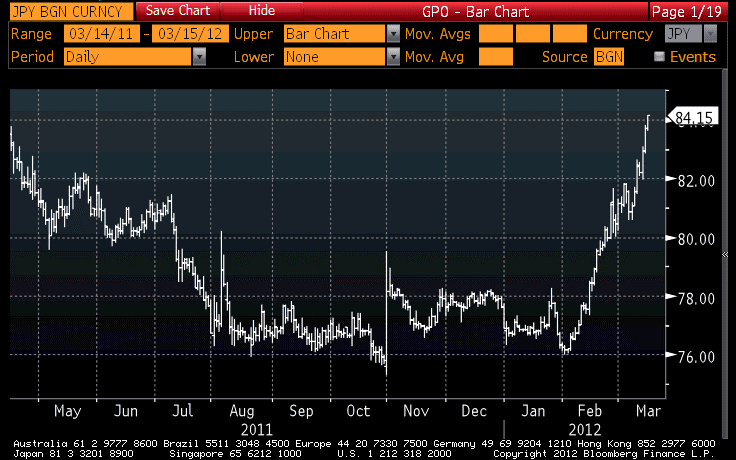
Oddly, the dollar was roughly unchanged. If the growth scare is sourced from Europe but the cold is caught by the U.S., where is the safe haven? Weirdly, the answer seems to be the Yen, which represents the most over-indebted developed economy with the worst demographic issues. Go figure, but the buck has fallen from 84 Yen to 80.7 Yen over the last couple of weeks.
Personally, I think our economy is more of the Prius variety, which has been my opinion for a while. Europe continues to be a basket case, and I keep repeating my conviction that it won’t be over until it’s over over there (and, unfortunately, before it’s over the Yanks may be coming)! But the U.S. will do fine, as long as you’re not looking for a big expansion. Low growth, and possibly a mild recession, are in our future…and that’s not the worst thing that has ever happened, it just feels like it since we’ve been told to expect the equity rally to be validated by subsequent growth.
Equities remain expensive even with the mild selloff. Until a week ago, the operative analogy for me was the rally in 2010 Q3 following the Bernanke quasi-announcement of QE2 at Jackson Hole in late August. There was a pullback in that rally as well – actually a deeper one – after QE2 actually showed up, until the liquidity gusher pushed stocks higher. The problem is that although we got the anticipation of the gusher, we didn’t get the gusher. And, unless we do, I think stocks will have difficulty rallying. And if the equity market won’t rally, it very likely will decline.
If (probably when) we actually get QE, then the equity rally will resume getting over-extended and ahead of itself, thanks again to the naturally optimistic investor and the professionally-optimistic stock jockey. When that happens, it will be time to look for the Pinto moment.
Copernican Economics
I start the second quarter on the road in beautiful Cincinnati, but I have some time to pen a few thoughts tonight (aside: will our grandchildren even know what it means to “pen” a few thoughts, or will they “pad” them?)
My first thought is that for the second month in a row, commodities ended weakly and then surged on the first day of the new month. Today, despite weak global data – although ISM was slightly stronger-than-expected – industrial metals and energy led the commodity complex higher. This is of course what we expect as the price level rises: microeconomic concerns of supply and demand in individual markets operate on the real clearing price, not the nominal clearing price; this latter should rise with the transactional money supply (though defining that is sometimes problematic) times money velocity. It continues to amaze me that commodities are as weak as they are, but today the DJ-UBS index rose 1.3% and national gasoline prices reached $3.92/gallon (and are still rising).
My second, unrelated, thought concerns the impact that weakening European growth (Fiat sales were -36%!) will have on the global economic crisis, which is assuredly not over and will not be over until the Euro changes membership or disintegrates completely – and, more importantly, on the participation/support of the United States for European sovereigns and institutions.
Until now, the U.S. has wisely remained above the fray (and the fraying); although the Federal Reserve has aided the ECB, the U.S. has pointedly refused to add its heft to the IMF and demurred against providing other aid. I say that this is wise because the European experiment should succeed or fail on its own merits. It does no good for the U.S. to keep alive a failed institution, whether that institution is industrial (as with GM or Chrysler, one of which ought to have failed) or quasi-sovereign (FNMA or FHLMC, at least one of which ought to have failed) or sovereign. On this final point, at least, the Administration has concluded that the costs of involvement far, far outweigh the potential benefits of involvement.
But if the European crisis starts its next unraveling in the next few months, the U.S. will enter the arena with, I think, a large contribution of support. What is a couple hundred billion when an election is at stake? The current “firewall” has barely enough height, once already-committed funds are deducted, to contain a modest campfire. When Portugal and possibly Spain step up to get aid, it will be a damned-if-you-do, damned-if-you-don’t moment for the Administration because both paths are painful. Americans clearly do not want to subsidize European institutions, and so (in contrast to the usual tin ear this government has displayed with respect to the People’s wishes) it has been relatively easy to deny the IMF the help it desires. But if there is an election in the offing, and a crisis threatens to burst into bloom in August or September? I believe they will quickly choose to take action they can characterize as “decisive action” to avert the crisis and portray themselves as stewards of global economic health. It isn’t clear to me that it will play to the positive for the President’s party, but I think given the Hobson’s choice they will choose to be involved.
And that might spell the end to the dollar’s strength, which is more due to every other developed currency’s weakness than to the strength of our own system.
The third, also unrelated, thought concerns St. Louis Fed President Bullard’s presentation in China last week, which a friend thoughtfully sent to me. The presentation concerns the question of whether the proper metric for monetary policymakers is not the domestic output gap but the global output gap. See, the problem is that the large domestic output gap is not consistent, as I’ve pointed out ad nauseum, with the fact that core inflation with or without housing has been accelerating for well over a year in the U.S., Europe, UK, and Japan. Thoughtful policymakers by now should have dispensed with the many-times-discredited notion that output gaps matter to inflation. I said in 2008 that the crisis would be an outstanding test of the two main policy theories: one, that money causes inflation; two, that growth causes inflation. For the first time in many years, money growth and economic growth were moving sharply in opposite directions by meaningful amounts. In the event, it has been a slam-dunk win for the monetarist crowd. More money has meant prices rose, even with a huge output gap. And even with declining money velocity. And even with 40% of the consumption basket, Housing, collapsing from a bubble.
While addressing the question if it’s the global output gap, rather than the domestic output gap, that matters (a reasonable question, since we know that something like 65% of domestic inflation comes from common global sources), Bullard’s Powerpoint presentation is initially encouraging. When he cites evidence, he includes the clear observation that “One study for Europe found that the global output gap did not appreciably impact Euro-area inflation from 1979-2003,” and there are several others. Unfortunately, he then argues that since the global economy is now much more fully integrated, maybe it will have an effect in the future. Indeed, he says “the global output gap idea may be the ‘wave of the future’ rather than an explanation for past economic outcomes.”
It is incredible to me that economists can’t bring themselves to simply abandon a theory that has not worked in practice. Not in the 1970s, not in the 2000s, not in Zimbabwe, and so on. They work hard to posit tweaks to the model that can explain the most-recent aberration.
When I was first entering the business, I worked for a company that did technical analysis, and I helped design quant models. One of the greatest sins was to design a model and, the moment it didn’t work in real time, to make a new rule to carve out the recent underperformance. If the out-of-sample test doesn’t work, you need to question the whole theory, from first principles.
But I’ll go further with my analogy. Prior to the development of the heliocentric model of the universe, courtesy of Copernicus, the previous-best theory was that the heavens revolved around the Earth. The problem was that certain observations did not comport well with theory. In particular, astronomers noticed that some stars – dubbed “wanderering stars,” the Greek word for which became “planet” – occasionally seemed to reverse course and head in the opposite direction they had previously been observed to travel. This “retrograde motion” clearly did not agree with a model in which all of the stars were fixed on a spherical firmament that rotated around the Earth. So, astronomers did the only thing they could do.
They fudged it.
Astronomers invented the concept of “epicycles.” These ‘planets,’ it seemed, existed on other spheres that rotated in the opposite direction but which were attached to the grand sphere. Epicycles made the theory fit the observations. Of course, it was wholly wrong, and Copernicus in time developed a model that was entirely consistent with observation without needing “epicycles” – simply by noting that if the Sun, rather than the Earth, was the center of the universe then we could observe such phenomena.
President Bullard, abandon this theory. You were so close to saying it! Just say that the theory that output gaps affect nominal prices (as opposed to real prices and exchange rates of the factors of production, which they can reasonably affect) doesn’t fit the observations, and be the Copernicus of economists.
None of this has anything to do with market action, but then market action these days has very little to do with anything in the news. Equities will eventually falter, and then the comeuppance could be severe; bonds rallied today but the future is grim aside from occasional flight-to-quality or Fed-frontrunning, and the risks of downside relative to potential upside gains make long duration positions foolhardy. And everyone loses to inflation, which continues to accelerate. These are the trends, although other people would read the trends as being “bullish stocks, bullish bonds, and inflation to fall.” I question the prevailing wisdom.
The Cool Kids Don’t Like Bonds Any More
Global stock markets were the boring markets for a change, as today global bond markets took a potentially meaningful step back. In the U.S., 10-year yields rose 15bps (with no economic data to point to), reaching 2.28%. Yesterday I noted that most of the last week’s rise in yields had come from an increase in inflation expectations; that trend corrected today, as TIPS were also hammered. Ten-year TIPS yields rose 12bps, to -0.10%, implying that the 10-year breakeven rose a mere 3bps.
This was not just a U.S. story. The 10-year UK Gilt rose to the highest yield since December, +17bps today. Germany was +13bps today although still in the range; JGBs up to the highest level since December although that’s also only 9bps above the low yield from the last quarter since JGB yields have been effectively ‘pinned’ for a long time.
Although in the U.S. our selloff was largely in real yields today, the underlying pressure here is from prices. I have previously illustrated the fact that core inflation globally has been rising for two years; this is starting slowly to be reflected in yields. The chart below is an eye-opening one of Japanese 5-year breakevens (there is no 10-year breakeven because Japan stopped issuing inflation-linked bonds a few years ago although they may soon resume). It has been rising almost non-stop since mid-2010, from -1.5% in five-year inflation expectations to…a positive number. That’s right, the poster child for deflation now has investors expecting prices to rise (albeit a small amount) over the next five years.
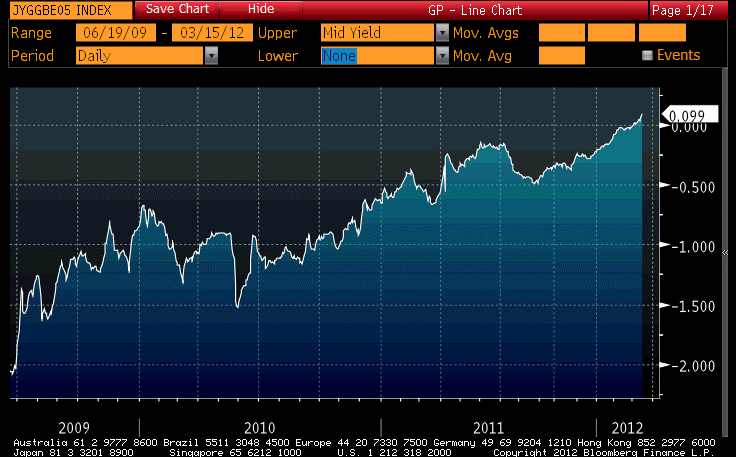
And with that small change, the yen has fallen 8 big figures against the dollar in about a month (see Chart, shown in terms of the number of yen per dollar). Higher inflation in Japan means the Yen is finally losing real purchasing power too, and is no longer essentially a one-way bet versus the dollar.
Here is another chart you don’t see much. This is 10-year Australian breakevens:

Euro 10-year inflation swap rates, despite the tremendous recent troubles, are closer to the highs than the lows of inflation expectations over the last several years:

Twenty basis points, or forty basis points, is nothing to get all in a lather about, yet. But I believe it is significant that global bond markets are all pricing in more inflation over the last few months, and nominal yields today all rose. This is not a global growth story – it’s mostly a global inflation story.
In that context, it was especially odd to see precious metals get battered again today (-3.3%), although the reasoning is easy enough to understand. Precious metals may hedge against a growth Armageddon, or they may hedge against inflation – but it is hard for them to hedge both outcomes at the same time. Betting on Armageddon has never been a good bet, so far (since we’ve had zero Armageddons as of this writing), and being long precious metals in anticipation of that event is never a good idea. That said, there are other reasons to be long precious metals as part of a diversified commodity index, and I continue to be amused and confused by the fact that inflation indications are sprouting up all over, in many markets…but not yet in commodities, which historically produces the highest inflation “beta” in the early stages of an inflation episode. I think the adjustment will eventually come, and it may be swift when it does.
To repeat, a one-day or one-week selloff in bonds, even global in nature, is nothing to get panicky about. But higher inflation, higher interest rates, and higher gasoline prices each singly poses a challenge for increasingly-lofty equity valuations. Collectively, they pose a dangerous threat. Right now, the stock market doesn’t seem to know what is good for it. It reminds me a bit of a rebellious teenager, like James Dean in “Rebel Without A Cause.” No good can come of the drag racing being done in equities right now. That being said, I covered some of my short (through equity options) on Tuesday before the Fed, because this feels like a pom-pom rally and everything is going to feel great until the morning.
So far, I can’t figure out how far away dawn is. The rapid movements in the dollar/yen, the abrupt drop in bonds, the rise in energy prices – these are all bad, but they’re still fairly insignificant moves. It will take more to derail stocks.
It won’t likely come tomorrow from the surveys (Empire Manufacturing, Consensus: 17.5 vs 19.53 last, and the Philly Fed Survey, Consensus: 12.0 vs 10.2 last) or Initial Claims (Consensus: 357k from 362k). But those are also not likely to be very bullish figures for bonds, either. I suspect the crack in stocks will come if investors notice that conditions in rates markets are getting less accommodative (or more attractive as a competing investment!). At 15bps per day, that may not take long but it’s probably not going to be on Thursday!
The Second-Slowest Prey
Finally, we can perhaps put Greece in the rear-view mirror. The result of the exchange “offer” produced around 83-85% commitment (there are several conflicting calculations out there), although much less on the foreign-law bonds which subsequently saw the exchange deadline extended as a result. Some reports say that 85% is a “very high” participation, with at least one report I read saying that it was “higher than even the most-optimistic estimates beforehand.”
That’s certainly false. Greece was publicly aiming for 95% and threatened the holdouts with every plague conceivable. Ultimately, they had to exercise the retroactively-added Collective Action Clauses, and triggered a Credit Event (therefore bringing to nothing the billions of dollars wasted trying to avoid just such an event), and will still fall a bit short. Troika representatives said a tranche of the second bailout will be released while further discussion continues on the next tranche.
It is important, and sad, to note that when-issued trading of the substitute securities being issued in exchange indicate yields of over 20%. Remember that one of the points here was to restore Greek access to markets – but, despite the fact that they continue to run large deficits (something about the economy contracting at a 7% annual rate will do that), there is no chance that they can raise more money on their own at anything like a sustainable rate. It doesn’t help that all future Greek govvies, and the existing exchange debt, are now subordinated debt.
Greece, in short, is “saved” only in this sense: they were being chased by a lion, and they managed to become the second-slowest prey for a little while. The lion is now zeroing in on Portugal, with everyone cheering for Portugal…except for Greece.
It will slowly dawn on investors that this solution, as painful and costly and dramatic as it was, buys only a short period of time for Greece. And there’s no way to ‘get its house in order.’ The right thing to do at this point would be to use the period of relative calm to gracefully leave the Eurozone and devalue. But being the second-slowest prey might provoke undeserved optimism, a vain hope that the lion will be sated soon (or tire of the chase). It would be a terrible mistake to take this as a signal that the worst is over, at least in Greece.
Hopefully, though, Greece will at least move lower in importance for a little while, so we can concentrate on other developments that in the absence of crisis are more-relevant to the dollar-based investor. Developments such as another decent month of Employment growth: in February, the economy generated 227,000 new jobs, a bit better-than-expected with the upward revisions to the prior month. The Unemployment Rate stalled at 8.3% as the number of unemployed actually rose as well (the Civilian Labor Force swelled 476k this month, and this time we can’t say it had anything to do with benchmark revisions – the labor force participation rate ticked up to a still-anemic 63.9%). Most of the internals were pretty good, although one indicator I follow is curiously flaccid. The chart below shows the number of respondents to the household survey that are “Not in the labor force but want a job now.” That is, they responded that they are not looking for work (ergo, they are not in the labor force, since you need to be employed or looking for work to be considered in the labor force), but would take a job if they thought there was one on offer.

This is an interesting series because it’s a weird category – if you want a job now, why aren’t you looking? These people are not officially “discouraged” workers; that’s another series. These are folks who just don’t think it’s worth the time to look. As you can see, from 2001 through the crisis, there were generally about 4.5mm-5.0mm people in this category, and so there is something like 1.5mm people who conceivably could enter the labor force to soak up jobs. That’s roughly 1% on the Unemployment Rate.
The number has been this high before: back in 1994 (as far back as BLS data goes for this series), there were also about 6.5mm in this category, and between 1994 and 2000 the number slowly dwindled. Now look at the chart below (Source: Bloomberg), and you will see that between late 1994 and 2000, the Unemployment Rate’s rate of improvement slowed. Had the 1% drag from this category not happened, the slope of the improvement would have been nearly constant.
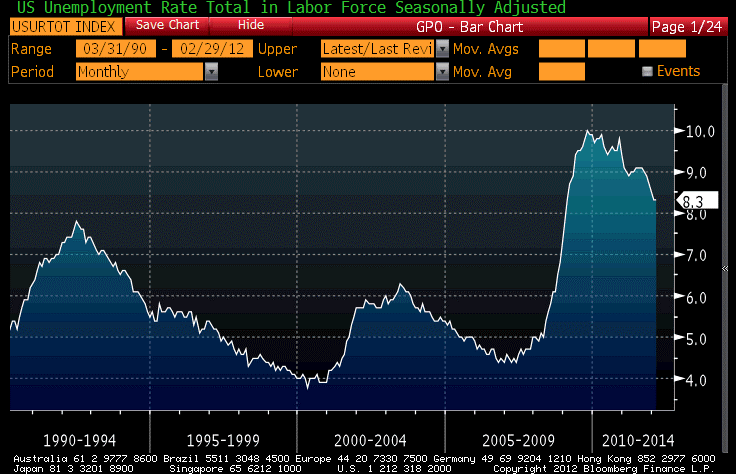
Now, I’m actually not claiming that the rate of improvement slowed because of this factor; in 2003-2007 the slope of improvement in the Unemployment Rate was about the same as it was in 1995-2000 so it’s more likely that the slope is related to the level – once you get below 6%, you can’t expect more than about 0.3%-0.5% per year. And, now that the Boomers are retiring, the employment dynamic is clearly different anyway. But the persistence of a large group of people who “want a job now” but aren’t working should dampen out enthusiasm a little bit about the improvement from 10% to 8.3% Unemployment over the last two years. That was the easy 2%. The next 2% is likely to take longer. To get down to the highs of the last recession will probably take three years at least, even though the exit of Boomers from the workforce will help.
Steady improvement in the Unemployment Rate would be a good thing. But what is the implication for Federal Reserve policy of an Unemployment Rate which – even in the absence of another recession, which is certainly not exactly assured – will be over 7% well into 2013? With a bloated balance sheet and core inflation above their target (core PCE right about at the target), if the Fed wants to forestall a bad inflationary outcome it needs to consider unwinding monetary stimulus while conditions are sunny. And yet, we’re hearing trial balloons about “sterilized QE3,” because the Unemployment Rate remains above 8% and will be above 7% for quite a while.
As I first pointed out in 2010, monetary policy is simple if both the growth and inflation mandates argue for the same policy (in that case, strong provision of liquidity to push inflation higher and, some believe, to improve growth). It gets much harder now. So which is the slowest prey, that tightening policy would bring down first? Growth, financial institution liquidity, or inflation? Unless the answer is “inflation,” there are no easy choices from here.
QEnull – What’s The Point?
I feel guilty when I have not much to add atop someone else’s words, but for the second time in a fairly short period of time, that humble explanation applies to an article that Stephen Stanley, chief economist at Pierpont Securities, wrote in response to an article in the Wall Street Journal today by Jon Hilsenrath that discussed a ‘new option’ that the Fed could conceivably deploy when QE3 takes place. While Wall Street was actually quite preoccupied today with cutting risks down ahead of the Greek invocation of the collective action clause (CACs) tomorrow – which seems far and away the most-likely event, since some 58% or so of Greek bond holders have come out in favor of the tender while enough have been opposed to ensure that the 95% hurdle for non-invocation will not be reached – there was plenty of discussion about this article, especially in inflation circles.
The article concerns the actions that the Fed could conceivably take if they decide to implement a third Quantitative Easing program (QE3). Recently, there has been little suggestion that any such possibility was forefront in the minds of Fed officials, but the appearance of such an article from Hilsenrath constitutes a “running it up the flagpole” event since he is the columnist assumed to be most-associated with “official leaks” these days (justified or not).
The article noted a third approach the Fed could conceivably take towards QE3:
Under the third approach, the Fed would create new money as it buys long-term bonds. But then it would effectively lock up the money rather than letting it loose in the broader economy. The Fed would do this by borrowing the money back from investors for short periods—say, 28 days—in exchange for some low interest rate it would pay investors.
Now, at some level there is nothing new about this. For decades, the Fed’s Open Market Desk has done reverse repos when it needed to temporarily drain reserves from the system. What is new is that this would be conducted on an extremely large scale, so that the Fed can buy longer-term securities (which adds reserves) and then ‘immunize’ them by draining the liquidity from the market at the same time. My initial reactions were “big deal – this isn’t new,” but Stephen Stanley’s take was much more insightful and I recommend that you read it in full. But at least, you can read these two snippets, which by themselves are devastating observations:
Do we need stimulus or not? The first and most obvious objection to “sterilized QE” is to ask why it needs to be sterilized. Does the economy need stimulus or not? If it does, just do QE3. If it doesn’t, then, for goodness sake, put the shovel down and stop digging.
That’s so insightful that I am embarrassed that it didn’t occur to me when I first read the Hilsenrath article. But golly, it’s right. We’ve become so accustomed to the idea of massive QE that doesn’t lead immediately to inflation because the added funds are sequestered on the central bank’s balance sheet (as happened with QE1, QE2, LTRO1, and it appears LTRO2), that I didn’t think to ask why you’d target that outcome! I believe I correctly asked that question leading up to QE2: why do QE2 when QE1 was still sitting in reserves? But my thought process has obviously been co-opted as well, embarrassingly. Here is another Stanley snippet:
In the article, the sources that Hilsenrath cites go to great pains to argue that Fed officials (at least the majority of them) think that these concerns about inflation are entirely misguided. The implication is that sterilizing QE is really about placating the irrational inflation fearers, not because there is a true need to protect against a future acceleration in price hikes. This is unbelievably weak. Either there is an inflation threat or there isn’t…If these inflation fearers are as misinformed as Fed officials seem to suggest, then they should be easily disabused of their erroneous inflation fears by some reasoned discourse from Chairman Bernanke and others on the FOMC.
Again, Stanley nails the hypocrisy here in a way I simply missed the first time around. Stephen Stanley is the first economist I think I have ever cited twice at length. The fundamental points he raises are devastating because they are so simple: either QE is needed or not; if it is needed, then there’s no reason to sterilize, if it’s not then there’s no reason to do it, q.e.d..
What’s amazing it that this topic even comes up while the stock market is near 4-year highs, bond yields are near all-time lows, and economic data have been consistently surprising on the positive side (according to the Citi Economic Surprise Index) since October. No, I’m not a bull on the economy, and yes I think Greece’s invocation of CACs will precede by only a short time the exit from the Eurozone of Greece and Portugal at least, but … I’m also not the one sitting around saying that everything is working, and I’m extensively on record as pointing out that monetary policy only works in the presence of money illusion and its main effect is to raise price levels. So why is Hilsenrath even penning this column?
Incredibly, I think the right answer is that the Fed feels it needs to be doing something, and at some level may fear for the future of the institution if a conservative government is put in place in November. I don’t think that the Fed would really be dissolved (it’s always easier to shout about change from the back bench than to actually implement it), but there’s no question that the Fed has all of its chips in the ‘interventionist’ camp right now so doubling-down may not be a crazy strategy from an institutional-imperative standpoint. As amazing, and discouraging, as that is to write…
On Thursday, you can fairly ignore Initial Claims (Consensus: unchanged at 351k) with Employment on Friday and, more importantly, the deadline for the PSI tender at 10pm Athens time (3pm ET). We may not know the official result of the tender until after the close, and will probably not hear about the CAC invocation until Friday. And then, as they say, the real game begins.
Whether we skate past the March 20th deadline or not is currently the market’s preoccupation. It is likely that on Thursday we will find out that enough tenders exist to allow the PSI to proceed with CAC-invocation, which will probably be perceived as a positive. Some chance exists of a complete failure, but most likely now is that there will merely be a technical default and some wrangling to get Greece past March 20th. All that really does, in my view, is give the country time to prepare for the inevitable withdrawal from currency union in a more-graceful way, but the markets may well regard this as a wonderful development – and worth selling into, frankly. Good luck.
