Archive
Can the Fed Remain Relevant?
Greece is skittering awkwardly towards temporary resolution of their crisis. Venizelos, the leader of the party Pasok (which placed third in the Greek elections) said today that the coalition may be ready tomorrow. Considering that this vote was supposedly a “referendum” on remaining in the Euro, it is surprising how long it is taking to negotiate a bare majority in the parliament. But they will, because there’s no cost right now to pretending to be unified while negotiating improved bailout terms with European authorities. If better bailout terms are not offered, there is plenty of time later to splinter the coalition, or to appear to splinter the coalition, to put pressure on the negotiators from Europe.
It bears remembering that there is nothing that can be done to save Greece and to keep her in the Eurozone absent transferring big losses onto the rest of Europe. Since most holders of Greek bonds due to mature in the next few years are official institutions – such as the ECB – it isn’t clear how the debt structure can be re-negotiated without opening a big can of worms. So will the European powers (aka “the Man”) significantly lessen the austerity measures? Will the Greek politicians who just won an election settle for anything less than significantly lessening the measures? I don’t see where these circles of interest intersect. I am sure there will be a big announcement at some point; I’m just not sure what difference it will make.
In the meantime, Greece is supposed to play Germany in the UEFA quarterfinals this Friday. Remember, wars have been fought over footy. I’m mostly kidding, but do you think Greece really wants to win this game or not?
The shortage of immediate crisis in Europe translates into a good day for stocks (+1%), adding to what is already a pretty good month; a pretty good day for commodities (+1%), adding to a positive if unimpressive month, and a weak day for bonds (10-year yields rose 4bps to 1.62%), adding to a marginally weak month. TIPS yields were higher as well, but not very much, and inflation swaps were higher by 3bps, bringing the total rise in the 10-year inflation swap rate to 5bps for the month (to 2.49%). Inflation expectations may be rising once again, and this is interesting. Consider the following two charts (Source: Bloomberg), of the 10-year Treasury (nominal) rate and the 10-year inflation swap rate, both for the same period over the last two years.


What is interesting here is that while the 10-year nominal rate keeps reaching new lows in each crisis, the 10-year inflation swaps rate keeps reaching higher lows in each crisis. The difference, of course, is the TIPS yield, which has continued to plunge faster even than nominal yields for each subsequent crisis.
In this context, we head into tomorrow’s trading session in which the day’s key event is the FOMC meeting. This is one of the more interesting meetings, in a sense, that we have had in a while because it’s the first in which there was any meaningful uncertainty about the immediate course of policy. Twist is coming to an end shortly, so many observers believe that the Committee will use this meeting to take concrete steps to either extend Twist, offer a different version of Twist, change the verbal signaling significantly, or even signal QE3. The answer will tell us something about how the Fed is looking at the current portfolio of risks in the global economy. When I think about what the Fed will or might do – admittedly, as a cynic – I break it down this way:
What the Fed can actually do about economic growth and global crisis
There’s really not much here. As the chief regulator, the Fed can help ensure that banks are adequately prepared for a possible Greek exit from the Euro. If there are key vulnerabilities in the financial sector, they can extend lines (either domestically or internationally through swap arrangements) to avert a liquidity crisis. But adding money doesn’t affect growth unless there is substantial “money illusion” such that economic actors take rising cash balances in their accounts to indicate actual improvement in their financial status and, acting on this, increase real spending. Even if there is money illusion, the actual capacity at this point for an important increase in real spending – especially in the parts of the world where it is really needed – is pretty slim.
What the Fed thinks it can do about economic growth and global crisis
This is where there has actually been a little bit of evolution recently, maybe, in the thinking of at least a few of the FOMC members who are capable of thought. Until fairly recently, the Fed’s faith in its ability to actually do something useful was absolute. The fact that trillions of dollars of stimulus later, U.S. real economic output is only 1.2% (not per annum – total) above where it was at the end of 2007 – with the economy threatening to sink into another recession, no less – has made some policymakers question whether the assumption of the omnipotence of monetary policy was correct. For example, it has long been an article of faith that one way that monetary policy such as “Operation Twist” worked was through the “portfolio balance channel.” This theory holds that by taking away lots of safe investment alternatives at the long end of the bond curve, the Fed essentially forces investors to contribute to animal spirits by owning riskier securities. While it may be the case that making U.S. Treasury bond yields truly abysmal may have contributed to the rise in corporate bond and equity prices to unhealthy levels, Fed researchers are questioning whether that actually produces any growth. St. Louis Fed Vice President Daniel Thornton (who actually is one of the voices in the wilderness arguing that runaway money growth might actually create a threat of inflation) recently wrote a paper called “Evidence on The Portfolio Balance Channel of Quantitative Easing,” and his conclusions are direct:
I present several reasons to be skeptical of the theoretical foundations of this portfolio balance channel and offer several arguments for why the effect of QE might be relatively small even if it is theoretically valid. Consistent with these arguments, an empirical analysis using a variety of interest rate variables and public debt supply measures used in the literature finds essentially no support for the portfolio balance channel.
Whoops!
What the Fed wants to be thought to be able to do
Herein lies the rub. If a hedge fund that is earning 2% on assets under management and a 20% performance fee realizes that it no longer has exceptional opportunities in which to invest its clients’ money, it should return the money to the investors, with a note saying “rather than take extraordinary risks at high fees to produce pedestrian returns, we are returning this money to you so that you can earn pedestrian returns on your own, with pedestrian risks and pedestrian fees.” However, we know from the periodic fund blowups we see that this hasn’t historically been the response. The Federal Reserve doesn’t earn 2%-and-20%, but if they ever got to the point where they no longer believed they could affect economic growth, what should they do? Their mandate says that they’re supposed to do it. If they cannot, they should say so and lobby for changes in the mandate to make them solely guardians of the real value of the currency.
Good luck with that. The Federal Reserve surely feels that whether or not it actually remains relevant, it must make sure that others think it is relevant so at least “confidence will be maintained.” They do this, I am sure, with the best of intentions.
And it is this third point where any policy changes will be born. If the Fed recognized the first bullet point, they would end Twist and work to start reducing excess reserves and reining in the money supply. That ain’t going to happen. It is the second bullet point where most observers spend time debating. What should the Fed do to help? More QE? Is Twist enough? Should they peg interest rates at a certain level, or implement an Evans-type rule that will require them to continue bond purchases until Unemployment falls or inflation gets out of hand? All of this requires one to think that the Fed thinks it can do something, and are merely discussing what they can do.
I think that many Fed officials are no longer sure of that, but they will go along with a vote promoted by the true believers because they want the Fed to seem relevant. The Fed will not do nothing. It will do something. I am not sure whether Twist will be extended (the fact that most banks are clamoring for it implies they have all told the Fed that the market expects it and will be disappointed without it, so it’ll probably be extended), but I would look for signs that an Evans-type rule is being implemented that will mechanically force something QE3-like over the balance of the year without the Fed having to explicitly decide to do it. This is also a way to side-step the whole ridiculous notion that the Fed shouldn’t do anything “near the election”: if there is a plan set in motion now, then presumably then can execute the plan when circumstances call for it.
None of this will do much besides ensure that the money supply keeps growing, enhancing the mispricing of commodity indices and increasing the risk of a bad (and difficult-to-contain) inflation outcome.
At least that would make the Fed relevant again.
A Whimper
With the whole financial world seeming bracing for the Greek elections this weekend, the results so far have seemed thankfully anticlimactic. There was talk late last week about a plan for coordinated central bank intervention in the event that the “wrong” party won in Greece. Dealers sent around lists of weekend contact numbers for back office personnel, and phone numbers for the overnight trading desk in Japan. Analysts circulated scorecards and “what-if” outcomes so that non-Greeks could tell who won, and whether the victory meant anything.
In the event, the pro-bailout party won. Believe it or not, that’s not the end of that – now, since they don’t have an outright majority, they must form a governing coalition with enough of the other parties that they have a majority of the elected representatives committed. So before anyone gets too excited, remember that that’s exactly what happened last time. Same winner, but no government. No coalition was in the offing, and so new elections were ordered. In theory, this new election was a referendum on whether to stay in the Euro or leave the Euro, or stay but with drastically renegotiated terms for the “aid” received so far. If that’s the case, then the referendum produced no clear answer. Are we expecting a government simply because everything is a little more desperate?
Forget the fuss: it isn’t clear to me what all the calm is about.
Greece will still leave the Euro. Government or no government, austerity or no austerity – the fiscal math simply doesn’t make sense unless Europe wants to pay for Greece forever. In principle, the Greeks can dig themselves out of trouble if they work harder, retire later, pay more taxes, and receive fewer government services. I do believe that people can change, and a society can change, under pressure of crisis. Remember Rosie the Riveter? But the question is whether they can change, whether they will change, do they even want to change, if the benefit of the change flows not to Greece’s people but to the behemoth European institutions that have lent money to Greece?
If a person declares bankruptcy, and the judge declares that he must pay all of his wages for the next thirty years, after deducting enough for food and shelter, to the creditors…do you think that person is going to go looking for a 60-hour workweek?
I hope they do, but I don’t see it.
Now, while we were busy ignoring economic data on Friday since Greece was so much more important, some more weak data came out. The Empire Manufacturing index fell to 2.29 from 17.09, reaching its lowest level of the year. Industrial Production fell -0.1% rather than rising +0.1% as had been expected. The University of Michigan confidence figure dropped to 74.1 from 79.3 – also the lowest level of the year. If you believe in government statistics conspiracy theories, then these government workers, and their cohorts in New York and Michigan, must really dislike Obama. The Citi Economic Surprise Index fell to its lowest level of the year, and the second-deepest trough since the 2008 crisis (last year’s Japanese-tsunami-induced plunge was quite a bit worse).
Now we wait until Wednesday’s FOMC meeting, with quite a bit of uncertainty about what the Fed may do, and cross our fingers that the Greeks will form a government. (Again, I don’t think that changes the size of the crater, just the trajectory we take before impact.) With 10-year yields at 1.57% and 10-year real yields at -0.58%, I can’t imagine what the Fed could possibly do to justify those levels. Further Twist would be limited in size by the size of the central bank’s short-end balance sheet, but a failure to extend the Twist program would be terrible for the supply/demand dynamic at the long end of the yield curve. Several dealers have pointed out that the Fed doesn’t even own many short TIPS, so the purchases of longer TIPS would be financed by sales of shorter nominal bonds, or left out of the equation entirely – which would also have the side effect of lowering inflation breakevens. Twist doesn’t really do very much for the economy, it seems, other than signal that the Fed cares. It isn’t the first time that I’ve said this, but I see more potential for higher yields than for lower yields. And, like with Greece, I don’t think there’s anything the Fed can do about it in the long run – it’s just math.
It is a tragic fact that this short column represents my 500th online post in this forum – tragic because the 499th was, I thought, one of my best. You can find that comment here. Remember that you can (and should) follow me on Twitter @inflation_guy and receive my articles as they are distributed along with occasional other tidbits. And you can contact me directly via our company website.
Sick Horses All Rounded Up And Ready To Go
Do you think that anyone who bought in the stock market updraft last Tuesday is having second thoughts?
Today’s retail sales figures were weak. Ex-autos, sales were down -0.4% versus expectations for unchanged, and revised to -0.3% versus the +0.1% originally reported last month. It’s the first consecutive negative prints since 2010, although the 2010 dip obviously didn’t lead to anything more sinister. Retail Sales, like Durable Goods, is a volatile series and one must be careful not to exaggerate the importance of any single month. That being said, it isn’t just the data but the whole backdrop: the whole package of news and data. It’s just not pretty, and it’s simply not priced in although it’s closer than it was in April.
The best news out of Europe is that there’s no one in the queue after Italy! Cyprus stepped up and asked for a bailout for its banks. Cyprus is tiny, but I am sure the timing is not entirely coincidental. “Sheesh, Spain is asking for cash? We better get in there before the money is all gone!”
The Spain bank bailout is proceeding, and seems like it will get done. But, unlike prior bailouts, no one seems to be calling this a “firewall” or claiming that this will finish off the crisis. Maybe that’s just because we have the Greek elections coming up, or maybe it’s because policymakers have finally learned to shut up and observe that old saying, “Better to remain silent and be thought a fool, than to speak and remove all doubt.”[1]
European bond yields are still not reacting well to the whole question of Spanish sovereign bond subordination. In case you’re counting, the following Eurozone credits trade over 6% at the 10-year point: Portugal (10.43%), Ireland (7.21%), Italy (6.17%), Greece (still 28.4%), and Spain (6.77%). The next-highest yield is owned by Slovakia (3.52%) (there is no 10-year Cyprus bond that I can find). So it appears that the corral holds all the sick horses and no more are running around. It’s incredible, isn’t it, that whoever coined the term “PIIGS” several years ago identified the whole group? And yet – supposedly no one saw this coming! Now the simple question is: what do we do with these horses? they won’t heal themselves, and it’ll be awfully expensive (and perhaps impossible) to nurse them all back to health. In my view, the question is whether someone opens the corral door and lets them run free for the open prairie, away from the rest of the herd, or whether one of the horses kicks a hole in the fence. I don’t think restoring them to the herd is the right solution, and it’s just a question of how they get released.
.
Along with Initial Claims (Consensus: 375k) on Thursday the BLS will also release CPI. The consensus is once again for a “soft” 0.2% rise on core inflation – that is, 0.15% through 0.19%, which would round up to 0.2% but cause the year-on-year rise in core prices to round down to +2.2%.
I think they are likely to be surprised again on the upside. There is still some lagged upward pressure on housing inflation; although this impulse is fading it is premature to expect it to begin to drag again. Medical Care services ought to continue to accelerate. Apparel is still rising, and I think that’s not an aberration but a trend.
Economists are forecasting ebbing inflationary pressures based on the idea that these things ought to correct. I don’t think there’s yet any evidence that they have.
Now, headline CPI should print negative, dropping the year-on-year figure to only 1.8%. It makes no sense to focus on headline inflation; it isn’t useful for forecasting and if anything, when it is below core it tends to indicate a more stimulative economic environment (because low energy prices are stimulative). However, you can expect many pundits to crow about how headline dropped to 2.0% or below (forecast is 1.8% y/y), and how that frees up the Fed to begin QE. While core inflation is over 2% and rising, a responsible central bank wouldn’t be considering QE…and without loss of consistency, I can say that the Fed probably will.
[1] Readers may make the obvious connection between this saying, and a certain author who has obviously not taken the advice to heart.
Not Out Of The Woods Yet (And A Book Review)
Over the weekend, the Spanish crisis was semi-resolved with the EU agreeing in principle to give money from the ESM (which isn’t operational yet) or the EFSF to the FROB (the Spanish banking entity). The €100bln will likely be senior to other Spanish government obligations, although this is not clear.
In fact, there is a fair amount that isn’t clear. Equities shot higher by 20 S&P points overnight, only to fall back to +7 before the NY open and finishing the day down 16.7 points, -1.3% on the day.
Stocks may have been taking a cue from Spanish and Italian bonds, which were smashed today. Spanish 10-year yields rose 30bps (see Chart, Source: Bloomberg) while Italian 10y BTP yields rose 12bps.
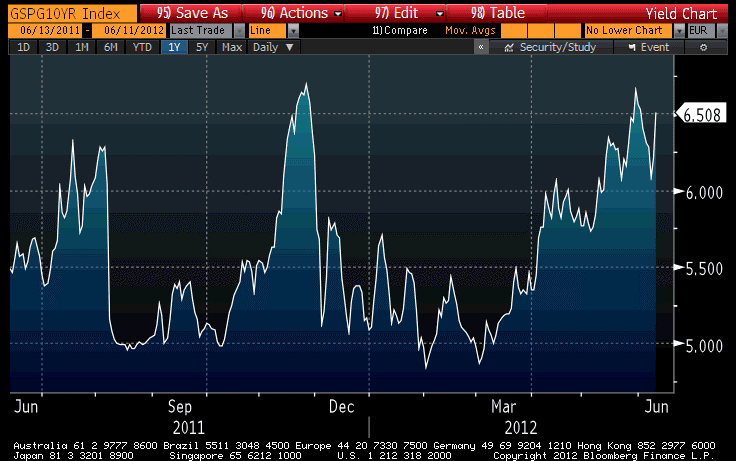
It may seem like the market is lodging a no-confidence vote, but I am not so sure that’s indeed what is happening. Yes, in general it has been a good trade over the last couple of years to bet that the grand plans will come to nothing, and quickly, but this is still the most decision-like announcement that we have yet seen come out of one of these weekend meetings. Yes, this only helps the Spanish banks, and Spain is likely to still need money while the ESM/EFSF now has €100bln less in capacity. But depending on the details, this isn’t a horrible attempt to address a very specific problem. The question, of course, is whether this is a specific problem, or a general one! (Pete Tchir had a great line; he said “Fixing Spanish banks is a bit like drowning one lawyer – a good start.”)
But the rise in Spanish government bond yields doesn’t necessarily mean investors view the announced measures as a failure. Rather, it might indicate that investors view the announced measures as a success and likely to happen – since once element of that program would be (probably) the subordination of the claims of Spanish government debt holders. It is entirely rational to mark yields higher when debt goes from a senior position in the capital structure to a junior position in the capital structure. The question is, what does it do next? That will be the real indication that the announcement quelled some of the fear that had developed…or did not.
Let’s not forget that Greece goes to the polls next weekend, so even if you thought the result of this weekend’s meeting was terrific, we still might be sitting here in a week staring down a Euro exit or breakup.
.
Book Review: Finance and the Good Society
Today’s is a short article, so I thought I would take a few paragraphs to review briefly a book I just finished reading: Bob Shiller’s Finance and the Good Society
I took up this book expecting, frankly, that it would be far too left for my personal tastes. I have great respect for Dr. Shiller, and like many other people I thoroughly enjoyed Irrational Exuberance

The reason that redistribution schemes don’t tend to work well in real economics can be illustrated with a simple, familiar example. Suppose that in a poker game, whenever a player won a pot he collected only a fraction of the pot; specifically, the larger his stack of chips already is, the smaller a share of the pot he gets and the more is distributed to the shorter stacks. Obviously, such a scheme is redistributionist, but if the measure of “good” is taken to be the Gini coefficient or some other objective measure of the evenness of the wealth distribution then this may seem to be a positive improvement to the normal way of winner-take-all from each pot. But advocates of this sort of policy tend to overlook what will happen to the game: if you are sitting on a big stack, you will tend to avoid playing most hands, since your benefit from victory is less the larger the stack you start with.[1] The economic equivalent is that in heavily-taxed societies, the wealthy do not provide as much capital to the system – and so it isn’t a priori clear if more-progressive tax rates will create a more-balanced distribution of wealth. Unless you force them to ante, via a wealth tax…but let’s not go there.
Anyhow, I’m drifting off-topic: Finance and the Good Society pleasantly surprised me. What is great about the book, and surprising I suppose, is that Dr. Shiller spends a great deal of time explaining why the practice of modern finance is mostly good. In Part I, he devotes one (short) chapter each to CEOs, Investment Managers, Bankers, Investment Bankers, Mortgage Lenders and Securitizers, Traders and Market Makers, Insurers, Market Designers and Financial Engineers, Derivatives Providers, Lawyers and Financial Advisers, Lobbyists, Regulators, Accountants and Auditors, Educators, Public Goods Financiers, Policy Makers in Charge of Stabilizing the Economy, Trustees and Nonprofit Managers, and Philanthropists. In each chapter, he explains why this particular role is necessary. Honestly, it’s worth the price of the book just to read an outstanding explanation of why Derivatives Providers, Financial Engineers, and Mortgage Securitizers aren’t inherently evil.
In Part II, Shiller dwells on the problems of modern finance. These we know all too well due to the events of the last five years: problems like “An Impulse for Risk Taking,” “Debt and Leverage,” and “Some Unfortunate Incentives to Sleaziness Inherent in Finance” among others. But unlike in his book Animal Spirits, he does detail some policy prescriptions (including how certain institutions could be redesigned to have the proper incentives). I must be very clear that I don’t agree with all of his policy prescriptions, but I tended to agree with his assessment of the problems.
All in all, this is an even-handed book that makes a distinction that has been rarely made in the post-crisis witch-hunt: hate the sin, love the sinner. The people involved in finance are, in general, good people and the structures, in general, work well most of the time. Improvements can be made, and when the serial crises are over in a few years, hopefully we can discourse intelligently on these improvements. Dr. Shiller has made a good contribution to that discourse with this book.
[1] In fact, if the proportion of the pot that you get to keep if you win is p, and the expected amount that you have to invest in the pot to win, as a share of the total pot, is y, then you will only play in a hand if your expected probability of winning the hand is at least y/p. Therefore, you will only play if you can win very large amounts of money relative to the amounts you bet, or if the odds of your winning are high. In normal poker where p=1, you will bet if your “pot odds” are better than your chance of winning. But in “taxed-winnings” poker, you need much better pot odds relative to the chances of winning.
Model Abuse
A central bank is easing again! The only problem for U.S. market participants is that it isn’t the Fed that is easing, but the Bank of China, which last night dropped rates for the first time since 2008. This set markets up on a good tone heading into the day, and investors waited with breathless anticipation for Chairman Bernanke to echo his Jackson Hole speech and send us off to the races.
He didn’t. The Fed chief delivered what passes for moderation from the chief helicopter pilot, matching his comments somewhat obviously to ECB boss Mario Draghi’s comments from yesterday: the Fed is ready to act; long-term inflation expectations are well-anchored; but the U.S. budget trend is “clearly unsustainable” and must be put on a “sustainable path.” (Unremarked-upon was the fact that he contradicted himself when he called the so-called “fiscal cliff” at the beginning of next year “a significant threat.” Which is it? Are smaller deficits bad, or good? The answer is both – bad in the short run but really good in the long run – and the Chairman should say that. This just sounds intellectually sloppy. Then again, he is speaking to Congressmen, so using even using multisyllabic words is frowned upon.)
Any way you slice it, Bernanke did not deliver the promise of “more to come” that some investors anticipated.
Patience. Having played the stern paternal figure, Gentle Ben can now proceed to warm up the choppers. There is a growing chorus of other Fed voices in support of an ease, and in my opinion this is likely a somewhat intentional choreography in which the Chairman can appear to be persuaded by the others on the Committee to do what he wants to do. Chicago Fed President Evans today said bluntly on CNBC that “more accommodation would be good,” that he is very concerned about unemployment and doesn’t see evidence that inflation will rise (apparently he isn’t concerned with the lack of evidence that unemployment will fall due to monetary accommodation). San Francisco Fed President Yellen said yesterday at a speech in Boston that the Fed’s objective is a quick return to full employment (it seems like the Fed’s objective once contained something about price stability, didn’t it?), and that Fed action might be justified “to insure against adverse shocks,” or even if the Fed concludes that the recovery “is unlikely to proceed at a satisfactory pace.”
Really? That’s the bar now? The Fed eases if growth is merely “not satisfactory”? If that’s the answer, then get ready for an enormous amount of easing, because growth isn’t going to be “satisfactory” for quite a while even if the nation skirts a recession.
I always laugh at the assertion that “inflation expectations are well-anchored.” Yesterday I compared this phrase to the analysis that a house has “good auras” by ghost-hunters. (That’s probably not fair to ghost hunters, who may have some science to back up what they are doing as far as I know.) But the phrase also seems to mean whatever you want it to mean. We all know that short-term inflation expectations have plunged, but as I argued in a post this week that is mostly because of energy prices until quite recently. But for market-based measures of long-term inflation expectations, the measure that is popular among policymakers is the 5y, 5y forward inflation rate. Often they take this reading of “expectations” from the TIPS/Treasury breakeven curve, which is wrong, but if you’re using it to tell fortunes I guess it doesn’t matter if you use pigs’ knuckles or rat bones. However, I do think it’s worth tracking 5y, 5y forward inflation from the inflation swaps market, if only to look at what the policymakers are looking at. A chart of 5y, 5y forward inflation in the US, UK (both on the left axis) and Eurozone is shown below. (Source: Enduring Investments)
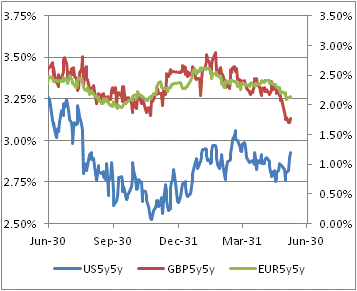
In case the point isn’t apparent, let me make it so. Euro “long-term inflation expectations” are near the lows over the last year. In the UK, that measure is plumbing new 12-month lows. But in the U.S., we’re stable if not rising. Since February 8th, 5y forward inflation is down 2bps in the U.S. but down 35bps in the UK and 49bps in Europe (which already had the lowest long-term measure of the three, near 2%, due to the prior credibility of the ECB as a Bundesbank-descended inflation fighter).
So which is “anchored?” Mario Draghi has the best argument, if this measure is useful for this purpose: Forward Euro inflation expectations are around 2% and have declined markedly recently. The UK has relatively high inflation expectations, but they’ve declined quite a bit, so that’s “anchored” to some extent…at least, there’s a drag on it. But in the U.S., forward inflation expectations are well above the Fed’s ~2.25% CPI target, and have been for quite some time. If anything, those expectations are actually rising but they’re certainly not declining. In any event, Draghi and Bernanke both call inflation expectations “anchored,” but market-based measures of this concept are showing totally different things.
.
Because I didn’t annoy enough equity bulls with my historical and quantitative observations about equity valuations and likely real returns[1] yesterday, I am going to use the tool I deployed yesterday in a manner for which it was absolutely not intended. I was reflecting on the fact that the method forecasts future 10-year returns, but it therefore takes ten years to get the scorecard back to see how things actually turned out. So why not, I thought, pretend that the future really did turn out so that the figures were perfectly accurate? What would the future history of the S&P look like in that case?
So what follows is a make-believe future price chart of the S&P 500. This is not a forecast. I am not even using rat bones.
What I did was take the 10-year real return forecast, (which as I’ve explained in the past takes the long-run real growth rate of the economy, adds dividends, and adds or subtracts most of the “pull to fair value” over the next ten years), and subtracted a 2% dividend to get the expected real index price appreciation. Then I assumed that the CPI index rose at the rate implied by the inflation swaps curve (I calculated the forward 1-month rates and accreted the CPI index by that rate each month, so roughly a 2.46% compounded rate over the whole period but around 1% in the beginning and more like 3% towards the end, as implied by the swaps curve). I took the real index price appreciation and added back inflation to get the nominal price appreciation, and voila! I have a hypothetical series which is the set of S&P index values that, if the projected real return forecast is realized and the inflation swaps curve is accurate, would occur in the future.
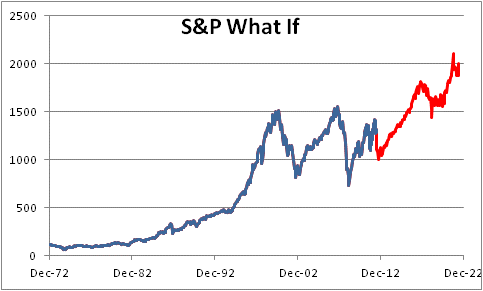
I am happy to report that based on this “method,” the S&P ought to break to new all-time highs sometime in 2016. (Please remember, this is not a forecast. It’s “for entertainment purposes only,” although the practical value of it is as a test to see if the 10-year-real-return-forecasting method produces predictions that aren’t necessarily ridiculous or overly morose. Frankly, it doesn’t seem so bad to me – the chart shows an initial 20% or so discontinuity since the current trailing 10-year return is about 2% higher than what the a priori forecast was in 2002, but then doubles over the next 10 years.
For investors that have been through a 15-year period in which the index went essentially nowhere, and actually fell appreciably in real terms, I would submit that’s not a horrible result. Yes, it’s slower than during the 1980s boom but the difference is we started that boom with stocks at very low valuations while we stand today at above-average valuations.
Let me repeat it one more time: this is not my forecast. I would certainly never forecast an actual path. It is simply the result of taking the forecasting model and essentially cranking it in reverse. And now everyone can tell me why this is stupid and implausible. Ready, go!
[1] Please do note the use of the term real return. To get the nominal return, add your expectations for inflation. But as investors, we don’t really care about the nominal return, but the returns in terms of how much additional stuff we get to consume, so I don’t normally worry about nominal returns, or look at them.
Curious Becomes Furious
The only thing that kept this from being Freaky Friday is that it wasn’t Friday. But it certainly seemed as if everything was reversed suddenly between when we went to bed last night and when we woke up this morning. U.S. equity futures were up 15 points before we woke up, and 38 points above the lows set on Sunday night. Plainly, some traders were either covering shorts or initiating longs before the ECB meeting.
But incredibly…the ECB did not cut rates. In fact, they did almost nothing (and certainly nothing that wasn’t fully expected). Putting on my monetary policymaker hat, I can’t think of any reason for not cutting rates if they actually believe what they profess to believe about economic growth and inflation. Obviously they’re not really worried about deflation, because if they were worried about that then they’d be aggressively cutting since if inflation gets to zero before rates get to zero, it means you can’t ever make real policy rates negative. And they clearly don’t really believe that inflation, using that tired policymaker phrase that Draghi produced again today, is constrained by “firmly anchored” inflation expectations,[1] because if they did then they wouldn’t have any concerns about triggering inflation through adding too much liquidity. True, cutting interest rates doesn’t provide much stimulus compared to a trillion Euros of LTRO, but it is at least a relevant signal.
On the other hand…we already know that Draghi is no Trichet. And we know that under Draghi the money supply is already growing more-briskly (although not exactly briskly) than it did under Trichet, and the current ECB President has done some distinctly non-Bundesbank sorts of things. Maybe keeping rates at 1% are just the cheapest “hawk” credentials he can buy?
I am sure I am coming across as flustered and confused – because I am. I felt like I had had a bead on what was going on, and today doesn’t fit my mental paradigm.
The overnight curious rally turned into a daylight furious rally as the market continued to melt up on light volume (760mm shares) throughout the day, despite the ECB’s relative intransigence and no other news of note. It was nothing short of a desperate grab for risk assets of all stripes as the Euro rallied, the DJ-UBS Commodity Index jumped 1.4%, European stock markets soared, benchmark financial bond spreads tightened 20-30bps despite the downgrade overnight of German and Austrian banks by Moody’s, and yield spreads of periphery bonds compressed (10bps for Spain, 7bps for Italy, 21bps for Portugal in the 10y area).
But why? I feel like the kid who keeps bleating questions until Dad throws up his hands in exasperation and says “because I said so!” Maybe there isn’t an answer, but I wonder if some investors are buying or hedge funds covering short bets just on the thought that Bernanke tomorrow might be dovish when he testifies before Congress at 10:00ET. It just seems like there’s more conviction when buyers are chasing the stock market 2.3% higher than it was yesterday, with no additional information except that the ECB is not easing as aggressively as they might have.
Now, the real equity risk premium, which we define as the expected 10-year real return of equities compared to the real return on 10-year TIPS, did advance a couple of days ago to the highest level in a couple of years. That’s significantly because TIPS yields are low, though, rather than equity returns looking particularly robust. However, I can imagine that some investors who were overweight in fixed-income might have chosen today to get into equities, thinking that the spike low in yields was not likely to persist. That seems like a rotten reason to get into a risky asset class – just because the safe asset classes don’t offer big returns – but there are definitely investors who think that way. Stock bulls, hold your water when you look at the next chart (Source: Enduring Investments).

Realize that although it appears that equities offer the best value relative to TIPS that has been seen since a brief period in early 2009, and more than has been seen for many years before that, we are looking at a period in which equities were congenitally overvalued. TIPS yields only go back to 1997, so I can’t look at the real equity premium from the early 1990s, or the 1980s. However, I can look at the expected 10-year equity real return from back then (and further), using the same methodology I use to produce the numbers in the chart above. The result is not as exciting. The chart below (Source: Enduring Investments using Shiller data) shows that the current projected forward real return of 2.8% is only interesting in the context of the last decade and a half, and only in the context of the poor range of investing alternatives. I included the actual subsequent real return, with dividends reinvested, that is associated with each point up to May 31, 2002 (which 10-year period just finished with a compounded real return of 2.01%).

With the exception of the equity bubble, which produced better-than-expected returns for cohorts starting in the late 1980s and worse-than-expected returns for cohorts starting in the late 1990s (but, you already knew that), the method has a pretty decent track record since 1972. So, while equities are a better real asset than TIPS right now, that’s not saying a whole lot!
None of that solves the conundrum of why stocks spiked today, but it makes me feel better by reminding me to keep focusing on the long-term! There will be wiggles, and my guess is that the next downward wiggle in stocks and upward wiggle in bonds won’t be long in coming. As soon as tomorrow, a bad Claims number (Consensus: 373k from 383k) could set a bad tone. Here’s a surprising statistic: since February 17th, economists’ estimates have been lower than the actual Claims figure – including subsequent revisions, that is – for every week but one. If Claims actually rise from 383k, it is bad news since we ought to be well beyond the weather give-back by now.
However, any reaction on Claims will be tempered by the fact that Bernanke’s testimony begins at 10:00ET or so. That clearly is the important event of the day, and it seems investors are quite confident that Ben will have cheerful things to say about the nearby course of monetary policy. After the ECB whiffed today, I am not so sure. While I think policymakers will respond with alacrity in the event of an actual emergency, I don’t think they are prepared to try to be pre-emptive (and anyway, if they tried to be pre-emptive and failed because Europe imploded anyway, it would look bad). So while the Chairman may be generous with his assessment that “we stand ready to help,” I don’t imagine we’ll get enough concrete promises that the market’s bounce will be validated.
[1] “Firmly anchored inflation expectations” are to monetary policymakers what “auras” are to ghost-hunters. It’s not possible to disprove that expectations are anchored, if you believe they are, because we don’t have any way to measure them one way or the other. But their existence is very important to the believers.
Inflation Risks More Balanced, But Not By Much
The G-7 finance minister/central banker call came and went today with no earth-shattering announcement. In a statement, the U.S. Treasury Department said:
The G-7 ministers and governors reviewed developments in the global economy and financial markets and the policy response under consideration, including the progress towards financial and fiscal union in Europe.
That isn’t the bombshell that some had been expecting. But there’s always the ECB’s meeting tomorrow! It is also a rare “Venus transit” of the sun, so you never know. According to that awesome repository of pure truth, the Internet, “…in general, the transit of Venus bodes well—it’s a good time to fall in love, find favorable resolution in a pending court case, or catch a much-needed break.” That’s welcome news, because Europe sure could use a break! Weirdly, few institutional economists are forecasting a rate cut from Draghi. I would be flabbergasted if the ECB did not cut rates, at least, and I wouldn’t be shocked at further policy measures although they’ll probably hold off on those until Greece actually exits the Euro.
Fed Chairman Bernanke is testifying on Thursday before Congress about the economic outlook. Between the post-ECB presser and the Bernanke testimony, I suspect we will know a lot more about how bankers are looking at the current economic environment by the time Friday rolls around. My suspicion is that they will sound a lot more dovish than they did just a month or two ago. A rotten Employment report in the largest economy and consistently bad PMI reports in the top two economies (U.S. and Europe), along with a rapidly-developing sovereign/banking crisis, will tend to do that.
Those things will also tend to dampen inflation expectations. Whatever your belief about core inflation, recessions tend to produce declines in energy prices and a consequent slowdown in headline inflation (which is what TIPS and inflation swaps are indexed to). Market prices make clear there is currently expectations of a near-term decline in the rate of increase, or even an outright fall, in headline prices. A reader sent me a link to this interesting blog where the author discusses the recent inversion of the TIPS curve. The inversion makes the recent decline in short-term inflation expectations look a lot more dramatic than it is (because short TIPS behave like gasoline futures more than bonds, essentially), but the decline in near-term inflation expectations has certainly happened. The chart below (Source: Enduring Investments) shows the inflation swaps curve currently, compared to the curve one month ago and one year ago. That’s a dramatic elbow in the curve!

And the “elbow” has been growing more pointed. Over the last month the 1-year inflation swap has dropped some 85 basis points, and since the March highs it has fallen 180 bps. However, the chart below (Source: Enduring Investments) shows that almost all of this was due to changes in energy inflation expectations. On May 29th, the core inflation implied by the 1-year swap (which was at 1.31%) was 2.16%, only about 18bps below what had been implied on March 13th. Over the last week, however, expectations for next year’s core inflation have fallen from 2.16% to 1.86%, accounting for about 70% of the decline in the 1-year zero-coupon inflation swap rate over that week. That is an actual meaningful sea change in the attitudes of inflation investors.
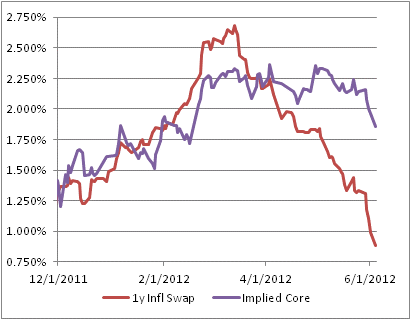
It does bear noting, though, that it is only a sea-change in near-term inflation expectations. The zero coupon inflation curve prices headline inflation over the next 12 months at 0.88%; for the next 12 months (1y, 1y forward) at 1.47%; for the 1y, 2-years forward at 2.21%; and for the 1y, 3-years forward 2.66%. As the chart below (Source: Enduring Investments) illustrates, investors are none-too-sanguine about inflation after whatever near-term correction they think is coming.

Let’s talk a bit about that correction. John Mauldin wrote recently that both deflation and inflation are coming, it’s just that the timing is uncertain. I agree with the part about the timing, but I am skeptical about the deflation.
Arguments in favor of the looming deflationary spiral, precipitating from the European implosion, must lean on expectations for a decline in the velocity of money. Recessions do not naturally cause disinflation. I’ve shown the chart below (Source: Bloomberg) before, but it is worth showing over and over! It shows real GDP (level) in 2005 dollars in white, versus the core CPI price index, in yellow, normalized to 12/31/1999=100. The upshot is that we’ve just come off the biggest recession in 80 years, and inflation barely slowed. In fact, if you remove the effects of the bubble unwind in housing, it didn’t slow at all. If growth causes inflation, and if recessions are by definition deflationary, then we should have seen a decline in core prices.

Now I agree that there’s likely a recession coming, most likely to the U.S. as well as Europe and perhaps globally. But I don’t agree that such a thing is necessarily deflationary.
However, as I said above one can rely on a money velocity argument in this case and Mauldin adeptly does so. I’ve demonstrated previously (for example, here) that money velocity is reasonably well-correlated to changes in the provision of bank credit. The updated chart from that article is below (Source: Enduring Investments), and if the quarter ended today the 2-year compounded rise in commercial bank credit would be up around 2.5%, implying that something like a 17% increase in velocity is expected (eyeballing from the chart).
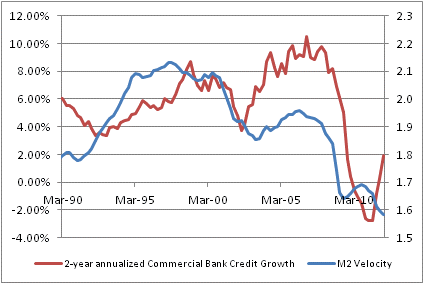
This does suggest a possibility, though, and a way that deflationists could be right. If commercial bank credit collapsed again, then I would expect velocity to keep on contracting. My argument about the upside risks to inflation – at least, the long-tail possibilities – depends on a rebound in money velocity that is not countered by aggressive tightening. We are not going to get aggressive tightening, certainly. But there is a possibility that credit could seize again, as it did in late 2008. Certainly, this is a reasonably likely outcome with European banks. The question is whether U.S. banks – which are much healthier now and currently increasing lending at a 6% clip versus 52 weeks ago – Canadian banks, Japanese banks, etcetera could pick up enough of the slack (or whether European regulators would allow or even encourage zombie banks to keep lending once they become effectively wards of the state) to offset this.
If policymakers get any inkling that credit is seizing up, then the monetary spigots will open wide once more, so in my view a deflationary outcome is very unlikely. But in fairness such a downside tail is more of a possibility than it was a year ago. Is it possible that central bankers might stand down even as velocity plunges? It’s possible, now that there is some concern about the sizes of central bank balance sheets – but I don’t think it’s very likely. So in my opinion, the possible downside “deflation” tail is short in length, short in duration, and low in likelihood; the possible upside “inflation” tail is quite long, quite long in duration, and not nearly as unlikely…in a world where monetary tightening is not viewed as feasible.
I’ll go further and say that if I had to hazard a guess, I would guess that five years from now, we will giggle when we think back and recall that we were concerned about whether our “entry point” for long-inflation trades was 2.10% or 2.40% on ten-year inflation.
It’s Not Hot Money Any More
Those rascals! While everyone was focusing on whether Greece would exit the Euro in the near-term (there’s little question they will exit the Euro eventually), over the weekend German Chancellor Merkel and German Finance Minister Schaeuble urged Spain to request a bailout so that it can reinforce the condition of its banks.
Now, we all knew that was probably coming eventually as well, but last week there had been data showing that deposits have been moved out of Spanish banks in recent weeks and so European policymakers are rightly concerned about a full-scale bank run in the absence of credible (that is, not backed by insolvent sovereign entities but by cash in a fund) deposit insurance on the Continent.
So add Spain to the “To-Do” list, and also to the list of potential arguments. While Germany suggested Spain look for help, Merkel also made clear, again, that Germany will not stand for Eurobonds. Some people seem to think that Merkel is just bluffing. For example, the Wall Street Journal ran a curious article entitled “Germany Signals Crisis Shift” which suggested that “Germany is sending strong signals that it would eventually be willing to lift its objections to ideas such as common euro-zone bonds or mutual support for European banks if other European governments were to agree to transfer further powers to [a central authority in] Europe.” I don’t see anything in what Merkel said, or what her spokesman later clarified, that suggests Merkel would support Eurobonds in almost any set of circumstances – or, at least, relevant circumstances, meaning something that might actually be useful in this crisis over the next year or two.
Merkel is not bluffing. I know this because there is no point in bluffing if you are sure you will be called anyway; in fact, the only reason to bluff is if there is a chance that you will not be called. There is certainly no chance that Merkel saying she’s opposed to Eurobonds will kill the desire in other quarters to have Eurobonds, so I can’t imagine she is trying to defuse that discussion by bluffing but will later cave in. She’s believes in her position, and Eurobonds are dead-on-arrival.
Also kicking around is the idea of a “banking union,” which essentially means that all of the drowning people will embrace and agree to help one another. Spain cannot bail out her own banks because she cannot print money to do so (that was what she tried to do by issuing bonds to Bankia that would be discounted at the ECB in exchange for cash) and doesn’t have enough assets or revenue to do so otherwise. So the idea of a banking union is that all banks would be part of a single network backstopped by Europe. Since that means in the current instance that Germany would have to bail out Spanish banks, and since there are no mechanisms in place to do this in any event, we can also put this idea to one side. It’s an idea for the distant future, one in which Europe survives as a single institution. It doesn’t help in 2012 or 2013, and the reason it is being discussed can only be because authorities think, or hope, that talk along these lines will improve depositor and consumer confidence. Good luck with that.
Stocks had sagged in the U.S. for most of the day, coming ever closer to wiping out 2012 gains for the S&P, when a story came out saying that the G7 will hold “emergency Euro Zone talks tomorrow.” This top-secret meeting was leaked because, again, policymakers are trying to get the nail hammered down without actually having to use a hammer. It won’t work, and so one hopes that the meeting will end with some useful pronouncement. Perhaps a pledge of a coordinated reduction in global swap line rates, or global LTRO, would get a brief pop out of markets. But I doubt it will calm things enough.
The problem is that the big elephant investors are moving, and/or have already gone through the trouble to have changed their country allocations and investing approach. That’s not hot money. That’s not a flow that will reverse overnight. Institutional investors have developed serious and reasonable concerns about the investing climate in Europe, and there will have to be a convincing end to the crisis – or prices low enough that the crisis is fully discounted – before these investors will come back. Investors in motion tend to stay in motion, while investors at rest tend to remain at rest. The inertia has been overcome, I think, so the time for bold-sounding meetings with no concrete results is over. Pops on news such as that will likely be increasingly short-lived.
From May Day to Mayday
By the time the calendar turned to May, one month ago, we already knew that the economy was weakening. The jury is still out on whether the weakening in the U.S. economy is due entirely to payback from the unseasonally good winter weather, but over the course of the month it became clear to most observers that the data were coming in soft. The exception to that rule was the inflation data, but we have been assured that worry is needless.
But back in the halcyon days of April we were just beginning to realize that the Greek “bailout” had not kicked the can down the road sufficiently far. Bankia had not failed, and Spain was not yet so threatening as it is today. And certainly, the head of the ECB had not yet taken to calling the Euro framework “unsustainable,” as he did today:
“That configuration that we had with us by and large for ten years which was considered sustainable, I should add, in a perhaps myopic way, has been shown to be unsustainable unless further steps are taken,”
Lest we forget how far we traveled in May, here is a quick summary of the way we were: (Source: Bloomberg)
|
4/30/2012 |
5/31/2012 |
Change | |
| Crude |
104.87 |
86.54 |
-17.5% |
| Gasoline |
318.44 |
282.5 |
-$0.36 |
| DJUBS Ag |
160.8088 |
144.8983 |
-9.9% |
| DJUBS Softs |
153.9553 |
135.8419 |
-11.8% |
| DJUBS Prec Metals |
514.6371 |
477.9181 |
-7.1% |
| DJUBS Ind Metals |
326.637 |
295.1249 |
-9.6% |
| Dollar Index |
78.776 |
83.066 |
5.4% |
| S&P 500 |
1397.91 |
1310.33 |
-6.3% |
| Spanish 10y yields |
5.77% |
6.56% |
+79bps |
| US 10y yields |
1.92% |
1.56% |
-36bps |
| US 10y real yields |
-0.35% |
-0.56% |
-21bps |
| US 10y breakevens |
2.24% |
2.09% |
-15bps |
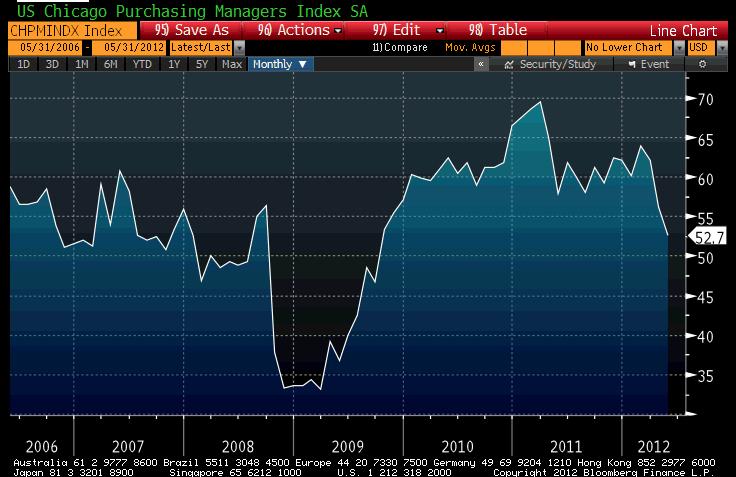
Those are the financial market indicators, but we could go further. Initial Unemployment Claims for the last week of April were 368k; for the last week of May, the figure was 383k. That would seem to be the wrong direction. ADP was also weaker-than-expected at 133k. More concerning perhaps was the Chicago Purchasing Managers’ Report for May, which fell to 52.7 (the lowest figure since 2009) instead of rising to 56.8 as expected. The chart below suggests that the recent numbers have been weaker than the prior numbers were strong.
Stocks sank, although slowly, until the S&P reached and briefly sank below the 1300 level again. Then, for the second time this week, the market rallied on a poll showing the largest pro-austerity party in Greece leading the largest cancel-bailout party by 26% to 24.3%. Yes, that’s right: a 1% increase in the aggregate value of the equity market in the U.S. in response to a polling that was within the margin of error!
If you sold in May, I hope you went away because there weren’t many places to hide. Bonds were the clear winners, but with core inflation rising in virtually every country that is obviously a limited-time offer. Today, year-on-year core inflation in Europe exceeded expectations for the second month in a row. European HICP ex-tobacco, food, and energy rose 1.6%, matching last month’s figure and the high since 2009. (You wouldn’t know this from the widespread headlines of “Euro Zone Inflation Drops to 15-Month Low,” focusing on a headline figure that pundits hope can be interpreted as giving the ECB more room to ease. I fully expect that to happen, and for the Fed to also ease as the European disaster grows more frightening. It isn’t necessary for inflation to be falling, and it won’t matter that core inflation continues to rise. Central bankers simply won’t consider inflation to be a matter of signal importance compared to recession/depression fears.
What a month it has been. And as May draws to a close, we are plainly getting close to a mayday cry.
The Not-Laid Plans Of Mice And Men
The nice aspect about Europe being the only thing that matters these days is that I don’t have to wait until the end of the U.S. trading day to begin writing an article. All of the damage is done early in the day, and then we watch the markets trade more or less sideways or sometimes even correct a bit once the sun sets on the Continent.
Wednesday was no different. Earlier in the week, there had been some optimism that Greek voters on June 16th might vote into power a bailout (and austerity)-friendly coalition. With weeks to go before the election, this seems a thin reed on which to base a strong rally, especially since the polls in question are both highly variable and highly suspect, given the perceived extreme importance of the election. Personally, I don’t see the election being extremely important – mathematics trumps politics, so no matter who wins the election the outcome won’t change. Greece will almost certainly leave the Eurozone, and the only questions are how soon it will happen, and how prepared Euro institutions will be. The answer to that latter question is somewhat frightening, since the headlines last week focused on how this country or that agency or that supranational organization was “discussing contingency plans” in case Greece exits the Euro. It is incredible to me that such a contingency hasn’t already been discussed in each of these institutions sometime over the last year, even if a Greek exit was seen as very unlikely. It’s prudent to plan! (Then again, I spent hours last night getting home because New Jersey Transit had no plan in place describing what to do if a tree fell on the tracks).
The optimism early in the week faded quickly and markets were more or less in rout mode today. Spanish 10-year yields rose to 6.65% (see Chart, source Bloomberg), near a new crisis high, so we are only days or at most weeks away from that situation coming to a head.

In Spain, the bailout of Bankia has taken on a drama all of its own. The original estimate of the size of bailout required was, of course, too low. Spain cleverly proposed to inject €19bn of its own government bonds to Bankia, that is would then use as collateral to borrow actual money from the ECB. Spain would count this as an investment, rather than as a debt, so that it would improve the country’s balance sheet rather than worsening it. The ECB thought this too clever by half, and by the way far too transparent a violation of the ECB’s stricture against “monetary financing of governments,” and rejected the plan out of hand.
But that’s okay, because this morning some EC functionaries passed around the notion that they were “open” to using the ESM to lend directly to banks. Markets rallied euphorically but briefly on this news, but the rally quickly failed on some little details…such as the fact that the ESM isn’t set up yet. Actually, the best discussion of the merits and demerits of this idea was Peter Tchir’s article “National Acronym Day in Europe. Don’t Underestimate the ECB.” Pete explains why there’s some desire to use the ESM rather than the EFSF:
“If ESM can be launched, and it can get a banking license, then the EU has a powerful tool. The ESM is allowed to do all the things the EFSF can do – participate in new issues and the secondary market and lend to countries for them to support their banks. Without a banking license its firepower is limited. With a banking license it can leverage itself to a very high degree and can tap all the cheap funding already in place and whatever new programs the ECB decides to launch.”
As Pete and others noted, the fact that the ESM isn’t set up yet is an important qualification of this idea. The other qualification is the fact that Germany and Finland, whose backing is absolutely required if the ESM is to have any value at all, flatly rejected the idea.
Markets erased all of Tuesday’s gains and then some, with the S&P dropping 1.4% on the day. Commodities, which increasingly seem to be suffering from divestment flows (and possibly momentum players on the downside), fell also with the DJ-UBS down 1.3%. That index is -8.4% on the month, even worse than the -6.1% of the S&P. NYMEX Crude was -3.7%, Gasoline -2.2%. In fact the commodities for the most part were down in direct proportion to their liquidity, with the main exceptions being gold and silver. Yes, the dollar is strong versus the Euro, but it is weak versus the yen! The buck is nearly 6% weaker versus the Yen since its highs in March, and 7% stronger against the Euro. Fortunately for commodities bears, Asians don’t use commodities…right?
Confounding expectations, including mine (although thank heavens I covered that short-bond trade), nominal and real rates continue to decline. The 10y Treasury yield hit 1.62%, 13bps lower on the day, while the 10y TIPS rate fell to -0.48%. The 30-year real rate is now only 0.55%. While real rates and nominal rates continue to hit record lows, inflation expectations do not. 10-year inflation swaps ended the day around 2.41%, well below the 2.75% of March but still well above the 2.20% of last autumn, the 2% of autumn 2010, and the 1.25% of late 2008 (see Chart, source Bloomberg).

As silly as it was for the EC to propose using an ESM that isn’t even set up yet, I actually think that the idea is targeting the right response in a way. The best (remaining) solution, in my view, involves kicking out the weaker members of the Euro and then bailing out the banking system with the huge amounts of money that will be required. Yes, it will have to be printed because there’s just not enough real capital available. But the Euro is untenable in its form, at least now. And any disaster that supposedly follows the exit of one or more members will primarily stem from the carnage it would inflict on a financial system that is loaded to the gills with sovereign debt.[1] Bailing out the financial system – not indiscriminately, mind you, but favoring the stronger albeit not necessarily the larger institutions – won’t be popular but is not entirely unfair in this case since the banking problem in Europe was partly caused by dumb regulatory risk weightings that encouraged banks to hold more sovereign debt, partly by ill-considered moral suasion used to persuade banks to hold more sovereign debt, and only partly by poor risk management.
That solution will never happen, because it would require a whole lot of legislatures to authorize some extreme solutions, and such an approach is not politically palatable. What is more likely to happen, because it is constituted of bite-sized political pieces, is closer to the worst case: don’t kick out the weaker Euro members, so that the imbalances remain, and bail out banks in serial fashion rather than all at once.
Not that there weren’t better solutions, mind you, in the past – but the time for them is gone. We’re down to just hard solutions. In this case, the cheapest fix remaining will be liberally applied: cheap money. Yes, I know that the Fed is insisting (as Fisher did today) that more stimulus isn’t needed. And they’re right, because stimulus doesn’t work. But it’s still perceived as a cheap lunch, and as the situation in Europe worsens and the bank runs accelerate, central bankers will fire up the technology that fired up Bernanke’s imagination back in 2002: the printing press.
Back on the boring side of the Atlantic, tomorrow ADP (Consensus: 150k) and Initial Claims (Consensus: 370k) will be released. There is reason to be wary of these numbers. Last month ADP came in at 119k, which was well less than expectations. History shows that with ADP economists tend to miss in the same direction at least a few times in a row, so another soft print is likely. It’s unlikely to show the economy is collapsing, but it will reinforce the sense that the U.S. economy is slowing, and unlikely to be robust enough to pull Europe (and perhaps China) out of the tailspin. This will not hurt the bond market, but if the data is weak…yet not dramatically weak…then equities may get a bounce from the idea that QE3 just got closer.
[1] Of course many other businesses will suffer losses on cross-border contracts that were poorly constructed, not providing a fallback currency arrangement to the Euro. This violates the girlfriend rule of thumb: Don’t make plans that are further in the future than you have been together so far. Greece joined in 2001, so if you wrote a contract in 2007 that went further out than 2013 without a fallback mechanism, shame on you!
