Archive
Bundespanked
Draghi’s celebrated, chest-thumping, “whatever it takes” to preserve the Euro was apparently…nothing. The ECB did nothing. Perhaps he meant the value of the Euro, not its existence, and they would preserve it like the Bundesbank wants to, by controlling its supply? Yet, in his press conference he seemed to make clear that he meant the ECB would go to bat for European union, as he said the “Euro is irreversible.”
Actually, Mario, that’s precisely the question at hand!
Also, like a true central planner, he intoned that “high yields [for peripheral countries] are unacceptable.” At least, I assume he means for the peripheral countries, although it was not so long ago that 7% was considered a sustainable yield. At some level of debt, I suppose that even 2% is unsustainable! But this isn’t the point. The point is that it isn’t up to Draghi to “accept” high yields. It isn’t his market to arrange. The market itself makes the decision about what yields are “acceptable,” given the risk. I think he means the same thing my daughter means when she stamps her 5-year-old foot and declares something “unacceptable.” What she means is, she doesn’t like it. Just like with her, the answer to Draghi is “too bad.”
The Fed’s inaction was surprising (to me), but justifiable with the ECB up the following day. The inaction of the ECB is much harder to fathom in the context of President Draghi’s boast of only a few days past. A lot of theories about future paths of policy have now been thrown somewhat into question, for the ECB appears to have been Bundespanked.
Are monetary policymakers maybe finally growing concerned about money? They haven’t been for a long time; Daniel Thornton, a senior economist at the St. Louis Fed, has been fairly in the wilderness with his publications exhorting economists to actually look at the data again. His latest piece, “Monetary Policy: Why Money Matters and Interest Rates Don’t”, likely will get no more read inside the Fed than his other pieces have, more’s the pity.
Now Draghi did say in the Q&A part of his press conference that we shouldn’t assume the ECB “will or will not sterilize” any bond purchases that happen. Since always previously the ECB has claimed it was sterilizing purchases (which means they soaked up the money that they were inserting with the purchases), this would represent a weakening of hard-money resolve…if it were actually going to happen. I rather wonder if he didn’t say that just to tweak the Bundesbank. Anyway, he says that “details [are] to come in the next weeks,” which was enough to save markets from a pure meltdown.
Strangely, the Euro weakened along with stock markets in the U.S. (S&P -0.7%) and in Europe (Eurostoxx -3.0%). The Euro ought to be strengthening if investors thought that the ECB just got monetary policy religion and so would restrict the money-printing activities everyone was assuming would happen. Unless, that is, investors are selling Euro-denominated issues because they think the union will break up due to ECB inaction.
My head hurts.
What seems clear enough is that for at least a month or two, the markets are on their own. I don’t know how that’s going to work, when Greece is due to borrow money from the ECB to pay off maturing bonds in only 3 weeks. Conventional wisdom is that the ECB will advance the money, since the ECB holds most of the debt that will be paid off, but I’m no longer so sure of anything.
I do know that we have Payrolls tomorrow morning, and expectations are justifiably low. Consensus expectations are for 100k in nonfarm payrolls and an unchanged 8.2% Unemployment Rate. Payrolls over the last three months have been, after revisions, 68k, 77k, and 80k respectively. The market likely reacts to a very weak number in a positive way, because the conventional wisdom seems to be that the Fed will surely ease at the next meeting if the data remains this weak. But what do we do with a strong number that throws the Fed’s immediate next move into doubt? My guess is that something in the high 100s (175k, 190k, etc) is taken as bearish equities, bullish bonds for this reason, while much above that it all becomes confusing because it won’t be clear whether the first three months of the year were the aberration (the operating hypothesis) or the last three months were.
The only clear investment to me remains commodities, which corrected strongly today , down around 1.25-1.50% ex Nat Gas, which plummeted nearly 8%. Gasoline, however, rallied another three cents. If the central banks abruptly started to control money supply growth and shrink central bank balance sheets – a prospect that I give about a 20% chance to – then the future returns to commodities would be less than I expect. But they’re still undervalued with respect to the current money supply, so even in this case I’d expect solidly positive 5-year real returns.
And if the Bundespanking wears off (and as a father I can tell you, they tend to wear off very quickly), the near-term returns to commodities will continue to look great as well.
Your Lead, Mario
Quite contrary to my expectations, not to mention those of a majority of investors and analysts, I think, Ben Bernanke’s Federal Reserve confronted the recent weak economic data and delivered almost exactly nothing.
The Fed didn’t even extend the “at least through” language. Changing “at least through late 2014” to “at least through mid-2015” was probably the smallest token gesture the Committee could have made. The language, originally perceived to be a ‘promise,’ has become a bit of a joke since the projections by members of the FOMC indicate that many of them don’t take the promise as representing any kind of commitment, merely a projection that they don’t all agree with. As such, it has zero policy value since buying 2-year notes on the basis of what the pointy heads suggest they think will be their policy a year from now would be just plain stupid. And yet, the Fed didn’t even incline its head with a small nod in this direction.
Wall Street Journal columnist Jon Hilsenrath must feel used. His column last week suggested strongly that Fed officials “find the current state of the economy unacceptable” and that they “appear increasingly inclined to move unless they see evidence soon that activity is picking up on its own.” Wall Street assumed that Hilsenrath wasn’t engaging in unsubstantiated guesswork about policy, but that the suggestion was being run up the flagpole.
Guess not.
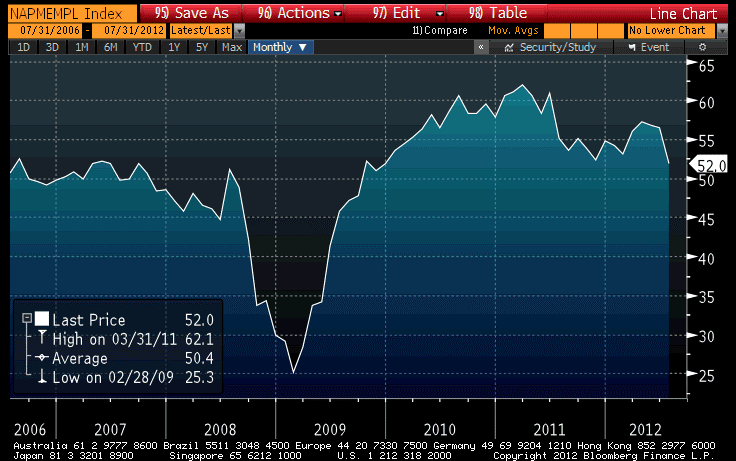
There is certainly no evidence yet that “activity is picking up on its own.” The ISM Manufacturing Index remained just barely on the shady side of 50.0, when a bounce was expected; this included a drop in the “Employment” subindex to the lowest level since the end of 2009 (see Chart below, source Bloomberg). The data will keep on coming, of course, but so far there haven’t been any signs of imminent dawn. Indeed, the Fed continues to see “significant downside risks” in the global economy.
I admit that I thought they would do something more than merely change the non-binding promise language, and I was surprised they did not. I thought they would cut the Interest on Excess Reserves (IOER) rate back to zero. That doesn’t mean, however, that I thought cutting IOER is the right thing to do. Monetary policy here is impotent with respect to growth, and while they can push inflation higher or lower with policy the move they should make is probably to start pulling back on liquidity once Europe is clear of danger. They should not wait until money velocity begins to rise again.
But that isn’t what they will do. The Fed doesn’t believe that it is impotent with respect to the Unemployment Rate, so even though they are firing blanks at a charging enemy with no apparent effect, I fully expect them to keep on firing. It’s odd, as an analyst, to try and get into the “Fed’s brain” and think intentionally wrong, but I suppose it’s what actors and actresses do when they’re getting into character. It’s just that my liberal arts education didn’t include a thespian turn.
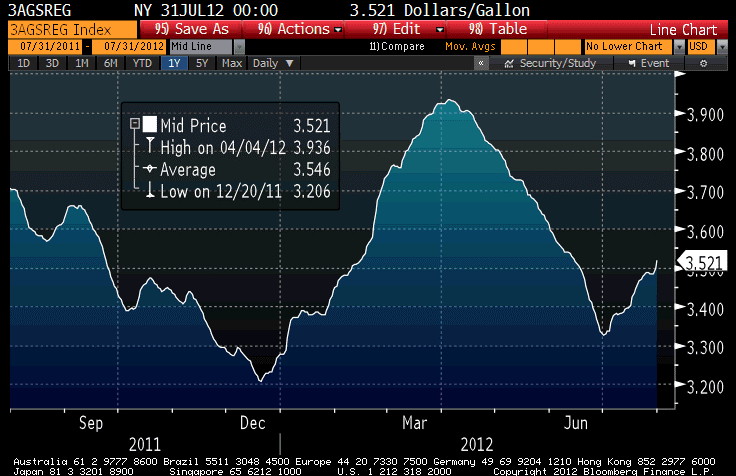
If I am in character as the Fed chairman, I’d be thinking it’s awfully dangerous to wait before firing my next blank bullet. Gasoline prices are back on the rise, with retail unleaded back above $3.50 (see Chart, source Bloomberg), joining agricultural produce. This means headline inflation, which currently appears tame, is unlikely to stay that way for very long. If the Fed wants to ease policy in late September, they may have to do it with less-accommodating price data.
It is possible that the Chairman is afraid to do anything unusual, like cutting IOER, unless he has a presser scheduled so that he can explain it to us poor benighted folk? This could be the case, but it doesn’t explain why they didn’t do anything.
Could it be that, with the ECB meeting tomorrow and that body very likely to ease more aggressively than the Fed anyway, that the Fed chief wanted to let Draghi ‘hold serve’? This seems strange, but it’s plausible.
In any event, investors seem to believe there is another monetary policy shoe to drop. While yields backed up slightly with 10-year yields +5bps (1.52%) and stocks dropped a trifle (S&P -0.3%), commodities actually rallied after the Fed announcement! Almost certainly, the market will get something from the ECB tomorrow, but I suspect stocks and bonds are clinging too desperately to that eventuality and I expect any rally on the news will be short-lived.
Happy $10 Trillion Day!
It seems that few people look at M2 money supply these days, so the fact that the odometer on the key money supply gauge rolled to $10 trillion today seems likely to remain unlamented. The trip from $9 trillion to $10 trillion took a mere 66 weeks, half the time that the trip from $8 trillion to $9 trillion took. The robust growth of money supply, even though money velocity continued to decline over most of the period (we will find out whether it declined in Q2 when tomorrow’s GDP figures are released), is clearly implicated in the rise of core inflation over the same period (see Chart, source Bloomberg).
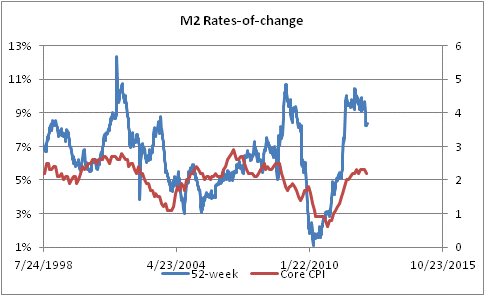
The pace of M2 growth recently has softened to only 8.4% over the last year, and is likely to fall further over the next few weeks as the end-of-July spike from last year falls out of the data. Yet even a decline to 7% implies a faster rate of core inflation, unless velocity continues to decline as well. As commercial bank lending growth is now growing comfortably faster than 5% per year (most recently at 6% over the prior 52 weeks), this seems a bad bet, and I continue to expect core inflation in the U.S. and in other developed countries to move higher rather than lower.
The Fed, as it readies QE3, will not be acting alone. This is made evident by ECB President Mario Draghi’s statement this morning that “Within our mandate, the ECB is ready to do whatever it takes to preserve the Euro. And believe me, it will be enough.”
And yet, as of yesterday, Greek bonds are no longer good collateral at the ECB. The reports from the Troika out of Greece seem to make plain that no more rescue money will be headed to that country. I will note that a “planned” exit of Greece from the Euro, or at least a planned default, would surely include the refusal of Greek bonds as ECB collateral, because otherwise upon the event the ECB would be suddenly vastly undercollateralized or uncollateralized on its loans to Greek banks – not a good idea. I won’t go so far as to predict that Greece is about to be squeezed out of the Euro, but it is consistent with the following:
- Increased discussion of QE3 and the mooting of the question by presumed Fed mouthpiece Jon Hilsenrath of the Wall Street Journal.
- The ECB’s decision at its last meeting to cut the deposit rate to zero, and recent discussion of the possibility of a negative rate, even as Euro M2 last month rose to its highest year-on-year growth rate in several years (albeit still a feeble 3.4%), shows a renewed determination to get the pendulum of monetary policy swinging in a positive direction.
- The rejection of Greek bonds as good collateral at the ECB, as mentioned above.
- The story in Der Spiegel that declared the IMF wants to cut off Greek aid, which is after all a reasonable thing to do the moment it is clear that it has no chance of staving off Greece’s collapse and exit from the Euro.
- Increasingly us-against-them comments by Greek Prime Minister Samaras, who sill be responsible for rallying his country’s spirits and economy after the exit.
The timing of a Greek exit from the Euro is perhaps not ideal – that would have been last year, before so much money was wasted, when the European economy wasn’t yet in recession, and when the U.S. economy at least had some positive momentum – but it is not likely to get much better. From the Fed’s perspective, the timing of additional easing will get more difficult, especially if the domestic economy awkwardly begins to zig-zag back up. It is much more politically astute to do QE3 after a horrible Durable Goods number (like today’s, which pushed the 6-month average change in core Durables negative for the first time since 2009) than it would be to do it when it was obviously done to help Europe.
Moreover, headline inflation has recently dropped below core, but it will not stay below core for long as gasoline and food prices have recently begun to rise. So there is a limited window during which the doves can point to domestic economic weakness (this window may not be so small, but you never know) and the hawks can claim they see no inflation evil even with core inflation sitting at the Fed’s target. The Fed’s contribution would very likely be to drop the interest on excess reserves (IOER) charge to zero, which would also harmonize deposit rates with the ECB. This would be a significant policy move, spurring even more lending, while not looking as significant as a QE3 that involved further bond-buying.
In short, I think you should say your goodbyes to IOER and to Greece, because I expect neither of them is going to be around for very long.
There was another interesting development last week – a very significant story whose implications seem to have been largely overlooked. I will discuss this story, which has near-term bullish implications for both stocks and bonds, tomorrow.
The Importance of Being Clueless
We wrote off last week’s dull equity trading to the fact that the U.S. had a holiday in the middle of the trading week. Despite some interesting data, including weak Employment news on Friday that moves us closer to another Fed action (as I wrote on Friday), trading was lethargic. I’ve been chronicling the decline in equity volumes for a while now. It has become unusual to break 900mm shares unless there is an options or futures expiration, or a month-end. Cumulative year-to-date volumes are only 81% of last year’s volumes, and only 58% of the last 5 years’ volumes (see Chart, source Bloomberg).

Sure, some of this is due to the moving of share volumes off of traditional exchanges, but that doesn’t explain that much of the trend – if you measure other volumes, instead of NYSE volumes, you get a similar story. I hold that a lot of this is due to the crusade against high-frequency trading (some of which is actually market-making), some of it is due to new SEC and CFTC rules concerning reporting, and a significant part is due to Volcker Rule restrictions. Hopefully, some of it is also due to public disenchantment with the stock market as a path to easy wealth – that would be a healthy development.
But we’re not exactly going through a boring time in the markets. Just a couple of weeks ago we had a really exciting European summit, and on virtually every day since we have unwound the significance of what happened then. Today, ECB head Mario Draghi said that the ESM (which is supposed to recapitalize Spanish banks) will not be functional until 2013. Oh, and Italy and Germany still need to give their final approvals.
Spanish yields in the meantime continue to slip higher, with the 10y Spanish yield back above 7% today. U.S. bonds weren’t asleep: the 10y Treasury rallied 4bps to 1.51% (10y TIPS rallied to -0.60%). But stocks snoozed, even when President Obama announced his intention to seek an extension of the Bush tax cuts for all taxpayers earning less than $250,000 per year. That ought to have launched stocks higher, and in years past certainly would have. It’s a bad sign for the President when the market takes his big announcement as being nothing more than a cynical political ploy. Hey, even if it is a cynical political ploy, it ought to be supportive of equity values since it removes one reason to sell stocks this year to take gains under a lower tax regime!
Commodities certainly weren’t asleep: the DJ-UBS added another 2% today, with across-the-board strength in Crude (+1.8%) and Gasoline (+1.6%), Grains (+3.6%, now up 25% over the last month), Softs (+2.0%, up 12.6% over the last month), Precious Metals (+0.9%), and Industrial Metals (+1.0%). Where did that come from?
I admit to bias here. Readers know that for a long time I have been pounding the drum for commodities as the cheapest conventional asset class (and which provides inflation protection besides). Partly, this rally – for the DJ-UBS, it’s 7% over the last 7 trading days – is due to the asset class being semi-loathed and certainly under-owned. Yes, grains are shooting higher because of Midwestern drought, but what about Nymex Crude? Sugar? Coffee?
I think there may also be an inkling from the so-called ‘smart-money’ along the lines of what I wrote Friday. The weak data recently increases the odds of QE3, at least in the form of an elimination of interest paid on excess reserves. Europe has already taken that step, with some immediate effects:
- JP Morgan, Blackrock, and Goldman closed their European money market funds to new money after the ECB lowered the floor rate. This was the Fed’s stated fear, that ultra-low rates could cause the money market industry to close down. Then who would buy the Treasury’s TBills?!
- The first French T-Bill auction after the ECB rate cut resulted in negative yields (for the first time), joining Germany and the Netherlands in doing so. It turns out that all we will do by letting the money funds go out of business is to save a layer of fees! By the way, I still think that if money funds just reorganize into a form where there is no forced $1 share price, then problem solved. Maybe that takes legislation, but it certainly insurmountable.
- Commodities launched higher. While the launch occurred prior to the actual rate cut, it wasn’t like the cut was a complete shock.
The real question, as central banks eliminate these floors, is what happens next. What should happen if the Fed stopped paying interest on excess reserves, or made it a penalty rate?
The Federal Reserve has made much ado about how their large-scale asset purchases (LSAP) have “acted like” a further easing of interest rates. But I am not so sure of that. The money went into vaults, and short term interest rates didn’t decline. The effect on longer-term interest rates is unclear – while it’s plausible to think a ‘portfolio balance channel’ drove long-term rates lower, it’s hard to read the magnitude of such an effect with the huge amount of noise from changing issuance patterns, various flight-to-quality events, and so on. If the Fed wants to see how much LSAP affected short-term interest rates, then let the market find the clearing price! If the Fed declared that there would now be a -2% penalty rate to keep money at the Fed, I have no doubt that the clearing rate for overnight rates in the U.S. would be clearly negative. And there’s nothing at all wrong with that, philosophically. Repo rates already trade negative from time to time, as do T-Bills. The market can cope. Really.
But if the Fed did that – said “take your money back,” essentially – where would it go? It would definitely in that case push the short end of the yield curve even lower, perhaps even out to 2-years, and by extension the entire curve would be affected since longer-term rates are after all just impounded expectations of short rates.[1] More importantly, some banks would choose to make more loans rather than endure negative carry on reserves. With commercial bank credit now growing at a post-2008 high rate of 6.0% over the last year, this seems less important, but if the Fed believes they can do something about growth, this is the thing they can do and I think a prime candidate for what they will do. Some of this cash also will flow into assets that historically earn zero real returns: commodities, for example.
Now, in Europe it is harder to figure out what will happen. If banks can give money back to the ECB rather than experiencing increasing negative carry, they may. I don’t remember if the LTRO allows that. European banks seem to be increasingly stuffed to the gills with sovereign paper, and are probably less able than U.S. banks to extend loans given the sorry state of their balance sheets. Gold at least stores well, but there’s a lot of volatility there, and it means dollar exposure as well.
I don’t know the answer, but the freeing of short rates to go negative is potentially a game-changer. I think it’s far more important than more asset purchases, especially because investors are likely to be somewhat clueless about how important it is and what it should do to the inflation outlook. That cluelessness is important, because the last thing in the world that central bankers want to do is “unanchor” inflation expectations. (Personally, I don’t think inflation expectations matter, but the important thing is that the central bankers think so).
[1] Well, okay, they’re not “just” impounded expectations of short rates, but in many ways they behave like that, so if we allow negative short rates then we impound lower expectations in longer nominal rates and they should decline.
The Choppers Are Warming Up
Today’s market selloff owes much to the people who put together the ADP figures (that is, Macroeconomic Advisers). Yesterday’s cheerful ADP report raised expectations for today’s Employment report. Unfortunately, those expectations were dashed. The U.S. economy generated 80,000 new jobs in June, which wasn’t far statistically speaking from the Bloomberg consensus of 100,000 but was far from what investors were hoping for. The economy has now expanded payrolls at the blistering pace of 75k per month over the last three months. Wow!
The Unemployment Rate nudged slightly higher to 8.217%, although unchanged on a rounded basis.
It wasn’t a horrible report, just horrible compared to what investors were expecting. The stock market judged the labor market progress harshly, with the S&P losing -0.94% although it was down more than that for most of the day. It didn’t help that European markets were getting smacked again, with Spanish 10-year yields +53bps and Italian 10-year yields +25bps. It was revealed today that another of the key summit concessions, the fact that the ESM would lend directly to banks rather than to the Spanish government which would then lend on to banks, won’t actually happen in practice. First of all, the Troika report which was to precede the signing of the memorandum of understanding wasn’t ready on time (because you know, they probably have more-pressing problems than the €100bln hole in Spanish banks). Second of all, the ESM isn’t ready yet, so any money going to banks will have to pass through the sovereign and that messes up the whole works. Moreover, a senior EU official reportedly said today that the mechanism of having the ESM lend to the banks was only to “cut out the effect of that loan on the debt-to-GDP ratio of the sovereign…It remains the risk of the sovereign.” So, again, financial legerdemain over substance.
Moreover, if the Spanish banks can’t or won’t buy Spanish bonds, and the ECB won’t buy any more Spanish bonds, who is going to buy the Spanish bonds? Apparently, this is something of a question or 10-year yields wouldn’t be back near the crisis highs (see Chart, source Bloomberg).

Commodities finally reacted to the weak turn in the growth story, and the further rise in the dollar, by declining today. The energy sector, let by Nat Gas, fell 3.1% (Natty was -5.4%). The DJ-UBS index was -2.3% (although our preferred commodity index vehicle, USCI was only -1.2%). U.S. bonds rallied, with 10-year real yields -2bps and 10-year nominal yields -5bps. Ten-year inflation expectations as reflected in US CPI swaps fell to 2.39%, the lowest since January although well above the lows of last year.
In the jobs report, Average Hourly Earnings provided an upside surprise, with the year-on-year rate of earnings increase rising to 2.0%. As I’ve said in the past, though, wages follow inflation so this isn’t particularly important to the inflation outlook. Potentially more-significant is the fact that M2 money supply growth on a year-on-year basis fell yesterday (largely from base effects) to +8.0%. While that’s still quite high (if we had real growth of 2.5% and velocity was stable, it would imply inflation of 5.5%), it is the lowest it has been in almost one year. Further base effects could bring M2 down to the 6-7% range over the next couple of months, which is still too high for comfort but which will help Chairman Bernanke build the internal coalition for additional easing as some of the traditional monetarists conclude they can stop worrying about the money supply. In the next few weeks, M2 will surpass the $10 trillion mark, but this is likely to go unremarked and unlamented. Today’s Payrolls report, along with the ebbing M2 growth and continued malaise in Europe, raises significantly the likelihood of near-term Federal Reserve quantitative easing.
Green Acres Is The Place To Be
The repudiation didn’t take very long to begin. Despite good economic data and generous central bank action, stock markets sank in Europe and the U.S. and the U.S. bond market rallied with both real and nominal 10-year yields falling 3bps.
The ADP jobs report produced a 176k gain, compared with expectations for +100k, provoking some economists to raise their expectations for tomorrow’s Payrolls gain. ADP is an imperfect measure, but it gets the sign right more often than not. Initial Claims were also slightly stronger than expectations, but more significant were the actions of central bankers globally. The Bank of England announced an expansion of their Quantitative Easing program of another £50bln. Accounting for the size of UK GDP compared to US GDP, as well as the UK/US exchange rate, that works out to the equivalent of roughly a $500bln increase if the Fed wanted to do the same thing, so it isn’t a small measure. The People’s Bank of China and the ECB acted (apparently coincidentally) in near-unison, with both cutting rates. Significantly, the ECB cut its deposit rate to zero, so all banks that took LTRO and left the money on deposit at the ECB are seeing their negative carry on that deal worsen. Denmark also cut its deposit rate sharply – in that case to a sub-zero rate. More on the zero and sub-zero deposit rates, later.
And yet, global equities dropped, in some cases sharply.
This may be somewhat related to the slow-motion repudiation of the “progress” made at the summit last week. German Chancellor Merkel said the deal cut at the Euro summit last week doesn’t mean that German has taken on any additional liabilities. This echoes what I said on Monday:
What in Merkel’s history or makeup would make you expect that she would cave in to foreign leaders, especially just one day after she had been so hostile to Eurobonds? Isn’t it much more likely that she doesn’t see the new deal as being a big deal, since it doesn’t involve much new money?
The old riddle goes Question: “How can you tell if a politician is lying?” Answer: “Her lips are moving.” Never, never accept the joint statement of a summit meeting as representing anything useful, and certainly not truth. In the wake of the good economic data and the robust central bank actions, Spanish 10-year yields rose 36bps and Italian yields rose 21bps.
The dollar reached one-month highs today, but here is the interesting part: commodities reached two-month highs. Believe it or not, since the end of March the DJ-UBS commodity index has now outperformed stocks, thanks mainly to the rally over the last week.
That rally, to be sure, owes a lot to the energy and grains complexes. Energy is up partly because the “tail risk” of a renewed global depression seems to have receded somewhat in some investors’ minds and partly because of renewed tensions in the Middle East (with Iran drafting a bill that would adjure its military forces to try and stop tankers from passing the Straits of Hormuz en route to countries that are sanctioning the nation, and the US reportedly stepping up its military presence there). And grains are up primarily to poor weather conditions in the Midwest, which has led to downgrades on the expected crop yields.
Those are the excuses, but remember one advantage that commodities have over stocks is that commodities tend to “crash” upwards (they are statistically positively skewed and positively kurtotic) while stocks more often do the opposite. Sharp moves higher, especially after a long period of being beaten down, are not unusual in commodities.
That said, real grains prices are not at all-time highs. Not even close, although nominal corn prices are near all-time highs and real corn prices are about to reach the highest level since the early 1980s (see Charts, with real wheat prices first. Ignore the absolute level of the y-axis, which is an artifact of the formula “commodity price/CPI price level * 100”).


In fact, the huge rally in corn prices since 2005 has done nothing more than to cause the long-run rise in corn prices to just about exactly equal the long-run rise in prices generally. From December 1969 until now, headline CPI has risen around 509%, while front Corn futures have now risen about 536%. While Corn, since it’s not a storable commodity, doesn’t have the automatic tendency to a zero real return that, say, gold or copper does, in the long run it should still rise in the general direction as the overall price level. The languishing of grain prices for most of the 1980s and the 1990s helped speed the demise of the small farmer although it was beneficial for the development of emerging economies and our own. But, as with other trends that have tended to dampen inflation – apparel prices come to mind – this one seems that it may have run its course. How surprising would it be to find grain prices actually rising with overall inflation again?
.
The actions by Denmark and the ECB to cut their deposit rates to or below zero, and the opposite prescription mentioned today by San Francisco Fed President John Williams, recall to my mind the prescription I’ve mentioned many times in these pages. The key link between QE and inflation isn’t base money, but transactional money (I generally use M2). These two have always been closely related, until the Federal Reserve began to pay interest on excess reserves (aka IOER).
IOER is basically the barn door holding the monetary horses in. Traditionally, it has been okay to look at the monetary base with respect to the MV≡PQ equation – not because it was right to do so, but because the relationship between the money base (which the Fed controls directly) and transactional money was very regular. That is why some inflation-phobes got really terrified when the Fed was doing QE, while those of us who focused on the significant part of the relationship perceived that inflation would come, but much more slowly. While base money exploded, M2 did not explode, simply because the Fed was paying banks not to lend it.
Money sitting in vaults, unlent, to a large extent doesn’t act like “money” at all (it is a store of value, but not a medium of exchange!), which means it doesn’t pressure prices since it has never entered the flow of commerce. There may be “too much money” and “too few goods,” but there was no “pushing,” or at least not as much as the rise in base money would have suggested. Because, again, because the Fed was paying IOER and therefore incentivizing banks to be more hesitant to lend.
If excess reserves yielded zero, or especially if there was a penalty rate, all of that money would have been lent and M2 would have exploded. This is the policy that the ECB and (less-significantly) Denmark are following. As noted above, banks have negative expected returns on the LTRO funds sitting at the ECB. Some of those funds will stay there simply because there is an insurance value to liquidity. But at the margin, if a bank can make a loan even if it has an expected loss, as long as the loss is smaller than the guaranteed loss of keeping money at the ECB then it will have a tendency to do so.
The problem with IOER is that we don’t know how sensitive the money multiplier between base money and M2 is to IOER….since we’ve never had IOER before.[1] So – we don’t know whether those reserves will slowly leak into the system, or if a 10bp change in the IOER would have a huge effect, or none at all, or what. The ECB also doesn’t know this, but they obviously sense that it’s now or never, and before they do another QE they ought to free up the first one. It seems like a fairly innocuous move, and will produce fewer fireworks than another LTRO (it may be that disappointment about the lack of an LTRO was part of the reason for weak market reaction today), but in fact it may well be more significant.
All in all, it may be better to be a farmer than to be a policymaker!
[1] When I wrote this sentence it sort of reminded me of the line in Dr. Seuss’s “Bartholomew and the Oobleck,” when the magicians tell the king, “We just can’t tell you any more/we’ve never made oobleck before.” And the similarities don’t end there. “IOER is gooey, it’s sticky, it’s like glue.” “If it sticks up robins, then it will stick up people too!” And so on. I wonder if Seuss was a policymaker wannabe.
Slow-Motion Repudiation Yet To Come
After a huge rally like we had on Friday, it’s often prudent to wait for at least one trading day to see whether the move will be instantly repudiated, or whether the repudiation will take place over time.
Here’s how I see the results of the Euro summit. A bunch of heads of state agreed to a package that increases by a little bit the total amount of capital committed (not the €120bln of the headlines, as the headlines included some programs already planned), makes some concessions to help Spain, and makes some important improvements in the way money is to be dispensed and the seniority of the claims of the EU authorities in such a case. Nothing has been approved by any legislatures, and nothing is to go into effect very soon.
It’s a useful step, but merely a step; the perception of success was enhanced by the convenient fact that the conditions of quarter-end raise the costs of incredulity. Better to go along, for at least the last day, and keep from ruining a quarter of good trading! That’s why a modest step forward was worth 20 S&P points, as well as 40-50bp rallies in the 10-year bonds of Italy and Spain, which in turn produced a palpable sense that this time, the Eurocrats sounded the right note.
It was better, to be sure. Subordinating the bailout money to the claims of holders of sovereign debt was critical, since otherwise yields would have gone to the moon in very short order. Make no mistake, if push comes to shove the authorities will still do a cram-down, but at least they seem to understand why they don’t want to make it obvious now.
I always find amusing how important “narrative” is to the markets. Investors cling to a popular narrative point even when it makes little sense. I heard on Friday that Merkel “conceded when surrounded by foreign leaders.” Really? What in Merkel’s history or makeup would make you expect that she would cave in to foreign leaders, especially just one day after she had been so hostile to Eurobonds? Isn’t it much more likely that she doesn’t see the new deal as being a big deal, since it doesn’t involve much new money?
But the market jumps were so powerful psychically that moves were mostly sustained today even though the predictable chinks appeared in the story. Crude oil jumped 9.4% on Friday, as well as copper, coffee, gold, and other commodities as the dollar dropped sharply. They sustained most of those gains today as the DJ-UBS closed +0.2%, even though the buck rallied some. It makes sense, if commodities have been beaten down so badly on the disaster scenario, that any whiff that the scenario might not come to pass should send them skyrocketing. Not that I think that commodities really need global growth to accelerate in order to do just fine, but the asset class is out-of-favor, widely scorned, and under-owned for the first time in several years so it shouldn’t take much to provoke a rally.
Equities, up sharply on Friday, added another +0.25% today (on the S&P), again extending the prior gains as the narrative continues to beat. Bonds, on the other hand, reversed their Friday selloff to rally today, almost wiping out Friday’s loss. It seemed the bond guys were the only ones to notice that the Manufacturing ISM printed its lowest level (and first sub-50) since 2009 (see Chart, source Bloomberg).

The last couple of months have seen a rather sharp fall. There are more important data this week than ISM – Employment on Friday, for example – but this is somewhat disturbing, especially after the Milwaukee and Chicago purchasing managers’ reports late last week both exceeded expectations slightly. The 2-month change in the ISM is actually the worst 2-month fall since December 2008, worse even than the post-Japanese-earthquake setback. So it’s not just the level, and not just the direction, but the rate of acceleration that’s disturbing. Again, though, it’s just one piece of a data collage.
As for those predictable chinks, how about this one: Finland declared that it, along probably with the Netherlands, will prevent the ESM from buying sovereign bonds in secondary markets. Well, whoops! The decision to use the new entities to stabilize markets was kinda sorta one important development to come out of the summit. And, while technically the summit wasn’t about Greece, it can hardly be productive that, hard on the heels of a new Greek government being installed (and one elected on a platform of renegotiating the austerity measures so as to remain in the EZ), the ECB told Greece not to hope for any concessions or aid such as Spain has received.
I suspect that we are going to see, shortly, yet another re-think about the prospects for Europe. But while it’s easy for me to see that I am still not excited by the prospects for equities, it is harder for me to see where bonds are likely to go, near-term. The knee-jerk reaction, conditioned over decades, to every piece of bad economic data is to buy Treasuries. But at 1.59% for the 10-year note, we are clearly not just pricing in weak economic data. With core inflation at 2.3%, and 10-year inflation expectations at 2.40%, we are clearly not pricing in deflation or disinflation. I can’t think of any reason to buy bonds here, and even if I was running an LDI program that needed to be 100% in fixed-rate bonds to be immunized, I’d buy inflation-linked bonds as a surrogate that has pretty much only upside (relative to nominal Treasuries!) from here. But that reasoning was the same at a 2% 10-year note, so the glass remains dark to me. I will say that our “Fisher decomposition” model (which sounds a little bit like a mortician’s dissertation, come to think of it) is indifferent on being short the bond market through being long inflation or being short the bond market through being short TIPS – it is simply short nominal rates, but importantly at a leverage ratio below 1.0. I suppose that matches my view: bearish on bonds, bullish on inflation breakevens (e.g. through RINF or INFL, neither of which I currently own), but very cautiously in all cases.
Where Can I Buy Global Economic Health Insurance?
For a few hours, Americans actually paid attention to news from the United States this morning. It wasn’t the continued weakness in Initial Claims (386k this week, with last week revised up to 392k) that involved investors in domestic affairs for a change, but rather the drama of the Supreme Court’s decision on Obamacare. Just after 10am, the Supreme Court handed down the eagerly-awaited/dreaded decision, and it contained a surprise for just about every observer. The Court upheld the vast majority of the law, including the individual mandate that had so agitated conservatives. But the majority actually held that the law would have been unconstitutional under the commerce clause of the Constitution, which was the argument of those who wanted the law struck down. The interesting twist is that they also ruled the mechanism still worked because it can be construed to be a tax, rather than a ‘penalty.’
In other words, if the law said that you must take an insurance policy or else you’re guilty of a crime, it would have been unconstitutional per se. But the law offers a choice, however bad, that allows you to evade the requirement of the law: you can just pay a rather stiff fine. According to the Supreme Court, that makes it a tax and since it doesn’t force anyone to enter the stream of commerce – it merely persuades them financially that they ought to – it doesn’t run afoul of the Constitution. Bad law, perhaps, but not unconstitutional.
It’s an interesting and depressing ruling. Since there is no limit on the amount of money the government is permitted to levy in taxes, there would be no difference in principle if the Congress had made the “opt-out tax”, say, $100 million, completely bankrupting anyone who refused to comply. It strikes me as a plausible ruling (not that I am a Constitutional lawyer), though I’m not pleased with the result, and anyway it’s the law of the land. But the implication is that your ‘inalienable rights’ are not life, liberty, and property (aka ‘pursuit of happiness’), but life and one of liberty or property. You can give up your property to keep your liberty, or give up your liberty and keep your property. Thanks, Congress.
The stock market reacted instantly, driving lower. Actually the damage was not as severe as I expected it would be, but that’s probably because Europe was still lurking with headlines to come. But in a weird way, the implications for the stock market are in my mind somewhat positive. Hear me out: I think this is the worst possible outcome for Obama, because this decision will energize the right and those who are not on the right but oppose the health care bill (54% of Americans still favor repeal, the same percentage as right after it initially passed two years ago), and American elections are about turnout. As they did four years ago, the Republicans have nominated a dull, milquetoast candidate; but four years ago the citizens who self-identify as Republicans were tired of spending eight years of having defended Bush and by contrast, those same voters are now energized to get out and vote. A Gallup study earlier this year found that since 2008 the number of states that were either “Solid Democratic” or “Lean Democratic” fell from 36 to 19, while the number of states that were either “Solid Republican” or “Lean Republican” rose from 5 to 17, based on professed party affiliation. There were 15 “Competitive” states, and that’s where the suddenly-energized anti-Obamacare voters can tip the balance. Included in that list are states like Pennsylvania, Ohio, and Florida, where the Presidential election has been won or lost in recent years. Oh, and by the way: older Americans (think: Florida) like Obamacare even less than younger Americans who don’t use as much health care.
So, had the Supreme Court struck down parts of the law, both parties could have engaged with voters on what they would do to fix the law. But now the Democrats are forced into defending a piece of legislation that a majority of Americans say they want repealed, and Republicans are saying they will repeal it. That’s a much tougher landscape for the Democrats, and that’s good for equities.
However, the election is still a long four months away, and in the meantime we have a lot of Europe to get through.
As I noted above, the stock and bond markets had flattened out and quieted down – with the S&P down about 10-15 points and bond yields down a handful of basis points – within an hour or so of the ruling. Ironically, Europe provided bullish news when Herman Van Rompuy (the first, and perhaps the last, EU President) declared that the EU had agreed on a new growth pact. Stocks shot higher in moments, almost finishing the day with gains but in any event with slim losses. Unfortunately, it proved a mirage – apparently they “agreed” on a relatively small €120bln deal, but hadn’t completed the details. To me, that means they haven’t agreed on the pact, but perhaps agreement means something else in Brussels. Apparently, though, Spain and Italy were upset at hearing there was a deal even though their concerns – namely, a desperate plea for short-term measures to support their bond markets – hadn’t been addressed, and as of this writing those two countries are blocking the deal (although Van Rompuy said he “wouldn’t say there is a blockage, discussions are ongoing”). So we will see what dinner brings, but if the best that comes out is a mere 120bln-euro deal then it is fair to say that nothing really happened and the Treasury selloff can be delayed somewhat longer!
.
I promised yesterday some words on oil and TIPS. Several people recently have forwarded this article to me, by a Harvard professor, asking for my opinion; it is purported to debunk the “peak oil” hypothesis.
I suppose that the insights in the article are somewhat useful, but it doesn’t really have anything to do with the real theory of “peak oil.” The peak oil hypothesis holds that since production in any given oil field tends to rise, peak, and then sharply decline, and since most of the mega-fields are fully mature and the pace of discoveries of new fields has declined, the global production of oil will eventually decline.
But the hypothesis of course isn’t about the absolute impossibility of producing more oil – we could always assemble molecules by hand in a lab – but involves two different and hard-to-dispute facets: (1) If traditional oil fields grow, mature, and die, and we don’t discover more oil fields, then the amount of oil produced from traditional oil fields must eventually decline. (2) The theory doesn’t say that no alternative fuel will be developed; it isn’t called the “peak energy” hypothesis but the “peak oil” hypothesis! Arguably, oil that is produced from shale or with other advanced technology is an alternative fuel in the sense contemplated by the original Peak Oil hypothesis. But the availability of these alternative fuel sources, or alternative methods of extracting oil, is clearly related to the price of the fuel that is being displaced/replaced. “Peak oil” is a phenomenon that holds ceteris paribus, in particular at unchanged prices.
The price that was extant when “Peak Oil” theories first developed was far lower than it is now. And, for a long time, supply acted more or less as Peak Oil predicted it should, because production is constrained in the short run. But higher prices elicit a higher quantity of supplies, in the long run, of virtually any good. This paper provides proof that (a) this works in the long run but (b) there’s a long lead-time – the author declares the surge in spending on R&D began around 2003, and as long as there isn’t a major decline in prices before 2015, his predictions should come to pass.
The ‘prediction’ of a collapse in crude prices has drawn a lot of attention, but the author makes such a collapse contingent mostly on demand-side events:
“In particular, a new worldwide recession, a drastic retraction of the Chinese economy, or a sudden resolution of the major political tensions affecting a big oil producer could trigger a major downturn or even a collapse of the price of oil, i.e. a fall of oil prices below $70 per barrel (Brent crude)…
“Coupled with global market instability, these features of the current oil market will make it highly volatile until 2015, with significant probabilities of an oil price fall due to the fundamentals of supply and demand, and possible new spikes due to geopolitical tensions. This will make difficult for financial investors to devise a sound investment strategy and allocate capital on oil and gas companies.
So the main shock conclusion is that higher prices for oil beginning in the 2000s led to more R&D and ultimately more production, which could eventually lead to lower prices if demand doesn’t keep up. Wow, give that guy a Nobel prize! I’m actually more interested in the author’s conclusions about the distribution of energy production; he basically suggests that these new technological developments will greatly democratize the production of oil and remove much of the specialness of the Middle Eastern oil patch. That would be welcome, surely.
A surge in energy production is great news, of course, and I would love to believe that the real price of oil will decline (the nominal price will not, if the price level advances sufficiently – so keep in mind we’re talking about the real price) since the developed world really needs a break.
But TIPS are taking the idea of a collapse in oil prices too far. The first two TIPS issues (after the July-2012s which mature in two weeks) are the April-2013s and the July-2013s. At today’s close, they yielded 0.46% and -0.44%, respectively. Let’s first think about the April 2013s. April 2013 nominal Treasuries sport a yield of 0.20%, which means that the April TIPS are implying an outright decline in prices (aka deflation) between now and January and February of next year, when the final payment will be set for that issue. While gasoline futures are significantly backwardated, implying that traders expect energy prices to continue to decline, there’s nowhere near enough drag to imply a decline in the aggregate CPI over the next eight months. We think the gasoline market is implying CPI ought to rise about 0.8% over the next eight months, which means those TIPS are substantially cheap. The same applies to the July 2013s, actually slightly more so since the seasonal inflation pattern is more accommodating for that issue. So, if you’re buying short-dated Treasuries, I suspect you will be much better off buying those TIPS instead – they are far too negative on inflation, and remember: you get the “Middle Eastern crisis” option as well.
Getting Chippy In The EU
Things are getting a little chippy in the EU, and I don’t mean on the soccer pitch. While in the U.S., the economic data continues weak (with Consumer Confidence and core Durable Goods the latest numbers to fall short of expectations, although not terribly so), the important drama is still on the continent.
Temperatures are rising, at the EU summit meeting and outside of it. George Soros has started the Countdown to Disaster; the three days he declared Europe had left to act to avoid a “fiasco” ends tomorrow (generously, let’s give him until the end of the week). But years from now, we may look back on the behind-closed-doors, but widely-reported, declaration by German Chancellor Angela Merkel that Eurobonds and other forms of pan-European debt sharing would not happen “as long as I live” as being the moment of clarity. If it were just Merkel saying this, it would mean little. But Merkel’s position has not been softening with time, but hardening; she is, in short, moving to a position more in tune with her electorate. Germany is not going to agree to Eurobonds. Europe better hope that the EFSF and ESM are enough, because that seems to be about the extent of what it is willing (or able) to give.
Some observers think this is just a hard bargaining line, and that Germany will agree to union as long as it’s a German-dominated union. I don’t think it is a bargaining line, but for a minute let’s suppose it is and let’s ignore the touchy question about whether the other creditworthy Eurozone entities – Finland springs to mind – will blithely hand the checkbook over to Germany. If such a fiscal and political union actually happened, it might defer the Euro crash for years or even a decade or two. But European union will not work in the long run if one country is put in the driver’s seat. Because what happens when Germany’s time to be ascendant is over? Can you imagine if the EU was led today by Italy? Well, between 300BC and 300AD, Rome was the unquestioned seat of European power. Spain was also a world power once, as was Portugal, and of course France during Napoleon’s time. The only way that a confederacy works, such as the one that includes such different populations as Texas and California, is if none of them is in charge.
In other words, the best chance that Germany has to remain the unquestioned leader of continental Europe is for it to remain independent, not for it to accept vassal states. To me, it looks like that nation is gradually figuring out that its interests are not in fact shared sufficiently with its neighbors to continue down an irrevocable path. I suspect Greece is as well, for the opposite reason.
Meanwhile, although U.S. growth indicators have been surprising on the downside (the Citi Economic Surprise Index for the U.S. is at -60.9, but it was as low as -117.2 one year ago), European indicators are significantly worse. The Citi Economic Surprise Index for Europe is at -90.5, just about as bad as in the months following the Japanese disaster last year and otherwise the worst levels it has seen since 2009 (see Chart, source Bloomberg).

The chart doesn’t illustrate the level of economic activity, but rather the severity and frequency and degree of the miss of the actual data relative to expectations. A big negative number means things are getting worse faster than economists predicted (or it could mean, in a different context, that they’re not getting better as fast as they had predicted). In that context, consider the next story, which ran on Bloomberg today: “Draghi May Enter Twilight Zone Where Bernanke Fears to Tread.” The article suggests the ECB is considering cutting interest rates to zero in fairly short order, and might even make ECB deposit rates negative as a spur to get banks to take money out of the ECB vaults and lend it. Gee, what a fine idea – I wonder where I’ve heard that before?
The Fed doesn’t want to lower the overnight deposit rate below 0.25% because they are afraid of damaging the money market industry irreparably. The lack of confidence that the Fed has in capitalism to figure out a way that the money market can survive and/or regenerate once rates rise again is appalling. Sure, I know that the government is doing everything it can to destroy the finance industry so that it can never regenerate, but I think Fidelity would figure something out if money market interest rates were negative. For example, it could design a money market fund that wasn’t guaranteed at a buck. See? That wasn’t hard.
Yes, doing this would hurt the credit quality of the European banks. Golly, that was hard to even write with a straight face. Look, the sovereigns will end up bailing out many or most of the banks anyway. So what if they make some negative-expectation loans? Isn’t that whole point of forcing negative real rates anyway?
.
I have some comments on oil and TIPS but I will save them for tomorrow. I want to make sure I say congratulations and welcome to a professor (and good friend) of mine who recently posted his first on-line article here. Dr. Huston is an outstanding economist, a very creative thinker, a fine nurturer of student minds, and an enthusiastic lecturer. His article points out the current status of the “Fed model,” and illustrates the point that stocks are quite cheap relative to bonds on that model (although it’s a bad model for trading decisions!). I agree that stocks will probably outperform nominal bonds over the next ten years, although neither return series will be very exciting and inflation-linked bonds stand a chance of beating both of them depending on how much margins compress and multiples fall when inflation first rises. Congratulations on your first post, John. (By the way, he and co-author Roger Spencer – both of Trinity University – wrote an outstanding quantitative history of the Federal Reserve called “The Federal Reserve And the Bull Markets: From Benjamin Strong to Alan Greenspan.” At $110 I can’t recommend you buy it, but persuade your local library to buy it so that you can check it out! Or better yet buy it, donate it to the library when you’re done, and get a tax benefit.)
Pain Everywhere Except In The Commodity Pits
Writing a column these days is challenging, because the observations are sometimes out-of-date before you finish writing. At the least, it is risky to wait a day to share observations. On Friday, I was ready to write about the incredible negativity surrounding commodities. On Thursday and Friday of last week, I was tuned into CNBC while visiting with customers, and it seemed all that anyone could mention was the decline in commodities – even though they were up, on balance, on Friday. There was some joker who said that the only way oil “can go up from here” is if there is some crisis in the Middle East. That’s just crazy talk, and I’d planned to write about the fact that when you get such crazy talk and no one is really questioning it, it’s normally a sign that just about everyone who can be short something is already short. But it was Friday, and sometimes I don’t write an article on Friday.
So of course, on Monday the DJ-UBS commodity index rallied 1.8%, while the S&P declined 1.6%.
The bounce in commodities by itself is not unusual; like stocks, commodities bounce around all the time. It is somewhat more unusual, at least by the standards of the last couple of years, to see them move sharply in opposite directions. Prior to 2008, believe it or not, commodities and stocks didn’t always move together. Beginning in mid-2008, they moved together more often than not, as the chart below (Source: Bloomberg) – which shows the S&P and the DJ-UBS index, normalized to June 27, 2006 – illustrates.

It made some sense when commodities and stocks both cratered in 2008, and some sense when they began to move up together in 2009 since the extraordinary efforts the Fed was making to increase liquidity should have affected both markets. But in late 2011, the two markets became uncoupled, with the commodity market moving lower partly because of a perception that more QE was not forthcoming, and stocks moving higher because QE wasn’t needed (I’ve noted elsewhere that I think that’s erroneous analysis, but I think that characterizes the perception). Still, the basic wiggles were similar.
I wouldn’t make any huge conclusions about one day’s price action, even if this is the first time since December 11th, 2008 that the DJ-UBS rose at least 1.5% and the S&P declined at least 1.5%. That divergence was formed over a long period of time, after all. But it is worth noting. (I just wish I’d made the speculation on Friday!)
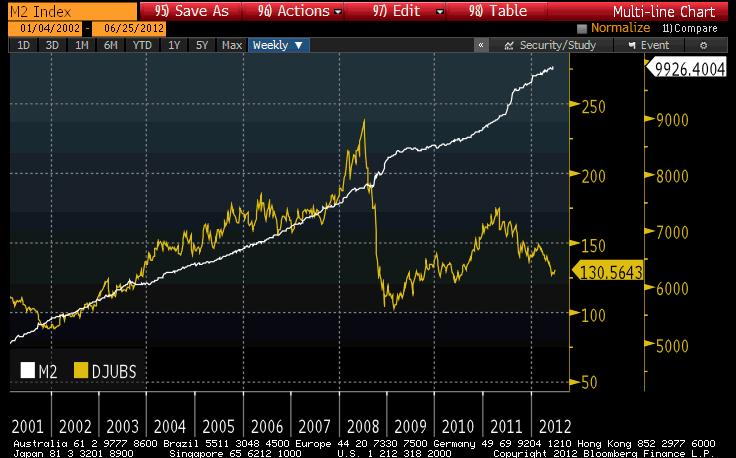
The question, of course, is whether the divergence will be resolved with commodities rallying, equities declining, both, or with the markets moving in the same directions at different speeds (for example, stocks rallying slowly while commodities rally hard). Since commodities are also out-of-whack relative to money supply, a variable to which they ought to be closely related (see Chart, source Bloomberg, below), my expectation is that commodities are more likely to catch up with stocks in the context of higher prices for commodities.
This view, as I am duty-bound to point out, has nothing to do with the fact that domestic and indeed global growth is looking worse and worse. Yes, New Home Sales today reached the highest level in two years, albeit at a shadow of the normal level of new home turnover. But Thursday’s Philly Fed index was abysmal (-16.6 vs expectations for flat). China is experiencing a slowdown. I just saw this note about India. And then there’s Europe.
On Monday both Spain and Cyprus formally requested EU aid – Cyprus saying that its direct exposure to Greece led to this sorry pass. Speaking of Greece, is it a good sign that the newly-appointed finance minister has already resigned due to illness, leading to a postponement of the Troika’s visit to Athens? Speaking of Spain, is it a good sign that a Forbes-associated blogger is taunting that country about its obviously-optimistic request for funds?
The optimists on Europe say that the obvious pain associated with a Euro breakup will ensure that the region comes together on a plan for Eurobonds or fiscal union. Aside from the unwarranted optimism that any large group of politicians could pull together a plan to make a ham sandwich by an arbitrary deadline…
Look, I understand that there are huge penalties for not putting together Eurobonds. I don’t think they’re any larger than the penalties for succeeding in putting together Eurobonds or a pan-European fiscal authority, but the timing of the failure is worse (for politicians, anyway). And I understand that European politicians are somewhat insulated from the pressure of the electorate because of the great cynicism of the masses in Europe (“Why throw them out? The new folks will do the same thing.”). But I don’t believe that democracy is dead in Europe, and if democracy means anything then it means the overwhelming opinion of the populace – as illustrated by the soccer-fan chants on Friday – might still matter. The Intrade market on the question “Any country currently using the Euro to announce intention to drop it before midnight ET 31 Dec 2012” is 27%-30% at the moment. I think that seems low.
But in any event, the volatility is still with us, and seems likely to rise further in the weeks ahead rather than to recede. Some investors will continue to flee to Treasuries (10y yields down 7bps to 1.60% today) or TIPS (10-year real yields down 5bps to -0.50%). But at these levels I don’t know why, for a flight-to-safety, I would hold those securities rather than T-bills. Or, for that matter, commodities! At this point, surely most of the bad news – and some fair bit of gratuitous sneering from bears – is in the price of commodities.
