Archive
The Gravity of the European Situation
Markets continue to gyrate in what seems like wider and wider arcs as volumes gradually decline but the density of news headlines does not. Today, at least one meaningful piece of news that pressured stocks early was that hedge fund (and market-maker) SAC Capital told its investors that it has received a Wells notice from the SEC (indicating that the SEC has determined it may bring legal action against the firm), alleging insider trading. An allegation against the firm, as opposed to individuals within the firm, is a much bigger deal and the concern is that if SAC is impacted or distracted by the charges that liquidity in certain parts of the market may suffer.
This concern didn’t linger very long, though, as stocks were back in the black by lunchtime.
New Home Sales were reported significantly weaker-than-expected, with a downward revision to the prior month’s reported sales. While sales of existing homes have been on a steadily improving pace for a while, New Home Sales have been stuck around 365k since January. Economists had expected a number more like 390k, which sounds aggressive when you look at the chart (source: Bloomberg) below but recall that last month’s figure had been previously announced at 389k and the economists’ estimates don’t seem so outlandish.

This figure doesn’t appreciably change my positive view of the housing market (and more important for me, price change in the housing market) going forward, for two reasons. First is that sales of new homes are dwarfed by sales of existing homes, so that the latter is simply lots more important and the data more statistically useful (e.g., the year-on-year change in the median price follows the same path, but as you can see below in the Bloomberg chart, the new home sales number is dramatically more volatile).

The second reason is that I suspect one reason for the failure of New Home Sales to rise more aggressively is that the gross inventory of new homes has recently been at the lowest level on record (dating to at least 1963). This is a better number to look at, incidentally, than the “months of inventory,” which still shows slower inventory turns than was normal back prior to the bubble. But that’s because of the denominator (monthly sales), not the numerator (houses for sale). And at some level, there are just not enough of the right kind of homes where they are needed. With just 147,000 new homes available for sale, there is only 1 new home for every 2,200 Americans. And they’re mostly bunched together. I suspect this dampens new home sales, and so I am looking much more closely at existing home sales for both activity indications and for price indications.
.
I had the honor of speaking today at the Euromoney Forex Forum 2012 in New York, on a panel concerning the future of the Euro and how much that future depended on individuals as opposed to bigger historical/economic forces. Readers will be unsurprised to hear that I was fairly firmly on the side of “in the long run, economics wins.”
But as often happens when I am running my mouth, I hit on what I think is an interesting analogy for the Euro and the Euro crisis, and for why “kicking the can” makes at least a certain kind of sense.
The analogy is astronomical in nature, and concerns the process of accretion as it applies to planets. The way that planets are thought to form is by the gradual accretion of small bits of matter – asteroids, rocks, dust into larger and larger bodies until the resulting body is able to sweep its orbit clean of anything which might otherwise accrete. But in the process of that accretion, there are two main determinants of how quickly the accretion occurs (actually, there are probably hundreds, but an analogy is supposed to be a simplification, right?). One is the speed of rotation of the body. A body that is spinning rapidly has a greater tendency to fling stuff outward, while a body that is spinning slowly allows more stuff to clump together. The second is the radius of the body: the larger the body, the greater the angular momentum of the outlying bits for a given rotational speed.[1]
Now, the unification of the Euro was like the creation of a planetoid from seventeen different asteroids, each of which was originally moving with a different vector. As you may recall, the Maastricht Treaty described convergence criteria that required all of the member states to essentially match their inflation rates, their debts, deficits, and interest rates, because the treaty signers wisely realized that if the countries were all moving at different speeds when they joined, there was no chance that they would accrete into a single, unified entity (a planet in my analogy).
But the planet never entirely formed, and some pieces of it on the outer fringe are in danger of being ejected by inertia. The crisis is effectively spinning the planetoid faster and faster, making it harder and harder for the pieces on the outside to avoid flying off into new orbits of their own. In this context, it makes sense to try and slow the rotation, on the theory that if everything just stops spinning long enough, the natural gravity will take over and the pieces will fall back in towards the center and everything will be okay. So policymakers kick the can down the road, assuming that if they can just keep everything together for long enough, it will get easier and easier to do so.
The problem, though, is that this body isn’t acting in isolation. There are tidal forces acting to rip the body apart, in the same way that the comet Shoemaker-Levy 9 was ripped to pieces as it approached Jupiter – the difference in the the pull of Jupiter’s gravity from one side of the comet to the other was so significant that there was no way that the object’s gravity could hold it together .
In the same way, in my view, the many significant differences between the periphery and the core of Europe, combined with the effects of over-indebtedness and a debt market no longer willing to ignore the question of a state’s ability to repay the debt, are tidal forces that are destined to rip the periphery from the core, eventually. I recognize that Europeans will tell me that the gravity of the Euro itself is far greater than I think it is, and if they’re right then the Euro will not splinter and the policymakers are correct to kick the can. But I don’t think they’re right.
[1] These two forces work against one another, for when the radius of the body decreases because stuff falls towards the center, the speed of rotation accelerates because of the conservation of angular momentum, but that little detail doesn’t enter into the analogy.
Do Androids Shop With Electric Money?
“Cyber Monday” sounds like something dreamed up by Philip K. Dick for his book “Do Androids Dream of Electric Sheep?” (which later, of course, became the basis for the movie Blade Runner). So, how did it go?
Who cares?
The amount of time, money, and energy spent figuring out how “Black Friday” and “Cyber Monday” is going is all out of proportion to the amount of money actually being made by retailers those days. To be sure, this is an important selling season, and these are some of the most important days in that season. But it’s still a small number. Today eBay gained 4.9% and Amazon.com gained 1.6% in a market that was flat-to-lower all day (the S&P ended -0.20%).
Having said that, the frenzy seemed to be less intense than in years past, perhaps because the global economy (and the markets) face very real challenges in the next month, quarter, and year. On Friday, the tiny European nation of Cyprus asked for, and received, a financial bailout, according to government officials there (although denied by the EC). It’s good to be small – allegedly, their bailout could be as much as 100% of Cypriot GDP, but that’s only about $28bln. According to the story, the bailout includes “unpleasant measures.”
Not half as unpleasant, I’ll wager, as what would have happened if Cyprus had been forced to leave the Euro. As small as Cyprus is, it’s a cinch that no one would let that be the first domino. The first domino will fall when everyone has lost the capacity, or the will, to force the unmatched puzzle pieces to artificially jam together in an apparently cohesive unit. This denouement may still be some time away. As my friend Andy F wrote in his daily (FX markets) commentary today, “German Chancellor Merkel has been very clear that Greece will not fail, regardless of the fact that it already has.”
Now tonight, supposedly, we can again temporarily put aside the fears of a Greek exit from the Euro as the IMF and European finance ministers reached a deal on the (revised) terms of the Greek bailout. ECB President Draghi said that the agreement “will certainly reduce the uncertainty and strengthen confidence in Europe and in Greece,” and we will doubtless be told that repeatedly over the next few days.
Here is the full text of the Eurogroup statement on Greece, if you are curious, but in the interest of summarizing, I present here just the beginnings of the paragraphs, except for one paragraph worth quoting in full, and you can judge how much important content there is and how much progress was made in this meeting:
The Eurogroup recalls that…
The Eurogroup in particular welcomes…
The Eurogroup noted with satisfaction that…
The Eurogroup again commended the authorities…
The Eurogroup noted that the outlook for the sustainability of Greek government debt has worsened…
The Eurogroup considered that…
The Eurogroup was informed that Greece is considering certain debt reduction measures in the near future, which may involve public debt tender purchases of the various categories of sovereign obligations. If this is the route chosen, no tender or exchange prices are expected to be no higher than those at the close on Friday, 23 November 2012.
The Eurogroup considers that, in recapitalizing Greek banks…
Against this background and after having been reassured of the authorities’ resolve to carry the fiscal and structural reform momentum forward and with a positive outcome of the possible debt buy-back operation, the euro area Member States would be prepared to consider the following initiatives:
- A lowering by 100 bps of the interest rate charged to Greece…
- A lowering by 10 bps of the guarantee fee costs paid by Greece…
- An extension of the maturities of the bilateral and EFSF loans by 15 years and a deferral of interest payments of Greece on EFSF loans by 10 years…
- A commitment by Member States to pass on to Greece’s segregated account, an amount equivalent to the income on the SMP portfolio accruing to their national central bank as from budget year 2013.
The Eurogroup stresses, however…
The Eurogroup is confident that…
As was stated by the Eurogroup on 21 February 2012…
The Eurogroup concludes that the necessary elements are now in place for Member States to launch the relevant national procedures required for the approval of the next EFSF disbursement…
The Eurogroup expects to be in a position to formally decide on the disbursement by 13 December…
To my mind, the interesting part was the “Eurogroup was informed that Greece is considering” part, where what Greece is considering is “certain debt reduction measures” in which debt that is trading at, say, 34 cents on the dollar would be paid 34 cents on the dollar. Now, I am no expert on international bond law, but since the last “rescue” deal resulted in Greece taking on more debt, in terms of notional, in exchange for lower current interest rates, it seems like it may eventually dawn on the Greeks that if the Germans and Finns and French really want to keep the Euro inviolate, they might consider actually writing down some of the debt burden.
I have no idea how such a deal would work mechanically, and clearly it would have to be coercive (since if Greece is offering to buy all bonds at $0.35, they clearly will trade a tiny bit above that since there’s a chance they may be worth more). But I have long scratched my head about why the Greeks were so keen to stay in the Euro at the cost of extended deflationary economic depression in Greece. Could leaving the Euro really make things dramatically worse? Maybe before, when there was hope that the bailout deal would improve conditions, it was worth a smidge of obsequiousness. But nothing between the first loan request in April 2010 and the bailout/restructuring in February 2012 has had any effect at all on the suffering in Greece (and many people think it has exacerbated it). The chart below (source: Bloomberg) shows the Greek Unemployment Rate.

Moreover, as we recently pointed out in our Quarterly Inflation Outlook to our clients, the effect of having one rigid currency rather than 17 has been that inflation experiences have diverged dramatically rather than, as between nations which freely float a currency, tending to equalize. In the first 10 months of 2012, inflation has risen 0.1% in Germany, 0.8% in the Netherlands, and 0.8% in Finland (collectively representing a third of Euro GDP) while in Italy it has declined 1.2%, it is -1.3% in Portugal and -1.3% in Greece (collectively adding up to a quarter of Euro GDP). Interestingly, in France inflation has fallen -0.4%, as it has begun to migrate PIIGS-ward. The chart below (Source: Eurostat, Bloomberg) shows the acceleration in inflation for these countries (and Austria, -0.1%) versus their 10-year bond yields. The logarithmic function fit to those points shows an R2 of 0.73, which actually gets better if Greece is removed.
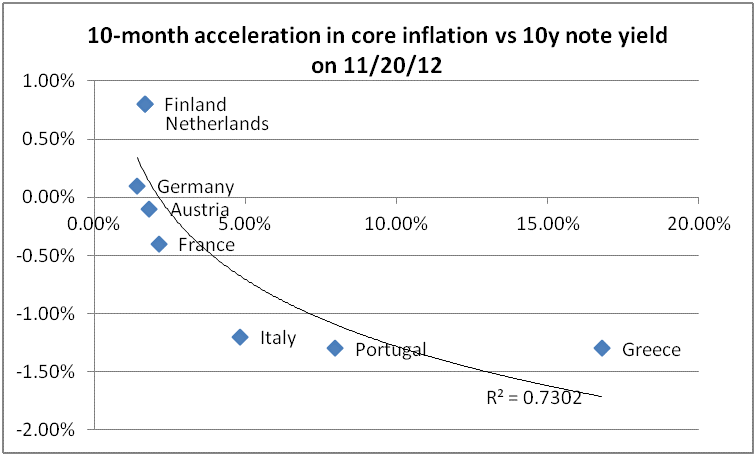
Clearly, the weaker countries are being forced into deflation as an alternate leveling mechanism because they cannot float their own currency lower. Why Greece, Portugal, and Italy would want to allow this to happen (rather than leaving the currency union) is beyond us, and if the trend continues then Finland and the Netherlands will be none too pleased as well for the opposite reason.
But for today, we can all pop champagne corks and celebrate the “Grexit has been averted again!” all the while ignoring the fact that the countries themselves have not voted on the “agreement” and Greece is at least tacitly threatening to take matters into its own hands unless the deal is pretty good.
This is not to say that last week’s U.S. equity rally had anything, really, to do with optimism about the European circumstances, our own fiscal cliff, or Japan’s election. Immediately after our own election, intelligent taxpayers began to try and realize gains in 2012 so that the potentially drastically-higher tax rates to be imposed next year will occur on profits realized from a higher tax basis. But as I noted at the time, that by itself is not a net negative for the market, since sellers will rotate into other names that they consider bargains at lower prices. So, while Apple plunged from $700 in late September to nearly $500 in mid-November, it is back to $589 today as some investors (including some who sold in September and have waited the requisite 30 days) have leapt back in with delight. It has also helped that a number of companies have paid large cash dividends in 2012 to beat the tax hikes, making the index dividend yield look artificially higher (and therefore the market look cheaper) than it really is.
There are other reasons to be skeptical about the medium-term trajectory of the market, of course, and I am not sanguine about the opportunities which the equity market offers at the moment. I think the key thing to keep in mind is that we are on the cusp of December, and “holiday style trading volumes” have been happening earlier and earlier every year it seems. Today’s volume was on less than 600mm shares, and fully one-third of that was in the last fifteen minutes of trading. Expect volatility to continue, but don’t get married to the price action.
Clearer Communication in the Wrong Quarters
Whether it is that the passage of the U.S. election released Europe to begin fighting amongst themselves again about Greece, or instead that they’ve been fighting the whole time and we just didn’t notice because we were so introspective, it’s certainly happening and heating up again. The Eurozone finance ministers are bickering, publicly, over whether Greece should be given two more years to hit its financial targets. (See articles here and here.) Also, and more importantly, the IMF wants the government owners of Greek bonds to write off some of their losses and lessen the Greek burden while some of the finance ministers (e.g., German Finance Minister Schauble) insist “that’s not legally possible.” Guess what? It’s going to happen whether it’s legally possible or not – but not this month. Greece will probably eventually get its tranche/lifeline this month, but the battle will be engaged with increasing intensity as time goes on.
That, however, is not the reason why stocks keep sliding (S&P -1.4% today) and bonds keep rallying (albeit gently today, with the 10y note yield down to 1.59%). I think that is happening because one week post-election, there is no sign that either Democrats or Republicans are budging on their positions vis a vis the fiscal cliff. The Democrats are winning on messaging, as they usually do these days, with the “Papa John’s Pizza approach” in which they have seized on the part of Romney’s budget proposal that they liked (reducing deductions for high-income taxpayers) while ignoring the connection of that element with the intention to keep tax rates down. I call it the Papa John’s Pizza approach because it reminds me of the commercial with Peyton Manning.
Republicans: So how are we going to do this?
Democrats: We loved Romney’s idea, and we agree with you. We’ll cut deductions.
Republicans: No, no, no, no, no…you mean we’ll cut deductions and keep income tax rates from rising.
Democrats: Right. We’ll cut deductions.
Republicans: …you mean we’ll cut deductions and keep rates from rising.
Democrats: I’m glad we agree. We’ll cut deductions. See how open minded we are? We’re using Romney’s plan!
Say what you want about the class warfare approach, the Democrats run rings around the Republicans when it comes to communication.
One place where better communication is actually destructive, but ironically one of the only places where we’re actually moving towards better communication, is at the Federal Reserve. A Wall Street Journal article today was entitled “Fed Leans Toward Clearer Guidance,” and indicated that “the Fed would state how high inflation would have to rise or how low unemployment would have to fall before it would begin moving rates, which have been near zero since late 2008.” This was the main newsworthy point that Fed Vice-Chair Janet Yellen made yesterday, and it was driven home today in the release of the minutes from the October Fed Meeting:
“A number of participants questioned the effectiveness of continuing to use a calendar date to provide forward guidance….Many participants thought that more-effective forward guidance could be provided by specifying numerical thresholds for labor market and inflation indicators.”
Since June, a “soft” Evans Rule based on this idea has been in place, as I pointed out at the time. It is not terribly surprising that the Fed would move towards a more explicit formulation of the rule, because Fed economists have never figured out why ambiguity is a good thing when it comes to policy-making. If they really do manage to reduce the Fed’s deliberations to a series of simple and public rules, then they should just finish the job and replace the Fed with a computer, as Milton Friedman proposed many years ago.
As I’ve written frequently (and borderline obsessively), clarifying the exact path that the Federal Reserve will take in the future reduces the uncertainty that investors face. This is good in the absence of leverage, but if the opportunity to leverage exists then the decrease of apparent uncertainty causes an increase in the leverage desired by investors. The problem is that a margin of safety doesn’t only protect an investor from known uncertainties, which would decrease in this instance, but also from unknown uncertainties, which would not be affected and for which a margin of safety is absolutely crucial if we desire to avoid another financial market meltdown. But no one is listening to me.
Commodities rose today, despite the continued decline in equities. This is not unreasonable. I think that commodities and stocks are telling two different stories. If there’s a recession, it should hurt stocks and commodities (but more directly should hurt stocks) while further QE3 ought to help them (but more directly help commodities). Right now stocks are going up on QE3 while commodities are going down on the recession … exactly the opposite of what ought to be happening. To my mind that just means the ‘value gulf’ is getting wider and wider. The chart below (Source: Bloomberg) shows the ratio of the S&P total return index to the DJ-UBS index.
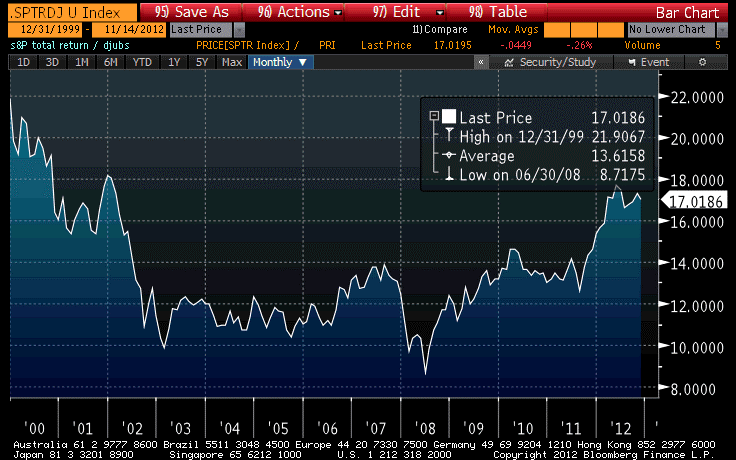
Right now there is an enormous loathing for commodities that I don’t really understand – it seems to me to be the bipolar nature of commodities investors that they either love or hate the stuff. It probably comes from the fact that there are no “value” investors in commodities since the theory on what constitutes “value” is so light. Right now it looks to me like stocks are relatively expensive, although they’ve been that way for a while.
For tomorrow’s CPI figures, the consensus forecast calls for an 0.1% rise month/month for both the headline and core indices (seasonally adjusted), maintaining the y/y core increase at 2.0%. Last month, core rose to 1.98%, and we’re ‘dropping off’ a +0.17% on the y/y comparison. If economists are right, and 0.1% is the rounded change in core inflation on the month, then the y/y rise in core inflation will more likely decline to +1.9% than stay at +2.0% (of the possible prints that would lead to +0.1% on the monthly, from +0.05% to +0.149%, anything from +0.05% to +0.129% would cause a downtick in the y/y figure while only monthly changes in the range of +0.130% to +0.149% would keep the number stable.
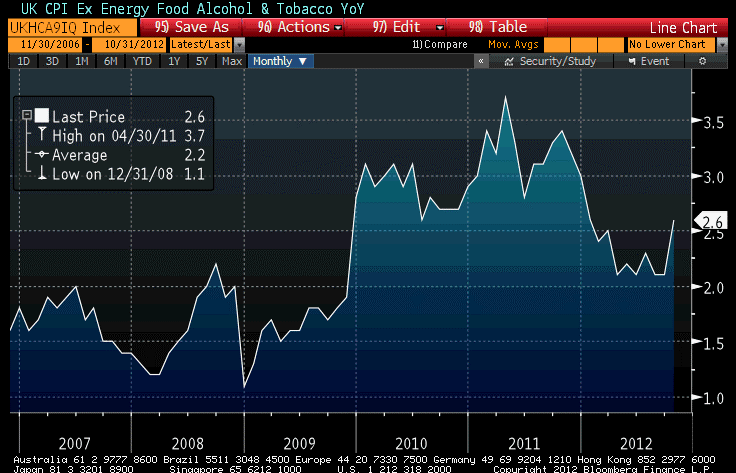
However, I don’t see what will cause core to droop like that. I think economists are paying too much attention to the last several monthly changes and ignoring the fact that the weak prints were caused by outlier points (as evidenced by the fact that the Median CPI of the Cleveland Fed and the Sticky CPI of the Atlanta Fed, both different measures of central tendency, remain at +2.3% and +2.2% respectively). Moreover, housing CPI – the main driver of core inflation – is accelerating with both primary rents and owner’s equivalent rent rising last month, and all indicators of housing tightness from housing inventories to apartment tightness continue to suggest that higher price increases are more likely than lower price increases ahead. Moreover, we’re seeing upside surprises in other countries, such as in Greece that I mentioned yesterday, the in the UK where core inflation rose to +2.6% y/y versus 2.2% expected (see Chart, Source Bloomberg), befuddling most economists there.
That doesn’t mean the y/y core figure in the U.S. will definitely rise back to +2.1% this month; to do that, core would need to print +0.23% for the month, meaning the main body of the economist profession was off by half. Come to think of it, that’s not so far-fetched. If the last three months of core prints (+0.090%, +0.052%, and +0.146%) are quirky-low, then there should be a payback at some point. It’s hard to call for that in any given month, though.
Mounting Pressure
The most striking facet of today’s trading was that the stock market actually reacted to the Fed’s announcement, which was precisely as universally expected: no change in anything but the technical language about where the economy currently stands. It wasn’t a huge reaction, but the fact that the S&P actually dropped 5 points on the news is mind-boggling to me because it implies that some people were expecting big things out of the Fed today.
To be sure, the arrow of action on the Fed is clear and pointed to ever-increasing amounts of liquidity, but this wasn’t ever on the docket for today. However several Street economists have predicted, plausibly I think, that when Operation Twist expires in December (partly because the SOMA will run out of short-dated Treasuries to sell) the Fed might keep going with the buying leg of the Twist – effectively increasing the monthly outright purchases of paper to $85bln (including Treasuries) from $40bln (all mortgage paper) currently.
Operation Twist has been a useless operation from the standpoint of monetary policy – it has neither added nor subtracted liquidity from the system. It may have had some value from the standpoint of asset-market-maintenance policy, by removing duration from the market and forcing investors to accept more risk for the same amount of reward. So it may be the case that Twist had some effect, but mostly a bad effect since it certainly doesn’t seem from market pricing that investors have been timid about taking risk. And I suppose it ought also be observed that “asset-market-maintenance” isn’t part of the legislative mandate of the Federal Reserve. However, legislators can be generous when markets are being pumped up – it’s when the air goes out that they’re unhappy.
Weirdly, though, I would prefer Operation Twist, which has little impact, to what is likely to replace it (additional QE).
Policymakers globally are growing increasingly bold about quantitative easing. In Europe today, ECB President Draghi told German legislators that outright bond purchases by the ECB “will not lead to inflation. In our assessment, the greater risk to price stability is currently falling prices in some euro-area countries. In this sense, OMTs are not in contradiction to our mandate: in fact, they are essential for ensuring we can continue to achieve it.” (See also this story.)
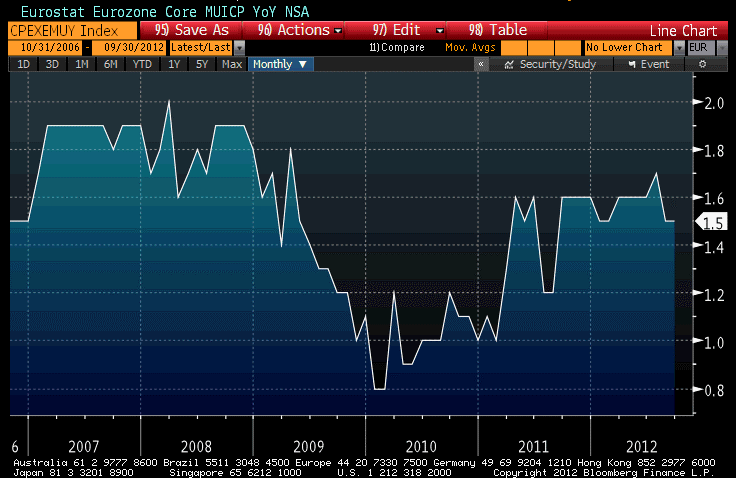
Central bankers are getting bold, but I’m not sure I understand why. They clearly see the connection between QE and inflation – fending off deflation was the purpose of QE2 and Draghi is clearly indicating the same even though core inflation in the Eurozone has risen from 0.8% in 2010 to 1.5% now (see chart below, source Bloomberg). That’s not exactly flashing red signals on inflation, but it is utterly fantastic to suggest that it indicates deflation is a greater risk.
In the U.S., QE3 and the likely acceleration of QE3 later this year is happening in the context of year-on-year rises in median new home sales prices (released today) and existing home sales prices (released last week) of over 11%, as the chart below (Source: Bloomberg) shows. Note that the existing home sales data is much more dependable on a month-to-month basis, because the number of existing homes and existing home sales swamps the number of new homes sold, but both show the same, clear trend. Home prices are now rising nearly as fast, nationwide, as they did in the bubble years.

For the record, the all-time record one-year price rise in existing home sales was 17.4% in May, 1979. Of course, in May 1979 core inflation was rising at 9.4%. In fact, with the exception of the last phases of the bubble of the early ‘Aughts, existing home sales prices are rising at the fastest margin above core inflation ever, as the chart below shows (Source: Bloomberg; Enduring Investments calculations)

Policymakers, and investors, seem to be numb to the threat of additional QE for one of two reasons. Either it is because of the belief that prior QE did not cause inflation (incorrect, as illustrated above and by the statements of intentionality of the policymakers themselves) or because they’re buying the line that QE is only adding to “sterile” excess reserves.
I think that this is dangerously sanguine. In fact, although it is true that QE initially results in greater excess reserves only, and these have only slowly trickled into transactional money, I think there’s reason to believe that adding more QE may increase that pace of transmission. Picture a large cylindrical vat, open on top with a small valve at the bottom. The water in the vat represents excess reserves, and the water trickling out through the valve is transactional money.
Many things can affect the pace at which the vat water flows through the valve – lending opportunities tied to credit demand and credit quality, disincentives to lend such as Interest on Excess Reserves (IOER), and moral suasion in both directions. Crank IOER to 25%, and all of the water poured into the vat remain as sterile excess reserves and QE is just reliquifying the banking system. Put IOER at a 10% penalty rate, and all of the water going in the top will flow out of the bottom very quickly – and all of the other water that’s already in the vat, too.
But even if you don’t adjust the valve at all, the greater weight of water in the cylinder, as you keep adding more water, will increase the flow out of the valve. Adding more QE is akin, economically, to increasing the weight of water in the cylinder.
The parallel economic concept is that a greater of excess reserves increases the opportunity cost of reserves. The average return on assets for a bank gradually declines as more of these assets become excess reserves rather than required reserves against lent funds. Leverage also declines, with the result (as I have pointed out before) that return on equity suffers. The chart below (Source: Bloomberg) shows the return on equity for large banks (those with more than $10bln in assets). You can see that while bank earnings have recovered significantly from the nadir of the crisis, they also appear to have leveled off at around 8% compared to the 15% that was the consistent standard prior to 2007.
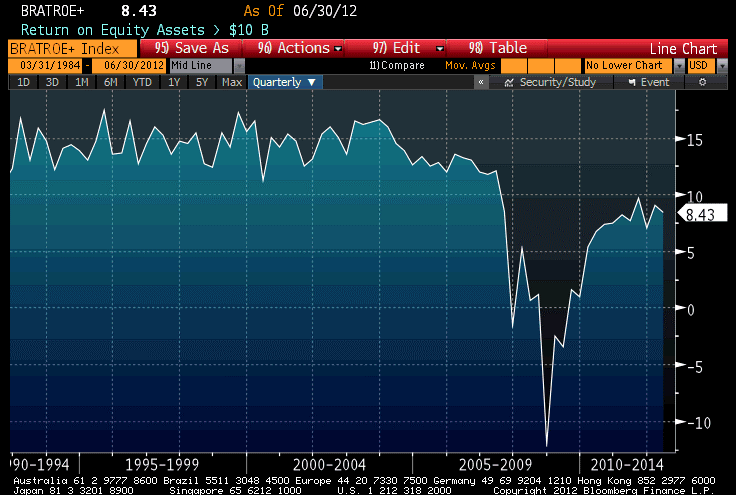
The lending officers in these banks, although they’re being told to increase the quality of their loans, are being told more and more to also increase the quantity of their loans. They cannot do both, but as the pressure of too many reserves on the balance sheet builds, the pressure to make more marginal loans increases as well. This is the part of the valve that the Fed cannot control, and where danger lies going forward. The multiplier may well respond, eventually, to the weight of the reserves themselves.
Mostly Molehills
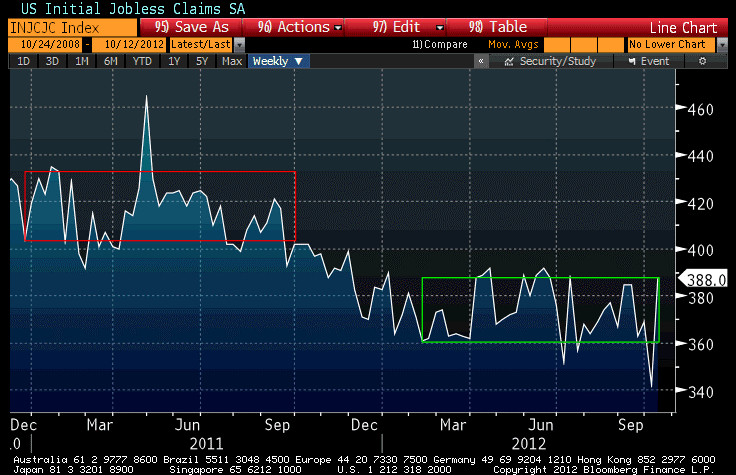
I suppose it is more interesting to have a whole plateful of interesting news and data to look at than to be fixated on one thing (say, Europe), but it does make it much harder to figure out what things the markets will take seriously. Note that this is distinct from the things that the markets should take seriously. For example, Initial Claims launched higher today, to 388k, the highest level since June. This was clearly a correction from the incredible drop last week, which was the result of an error. In the mountain-to-molehill continuum, this definitely falls on the “molehill side,” as did the drop last week, but S&Ps rose 8 points on the release last week (which was obviously flawed) and dropped a mere 2.5 today on the reversal. Maybe that should tell us something about sentiment, but as investors we really ought to be ignoring both of them and focusing on the fact that the true run rate of ‘Claims seems to be pretty stable at around 365k-375k, and hasn’t improved measurably since January. To be sure, that doesn’t mean it isn’t about to improve. In 2011, Claims were basically stable around 420k until October, and then improved into the end of the year to about the current level (see Chart, source Bloomberg).
We also shouldn’t worry too much about Vikram Pandit, the ousted CEO of Citigroup. It makes good voyeuristic television to wonder about why Mr. Pandit was dismissed and to go back and forth about his reputation, but it doesn’t mean anything for most of us. It probably doesn’t even mean very much for Citi. The 1980s-90s global giant überbank model is dying, as I first predicted back in 2008 it would. It’s a very simple analysis: lower turnover, smaller margins, and less leverage means lower return on equity. It does so by definition, since these are the three components of the DuPont model. And, since at least 2008, the trends were really obvious: regulators are demanding less leverage, and have decimated off-balance-sheet leverage so that the effect is larger than it seems; turnover was almost surely going to ebb because banks were weaker and customers more cautious; and margins were going to be depressed by the evisceration of truly structured business and movements of most products to exchanges. To be fair, we didn’t know Dodd-Frank was going to enshrine these trends in legislation, but it was obvious where they had to go. So big banks will rally, big banks will sell off, but the fundamental pressures on the business means that banks will need to shrink and specialize to survive. So Mr. Pandit? He could no more have saved Citi in its current form than he could have turned back the tides, and neither will the next CEO.
The formal establishment of the ESM, with a tiny sliver (~$32bln) of leverage-able capital, could potentially mean more, but only if it’s used intelligently. On past history, that seems unlikely, but in any event until it is used it doesn’t mean anything. I guess it means more than the two items above.
What about the rotten mid-day earnings from Google (horrendous) and Microsoft after the bell (awful)? Now, when the analysts tell us not to worry because something isn’t very meaningful, that’s when I start wondering about how important it is. I should say I couldn’t care less about either of these companies. I still can’t figure out how Google makes $36.5 billion (in 2011) from search. Who actually clicks on those ads? I once used a Google placement to try and sell my book. I generated millions of impressions, a couple hundred clicks, and sold one book. The campaign cost me $200. It was mainly an education expense because I was curious how it worked. It doesn’t. Oh, I’m sure you can sell some product through cute banner ads, but it’s only attractive if it’s dirt cheap. And if it’s dirt cheap, how do you sell $36.5bln of it? Even more, how do you keep growing that chunk, when it is getting harder and harder to keep attention on any given website or search engine? As I said, I don’t understand Google’s business and I don’t much care about the results. I understand Microsoft’s business a bit better, since it’s essentially a slow-growing industrial concern now that churns out a set of products (buggy software) that dominate their niches. But it still doesn’t matter to me, because I don’t own MSFT (or GOOG or C, for that matter), and likely never will.
But does it matter to the market? It’s only Microsoft and Google, right? Sure, and it was only Stonewall Jackson who got killed at the Battle of Chancellorsville. It matters when the generals fall, especially late in the year. I’m not saying it means that stocks are going straight down, but it is not a good thing, and it may matter.
.
The 30y TIPS auction today doesn’t matter to most observers, but it matters to me. The auction was good, better than was widely feared. After all, the last few TIPS auctions have looked very weak, and this was $7bln of a 30-year accreting issue. It’s a lot of duration (roughly the equivalent of $19bln 10-year TIPS), but the market needs duration in inflation-linked product. Last year, the Fed took out of the TIPS market as much as the Treasury was increasing issuance in that sector, which is one of the reasons that TIPS yields are as low as they are. There is a shortage of inflation-linked paper (and a great opportunity to issue, incidentally, although corporate issuers in the U.S. are always remarkably reticent to issue real bonds for some reason), and especially at the long end of the curve where inflation matters more than at the 5-year point. Not every TIPS bond auction has gone well, or will go well, but it doesn’t surprise me much when they do.
Not Good Enough To Warrant That Reaction
Stocks surged today, although still on fairly light volume, in a striking response to the ECB’s proposal of a plan we already knew most of the details of. The S&P rallied 2%, and Treasury yields rose 7bps at the 10-year point (1.67%), with 10y TIPS yields +5bps (-0.65%) and breakevens therefore 2bps wider. Commodities were relatively strong, outside of the livestock group.
The ECB’s plan is essentially as described in leaks previously, although apparently there are some minor asterisks that prevent the central bank from just going in to buy lots of bonds right away. The ECB didn’t cut rates, or make the deposit rate negative, as some 40% of economists expected according to Bloomberg. That cut wasn’t in the cards, for the nonce anyway. As I pointed out yesterday, if the ECB wants to sterilize bond purchases, they certainly can’t cut deposit rates and probably have to raise them (if they were serious about sterilizing). In theory, they could cut deposit rates and then offer short-term bank bills as a way to absorb the extra money in circulation, but that’s the same thing in the end: we hold your money and pay you interest. The fact that it isn’t reserves, but bills, is not relevant to the sterilization discussion, and that approach is actually somewhat more flexible since the ECB can more easily raise the rate it pays on bills to be sure of soaking up enough money than it can adjust the deposit rate to accomplish the same thing. The problem, though, is that bill sales occur in the open, and it will be really obvious if they aren’t able to sterilize the purchases.
It continues to be striking how resistant central bankers are to the notion that markets, and not central bankers, ought to set market rates. Bloomberg and other media sources wrote of the ECB’s “fight to wrest back control of rates…after nearly three years of turmoil.” When, exactly, were rates in control of central bankers to begin with? Other than the trivial case of the overnight rate, that is. That’s just crazy talk.
There is, however, still the issue that sovereign governments need to formally request aid, and agree to conditions, before the unlimited buying can begin. It occurs to me that the unlimited buying might be tied to the conditions, and so not be unlimited after all. But the bigger problem is that governments (especially now that their rates have rallied a bit and the wolf has temporarily retreated from the door) insist on having the temerity to negotiate conditions, rather than to simply accept the gruel the EU says they’re entitled to. For example, according to the Spanish news outlet El Pais, Spain’s opening bid is for a full bailout without any extra conditions (hat tip to Andy F). At least that gives them plenty of room for concessions.
Now, perhaps the rally in equities wasn’t due to the ECB’s offer to buy bonds after all. Maybe it was because the economic data was slightly stronger than expected, although I’m skeptical of that. ADP showed a gain of 201,000 jobs, the highest gain since March, plus an upward revision to 173,000 last month. Initial Claims were a bit lower than expected, at 365,000. These are both on the better side of expectations, but negligibly so given the size of the error bars involved. The ADP report may have encouraged some shorts to cover in front of the Employment Report tomorrow, but the short-term correlation between changes in ADP and changes in the Employment Report is quite poor, as the chart below shows. The R-squared of the relationship is 0.165. That is, if you know that ADP accelerated 28k this month compared with last month, it tells you almost nothing about whether Non-Farm Payrolls will accelerate or decelerate from last month’s figure.
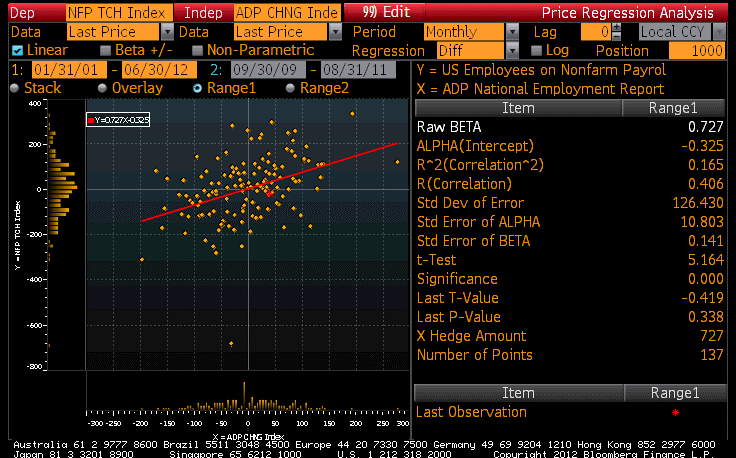
The correlation of the levels of the changes themselves is of course much better, with an R-squared of 0.857 over the same period, but the standard error is 93k. So, today’s 201k from ADP would produce a point estimate, based on the regression (not shown here), of 210k for Payrolls. But the error bar would make the expected range 117k on the low side to 303k on the high side. Ergo, it’s still a bit early to get over-excited about the Payrolls report tomorrow.
There’s a secondary concern here that is silly, but needs to be considered. If the number is strong tomorrow, there will be some investors (and perhaps quite many) who will be skeptical that the numbers just happened to improve right in the middle of the Democratic National Convention, hours after President Obama accepts the nomination. I am not one of those who will be skeptical, not because I think any particular Administration is above the idea of manipulating the data, but because I think it would be almost impossible to do so without the conspiracy coming to light. There are simply too many people involved in the generating of this government statistic (and, of course, the ADP figure is not remotely influenced by the government). But the same people who believe the government manipulates CPI will believe they manipulate the jobs report, and this has market implications: if the figure is weak, investors will have a higher level of confidence in the data (since it goes without saying that no one would manipulate the number to be worse) than if it is strong, which further implies – especially after today’s rally – that the price response in the equity market is likely to be skewed negatively. I don’t like taking positions ahead of major numbers, but in this case I’d be inclined to shade a bit short. But just a bit.
ADP was a bit stronger-than-expected, and Payrolls may be higher or lower. But either way, these figures do have the usual error bars, and it seems unlikely that this augurs an unexpected and durable improvement in the employment situation when the man on the street is still reporting that jobs are harder to get. Nevertheless, the economy seems not to be getting worse at the moment, either, and with traditional monetary policy there would be no cause whatsoever to ease. I suppose it goes without saying that those traditions are no longer being observed, however, and I continue to think we’ll see the Fed ease next week – almost regardless of what the data does.
Deserving It
Does Chad “Ochocinco” Johnson deserve another chance?
That’s a question I saw several times bandied about today on the NFL Network. (It is, after all, kickoff night of the NFL and so you will perhaps forgive the digression.) But no one seemed to ask the question that I find much more interesting, and more relevant in other familiar contexts as well:
Does any other team deserve to be saddled with Ochocinco for another season?
Because really, it isn’t just a question of whether he deserves another chance. That would imply there is some objective standard by which his ‘deservedness’ should be measured. It seems to me that this begs the question. Shouldn’t the arbiters of whether he deserves another chance be the people who actually have to be saddled with the consequences of giving him another chance?
I’m just saying…
.
There is a very interesting development in inflation land: Deutsche Bank, which along with Credit Suisse distanced themselves from less-innovative firms earlier this year when they issued ETN/ETF structures that allow an investor to invest in a long-breakeven position, has created a tradeable index that proxies core inflation.
Now, it isn’t any mystery that you can create core inflation by taking headline inflation and stripping out energy (and, if you feel like torturing yourself with tiny futures positions, food) – for example, I presented a chart of ‘implied core inflation’ in the article linked here – so the DB product doesn’t break any new theoretical ground. But it is a huge leap forward in that it allows more market participants to trade in a direct way something that acts like core inflation.
Why would an investor care about core inflation? Is it because he “doesn’t care about buying gasoline and food”? No, an investor may wish to buy a core-inflation-linked bond for the same reason that a Fed governor wants to focus on core even though all prices matter: core inflation moves around less in the short run, but in the long run core and headline inflation move together. The chart below (Source: Bloomberg) shows the core CPI price index, and the headline CPI price index, normalized so that they were both 100 on December 31, 1979. Since then, prices have tripled, whether you are looking at headline or core. The difference in the compounded inflation rate? Core inflation has risen at a 3.471% inflation rate, while headline inflation has grown at 3.415%.
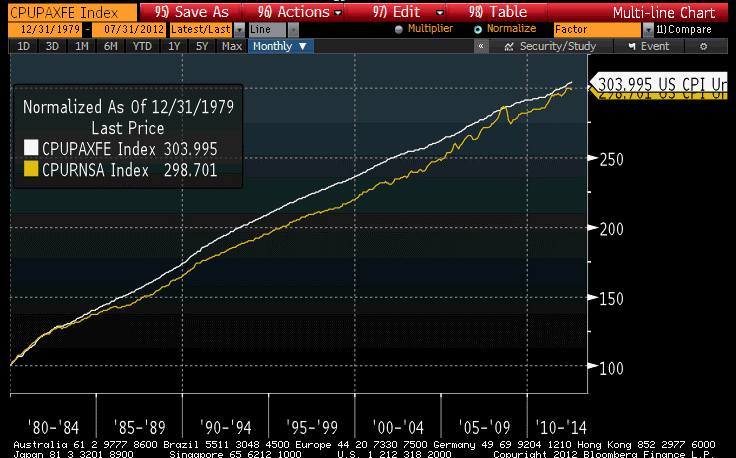
This is why central bankers want to focus on core – headline provides lots of noise but almost no signal. And it’s the same reason that investors should prefer bonds linked to core inflation: you get virtually all of the long-term protection against inflation that you do with headline-inflation-linked bonds (like TIPS), but with much lower short-term volatility.
Now, Deutsche’s index isn’t truly core inflation, but a proxy thereof. It appears to be a decent proxy, but it is still a proxy (and we have some more theoretical/quantitative critiques that are beyond the scope of this column). And their product is a swap, not a bond (although it would not surprise me to see bonds linked to this index in the very near future). So it isn’t perfect – but it is a huge step forward, and Deutsche Bank (and Allan Levin, the guy there who has the vision) deserves praise for actually innovating. Innovation tends to happen on the buy side, and with smaller firms, not with big sell-side institutions, and we should cheer it when we see it.
.
Now, back to actual markets: tomorrow, the ECB is expected to announce a new program of buying periphery bonds when necessary. Actually, it is a bit more than expectation, since the plan was leaked today. Supposedly, the ECB will announce that they are going to do “unlimited, sterilized bond buying” of securities three years and less in maturity.
The Euro was somewhat buoyed by this news. The idea is that big bond purchases will bring down sovereign yields, but sterilization of the purchases will mean that it isn’t truly monetization and therefore not inflationary.
This seems ridiculous to me. I am not surprised at the idea that the ECB would conduct large purchases of bonds that no one else seems to want; they did quite a bit of that with Greece, after all. But I’ve lost track – are they still sterilizing the billions in bonds that they’ve already bought, as well as the two LTRO operations which they claimed to sterilize, but never explicitly did except through the expedient of paying interest on reserves to sop up the liquidity?
How are they going to sterilize more purchases? There are basically three straightforward ways for a central bank to remove liquidity from the market. We used to think that there were only two, because the only ways the central bank ever did it was to (a) conduct large reverse-repurchase operations in which the central bank lent bonds and borrowed cash, taking the cash temporarily out of the economy and (b) to sell bonds outright, to make a permanent reduction in reserves. Now we recognize a third option, although we’re not sure how efficacious it is: (c) raising the interest rate on deposits of excess reserves at the central bank, so as to discourage the multiplication of those reserves.
But for the ECB’s purchases to be effective in terms of their size, they will be far too large to use reverse-repos as a sterilization method; and it doesn’t seem to make much sense to be selling bonds when they’re buying other bonds, unless they want to try and push up the yields of countries like the Netherlands and Germany (which might not be politically too astute) at the same time that they’re lowering the yields of Spain and Portugal. And they just cut the deposit rate to zero in July…are they going to raise it again?
I can understand the political cleverness of such an announcement, if the ECB makes it: make the bond buys “unlimited” to suggest that they can’t be outmuscled, but also sterilized so it’s not printing. But these can’t both be true – because there is not unlimited capacity for sterilization.
That plan can only work if, in fact, the ECB doesn’t actually buy many bonds. In the past, they’ve tried to trick the market into rallying with “bazooka-like” comments so that they didn’t actually have to do anything. To date, it has never worked. I doubt this will, either.
.
Back in the U.S., the wave of Employment data is about to hit. Tomorrow morning, Initial Claims (Consensus: 370k) will be released; about Claims the only thing I want to note is that while it is down considerably from the peak of the most-recent recession, it is only slightly below where it was at the peak of the last recession. Over the last 52 weeks, Claims have averaged 381k; in May of 2002 that average reached 419k. Also due out tomorrow is the ADP report (Consensus: 140k), which is expected to weaken slightly from last month’s figure. On Friday, of course, the Payrolls report is expected to show a rise of 127k new jobs with the Unemployment Rate steady at 8.3%.
Some observers have made a lot of the fact that the Citigroup Economic Surprise index has risen from -65 or so in July to nearly flat now. But this is not a sign of improving economic conditions; it is a sign of improving economic forecasts. Remember that this index doesn’t capture absolute levels, but the degree to which economists are missing. The current level is near flat because economists adapted their forecasts to the weak data, not because the data improved to catch up with the over-optimistic forecasts. I wouldn’t draw much relief from that indicator.
Now, with the ECB and the Fed on the calendar over the next week, markets may well get some relief. But the economy, not so much, even if we do deserve it.
August Hangover
Don’t begin to worry, just yet, about the continued low volumes. It isn’t unusual, following a long weekend, for the first day back to still be sluggish. People are catching up with e-mail, greeting friends (friends which, in Europe at least, they may not have seen for a month or more), and so on.
And anyway, we should put today’s light volume – 599 million shares on the NYSE – in context. The average for all of last month was only 581 million shares, and only 544 million for the last half of the month. Only eight days in August were busier than today’s total, and three of those were the FOMC meeting day, the last day of the month, and Employment day. That’s slim solace if you’re a broker, I am sure, but brighter and busier days are ahead. In fact, proximately ahead.
European bonds rallied strongly as details of the ECB’s plan to buy Eurozone bonds were leaked; ECB President Draghi told the European Parliament in a “closed door” (but apparently open-mic) session that the ECB simply must buy bonds because the traditional instruments of monetary policy are ineffective. “We cannot pursue price stability now with a fragmented euro area because changes in interest rates affect only one country, or two countries at most. They have no importance whatsoever in the rest of the euro area.” It is true that to a man with a hammer, everything looks like a nail, but Draghi was essentially arguing that in want of a hammer, anything that will pound a nail will do. In short, because the traditional tools don’t work, Draghi claims that anything else which accomplishes the same ends is allowed.
The Bundesbank will not agree.
But Draghi claims the Euro’s survival depends on his being allowed to buy bonds under 3 years to maturity (why there is a limit at 3 years is unclear to me; if it was necessary to extend the program to 5 years because buying everything less than 3 years wasn’t working, why won’t the same argument work?), and it seems unlikely that there will be enough opposition to dissuade him from this action. It is one thing to ask legislatures to write a check, but the costs of profligate monetary policy (as we have seen) are not as apparent and not as immediate; and anyway, the politicians can campaign later on the need to have them around to fix whatever new problem that is created as a result.
The continuing question should be – if there is no cost to buying huge numbers of bonds, then why should the central banks ever have eschewed that action? Of course, there is no such free lunch, as William White wrote last week. But from the standpoint of a politician, it’s almost a free lunch. “I’ll glad you pay you next election cycle for a hamburger today,” as Popeye’s pal Wimpy might have said.
Or, better yet, chastise the monetary policymakers for not foreseeing the true cost of that hamburger today!
One more comment on that William White piece. In it, he discusses among other things the many ways in which overcapacity has developed last couple of decades in many countries and many industries. He does this to illustrate the concept of “malinvestment,” which mainstream economists these days pooh-pooh but which many Nobel Laureate economists (such as Hayek) did not.
However, like many of those earlier authors, White seems to take the existence of overcapacity as implying that deflation is a serious risk. I think this is based on a misunderstanding and misapplication of the original concept of malinvestment. Overcapacity implies that resources have been mis-allocated in the past, and this creates a cost in the future – but it only implies deflation in the presence of traditional monetary response (which, let’s remember, we haven’t had in a decade or more). Overcapacity implies declining real prices, and declining real returns to property, plant, and equipment relative to labor – and that is good news for consumers. But, if this overcapacity is coupled with ample money printing, this is not inconsistent with rising, rather than falling, price levels.
Remember that the original Keynesians and Austrians were writing in a period during which most of the historical record involved a money supply effectively, if not explicitly, limited by linkage to gold. In the presence of a fixed money supply, overcapacity most assuredly leads to deflation. But in the presence of a rising money supply, these are no longer automatically connected concepts: overcapacity is a statement of investments and returns in real space, while inflation measures a change in nominal prices.
And that’s why the malinvestment of the 1990s and 2000s need not lead to the same end result as the malinvestment of the 1920s. Indeed, unless something very odd happens – and I gave the parameters I would consider odd last week – deflation, with or without the hangover effects of prior malinvestment, isn’t going to happen.
The next few weeks will be more increasingly more active, to a degree that we may long for the quiet days of August. Keep in mind that it is a very strong time of the year for bonds, seasonally speaking, and a weak one (although not as consistently so) for stocks. But I wouldn’t try to play those zig-zags. The DJ-UBS index reached a 6-month high this morning, before backing off; that’s where I would have (and do have) my money.
It’s In ‘The Hole’
As the end of August approaches, the somnambulation of the markets should be slowly diminishing. Events are still proceeding in slow-motion, but investors will gradually wake up and re-assess their surroundings in the days remaining before the Jackson Hole colloquium that represents the next major scheduled event on the domestic calendar.
But even in the dog days of August, governments borrow and spend money, and sometimes they even have to pay it back. Today, the emerging market of Belize missed a bond payment as its deficit swelled to a level of (gasp!) 2.5% of GDP, and the Prime Minister declared a restructuring is needed since the country simply doesn’t have the ability to pay the 8.5% coupon on its superbond. Isn’t it nice to be a superpower? The U.S. runs a deficit of around 8% of GDP, and our creditors seem to have no quarrels with us – at least, for now.
Of course, we’re too busy to worry about Belize when Greece beckons. Greek Prime Minister Samaras is asking for a two-year extension of the deadline for deep spending cuts and tax increases, but German Financial Minister Schaeuble (among others) said over the weekend that “It can’t be helped – we can’t make yet another new program. There are limits.” http://economywatch.nbcnews.com/_news/2012/08/20/13377541-germany-forcing-greeces-day-of-reckoning Certainly, the suggestion that there are limits to European largesse in the case of Greece is not a new one; the appearance of actual limits is still what all parties are waiting for. We are approaching the next showdown, surely.
More stirring was the report over the weekend in Der Spiegel that the ECB is considering a program to ‘cap’ European rates versus Bunds, such that they would determine an “appropriate” spread (appropriate in a cosmic justice sense, one supposes, not in a ‘market clearing’ sense) and then buy unlimited quantities of bonds of countries whose yields strayed above the cap. The idea, surely, is to make the cap unnecessary, since rational (and, it should be pointed out, credulous) investors would buy unlimited amounts of bonds just shy of the cap, knowing they had a much higher upside than downside, guaranteed. But ask Soros and the Bank of England how that works, when the economics aren’t there.
The Bundesbank, predictably, came out with immediate criticism of such a plan, which isn’t surprising since they had previously spanked Draghi for suggesting that the ECB would do “whatever it takes” to preserve the Euro. The ECB promptly hove to today, as well, muttering something about how it’s “misleading to report on decisions, which have not yet been taken and also on individual views, which have not yet been discussed by the ECB’s Governing Council, which will act strictly within its mandate.” And, of course, that begs the question of why they leaked the notion in the first place. Who’s in charge over there, anyway?
It also was unclear if the idea of an automatic cap replaced the prior assertion that the countries themselves must formally request help, or was in addition to that requirement.
All in all, it should be an interesting autumn.
But I nevertheless contend that the first really important event for the market is going to be the Bernanke speech at Jackson Hole on August 31st. The machine is already at work, setting up the arguments so that Bernanke need only nod in the general direction of what the Fed is going to do. An article on Bloomberg yesterday was entitled “No Inflation Proves Critics of Fed’s Bernanke Wrong.” The content of the refutation is essentially that it’s obvious that Bernanke was right, all of those opposed are just ‘haters, and clearly the money-printing didn’t cause inflation.
However, since the money-printing also didn’t evidently cause unemployment to improve very much, we are left with this: either monetary policy simply doesn’t matter, and affects neither inflation nor growth in any important degree (in which case we can safely disband the Fed since it’s just an economist-employment project), or it does matter, and it’s too early to judge the effects of a rapidly-expanding money supply which, until one month ago was still expanding at better than 10% per annum. After all, along with that expanding money supply we did, until three months ago, have core inflation that was accelerating every month, so that’s hardly an open-and-shut case in favor of the notion that large amounts of money don’t cause inflation. Moreover, clearly the Fed itself believes that QE causes inflation, or it wouldn’t have cited the possibility of deflation as a key reason for QE1! They seem to want it both ways: money-printing causes dis-deflation, but doesn’t cause inflation above target.
In my view, it is very premature to declare victory over core inflation merely because we have had a couple of months where core inflation went sideways – mostly due to base effects.
But as investors, what is more important in the near-term is that this argument is silly to make now, when its veracity won’t be judge-able for at least a year or two, unless the purpose of the argument is to encourage additional monetary easing.
Perhaps you may think that my cynicism knows no bounds. This may well be true, but is not relevant at the nonce. Consider that the Fed also has just released a study (summarized here) that argues there is much more ‘cyclical’ unemployment left from the recession that can yet be reversed. This tends to mean (according to the Bloomberg article) that more can be done on the employment front without spurring inflation. Other economists cited in the Bloomberg piece, who think structural unemployment is higher, figure that if the unemployment falls too fast it could spell inflation.
I have pointed out here a number of times that there is no strong relationship between unemployment and overall inflation, although there is a decent relationship between unemployment and wages (see this article for some pretty charts). Lower unemployment would mean higher wages, and probably higher real wages, but it doesn’t necessarily mean broad inflation (consider the late 1990s).
So we have an argument that inflation is tamed and Bernanke was right, and we have an argument that there is still more room for policy to lower unemployment without triggering inflation. Yes, I am cynical, but as investors it sometimes pays to be that way. If I were looking to push further unprecedented monetary policy on a suspicious investor community, these are just the sort of articles and studies I would like to see floated.
How Disinflation Could Happen
While the markets are relatively quiet – bond yields rose slightly today and stocks were essentially flat; only commodities were reasonably buoyant – it may be a good time to examine the case for an acceleration of inflation and the risks to that case.
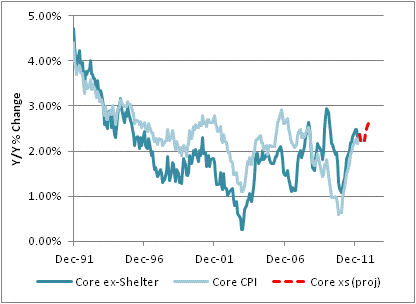
Inflation does not derive from excessive growth, nor deflation from excessive slack. While certain goods and services may experience relative price increases or decreases due to the microeconomic conditions of supply and demand, there aren’t any convincing examples of that happening for “aggregate” supply and demand in the absence of accommodating money supply growth. The clearest counterexample to the notion that growth and inflation are intimately interrelated is that in the period just past, the greatest recession in almost a century, year-on-year core inflation never declined, and if we remove the effect of the deflating bubble in housing, core prices in the rest of the economy never increased less than 1.1% on a year-on-year basis (see Chart, Source: Enduring Investments).
Nor is the expansion or contraction of the monetary base the key element in inflation. At one time, when the money multiplier that maps base money into transactional money (e.g., M2) was relatively stable, it didn’t matter if one used the monetary base – it was incorrect, but the relationship was stable so it didn’t matter. Once the Fed started paying interest on excess reserves, however, the relationship between base money and transactional money was artificially severed and it now matters which aggregate one uses. (See Chart, Source Bloomberg, which shows M2 divided by base money).
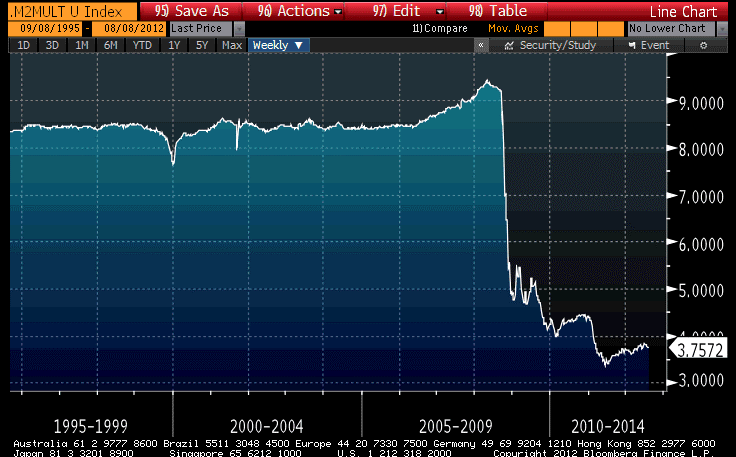
When the crisis hit, the velocity of money plunged as commercial bank lending dried up. The Federal Reserve properly countered this drop in velocity by pumping up the raw quantity of money. They did so in an awkward fashion; paying IOER meant the central bank had to add a lot more base money to cause M2 to rise appreciably, but it worked and prices as noted above never declined.
Now, commercial bank credit in the U.S. is expanding again, auguring a turn higher in money velocity in the near future. And yet, the Federal Reserve and other central banks continue to add money, setting up the potential for a long-tail inflation accident if velocity rebounds and the central banks do not begin to tighten in advance of that event. (I find that an extremely unlikely possibility, with Unemployment over 8% in the U.S. and no longer falling, and at least one Fed President calling for unlimited QE!) That doesn’t mean that we will get an inflation spike; in fact, year-on-year M2 growth is now under 7% here in the U.S. If money velocity doesn’t pick up, then core inflation may only rise slowly from here.
But all of that presumes a closed system where only the U.S. central bank affects the money supply that matters. Unfortunately, or perhaps fortunately, that isn’t the case. Inflation is substantially a global phenomenon, and here lies the potential for both optimism and pessimism on inflation.
On the pessimistic side, one must note that even if the Fed does not in fact pursue further QE, other central banks are sure to continue to do so. The Bank of Japan is not about to stop easing when core inflation in that nation remains below zero. The BOE continues to ease and the ECB has little choice but to ease further (or so they believe), and even the relatively responsible RBA is likely to keep money easy with China’s slowdown threatening on its doorstep. More money, all else equal, means more global inflation, and more global inflation – unless the U.S. dollar undertakes a serious and extensive appreciation – means more domestic inflation.
But on the optimistic side – for inflation, anyway – European money velocity may be on the verge of collapsing. If you want to make a case for slowing U.S. inflation, I do not believe you can look to the U.S., but rather must look to Europe. If domestic lending (and hence velocity) is rising partly because European lending (and velocity) is contracting, then some of the inflation potential is being sucked out, at least temporarily, by financial and credit strains in Europe.
In my view, the only plausible way we get appreciably lower inflation is if central banks abruptly stop quantitative easing (I don’t think there’s any measurable chance that they tighten) and the velocity of money in Europe (and Japan) drops faster than the velocity of money in the U.S. rises. In fact, I can make up a deflationary scenario, in which U.S. velocity rolls back over – perhaps because of some unforeseen consequence of the Volcker and conflict-of-interest rules, which some believe may impair securitization markets if the regulators don’t clarify certain issues – and central banks actually choose that moment to swear off QE. It’s very unlikely – mainly because I don’t think central banks will ever do more than pretend to care about inflation, and will keep on adding QE until inflation is not just a danger, but actually high enough that it becomes considered a bigger problem than persistently high unemployment.
However, if I’m wrong, I think the ‘optimistic’ (in a sense) scenario above is how mild disinflation could come to pass.
