Archive
No Default in Our Day
I suppose it should not be surprising that there is a great deal of misinformation and misunderstanding about the debt limit and government default. A lot of people and especially folks in the media don’t understand these issues because they have never confronted them, and the warring parties seem to believe they have an incentive to get the media telling their story by whatever means necessary, even if that means spreading disinformation.
Some of this is confusion among non-financial people about what “default” actually means. An individual defaults when he or she fails to pay bills within a reasonable time after they come due. If the default is serious enough, a creditor can force the defaulting party into bankruptcy and attach assets.
This isn’t what it means to default as a sovereign country, however. A sovereign default is when a nation fails to pay interest or principal on its debt when due. And that’s all. If the U.S. fails to pay its soldiers, that is not default. It’s a bad move, perhaps, but it is not default. If the government doesn’t pay you, you can sue…but even if you win, there is no Chapter 7 or Chapter 11 bankruptcy for the U.S. government so you cannot attach assets. So this distinction is key: if the U.S. services the debt, there is no default. This is the case whether or not the debt limit increases or not.
It is much more surprising to read James Baker, who among other things has been Treasury Secretary, equating the debt limit increase with solvency. Mr. Baker was interviewed for Peggy Noonan’s column this week in the Wall Street Journal and said, speaking of the President, “He has to get the debt limit raised to avoid default.”
We can walk this through and show why there need not be a default in the case where the debt limit is not raised.
While the government at some point ceases to spend, since it doesn’t have Congressional authorization to do so, it still continues to collect revenue. The U.S. takes in a little less than $3 trillion per year in revenues, and if you think those taxes don’t need to be paid while the government is shut down I invite you to try. Against that revenue, interest payments on Treasury bonds are on the order of $300bln (I don’t have the exact figure). Principal repayments aren’t relevant for this calculation, because as bonds mature the Treasury can re-issue the same nominal amount of bonds. So all the Treasury needs to do in order to avoid default is to pay the interest. They probably also want to pay the $1.6 trillion in Social Security and Medicare payments, and maybe a fair amount of the $700bln in defense and homeland security spending although a lot of that is procurement. But there’s plenty more than is needed to avoid a default.
Incidentally, in theory the Treasury could take in more money by issuing Treasuries with above-market coupons. Perhaps there is a statute that requires the Treasury to always pay the minimum coupon possible, although I am not aware of it. But if there isn’t such a statute, then the Treasury could raise more money by doing the following: when a $10bln TBill issue comes due, the Treasury immediately re-issues a $10bln, 10-year, 10% bond at a price of around 165% of par. Voila, an extra $6.5bln for the coffers. What is limited by statute, as far as I know, is the face amount of bonds that may be issued, not the amount of money that can be taken in.
Now, the Treasury claims that it is unable to pay selected obligations. According to them, it is not operationally possible – the check run is either on, or it is off. All, or nothing. This represents either ridiculous incompetence, or an outright lie. Seriously? The Treasury has no way to cut a single check if it wants to? How about this: take a big stack of blanks and, instead of running them through the printer, fill them out by hand and have the Secretary sign ’em. Painful? Absolutely. But it is inconceivable that it isn’t possible to run only some checks. The Secretary should speak to his I.T. guys.
We should keep in mind that the Secretary is the President’s former Chief of Staff, and probably knows a lot more about the politics of appearing to be unable to pay than he does the actual capabilities of the machinery.
Does any of this make default impossible? Of course not. There is always the possibility that politics or petulance cause the President to simply refuse to order the Secretary to prioritize interest payments on the debt. It would most likely cause dramatic long-term costs for the government and precipitate a real crisis, and I wonder if it might even be impeachable (the 14th Amendment does not seem to me to give the President the power to raise the debt ceiling and pay anything he wants, but it certainly seems to give him the power to cut checks in order to defend the “validity of the public debt of the United States authorized by law, including debts incurred for payments of pensions.”) But there is no financial reason that failure to raise the debt ceiling should result in an actual default.
Certainty About Uncertainty
I haven’t written recently because it is hard to figure out what to do here. Market action at this point seemingly has little to do with fundamentals, and isn’t even in “risk on/risk off” mode because no one seems to be sure how the government shutdown affects risk (the debt ceiling debate is another issue, which I will discuss later).
I often get comments to the effect that “political uncertainty is a fact of life,” or “the Fed always manipulates markets,” implying that we cannot simply refuse to invest because markets aren’t trading cleanly off of economic fundamentals (which don’t directly translate into market action even in the best of times anyway). This is true, but I always hearken back to the notion that uncertainty implies a smaller bet size (a long time ago I wrote an article in which I discussed the implications of the Kelly Criterion for thinking about how one invests). When the economic signals are clear but the market isn’t pricing them properly, then you have a great edge and the market is giving you good odds, and most of your chips should be on the table. When the economic signals aren’t clear, or when stochastic political events are likely to overwhelm them, then your bet should be small because your edge is lower even if you are getting good odds.
In this case, of course, no matter what market you are talking about it isn’t at all clear how the debate (perhaps calling it a “debate” is generous) about the continuing resolution to fund government operations, the ACA, and the debt ceiling will be resolved.
We can speculate about what various outcomes might mean to the markets, but even here our analysis is fraught with uncertainty. Would an extended shutdown be good for equity markets because it would imply a greater chance of lower ACA costs and a lengthier period of Fed quantitative easing? Or would it be bad because of the short-term impact on growth as government spending is delayed? Would bonds rally because there would be no incremental supply, or sell off because of the implied risk of default? A lengthy government closure might be bad for the dollar because it implies more monetary ease, but might be good because it represents “fiscal discipline” (admittedly, in this case it’s discipline in the fetishistic sense rather than in the self-control sense). The only thing I am certain about is the uncertainty, and that spells a smaller bet.
Retail investors are especially at a disadvantage, because of the huge amount of misinformation that is out there about likely scenarios and the results of various outcomes. This misinformation is often unwittingly disseminated by media outlets, but I suspect it is rarely unwittingly initiated by the original sources.
For example, a recent New York Times blog was pretty good at discussing the possible outcomes, but flunked on at least one aspect when it stated what would happen to the economy as a result of a federal default. I don’t mean to pick on the Times here, and in general it is a good article. But at one point the writer said that a default could cause a spike in Treasury yields (likely true), but then continued “The price tag on a huge range of other debt products is benchmarked to the cost of Treasuries. That means a spike in the federal government’s borrowing costs would translate into pricier mortgages, car loans and corporate borrowing costs.”
Well, that’s wrong. It’s not offensively wrong, but it’s wrong (and I’m pointing it out partly as an example of how even simple stuff is confused right now). The interest rate on any nominal debt instrument consists of several components: the real cost of money, a premium for expected inflation, and a premium for the riskiness of the credit.[1] Normally, with Treasuries we can say the credit spread is effectively zero, so that we refer to the spread that a corporate bond trades over Treasuries as “the” credit spread because that spread minus zero equals that spread. But there is no reason to think that spread would remain constant if the Treasury’s credit was diminished, any more than it would remain constant if the corporate’s credit was diminished. If Treasury rates spiked because the government’s perceived credit spread was no longer zero, then unless that also affected the perceived credit of, say, Caterpillar then there is no theoretical reason that CAT yields should also rise.[2]
In any event, a federal default is not going to happen unless someone in the Administration wants it to happen. The government’s $2.9 trillion in revenues is quite a bit more than is needed to pay the $300bln or so in interest costs per year, so unless the Treasury simply decided to default (see an excellent article here by my friends at TF Market Advisors) it isn’t going to happen. The Treasury has made some mystifying statements about how they don’t have the capability to pay some expenses and not others, but in the worst case someone can sit down and manually wire the money to every holder. So that’s nonsense that is meant to scare us.
So I don’t have any decent “trading opinions” on the basis of the government shutdown. What I do believe is that this is an unmitigated positive for inflation (positive in the sense of pushing it higher), and thus for breakevens and inflation swaps. The longer the government stays shut, the longer quantitative easing will be in force as the Fed attempts to counteract the short-term contraction of economic activity (the fact that monetary policy is ineffective at affecting growth rates never seems to enter their minds); furthermore a long shutdown will more likely to push the dollar lower in my opinion – although, as I said above, I can argue the reverse position as well. On the other hand, if the Republicans cave quickly, as is likely in my view, and the ACA goes into effect, prices for consumer-purchased medical care will rise rapidly. This is less a statement about whether the ACA will push aggregate health care costs higher, although I believe that it will. It’s more an observation that controlled prices in the government-purchased sector will produce higher prices outside of the controls, and it is this latter group that will be sampled for consumer prices (since the price the government purchases at is not a “consumer” price). Since it is the Medical Care subgroup of CPI that has been pressing core CPI to be lower than median CPI, any rebound in Medical Care inflation will push aggregate core inflation higher.
Was that said in a confusing-enough manner?
TIPS should do well while the government is shut, because there is ongoing growth in demand for TIPS while the supply will be drying up. Unlike with the nominal Treasury market, there is no corporate inflation-linked bond sector that can replace the inflation exposure (although there should be) demanded by investors, so TIPS will tend to outperform nominal bonds in the event that both sets of auctions are canceled.
[1] There are other costs, such as the discount to the interest rate that the Treasury pays as a result of the status of Treasuries as superior collateral in repo and similar exchanges, but they are not relevant to this point.
[2] There may be a practical argument that there might be a substitution effect, but that’s also saying that investors would bet the selloff in Treasuries makes them a better risk-adjusted bet than CAT bonds. However, if the Treasury’s credit spread moved permanently higher, it would not affect the equilibrium bond yield of a corporate bond.
The Disturbing Evolution of Central Banking
One of the more disturbing meta-trends in markets these days is the direction the evolution of central banking seems to be taking.
I have written before (and pointed to others, including within the Fed, who have written before[1] ) about the disturbing lack of attention being paid in the discussion and execution of monetary policy to anything that remotely resembles money. Whether we have to be concerned about money growth in the short- and medium-terms, ultimately, will depend on what happens to the velocity of money, and on how rapidly the central bank responds to any increase in money velocity. But there are trends that could be much more deleterious in the long run as the fundamental nature of central banking seems to be changing.
Today the Bank of England released its Quarterly Inflation Report, in which it introduced an “Evans Rule” construction to guide its monetary policy looking forward. Specifically, the BoE pledged not to reduce asset purchases until unemployment dropped below 7% (although Mark Carney in the news conference verbally confused reducing asset purchases with raising interest rates), unless:
“in the MPC’s view, CPI inflation 18 to 24 months ahead is more likely than not to be below 2.5 percent; secondly, if medium-term inflation expectations remain sufficiently well anchored; and, thirdly, the Financial Policy Committee has not judged the stance of monetary policy — has not judged — pardon me — the Financial Policy Committee has not judged that the stance of monetary policy poses a significant threat to financial stability, a threat that cannot otherwise be contained through the considerable supervisory and regulatory policy tools of various authorities.”
This is quite considerably parallel to the FOMC’s own rule, and seems to be the “current thinking” among central bankers. But in this particular case, the emperor’s nakedness is revealed: not only is inflation in the UK already above the 2.5% target, at 2.9% and rising from the lows around 2.2% last year, but the inflation swaps market doesn’t contemplate any decline in that inflation rate for the full length of the curve. Not that the swaps market is necessarily correct…but I’ll take a market-based forecast over an economist consensus, any day of the week.
So, for all intents and purposes, while the BOE is saying that inflation remains their primary target, Carney is saying (as my friend Andy the fxpoet put it today) “…the BOE’s inflation mandate was really quite flexible. In other words, he doesn’t really care about it at all.”
Along with this, consider that the candidates which have so far been mooted as possible replacements for Bernanke at the US Fed are all various shades of dovish.
Here, then, we see the possible long-term repercussions of the 2008 crisis and the weak recovery on the whole landscape of monetary policy going forward for many years. In some sense, perhaps it is a natural response to the failure or monetary policy to “get growth going,” although as I never tire of pointing out monetary policy isn’t supposed to have a big impact on growth. So, the institutions are evolving to be even more dovish.
At one time, I thought it would happen the other way. I figured that, since the ultimate outcome of this monetary policy experiment is clearly going to be higher inflation, the reaction would be to put hawkish central bankers in charge for many years. But as it turns out, the economic cycle actually exceeded the institutional cycle in duration. In other words, institutions usually evolve so slowly that they tend not to evolve in ways that truly hurt them, since the implications of their evolution become apparent more quickly than further evolution can kick in and compound the problem. In this case, the monetary response to the crisis, and the aftermath, has taken so long – it’s only half over, since rates have gone down but not returned to normal – that the institutions in question are evolving with only half of the episode complete. That’s pretty unusual!
And it is pretty bad. Not only are central banks evolving to become ever-more-dovish right exactly at the time when they need to be guarding ever-more-diligently against rising inflation as rates and hence money velocity turn higher, but they are also becoming less independent at the same time. A reader sent me a link to an article by Philadelphia Fed President Plosser, who points out that the boundaries between fiscal and monetary policy are becoming dangerously blurred. It is somewhat comforting that some policymakers perceive this and are on guard against it, but so far they seem ineffectual in preventing the disturbing evolution of central banking.
[1] Consider reading almost anything by Daniel L. Thornton at the St. Louis Fed; his perspective is summed up in the opening sentence of his 2012 paper entitled “Why Money Matters, and Interest Rates Don’t,” which reads “Today ‘monetary policy’ should be more aptly named ‘interest rate policy’ because policymakers pay virtually no attention to money.”
A Quick Thought on Municipal Bankruptcy
On CNBC today, analyst Meredith Whitney commented that “everybody loses” from the Detroit declaration of bankruptcy.
If that is the case, then why in the world are they seeking bankruptcy? If everybody loses, then it means nobody wins from declaring bankruptcy, and if that’s the case then it would be truly idiotic to seek it.
But of course, this is nonsense. There is no wealth being either created or destroyed in a bankruptcy proceeding; it is merely being forcibly reallocated. In this case, the winners are the taxpayers of Detroit. More to the point, it is the future taxpayers of Detroit, who were on the hook for a bunch of liabilities that they were going to have to figure out how to pay someday, but are not now going to have to pay. Those folks win big. And it’s a good thing, too, because Detroit needs more of these future taxpayers to move to Detroit.
The losers are many in number. Bondholders will lose a lot. Pensioners will, unfortunately, lose a lot. Many of the public service unions will lose a lot as their contracts are rolled back. But their losses are equal in magnitude to the gains of the future taxpayers.
Another prediction that Whitney made is on firmer ground. She said that this bankruptcy would touch off a wave of other municipal bankruptcies. I think there is a very good chance of that. I am not saying that because I have analyzed the balance sheets of many municipalities in great detail, as Whitney have (although I have seen enough, in trying to persuade some of them to hedge their post-employment medical liabilities, to be concerned). I say it because we have seen such phenomena before in industries which were overburdened. Consider telecommunications in the early 2000s. Once one big telecom company declared bankruptcy, it suddenly had a big cost advantage over its rivals, and could underprice them until its rivals followed the same path. We’ve also seen this in airlines. It seems to me that it is entirely possible that, if Detroit is able to lower taxes and reinvigorate the economy once it no longer needs to service these overwhelming liabilities, and begins to attract migrants from high-tax neighboring cities and states, then it makes the finances of places like, say, Chicago that much worse as their taxpayers leave.
Stealing Really Is That Bad
Cyprus banks are closed until Thursday. At this point, the Cypriot legislature has not voted on any particular scheme of theft, although some Eurozone officials seem to think that it would be okay to only rape the people who have deposits bigger than €100,000, just as long as it’s a really brutal rape to make up for letting the smaller depositors off. (This only sounds like it makes sense if you use their words, but not if you use their meaning.)
It is incredible but the Eurozone elite really don’t seem to understand why the Cyprus plan is so bad. They really are natural Socialists! As Merkel and her party became the primary defenders of the decision to seize Cypriot depository assets today, there was a very good article in Businessweek that contained several jaw-dropping quotes.
“I have to go to my constituency and explain to my people in my constituency why we are willing to lend more than 3 billion euros ($3.9 billion) to Cyprus,” Michael Fuchs, deputy parliamentary leader of Merkel’s Christian Democratic Union party, said in an interview with BBC Radio 4 today. “Why should Germans bail out these people and they are not willing to accept at least a minor bailing out by themselves?”
Well, Mr. Fuchs, here is the problem: you didn’t ask them if they would “accept” at least a “minor” bailing out. You ordered people who didn’t need a bailout – savers with earned balances in the banks – to pay for the bailout. I daresay that it doesn’t seem “minor” to those who had their money stolen to save someone else.
Yes, I understand the parallel, that you feel the alternative was to have your taxpayers foot the bill, and they don’t need a bailout either so why should they pay for it? As Merkel said: “the responsible people are partly included and not only the taxpayers in other countries.” But here’s the thing – at least you have the authority to order that the taxes your citizens paid be used for things they didn’t want, but you did. You have no authority, and indeed no one had the authority, to order the seizure of private assets for something you wanted. (Cyprus, and Cypriot banks, had the ability to seize the assets, but that’s not the same as the legally-sourced authority to do so.)
Moreover, you had another alternative, and that’s to recognize that the elite who want the Union to survive in its current form can’t afford to foot the costs for it to do so – and to let Cyprus go. Yep, I understand that to you that would have been tantamount to Armageddon. But the more you destroy the foundations of capitalism and the free market in favor of naked Socialism, the more appealing Armageddon looks by comparison…
And here’s another quote, by the budget spokesman of Merkel’s main opposition party: “The profiteers of the Cypriot business model must pay the bill – not the European taxpayers.” I heartily agree, but the “profiteers” aren’t the depositors! If that appellation is attached to anyone, it would be to the bank equity holders, and perhaps the bondholders. Arguably, it may apply to the citizens of Cyprus, but almost equally to the people of the Eurozone who benefited when Cyprus lived and consumed beyond her means. But the depositors were not ‘profiteering’ by putting deposits in the bank. They were saving.
So it’s the Russian and the Greek depositors that you really wanted to target? Then why not target anyone who is Russian or Greek? I would go further and say that it isn’t the Russians’ fault that Cypriot banks were willing to take their money, and not the Greeks’ fault that European oversight of Eurozone banks was so fractured that Cypriot banks sought out these deposits as they grew and became unsustainable, ungainly creations. Being a Greek or a Russian with money isn’t a crime – unless you’re a Socialist. And if you’re a Socialist, then it isn’t the Greek or Russian part…it’s the “having money” part.
But they don’t seem to see why people are concerned.
Now, in the micro picture none of those reflections are very market-oriented, but in the macro picture they certainly are. We all have to deal on a day-to-day basis with the reality that markets are nakedly manipulated by central banks these days (with fancy names like “portfolio balance channel,” for example). I was speaking today to an investor about a particular type of arbitrage in my sphere of expertise. As we were brainstorming what could go wrong with the trade, the biggest possibility was “what if one central bank decides to stop manipulating markets and another central bank continues, but they’re the wrong ones? Or what if they start manipulating markets in a different way?” We didn’t directly consider the question of “what if they just seize the profits?” but investors actually now need to consider that in the calculus of risk and return.
But that part isn’t new, as some readers of my articles have pointed out. Government witch-hunts have long been carried out in search of the miscreants who “caused” market mayhem. After the 1929 crash, the Senate held hearings and even went after stock exchange members who’d actually held long positions during the crash. What is new is the targeting of people who have saved simply because it would be more convenient for the government to have their money.
They came for the hedge funds, and I didn’t speak out because I wasn’t a hedge fund. They came for the banks, and I didn’t speak out because I wasn’t a bank. They came for the savers…and there was no one left to speak for me. Right?
Equities took the news with surprising aplomb. Yes, stocks fell 0.55% after being down somewhat more than that, but that reverses only two average days during this most recent run. Commodities, which should be a direct beneficiary of global monkey-business associated with fiat money deposits, sold off hard with the notable (and reasonable) exception of gold. That is borderline insane, but consistent with the insanity of the last couple of months. These days I wake up every morning half expecting to see commodities prices offered at zero. Interestingly, inflation traders seemed to grasp the point, as 10-year inflation swaps and breakevens were stable even though rates generally declined. But commodities is Q1’s red-headed stepchild (and I say that as a red-headed stepchild).
It sounds crazy to say, but Europe losing its collective mind on this topic is bad for equities only if the bank run spreads to other countries in Europe, or if Cyprus decides to leave the Euro and to flee into the tender mercies of Russia’s embrace. Those aren’t certainties by any stretch of the imagination. Consequently, anything that looks vaguely like calm will likely be rewarded by a melt-up in stocks, probably to new highs. The outcomes are distinctly binary at the moment, which isn’t risk I personally care to take since equities are aggressively valued even if these risks were not present.
Willie Suttonomics
I am sure that the Eurozone finance ministers have never heard of Willie Sutton. But they are engaging now in Willie Suttonomics.
Willie Sutton was the bank robber from the early part of the 20th century who, when asked why he robbed banks, reputedly answered “because that’s where the money is!” This weekend, the Troika agreed to extend a critical loan to Cyprus in order to stave off a default for the small Eurozone nation. The €10bln loan was extended on condition that bank depositors be levied 6.75% or 9.9% of their deposits (the lesser amount if under €100,000) as part of the solution, and the new president of Cyprus said he accepted because he was given no choice.
I fail to see how this differs from what Willie Sutton did, except that Sutton at least went to prison – multiple times – for the crime. You went into the bank on Thursday and your deposits read €20,000 as you were saving for a new car, or a house, or college; on Monday, you have €18,650. It is being called, disingenuously, a “tax,” but considering that no Cypriot body approved the “tax” it is hard to see how that appellation fits. The money vanished from the vault with no warning. That seems more like a bank robber’s job…except that ordinarily, when a bank is robbed the depositors are protected. The depositors would have been better off if the money had been stolen by Willie Sutton!
My son, who is 9 years old, saw it the same way when I explained the basic facts of what happened to the depositors. He said “that sounds like something Lex Luthor would do.” From the mouths of children…and I don’t judge him wrong on this.
On Monday, I imagine that markets will try and behave as if this “puts the crisis behind us” again. But also on Monday, I imagine that every corporate Treasurer who has money in a bank in Europe will be trying to diversify those deposits to other jurisdictions. Perhaps, if I am such a treasurer, I will pull money from Italy to put into Germany or perhaps I will put it into UK or US banks. But one thing I certainly will not do is leave all of it in a bank in Italy, or Portugal, or Hungary, or Spain.
It is possible that nothing will happen, or at least not right away as stunned European depositors wait to find out if it’s really true, and some dwell in denial. But it’s also possible that we could see the mother of all bank runs, because it’s no longer necessary for depositors to stand in long lines to withdraw their cash, as happened in every major banking crisis that happened before deposit insurance. This is exactly the opposite of deposit insurance – instead of the government protecting depositors, the government is opening the vault for the robbers.
Now, it’s not completely approved as of this writing. According to Reuters, the Cypriot parliament will vote on Sunday whether to mug depositors for the levy. But, since the alternative is that Cyprus will have to default on Tuesday, the odds are good that either they’ll approve the levy (which banks have already sequestered, without any law to tell them to do so), or there will be some 11th hour brinkmanship with the Troika and Cyprus on Monday. But by Tuesday, you will either have the disorderly default of a Eurozone member, or confiscation of deposits held in banks of a Eurozone country. Now that’s a Hobson’s choice if ever there was one.
Here are some stories elsewhere about the crazy Troika scheme: here, here, and here. And I rarely cite Zerohedge but here is a good summary of some quotes from well-placed individuals in Europe. Comfortingly, the response so far has been shock and anger. Most observers are, rightly, dismissing the soothing statements that this action is an “exception.” Yes, it is – a confiscatory exception, and one that was completely random and unforeseeable by the depositors. Does it make one feel better that the crazy man on the street just set his neighbor’s car on fire, if he says “but it’s just his car – no one else’s.” No, because you know he’s a crazy man, and now you know there is nothing he won’t do. Random injustice is worse than systematic injustice.
Hold on to your assets, folks – I have no idea what happens on Monday but I have a feeling it will require more liquidity. But then, doesn’t everything these days?
For Want of a Nail
The latest fiscal cliff follies are redolent of that old proverb:
For want of a nail the shoe was lost.
For want of a shoe the horse was lost.
For want of a horse the rider was lost.
For want of a rider the message was lost.
For want of a message the battle was lost.
For want of a battle the kingdom was lost.
And all for the want of a horseshoe nail.
On Wednesday, Treasury Secretary Geithner – one of the worst, if not the worst, Treasury Secretaries in history, I am pretty sure – said in an interview on CNBC that the Administration would “absolutely” send the country off the fiscal cliff if the rates on the top 2% of Americans don’t go up.
Now, I’ve heard lots of numbers bandied about, and decided I wanted to get the source data directly. The latest information i can find from the IRS is from tax year 2009, but it is instructive. According to the IRS, in 2009 there were 104,164,970 tax returns filed. The number with adjusted gross income above $200,000 was 3,912,980, or about 3.8% of all returns. They don’t break it down any more than that, so let’s call those successful people “the rich” and work from there.
Those 4 million returns covered $1.626 trillion in modified taxable income (32% of the total taxable income) and produced $429bln in tax (45% of the total tax generated). Now, let’s suppose that the top tax rate rose from 35% to 39.6% in tax, and for grins we’ll pretend that taxpayers are completely indifferent about this and so they do nothing to try and reduce taxable income (by, say, buying municipal bonds rather than corporate bonds). You might think that the tax take will rise by $74.8bln (4.6% * 1.626 trillion). But you’d be wrong, because the increase wouldn’t affect all of the taxable income paid by high-earners, but only that income that is taxed at the top marginal rate. In 2009, only $485bln in income was taxed at that rate, so a 4.6% increase in the marginal rate would only raise $22.3bln per year, or around $250-300bln over the next 10 years.
Now, over the last year the deficit has been about $1.1 trillion, so if I understand Geithner correctly, the Administration is willing to push the country over the cliff about an issue that amounts to 2% of the deficit, and would increase aggregate revenues by only 1%.
It’s one thing to argue for the philosophical point, but to say that you’re willing to put a hole in the bottom of the boat because you don’t like the seat you were offered…it seems a bit irrational.
What might be even more irrational is the sudden optimism that is breaking out all over Capitol Hill, about how great the economy will be if the fiscal cliff can just be averted. Today a Republican Senator being interviewed on CNBC said “The economy is ready to explode. There’s no doubt about that,” echoing what President Obama had said just a couple of days ago.
Do they mean implode, perhaps?
There is certainly no sign whatsoever that “the economy is ready to explode” ecstatically if the fiscal cliff is averted. Indeed, I think part of the reason we’re likely to go over the cliff is that the President wants to be able to blame the poor growth for the next few years on the Republicans in the same way he spent the last four years blaming the previous President. And the Republicans, since the Administration has offered no spending cuts and has dismissed entitlement reform altogether, don’t really have a choice unless they want to completely capitulate – at least with the fiscal cliff, some spending will be cut. Since, if austerity is enforced, there will be no way to test the counterfactual, it makes sense to build up how great it would have been. But the point I want to make is that to proffer such a claim only makes tactical sense if no deal is in the offing…because if a deal is struck, then we’ll quickly find out that the economy isn’t going to explode higher at all, and those statements will be exposed as completely moronic.
We will on Friday find out how much the economy is not exploding – surely, because of the impending cliff – when Payrolls (Consensus: 85k vs 171k) and Unemployment (Consensus: 7.9%) are announced. These figures will be impacted by Hurricane Sandy, so it will be difficult to interpret them. Or, perhaps I should add cynically that this uncertainty will make it even easier for politicians to claim whatever the heck they want!
With 10-year yields already at four-month lows (1.59%) and the bullish seasonal pattern having run its course, I think the risk is for higher bond yields both tomorrow and going forward. Now, the 1.82% level has mostly contained any selloff since April, but I think we will be headed in that direction. Equities have downside risk in my view after this recent rally (an even more impressive rally when you consider that Apple was dragging on the index!); I think there is far too much optimism about an imminent resolution to the fiscal cliff, and I don’t think we’ll see any resolution until after the new year.
The Nation’s Balance Sheet and Crowding Out
Recently, I pointed out (in “Kissing Assets Goodbye” from November 1st) that disasters lower a country’s net worth. Therefore, even though they will tend to increase flows-based measures of economic activity, such as today’s New York ISM where the “6-month outlook” subindex jumped from 57.7 to 75.3, it’s not good news. I lamented that, although the numbers are not wrong per se, they are misleading. And they are misleading because there is no economic “asset” and “liability” account for the nation.
I recently saw a paper which attempts to create just such a “balance sheet” for the nation, albeit with a very long lag. It is a project to define “the integrated macroeconomic accounts” of the United States, and it is jointly produced by the Bureau of Economic Analysis and the Fed. You can find a discussion of the effort here, and if you search on “disaster losses” you can find evidence on household, government, and business balance sheets of the impact of Hurricane Ivan in 2004 (about $28bln) and Hurricanes Katrina and Rita in 2005 (about $110bln).
Read through the paper and you can see this is an ongoing project with many current shortcomings, but it’s progress. However, it’s doubtful it will ever be used by economists in anything approximating real time, which means my objection – that economists ignore the fact that a disaster is a net negative even though it is positive in an activity sense – stands. Still, with as much as I bash economists, it’s only fair that sometimes I point out when they’re trying to do things the right way.
Now, one interesting part of the paper is on page 6, where the economists detail the sources of net lending and borrowing in the capital and financial accounts, broken down by sector. For those who think that deficits don’t matter, this is something to chew on. According to the table, in 2007 we were all borrowing: households, businesses, state and local governments, and the federal government. This was financed by our overseas trading partners. Everything changed in 2008, when the government borrowing “crowded out” private borrowing. The table below is a summary of two columns from the paper, and compares net lending or borrowing by sector for 2007 and 2011.
| (billions) | 2007 | 2011 |
| Households & nonprofits | -126 | 476 |
| Nonfinancial noncorporate businesses | -74 | -6 |
| Nonfinancial corporate businesses | -94 | 422 |
| Financial business | -3 | 125 |
| Federal government | -315 | -1357 |
| State & local governments | -93 | -113 |
| Rest of the world provides the difference | 716 | 484 |
| – indicates net borrowing | ||
| + indicates net lending |
The last number in the column is essentially the number needed to make the column sum to zero (although not exactly, due to statistical discrepancies…that is, it isn’t a “plug” number but rather is measured directly), and it clearly is bounded at some level. The rest of the world will not lend us, especially in the current economy, a bazillion dollars. And when so many other countries are running large deficits, there is great competition for those dollars. So the “rest of the world” line cannot simply rise to any level in order to balance out the column. (When our economy was less open, this line was far less flexible even than it is today).
Consequently, when the “Federal government” deficit rises by a trillion dollars, it essentially forces (in a mathematical and accounting sense that the books must balance) the other sectors to become lenders. Or, put another way, if no one buys the bonds then the federal government can’t run that deficit; ergo, the existence of the deficit implies that other sectors have lent.
A more-generous interpretation would be that the other sectors became savers due to the crisis and so, in order to maintain economic growth, the Federal government was forced to borrow. Aside from being a false choice (the government could have chosen to let the economy solve its own problems), that interpretation is less plausible now that we are four years out from the crisis and the deficits still persist.
There are other ways to illustrate this same proposition, such as through the numbers the Fed produces in the Z.1 report, which show that Treasury debt has gone from being 25% of total domestic non-financial sector debt to 40%, in only four years (see chart below, source Federal Reserve Z.1 report).

However, this doesn’t illustrate the “crowding out” causality as well as the table above does. The following chart (Source: Fed Z.1 report) shows it better, but it still begs the question a bit because it shows levels and not flows. For my money, I like that table.

All in all, the paper is worth reading – it’s only 17 pages, and lots of great charts and numbers to go with that.
Fiscal Baby Steps Aren’t Worth the Angst
Unless today’s unseasonably-warm temperatures in the New York area (through some metaphysical conservation-of-energy mechanism) means that Hell is freezing over, we are a long way from resolution on the fiscal cliff discussions.
The Republicans countered President Obama’s proposal for a $1.6 trillion tax hike with their own plan that would cut the cumulative deficit (according to static scoring, as all of these proposals are) by $2.2 trillion through a combination of closing special interest loopholes, introducing deduction caps on high earners, increasing the Medicare eligibility age, cutting some discretionary spending, and using chained CPI as the Social Security escalator in order to slow the growth of benefits. After having previously lambasted the Republicans for not offering specifics, the White House today labeled the proposal “nothing new,” apparently without irony.
To be fair, the Republicans had called the President’s proposal a “la-la land offer.” So you can see, we are obviously very close to a deal and a smiling, hand-shaking, giddy signing ceremony in the Rose Garden.
All of this is sheer madness. These hikes and cuts are measured over the projection horizon, so we’re arguing about cutting perhaps 20% per year from the current trillion-dollar deficits. Good heavens, it’s a good thing we’re not trying to do something radical, like balance the budget. The combination of the national debt and the Social Security and Medicare liabilities add up to over $1.1million per taxpayer (Source: www.usdebtclock.org), and the debate is over cutting around $20,000 per taxpayer over the next decade. Don’t strain yourselves, fellows.
It’s incredible that some of these things are even subject to argument. The Medicare eligibility age will eventually be effectively infinity, because the program is not viable on this planet with health care such as we have come to expect, and since the liability is in real terms (units of healthcare, not of dollars) we can’t inflate our way out of it. So gradually moving the eligibility age a whole lot higher is something that we simply will have to do. Why not now?
People who say that cutting the deficit by $2.2 trillion over 7-10 years is hard to do have not actually tried it. It is actually pretty easy to get the budget back to some semblance of balance, as long as you don’t have to run for re-election or if you consider the future of the country to be more important than winning another term (and you know, there’s even a chance your constituents may reward that bold sacrifice!). All that you have to do is to reverse most of the things we’ve done to the budget over the last decade and you’re close – of course, the interest costs now are a lot higher, and will only climb in the future. But if you put entitlement reform on the table, it gets downright easy…again, if you don’t have to run for re-election.
Now, that interest portion of the deficit is somewhat scary. The chart below comes from Bloomberg, and it’s one of my favorite Bloomberg functions (DDIS). It shows the debt maturity distribution of U.S. Treasuries, and shows the interest and principal amounts currently scheduled.

It appears as if the interest costs (right column) max out at $196bln in 2013 and then decline, but keep in mind that these numbers ignore the fact that debt will be rolled when it matures. The $196bln is something closer to the baseline expectation, in the event that the Fed keeps interest rates anchored pretty near zero. It may be disturbing to note that the Treasury next year needs to roll $1.26 trillion in maturing securities, in addition to the $1 trillion of new money they need to raise due to the deficit; in 2014 the problem will start to grow even scarier as all of the 5-year issuance from 2009 starts to come due, along with all of the debt that has been rolled in the last couple of years. If you want to point to a come-to-Jesus moment in the bond market, it is likely to be in 2014 when this fact intersects with the expectation of the end of QE. It’s one thing to sell $2.26 trillion in Treasury securities if the Fed is committed to buying $1 trillion of them. It’s a little harder when they’re not, or if they are (as they claim they can) actually trying to sell some Treasuries from their own vaults. Good luck.
That’s why I don’t think we ought to be arguing over $200bln per year in the fiscal cliff. The problem is already much larger than that.
Now, that presumes that QE actually ends sometime in 2013. Some Fed officials have recently made noises to suggest that there is no reason that QE needs to end any time soon, and that the Fed is “nowhere near” the limit of what it can do. The problem is that 2014 will force a very serious choice on the Fed, because I think inflation is going to continue to rise throughout next year (our point forecast for core inflation is about 2.8% for 2013, but with all the tails to the upside), while I seriously doubt that Unemployment will get below 7%. And, as just noted, the market reality is that without Fed buying, the Treasury is going to have a devil of a time placing its debt in 2014 without higher yields (as an aside, I also suspect all dollar swap spreads will be negative in the next few years).
I’m not the only one who thinks that inflation is likely to be rising. While the nominal interest rate debacle is, in my opinion, not likely to hit us until 2014, rising inflation is happening today and the expectation of a continuation of that trend is being reflected in inflation swap rates. The chart below (Source: Bloomberg) shows that 10-year inflation swap rates are again up around 2.75%.

Now, if inflation expectations are rising but the Fed is going to fix nominal 10-year rates at 1.60%-1.80% where they are now, then the scary result is that TIPS yields, already ridiculously low, could go further. I am not bullish on TIPS, because as a rule I won’t buy something that is rich on the expectation that it might get richer. That way lies madness, since when the thing you bought goes down you have no plausible excuse. Moreover, speaking for myself, I know that I would be unable to maintain a position that I knew to be fundamentally mispriced the wrong way. But if 10-year inflation expectations went to, say, 3.6% and 10-year nominal yields were fixed at 1.6%, real yields would be forced to -2.00%. This is the reason I won’t short TIPS in the current environment, although I view them as overvalued.
.
What article would be complete without news from Europe? Today Greece offered to pay up to €10bln to buy back their own bonds, with bids due Friday. Completion of this buyback is a precondition to Greece’s receiving the next tranche of the bailout, but it will be challenging if they refuse to pay market prices (as the Euro finance minister communiqué released last week suggested, since it limited the prices paid to those prevailing on November 23rd). It still is a philosophical step forward, since at least it serves to recognize the unrealized gains that Greece effectively has when its liabilities are priced where they are now. This is, after all, essentially the same thing that happens in a default: in that case, Greece would offer to pay 35 cents on the dollar for all of its debt. In this case, they’re trying to “default” on just enough of the private debt so that the public debt can be carried at par for a while and maybe, someday, be paid off at par.
I just wonder if they can make it to “someday.”
Good News, For Now
First, an observation: yesterday’s article, “Incredible Inflation Bond Bargain,” received more hits than any other article I have written in recent memory. Apparently, people still are looking for bargains, and still looking for bond bargains as well. This is heartwarming to a bond guy, and of course even more to an inflation guy. But then, true bargains are rare, and true bargains offered by the government are even more rare. A belated hat tip to “Gratian”, who asked me what I thought about I-bonds and provoked that article. Thanks for the suggestion!
.
There was some mild good news today. Consumer Confidence rose more than expected, to 70.3 and only a couple of points below the post-Lehman highs set in early 2010 and 2011. Yes, 70.3 is still very low (the series is set so that confidence in 1985 equals 100, and in the recessions of the early 1980s and the early 1990s it was generally in the 55-80 range), but the longest journey begins with a single step. On the bright side, there’s lots of room for improvement (see chart, source Bloomberg).
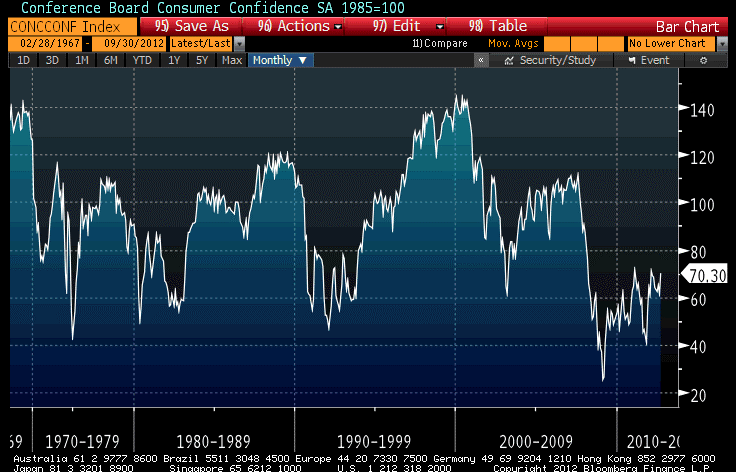
The internals of the Confidence number are not as good. Both “current conditions” and the 6-month ahead outlook improved, especially the outlook (when ‘my guy,’ whoever your guy happens to be, will be in the White House six months from now, surely things will be better), but the “Jobs Hard to Get” subindex, which is highly correlated with the level of the Unemployment Rate, barely nudged lower. Still, as depressing as it sounds, consumer confidence is a relative bright spot among recent data.
Home prices, as we have documented several times, are rising and the S&P/Case Shiller Home Price Index confirmed that by reaching the highest level it has seen since 2010. The 20-city composite is now rising at 1.2% year/year, which doesn’t sound much but is the highest rate of change since the dead-cat bounce of 2010. Keep in mind that the index methodology involves a fair amount of smoothing, so it lags the actual improvement in the market. By comparison, the RadarLogic 28-day composite index as of the end of July recorded the highest year-on-year change since 2006 (see chart, source Bloomberg).

Also relatively good news was the Richmond Fed Manufacturing Index, which rose to +4 – not as good as it was earlier this year, but 23 points above its July low. The Richmond Fed district includes the “toss-up” battleground states of North Carolina and Virginia and the “leans Romney” state of South Carolina. It is encouraging that manufacturing in this region (with its 28 toss-up electoral votes) is outperforming activity in the Dallas Fed district (Texas, northern Louisiana, and southern New Mexico, none of which are considered toss-ups), the Chicago Fed District (which includes Michigan, most of Illinois and Wisconsin, and 6-electoral-vote-toss-up Iowa) and the Philly Fed district (which is Pennsylvania, NJ, and Delaware, and no toss-ups). This is merely an observation, and even if there were clear indications that the Administration was directing money towards projects in battleground states I wouldn’t object to it – that’s one of the prerogatives of incumbency. If you want that prerogative, work hard so that you can get to be the incumbent.
While the data points today were good, stocks gave up the ghost and managed to lose most of the post-FOMC rally. That doesn’t really shock me so much. Commodities, which should be more sensitive to inflationary monetary policy, are down outright since the Fed declared an unbounded easing policy, and both markets have rallied since June on the growing expectation of QE3. The fact that QE3 was larger than many observers expected caused some short-covering on the news, but I suspect most investors who thought QE3 was coming were already long their preferred assets. The actual open-ended Fed buying will definitely buoy commodities (which remain undervalued relative to past QEs) and might lift equities (which, however, offer fairly weak prospective real returns given the current market valuations), but we had already priced in some expectations.
And in the meantime, while today’s numbers were not bad, the overall picture remains pretty weak. I think the threat of sequestration at the end of the year will start to affect growth more seriously in October, because the end of the fiscal year for government expenditures is September 30th. Businesses that have the government as a significant client recognize that they may well be in Limbo on October 1st. This is what happens when government spending is 40% of GDP! The sequestration doesn’t happen until January, so spending from October until December in theory will be unaffected. But, in practice, the government enters into contracts (for equipment and construction, for example) that cover many months, and it isn’t entirely clear whether for example the Defense Department can enter into a one-year contract if it isn’t known that the money will be there. I know several people in businesses that are directly affected by this issue, and they’re concerned about it now, not just in January.
.
I saw an interesting study by State Street Global Advisors mentioned in a Pensions & Investing Online article. According to the study, about ¾ of institutional investor executives consider a ‘tail-risk’ event in the next twelve months to be likely. But here is the interesting paragraph in the P&I article:
“Survey respondents — money managers, family offices, consultants and private banks — expect the five most likely causes of a tail-risk event in the next year would be a global economic recession (36%); a recession in Europe (35%); the breakup of the eurozone (33%); Greece dropping the euro (29%); and a recession in the U.S. (21%). (Percentages total more than 100% because respondents could select multiple causes.)”
Apparently, ‘inflation’ isn’t even on the radar as a tail risk. Of course, as an investor, what is more important than the tail risks you can estimate the probabilities of are the tail risks you aren’t even thinking about or can’t estimate the probabilities of. Incredibly, not only has the myth that recessions cause disinflation and deflation failed to weaken during the last few years, when weak growth has been accompanied by accelerating core inflation, it seems to have strengthened! While investors, as evidenced by the performance of inflation-linked bonds and of breakevens (and inflation swaps) and commodities, believe that inflation might well be a risk, it doesn’t seem that many investors are focusing on it as a tail event. That is, they expect that a “bad” inflation outcome might be 2.5% or 3.0% core inflation. An outlier event to them may be 3.5% or 4.0%.
But what we know about inflationary outcomes is that if anything, they have tails that are quite long. And there’s plausible reasoning which can produce very high numbers for that tail; see for example my article from late last month – before QE3 – called “What Keeps Me Awake At Night.” I always take care to say that these concerns aren’t predictions, but they are plausible possibilities, and the bottom line is that we don’t really know how these relationships work at this scale. No central bank has ever dealt with numbers like this. It is a known unknown, and thus a source of a tail risk of indeterminate length.
In my opinion, when it’s cheap to insure against such risks then it ought to be done. Presently, you can (as an institutional investor) protect against the risk that inflation will compound at greater than 4% for the next ten years for roughly 2.2% of the notional amount, or 22bps per annum. There are multiple ways to do this, some of which may be cheaper and all of which are beyond the scope of this article – but the point is that we have investors enumerating downward “tail risks” on growth while equity margins and valuations are high, and largely ignoring “tail risks” on inflation that could damage a number of different asset classes. I see lots of potentially dangerous scenarios for equities in October, several (but not all) of which are also dangerous for bonds.
