Archive
Tempest in a Microsecond
News flash! High-frequency trading (HFT) is happening!
The “60 Minutes” piece on HFT that aired this weekend ensured that now, finally, everyone has heard of HFT. Even “60 Minutes” has now heard of it, four years after the Flash Crash and more than a decade after it began. Apparently the FBI is now suddenly concerned over this “latest blemish.”
Again, this is hardly new. Here is the record of Google search activity of the term “high frequency trading.”

So why is it that, for years, most of the world knew about HFT and yet no one did anything about it?? According to author Michael Lewis, the stock market is rigged! There should be an uproar (at least, there should be if you are selling a book). Why has there been no uproar previously?
To put it simply: this is a crime where it isn’t clear anyone is being hurt, Lewis’s panicky declaration notwithstanding. Except, that is, other high-frequency traders, who have fought over the tiny fractions of a penny so hard that the incidence of HFT is actually in decline. Let’s be clear about what HFT is, because there seems to be some misunderstanding (one commentator I saw summarized it as “the big banks buy the stock and then the retail investor buys it 5%-10% higher.” This would be a problem, if that’s what was happening. But it isn’t. The high frequency traders are playing for fractions of a penny. And the person they are stepping in front of may be your buy order, or it may be the offer you just bought from – if you ever see fills like $20.5999 when the offer was $20.60, then you were injured to the tune of minus 1/100 of a cent per share. The whole notion of HFT is to be in and out of a position in milliseconds, which basically limits expected profits to a fraction of the bid/offer. And when there are lots of high frequency traders crossing signals? Then the bid/offer narrows. That’s not a loss to you – it’s a gain.
High frequency traders aren’t just buying and pushing markets up. They are buying and selling nearly-instantly, scalping fractions of pennies. From all that we know, they have no net effect on prices. Indeed, from all that we know, both the beneficial aspects and the negative aspects remain unproven (see “What Do We Know About High Frequency Trading?” from Charles Jones of the Columbia Business School.
So, if you’re being ripped off, it’s far more likely that you’re being ripped off by commissions than that you’re being ripped off by the robots.
But let’s suppose that the robots do push prices up 5% higher than they would otherwise be. Either that’s the right price to pay…in which case they made the market more efficient by pushing it nearer to fair value…or it’s the wrong price to pay, in which case the only way they win is by selling it to someone who pays too much. If that’s you, then the robots aren’t the problem – you are. Stop giving them a greater fool to sell to, and they will lose money.
Now, this is all good advertising for another concept, which needs to be stated often to individual investors but probably could be said in a nicer way than “you’re getting ripped off by robots”: yes, the market is full of very, very smart people. And yet, on average returns cannot be above-average! This means that if you don’t know everything there is to know about TSLA and you buy it anyway, then you can be sure you will still own it, or be still buying it, when the smart guys decide it is time to sell it to you. They don’t have to have inside information to beat you – they just have to know more than you about the company, about valuations, about how it should be valued, and so on. This is why I very rarely buy individual equities. I am an expert in some things, but I don’t know everything there is to know about TSLA. I am the sucker at that table.
Long-time readers will know that I am no apologist for Wall Street. I spent plenty of time on that side of the phone, and I have seen the warts even though I also know that there are lots of good, honest people in the business. The biggest problems with Wall Street are (a) those good, honest people aren’t always fully competent, (b) the big banks are too big, so that when you get weak competence and very weak oversight combined with occasional dishonesty, there can be serious damage done, (c) there is not a strong enough culture at many firms of “client first;” although that doesn’t mean the culture is “me first,” it means the client’s needs sometimes are forgotten, and finally (d) the Street is not particularly creative when it comes to new product development.
And I don’t really like the algo traders and the movement of the business to have more robots in charge. But look, this trend (not necessarily HFT but automated trading) is what you get when you start regulating the heck out of the humans. Which do you want? Kill the robots, and you need more of those dastardly humans. Remove the humans, and those lightning-quick robots might trade in front of you. Choose. In both cases, you will be victimized less if you (a) trade large and liquid indices, not individual equities, and (b) trade infrequently.
The far bigger problem in my mind is the opacity, still, of bond trading and the very large bid/offer spreads that retail investors pay to buy or sell ordinary Treasury bonds that trade in large size – often billions – on tiny fractions of 1% of price. Think of it: in equities, with or without HFT you will get a better price for a 100-lot than for a 1,000,000-lot. But in bonds, you will get a vastly better price for a billion than for a thousand. Now that is where a retail investor should get angry.
The Fed and Regulators Should Draw the Veil
When I remark, from time to time, that I think the Fed has made a mistake in increasing transparency of its deliberations and actions, people occasionally look at me as if I had come out opposed to motherhood or apple pie. But my point is that transparency is good if it permanently decreases risk…but it doesn’t.
What matters is how market actors respond to increased transparency. It is much like the old debate about whether football players ought to wear helmets. It is clear that helmets decrease the likelihood of brain damage in any given collision, compared to the un-helmeted rider in an identical collision. But it is also clear that as helmets have gotten better and better, football players have played faster and faster, with more abandon, and lead with their heads a lot more than they did when all they had was a leather cap. The net effect is indeterminate.[1]
In markets, increased transparency from a central bank or regulator leads to increased leverage in a very direct way. The central bank’s dial is for transparency, but the investor’s dial is for risk appetite and when the central bank turns its dial it does not change the investor’s risk preferences. The result is that increasing transparency, which decreases the risk at any given leverage and at any particular moment, leads to higher levels of leverage, which lowers the tolerance for error. And, as we have seen, central banks and regulators are quite prone to error.
In an interesting way, this is tied into the volume question. The chart below (source: Bloomberg) shows rolling 250-trading-day volume for the NYSE in billions of shares. As has been well-documented, market volumes have been steadily declining for years.

As we have mentioned here before, there are lots of excuses for lower market volumes on the major exchanges, and probably many of those excuses are part of the answer. But we can no longer simply attribute this to the movement of volumes to “dark pools.” There is simply less going on in the markets, whether in rates or in equities. Ask the dealers. Dodd-Frank and the Volcker Rule are simply decimating volumes. And this is not just bad for dealers, it is bad for everyone.
When a trade happens, there is information revealed. Indeed, in some markets a meaningful proportion of the volume transacted is between dealers who are testing the market to get more information. More trades means that there are more quanta of information. More quanta of information produces more confidence in prices. More confidence in prices means more support for the current prices, and more de facto liquidity.
Think of it this way. If a bond has never traded, and two counterparties come together to trade some at a price of 103, what is your estimate of the true market for another trade? Is it one tick around 103? If so, then you are displaying almost outrageous overconfidence – one data point between two counterparties, about whose motivations you know precisely nothing, tells you almost zero about what the true market (by which I mean, the prices at which you could buy, for an offer, or sell, for a bid, a typical-sized transaction) is, and even less about what the support market (by which I mean the prices at which you could transact in substantially larger sizes) is. And so bid/offer spreads, whether quoted on-screen or over-the-counter from a dealer in the security, must be wider since the market-maker just doesn’t know as much as he would if volumes were higher – and, more to the point, the market must be wider because the client who initiates the trade is likely to know more than the market-maker does about the right price. This is because the market-maker must make a market whether or not he knows the fair price, but the buyer or seller doesn’t have to trade unless he/she believes the fair price is outside of the quoted range. Of course, that’s where the information comes from: if the offer is lifted, it means someone is saying “I think the fair price is higher than your offer,” and that is information.
I mention this today for several reasons. First, because it has been a while since I showed the NYSE volumes chart in a while. Second, because there was an article on Bloomberg today entitled “Professor Who Helped Pop Junk Bubble Says Trace Slows Trade” which ties transparency to diminished volumes. To the extent that Trace produces true transparency and reduces the need for “testing” trades, it is a good thing…but then we should see tighter spreads for size, and while the study is suggestive it isn’t conclusive on this point. More interestingly, the professor in question also made the point that “less trading may hurt investors if, instead of reducing ‘noise’ from the market, the reduction slows how quickly new information alters prices.” And this point is also key:
”…if the decrease in trading activity is the result of dealers’ unwillingness to hold inventory, transparency will have caused a reduction in the range of investing opportunities. That is, even if a decline in price dispersion reflects a decrease in transaction costs, the concomitant decrease in trading activity could reflect an increased cost of transacting due to the inability to complete trades.”
So transparency, it seems, is not an unalloyed positive like apple pie. But lower trading volumes, which are partly the result of transparency (and partly the result of poorly-conceived rules like Dodd-Frank, the Volcker Rule, and Basel III), are very probably bad for everyone. This doesn’t just affect hedge funds. Markets which are deep and liquid are much less prone to sudden price breaks. With the US equity market still floating near the highs despite rapid increases in nominal and real interest rates and worst-ever outflows from ETFs last month, this is a point that may be more than academic at the moment.
[1] However, no one disputes that the faster game is a lot more fun to watch. What I suspect has happened is that the introduction of hard-sided helmets probably increased injuries until players essentially reached maximum speed/recklessness, after which point the further improvements in helmet design probably started to make the game safer again. But it is really hard to prove that.
The Healing Power of Quarter-End
Ah, it is so nice to be in this illiquid period right before quarter-end, when interested parties can easily ramp up prices to where they need them to be in order to get good end-of-period marks. One would think this game would diminish somewhat, given the crusades against the LIBOR and possibly FX price-setting conspiracies, but there’s no conspiracy here. There’s no need for investors and dealers to discuss putting the stock market up; everyone knows it happens and everyone knows why. The hedgies who flush microcaps higher because they can ought to be stopped, but there’s no way to stop the general tendency, especially when you have very clear indications of when that trade is supposed to begin…such as when Fed officials show up and start chanting “stocks shouldn’t go down!” in unison.
For the last couple of days, Fed officials have been out in force saying that the “market overreacted.” (Mostly, they mean the bond market, but for many people “the market” equals “stocks” because they think CNBC is about “markets” rather than “stocks”.) Today, New York Fed President Dudley, Fed Governor Powell, and Atlanta Fed President Lockhart pursued the overreaction theory in separate speeches, echoing Minneapolis Fed President Kocherlakota’s sentiment from yesterday. Yes, yes, we all know that everyone else will treat that as a signal to get long again (both stocks and bonds) into quarter-end, but what it really shows is that utter cluelessness of the people in charge at the Fed. Powell said that “Market adjustments since May have been larger than would be justified by any reasonable reassessment of the path of policy.” Well, duh. As I pointed out a while ago – before the real selloff – such a virulent selloff was entirely to be expected at some point due to convexity demands. The most-virulent part of the selloff may have coincided with Bernanke’s statements last week, and that might have triggered some of the convexity selling, but the degree of selloff had nothing to do with the Fed.
Someone should tell these guys that not everything is controlled by the Fed. Sometimes, rates move for other reasons.
To be sure, the Fed is correct about the fact that their communication is helping to cause the volatility. But it isn’t because they haven’t been clear enough, or that what they said was misinterpreted. The problem is too much communication, and making the path of policy (and any inflections in that policy path) crystal clear. When policymakers are opaque about monetary policy, then investors change their opinions stochastically, at random intervals; when policymakers set off a flare for every minor change in the trajectory, all investors change positions simultaneously. Transparency not only doesn’t reduce volatility, it is a prescription for creating volatility.
Clarity on the fiscal and regulatory front, incidentally, is quite different. Volatility in business ventures is high enough already to ensure that entrepreneurs don’t have an incentive to get too far out over their skis no matter how clear the regulatory environment, and decisions made in a business context don’t have the hair-trigger half-life of decisions in financial markets. Uncertainty, when long-term decisions have to be made, impairs that decision-making. But uncertainty is good when decisions are easily reversible and the cause of volatility is that consecutive orders to sell aren’t spread out enough. For stable markets, you want buys and sells to come all jumbled up, rather than all the buys together or all the sells together. For maximum economic growth, you want risk-takers to have the ability to make long-term decisions with confidence.
So while equity markets have rallied as we approach quarter-end, I don’t think this rally will far outlast quarter-end, because there are just too many negatives at the moment for equities – high multiples, rising interest rates, softening global growth, a less-benign regulatory environment etc. The selloff in stocks was never very bad (compared to bonds), because there’s not the same kind of convexity problem in stocks, but it also has a lot further to go than bonds do.
Fixed-income markets have rallied along with stocks, with TIPS leading the way up as they led the way down. The interpretation here is different, because in the case of the bond market we are looking at the well-known phenomenon of convexity selling. My advice for fixed-income investors, from long and painful experience, is this: don’t jump in with both feet yet. These bounces are normal in this kind of flush. It does probably mean we are closer to the end of the flush than to the beginning, but usually you need a period of a couple of weeks of sideways action before you can start to retrace the “convexity selling” damage and get back to something like fair value.
The healing period is necessary because every prospective bond buyer knows (or should know) that there are large trapped sellers out there who are waiting to pitch bonds overboard (at the new, improved levels!) if there is any sign of further market weakness. The rally over the last few days is fast money, doing what they think the news is telling them to do, and they will be back out as quickly as they got in.
We’ll see what happens next week. On the one hand, dealers will have more ability to hold positions (although they’re not supposed to, under the Volcker Rule); on the other hand, quarter end will be past and any inclination to hold off to avoid making a bad situation worse will be past as well. It will still be fairly illiquid, with a half-day on Wednesday, the Independence Day holiday on Thursday, and then Payrolls on Friday. I suspect we will see a resumption of prior trends in fixed-income and equities – although I hasten to add as a reminder that there will eventually be a rally off these rates. I just don’t think we’ve exhausted all of the sellers yet.
Bond Beatings Continue
The beatings are continuing, and apparently morale really does improve with such treatment. Consumer Confidence for June vaulted to the highest level since early 2008, at 81.4 handily beating the 75.1 consensus. Both “present situation” and “expectations” advanced markedly, although the “Jobs Hard to Get” subindex barely budged. It is unclear what caused the sharp increase, since gasoline prices (one of the key drivers, along with employment) also didn’t move much and equity prices had been steadily gaining for some time. It may be that the rise in home prices is finally lifting the spirits of consumers, or it may be that credit is finally trickling down to the average consumer.
Whatever the cause, it is not likely to prevent the rise in money velocity that is likely under way, driven by the rise in interest rates. Between the rise in home prices – the Case-Shiller home price index rose a bubble-like 12.05% over the year ended April, and Existing Home Sales median prices have advanced a remarkable 14.1% faster than core inflation (a near record, as the chart below shows) over the year ended in May. (Lagged 18 months, such a performance suggests about a 3.9% rise in Owners’ Equivalent Rent for 2014).
 But of course, we must fear deflation more than ever!
The nonsense about deflation is incredible to me. Euro M2 growth hasn’t been this high (4.73% for year ended April) since August of 2009. Japanese M2 growth hasn’t been this rapid (3.4% for year ended May) since May 2002. US money supply is “only” growing at 6.5% or so, down from its highs but still far too fast for a sluggishly-growing economy to avoid inflation unless velocity continues to decline. But you don’t have to be a monetarist to be concerned about these things. You only need to be able to see home prices.
Core inflation in the US is being held down by core goods, as I have recently noted. In particular, CPI for Medical Care just recorded its lowest year-on-year rise since 1972, and Prescription Drugs (1.32% of CPI and an important part of core goods) declined on a y/y basis for the first time since 1973. The chart below (source: Bloomberg) illustrates that as recently as last August, that category was rising at a 4.0% pace.
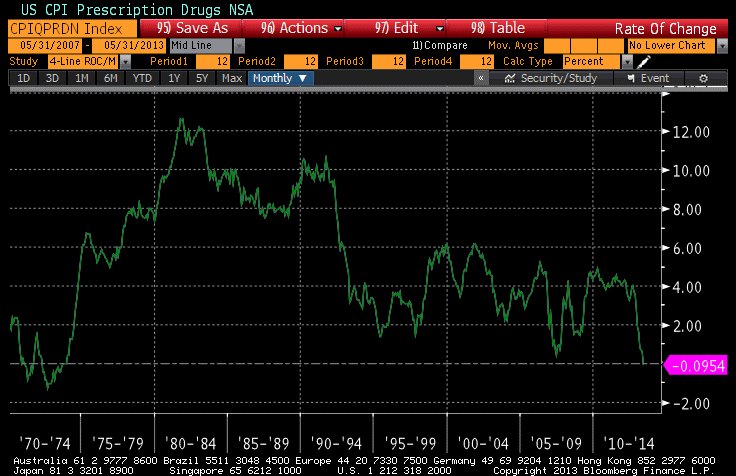
Now, I suspect that this has something to do with Obamacare, but no one seems to know the full impact of the law. Keep in mind that Medical Care in CPI excludes government spending on medical care. So, one possible narrative is that the really sick people are leaving for Obamacare while the healthy people are continuing to consume non-governmental health care services. This would be a composition effect and would imply that we should start looking at CPI ex-medical for a cleaner view of general price trends. I have no idea if this is what is happening, but I am skeptical that prescription meds are about to decline in price for an extended period of time!
But that’s the bet: either core inflation is going to go up, driven by things like housing, or it’s going to go down, driven by things like prescription medication. Place your bets.
Equity prices recovered today, but bond prices continued to slide into the long, dark night. For a really incredible picture, look at the chart below (source: Bloomberg), which shows the multi-decade decline in 10-year yields on a log scale, culminating in the celebrated breakout below that channel. Incredibly, the recent selloff has yields back to the midpoint of the channel and not outrageously far from a breakout on the other side!
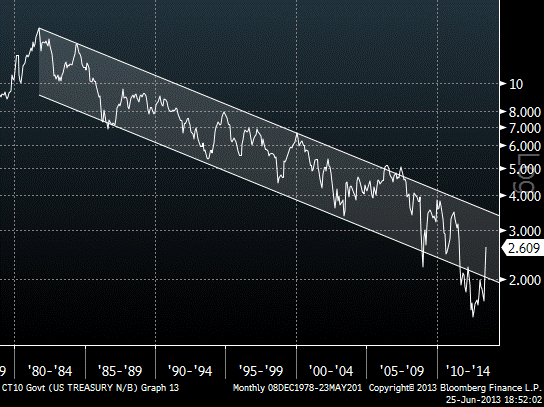
Incidentally, students of bond market history may be interested to know that the selloff has now reached the status of the worst ever bond market selloff (of 90 days or less) in percentage terms. Since May 2nd, 10-year yields have risen from 1.626% to 2.609%, a 98.3bp selloff which means that yields have risen 60.5% in less than two months.
And we are probably not done yet. I wrote about a month ago about the “convexity trade,” and I made the seemingly absurd remark that “This means the bond market is very vulnerable to a convexity trade to higher yields, especially once the ball gets rolling. The recent move to new high yields for the last 12 months could trigger such a phenomenon. If it does, then we will see 10-year note rates above 3% in fairly short order.”[emphasis in original] Incredibly, here we are with 10-year yields at 2.61%, up 60bps over the last month, and that statement doesn’t seem quite so crazy. As I said: I have seen it before! And indeed, the convexity trade is partly to blame for what we are seeing. I asked one old colleague today about convexity selling, and here was his response:
“massive – the REITs are forced deleveraging and there are other forced hands as well. The real money guys are too large and haven’t even sold yet – no liquidity for them. The muni market has basically crashed and at 5% yields in muni there is huge extension risk on a large amount of bonds: something like $750bln in bonds go from 10-year to 30-year maturities as you cross 5%.” (name withheld)
Now, I am not a muni expert so I have no idea what index it is I am waiting to see cross 5%. But the convexity trade is indeed happening.
Lots of bad things have happened to the market, but they really aren’t big bad things. In fact, I move that we stop using the term “perfect storm” to mean “modestly bad luck, but I had a lot of leverage.” The Fed was never going to be aggressively easy forever, and as various speakers have pointed out recently they didn’t exactly promise to be aggressively tightening any time soon. There is bad news on the inflation front, but the market is clearly not reacting to that. Some ETFs have had some liquidity issues, and emerging markets have tumbled, and there was a liquidity squeeze in China. But these are hardly end-of-the-world developments. What makes this a really bad month is the excess leverage, combined with the diminished risk appetite among primary dealers who have been warned against taking too much “proprietary risk.”
And markets are mispriced. Three-year inflation swaps imply that core inflation will be only 1.9% compounded for the next three years (the 1-year swap implied 1.6%; the 2y implies 1.75%). That is more than a little bit silly. While I have not been amazed that the convexity trade drove yields very high, and probably will drive them higher, it has surprised me that inflation swaps and inflation breakevens have continued to decline. Still, investors who paid heed to our admonition to be long breakevens rather than TIPS have done quite a bit better, as the chart below (source Bloomberg), normalized to February 25th (the date of one of our quarterly outlook pieces) illustrates.
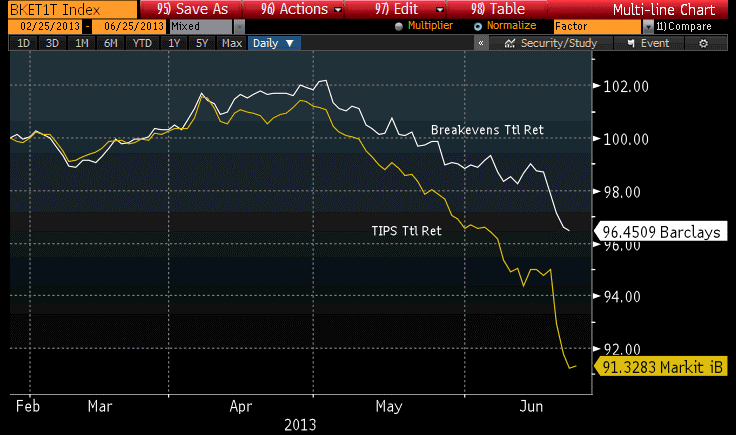
As the bond selloff extends, I don’t think TIPS will continue to underperform nominal bonds. I believe breakevens, already at low levels (the 10-year breakeven, at 1.97%, is lower than any actual 10-year inflation experience since 1958-1968), will be hard to push much lower, especially in a rising-yield environment.
Quick Notes on the Week
I have been quasi-vacationing this week on the Continent, and trying to follow the news and the markets. This will be a brief comment but I wanted to make a couple of quick notes:
1. I did not, and I still do not, understand why there was such a violent (and negative) reaction to the Fed’s statement and Bernanke’s suggestion that the “taper” may start later this year and end in mid-2014. There are all kinds of reasons not to freak out about that. First, it was approximately what was expected (although two weeks ago there were many who thought absurdly that the Fed would begin a taper at this meeting). Second, the taper is contingent on growth continuing to strengthen, and there are scant signs of that. Third, as Bullard showed today there is far from a consensus on whether Bernanke’s time frame is going to work out – and, while ordinarily the Fed Chairman’s vote is the only one that matters, in this case he is not going to be present for the end of the taper so what really matters is who is selected to replace him. Fourth, QE isn’t doing anything right now, except artificially depressing long Treasury yields. It is probably pressuring money supply growth, but not very much. The only thing that further QE will do is make the exit that much more difficult.
That said, the violent reactions to the Fed statement are prima facie evidence of what critics of the QE policy (me, for one) have always said: we have no idea how rates and markets will react when the Fed finishes and unwinds this policy, regardless of Bernanke’s assurances. The harsh reaction (quite a bit more than I expected, especially with such a tepid adjustment to the expected trajectory) is great evidence of how over-dependent the market is on the view that the Fed’s support makes losses extremely difficult. And, I will say again, this would be so much easier if the Fed wasn’t telegraphing everything, because then investors would have invested with much more caution. The reaction this week was partly due to the shock of actually hearing the Fed mention a date for the first time.
2. Speaking of investing with much more caution, the amazing stress in certain ETFs that has accompanied significant but not exactly dramatic moves in (for example) emerging markets should blare two huge lessons to investors. The first is that you can’t increase liquidity of a pool of assets by putting them in an ETF wrapper. A pile of illiquid securities, or securities that can become illiquid in a crisis, are not more liquid because you can get a quotation every second. An ETF consisting of emerging markets bonds is never going to be more liquid than the underlying emerging markets bonds (although it may be more granular, and there are other ETF advantages…but not liquidity). An ETF consisting of commodity futures, by contrast, will be tremendously liquid because the underlying commodity markets are tremendously liquid. The second lesson is more subtle, and that is that an ETF of less-liquid securities is, in a crisis, only as liquid as the least liquid element. If you present an ETF to me for redemption and there is 1% of it that I can’t get any bid on, then the best you’re going to get is a quote at 99% of the “fair” market price. And that is especially true these days, since dealers and market-makers are capital-constrained and can’t merely take those illiquid positions on the books.
3. There is a lot of dry tinder around in the world today, and never for a minute suppose that they are not related. Stress begets stress. Two million people protesting in Brazil are doing so partly because of economic stress. Tight money market rates in China (persistent since if the central bank adds too much liquidity it will cause the CNY to depreciate) is a partial consequence of economic stress. A return of Greece from the frying pan to the fire: economic stress. And so on. This is not a safer world for all of the QE.
4. Finally, remember that growth and inflation are not related in any meaningful way. Median home prices rose more than 15% over the last year according to a report this week, and not because of great economic results. Money velocity is rising with interest rates although we may not see the results for some months. Inflation, which got a boost in the US this week with a strong CPI report (see my brief comments here), surprised on the high side in the EU and UK. TIPS yields are at +0.56% in the 10-year sector and 10-year breakevens are at 1.92%. There is absolutely no reason to own Treasuries rather than TIPS at this point. The 10-year expected real return of stocks is now less than 1.5% per annum above 10-year TIPS, and there is absolutely no reason to own equities rather than TIPS. Are TIPS cheap on an absolute basis? No. But they are screamingly cheap on a relative basis in an environment of rising inflation (and nothing the central banks can do about it – at least those who aren’t actively trying to boost it). Long-time readers will know I have been tepid at best about TIPS for some time. But, while 0.56% isn’t ridiculously cheap (and they could still get there!), our models are already maxed out on breakeven exposure and are starting to add to outright long exposure in TIPS.
Comparisons
With little economic data on the calendar, and the Fed speakers back-loaded at the Chicago Fed conference later in the week, there is time to reflect on other questions (unless, of course, the Israel/Syria back-and-forth turns into something more than the last couple of jabs have produced).
It is interesting to me that analysts and journalists truly enjoy finding comparisons between present situations and actors, except when the comparisons suggest unpleasant conclusions. This is at a time when there are really no comparable periods in history to compare to, at least with respect to major global policy initiatives!
I read comparisons between Shinzo Abe’s pressure on the Bank of Japan and Fed Chairman Bernanke’s campaign to resurrect the American economy with ever-greater monetary policy shocks. Somewhere, I saw an analyst ask “isn’t Abe taking note of the failure of U.S. monetary policy to goose the economy?” But the comparison is not apt because the two men, and the two economies, face very different challenges. Abe doesn’t need to increase consumer spending and reinvigorate the economy with monetary policy. While that might be nice, the main goal of Japanese monetary policy now is to raise the price level and the rate of inflation. They are using exactly the right tool to do so: lots of monetary easing. On the other hand, Bernanke is trying to kick-start the real economy with a monetary tool, while at least in principle avoiding an inflationary outcome. That’s like trying to hammer a nail with a fish. It might work, but it’s the wrong tool for the job. So the comparison doesn’t work: one man knows how to use his tools, the other does not.
Here is another useless comparison: “Bond Buyers See No 1994 as Bernanke Clarity Tops Greenspan.” The myth that transparency really helps markets in the long run is sort of silly: is there any sign that the crises caused by monetary policy have become less frequent since the Greenspan glasnost than they were before? I know that’s the belief, because the Fed has told us that’s the way it is. But my scorecard tells a sorry tale of bubbles and crashes since the early 1990s. It isn’t a lack of transparency that causes routs. It’s leverage, and negative gamma. Mortgage hedgers are more active now than they were in 1994, and they have larger books. Hedge funds are orders of magnitude larger. And Wall Street is smaller, and is able to provide less liquidity – partly because they are more levered (which they think is okay because of “Fed transparency”), and partly because the government doesn’t want them to take bets with the leverage they have (which, since they’re paying for failures under the current system, isn’t wholly absurd).
So will the next bond selloff not be as bad as in 1994, because the Fed will give more warning? Remember that no matter how transparent the Fed is, there is still a transition point. Somehow, the market goes from a state of thinking there will be no tightening of policy, to a state of thinking that there will be a tightening of policy. That requires a re-pricing, whether it occurs because the Fed signaled it in a speech or a statement, or because they signaled it by doing Matched Sales for the SOMA account with Fed funds already trading above target (as was the old way of telling us something had changed). There is no way to go from “not knowing” to “knowing” without a moment of realization. And when that phase change ultimately occurs, the greater leverage inherent in the market and the diminished role of market makers will cause the selloff (in my view) to very likely be more dramatic than in 1994.
One place where we cannot prevent comparisons – nor should we want to – is in the asset markets. Stocks are doing well, despite absurd valuations, because most other markets are either more-absurdly valued (e.g., Treasury bonds) or have horrible momentum that means they’re not popular right now (e.g., commodities). I have no doubt that equity performance over the next 10 years will be very uninspiring, because equity markets that start from this level of valuation never produce inspiring returns. But when people ask me what the trigger will be for a selloff, I have to shrug. There have been plenty of “reasons” for that to happen. But I think the ultimate reason is probably this: equities are perceived as the “only game in town.” I have read several articles recently that echo this one: “Bond Fund Managers are Loading Up on Stocks.” When there is some other asset class, or some other world market, that starts doing appreciably better, perhaps investors will decide to allocate away. Unfortunately, the candidates for that market are pretty few, given the general level of valuations. Could it be commodities, which is one of the few genuinely cheap markets? Or perhaps real estate, which is still only fair value but has some pretty striking momentum? I don’t know – but I am also not sitting around waiting for a “trigger event.” There may well be a selloff without such a trigger.
The End-of-Year Downshift Is Beginning
With the last major central bank meeting of the year (the Federal Reserve’s) due on Wednesday, and few important pieces of data ahead aside from Friday’s CPI, markets seem to be starting the inevitable downshift into the end-of-year holidays. Admittedly, it is somewhat hard to tell. It looks like aggregate equity volume in 2012 will be down a stunning 28% or so from 2011 (see chart below, source Bloomberg). This continues a recent trend, but accelerates it as well.

I’ve discussed in these articles in the past the possible causes of this seemingly-secular decline. I believe that there are at least two causes. One is not particularly worrisome; there was probably already a trend in place for volume to move off of organized exchanges to “dark pools” and the like. But the recent drop in volumes seems more likely to be caused by recent events, and judging from anecdotal evidence I’ve seen – namely, that market-makers are reducing the scale of their operations across almost all products because of the regulatory difficulties of maintaining those operations – a big part of the recent decline is likely to be attributable to the gradual implementation of Dodd-Frank and the Volcker Rule. This is something less than shocking. What hasn’t yet happened, but I suspect may, is that asset prices themselves decline if liquidity is meaningfully impacted by declining volumes. For any given asset, the fair price is a direct function of liquidity (as well as many other things, of course), which is why there is such a thing as a ‘liquidity discount’ enshrined even in tax law. The decline in liquidity itself is probably non-linear (since market-makers will be less aggressive as they perceive other market-makers being less aggressive), and therefore the decline in asset values is likely non-linear as well.
Not to mention being totally unpredictable as to timing, I might add. But there is something to the old rule of technical analysis rule that markets can go down on big volume, but they can’t typically go up for an extended period on low volume.
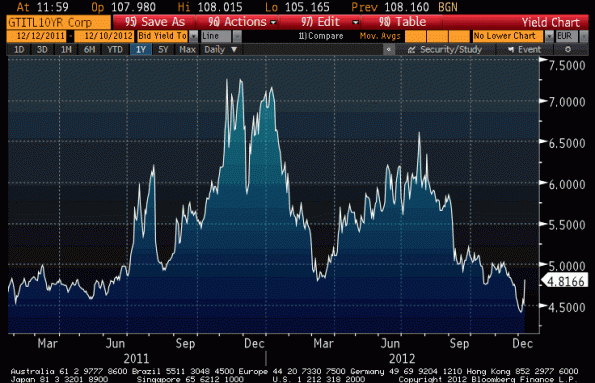
Global political events haven’t yet left town for the holidays. Italian Prime Minister Mario Monti announced on Saturday that he plans to resign after former Prime Minister Berlusconi withdrew his support. 10-year Italian yields jumped 30bps to 4.81%, but remain considerably below the levels associated with any serious concern about Italy (see chart, source Bloomberg).
Across the Ionian Sea, Greece extended the original deadline for its debt buyback by two days, signaling that it hasn’t reached its target. According to reports, the government has received tenders for €26bln (in face amount) versus its target of €30bln. However, the important number is the difference between the face amount of the debt offered compared to the price paid by the government. That number needs to get to €20bln, and there is no way to know if the government is close. If they have overpaid relative to the 33 cents on the dollar they were expecting to pay, and have spent, say, €10bln to get those €26bln in tenders, then they’re not really all that close. If they have spent €7bln, then they’re very close and I would guess close enough. I’m not sure we know.
In the U.S., no apparent progress has been made on the fiscal cliff.
But here’s a little story that caught my eye. “NYC Base Subway Fare May Rise to $2.50, Board Members Say.” I only point it out because the 11% hike in base fares seems out-of-place with a weak economy…if, that is, you think that economic growth causes inflation. Personally, I don’t believe in that old, discredited notion, but some people do.
Looking forward over the balance of the month, I don’t expect that we will see a Santa Claus rally in equities. Although we got such a rally in 2010 (+6.5% in the S&P 500), and smaller ones in 2009 (+2.8%) and 2011 (+0.9%), there seems to me to be too much uncertainty for investors to make significant bets into the end of the year. The outcome in December is likely to be decided by a coin flip – if the fiscal cliff is resolved, then equity markets will rally (and that rally probably should be sold, since the underlying fundamentals are still very poor); if the fiscal cliff is not resolved, stocks will slide into the end of the year (and that selloff is probably worth buying, if it’s deep enough, since there’s a reasonable chance that the issues are resolved after both sides realize the other side isn’t going to blink). I’m not sure that’s a market I want to have a strong commitment to right now, in either direction.
Let the (Political) Games Begin
The Olympics are over, so the political games begin in earnest. Over the weekend, presumptive Republican Presidential nominee Mitt Romney made his first revealing executive decision when he tapped Wisconsin Congressman Paul Ryan to be his running mate.
The selection changes the contours of the U.S. political race, as veep selections often do. It probably does not create any near-term consequences for the markets, but as and if the Romney/Ryan ticket gains in the polling (as they surely will; for starters, announcing a VP pick almost always produces a bounce but also this tends to energize the base that Romney absolutely needs good turnout from to win) it is likely to be beneficial to equity markets at the margin. The improvement, if it happens, will not be uniform. Some industries, such as autos, which benefit from direct government largesse will probably do worse; but the notion that smaller government may be in train with somewhat greater probability is likely to have positive impact on perceived long-term values. And any possibility that a fiscal conservative (that is, Ryan, not Romney) might be a senior member of the executive branch is likely to have salutatory effects, all else equal, on U.S. Treasury credit as well.
More than likely, these effects will be mere ripples in a much more turbulent pond. In an ordinary Presidential election cycle, markets and market sectors can ebb and flow with the fortunes of the incumbent and challenger; this cycle though is anything but ordinary. European events can, and most likely will, dominate the macroeconomic picture as well as global risk appetites and foreign exchange swings. Which is to say: you can cheer for whoever you want in this election, without worrying whether it will help your investments!
While most of Europe remains on holiday (and more and more Americans seem to want to emulate that behavior), market action remains excruciatingly slow. At 3:15 ET today, New York exchange volume was only 275 million shares and even the usual surge into the close only brought the total to 450 million. In a year of slow days, this was slower than slow. In fact, I was only able to find one session (other than half-sessions around Christmas or Thanksgiving) in the last ten years or so that had a lower volume number: the Monday after Christmas in 2010!
This lack of liquidity, with the stock market so near to setting new (nominal) highs for the year, creates instability even as it appears to suggest stability. As I argued last week, when liquidity is low there is a larger cost to initiating any move – but any move that happens is likely to be bigger.
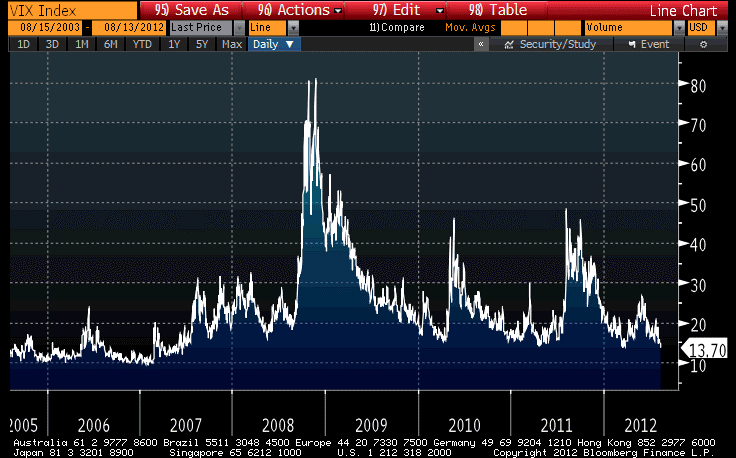
Add to that the fact that many investors have turned to covered-call writing to earn “extra income.” Admittedly, I only have this anecdotally, as I was approached at a backyard party recently by someone who was writing naked puts (actually, they were writing covered calls, but because of put-call parity we know that that is exactly the same as writing naked puts with the same strike) and seemed to not understand my question about whether implied volatility was high enough to make that worth the risk.[1] Which, since the VIX is at its lowest level since early 2007, it’s probably not (see Chart, source Bloomberg).
If this anecdote generalizes, and there is widespread selling of options, then it takes a dangerously-illiquid situation and makes it even less stable. With lots of gamma outstanding, what tends to happen is that small moves become microscopic moves since long-gamma hedgers try to recapture their time decay (selling rallies and buying selloffs), but large moves become really large moves because short-gamma investors try to save themselves from blowing up (buying into a market rally that they’re missing, or selling stocks that are abruptly plunging, overwhelming their small ‘income’ advantage). I would be a much better buyer of options here, even in the middle of boring August.
Now, although markets are currently quiet, and government committees and the like are less-active as well (and in the U.S., elected officials are heading out to politick for the next few months), it doesn’t mean that there’s a complete lack of action. Indeed, with Dodd-Frank now steamrolling towards implementation, there are pockets of frenzied activity! One story that I saw today (which has nothing to do with Dodd-Frank) is interesting to investors since it lowers the hurdle for eliminating the payment of Interest of Excess Reserves (IOER). The title of the P&I Online story was “Money fund firms prepping in case SEC breaks the buck,” and it described how the SEC plans to vote on August 29th on whether to issue a formal proposal requiring the sponsors of money market funds to either create a ‘capital buffer’ (perhaps similar to what the NY Fed recently proposed, and I mentioned here) or adopt a floating NAV policy rather than guaranteeing a $1 price.
We’ve discussed both of these proposals before in this space, but for today the significance is that if the floating NAV policy is generally adopted by money funds, the argument that a zero IOER could destroy money funds goes away. Since this is very likely to happen soon, either alone or as part of a parcel of monetary policy maneuvers, it is not insignificant that the SEC is pressing this issue.
.
Tomorrow the scheduled economic data includes Retail Sales (Consensus: +0.3%/+0.4% ex-auto). Core retail sales have been negative for the past three months in succession, something we hadn’t seen since mid-2010. Four in a row would make the streak the longest since 2008, and I think it would be taken quite negatively by the markets. A positive print by Retail Sales isn’t terribly significant by itself, since the series is quite volatile, but may be enough – even though expected – to continue to push the bond market lower.
[1] Note: if you do not understand and/or are not intimately comfortable with the definitional equivalence between a covered call and a naked put, then I will put my “friendly advice” hat on and beseech you, for your own good, not to sell options until you do!
Interesting, Even In August
It was another slow day, part of what is shaping up to be a typically slow August week.
I am always fascinated during these slow weeks by the fact that the same news that ordinarily would send markets spinning one way or the other will often seem ignored altogether, as if each hair-trigger trader is waiting for someone else to make the first move which never, as a result, occurs. Other times, a possibly less-significant item will trigger a bigger move if only a few large positions try to move through the illiquidity.
What that probably reflects is that very large traders – pension funds, large hedge funds, money managers – recognize that when liquidity is low there is a larger cost to initiating any move. Therefore, it takes more certainty of the result before it makes sense to re-allocate any meaningful amount of the portfolio. (Thus, the decline in volumes we have seen this year could be seen as deriving either from a lack of confidence about market direction, or from a decline in liquidity, or both.)
Today’s news was in the form of an interview in the Wall Street Journal, later followed up by an interview on CNBC, of Boston Federal Reserve Bank President Eric Rosengren. Now, Rosengren is a known hawk, but he called out his cohorts on the Fed to “launch an aggressive, open-ended bond buying program that the central bank would continue until economic growth picks up and unemployment starts falling again.”
This is monetary idiocy. Mr. Rosengren has just become the Krugman of monetarism: it isn’t working, thinks Rosengren, because a couple of trillion just isn’t enough to make a difference. I have renewed sympathy for Chairman Bernanke, if he is forced to deal with people like this who don’t understand what they’re doing, but figure they just need to do more of it.
Let’s be clear on the theory: if the Fed increases the money supply while the velocity of money remains static, nominal GDP (PQ in the monetarist equation) will rise. But here’s where it’s important to actually understand the theory, rather than rely on an equation. Nominal GDP can grow for two different reasons: because the real economy has expanded (Q) or because the prices attached to all transactions has risen (P). Theory says that if economic actors are fully rational, they will recognize that the increase in money lowers the value of each transactional unit of money (dollar) and so the increase in M will be fully mirrored in P. If economic actors are at least somewhat stupid or naïve, and take the increase in the money in their bank account as an actual increase in wealth, they’ll spend more and the real economy will benefit.
This is called ‘money illusion’, and the evidence of the last few years is that it’s pretty weak. I suspect that’s because most people judge the balance in their checking account in two ways. First, they notice when the balance itself is increasing over time. But second, and significantly, they notice that each month the checks they write take more out of the balance than they previously did. That is, their reference point is not just the balance itself, but the interplay of balances and consumption. This makes it hard to fool them with money illusion. The Fed’s continued talk about how “inflation expectations are contained” is clearly partly intended to increase the money illusion effect and thereby increase the efficacy of monetary policy on the real economy – the ethics of that practice I will leave to others to discuss.
So if Rosengren had his way, and the Fed bought a trillion dollars of securities every month, it wouldn’t have a big effect on the real economy. But you can bet it would have a huge effect on the price level!
Now one place that I actually agree with Rosengren is on the interest paid on excess reserves (IOER). He said the Fed should reduce IOER, as I have written numerous times, and moreover that they should do it gradually so as to make sure it didn’t disrupt money market funds. Oddly, he said he didn’t want to go all the way to zero, so he’s arguing about maybe a 10-20bp ease, but since results to such a policy are likely to be non-linear it’s not unreasonable to go slowly.
Maybe it is talk like this that explains why inflation breakevens have recently been striking out higher. To be sure, another reason for the rise in inflation expectations, at least at the short end of the curve, is the 17% rise in spot gasoline prices since June 21st, but this shouldn’t cause a severe effect at the 10-year point of the inflation curve. 10-year inflation expectations as measured by inflation swaps are up 25bps over the last two weeks, and breakevens (the spread between TIPS yields and Treasury yields) has risen by a similar amount.
This is an unusual time of year for breakeven inflation to be rising. As the chart below (Source: Enduring Investments) illustrates, compared to the last ten years’ worth of data on 10-year breakevens it seems almost as if this year’s pattern has been shifted earlier by about two months.

I don’t have a great explanation for this; most likely, it’s just spurious. But it helps to illustrate that this is an abnormal behavior. In the last 13 years, 10-year breakevens have declined in the 30 days following July 25th on ten occasions, and this is also true (10 out of 13) at the 60-day horizon. The average additional “normal” decline in breakevens forward from this date, as you can see from the green line above, is about 15bps.
Now, that may mean that TIPS are overextended (relative to nominal bonds; there’s no question in my mind that they’re overextended on an absolute basis) and that breakevens are about to fall back. But it may also mean that there is something more significant happening here. I recently highlighted the unusual recent performance of commodities relative to the dollar, and this is of a piece with that observation. Our Fisher model has TIPS overextended, but also has inflation expectations lower than they ought to be, so that effectively it indicates a short position is warranted in both TIPS and nominal bonds rather than one versus the other (it first signaled this on July 31, for the record). The model signals go back to 2001, and this is the first time that we have ever had that configuration indicated.
Something interesting is happening, indeed, even if it is August.
…And From Mayday to Mayans
If you missed yesterday’s comment “From May Day to Mayday,” you can find it here.
If there were any question whether the recent weakness seen in the economic figures were a payback from a mild winter or an actual slowdown in activity, today’s numbers essentially dispelled that question. The Payrolls numbers were horrendous. The Labor Department reported that only 69,000 new jobs were created in May, but also revised down prior estimates of jobs created for the last couple of months by a net -49,000 jobs. The net of +20,000 jobs does not compare favorably with pre-data expectations of +150,000. If this is payback for the weather effect, it means the rate we are paying back from was already lower than people thought it was.
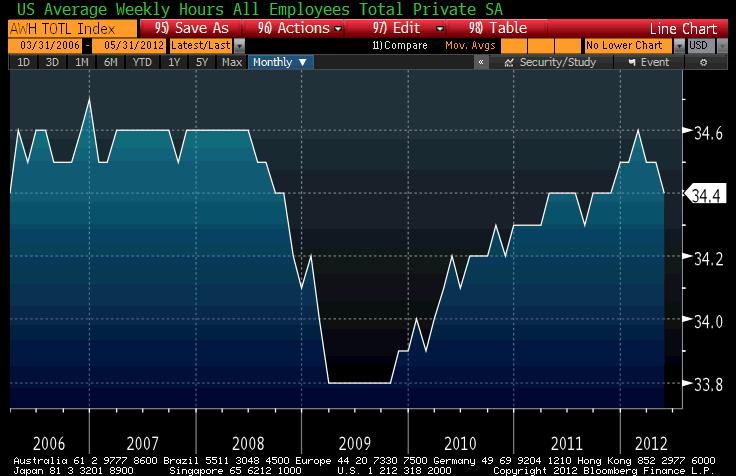
The Unemployment Rate rose to 8.206% from 8.098%. The workweek fell, but is still okay compared to last year (see Chart) although it has never stabilized at full “recovery” levels. The labor force participation rate improved, which was the only bright mote, but of course that is one reason that the Unemployment Rate rose.
The perception of the man on the street, as indicated in various surveys, is consistent with the idea that the labor market is actually weakening (although it may also be that people are disappointed about the results compared to what has been previously promised).
Personal Income was also a smidge weak, although Consumption held up (God Bless America!). More importantly, while the year-on-year Core PCE deflator was as-expected at +1.9%, it was a soft +1.9% with the monthly change coming in flat. The deflator was 2% last month, which is the Fed’s putative target. One month is not a trend – as we have seen, since Core CPI re-accelerated to new highs after its dip – but if the Fed wants cover for a decision to increase monetary accommodation, they have a tiny bit of cover now.
The ISM Manufacturing survey was somewhat weaker-than-expected, but it remains above 50 (53.5). Meanwhile, Manufacturing PMIs in Europe have been consistently weaker and today’s releases put Spain at 42, Greece at 43.1, Italy at 44.8, France at 44.7, and Germany at 45.2.
Maybe the Mayans knew what they were doing when they said 2012 would be the end of the world? Just kidding, I think. Anyway, things would have to get substantially worse even to be the worst recession of the last five years, so let’s look on the bright side!
Stock markets were crushed on the uniformly bad news. Major European stock markets fell between 1% and 3.5% across the board. The S&P dropped 2% and couldn’t even manage a respectable dead-cat bounce – rather then continued a slow-motion slide for most of the day. Commodities also took a beating, although less than stocks; in fact, if you avoided the Energy complex (which fell 3.1%) you would have been nearly unchanged in commodity indices. Precious metals gained 3.5% with gold itself up $61. Of course bonds did well. Ten-year real yields fell to -0.62%, and 30-year real yields to 0.35%. Ten-year nominal Treasury yields dropped to 1.46%. As the picture below shows, this is so far outside of the thirty-year downtrend (note the logarithmic scale) that there’s nothing to compare the levels to.

The outlook is dim, but the sky isn’t exactly falling yet, in the U.S. anyway. Stocks are only 10% off the highs, after all, although why they were ever at those highs I haven’t figured out. They’re still up on the year. There is some chance, though, that enough of these bad eddies – European growth, Greek election, Spanish/Bankia crisis, and so on – come together to cause some real rough seas over the next couple of weeks.
But we always have the central bankers! Talk of how this makes QE3 more likely may have been the only reason stocks didn’t end up down 4% rather than -2.5% today. Recent pronouncements, however, such as by NY Fed President Dudley on Wednesday, have tended to be fairly discouraging about QE3. The question which is being continuously raised is: why bother with QE3 if interest rates are already at record lows for the whole yield curve?
There’s some merit in this question, but let me start by pointing out that before the Fed eased in October 2008, 10-year rates were already around 3.50%, and hadn’t been below 3% since the 1950s. So the argument that low rates obviate the need for easing clearly didn’t stop the Fed in 2008 and I can’t think of why it would stop them now. There’s always room to have them lower.
Let’s consider the question more formally, though. The Fed believes that monetary policy affects the economy in three ways: through the portfolio balance channel, by signaling, and by improving market functioning. The “portfolio balance channel” is just a cute way of saying that if the Fed buys all of the Treasuries, you’ll have to buy something else. And when you buy corporate bonds or equities, for example, you provide cheap capital to business which then hires and the economy expands. Yes, I can hear you say “this sounds to me like getting the rubes to pour money into risky assets at bad prices.” Precisely. But the Fed sees this as supporting business, and you can see what a wonderful expansion this has produced! Importantly, it isn’t just the level of rates that matters, but the level of rates relative to other assets. So if stock prices fall, then merely maintaining rates where they are should be supportive of a return to the previous-bubbly levels.
The signaling channel is just what it sounds like. The Fed believes that we feel better when they’re assuring everyone that rates will remain low through 2014 (even though they spent months trying to convince us that they didn’t really mean it), and that businesses will invest more confidently knowing money will be cheap for a while. I doubt this has very much importance since the Fed is not held in the esteem it once was, and because businesses and individuals who are concerned about rising rates in the future have the option to lock in rates today with longer-term loans or derivative structures. But again, the important point is that they believe it.
Finally, there is no question that adding lots of liquidity does help “market functioning.” If markets shut down, the economy will tumble. The Fed definitely needs to focus on keeping markets running smoothly. It isn’t clear how much they need to increase the amount of money in the system for that purpose as opposed to directly supporting financial institutions, but this is certainly a valid reason to have easy money.
There is a fourth reason that isn’t usually included in the list, and that’s the fact that increasing monetary liquidity pushes prices higher, and in some cases (such as when a collapsing housing bubble threatens banks as borrowers walk away from loans) it may be perfectly reasonable policy to try and push prices higher. This is the main reason the earlier QE was defensible – because core inflation was low and sagging. It doesn’t really apply in the U.S. at this time.
The biggest hurdle for more QE at this point is that the earlier QE evidently didn’t work very well. Obviously, the world economy is still in a real mess, although there’s no question QE succeeded in raising the price level. So either QE is fairly ineffectual when it comes to raising output permanently – in which case they definitely shouldn’t do more of it but moreover should reverse whatever they’ve done – or it works, but they just haven’t done enough of it yet. Regular readers of this space know that I adhere to the old theory that monetary policy affects prices but only affects growth in the presence of money illusion, which probably is not operative in a world where everyone thinks inflation is higher than it actually is.
That is, I don’t think the Fed can do anything about the economy except raise prices, or try to rein in inflation. They ought to work to keep the financial system itself working, keep banks trading with each other (but not to make trading profits, nooooooo, just to help fill customer orders), and unwinding in an orderly way the institutions that cannot survive. But I wouldn’t be voting to ease here.
But what are they going to do? Will central bankers sit by as markets and economies tumble and do nothing, simply because there’s nothing they can do that would help? One thing I believe you can be certain of is that the Fed, the ECB, the BOE, the BOJ, and other central banks are not about to call themselves ineffectual. That means they will try to “do something” at some point, and they really only have one tool: the money supply. Whether it’s through LSAP, or announcing a target 10-year rate, or eliminating the Interest on Excess Reserves, the process they use operates through the medium of the money supply. I strongly suspect that if markets continue to weaken and/or the Eurozone is sundered, the Fed and other central banks will wade back into the fray.
After all, how badly can they screw up? The Mayans say we only have six months anyway.
