Archive
This Is Your Brain On Leverage
The event du jour on Tuesday was the release of the FOMC minutes from the March 13th meeting. There was almost nothing surprising in the minutes, although the market’s reaction suggested otherwise.
Prior to the release, there had been some very odd reports from respected sell-side shops (such as Goldman) that predicted the Fed was about to announce an extension of Operation Twist or some other policy initiative. Those reports were nonsensical. This was not an FOMC meeting; it was the release of minutes from a meeting several weeks ago. The Fed has never use the minutes as a way to announce new policy measures; not surprisingly, new policy measures that need to be announced are announced, either in the statement following the meeting or on rare occasions in a separate news release. It is a real head-scratcher to me why these economists in the last few days suddenly decided that the FOMC minutes might be the place we find out about an official new policy.
At best, the minutes occasionally reveal more concern, or less concern, about a particular economic variable than the market expected, or more interest or less interest about a particular policy tilt. The one quasi-surprise in these minutes was that the Fed explicitly stated that their description of the period of extremely low rates “at least” until mid-2014 was conditional:
“It was noted that the Committee’s forward guidance is conditional on economic developments, and members concurred that the date given in the statement would be subject to revision in response to significant changes in the economic outlook. “
In other words, it isn’t “at least” at all. Rates will be low until they need to be increased, which means it was complete idiocy to ever put a date in the statement to begin with. If it is a promise, it bound their hands unnecessarily; if it was not a promise, then (a) why say it at all, since the operating understanding is that the Fed will change rates when it feels conditions require, and (b) learn some English, and don’t put absolute phrases like “at least” in statements meant to be squishy on timeframe. I draw the almost inevitable conclusion that the Fed believed we cared about their forecast of economic conditions two years forward, as if they not only are not the worst economic forecasters out there, but actually are dramatically better than most other economists who feel that a 6-month forecast has pretty big error bars.
Either that, or the statement was never meant to do anything other than jack around with interest rates. Perhaps it shouldn’t be surprising that the Fed, and even the Chairman himself, are alternating between saying dovish things and saying hawkish things (or re-interpreting prior dovish statements to appear more hawkish). The Fed’s main tool right now is its “communications strategy,” in which it wants to talk down inflation expectations while also talking down interest rates. The former requires hawkish talk, while the latter requires dovish hints. While QE3 is probably still coming (although I don’t see a “sterilized Operation Twist,” which doesn’t really accomplish anything I can think of), it’s a decidedly more-difficult operation now when core inflation is at 2.2% and global inflation is rising than when it was at 0.6% and bottoming. Before, they didn’t mind if inflation expectations rose; that also suited their purpose. Now, though, it would damage the same purpose.
The reaction in the bond market was swift and violent although the ‘disappointment’ was small and insignificant. The severity of the move – 10-year rates rose 14bps in minutes – is a direct result of the Fed’s policy of pegging interest rates and trying to be very transparent. In short, rates are so stable that “2 basis points is the new 5 basis points.” With no market movement, traders and investors put on larger positions because they are confident that there won’t be violent moves with Sheriff Bernanke on the watch, and because to make any money at all from a trading position, trading size needs to be larger. When there actually is a market move, the move will tend to be more violent because positions are larger (and, because of the Volcker Rule, liquidity once the market leaves its safety zone grows thin quickly).
You can see this in the curve’s movements today. While the main change was that the FOMC made the unconditional rate pledge entirely conditional, 2-year rates moved only 4bps. But 5-year and longer rates rose 12-15bps on the announcement (the 10-year note is now at 2.30% again). Honestly, 2-year notes at 0.37% if the Fed isn’t promising to keep rates low seems a little rich to me (meaning that the yields are too low), if only because of the relative lengths of the up and downward tails (since the bearish tail is not truncated by the Fed promise!), although I happen to believe the economic situation is such that the Fed will end up honoring its pact despite inflation that will continue to accelerate.
Nonsensical was the trashing of TIPS today. Inflation-linked bonds fell just as far as nominal bonds, so that inflation breakevens were approximately flat on the day. That’s wild. It isn’t as if the inflation outlook depends on the next trillion in Fed-sponsored liquidity! The global spigots remain on, and the Fed has already done far more than enough to ensure inflation will keep rising unless money velocity rolls over again. 10-year breakevens have risen this year from 2.00% to a recent high of 2.45%; at the current level of 2.35% they remain an easy buy. 5-year breakevens at 2.06% are an even better deal, since headline inflation over the next year will be well above that level thanks to gasoline. You’re buying forward inflation there at a very cheap level, in my opinion. (Retail investors can’t directly access the short inflation part of the curve, although they can participate in a general rise in inflation expectations through the INFL ETN and the RINF ETF. I own small positions in both of those securities and have no plans to change that position in the near-term).
To be sure, negative real rates are not sustainable in the long run, and while the 10-year TIPS real rate of -0.07% is starting to look almost cheap compared to where it has traded in the last six months – and indeed, I think investors will scoop them up at 0%, and 30-year TIPS if they get to 1.0% – they probably won’t be there a year from now. But TIPS are still a better deal relative to nominals, so if you must own some fixed-income, I prefer to position in real rates.
Wednesday’s main release is ADP (Consensus: 206k from 216k). Although this report is losing its punch as it fails to track the Payrolls number well, in this case there may well be more attention paid to it than usual because the Employment Report will be released in thin market conditions this Friday during a half-session recognizing the Good Friday holiday. Accordingly, if ADP contains much of a surprise, you may well see an outsized-reaction.
An Umbrella, Just In Case
Greece, Greece, Greece. I’ve had it up to here with Greece. I’m tired about writing about Greece. Apparently, I am not alone; after the conference call today, Jean-Claude Juncker said that he was confident that a “decision” on a bailout for Greece will be made at the next meeting…on February 20th. Gee, that would be great, Jean-Claude. If it’s not too much trouble, you know.
I grow more confident by the day that the Greek default is reasonably imminent. Today there was also talk about the possibility of a ‘bridge loan’ to get Greece past the March bond payments. Aside from the fact that the mere possibility of a bridge loan will keep holders of the March debt from agreeing to the PSI (gee, get paid at par or get paid 30% of par. Hmmm.) in the hopes that they get paid out, and the fact that (as TF Market Advisors points out) paying the March redemption would add about €8bln to the total cost of the bailout, my question is: what good does more time do? Have the last months and years not been enough, so that another month will allow you to reach a solution? If that’s the case, then by all means fritter away another €8bln, but that’s one heck of a leap of faith if the only thing they could resolve on the conference call today was to have another meeting on February 20th. Can I hear an ‘Amen?’
More likely, the foot-dragging now is to figure out how best to effect the default so that it has the most salutary (or least-hurtful) effect on the political careers of those currently on the stage. For example, a certain French President announced today that he is going to seek re-election, a prospect which is fairly dim at the moment since Sarkozy is trailing the Socialist candidate (Hollande) by a healthy 7-9 points in the polls and, more importantly, losing by a huge 59-41 margin in a hypothetical head-to-head runoff matchup with Hollande. It isn’t clear what Sarkozy can do to salvage his re-election, although with two months to go anything can happen, but I can’t imagine it would hurt to stop shipping French taxpayer money to Greece. What do I know, I’m not French, but my point is that the political pain of keeping Greece may finally be outweighing the political pain of sending her on her way.
There are more reasons to be wary of the equity market here. As readers know, I’ve been reluctantly long in this rallying (but expensive) market, but this is no time to be a hero.
One of the other reasons is the news this evening that Moody’s is considering cutting the ratings of Morgan Stanley, Credit Suisse, and UBS three notches, and Goldman, Barclays, BNP, Deutsche, JP Morgan, Credit Agricole, HSBC, Macquarie, RBC, and Citi two notches each. Oh, and for good measure, Bank of America, Nomura, RBS, and Soc Gen are potential single-notch downgrade targets. They also acted today to cut some European insurers’ ratings. While we all know that ratings should be taken with a shaker of salt (if not altogether ignored and replaced with actual analysis), in a world of CSA (collateral support annex) ratings triggers, downgrading the whole financial system would have the effect of pulling a Lehman/AIG on the whole mess. All of these counterparties would suddenly have to post large amounts of additional margin with each other. Financial companies’ leverage has declined markedly over the last few years (in contrast to households, for example, where leverage hasn’t changed much), but this could still conceivably require a strong, concerted central bank liquidity injection of massive proportions.
A 3-notch downgrade to Morgan Stanley would put them at Baa2, which it might share with Citi and Goldman only slightly better at Baa1. Now, in 2008 both MS and GS became commercial banks, so they have access now to the Fed window – a Bear/Lehman moment would thus be unlikely. However, either or both could conceivably be in a BOA/Merrill shotgun wedding situation.
I don’t want to sound alarmist, because no ratings actions have yet been taken on the banks. And I obviously don’t disagree with Moody’s reasoning, when I have said as much here myself. They said
Capital markets firms are confronting evolving challenges, such as more fragile funding conditions, wider credit spreads, increased regulatory burdens and more difficult operating conditions. These difficulties, together with inherent vulnerabilities such as confidence-sensitivity, interconnectedness, and opacity of risk, have diminished the longer term profitability and growth prospects of these firms.
Yes, agreed, but the point here is that the ratings downgrade itself can cause a contagion, because of the existence of (well-intentioned) credit triggers. Those credit triggers are the papier mâché palm trees in the Coconut Grove.
I haven’t the faintest idea where those triggers are, and which ones may be triggered. And because no one else does either, it will not surprise me a bit if interbank lending grinds to a halt again. And this time, JP Morgan can’t step in as the big man on campus, because they’re in the same boat.
That’s not the only reason that the landscape suddenly looks less inviting for investors. Let’s talk about Apple. Now, I am a big fan of Apple products. I will note the Graham and Dodd admonition that a good stock differs from a good company in that a good stock is also cheap, but I’m not passing judgment on the valuation of Apple stock. Frankly, it’s not even a stock I watch very much, because it doesn’t pay a dividend and stocks of that type don’t generally interest me (firms that distribute dividends historically have tended to have a higher ROE). But today, when a highly-touted stock hits a new high and then reverses on huge volume – especially in an otherwise-somnolent market – it is a bad technical signal. When I say huge volume, I don’t just mean it was the highest share volume since January of last year. Keep in mind that the price is also some 45% higher now, and also keep in mind the aforementioned sleepy-market context. The chart below shows what I mean: Apple’s dollar volume today (with no news evident that I could see), on a day it set a new high and then reversed, was an absurd 5.2% of the total dollar volume traded on the Nasdaq. And frankly, that understates the point since I valued the dollar volume as the total shares traded times the closing price, and the closing price for Apple was the low of the day and more than 5% below the day’s highs.
So this is bad behavior from one of the generals.
Finally, back in geopolitics, Iran threatened to cut oil exports to six countries. It didn’t cause much distress in the oil markets, since these are six countries that were already planning to embargo Iran in the summer. So Iran’s “you can’t fire me because I quit” routine should have scant effect. That said, Brent Crude was already at highs not seen since last summer, and NYMEX Crude was near the top of its recent range as well. I don’t expect any spike (although the ideal time for an Iranian provocation would be in the midst of a Greek default-related turmoil in global markets, wouldn’t it?), but it’s another risk that is turning acute at the moment.
None of this stuff is deterministic. They are all warning signs, and they might be completely ignored tomorrow, outweighed if there is a strong report from Initial Claims (Consensus: 365k), Housing Starts (Consensus: 675k), the Philly Fed Index (Consensus: 9.0), or all three. But the possibility of a very bad payoff, and a worsening edge/odds calculus, implies that investors should be scaling back long-stocks bets. (I wrote something similar back on March 1, 2011 in a piece called “The Market’s Pot Odds,” which references in turn one of my all-time favorite article from back in 2010, “Tales of Tails,” talking about the implication of the Kelly criterion for investing. I submit these may be worth reading if you are interested in the edge/odds reference I just made.)
Implied volatilities, as represented by the VIX, have recently begun rising again, but protection is still relatively cheap considering the risks. If you feel this is a passing thundercloud, it still might make sense to buy an umbrella just in case.
Disowned
The data today were weaker-than-expected, but I can’t characterize them as weak. ADP missed expectations by 45k when revisions are included, but if we can blame the spike last month and the plunge this month on poor seasonal adjustment, the average was still 231k and that would ordinarily be considered quite acceptable for an expansion (if not for the early stages of an expansion). The average for 2004, 2005, and 2006 was 165k, so this isn’t too shabby in the grand scheme of things.
Similarly, although ISM Manufacturing fell short of expectations at 54.1, as I pointed out yesterday that’s not really falling short of where the actual expectations were. And it represents a jump from 53.1 last month. Again, 54.1 is in the ‘expansion’ zone. It’s below where it was last spring, and in the spring of 2010, but manufacturing isn’t falling apart, at least yet.
Not to be overlooked is that domestic vehicle sales for January were at a seasonally-adjusted 14.13mm units, above expectations and at the highest level (excluding the cash-for-clunkers spike) since May 2008 (see Chart, source Bloomberg).
Considered another way, sales almost reached levels that were typical of mature expansions such as those in the late 1990s and the late 1980s. They are not at levels, and probably won’t reach levels, at the 0%-financing-induced plateau of the early 2000s. It is incredible, when you think about it, that car companies were floundering through the 2000s despite record sales. This is a great example of how excessive private debt can dampen inflation: margins were tight and, rather than push up prices and margins but lose cash flow, heavily-indebted car companies had to spread their interest costs over as many cars as they could in order to make any profit at all. Now, of course, Government Motors has dramatically less debt (in 2008, the old GM had $102bln in long-term liabilities; now it has $55bln) and wiped out $50bln of a $60bln post-retirement medical care liability out when they turned it over to the UAW to run. With essentially $100bln less in debt, GM doesn’t need to sell a trillion cars to make money. (More cynically, the profit motive is somewhat less operative now as well, considering that the overlords have other metrics they are shooting for).
So, while the data are disappointing to those economists and investors who were reaching for the stars but only got the moon, it’s not that bad. I need to add the caveat ‘yet,’ because I think the economy isn’t going to be expanding all year, but we’re still chugging along.
Equities therefore had another swell day, rising 0.9%. Commodities rose, and inflation swaps jumped about 4bps as bond yields rose. Portuguese yields fell sharply as it was able to easily sell its Treasury bills, as I suggested on Monday would happen. By these bill sales Portugal thereby kicks at least some of its funding problem all the way to May and July. Whee! The country is not out of the woods yet, folks.
While we enjoy some good data here, the biggest dangers for investors remain European growth, and global inflation. Regarding the latter, a strongly-worded speech by Bundesbank president Jens Weidmann suggested that the ECB’s provision of liquidity is “too generous” and raises “higher risks for banks and thus also risks to price stability.” The old wisdom held that the ECB had “Bundesbank DNA,” but it sounds to me like it is on the verge of being disowned by Daddy.
Another back-page story to keep an eye on as it is a prime candidate for the 2012 “unintended consequences award” was the recommendation, contained in the report released yesterday from the Treasury Borrowing Advisory Committee (TBAC), that the Treasury start to allow T-Bill auctions to clear at negative yields. What happens now is that in periods of crisis, T-bills have been trading with negative yields; however, since the Treasury can’t mechanically auction them at negative yields, the auctions will be extremely well bid at a zero yield (that is, the T-Bill is issued at par and matures at par, with no interest) and then immediately trade at a negative yield in the secondary market. It’s free money to the banks who participate, and the TBAC suggests seemingly-cleverly that the auctions should be allowed to clear at negative yields so that the Treasury isn’t just throwing away money.
The problem is akin to the problem a football team faces when it sells tickets at $80 and watches them immediately be scalped for $150 to fans clamoring for tickets to the sold-out game. Why doesn’t the team just charge the going rate of $150 and cut the scalpers out, taking all the surplus to themselves? There are lots of reasons, most of which boil down to wanting to make sure they keep fans happy,[1] but one reason is that the team wants to make sure the game sells out all the time. If the game isn’t sold out, it can’t be shown in local markets. And if it can’t be shown in local markets, it means the TV revenue is lower. So by sacrificing a few bucks, the team makes sure the game is sold out.
I would suggest the Treasury ought to consider this analogy. A failure to “sell out” a T-Bill auction – for the record, this week the Treasury sold $93billion in 4-week, 3-month, and 6-month bills – would be worth far more in a negative direction than the pennies the Treasury gives up to the “scalpers.”
From a trading perspective, this creates a singular risk every time there is an auction that may clear at negative yields. Maybe everyone will show up and bid 0%, so the auction will just tail back to zero. And, maybe not. It’s a small chance, but it’s one more random thing to have to keep an eye on.
Thursday before Employment would ordinarily be a sedate trading session but we are again on Greek PSI watch. Today a headline ran (on Dow Jones, I think) predicting there would be agreement within 24 hours. Obviously, there will be a knee-jerk positive response when there is a deal announced, even though the details may not be announced right away and we certainly won’t know whether anyone will participate. Greece is not only not out of the woods, it’s tied to the tree.
Initial Claims (Consensus: 371k from 377k) is due tomorrow. Claims the day before Employment doesn’t usually deserve much attention, but in this case it’s worth watching with one eye because the seasonal volatility is diminishing and so the error bars are narrowing as well.
Be aware that both Chicago Fed President Evans (he of the ‘Evans Rule’ suggesting that rates be declared to be immobile until Unemployment falls below some stated threshold) and Chairman Bernanke are speaking tomorrow morning.
[1] By letting fans pay a floating price to a scalper, the scalper can extract the consumer surplus while the football team charges a price that most fans could pay. So a fan who can’t get into the game because the scalper is charging $150 isn’t mad at the team because the team charged $80. He’s mad at the scalper. But I digress.
Maybe Silence Really Is Golden
It wasn’t the slowest day of the year so far, but that is only because of the extraordinarily weak start we have had to the year in terms of market volumes. I will have a little more to say about that, later, but for comparison today’s volume was lower than any day in the first three full weeks of December!
I thought, and I gather that others thought, that today might have been more interesting. The Greek PSI talks, which were supposed to be finished on Friday, were suspended temporarily and, while they have now resumed they have apparently done so with lines drawn in the sand. There is no way to construe the current state of that discussion in a positive way – even if agreement is ultimately reached, it probably is the last such agreement and it isn’t going to be enough anyway.
Those talks were supposed to be done before a meeting of EU ministers today, at which Germany suggested combining the ESM and the EFSF or letting them both operate at the same time. Until now, the plan has been for ESM to replace the EFSF; if both are kept open then it means the new guarantees associated with the ESM become additive to those guarantees still “untapped” in the EFSF, rather than replacing them. It’s not clear to me why other nations contributing to the ESM, who were told the ESM was a replacement for EFSF, would go along automatically with what amounts to an additional coerced contribution, but it’s today’s ‘happy thought’ from the Euro politicians.
The EU over the weekend also determined that indeed there will be an embargo of Iranian oil – they have heretofore dithered – starting in the summer. This helped energy markets, and commodities rallied again, with the DJ-UBS index up 1.62% as the dollar fell 0.5%. Natural Gas spiked more than 10% as Chesapeake Energy (the second-largest domestic producer of nat gas) said it will “cut output, idle drilling rigs and reduce spending in gas fields by 70 percent” according to Bloomberg. The combination of less supply and more demand if there is shifting away from oil at least among dual-source consumers turned out to be helpful for gas.
The stock market ended the day nearly unchanged after trying both a rally and a selloff and deciding that neither direction provoked activity from investors. Treasuries sagged again, with the 10-year up to 2.06% and near the highest yields since October. I think there is more coming to that selloff, but we might some modest support near this level. 10-year real yields are also at their highest levels in a while, back up to 0% although 13bps of that is the roll to the new TIPS issue (that is, the old guy is at -0.13%). TIPS yields also I expect to rise, although less so than for nominal bonds. Breakeven inflation remains quite inexpensive.
The VIX has fallen all the way back down to 18.7, a level it hasn’t been at since July. It is very hard to maintain options implied volatilities if the actual payoff to delta-hedging is virtually nil, and that’s partly what is happening. At these levels, it starts to make sense again to add equity exposure through options rather than through outright positions.
I didn’t say whether the position I would take here is a bullish one or a bearish one. I continue to be modestly optimistic that the economy can avoid a recession as long as Europe doesn’t implode; the problem is that is still looking quite likely. And equity prices are high, measured in reasonable ways, even if you don’t assume that margins will return to long-run means.
However, it occurs to me that one way to look at the current volume lull – an admittedly rose-colored glasses view, but perhaps not indefensible – is that this could represent the first stage of revulsion/exhaustion among investors. After more than a decade of putrid returns and plenty of volatility, it would not be surprising to see America’s love affair with the stock market finally tarnish. Frankly, it’s something that many long-term bears have been expecting for years. (I can’t claim credit for being one of those who declared that investors need to hate equities before we can have a long-term rally. But I thought they needed to stop loving the market irrespective of price.) For me, the connection with price is still important: loathing would be nice, but loathing ought to be accompanied by cheap prices before the low-risk “high margin of safety” opportunities are legion. I don’t think we’re there yet, so I don’t think the current rally is the beginning of a long-term upswing. But the next big selloff we get – say, at least 20% – might produce the revulsion that keeps markets down for a while, and sows the seeds of great opportunity.
As I say, that’s an optimistic view of the awful volumes so far this year. The more-pessimistic view is that this is a natural result of the legislative and regulatory assault on market makers. Darrell Duffie took this view in a recent paper called “Market Making Under the Proposed Volcker Rule,” in which he says:
The Agencies’ proposed implementation of the Volcker Rule would reduce the quality and capacity of market making services that banks provide to U.S. investors. Investors and issuers of securities would find it more costly to borrow, raise capital, invest, hedge risks, and obtain liquidity for their existing positions. Eventually, non-bank providers of market-making services would fill some or all of the lost market making capacity, but with an unpredictable and potentially adverse impact on the safety and soundness of the financial system. These near-term and longer-run impacts should be considered carefully in the Agencies’ cost-benefit analysis of their final proposed rule.
It is a very good paper, and worth reading in its entirety. I admit bias in that Duffie discusses the subject and reaches conclusions similar to those conclusions I jumped to initially (see for example my comments on the Volcker Rule proposals in May 2010 and September 2010), but he applies more thorough reasoning and more rigor. I doubt very much it will matter, since I suspect most Members of Congress can’t read.
And maybe Congressional revulsion is part of the process as well. Lower prices are a reward to long-term investors to provide liquidity when short-term buyers and market-makers are reluctant to – so perhaps this is all part of the process. The bad news is that I don’t think the process is complete yet, but at least it has (perhaps) started.
As We Snooze, We All Lose
Monday was another day of feeble volume in the markets, but at least today there was the excuse that there wasn’t any important economic data due out until Alcoa’s earnings announcement after the close (as expected, they lost money for the quarter but on better-than-expected sales). NYSE volume matched Friday’s paltry sum of around 675mm shares.
As the weak volume trend continues, it is growing more remarkable. It implies a lack of conviction, or indecision. How is this likely to resolve? Is it likely to resolve into conviction, and buying, or alarm/concern, and selling? My suspicion is that in the absence of a positive exogenous event, we are more likely to see weak longs get weak-kneed and equities to head lower.
But my personal conviction level on that topic is low. Volumes in other markets are also weak, so applying the same logic as I have just applied to equities would suggest all markets should head lower. While that is possible, it seems unlikely. It may simply be that we are moving to a ‘new normal’ (pardon the misappropriation of the expression) of lower volume and thinner market conditions. One market participant opined to me that the Fed’s recent announcement that it would substantially adopt the Basel III recommendations for bank regulations – it was expected that they would adopt some, but not all, of the restrictive regulations – has caused many banks to re-think the scale and scope of their U.S.-based operations and, in some cases, to pull back from business and market-making. This is not terribly shocking, except that the degree of this effect would be surprising if the current desiccation of volume continues.
Lower liquidity implies lower prices (there is a reason that they call it a ‘liquidity discount’), although probably not substantially in any particular asset class. But lower liquidity represents a loss of societal wealth and efficiency. Does this affect a retail investor? Yes, since it implies lower prices overall, but in terms of a noticeable effect on day-to-day trading, not much. But it will affect the retail investor through the return drag that larger mutual funds (for example) will experience. Large institutions already have complicated algorithms to efficiently enter and exit positions while minimizing market impact; less liquidity implies more market impact (which is a cost, although it shows up as return drag rather than a customer fee). None of this will cause retail investors to march on Washington, which is why it is being enacted even though society bears a cost for it.
Again, I don’t want to read too much into a few days of low-volume trading, but these are my thoughts as more of these days get strung together.
Heading into a potential crisis, by the way, is a bad time to be sucking liquidity (in the sense of transactional liquidity, not monetary liquidity) out of the market. Today Germany sold €3.9bln of 6-month TBills at a negative yield (-0.0122%); recall that happened in the U.S. in late 2008, so it’s not unprecedented. It is even rational: investors are taking a certain loss instead of some unknown probability of a substantial loss they might realize on bank deposits if a bank goes bust, especially if it goes bust in conjunction with a sovereign bankruptcy. The classic argument is that yields cannot be negative because cash has a zero yield, so the worst case is you hold cash. This works for you and me, but not Siemens or another huge company that doesn’t want to take hundreds of millions or billions of Euro notes. If such a company sees a 0.5% chance of losing 20% of the money they have on deposit, then they would happily own a German bill that yields as little as -0.10%. Or, if a company sees a 10% chance of losing 1% simply because their cash deposits are tied up in a bankruptcy and not accessible (or earning a return) for a while, the same reasoning applies. So it is not unthinkable that yields can be negative. It is, however, a harsh indictment on the state of the banking sector.
Speaking of Germany, a Barclays analyst appeared on CNBC today actually talking about the fact that inflation expectations are rising in Germany. He pointed to 5- and 10-year inflation breakevens and noted the chance of a ‘break higher’ in expectations. I don’t necessarily read this this chart (see below, source Bloomberg) quite as bullishly as he did, but it’s surprising to hear anyone talking about inflation in Europe these days, and no doubt inflation is not expensive, pretty much anywhere.
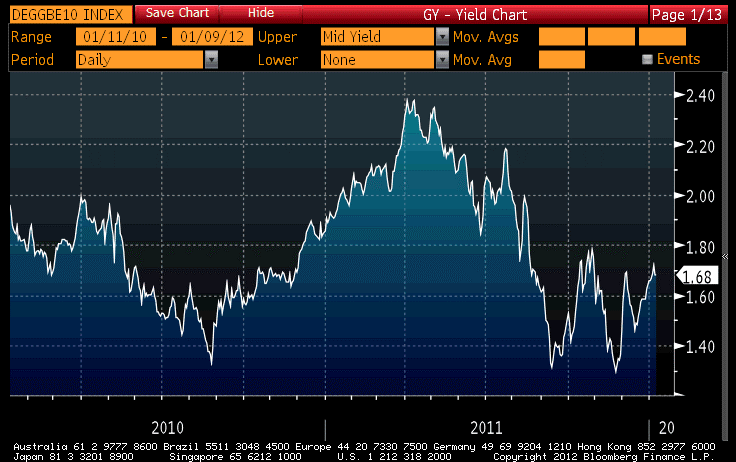
German 10-year breakevens. Certainly not expensive given the ECB's stance.
That’s not to say that I don’t think investors should be thinking and bracing for possible inflation. If there is a trade out there that looks relatively easy to me, it is being long breakevens. As I wrote last week,
It is incredible to me that with monetary conditions as accommodative, globally, as they have been in decades, inflation swaps are still nearly as cheap as they have ever been. That’s truly striking. What is the 10-year downside to a long inflation position from these levels? One-half percent per annum? Seventy-five basis points per annum? How low can inflation be over the next 10 years, especially with central banks apparently willing (and even anxious) to produce as much liquidity as is needed?
Commodities are still holding in, and that is one way to be long inflation. Commodity indices tend to have a high beta when inflation first begins to rise. However, one can also be long inflation expectations themselves. Institutional investors can do this through inflation swaps or breakevens, but retail investors can do this as well. On Wednesday, I will discuss a new exchange-traded security that allows investors to bet directly on inflation breakevens.
If you have not already done so, would you please help me gather some market information by taking a single-question anonymous poll, about your interest and/or willingness to buy certain kinds of hypothetical inflation-linked bonds linked to different things? The poll will take no more than two or three minutes, and I would really appreciate it. I’d also appreciate it if you would forward the poll link to your social networks and ask them to participate as well, since a bigger sample is usually better! The poll is here. Thank you very much!
Inflation Swaps For The Long Run
After buying stocks ‘with both hands’ on Tuesday, investors went with a distinctly one-handed approach as stock indices ended mixed on even lighter volume. It is far too early to be deeply concerned about the lack of volume, but…it’s not too early to be a little concerned. Volume the first two trading days of 2012 is down 25% from the first two trading days of 2011, which itself was the lowest total in at least 5-10 years.
To be sure, there is little new information to warrant a shift of position in the new year if you were happy with your position in the old year. And the indices are still at the top of the ranges of the last five months, so perhaps investors are waiting for resolution before jumping on board. The more sinister interpretation is that Volcker rule restrictions are continuing to erode market makers’ ability to provide liquidity, as many of us have warned is a likely consequence of limiting market makers’ ability to ‘intermediate temporally’ by taking a position.
However, I suspect the quiescence is at least partly for the former reason. Website hits for my comment are down as well from the same period a year ago, which suggests fewer people are tuned in so far this year.
Commodities markets have enjoyed the beginning to 2012. Energy markets and industrial metals rallied today. Crude was only up a little, although there was a development that threatens to change the calculus for Iran. In Brussels, EU members agreed in principle on economic sanctions against Iran, crucially including an embargo on importing oil from that nation. If enacted, this significantly changes the balance of risks for Iran associated with closing the Straits of Hormuz. If they are not going to be exporting through the Straits, then there is much less economic cost to Iran to close the Straits. If they aren’t selling much oil anyway, then the actual act of closing the Straits carries only military risks – and perhaps not even that, if the regime doubts the determination of the White House. The EU still hasn’t put an embargo into place, and it may be implemented ‘gradually,’ but in my mind the probability of a conflict just went up meaningfully.
But again, it wasn’t just energy markets that rallied. And today, the dollar was stronger rather than weaker. Nominal interest rates rose again (10-year Treasuries now yield 1.99%), but TIPS rallied and inflation swaps increased as well. Moreover, it wasn’t just short-term inflation swaps, as would be the case if the market was pricing in a potential oil spike. 10-year inflation swaps are up about 10bps over 2 days to 2.365%. That’s still terribly low in the grand scheme of things, as the chart below (Source: Bloomberg) shows. Indeed, Fed officials cannot be blind to the fact that 10-year inflation expectations have only been appreciably lower in the 2008 crisis and in 2010 right before QE2 was ‘announced’ by Chairman Bernanke.

10y CPI swaps are much lower than average
It is incredible to me that with monetary conditions as accommodative, globally, as they have been in decades, inflation swaps are still nearly as cheap as they have ever been. That’s truly striking. What is the 10-year downside to a long inflation position from these levels? One-half percent per annum? Seventy-five basis points per annum? How low can inflation be over the next 10 years, especially with central banks apparently willing (and even anxious) to produce as much liquidity as is needed?
On Thursday, the ADP report (Consensus: 178k from 206k) for December is the keynote release. Initial Claims (Consensus: 375k vs 381k) makes it a rare labor-market double, but Claims for the last week of the year isn’t a particularly useful figure and should be ignored. The Non-Manufacturing ISM (Consensus: -46.0 vs -47.5) rounds out the pre-Employment data. Of these, ADP is clearly the most important, but traders will prefer to be conservative in interpretation of any outlier points. This is partly because there is some evidence that ADP suffers seasonal-adjustment problems in December and partly because just last month ADP significantly exceeded estimates and Employment was right on target. In still-thin trading conditions, and only one day to wait to get the ‘real’ data, traders will prefer to avoid making bets on ADP.
.
I have a favor to ask readers. Would you be so kind as to take a single-question anonymous poll, about your interest and/or willingness to buy certain kinds of “different” inflation-linked bonds? It will take no more than two or three minutes. This is the link to the poll. Thanks in advance!
Autopilot Through the Andes
Tuesday’s bright start to equities was tarnished by selling in the last couple of hours. Overnight, the market had moved higher on the usual reasoning about how the market is oversold, undervalued, unloved, and that everyone is too bearish even though most people are telling the bullish story. Sunshine disinfects, though, and the highs for the day were set during the optimistic first half-hour.
Neither stocks nor bonds responded to the modest shortfall in Retail Sales from expectations. The print of +0.2%, +0.2% ex-auto, was the second-weakest reading of the year, and a mild surprise; however, as has been true for some time economic data was ignored. The focus was ostensibly on the Fed and a result that few thought would be surprising. That’s why it was curious to see currency markets trading rather sharply. The dollar index rose to nearly the highest level of the year, with the Euro off nearly four big figures since Friday. What is more, despite the dollar strength and equity weakness, commodities rallied. This is an unusual combination. In fact, the last time that the S&P fell at least as much as it did today (-0.9%), the dollar index rallied at least as much as it did today (+1.0%), and the DJ-UBS Commodity index rallied at least as much as it did today (+0.6%) was in February 2009.
There was some speculation that the odd mid-day timing of the Euro breakdown might have had something to do with the S&P downgrade announcements, which are due any day now. Apparently, under the new rules controlling rating agency behavior in Europe, they are required to report ratings changes to regulators twelve hours before formally announcing the change (I hadn’t known this), and there was suspicion that there was a leak. We’re all pretty sure which direction the changes will be in, but the actual report will still cause some ripples in an illiquid year-end market.
As of this writing, S&P has made no announcement, but we have all night.
I think this is a more likely explanation for the market action than attributing the moves to the FOMC announcement. There were no surprises in the statement or lack of action. Personally, it seems to me like the Fed is trying to coast on autopilot through the Andes Mountains, but no one was seriously expecting any change in policy; at most, some people expected a statement about how the communications policy will change going forward. So I don’t think that’s why the markets were moving (besides, the bond market rally was at 1pm, and nominally charged to a strong 10-year note auction, while the Fed statement wasn’t until after 2pm).
Equity volume was a bit higher than recent standards, but liquidity is going to be an issue if there are any surprises over the next couple of weeks – for example, if Italy’s auction on Wednesday is not well-received or if S&P downgrades France the full two notches rather than only one. This is mostly a year-end issue, but as I have pointed out all year, equity volumes this year have been consistently lower than in prior years. The following chart shows cumulative NYSE Composite Volume through the first 240 trading days of the year. The volumes leading up to and since the Volcker Rule assault on dealer market-making abilities (aka “proprietary risk taking”) have been demonstrably lower than in the four years prior. I am sure there are other secular pressures on equity volumes, but in any event it seems obvious that we are in an era of less volume and diminishing market liquidity. (This should by the way favor small investment managers, who have lower market-impact costs of trading…which is another trend I see continuing.)
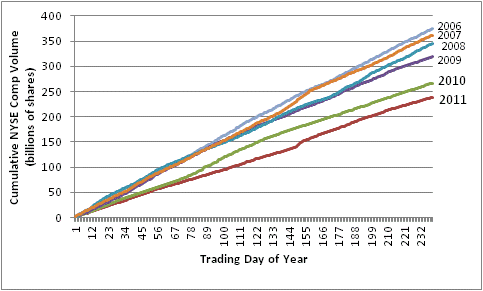
Source: Bloomberg. Equity volumes have been consistently weak all year.
10-year real yields are at their lowest levels ever (-0.087%), save for a spike down back in August. And that’s happening despite the fact that a TIPS auction is only two days away and we would ordinarily expect prices to be backing up (especially with year-end liquidity!). But the chart below explains part of the dynamic. As European inflation-indexed bonds are being beaten up because of credit issues, TIPS are clearly deriving some support. Actually, although French real yields around 1.5% are not exactly cheap, they’re pretty cheap if France is only downgraded one notch to match the U.S. rating. A few days ago they were over 2%. Once the French downgrade announcement is actually made, that is one place I would look to add exposures. I would, however, continue to avoid Italy at 6% real yields. Greek 2025 inflation-linked bonds at a 21.5% real yield and a price of around 20…if the prices on Bloomberg mean anything…actually might be worth buying for the negative miracle.

Source: Enduring Investments. 1.5% real yields in Europe doesn't sound so bad, especially for a US investor who doesn't currency-hedge.
The economic calendar on Wednesday is thin, so keep an ear out for pings from S&P and otherwise, enjoy the seasonal cashews.
Any Fireman Will Do
Thursday’s spotlight turned out not to be on the European summit but on the ECB. As expected, the central bank cut rates 25bps (although some expected 50bps) and loosened collateral criteria so that banks can pledge dicier assets at the ECB.
By the way, although this is a bad idea it becomes necessary because the best-quality collateral – sovereign bonds – are the securities causing all of the problems, so if a bank wants to rid itself of toxic sovereign bonds it also rids itself of a lot of collateral. So banks were doing “collateral swaps” (a good explanation is given by the Financial Times here) in increasing amounts, which in turn has the effect of creating a great contagion possibility if banks falter.
The Danish Central Bank also cut rates, to 0.80% from 1.20%, in case you’re keeping score.
But the real fireworks came when new ECB President Draghi declared that the ECB wouldn’t lend to the IMF to re-lend to sovereigns in need of aid, noting that the capital-T Treaty prohibits the ECB from financing member countries (and cute optics aside, that’s plainly what the plan was). Equity investors were shocked. The Gordian Knot of treaty obligations and limitations was supposed to be subordinate to “whatever needs to be done,” wasn’t it? After all, in the U.S. the Federal Reserve in 2008 was, um ‘flexible’ about its interpretation of its legal limitations.
If EU ministers were unified, that Gordian Knot could be cut. But the knot was tied that way on purpose; it was supposed to be problematic to circumvent because smaller countries needed assurances that their will would not be circumvented. For example, Finland’s Grand Committee of parliament today rejected the notion put forward by Merkel and Sarkozy that financial rescues conducted by the ESM needed to be fast-tracked and approved by a “qualified majority” rather than requiring unanimity. Finland pointed out that the treaty requires unanimity, and they (quite reasonably) intend to resist weakening that protection of their sovereign prerogative.
So the probability of having something awe-inspiring emerging from the European summit…something which would save the ratings of many of the Eurozone members…is very obviously decreasing. The rules are constraining the options, as they were meant to.
Stocks dropped 2.1% on this dawning realization, as well as the notion that the ECB isn’t ready to pull the “Quantitative Easing” lever as rapidly as investors were expecting them to. Inflation-linked bonds were very weak, with inflation swaps down 6-10bps despite a rallying bond market (the 10y nominal yield fell to 1.98%). Commodities were somewhat weak (DJ-UBS -0.8%), but not too bad compared to what happened in inflation markets.
This was probably partly due to some investors getting cold feet when the ECB didn’t come forth with a fountain of cash. I don’t think Draghi was as intransigent on this point as he was made out to be, and I think the ECB will continue to buy bonds until they simply can’t sterilize them all and they back into QE. But let’s suppose that the ECB really was immovable on this point, and central bankers determined that more was needed. In that case, I think it increases the chances of the Fed doing QE3. Liquidity is liquidity, as last week’s example with the coordinated action on swap lines reminds us. It’s more awkward to print dollars if Euros are needed, but there is a way to change dollars into Euros!
This is why inflation is substantially a global phenomenon, with something like 2/3 of the inflation in developed nations coming from a common global factor. You can’t just watch the Fed, although the Fed moves the needle the most. You have to watch the global tide of money, which (it hardly needs to be said) continues to rise.
While all eyes are turned on Europe, few cared about the somewhat stronger-than-expected Initial Claims (381k) today. And in the U.S., it seemed that few noticed that Japanese data has taken a serious turn for the worse. Japanese data last night (Our Wednesday night) was awful. October Machine Orders were -6.9% versus expectations of +0.5%, and that follows -8.2% in September. Don’t look now, but that’s the worst consecutive months of orders since Nov/Dec ’08. Somehow Japan’s fiscal situation has escaped notice, even though this AA-rated nation has a debt-to-GDP ratio of 200% (as of 2010 according to the CIA Factbook), which is substantially higher than Greece’s (143% in 2010) and Italy’s (119% in 2010). But let’s not think about that right now…
Choppy trading will continue on Friday and it will probably stay that way even after the summit ends, at least until the end of the year. It seems to me that stocks are more vulnerable to the downside due to optimistic positioning, especially with a weekend looming and every indication that big solutions are unlikely to come out of this summit. But I am happy to keep my hands off the trigger.
Happy Holidays! From: Your Central Bankers
I don’t know whose idea it was, but someone out there is smart enough to push when no one is around to push back.
“Dow Jumps Most Since 2009 as Central Banks Take Action on Crisis.” “Take action,” they certainly did. But what action did they actually take? You will be hard-pressed to find very many people who can explain just what it meant when the central banks of the U.S., Canada, Europe, the U.K., Switzerland, and Japan announced a coordinated 50bp cut in the bilateral foreign exchange swap lines that connect the central banks to one another. The story linked to above summarizes the action by saying the central banks did this “[to make] it cheaper for lenders to borrow in dollars.”
At best, what they did was to cut the interest rates at which banks can borrow dollars by 50bps (assuming that they are borrowing from the central banks, which is in itself a bad thing). With the last couple hundred basis points of easing not doing a lot to prevent or to stem the crisis, it is hard to imagine that 50bps here is a big deal. The real issue here is the availability of dollar funding, more than its cost. What is a big deal, the market thinks, is the fact that the central banks are coordinated – they are all singing from the same hymnal.
And what hymn are they singing?
They’re singing a song of more liquidity, lower interest rates, and more liquidity on top of it. Incidentally, onto the list of easing central banks you can now also add the Chinese Central Bank, which last night reduced reserve ratios for their banks (many people think the Chinese banking system is already a mess, so reducing reserve ratios may be a way to prevent them from going bust as well as stimulating the economy). Equity investors reasonably think that this is good for them (at least, until inflation arrives), so the S&P rallied 4.3% on the day; inflation-linked bond buyers know that this is good for them, so breakevens widened 6-10bps; commodity investors suspect they too will not be left out so Industrial Metals rallied 5.3% and Gasoline jumped 1.1%.
But if it’s good for everyone, why don’t central bankers just do the same thing every day?
Clearly, it can’t be good for everyone. Where all of today’s wealth is coming from is…the future. Today’s jump in prices serves to shift wealth from the future “us” to the “us” right now. (There are also other effects between individuals and groups, such as from consumers who have to pay higher prices to investors who are at least partially immunized, but the main thing is that by pushing up markets now we are assured to have lower returns going forward, assuming that the future real value of the assets don’t change because more money is printed). So the central banks are robbing Peter to pay…Peter. And we are oh so excited about that!
I said yesterday that there was a glimmer of hope. I meant that. It’s a glimmer of hope, not a shining beacon that we can’t miss. Despite stronger-than-expected ADP figures today (+206k vs +130k expected) and higher-than-expected readings from the Chicago Purchasing Managers’ report (62.6 vs 58.5 expected), this is still just a glimmer while Europe flails. To fan this spark into a flame, we need policymakers to have a steady hand and not freak out. Today’s coordinated action is a small thing, but it isn’t clear to me that it is in lieu of freaking out – for example, by implementing a coordinated global QE3.
I noted earlier that today’s rally just takes money from the future “us” to the “us” today. That’s true, I said, if the future real fair values of the markets are not affected by this policy (if those values are indeed affected, then the central banks should just keep easing forever). But in the spirit of positive thinking I will admit to one possibility in which today’s rallies represent real gains. If, by ‘jump-starting’ confidence, policymakers are able to change the future equilibrium level from a depressed state to a growing state, then such action really does represent gain.
However, some people would say that sounds an awful lot like “pumping up a bubble.”
On Thursday, the future “us” will probably start taking their wealth back. While economic data – Initial Claims (Consensus: 390k from 393k), ISM Manufacturing (Consensus: 51.8 from 50.8), Vehicle Sales and Chain Store Sales – have room to exceed expectations, it will be too tempting for investors sitting on 7.6% gains for the week to resist taking profits. And the lack of liquidity cuts both ways. I doubt we’ll plunge 4% on Thursday, but I would not be surprised to give back half of the day’s gains. A slow grind higher would surely have been better…and then we might have snuck up on the “future us.”
The ‘Fix’ Is In
Economic data last week was not discouraging. If you want to look backward for comfort, the Retail Sales data was a little stronger-than-expected, along with Empire Manufacturing and Industrial Production. Initial Claims retreated to the lowest level since April, at 388k. None of these numbers blew the doors off of predictions, but they were all shaded positively. The chart of the Citibank “economic surprise” index, below, shows that “good” surprises have finally started meaningfully outweighing “bad” surprises for the first time since, again, late March or early April.

Domestic economic data have been pleasantly surprising lately.
The inflation data, too, was good news, although as I said on the radio last Wednesday the slowing of core inflation these last two months was overdue and should not be taken as an ‘all clear’ signal.
This is all encouraging news. The United States is not in recession at the moment and, left to itself, would appear to be on a track to improve (although far too feebly for anyone’s taste) in the immediate future. Unfortunately, the U.S. is not being left to itself. Far from it, and the conditions in Europe continue to deteriorate alarmingly.
Both Spanish and Italian 10-year yields are in the 6.25%-6.50% range. Italian bond yields are only that low because of ECB buying last week. Over the weekend, Spain ousted its ruling party. As with Italy, there will be some cheerful interpretations of this as good news since the new government may be able to implement the “needed fiscal reforms,” but in Spain’s case the existing damage to the cajas probably puts the country’s situation beyond ultimate repair.
We are moving seemingly inexorably to a resolution in which the Euro either dismembers, disintegrates, or draws even closer together. For all of the talk, I can’t imagine that more integration is something that the populace will accept in the middle of a crisis. The view of such plans will be something like “the Titanic is going down! Let’s all hold hands on the deck and everything will be okay.” I believe the choices are dismemberment – letting (or forcing) weak members to leave while preserving a strong-ish core – or disintegration. Secondary and tertiary choices will affect how controlled or how uncontrolled that conclusion is. The signs there are not great, as the political bodies in Europe seem unable to choose the stitch in time that might save nine. Although I suppose I ought to also add that the Union’s changing tone towards Greece, in what looks like triage to me, has the aroma of a fairly grown-up decision.
As the markets slide into ever-less-liquid conditions, this is starting to come to a head. And this isn’t the only thing we will have to deal with over the final five or six weeks of the year. The U.S. “supercommittee” seems unlikely to agree to any meaningful deficit reduction arrangements before the deadline on the 23rd. Now, few people really expected them to do so, but it is an unhelpful reminder of how dysfunctional our political system has become, where increasing deficits is trivially easy and decreasing deficits is almost impossible. Add to this the escalation of anti-Iran rhetoric coming from Israel, that could well come to a head in a week, or not for six months.
To say that we are in a dangerous period is cliché by now. But the fact that we are in this state while liquidity conditions are set to get much worse over the next few weeks makes the danger acute.
Since the beginning of August, the S&P has been in a range from 1100 to 1300, and after exploring both sides of that range finds itself almost smack in the middle. This should be a stable position to be in, and it surely beats being at 1100 or 1300 since there will be plenty of investors with views as the market moves to one or the other extreme. I suspect we will see lower prices into the end of the year. In a normal year, starting from 1200 in a 1100-1300 range would mean the extremes of the range were likely secure. I don’t get that feeling this year, with this backdrop and the illiquidity that we are going to see (made even worse by the stressed conditions of European counterparties).
But don’t get complacent and think that longer-term Treasuries are safe. With the 10-year yield at 2%, in the middle of a 1.70%-2.40% range that has prevailed since mid-August, the same caveat applies. Investors who need safety will hold short-dated Treasuries, but that might also include some current holders of long-dated Treasuries. Twist or not, I don’t care for Treasuries at 2% when the bond vigilantes are riding. Greece, Italy, Spain…can Japan be far behind? And the U.S. is not sacred.
What will monetary policymakers do? In a word, they will pursue every simulative action you have ever seen. Some will buy sovereign bonds. Some will buy mortgage bonds. Some will simply sell unlimited amounts of their own currency (such at the SNB). The forex markets will continue to be choppy and I think hard to trade.
Let’s turn back to the U.S. a little bit, and talk about the probable and possible actions of the Federal Reserve. And again, let me look backwards and note some soothing data. The chart below shows 52-week commercial bank credit growth. While the absolute level of commercial bank credit is still 5.5% below the all-time highs of 2008, and a 2% year-on-year rate of growth is still pretty feeble, it ispositive and the trend is upward.

Yay! Commercial Bank Credit is up almost 2% over the last year!
Is this good news or bad news? Well, it is certainly good news that banks are lending, although the fact that M2 money supply is still expanding at a 10% rate over the last 52 weeks is probably not unrelated to this fact and that creates a clear inflationary possibility. The bad news is that the Fed’s actions are most likely slowing down this process.
The Federal Reserve has added copious amounts of liquidity over the last few years, which as has been well documented has flowed into reserves rather than into loans and M2. That liquidity has been stuck in reserves for two reasons. One is that the Fed is providing an incentive for banks to hold excess reserves, by paying them to do so. The other, which I have not previously mentioned, is that the Fed is providing a disincentive to lending by holding interest rates abnormally low. And the reason why is really Econ 101.
There is no question that loan volumes have been poor. Bullish analysts claim this is because no one wants to borrow money; analysts who actually have spoken to borrowers and lenders know that many borrowers (especially underwater mortgagees and small business owners) want very much to borrow at these low rates, but cannot, and understand that the low loan volumes are due mainly to the fact that standards have changed sharply for lending. The bullish analysts will point to charts like the one below, which shows that the net percentage of domestic respondents reporting tightening standards for commercial and industrial (C&I) loans for large and medium firms has been negative for eight quarters. That is, banks have been responding to the Fed’s Senior Loan Officer Survey by saying that they have on balance been easing standards slightly.

Sure, slightly more Senior Loan Officers report easing standards then tightening, but by how much?
However, the survey doesn’t measure by how much the standards tightened back in 2007-2009 compared to the amount they have loosened recently. For example, if banks had previously been willing to lend money on an unsecured basis in 2006, and by 2009 were requiring 140% collateral coverage of the loan, and then gradually loosened standards so that they now require only 100% coverage, conditions would obviously be much tighter now than they were in 2006 and still quite tight…and yet, going from 140% to 135% to 130% to 125% would result in three quarters of “easing standards.”
We can have some idea this is happening by looking at mortgage loans. The Fed’s Operation Twist was supposedly motivated partly by a desire to lower long rates further so that more consumers could refinance their mortgages. But refi volumes haven’t responded to Twist from the levels they were already at, and the overall level of refinancing (the Mortgage Bankers’ Association Refi index is shown below) remains below levels seen in late 2008, mid-2009, and late 2010.

MBA Refi Index. Operation Twist hasn't done a lot yet - refis were already modestly above the baseline.
Banks are still not lending aggressively at record low rates. And why would they? Given the choice between being paid something for holding risk-free excess reserves or being paid slightly more for extending a ten-year, risky loan, is it so hard to understand why the lending hasn’t happened? Moreover, it makes perfect sense: when you place a ceiling on the price of something…say, interest rates…then you tend to have a shortage as the chart below illustrates. At a price of “a,” “b” units of credit are supplied and “c” units are demanded, so there is a shortage of c-b. Right now, there appears to be a shortage of credit available to borrowers at the price the Fed has “fixed.”

Econ 101 depiction of the supply and demand of a product.
The supply of credit, in other words, is not exogenous. The Fed is treating the amount of credit available as being determined independently from its price, which the central bank is endeavoring to keep low in order to stimulate the economy. The demand for credit and the supply of credit are both functions of price, of course.
Does that mean that the Fed should let long rates rise? If the Committee’s goal is to increase credit availability (it isn’t entirely clear that this is their goal, or that it should be given that the economy is busy recovering from a contraction of credit), then letting rates rise might allow the market to clear at larger credit volumes.
.
On Monday, the Chicago Fed Index (Consensus: 0.19 from -0.22) is due to be released at 8:30ET and Existing Home Sales (Consensus: 4.80mm vs 4.91mm last) will be out at 10:00ET. These numbers will probably be largely ignored as most other domestic data has been recently, as investors continue to digest doings in Europe.
