When and How Much Tariff Effect?
As we look forward to the CPI report next week, the monthly-repeating theme is ‘when will the tariff effect show up?’ The answer, so far, is ‘not yet,’ but economists who had forecasted the end of life as we know it when the Trump tariffs went into effect have been befuddled.
I’ve already admitted in this column that I was educated in the tradition of ‘tariffs bad,’ but that over the years Trump’s insistence otherwise has made me carefully re-think of which ways tariffs are truly bad, and which ways they’re not so bad. Naturally, if tariffs were uniformly bad – which seems to be the orthodoxy – then it would be really hard to explain why almost every country levees tariffs. Maybe forty years ago we could blame the benightedness of those poor policymakers in other countries, who clearly just didn’t understand how bad tariffs are. But now? Heck, all someone in one of those countries needs to do is ask ChatGPT ‘are tariffs bad,’ and they’ll learn!
… Conclusion: Tariffs can be useful tools in specific, limited circumstances — like protecting vital industries or responding to unfair trade practices. But long-term, high or broad tariffs often do more harm than good, especially in highly interconnected global economies. (ChatGPT, July 9, 2025 query ‘Are tariffs bad’)
But it seems every country has these specific limited circumstances! It’s evidently only bad when the US does tariffs. And that is what made me ask whether maybe there is some nuance. My 2019 article “Tariffs Don’t Hurt Domestic Growth” was really good, I thought.
Even as there has been some small movement in the economintelligencia, though, about whether tariffs are all bad there has been very little movement in the notion that they are clearly inflationary. No doubt, implementing a tariff will raise prices at least a little, but how much is the important question. And regardless of that answer, tariffs are a one-time adjustment to the price level even if that effect is smoothed over a period of time. (This is why it’s weird to hear Powell say that the Fed can’t ease because they’re waiting to see the effect of the tariffs on inflation. That’s economic nonsense. The Fed can’t possibly believe that keeping rates high is the proper response to a one-time shock.)
On this question, I thought I’d share something I wrote in our Quarterly Inflation Outlook from Q1 (in mid-February), in which I roughly estimated the effects of a 20% blanket tariff. I know the answer isn’t “right,” because that’s the wrong question – there isn’t a 20% blanket tariff. But I undertook the estimate to get an idea of the relative scale of effects. (I included in the piece some parts from that 2019 article mentioned above, because I’m not above stealing from myself!) I will add some concluding thoughts after this ‘reprint’ from our QIO – which, by the way, you can subscribe to here.
Tariffs as a Tool to Promote Domestic Growth and Revenue
In the President’s view, the fact that the U.S. has a very low tariff structure compared to the tariffs (and arguably VAT taxes) that other countries place on U.S. goods is prima facie evidence that the U.S. is being taken advantage of and treated unfairly on world markets. The U.S. has, for the better part of a century, been the main global champion of free trade and this tendency accelerated markedly in the early 1990s (as the familiar chart below, sourced from Deutsche Bank, illustrates well).

The effect of free trade, per Ricardo, is to enlarge the global economic pie. However, in choosing free trade to enlarge the pie, each participating country voluntarily surrenders its ability to claim a larger slice of the pie, or a slice with particular toppings (in this analogy, choosing a particular slice means selecting the particular industries that you want your country to specialize in). Clearly, this is good in the long run – the size of your slice, and what you produce, is determined by your relative advantage in producing it and so the entire system produces the maximum possible output and the system collectively is better off. To the extent that a person is a citizen of the world, rather than a citizen of a particular country – and the Ricardian assumption is that increasing the pie is the collective goal – then free trade with every country producing only what they have a comparative advantage in is the optimal solution.
However, that does not mean that this is an outcome that each participant will like. Indeed, even in the comparative free trade of the late 1990s and 2000s, companies carefully protected their champion companies and industries. Even though the U.S. went through a period of being incredibly bad at automobile manufacturing, there are still several very large U.S. automakers. On the other hand, the U.S. no longer produces any apparel to speak of. In fact, the only way that free trade works for all in a non-theoretical world is if (a) all of the participants are roughly equal in total capability, and permanently at peace so that there is no risk that war could create a shortage in a strategic resource, or (b) the dominant participant is willing to concede its dominant position in order to enrich the whole system, rather than using that dominant position to secure its preferred slices for itself and/or to establish the conditions that ensure permanent peace by being the dominant military power and enforcing peace around the world. We would argue that (b) is what happened, as the U.S. was willing to let its own manufacturing be ‘hollowed out’ in order to make the world a happier place on average.
The President (and many of those who voted for him) feel that (b) is inherently unfair, or has reached extremes that are unfair to U.S. citizens. Essentially, the President is rejecting the theoretical Ricardian optimum and pursuing instead a larger slice for his constituents. This is where reciprocal tariffs (where the U.S. matches the tariff placed on its exports by a trading partner, with a tariff placed on the imports of that product from that trading partner) or blanket tariffs (where the U.S. imposes a tariff on all imports of a product irrespective of source – e.g. aluminum – or on all imports from a given trading partner) come in.
Blanket tariffs are good for domestic growth,[1] but definitely increase prices for consumers. How good they are for growth, and how much prices rise, depends on how easily domestic un-tariffed supply can substitute for the imported supply and also on whether your country is a net importer or exporter, and how large the export-import sector is in terms of GDP. Because this is an inflation outlook, let’s make a very rough estimate of the impact on the overall domestic price level of a blanket 20% tariff (such as the one Treasury Secretary Bessent has proposed). We suppose the average elasticity of import demand in the U.S. to be 3.33[2] and the elasticity of export supply to be 1.0[3]. In that case, the incidence of a tariff falls about 23% on consumers: [1.0 / (3.33+1.0) ]. So, for a 20% tariff, prices for the imported goods would be expected to rise about 4.6% (20% tariff x 23% incidence). However, imports only account for about 15% of US GDP, which means the effect on the overall price level would be 15% x 4.6% = 0.69%.
So, for a 20% blanket tariff on imports, Americans should expect to see a one-time increase in the overall price level of something on the order of 0.7%, smeared over the period of implementation. This is not insignificant, but it is also not calamitous. It does affect our estimates for 2025 and 2026 inflation, shown in the “Forecasts” section (somewhat less than 0.7%, because we do not expect a blanket tariff but rather reciprocal and targeted tariffs). Also note that the retaliatory tariffs on US exports have no direct effect on domestic prices, so that whether or not trading partners retaliate is irrelevant to an analysis of first round effects, anyway.
Thus my wild guess back in February was that a 20% blanket tariff would result in a bit less than 0.7%, smeared out over 2025 and 2026. That doesn’t answer the ‘timing’ question, but the delays in implementation (so as to not affect Christmas 2025 prices of the GI Joe with the Kung-Fu Grip) and the importer/retailer initial reaction to try and absorb as much as possible for optics – presumably, easing price increases into the system later – mean that it shouldn’t be shocking that we haven’t seen a big effect yet. My point in the above calculation, though, is that we really shouldn’t expect to see a big effect, regardless.
For what it’s worth, the Budget Lab at Yale estimates that currently “the 2025 tariffs to date are the equivalent of a 15.2 percentage point increase in the US average effective tariff rate,” so if we take my 0.7% guess for 20% then we would be looking closer to 0.5% in total. And in fact, lower even than that since the 15.2% average will have less impact than a 15.2% blanket tariff, assuming that the tariffs will be highest where domestic substitution is easier.[4]
Wrapping this up, let me make one final observation. Current year/year headline CPI inflation is 2.35%. The inflation swaps market, specifically the market for ‘resets’ where you can trade essentially the forward price level, currently suggests that traders expect y/y inflation to rise to 3.29% over the next six months: almost 1 full percentage point from here. But that actually flatters what the market is pricing, because the shape of the energy curves suggests that rise is being dragged about 20bps lower by the implied moderation in energy prices (give me a break, inflation traders: I’m doing this in my head).

So, the market is pricing core inflation peaking about 6 months from now, about 1.2% higher than it currently is. Not all of that is the effect of tariffs; some is due to base effects as the very low May, June, and July 2024 numbers roll off of the y/y figure. But if we get that result, you can be sure that economists will put most of the blame on Mr. Trump, while Mr. Trump will put most of the blame on Mr. Powell. Either way, I think the interest rate cuts that the President would prefer are unlikely unless growth takes a significant stumble.
[1] …but bad for global growth! There is no question that unilaterally applying tariffs to imports is bad for all suppliers/countries providing those imports. If Ricardo is right, the overall pie shrinks but the domestic slice gets larger…at least for the dominant players who already have a large slice. If everyone raises tariffs in a trade war outcome, the less-productive countries suffer the most loss of growth and the most-productive countries likely still benefit. But prices rise for all.
[2] Kee, Nicita, and Olarreaga, “Estimating Import Demand and Export Supply Elasticities”, 2004, Figure 5, available at http://repec.org/esNASM04/up.16133.1075482028.pdf Your answers may vary!
[3] Estimates are wildly all over the map, depending on the exporting country and the product. In general the smaller the country, the more price-inelastic it is. We chose unit elasticity here (a 1% increase in price cause a 1% increase in the quantity supplied) just to be able to get a rough guess.
[4] To be fair, the Budget Lab at Yale also estimates the effect on PCE inflation of a whopping 1.74%. They must be really surprised at the impact so far.
The Twin Deficits – One Out of Two IS Bad
From time to time on this blog, I circle back to the question of the balance of deficits. In my mind, as our economy goes through whatever the “Trump Transition” is, the biggest risk to the bond markets is not from some fear about whether the Treasury will default or whether the US dollar will cease to be the world’s currency of choice for reserves (neither of which I think is going to happen any time soon) but that large secular changes in the balances of savings and dollar demand could lead to outsized moves in interest rates.
First, let me remind you that the deficits are all intertwined. When the US Federal Government runs a deficit and borrows money, they have to get it from people/entities that have saved that money. One place that the government bond salesmen know they can turn to is non-US investors, who are in possession of those dollars because the US runs a large trade deficit with most other countries. When we run a trade deficit, it means we are importing more stuff than we are exporting or, equivalently, we are exporting more dollars than we are importing. Those dollars are pretty useless except to buy things that are dollar-denominated. By construction, we know that the new owners of dollars aren’t buying goods, because if they did there wouldn’t be a deficit; the main other thing they buy are securities or real property.
So if you don’t want other countries buying US stocks, buildings, and farmland, run a big trade surplus and they won’t have the dollars to do it.
It’s a good thing they have all of those dollars, because the Federal government needs them! The federal deficit needs to be funded by those foreign dollars, or by domestic savings (banks, individuals, companies, e.g.), or by the central bank buying up those bonds. And that’s pretty much it. Over time, the trade balance plus the budget balance plus the central bank balance plus private savings equals zero, more or less. During COVID, the massive expansion of the federal deficit was only possible because the Fed bought about the same number of bonds as the government sold. Had they not, interest rates would have risen precipitously because private savers would have had to be induced to put those dollars into bonds.
(Or, the government would give incentives for banks to hold more govvies, say by exempting them from the SLR. Not that such a thing would ever happen!)
Let’s pivot this then back to the Trump Transition. The stated goal of the Administration was to lower the trade deficit a lot, lower the budget deficit a lot, and lower interest rates. That all makes sense and is internally consistent. It could happen that way, if all of it happens that way.
What if, though, the President’s team makes more progress on one front than on the other? Early returns on the tariff front seem to imply that the US will face a smaller trade deficit going forward. Now, the latest spike higher (smaller deficit) here is at least partly and maybe mostly due to a ‘payback’ of the pre-tariff front-running that led to massive deficits in the prior three months. But it should not surprise us that increasing tariffs should cause the trade deficit to decline. That is, after all, sort of the point.

If we concede that the trade deficit is actually heading back towards some better semblance of balance, then that’s plank 1 of the Trump agenda. That will supply fewer dollars to cover the federal budget deficit, though. As long as the federal budget gets into something closer to balance…
That was the promise of DOGE, and of the revenues from tariffs. The latter will indeed be yuge, and will help balancing the budget. Or it would, if we weren’t about to run an even bigger deficit with the Big Beautiful Bill soon passing into law. The trailing-twelve-month budget deficit is just less than $2 trillion, which was a number we never even sniffed prior to COVID. So that’s the demand for savings: the feds look like they’re going to keep on spending more than they take in.

Unlike during COVID, too, the Fed is now letting its balance sheet shrink. No help there.

Now, there is also a movement in Congress to pass legislation preventing the Fed from paying interest on the reserves that banks hold at the Fed. For decades, the way the Fed managed the money supply was to adjust the quantity of reserves, which rationed credit and caused the price of credit (interest rates) to move as well. But it was the rationing of credit, not changing the price, that affected the money supply. Beginning with the Global Financial Crisis, the Fed flooded extra reserves into the system, forcibly deleveraging banks (look at that chart above again) – but, since that would also crush bank earnings, they started paying interest on reserves (IOR). Since, if banks were not being paid to hold reserves, they would hold as little as they could, the Fed had to pay interest or the excess of reserves in the overnight market would cause interest rates to always be zero. So the Fed started to manage the price of credit, rather than its quantity. The central bank fully intends to always hold way more in securities and therefore force way more reserves into the banks, going forward – but has gradually been reducing its portfolio securities. As I said, no help there.
If Congress succeeds in preventing the payment of IOR – and the politics on this looks good since the Fed now runs operating deficits, so that it is basically paying banks interest with taxpayer dollars (see chart below…Fed remits to the Treasury have dried up completely), then as I said above banks will try to hold fewer reserves and overnight interest rates will drop as banks compete to lend their excess reserves at anything above zero, unless (a) the fed increases the reserves banks are required to hold (really unlikely) or (b) the fed makes reserves scarce so some banks will have to buy them and some will sell them (the old way) (also really unlikely). In neither case does the Fed expand the balance sheet as a first intention, so unless we get another crisis the expansion of the Fed balance sheet is unlikely in my view.

So that leaves private savings. If the trade deficit declines and the budget balance doesn’t move significantly towards balance, then interest rates will have to rise, potentially a lot. I think the President’s stated plan makes very good economic sense. I just wonder if it’s going to be derailed by the desire to keep the Federal spend going.
The Road to Crypto Conversion
While this isn’t exactly the conversion of Saul on the road to Damascus, I came to a realization recently that subtly changes the way I look at the potential for large cryptocurrencies, such as Bitcoin.
Historically, my attitude has been dismissive about the value of bitcoin itself. While I recognize the amazing reach of blockchain technology and the genius of using asymmetric key cryptography to secure the public record of private transactions, I’ve always thought that bitcoin didn’t really achieve the promised goal, which was to be a better money than fiat dollars. After all, bitcoin is not backed by anything more than the dollar is – nothing. Its value is based on scarcity, and scarcity by itself is not a source of value (if it was, my toenail clippings would be immensely valuable). So in my 2016 book What’s Wrong with Money? I wrote in a chapter on bitcoin:
“But is bitcoin money? Calling it a virtual currency, or a digital currency, or a crypto-currency doesn’t make it money. At some level, it is of course money in the same sense as cigarettes are to prison inmates. It serves as a medium of exchange, a store of value, and a unit of account – but only within the special community that already accepts bitcoin as credible…It is not yet broadly a credible currency. It doesn’t have universal value because not everyone believes that everyone else will accept bitcoin.”
Even in that chapter I recognized that bitcoin may someday be money-like. And I underwent a partial conversion and even worked for a while on a paper with my co-authors Kari Walstad and Scott Wald to define a measure (“Crypto Trust Index”) that would objectively measure how much like money the cryptocurrency world was becoming. [That paper ended up being overtaken by real-world developments, as stablecoins fully backed by fiat balances are obviously crypto money by identity, rendering the question moot.]
But in my mind bitcoin, eth, etc aren’t money but speculative vehicles – they are distinctly separate from USDC, USDi, and other fully-backed coins. It may be that they belong in a portfolio with stables and/or securities, but since bitcoin has no intrinsic value I have always held the view that I don’t want to own it as it can go to zero in a nonce.[1]
Recently, as I said, I’ve had a mild conversion as a result of two realizations.
The first realization is that even in the traditional securities world, we sometimes invest in things which have no intrinsic value in many states of the world. For example, we buy out-of-the-money options, or equity in a firm that is highly leveraged so that if the business goes under, the equity-holders get nothing. I am not sure this is a good excuse to buy bitcoin, though, since even if a far out-of-the-money option is unlikely to ever have intrinsic value there are at least future states of the world in which it could have intrinsic value. Similarly, that penny stock might end up being worth something if business booms. So we could think about bitcoin as being an option that may go to zero or may go up a lot. The problem with this, and the reason this reasoning alone is not compelling to me, is twofold. First, those far out-of-the-money options and long shots tend to have low prices, not high prices, and bitcoin certainly does not seem to have a low price. Second, there is no state of the world in which bitcoin will ever have an intrinsic value. Therefore, it doesn’t make a lot of sense to think of it as a real option, but at best as a speculation with an option-like payout (low in many states of the world, but massive in a few states). Put another way, while the value of that penny stock or out-of-the-money option can go to zero for some clearly-defined reasons, bitcoin can go to zero for any reason or no reason and it wouldn’t be wrong.
The second realization, though, relates to scarcity. Yes, scarcity alone cannot be the basis for value (see: my toenails). For scarcity to matter, there needs to be exogenous demand. And that demand need not be rational. If someone wants to hold bitcoin, not caring that it has no intrinsic value (or erroneously believing that it has some), then scarcity matters. The realization is that scarcity goes from not mattering at all, to mattering a great deal, as soon as there is any demand. To be sure, if that demand goes away, then scarcity again ceases to matter.
(By the way, it is entirely possible and even likely that someone else has pointed this out.)
So the case for speculating in bitcoin (no, I won’t call it investing) is that since the total supply is independent of price, the supply curve is vertical and moving to the right at an ever-slower rate. As this happens, it takes less and less increase in demand to push price higher.

It also takes less and less decrease in demand to push price lower. Since there is no slope to the supply curve, it means that oscillations in demand are responsible for all of the oscillations in bitcoin’s price. And we can say more about the volatility dynamics. Early in bitcoin’s development – when demand was very low, supply was relatively high compared to demand, and the price was as a result very low – we were operating at the far left end of the demand curve where demand was relatively more elastic and therefore there was a lot of volatility. As bitcoin matures, and demand catches up to the existing supply, we should expect price volatility to decline. And this is, in fact, what has happened (chart below, source: Bloomberg, shows rolling 100-week historical volatility (about two years, but I like round numbers today), now at the low-low level of 43% (about 3x equity market volatility).

The fun part comes later, when the supply curve shifts get slower and slower as the bitcoin halving converges to zero and the bitcoin supply gets closer and closer to its absolute maximum. At that point (and here is where the uberbulls get really excited), if there is a steady secular increase in demand, price just goes up without bound.
Don’t get too excited, uberbulls, because we aren’t there yet. When we are starting to get close to that point I would expect that we will also see volatility start to go up again. If historical volatility continues to decline, it means (a) we aren’t close enough to that point that the vertical singularity is nigh, and/or (b) people are losing interest in or diversifying away from bitcoin so that the steady increase in demand is not manifesting and interest is fluctuating less and less. So, I am waiting for that volatility to begin to expand at higher prices.
In any case, I am much more likely to invest in tokenized real world assets than I am Bitcoin or Ethereum. I am not a speculator at heart. Heck, I’m a bond guy which means I worry more about return of my principal than return on my principal. But if you are already long bitcoin, I will no longer sneer at you, because I recognize at last that one way or the other I will may be driving your car someday – either because it was repossessed and I bought it at auction, or because I am your chauffer.
Did You Know? Want to buy USDi, the inflation-linked stable coin, but don’t own any crypto you can exchange for it? You can actually use the coin as an on-ramp. Accredited investors need merely complete onboarding with USDi Partners and then can invest fiat dollars and receive USDi coins.
[1] Pun intended.
Inflation Guy’s CPI Summary (May 2025)
Well, this was an odd one to sort out.
Going into the CPI announcement this morning, the economist consensus was for +0.17% (seasonally adjusted) on headline CPI m/m and +0.28% on core. Market changes this month have been very contained, partly because of the usual summer doldrums kicking in and partly (most likely) because of the degree of uncertainty surrounding all of the chaotic policy changes that have taken place in 2025. The effects of these changes (and more to come!) are still making their way through the system.

This is a calm surface over a roiling ocean. Economists continue to debate (and their analysis, to me, seems in many cases to be colored by the political lens they are looking through) about the impact that the current tariff structure will have, about the effect of future tariff changes – and what those will be, about the impact of the Most-Favored-Nation policy on pharmaceutical pricing and availability, about the effect the deportation of illegals (and self-deportations) will have on housing (rent inflation softer, but how much?) and labor supply (wages upward, but how much?) and Lodging Away from Home.
Actually, I’m overstating that a little bit. Most classically-trained economists mostly agree about how horrible this will all be, because tariffs bad. My own estimates have tariffs pushing inflation a little higher in the near-term, but not terribly. I also think that mass deportations would be very disinflationary because of the effect on rents but it is looking less and less like ‘mass deportations’ means tens or hundreds of thousands, not millions, and that effect likely won’t be huge.
Meanwhile, the Fed is keeping rates slightly above neutral but money supply growth has re-accelerated to a level that’s not likely to be consistent with inflation at 2%. Underlying trend median inflation is running about 3.5% or so, and is unlikely to fall a lot further given the current configuration of fiscal and monetary policy.
Let’s get into the data, then. The actual CPI was +0.08% (SA) on headline and +0.13% on core. That’s a significant miss, especially on core.

Core inflation has recently been missing low on a fairly regular basis, although most of the misses have been small. Median inflation in most cases hasn’t been confirming those misses, because they’ve generally been one-offs that don’t really wiggle median too much. It’s still a positive sign if the ‘tails’ are to the downside so that core CPI is below median CPI, but Median tells us not to get too excited. This month, though, Median also showed an effect. My estimate is that Median CPI will be the lowest since last July, at +0.25% m/m. It’s still difficult to see a major disinflationary trend here.

There’s more uncertainty than usual around my Median guess, but let’s take it as a given for now.
You don’t have to look too far to see one of the major culprits for the miss this month. Primary Rents were up +0.21% m/m, which is a lot slower than they had been running at.

Owners’ Equivalent Rent was also soft, and between those two surprises it’s probably roughly 5bps of the Core CPI miss. Let’s be clear – rents are not collapsing and indeed, we’ve just converged with our model.

Let’s be clear: if you are in the camp that we’re going to get back to 2%, you need this to not be an aberration. You need shelter inflation to continue to decelerate. But as you can see from the chart of month/month primary rents above, sharp movements in rents tend to be reversed in subsequent months. This looks a lot to me like last July’s surprise, which was reversed in August. We will see. But ex-shelter, year/year Core CPI rose, to 1.87% from 1.78%.
What is interesting to me as I write this, looking at some of the other commentary, is that folks don’t seem to be focusing on this. Of course it’s all tariffs, all the time, and everyone is scratching their heads over why we are seeing price declines in some of the categories where you’d expect the tariffs to help. Key example (and significant example) is autos, where the CPI for Used Cars and Trucks was -0.54% m/m after a similar decline last month, and New Cars were down -0.29% m/m. If there is one place that economists were certain we would see tariff-induced inflation, it was in autos. Not so much, at least yet. This might be because the lags are longer than we expect in a just-in-time manufacturing world, or it might be because demand elasticity is bigger than people thought.
But even with autos, Core Goods inflation accelerated to +0.3% y/y from +0.1% last month.

Remember, above I said that core goods ex-shelter had accelerated. I don’t want to fall into the trap of taking out all of the things that go down, to make the insightful conclusion that everything else went up – but that acceleration in core goods included the weighty autos contribution to the downside so you can tell that there are indeed upward pressures. Just not in the big things.
One place we saw increases was in Tenants’ and Household Insurance, which rose 0.84% last month, and in Motor Vehicle Insurance, which rose 0.68%. That helped keep core services inflation at +3.6% y/y, even with the slowdown in housing. On the other hand, Airfares suffered a third straight significant decline, -2.74% m/m. And while we are surprised to see auto prices decline, given the tariffs, we are also surprised to see Medicinal Drugs prices increase, given Trump’s new “Most Favored Nation” policy. Pharma prices were +0.54% m/m (although the y/y increase slackened some and is only +0.35% y/y). Core Services less Rent of Shelter (aka “Supercore”) is down to 3.11% y/y, and that’s good news even if it’s still quite a bit higher than it was pre-COVID. The trend is your friend, and this is a good trend for now.

As with the market itself, then, we’re seeing a lot of movement in both directions; it’s just all canceling out into a relatively tame increase in the overall CPI basket. That’s not likely to be the ultimate outcome. The last four year/year increases in Median CPI (assuming I’m vaguely right about the m/m, and we’ll know that in an hour or two) have been 3.53%, 3.48%, 3.46%, and 3.44%. That does not give the impression of a series that is in a hurry to get down to 2.25%-2.5%, which would be roughly consistent with sustainable core CPI around 2%. Again, you need to get shelter prices to really decelerate significantly further.
Now, even if that does happen, it isn’t going to keep y/y measures on a steady deceleration track for the next year. While we haven’t seen a major impact from tariffs yet, and my view is that it won’t be a huge impact in any case except for particular items, I am pretty sure we will see something and median and core inflation will see acceleration over the balance of this year and into next year. Thereafter, it depends on what happens with policy in the interim. On that score, while the current numbers still give the Fed no good reason to ease it also should pretty much remove any notion that monetary policy is about to get tighter. M2 growth is back to 4.4% y/y, and 6.4% annualized over the last quarter. That’s back to what was normal when we were experiencing the tailwinds of globalization and positive demographics. It is too fast now that those are headwinds.

But as I said, that’s the story for later this year and it could change. In the meantime, we keep waiting for the tariff effect. If three months from now we still haven’t seen an effect, then things will get very interesting.
One final announcement. If you’re an investor in cryptocurrencies (in particular, stable coins) and have a Telegram account, consider joining the read-only USDi_Coin room https://t.me/USDi_Coin where the USDi Coin price is updated every four hours or so…and where these charts are also posted shortly after CPI just as I used to do on Twitter before they changed the API to make auto-tweeting charts very difficult.
Why a 4.5% Nominal Rate is Roughly Equilibrium…Hmmm, Sounds Familiar…
I was planning to write today about why a 4.5%-5.0% nominal Treasury rate is not only not the end of the world, but actually sort of normal. Naturally, the reason I am even thinking about the topic is because of all of the apparent alarm because the current long bond recent peeked above 5% and the 10-year note at 4.50% continues to flirt with those levels. Because we haven’t seen the 10-year rate above 5% for a sustained period in about 18 years, it is natural that some of the young folks who were raised in an era of free money would think that this is the end of the world.
I’ve previously written about the return of some of the phenomena that we used to take for granted, such as the presence of optionality in the bond contract. After most of two decades of unhealthy interest rates produced unhealthy leverage habits among other unwelcome developments (including the leveraging of the government balance sheet because it was so cheap to borrow for one’s programs with no cost), I suppose it shouldn’t be surprising that there is so much wailing and gnashing of teeth, rending of garments, etc. But for those people who expect the Fed to lower rates significantly, because “after all 2% is the normal level of interest rates,” I am here to say that you probably don’t want the crack-up that would be necessary to make that plausible. The current level of interest rates is inconvenient for many organizations with a borrowing problem, but it is really quite normal.
Anyway, I’d intended to write a longer version of that, and as I started to write something bugged me and I looked back and noticed that I’d already written essentially the same thing a few years ago. At the time (June 2022) I was explaining “Why Roughly 2.25% is an Equilibrium Real Rate,” and of course if you add reasonable inflation expectations of 2.5%-3% you get to 4.75%-5.25% as an equilibrium nominal rate (and a bit higher than that for the 30-year, which also incorporates a modest additional risk premium). If you go and read that article directly, you can also get my screed on how models trained on the last 25 years of data leading up to the inflation spike only survived if they forecast a very strong reversion to the mean, and so *eureka* all of those models missed the entire inflation spike. But here is a reprinted snippet (reprinted by permission from myself) outlining the argument for why the current level of long-term real interest rates is about right.
Kashkari made a different error, in an essay posted on the Minneapolis Fed website on May 6th.[1] He claimed that the neutral long-term real interest rate is around 0.25%, which conveniently is where long-term real rates are now.
However, we can demonstrate that logic, reinforced by history, indicates that long-term real rates ought to be in the neighborhood of the economy’s long-term real growth rate potential.
I will use the classic economist’s expedient of a desert-island economy. Consider such an island, which has two coconut-milk producers and for mathematical convenience no inflation, so that real and nominal quantities are the same. These producers are able to expand production and profits by about 2% per year by deploying new machinery to extract the milk from the coconuts. Now, let’s suppose that one of the producers offers to sell his company to the other, and to finance the purchase by lending money at 5%. The proposal will fall on deaf ears, since paying 5% to expand production and profits by 2% makes no sense. At that interest rate, either producer would rather be a banker. Conversely, suppose one producer offers to sell his company to the other and to finance the purchase at a 0% rate of interest – the buyer can pay off the loan over time with no interest charged. Now the buyer will jump at the chance, because he can pay off the loan with the increased production and keep more money in the bargain. The leverage granted him by this loan is very attractive. In this circumstance, the only way the deal is struck is if the lender is not good at math. Clearly, the lender could increase his wealth by 2% per year by producing coconut milk, but is choosing instead to maintain his current level of wealth. Perhaps he likes playing golf more than cracking coconuts.
In this economy, a lender cannot charge more than the natural growth in production since a borrower will not intentionally reduce his real wealth by borrowing to buy an asset that returns less than the loan costs. And a lender will not intentionally reduce his real wealth by lending at a rate lower than he could expand his wealth by producing. Thus, the natural real rate of interest will tend to be in equilibrium at the natural real rate of economic growth. Lower real interest rates will induce leveraging of productive activities; higher real interest rates will result in deleveraging.
This isn’t only true of the coconut economy, although I would strongly caution that this isn’t exactly a trading model and only a natural tendency with a long history. The chart below shows (1) a naïve real 10-year yield created by taking the 10-year nominal Treasury yield and subtracting trailing 1-year inflation, in purple; (2) a real yield series derived from a research paper by Shanken & Kothari, in red; (3) the Enduring Investments real yield series, in green, and (4) 10y TIPS, in black.

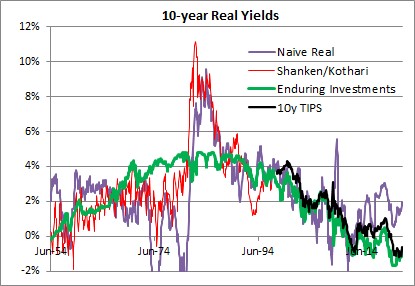
The long-term averages for these four series are as follows:
- Naïve real: 2.34%
- Shanken/Kothari: 3.13%
- Enduring Investments: 2.34%
- 10y TIPS: 1.39%
- Shanken/Kothari thru 2007; 10y TIPS from 2007-present: 2.50%
It isn’t just a coincidence that calculating a long-term average of long-term real interest rates, no matter how you do it, ends up being about 2.3%-2.5%. That is also close to the long-term real growth rate of the economy. Using Commerce Department data, the compounded annual US growth rate from 1954-2021 was 2.95%.
It is generally conceded that the economy’s sustainable growth rate has fallen over the last 50 years, although some people place great stock (no pun intended) on the productivity enhancements which power the fantasies of tech sector investors. I believe that something like 2.25%-2.50% is the long-term growth rate that the US economy can sustain, although global demographic trends may be dampening that further. Which in turn implies that something like 2.00%-2.25% is where long-term real interest rates should be, in equilibrium.[2] Kashkari says “We do know that neutral rates have been falling in advanced economies around the world due to factors outside the influence of monetary policy, such as demographics, technology developments and trade.” Except that we don’t know anything of the sort, since there is a strong argument against each of these totems. Abbreviating, those counterarguments are (a) aging demographics is a supply shock which should decrease output and raise prices with the singular counterargument of Japan also happening to be the country with the lowest growth rate in money in the last three decades; (b) productivity has been improving since the Middle Ages, and there is no evidence that it is improving noticeably faster today – and if it did, that would raise the expected real growth rate and the demand for money; and (c) while trade certainly was a following wind for the last quarter century, every indication is that it is going to be the opposite sign for the next decade. It is time to retire these shibboleths. Real interest rates have been kept artificially too low for far too long, inducing excessive financial leverage. They will eventually return to equilibrium…but it will be a long and painful process.
At the time I wrote the passage above, 10-year TIPS yielded about 0.25%; today they yield 2.125%. It turned out that returning to equilibrium wasn’t at all a long process. But it certainly was painful!
Returning to the original point: just because 10-year rates are now approximately at equilibrium is not at all a prediction that they will remain at equilibrium. Indeed, if I made that prediction I would be making a very similar mistake to the one I criticized above. Mean reversion in rates is not a particularly powerful force, when set against an active central bank and a profligate legislature. But if it matters at all, it is very important to correctly identify the mean to which rates should revert.
And it’s not 2%.
[1] https://www.minneapolisfed.org/article/2022/policy-has-tightened-a-lot-is-it-enough
[2] The reason that real interest rates will be slightly lower than real growth rates is that real interest rates are typically computed using the Consumer Price Index, which is generally slightly higher than the GDP Deflator.
Inflation Guy’s CPI Summary (April 2025)
Before the CPI analysis, I always try to give some context for where we are in the ‘story’ about the evolution of inflation right now. It’s really difficult to do that, though, because of all of the massive policy changes that are happening – and often in opposite directions with respect to the effect on inflation. Here is the Baker, Bloom & Davis Economic Policy Uncertainty Index, which is derived by scraping news sources. Even strong supporters of President Trump’s have to admit that his Administration has been a whirlwind on economic policy (for many of them, of course, that’s a feature and not a bug).

Here goes, anyway. Remember that last month, core CPI crashed but Median CPI actually accelerated. This kept us from actively celebrating the great inflation news; we knew that the good news was concentrated in a few one offs. In particular, Airfares (-5.3% for March), Lodging Away from Home (-3.5%), Used Cars (-0.69%), Car and Truck Rental (-2.66%), and Medicinal Drugs (-1.30%). But, as Median showed last month, there was really no reason to think that inflation was behind us…even before any effect from tariffs.
Speaking of tariffs, prior to this month we hadn’t really expected to see any effect yet and most economists thought that we shouldn’t see that much impact in the April figures either since the big tariffs on everyone went into place early in that month. However, remember that Mexico, Canada, and China had all faced escalating tariffs prior to April, so if there is going to be an impact we should expect to see something soon. I don’t expect a lot in most categories, but some impact in a few. It will be hard to discern how much of any monthly price change is tariffs, of course. We will look at Apparel, where demand elasticity in the short run is not terribly low. Broadly, though, remember that demand elasticity and foreign content percentage are both important…and foreign content in most goods is pretty low. I’d also look to Medicinal Drugs, since a lot of APIs are China-sourced and the demand for many drugs is pretty inelastic in the short-run, but I didn’t expect a lot of impact there (pharma companies will have had inventories), and going forward it will be muddied by Trump’s announcement of the Most-Favored-Nation policy in pharmaceuticals.
Speaking of that announcement, this month’s review of changes in inflation swap levels is seriously polluted because that announcement combined with the 90-day pause on China tariffs caused a massive crash in 1-year inflation expectations.

Despite the drop in tariff rates on China (for now), remember average tariffs remain the highest since the Great Depression (ominous music)! Of course, back then the US was a significant net exporter, so reciprocal tariffs were a bigger problem. Imports were only about 2-3% of GDP.

(Chart above is from https://www.stlouisfed.org/on-the-economy/2019/may/historical-u-s-trade-deficits)

(Chart above is from https://www.stlouisfed.org/on-the-economy/2020/march/evolution-total-trade-us)
There you go. That’s the context. Now onto the number.
CPI for April was expected to be +0.25%, and +0.27% on Core. The actual prints were 0.221% and 0.237%, respectively, so a mild surprise lower (although it turned the +0.3%/+0.3% rounded expectations to +0.2%/+0.2%, looking more dramatic a surprise than it actually was). Core is right about where it has been for the last 6 and 12 months (0.244% and 0.229% average, respectively) with the big January spike and the March plunge basically offsetting each other.

Amazingly, of the eight major subgroups only Housing, Medical Care, and “Other” increased on a m/m basis. What is especially surprising in that light is that Apparel – where the tariff canary in the coal mine lives – was down on the month.

Core goods continues to hook higher, now at +0.13% y/y. Remember, this is before any tariff effect has really been felt. In my mind, this is more the underlying ‘deglobalization’ effect: as I’ve said for a while, the deep deflation in core goods that we saw was a partial retracement of the COVID spike and we should expect going forward to see a small positive inflation in goods. Core services is decelerating nicely, and it will need to continue to do that if we’re ever going to see downward pressure in median inflation from where we are now.

Speaking of Median CPI, my early estimate is +0.308% m/m, putting the y/y at 3.43%. That’s about where we’ve been, and where we’re likely to be going forward.

Looking at some of those one-off categories from last month, Airfares fell another -2.83% m/m after that -5.3% prior decline. Some of that is jet fuel, some is tourism I suspect. Lodging Away from Home went flat (-0.1% m/m) from -3.54% prior. I think we’ll see continued downward pressure in that category, as hotels in some big cities are gradually emptied of illegal migrants and get added back to the stock of available rooms, but March’s drop was just too big. Used Cars’ decline (-0.53%) surprised some people, because the private surveys showed that prices advanced last month, but the seasonal assumption was a decent hurdle this month that wasn’t cleared. However, if you were worried about how the spike in car parts tariffs would cause car prices to spike…because that’s what the news was hyperventilating about…you needn’t have. New Car prices were also slightly down, -0.01% compared to +0.1% last month.
As for shelter, it continues to flatten out, with Primary Rents 3.98% y/y and OER at 4.31% y/y. Actually, Primary Rents were flat on a y/y basis compared to the prior month, and have basically converged with our model, which is around 3.7%. From here we should expect very slow deceleration, but rents should stay above 3.25% or so on a y/y basis.

Supercore is looking great. This is about the best news in the report, because if Shelter is just about tapped out and Core Goods is trending just above zero we’d need Core Services to continue to dive.

That’s the good news. The bad news is that the spread of median wages over median prices has returned to its long-run average, which means that it will be hard to see additional sharp declines here…it isn’t going to come from squeezing wages further.

Outright, the Atlanta Fed Wage Growth Tracker – the best measure of wages in my opinion – is at 4.3% y/y. That’s right where it was in November. It’s going to be very hard to squeeze services prices lower if wages don’t decelerate further.
Finally, let’s circle back to pharmaceuticals. I’m going to point you again to my article from 2020, which is the first time that the President mooted the idea of a Most-Favored-Nation clause affecting the pharmaceutical industry. https://inflationguy.blog/2020/08/25/drug-prices-and-most-favored-nation-clauses-considerations/ The upshot is that even if the MFN policy takes place exactly as the President states, retail drug prices are unlikely to decrease anything like as much as he has said. In fact, there could even be some circumstances in which drug prices rise because companies stop selling in foreign countries at levels lower than in the US (because they face a more-elastic demand there) but which contribute to the total profit of the drug company. There may be others in which the drug company stops selling the drug at all in the US. Furthermore, drug prices overall have only risen 7% since pre-COVID, compared to 23% for core prices generally (the black line in the chart below is the overall CPI for Medicinal Drugs; the blue is the core CPI price level – both normalized to December 2019).

By the way, if I was concerned about importing APIs from China and wanted the US to start producing more of them, I don’t think I’d be trying to crush end-product prices and reduce the incentive to spin up production of the APIs. So there will be a lot of exceptions to the MFN policy, and you can tell from the performance of pharma companies yesterday after the news (big up with the market, not down!) that investors don’t expect any important impact on the bottom lines of pharmaceutical companies. I agree. I think Medicinal Drugs going forward will probably decline a bit for some celebrated cases, but not in a big way that pushes CPI lower significantly.
The big conclusion here is that inflation continues to run at about 3.5% or so (Median), and there is no sign of a significant further deceleration to come. As long-time readers know, this has been my theme for a couple of years, that we will end up in the ‘high 3s, low 4s’ on median inflation, because the overall backdrop of deglobalization and demographics argue for a higher floor. If the Fed keeps money growth very low, my opinion could change (and I’d already amend my target to ‘mid to high 3s’ as the mode), but I am not very optimistic on that.
However, I also don’t think there is anything about the inflation picture that argues the Fed has a lot of room to drop rates significantly. I said last month “The right answer to uncertainty from a policymaker perspective is to increase the hurdle for taking action. The right answer is to make no changes to policy. I am not confident that the Federal Reserve will correctly separate the ‘price of risk’ effect from the ‘economic growth’ effect. They are correct to note that tariffs by themselves are not inflationary in that they are one-off effects. If they believe that, and they think there’s a big recession coming, they’ll cut rates. That would be a mistake, especially given the uncertainty.” I still think that’s the case. At the moment, there is no reason to cut rates any further than the ‘let’s help Biden’ cuts did, except to appease the President and I see little urgency from this Fed to do that. I wouldn’t expect any big moves from the Committee, any time soon.
One final announcement. If you’re an investor in cryptocurrencies (in particular, stable coins) and have a Telegram account, consider joining the read-only USDi_Coin room https://t.me/USDi_Coin where the USDi Coin price is updated every four hours or so…and where these charts are also posted shortly after CPI just as I used to do on Twitter before they changed the API to make auto-tweeting charts very difficult.
Inflation After 100 Days
It is hard to believe that a third of the year is already past. Some people, of course, would say that it seems like a hundred years have passed in the first hundred days of Trump’s second term, but to me it seems like a blink.
Here’s a quick mark-to-market summary of where I think we stand with respect to inflation and the economy generally…after which I actually have another point for this column:
Uncertainty. That’s the watchword, of course. One place this shows up is in the huge spread between survey data and hard data. The survey data is tinted with fear of uncertainty, and is very negative (and likely influenced by the media deciding that Trump’s Administration signals the End of Days); the hard data is clearly softening but not dramatically so – and frankly, that was already under way in some ways since at least 2023 when the Unemployment Rate started heading slowly higher. In my view the softening of the hard data won’t ever get to be dramatic in this recession, and this will end up being more like a garden-variety recession we used to have pre-2000.
Inflation will be higher than it would otherwise be, because of tariffs, but lower than many people think because people greatly exaggerate the effect of tariffs. Tariffs only affect goods, and only significantly if they are goods facing inelastic demand. There will be some shortages in the near-term, and unlike during COVID when many of the shortages were caused by too much demand induced by money-drops to consumers, in this case it really will be supply constraints. Look out for things like ibuprofen, which is 90% sourced from China which makes it hard to completely switch supply to domestic suppliers. But these are short-run or in some case medium-run disruptions as supply chains shift. As domestic or lesser-tariffed countries replace the highly-tariffed suppliers, the supplies will respond and prices will come back down – not all the way to where they were, but it will feel like deflation in some cases because we mentally refer to the most-recent price, not to the year-ago price.
But either way, the tariffs are a jump-discontinuity, a one-time effect. The uncertainty, less so but that will fade (as an aside, and as I’ve noted previously, the high uncertainty had the effect in Q1 of causing money velocity to decline very slightly for the first time in a couple of years). By the end of the year, things will be much more settled and inflation will be stabilizing again…but the story continues to be that inflation will stabilize in the high 3s, low 4s, not at 2%. This probably means the Fed will not be easing much, although if there is a significant slowdown not caused from net trade – the Q1 drag was significantly from the surge in imports due to front-running tariffs – the Fed will ease even if inflation hasn’t come down. They’ll point to tariffs being transitory, although I sincerely doubt they will use that word! And they’ll be right, but they’ll also be wrong. Money supply growth is still too fast to accommodate 2% inflation especially in a deglobalizing world.
We’ll talk more about all of these things in columns here and in my podcasts over the next few months. But today I am still very preoccupied with getting USDi[1] launched, getting investors involved, talking to crypto ecosystem providers, etc. And I want to address one question I get routinely these days – not just about USDi, which exactly tracks CPI but adds nothing on top, but about the underlying investment strategy that I’ve been running/marketing for 3.5 years. The question is, “why should I buy something that returns CPI when inflation is at 3% and I can buy Tbills and earn 4.25%?” Here are two important pieces of the answer – and they’re just as important to investors who operate wholly in the traditional finance world as it is to people operating in the crypto world.
The first part of the answer is that while Tbills are above inflation now, that is not exactly guaranteed. In fact, for the last quarter-century it has been fairly unusual.

Sure, if you go back to the 1980s and early 1990s, when inflation was high and coming down and the Fed was following inflation down, you can find a lengthy period when Tbill rates were above inflation. Is the current period, with inflation where it is, comparable to the period when inflation was descending from double-digits and the FOMC was dominated by hawks? Do you think Trump will replace Chairman Powell and other Fed governors whose terms expire, with hawks? It doesn’t seem that way to me. I think it’s important to realize that is the bet you’re making, if you hold short cash instruments as an inflation hedge.
The second part of the answer is that holding a cash instrument does not protect you during an inflation spike because the Fed cannot respond fast enough, and a cash instrument in nominal space does not protect you from a dollar crisis. Almost nothing does, in fact, as stocks and bonds both do poorly in those cases as do ‘inflation hedge’ products based on equities or bonds. Here is a chart of the recent inflation spike. How well did your Tbills, or short-duration bonds (VTIP) or long-duration inflation bonds (TIP), keep up? Did they ever catch up?

To me, any allocation to low-risk securities that is meant to serve as a volatility buffer for a portfolio, but does not hold inflation beta, is completely missing the value of that beta in certain scenarios where very little else is helpful. When inflation spikes, stocks and bonds become correlated (down). You can (and should) add commodity allocations to your portfolio, but those consume part of your risk budget and push out the equities, hedge funds, private equity, and other higher risk asset classes. If you can get the inflation beta from a very low-risk part of your portfolio, you ought.
The foregoing is, transparently, partly self-serving. But the products I’ve been involved with developing have never been developed because they produce big fees or are easy to sell.[2] I’ve developed them because they’re useful to investors. And, parenthetically, I do think that the worker is worthy of his wages.
If you want to find out more about USDi, I urge you to visit the home page https://usdicoin.com, where you can see the current value of the coin increasing minute-by-minute with inflation. If you’re a denizen of the crypto world, then you might also be interested in joining the Telegram read-only group for the USDiCoin, available at https://t.me/USDi_Coin. That group is where we will make announcements about the coin, post the price of the coin periodically (at least daily; automation in process), post the monthly reports confirming the collateralization of the coin, announce new market-makers and markets…and also post some inflation-related charts, such as I used to do on Twitter on CPI morning, when Twitter allowed such automation. If you’re at all interested in inflation and/or the inflation-linked coin, hop on.
[1] If you don’t know what USDi is yet, read my prior article https://inflationguy.blog/2025/04/15/announcing-usdi-inflation-linked-cash/
[2] Understatement of the century.
Announcing USDi…Inflation-Linked Cash
As many of you know, one of my goals in life – for decades – has been to expand the inflation-linked investing ecosystem to other structures (e.g. options), other legs of the liquidity triad (e.g. cash, swaps, futures), other more-specific inflation (e.g. medical care), and in every other way I could. Barclays originally moved me into the US CPI Derivatives seat not because they thought I’d be a tremendous trader (there was nothing to trade) but because they thought I’d be a good evangelist for the product. I’d like to think they were right. Certainly, I’ve been a durable one.
Over the years, through my time at Barclays and Natixis and Enduring, I’ve developed a lot of structured products – some which traded or were issued, but a lot that died on the drawing board or for lack of customer demand – and trading/hedging methods, funds, models, etc. But nothing, I think, is as impactful as what we’re announcing today. Because what we (at USDi Partners) are announcing is likely to be considered a security, I have to be somewhat careful about how I discuss this product. So, I am just going to post the press release, and let it speak for itself for now…although I would be remiss if I did not also refer to Elizabeth Stanton’s excellent article on Bloomberg (subscription required).
***
USDi Partners Notes Launch of the USDi Coin, the First US Currency to Permanently Preserve Purchasing Power
Basking Ridge, NJ – April 15, 2025
USDi Partners today launched its first cryptocurrency project, which will allow investors to hold an asset that is permanently linked to the purchasing power a US Dollar had in December 2024.
The coin (an ERC-20 token on the Ethereum blockchain) will be available to accredited investors from market making firms that have passed USDi Partners’ AML/KYC process and are able to mint or burn the token directly. Once an investor buys a USDi coin with ‘normal’ dollars, the value of that coin will rise every day on the basis of the increase in the Not-Seasonally-Adjusted US Consumer Price Index for Urban Consumers, calculated and released by the US Bureau of Labor Statistics, which is the same index on which trillions of dollars’ worth of U.S. TIPS bonds are based.
A Coin that Always Buys What a Dollar Buys Today
Holding the USDi Coin will effectively be the same as holding a dollar whose purchasing power rises as the cost of goods and services increases. If the US CPI index rises 10% from the launch date, the value of a USDi Coin will be $1.10 in terms of the current dollar, so that the investor’s purchasing power is undiminished. “The idea for USDi was inspired by the Chilean Unidad de Fomento (UF), a non-circulating currency that since 1967 has been indexed to the price level in Chile. The UF is often used as the basis for contracts in Chile, allowing counterparts to agree on terms without worrying about how inflation will change the significance of the sums exchanged,” explained Michael Ashton, Co-Founder of USDi Partners. “But, unlike the UF, the USDi Coin will actually circulate.”
The USDi Coin is collateralized by reserves that are managed by an inflation-hedging specialist to keep up with inflation in both the short- and long-term. The Coin itself, however, will not fluctuate on the basis of investment returns but will always track US CPI exactly. (Because of the public release schedule of the CPI, the value of the USDi Coin on any given day will always be known from 2-6 weeks in advance.)
The CPI index on which the USDi Coin is based is calculated according to a publicly-available handbook of methods and released publicly, along with hundreds of subcomponents and regional indices, on the website of the Bureau of Labor Statistics. This makes it ideal for Phase 2 of the USDi project.
Finally, Medical Inflation (and Other Things) Will Be Investible
In Phase 2, the USDi Coin will become splittable, so that an owner of a USDi Coin will be able to divide it into subcomponents that track the inflation rate of individual parts of the consumption basket, and trade them separately. For example, upon the launch of Phase 2 it will be possible for the first time ever to invest in Medical Care CPI directly. This is an innovation beyond just crypto, says Andy Fately, Managing Partner and Co-Founder of USDi Partners. “What you have never been able to do before, but will when we launch Phase 2, is to buy a collateralized coin to track Medical Care or College Tuition inflation explicitly. This hasn’t even been done in the Trad Fi world, but the low frictions of the crypto world make it the ideal venue for this breakthrough.”
About USDi Partners
USDi Partners LLC was formed in mid-2024 following an off-mic discussion after recording an episode of Cents and Sensibility: the Inflation Guy Podcast. Michael Ashton asked Andy Fately and Susan Joseph, his guests on the podcast, whether anyone had created a coin that is stable in real space. The answer – no – set in motion a series of intense discussions about how best to do this in a way that was financially sound and regulatorily acceptable. USDi Partners was formed to offer and make markets in this new real-stable coin while it also expands its roster of partnered external market-makers in order to bring this innovation – and other future innovations – to the world.
###
For more information:
Andrew Fately
***@usdicoin.com
Inflation Guy’s CPI Summary (March 2025)
Before we get started on today’s CPI, let me add a few wise words from an old market observer:
- The stock market is not the economy. The stock market is the (private real economy) times (price per unit of the private real economy). When the stock market goes down, sometimes it’s because the real economy is contracting, and sometimes it’s because the price people are willing to pay to own a piece of that is declining. Often, it’s both. Furthermore, the first part of that equation is really (real economic performance) times (capital share vs labor share vs government share) The tariffs will affect corporate earnings, especially for multinationals, and in the short term for domestic firms that single-source from a foreign source. But the effect on the economy will not be dramatic, even though we will see a technical recession because of the huge swings in the trade balance in Q1 and Q2 as imports surged ahead of the tariffs. So the main thing we are seeing in equities is a multiple effect. Stocks were way overpriced, and some of that is unwinding. Bottom line: if a bear market in equities causes you serious angst or damages your long-term financial goals, you’re too long equities. If a bear market in equities causes you serious damage to your short-term financial goals, you’re too long equities. It’s okay. A bear market does not mean we are headed for a depression.
- The amount of complaining about how the Administration didn’t consult Wall Street or think about how their actions would affect big equity holders and firms is amazing and the complainers are missing the point. That isn’t a bug of the policy, and most of the country doesn’t see it as a bug. It’s the main feature. Because if you consult those guys they all would have said “yeah, go get China with a 2% tariff and of course don’t touch anyone else.” These are the same guys who freaked out when Trump slapped tariffs on China in his first term…which were obviously in retrospect way too small to matter. The experts and Wall Street mainly want to make sure no one rocks the boat. But rocking the effect here isn’t a side effect. It’s the main point.
I have a third observation, but it’s inflation-related with all the rest so I will save it for the end. Let’s get into today’s number.
Heading into the number, the general consensus was that core CPI would be generally in the range it has been, around 0.25% or so, and headline would be soft due mainly to energy that was weaker than the seasonal adjustment accounts for. This month’s CPI, though, is a sidelight in the same way that the FOMC minutes are a sidelight when something really big happens subsequent to the last meeting: it isn’t March inflation we are interested in but rather inflation over the next 3-6 months as tariffs go into effect and begin to bite. The inflation swaps curve is sharply inverted, and has gotten increasingly so over the last year, as short inflation expectations (1y, 2y, 3y) have been rising while the long end of the curve has actually come down a bit.

Actually, long-term inflation expectations have been pretty steady, even in the recent market volatility, which is one way that you know that (a) this is a market-price event and not an economy event and (b) there aren’t big liquidity issues out there like we had in the GFC. 10-year inflation breakevens have been between 2.20% and 2.30% over the last week despite the record-breaking series of large equity swings. Anyway, back to CPI.
Some people thought we might see a little hint of the first tariffs in this data. Welp, we didn’t. Headline CPI actually declined – prices fell on average (but wait for it) – by -0.05% m/m and headline inflation is only 2.41% over the last year. More surprising was that core inflation crashed lower, and was only +0.06% m/m to bring the y/y down to 2.81%. That was far below expectations.

Unfortunately, it’s here I have to tell you to hold your horses. Because when we estimate Median CPI, we don’t get even a whisper of the same effect. In fact, my early estimate has m/m median inflation the highest it has been in about a year. (This month, several regional housing subcategories are clustering around the median so my estimate of +0.35% is subject to being off by a few basis points depending on how the official seasonal adjustment affects the actual m/m increases in those subgroups, but it will not be far from +0.35%).

The fact that median doesn’t really show any of the deceleration that core does tells us that this is different from the deceleration last May/June/July, when rents had a brief but temporary lull. In March, Owners’ Equivalent Rent was +0.40% m/m, and Primary Rents +0.33% – both of which are faster than last month’s +0.28%/+0.28%. The y/y numbers are still declining but at a decelerating rate. Still right on schedule, and still zero sign of deflation in housing. Sorry!
If rents accelerated last month, how did we get a big dip in core but nothing in median? That tells you that we must have gotten large moves in low-weight categories. Which is exactly what happened.
Medicinal Drugs, -1.30% m/m (last month, +0.18%)
Used Cars and Trucks, -0.69% (last month +0.88%)
Airfares, -5.27% m/m (last month -3.99%)
Lodging Away from Home, -3.54% (last month +0.18%)
Car and Truck Rental, -2.66% (last month -1.25%)
These are, sadly, most of the ‘usual suspects’ when it comes to surprises in either direction. When they all surprise in the same direction, it means we get a core number that is way off. And that, my friends, is why we look at Median CPI. Of this list, the Used Cars one is the only one that was actually a surprise in the sense that people nowadays pay attention to that subcomponent and the private surveys anticipated an increase. I’ve written previously about what I think is happening in Medicinal Drugs, and even had a podcast episode recently to discuss it (Ep. 137: Drug Prices and the Most-Favored-Nation Clause). This is not going to continue, with 100%+ tariffs on China, where most of our Active Pharmaceutical Ingredients come from. I do wonder whether the decline in airfares (more than would be expected from jetfuel prices) and lodging away from home could partly reflect a decline in tourism to the US – both the official kind and the unofficial ‘tourism’ that has been reversing recently with the help of INS – which means it won’t soon be reversed. Not sure on that.
The net effect of these big moves in small categories is that core goods has not yet turned positive (but it will, once the tariffs go into effect, although not by a huge amount) and core services dropped sharply to 3.7% y/y from 4.1% y/y.

Supercore looks great for the first time in a while. Month/month it fell -0.24%, the sharpest decline since COVID. And the y/y dropped towards 3% as if though it was going to miss the bus if it didn’t get there soon.

Before we all get excited, I’ll point out that the three spikes on the m/m Supercore chart below were all March and April numbers. I suspect that part of what we are seeing is due to the changing placement of Easter, along with Spring Break…and if so, those parts will be unwound in the next month or two.

That doesn’t explain the sharp fall in car and truck rental prices. That is a bit of a head scratcher.
There is a little bit of bad news here, but it is away from core. Food Away from Home (which is in supercore) was behaved at +0.36% m/m vs +0.39% m/m last month, but Food at Home was +0.49% seasonally-adjusted compared with +0.01% last month. It wasn’t just Eggs, which rose less than 2% last month at the retail level and are declining at the wholesale level. Milk, Cheese, and Meats/poultry/fish all saw meaningful increases. The proletariat (of which I am one) notices these things, so if we were weighting the index by salience instead of dollars spent they would get a heavy weight. Now, there’s a reason that we take out Food and Energy…the noise generally outweighs the signal. But take administrative note of the small but noticeable acceleration in food prices on a y/y basis.

Overall, even though this was the second pleasant Core CPI surprise in a row it was also the second Core CPI surprise that shouldn’t get you very excited. In both cases, the fact that Median CPI will not echo the deceleration tells you that this is happening in the small categories that tend to mean-revert. They didn’t mean-revert this month, but I suspect they will. Unfortunately, that will happen at the same time that 10% broad tariffs, and large tariffs on Chinese goods, are kicking into effect. We might have a whopper of a Core CPI coming up here in one of the next few months.
In the broader picture, inflation is settling in the mid-to-high 3s (measured by Median CPI), but there are clouds on the immediate horizon from tariffs. But as the stability in the longer-term inflation measures suggests, the market isn’t really yet concerned that another upswing is on the way. Tariffs are a one-off effect, and a reasonably small effect overall although significant in the specific categories where they are leveed. Remember, though, that core goods, where the tariffs mainly fall, is only 19.4% of the overall consumption basket.
The longer-term picture depends on how long the uncertainty lasts. As I have pointed out before, economic policy uncertainty – which is off the charts right now – manifests itself in downward pressure on monetary velocity. I expect that the uncertainty will largely be past us in 6 months, and in the meantime the upward pressure on prices from tariffs that shows up in core goods will probably dominate the downward pressure from policy uncertainty (which causes consumers to keep more precautionary savings, causing the velocity decline). Those effects will probably wear off at roughly the same time so that we will only notice it at the micro level.
Uncertainty also, obviously, lowers the price of risky assets (I’ve also written about this!), in a healthy way. But I am not one of those people who worries that uncertainty will have a large effect on the underlying economic activity. Yes, CEOs may delay making big plans for a month or two. But the uncertainty won’t last forever, and then they’ll make their plans. CEOs who can’t make decisions under at least mild uncertainty aren’t going to be CEOs very long. The domestic economy will be just fine, especially as we continue to produce more of our internal consumption needs, domestically.
And for the Fed? The right answer to uncertainty from a policymaker perspective is to increase the hurdle for taking action. The right answer is to make no changes to policy. I am not confident that the Federal Reserve will correctly separate the ‘price of risk’ effect from the ‘economic growth’ effect. They are correct to note that tariffs by themselves are not inflationary in that they are one-off effects. If they believe that, and they think there’s a big recession coming, they’ll cut rates. That would be a mistake, especially given the uncertainty.
The Coming Surge in College Tuition Inflation
Today’s news is clearly about the imposition of new reciprocal tariffs on US trading partners, and the responses that those countries will have to the tariffs. In terms of the markets’ reactions, it does seem shocking to me that people were shocked and appear to have not been particularly well hedged…considering that the Administration has clearly been telegraphing this action for a long time. For what it’s worth, expect the countries with big surpluses to the US (they sell us a lot more than we sell them) to rapidly cut their trade barriers while countries that are closer to balanced in their flows to beat the drum more. But there is a ton of analysis out there about the tariffs, most of it informed by bad modeling, and I have already expressed my view that this is going to (a) have a smaller price impact in the US than most people are worried about, (b) may produce a technical recession simply because of all of the front-running imports we have seen in Q1-Q2, (c) will increase, not decrease, US employment, although it (d) may well result in longer recessions ex-US. Oh, and furthermore (d) will tend to result in lower global energy prices, which will help further with (a).
Today, though, I want to talk about another policy that is going to work the other way on inflation…but no one else I have seen has mentioned this yet. And that is how the sharp decrease in federal appropriations going to colleges and universities is going to lead to a sharp acceleration in tuition inflation going forward, especially if the stock market continues to decline.
To understand why, consider a simple but descriptive model of how college tuitions are set. Colleges have fairly simple income statements in aggregate: expenses are primarily labor, along with ancillary expenditures on physical plant and other expenses, while revenues consist of tuition, government funding (in the case of public institutions), and endowment earnings (primarily in the case of private institutions). For the purposes of illustration, I randomly pulled the annual report of Indiana University, from https://finance.iu.edu/doc/reports/fy2023.pdf. The tabular numbers are on page 23, but here they are graphically.


So, as I said, compensation expenses are 2/3 of the budget and revenues are half tuition, and another 20% federal grants and contracts (and a little bit from state and local). Some of the ‘auxiliary enterprises’ or ‘other revenues’ may be endowment returns, but those tend to dominate more at private institutions. Either way, Note that the Board of Trustees has no control over endowment returns or government appropriations, even if they have nominal control on some of the other levers. Also, the Trustees have very limited control, especially in the short-term, on compensation and benefits – it isn’t like you can fire your tenured professors and go get cheap ones. So, in practice, the university budget is balanced on the one number the Trustees really do control in the short run, and that is tuition.
So expenses are fairly inflexible and highly driven by inflation (since wages follow inflation). That means that tuitions also increase faster, obviously, when the general level of inflation is faster and vice versa. But on top of that, tuitions tend to increase more slowly when governments are pitching in more (or endowment returns are awesome), and more quickly when governments are pitching in less (or endowment returns are weak). Here is our model, set against an index of tuition from 4-year public universities (sourced from College Board: https://trends.collegeboard.org/college-pricing/figures-tables/published-prices-national , author’s calculations). The model simply uses College Board’s information on government appropriations per FTE student from the same report, along with simple equity returns, bond yields, and inflation. The little deviation at the end is interesting in itself because it happens starting at COVID, when tuitions went up less than the model would have expected. Or did they? I wrote at the time (https://inflationguy.blog/2020/09/11/summary-of-my-post-cpi-tweets-september-2020/ for example) that the BLS was assuming no quality adjustment downward despite the fact that many schools were quasi-virtual or fully virtual. That’s an issue – our model also assumes no state change in the quality of education during the COVID years – but other than that, the model worked pretty well.

The point is that a decrease in federal appropriations will result in a large increase in expected tuition inflation. The betas on our model are not helpful, because they assume a homoscedastic relationship…that is, the effect of changes in that variable (beta) does not change with the size of the change in the variable. That seems unlikely here. If federal appropriations per student drop 10%, I feel reasonably confident that we have the scale of the impact right. If they drop 50%, I suspect states will pick up some slack, tuitions will jump, schools will try to cut costs (for a change), flush more from the endowments, and take some financial lumps. But tuition would still experience a really sharp jump in that case.
For scale, consider the following table. In the aftermath of the Global Financial Crisis (when admittedly endowments were also in bad shape…it turns out to be a little hard to disentangle those two highly-correlated effects), appropriations for education declined for four years in a row (red cells). Even though inflation overall during that period declined from 5% to -1.4%, and then 1.1%, 3.6%, and 1.7%, tuition inflation actually accelerated from 6.6% to 7.25% before finally decelerating a bit. In the 2013-2014 school year, when appropriations rebounded, tuition rose only 0.6% faster than headline CPI.

Now take those -4% appropriations changes and turn them to -30%. The model says that should give us something like 15% tuition inflation year/year. That seems unlikely to me, and even more unlikely the larger those appropriation declines are. Because colleges will adapt, or close. In the medium-term, the result will be higher tuitions, lower college services (what? No NIL money for the football team? No all-you-can-eat sushi?), tighter operating budgets and fewer ancillary staff. And lots of people will discover they are ancillary staff. In the short-term, it is hard to judge the scale (partly because we really don’t know how much federal aid will decrease). I am comfortable, however, with the direction. College tuition inflation is about to accelerate, and probably a lot.
