Archive
Good News, For Now
First, an observation: yesterday’s article, “Incredible Inflation Bond Bargain,” received more hits than any other article I have written in recent memory. Apparently, people still are looking for bargains, and still looking for bond bargains as well. This is heartwarming to a bond guy, and of course even more to an inflation guy. But then, true bargains are rare, and true bargains offered by the government are even more rare. A belated hat tip to “Gratian”, who asked me what I thought about I-bonds and provoked that article. Thanks for the suggestion!
.
There was some mild good news today. Consumer Confidence rose more than expected, to 70.3 and only a couple of points below the post-Lehman highs set in early 2010 and 2011. Yes, 70.3 is still very low (the series is set so that confidence in 1985 equals 100, and in the recessions of the early 1980s and the early 1990s it was generally in the 55-80 range), but the longest journey begins with a single step. On the bright side, there’s lots of room for improvement (see chart, source Bloomberg).
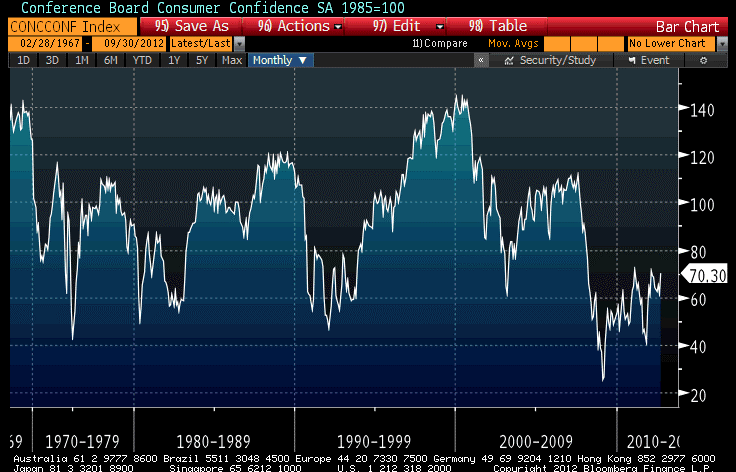
The internals of the Confidence number are not as good. Both “current conditions” and the 6-month ahead outlook improved, especially the outlook (when ‘my guy,’ whoever your guy happens to be, will be in the White House six months from now, surely things will be better), but the “Jobs Hard to Get” subindex, which is highly correlated with the level of the Unemployment Rate, barely nudged lower. Still, as depressing as it sounds, consumer confidence is a relative bright spot among recent data.
Home prices, as we have documented several times, are rising and the S&P/Case Shiller Home Price Index confirmed that by reaching the highest level it has seen since 2010. The 20-city composite is now rising at 1.2% year/year, which doesn’t sound much but is the highest rate of change since the dead-cat bounce of 2010. Keep in mind that the index methodology involves a fair amount of smoothing, so it lags the actual improvement in the market. By comparison, the RadarLogic 28-day composite index as of the end of July recorded the highest year-on-year change since 2006 (see chart, source Bloomberg).

Also relatively good news was the Richmond Fed Manufacturing Index, which rose to +4 – not as good as it was earlier this year, but 23 points above its July low. The Richmond Fed district includes the “toss-up” battleground states of North Carolina and Virginia and the “leans Romney” state of South Carolina. It is encouraging that manufacturing in this region (with its 28 toss-up electoral votes) is outperforming activity in the Dallas Fed district (Texas, northern Louisiana, and southern New Mexico, none of which are considered toss-ups), the Chicago Fed District (which includes Michigan, most of Illinois and Wisconsin, and 6-electoral-vote-toss-up Iowa) and the Philly Fed district (which is Pennsylvania, NJ, and Delaware, and no toss-ups). This is merely an observation, and even if there were clear indications that the Administration was directing money towards projects in battleground states I wouldn’t object to it – that’s one of the prerogatives of incumbency. If you want that prerogative, work hard so that you can get to be the incumbent.
While the data points today were good, stocks gave up the ghost and managed to lose most of the post-FOMC rally. That doesn’t really shock me so much. Commodities, which should be more sensitive to inflationary monetary policy, are down outright since the Fed declared an unbounded easing policy, and both markets have rallied since June on the growing expectation of QE3. The fact that QE3 was larger than many observers expected caused some short-covering on the news, but I suspect most investors who thought QE3 was coming were already long their preferred assets. The actual open-ended Fed buying will definitely buoy commodities (which remain undervalued relative to past QEs) and might lift equities (which, however, offer fairly weak prospective real returns given the current market valuations), but we had already priced in some expectations.
And in the meantime, while today’s numbers were not bad, the overall picture remains pretty weak. I think the threat of sequestration at the end of the year will start to affect growth more seriously in October, because the end of the fiscal year for government expenditures is September 30th. Businesses that have the government as a significant client recognize that they may well be in Limbo on October 1st. This is what happens when government spending is 40% of GDP! The sequestration doesn’t happen until January, so spending from October until December in theory will be unaffected. But, in practice, the government enters into contracts (for equipment and construction, for example) that cover many months, and it isn’t entirely clear whether for example the Defense Department can enter into a one-year contract if it isn’t known that the money will be there. I know several people in businesses that are directly affected by this issue, and they’re concerned about it now, not just in January.
.
I saw an interesting study by State Street Global Advisors mentioned in a Pensions & Investing Online article. According to the study, about ¾ of institutional investor executives consider a ‘tail-risk’ event in the next twelve months to be likely. But here is the interesting paragraph in the P&I article:
“Survey respondents — money managers, family offices, consultants and private banks — expect the five most likely causes of a tail-risk event in the next year would be a global economic recession (36%); a recession in Europe (35%); the breakup of the eurozone (33%); Greece dropping the euro (29%); and a recession in the U.S. (21%). (Percentages total more than 100% because respondents could select multiple causes.)”
Apparently, ‘inflation’ isn’t even on the radar as a tail risk. Of course, as an investor, what is more important than the tail risks you can estimate the probabilities of are the tail risks you aren’t even thinking about or can’t estimate the probabilities of. Incredibly, not only has the myth that recessions cause disinflation and deflation failed to weaken during the last few years, when weak growth has been accompanied by accelerating core inflation, it seems to have strengthened! While investors, as evidenced by the performance of inflation-linked bonds and of breakevens (and inflation swaps) and commodities, believe that inflation might well be a risk, it doesn’t seem that many investors are focusing on it as a tail event. That is, they expect that a “bad” inflation outcome might be 2.5% or 3.0% core inflation. An outlier event to them may be 3.5% or 4.0%.
But what we know about inflationary outcomes is that if anything, they have tails that are quite long. And there’s plausible reasoning which can produce very high numbers for that tail; see for example my article from late last month – before QE3 – called “What Keeps Me Awake At Night.” I always take care to say that these concerns aren’t predictions, but they are plausible possibilities, and the bottom line is that we don’t really know how these relationships work at this scale. No central bank has ever dealt with numbers like this. It is a known unknown, and thus a source of a tail risk of indeterminate length.
In my opinion, when it’s cheap to insure against such risks then it ought to be done. Presently, you can (as an institutional investor) protect against the risk that inflation will compound at greater than 4% for the next ten years for roughly 2.2% of the notional amount, or 22bps per annum. There are multiple ways to do this, some of which may be cheaper and all of which are beyond the scope of this article – but the point is that we have investors enumerating downward “tail risks” on growth while equity margins and valuations are high, and largely ignoring “tail risks” on inflation that could damage a number of different asset classes. I see lots of potentially dangerous scenarios for equities in October, several (but not all) of which are also dangerous for bonds.
Summary Of My Post-Employment Tweets
Here is a summary of my post-Employment tweets at @inflation_guy, for those not on Twitter and those who just want to see them all together. I also include a chart and some commentary:
- Ouch. #Canada added 1/3 as many jobs as the US did last month, and that nation has 1/9 of the population.
- Awful payroll data – 34k lower than expected with an additional -41k revision.
- Unemp rate fell from 8.254% to 8.111%, looks like a 0.2% fall but only b/c rounding. And it was all labor force shrinkage.
- Saw comment that the unemp # matters politically. No it doesn’t. These are numbers. What matters is what people feel is happening. And
- ..and with employment, the man on the street doesn’t need the government to tell him if the employment situation sucks.
- Weekly hours back to where we started the year. And Participation Rate now at the lowest level since 1979.
- One thing this ought to do is quiet the conspiracy theories about how Obama is cooking the numbers! Couldn’t have cooked up worse.
- Internals even worse: I follow “Not in Labor Force, Want a Job Now”. Highest since they strted asking that qn: [Note: I include this chart below]
- 7 million people aren’t even looking for work, but want a job and would take one if offered. 7 million!
- Don’t worry too much about hourly wages meaning deflation is coming. Wages follow #inflation, they don’t lead.
Here’s the chart referred to in the second-to-last tweet (Source: BLS):

Republicans, don’t cheer because we got a weak number. It isn’t the number that causes trouble to the Obama campaign; it’s the perception of the job market and that’s not necessarily correlated to the number itself. Perceptions were already bad, and it’s more likely this number is slightly understated.
Democrats, don’t cheer because of the decline in the Unemployment Rate. You might think it makes a nice talking point, but if you crow about the improving labor market people will think you’re an idiot. The labor market isn’t improving. It’s stagnating, at best; at worst, the crisis in Europe and the weakening of growth in Asia is dragging our increasingly export-sensitive economy down.
In fact, both sides of the aisle should be crying. But watch stocks jump! It’s a little disappointing to me, actually, since more pundits will now get the QE3 call right. However, this number didn’t “seal the deal” – it was already sealed, and the Fed was going to be easing next week no matter what today’s number was.
Tempestuous Times
At last, we are in the home stretch of August. This month has been excruciating by any measure – even by the measure of normal Augusts. Heck, even by the standard of normal Decembers; right now, New York exchange volume is on pace to be 15% less in August than on the slowest December in the last decade-plus.
That’s remarkable, but I remain unsure of the significance of this lull. We are plainly in the midst of a secular decline in trading volumes, and at least some of that is healthy since there was probably too much of the frenetic, momentum-type trading that adds to swing amplitudes. The flip side, though, is that some of the decline in volumes reflects a decline in market-making activities, which are typically ‘speculative’ in that they are short-term in nature but nonetheless add liquidity and decrease swing amplitudes. Again, I don’t have a clear answer to this.
It is tempting to say that it represents part of what Bill Gross means when he says “the cult of equity is dying.” Maybe it does, but I don’t see a lot of evidence that the cult of equity is dying. The average pension fund today has maybe 50% stocks rather than 60% stocks, most 401(k) accounts don’t offer commodity funds or inflation-linked bond funds but instead 12 flavors of equity funds, and Jim Cramer is still on the air.
Still, faith in “the system” is indeed at an ebb that hasn’t been seen since my lifetime, anyway. Perhaps in the 1970s the counterculture lost faith in America, but the majority still believed that working hard resulted in a person getting ahead, and that one’s children were likely to enjoy a higher standard of living than one’s self. Most of us would still like to believe this, but at least one party believes strongly that these days you can’t get ahead without a hand up, and members of both parties (and every sentient being) knows that the entitlements currently promised virtually assure that our young are being yoked to the Medicare plow. And yet, stocks trade above a 20 Shiller multiple and 30-year bonds sport a 2.80% yield!
Tempestuous times tend to produce momentous change.
We remain in tempestuous times, although we heard nary a peep from Europe this month. The global economic system is creaking again. On Friday, Durable Goods was much weaker than expected, with core durable orders -0.4% and revised downward by -1.1% to the prior month (from -1.1% to -2.2%). That produces the lowest year/year growth in core Durables since early 2010. As the Fed pointed out in their minutes, the U.S. economy is not ready to take another punch, and another punch may well be coming from Europe in the next few months.
It is therefore not surprising that presumptive Republican nominee Mitt Romney says that if he is elected, he would not re-appoint Ben Bernanke to be Fed Chairman when his term ends in a year and a half (January 31, 2014). In good times, candidates want to bestow laurels on the Fed Chairman (such as when Arizona senator McCain in a 1999 debate said that if Chairman Greenspan were to die in office, ‘I would do like they did in the movie Weekend at Bernie’s. I’d prop him up and put a pair of dark glasses on him and keep him as long as I could’), whatever his merits.
It is also not surprising, in times like this, that a political party (again, the Republicans) would consider a platform plank calling for a full audit of the Federal Reserve as well as one calling for a commission to study a return to the gold standard. These are momentous proposals! Change is a good thing, but in times like these we must always be careful of deploying change for change’s sake. I don’t think any of those proposals would threaten the republic, but going back to a gold standard would be too much in my opinion.
I don’t think a commodity or gold standard is necessary, if the central bank is run correctly, and in fact such a linkage could create rigidities that prevent some of the automatic stabilizers in the macroeconomy from working correctly. But it comes down to a question of whether central bankers can be trusted to do what they can, and to understand what they cannot do, and to eschew what they can, but should not do. Organizationally, I am not sure any groupthink body can manage something as complex as the U.S. macroeconomy, to say nothing of the world economy.
So what’s the alternative? ‘Ending the Fed’ and returning to a gold standard is one solution, but it sort of throws the baby out with the bathwater. Paul Ryan’s proposal in 2008 to limit the Fed’s mandate to only inflation, rather than the impossible dual mandate, would be significant progress (and is unlikely to happen). Failing that tweak, I still think the Federal Reserve can be more effective than it has been through the last two Chairmanships. The middle road between a gold standard and a continuation of business-as-usual – which would have, incidentally, completely opposite implications for inflation – is to appoint a better Chairman. A person who has a steady hand, a healthy respect for the difference between data and facts (data are just estimates of facts, not the same thing), and a healthy respect for the difficulty of certainty. A person who (as I say in my book) recognizes that the person running the Fed is in a short-options position, and therefore should focus on doing only the things which clearly must be done. A person who won’t tinker.
Now, we’re unlikely to get such a thing, because the prevailing wisdom is that the central banks should do everything they can. They should be in continuous motion, balancing and re-balancing, optimizing and re-optimizing. Choosing between that on one hand, or a gold standard on the other, is a much harder choice.
.
Speaking of commodities, the market seems to believe that we’re more likely to keep our activist central banks than to get a gold standard, and hence more likely to get inflationary rather than disinflationary/deflationary outcomes. The chart below shows the current technical condition of the DJ-UBS commodity index. As regular readers know, I don’t spend a lot of time looking at technical analysis; I do, however, think it can be useful in testing hypotheses and in ‘taking the temperature’ of the investing public.
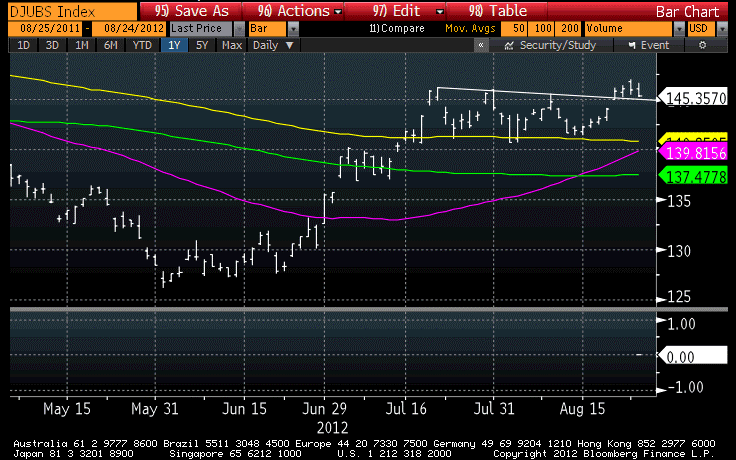
The DJ-UBS chart shows a break higher from a base on the last day of June, followed by a consolidation in early July that produced a second breakout and a longer consolidation band. This second plateau, covering late July through mid-August, seems to be resolving higher as well although without the sharpness of the prior thrusts. But the crucial test is whether the index can remain above 145 here and extend higher.
The evolution of Tropical Storm Isaac may help. While so far all the storm has done has been to cancel one day of the Republican convention, it is moving into the Gulf of Mexico and generating the possibility of disrupting gas and oil production there. It is not expected to strengthen above Category 2, so this isn’t going to have the monstrous effect of Katrina, but it won’t hurt the technical situation of the commodity indices any.
So what do these tempestuous times and momentous changes mean for markets? At the moment, they mean little, because the momentous changes are unlikely to happen if the current Administration wins a second term. But for the first time in a very long time, the two parties are offering very different views of America and very different plans; and that means that for the first time in a while, it actually may matter to the markets which party actually rules once the votes are counted. At present, polls have the Presidential race very tight, but with the Republicans favored to pick up some seats in the Senate and to retain control of the House. There is a chance, although still odds-off, that the Republicans gain control of both houses of the legislature and the executive branch as well. The difference in the policy portfolio in that circumstance, compared to the status quo or one in which the Democrats seize control of the House of Representatives as part of a general electoral landslide (this is much less likely than the reverse, since the House is the body that is most skewed at the moment – towards Republicans), is huge.
Is a Republican sweep good for bonds, since the fiscally conservative credentials (if taken at face value) would imply lower future debt issuance, or bad for bonds, because a President Romney would make QE3 less likely? This isn’t entirely clear to me, but more volatility and consequently more volume seem likely, as more focus turns to these polls over the next month or two. This election will matter to markets.
Let the (Political) Games Begin
The Olympics are over, so the political games begin in earnest. Over the weekend, presumptive Republican Presidential nominee Mitt Romney made his first revealing executive decision when he tapped Wisconsin Congressman Paul Ryan to be his running mate.
The selection changes the contours of the U.S. political race, as veep selections often do. It probably does not create any near-term consequences for the markets, but as and if the Romney/Ryan ticket gains in the polling (as they surely will; for starters, announcing a VP pick almost always produces a bounce but also this tends to energize the base that Romney absolutely needs good turnout from to win) it is likely to be beneficial to equity markets at the margin. The improvement, if it happens, will not be uniform. Some industries, such as autos, which benefit from direct government largesse will probably do worse; but the notion that smaller government may be in train with somewhat greater probability is likely to have positive impact on perceived long-term values. And any possibility that a fiscal conservative (that is, Ryan, not Romney) might be a senior member of the executive branch is likely to have salutatory effects, all else equal, on U.S. Treasury credit as well.
More than likely, these effects will be mere ripples in a much more turbulent pond. In an ordinary Presidential election cycle, markets and market sectors can ebb and flow with the fortunes of the incumbent and challenger; this cycle though is anything but ordinary. European events can, and most likely will, dominate the macroeconomic picture as well as global risk appetites and foreign exchange swings. Which is to say: you can cheer for whoever you want in this election, without worrying whether it will help your investments!
While most of Europe remains on holiday (and more and more Americans seem to want to emulate that behavior), market action remains excruciatingly slow. At 3:15 ET today, New York exchange volume was only 275 million shares and even the usual surge into the close only brought the total to 450 million. In a year of slow days, this was slower than slow. In fact, I was only able to find one session (other than half-sessions around Christmas or Thanksgiving) in the last ten years or so that had a lower volume number: the Monday after Christmas in 2010!
This lack of liquidity, with the stock market so near to setting new (nominal) highs for the year, creates instability even as it appears to suggest stability. As I argued last week, when liquidity is low there is a larger cost to initiating any move – but any move that happens is likely to be bigger.
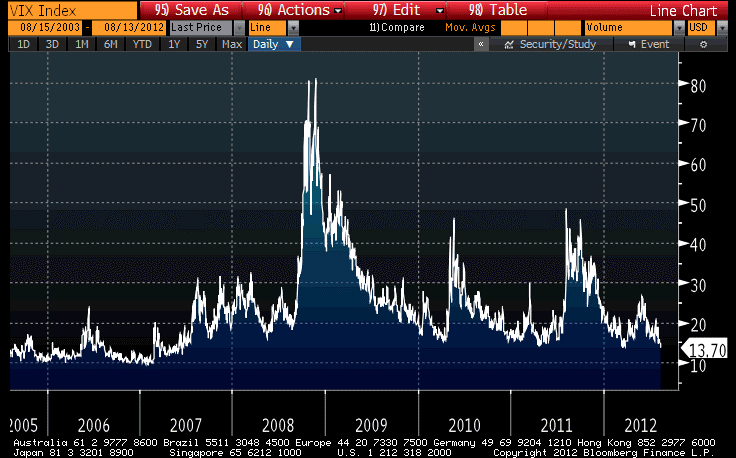
Add to that the fact that many investors have turned to covered-call writing to earn “extra income.” Admittedly, I only have this anecdotally, as I was approached at a backyard party recently by someone who was writing naked puts (actually, they were writing covered calls, but because of put-call parity we know that that is exactly the same as writing naked puts with the same strike) and seemed to not understand my question about whether implied volatility was high enough to make that worth the risk.[1] Which, since the VIX is at its lowest level since early 2007, it’s probably not (see Chart, source Bloomberg).
If this anecdote generalizes, and there is widespread selling of options, then it takes a dangerously-illiquid situation and makes it even less stable. With lots of gamma outstanding, what tends to happen is that small moves become microscopic moves since long-gamma hedgers try to recapture their time decay (selling rallies and buying selloffs), but large moves become really large moves because short-gamma investors try to save themselves from blowing up (buying into a market rally that they’re missing, or selling stocks that are abruptly plunging, overwhelming their small ‘income’ advantage). I would be a much better buyer of options here, even in the middle of boring August.
Now, although markets are currently quiet, and government committees and the like are less-active as well (and in the U.S., elected officials are heading out to politick for the next few months), it doesn’t mean that there’s a complete lack of action. Indeed, with Dodd-Frank now steamrolling towards implementation, there are pockets of frenzied activity! One story that I saw today (which has nothing to do with Dodd-Frank) is interesting to investors since it lowers the hurdle for eliminating the payment of Interest of Excess Reserves (IOER). The title of the P&I Online story was “Money fund firms prepping in case SEC breaks the buck,” and it described how the SEC plans to vote on August 29th on whether to issue a formal proposal requiring the sponsors of money market funds to either create a ‘capital buffer’ (perhaps similar to what the NY Fed recently proposed, and I mentioned here) or adopt a floating NAV policy rather than guaranteeing a $1 price.
We’ve discussed both of these proposals before in this space, but for today the significance is that if the floating NAV policy is generally adopted by money funds, the argument that a zero IOER could destroy money funds goes away. Since this is very likely to happen soon, either alone or as part of a parcel of monetary policy maneuvers, it is not insignificant that the SEC is pressing this issue.
.
Tomorrow the scheduled economic data includes Retail Sales (Consensus: +0.3%/+0.4% ex-auto). Core retail sales have been negative for the past three months in succession, something we hadn’t seen since mid-2010. Four in a row would make the streak the longest since 2008, and I think it would be taken quite negatively by the markets. A positive print by Retail Sales isn’t terribly significant by itself, since the series is quite volatile, but may be enough – even though expected – to continue to push the bond market lower.
[1] Note: if you do not understand and/or are not intimately comfortable with the definitional equivalence between a covered call and a naked put, then I will put my “friendly advice” hat on and beseech you, for your own good, not to sell options until you do!
It’s Not Hot Money Any More
Those rascals! While everyone was focusing on whether Greece would exit the Euro in the near-term (there’s little question they will exit the Euro eventually), over the weekend German Chancellor Merkel and German Finance Minister Schaeuble urged Spain to request a bailout so that it can reinforce the condition of its banks.
Now, we all knew that was probably coming eventually as well, but last week there had been data showing that deposits have been moved out of Spanish banks in recent weeks and so European policymakers are rightly concerned about a full-scale bank run in the absence of credible (that is, not backed by insolvent sovereign entities but by cash in a fund) deposit insurance on the Continent.
So add Spain to the “To-Do” list, and also to the list of potential arguments. While Germany suggested Spain look for help, Merkel also made clear, again, that Germany will not stand for Eurobonds. Some people seem to think that Merkel is just bluffing. For example, the Wall Street Journal ran a curious article entitled “Germany Signals Crisis Shift” which suggested that “Germany is sending strong signals that it would eventually be willing to lift its objections to ideas such as common euro-zone bonds or mutual support for European banks if other European governments were to agree to transfer further powers to [a central authority in] Europe.” I don’t see anything in what Merkel said, or what her spokesman later clarified, that suggests Merkel would support Eurobonds in almost any set of circumstances – or, at least, relevant circumstances, meaning something that might actually be useful in this crisis over the next year or two.
Merkel is not bluffing. I know this because there is no point in bluffing if you are sure you will be called anyway; in fact, the only reason to bluff is if there is a chance that you will not be called. There is certainly no chance that Merkel saying she’s opposed to Eurobonds will kill the desire in other quarters to have Eurobonds, so I can’t imagine she is trying to defuse that discussion by bluffing but will later cave in. She’s believes in her position, and Eurobonds are dead-on-arrival.
Also kicking around is the idea of a “banking union,” which essentially means that all of the drowning people will embrace and agree to help one another. Spain cannot bail out her own banks because she cannot print money to do so (that was what she tried to do by issuing bonds to Bankia that would be discounted at the ECB in exchange for cash) and doesn’t have enough assets or revenue to do so otherwise. So the idea of a banking union is that all banks would be part of a single network backstopped by Europe. Since that means in the current instance that Germany would have to bail out Spanish banks, and since there are no mechanisms in place to do this in any event, we can also put this idea to one side. It’s an idea for the distant future, one in which Europe survives as a single institution. It doesn’t help in 2012 or 2013, and the reason it is being discussed can only be because authorities think, or hope, that talk along these lines will improve depositor and consumer confidence. Good luck with that.
Stocks had sagged in the U.S. for most of the day, coming ever closer to wiping out 2012 gains for the S&P, when a story came out saying that the G7 will hold “emergency Euro Zone talks tomorrow.” This top-secret meeting was leaked because, again, policymakers are trying to get the nail hammered down without actually having to use a hammer. It won’t work, and so one hopes that the meeting will end with some useful pronouncement. Perhaps a pledge of a coordinated reduction in global swap line rates, or global LTRO, would get a brief pop out of markets. But I doubt it will calm things enough.
The problem is that the big elephant investors are moving, and/or have already gone through the trouble to have changed their country allocations and investing approach. That’s not hot money. That’s not a flow that will reverse overnight. Institutional investors have developed serious and reasonable concerns about the investing climate in Europe, and there will have to be a convincing end to the crisis – or prices low enough that the crisis is fully discounted – before these investors will come back. Investors in motion tend to stay in motion, while investors at rest tend to remain at rest. The inertia has been overcome, I think, so the time for bold-sounding meetings with no concrete results is over. Pops on news such as that will likely be increasingly short-lived.
The Not-Laid Plans Of Mice And Men
The nice aspect about Europe being the only thing that matters these days is that I don’t have to wait until the end of the U.S. trading day to begin writing an article. All of the damage is done early in the day, and then we watch the markets trade more or less sideways or sometimes even correct a bit once the sun sets on the Continent.
Wednesday was no different. Earlier in the week, there had been some optimism that Greek voters on June 16th might vote into power a bailout (and austerity)-friendly coalition. With weeks to go before the election, this seems a thin reed on which to base a strong rally, especially since the polls in question are both highly variable and highly suspect, given the perceived extreme importance of the election. Personally, I don’t see the election being extremely important – mathematics trumps politics, so no matter who wins the election the outcome won’t change. Greece will almost certainly leave the Eurozone, and the only questions are how soon it will happen, and how prepared Euro institutions will be. The answer to that latter question is somewhat frightening, since the headlines last week focused on how this country or that agency or that supranational organization was “discussing contingency plans” in case Greece exits the Euro. It is incredible to me that such a contingency hasn’t already been discussed in each of these institutions sometime over the last year, even if a Greek exit was seen as very unlikely. It’s prudent to plan! (Then again, I spent hours last night getting home because New Jersey Transit had no plan in place describing what to do if a tree fell on the tracks).
The optimism early in the week faded quickly and markets were more or less in rout mode today. Spanish 10-year yields rose to 6.65% (see Chart, source Bloomberg), near a new crisis high, so we are only days or at most weeks away from that situation coming to a head.

In Spain, the bailout of Bankia has taken on a drama all of its own. The original estimate of the size of bailout required was, of course, too low. Spain cleverly proposed to inject €19bn of its own government bonds to Bankia, that is would then use as collateral to borrow actual money from the ECB. Spain would count this as an investment, rather than as a debt, so that it would improve the country’s balance sheet rather than worsening it. The ECB thought this too clever by half, and by the way far too transparent a violation of the ECB’s stricture against “monetary financing of governments,” and rejected the plan out of hand.
But that’s okay, because this morning some EC functionaries passed around the notion that they were “open” to using the ESM to lend directly to banks. Markets rallied euphorically but briefly on this news, but the rally quickly failed on some little details…such as the fact that the ESM isn’t set up yet. Actually, the best discussion of the merits and demerits of this idea was Peter Tchir’s article “National Acronym Day in Europe. Don’t Underestimate the ECB.” Pete explains why there’s some desire to use the ESM rather than the EFSF:
“If ESM can be launched, and it can get a banking license, then the EU has a powerful tool. The ESM is allowed to do all the things the EFSF can do – participate in new issues and the secondary market and lend to countries for them to support their banks. Without a banking license its firepower is limited. With a banking license it can leverage itself to a very high degree and can tap all the cheap funding already in place and whatever new programs the ECB decides to launch.”
As Pete and others noted, the fact that the ESM isn’t set up yet is an important qualification of this idea. The other qualification is the fact that Germany and Finland, whose backing is absolutely required if the ESM is to have any value at all, flatly rejected the idea.
Markets erased all of Tuesday’s gains and then some, with the S&P dropping 1.4% on the day. Commodities, which increasingly seem to be suffering from divestment flows (and possibly momentum players on the downside), fell also with the DJ-UBS down 1.3%. That index is -8.4% on the month, even worse than the -6.1% of the S&P. NYMEX Crude was -3.7%, Gasoline -2.2%. In fact the commodities for the most part were down in direct proportion to their liquidity, with the main exceptions being gold and silver. Yes, the dollar is strong versus the Euro, but it is weak versus the yen! The buck is nearly 6% weaker versus the Yen since its highs in March, and 7% stronger against the Euro. Fortunately for commodities bears, Asians don’t use commodities…right?
Confounding expectations, including mine (although thank heavens I covered that short-bond trade), nominal and real rates continue to decline. The 10y Treasury yield hit 1.62%, 13bps lower on the day, while the 10y TIPS rate fell to -0.48%. The 30-year real rate is now only 0.55%. While real rates and nominal rates continue to hit record lows, inflation expectations do not. 10-year inflation swaps ended the day around 2.41%, well below the 2.75% of March but still well above the 2.20% of last autumn, the 2% of autumn 2010, and the 1.25% of late 2008 (see Chart, source Bloomberg).

As silly as it was for the EC to propose using an ESM that isn’t even set up yet, I actually think that the idea is targeting the right response in a way. The best (remaining) solution, in my view, involves kicking out the weaker members of the Euro and then bailing out the banking system with the huge amounts of money that will be required. Yes, it will have to be printed because there’s just not enough real capital available. But the Euro is untenable in its form, at least now. And any disaster that supposedly follows the exit of one or more members will primarily stem from the carnage it would inflict on a financial system that is loaded to the gills with sovereign debt.[1] Bailing out the financial system – not indiscriminately, mind you, but favoring the stronger albeit not necessarily the larger institutions – won’t be popular but is not entirely unfair in this case since the banking problem in Europe was partly caused by dumb regulatory risk weightings that encouraged banks to hold more sovereign debt, partly by ill-considered moral suasion used to persuade banks to hold more sovereign debt, and only partly by poor risk management.
That solution will never happen, because it would require a whole lot of legislatures to authorize some extreme solutions, and such an approach is not politically palatable. What is more likely to happen, because it is constituted of bite-sized political pieces, is closer to the worst case: don’t kick out the weaker Euro members, so that the imbalances remain, and bail out banks in serial fashion rather than all at once.
Not that there weren’t better solutions, mind you, in the past – but the time for them is gone. We’re down to just hard solutions. In this case, the cheapest fix remaining will be liberally applied: cheap money. Yes, I know that the Fed is insisting (as Fisher did today) that more stimulus isn’t needed. And they’re right, because stimulus doesn’t work. But it’s still perceived as a cheap lunch, and as the situation in Europe worsens and the bank runs accelerate, central bankers will fire up the technology that fired up Bernanke’s imagination back in 2002: the printing press.
Back on the boring side of the Atlantic, tomorrow ADP (Consensus: 150k) and Initial Claims (Consensus: 370k) will be released. There is reason to be wary of these numbers. Last month ADP came in at 119k, which was well less than expectations. History shows that with ADP economists tend to miss in the same direction at least a few times in a row, so another soft print is likely. It’s unlikely to show the economy is collapsing, but it will reinforce the sense that the U.S. economy is slowing, and unlikely to be robust enough to pull Europe (and perhaps China) out of the tailspin. This will not hurt the bond market, but if the data is weak…yet not dramatically weak…then equities may get a bounce from the idea that QE3 just got closer.
[1] Of course many other businesses will suffer losses on cross-border contracts that were poorly constructed, not providing a fallback currency arrangement to the Euro. This violates the girlfriend rule of thumb: Don’t make plans that are further in the future than you have been together so far. Greece joined in 2001, so if you wrote a contract in 2007 that went further out than 2013 without a fallback mechanism, shame on you!
Copernican Economics
I start the second quarter on the road in beautiful Cincinnati, but I have some time to pen a few thoughts tonight (aside: will our grandchildren even know what it means to “pen” a few thoughts, or will they “pad” them?)
My first thought is that for the second month in a row, commodities ended weakly and then surged on the first day of the new month. Today, despite weak global data – although ISM was slightly stronger-than-expected – industrial metals and energy led the commodity complex higher. This is of course what we expect as the price level rises: microeconomic concerns of supply and demand in individual markets operate on the real clearing price, not the nominal clearing price; this latter should rise with the transactional money supply (though defining that is sometimes problematic) times money velocity. It continues to amaze me that commodities are as weak as they are, but today the DJ-UBS index rose 1.3% and national gasoline prices reached $3.92/gallon (and are still rising).
My second, unrelated, thought concerns the impact that weakening European growth (Fiat sales were -36%!) will have on the global economic crisis, which is assuredly not over and will not be over until the Euro changes membership or disintegrates completely – and, more importantly, on the participation/support of the United States for European sovereigns and institutions.
Until now, the U.S. has wisely remained above the fray (and the fraying); although the Federal Reserve has aided the ECB, the U.S. has pointedly refused to add its heft to the IMF and demurred against providing other aid. I say that this is wise because the European experiment should succeed or fail on its own merits. It does no good for the U.S. to keep alive a failed institution, whether that institution is industrial (as with GM or Chrysler, one of which ought to have failed) or quasi-sovereign (FNMA or FHLMC, at least one of which ought to have failed) or sovereign. On this final point, at least, the Administration has concluded that the costs of involvement far, far outweigh the potential benefits of involvement.
But if the European crisis starts its next unraveling in the next few months, the U.S. will enter the arena with, I think, a large contribution of support. What is a couple hundred billion when an election is at stake? The current “firewall” has barely enough height, once already-committed funds are deducted, to contain a modest campfire. When Portugal and possibly Spain step up to get aid, it will be a damned-if-you-do, damned-if-you-don’t moment for the Administration because both paths are painful. Americans clearly do not want to subsidize European institutions, and so (in contrast to the usual tin ear this government has displayed with respect to the People’s wishes) it has been relatively easy to deny the IMF the help it desires. But if there is an election in the offing, and a crisis threatens to burst into bloom in August or September? I believe they will quickly choose to take action they can characterize as “decisive action” to avert the crisis and portray themselves as stewards of global economic health. It isn’t clear to me that it will play to the positive for the President’s party, but I think given the Hobson’s choice they will choose to be involved.
And that might spell the end to the dollar’s strength, which is more due to every other developed currency’s weakness than to the strength of our own system.
The third, also unrelated, thought concerns St. Louis Fed President Bullard’s presentation in China last week, which a friend thoughtfully sent to me. The presentation concerns the question of whether the proper metric for monetary policymakers is not the domestic output gap but the global output gap. See, the problem is that the large domestic output gap is not consistent, as I’ve pointed out ad nauseum, with the fact that core inflation with or without housing has been accelerating for well over a year in the U.S., Europe, UK, and Japan. Thoughtful policymakers by now should have dispensed with the many-times-discredited notion that output gaps matter to inflation. I said in 2008 that the crisis would be an outstanding test of the two main policy theories: one, that money causes inflation; two, that growth causes inflation. For the first time in many years, money growth and economic growth were moving sharply in opposite directions by meaningful amounts. In the event, it has been a slam-dunk win for the monetarist crowd. More money has meant prices rose, even with a huge output gap. And even with declining money velocity. And even with 40% of the consumption basket, Housing, collapsing from a bubble.
While addressing the question if it’s the global output gap, rather than the domestic output gap, that matters (a reasonable question, since we know that something like 65% of domestic inflation comes from common global sources), Bullard’s Powerpoint presentation is initially encouraging. When he cites evidence, he includes the clear observation that “One study for Europe found that the global output gap did not appreciably impact Euro-area inflation from 1979-2003,” and there are several others. Unfortunately, he then argues that since the global economy is now much more fully integrated, maybe it will have an effect in the future. Indeed, he says “the global output gap idea may be the ‘wave of the future’ rather than an explanation for past economic outcomes.”
It is incredible to me that economists can’t bring themselves to simply abandon a theory that has not worked in practice. Not in the 1970s, not in the 2000s, not in Zimbabwe, and so on. They work hard to posit tweaks to the model that can explain the most-recent aberration.
When I was first entering the business, I worked for a company that did technical analysis, and I helped design quant models. One of the greatest sins was to design a model and, the moment it didn’t work in real time, to make a new rule to carve out the recent underperformance. If the out-of-sample test doesn’t work, you need to question the whole theory, from first principles.
But I’ll go further with my analogy. Prior to the development of the heliocentric model of the universe, courtesy of Copernicus, the previous-best theory was that the heavens revolved around the Earth. The problem was that certain observations did not comport well with theory. In particular, astronomers noticed that some stars – dubbed “wanderering stars,” the Greek word for which became “planet” – occasionally seemed to reverse course and head in the opposite direction they had previously been observed to travel. This “retrograde motion” clearly did not agree with a model in which all of the stars were fixed on a spherical firmament that rotated around the Earth. So, astronomers did the only thing they could do.
They fudged it.
Astronomers invented the concept of “epicycles.” These ‘planets,’ it seemed, existed on other spheres that rotated in the opposite direction but which were attached to the grand sphere. Epicycles made the theory fit the observations. Of course, it was wholly wrong, and Copernicus in time developed a model that was entirely consistent with observation without needing “epicycles” – simply by noting that if the Sun, rather than the Earth, was the center of the universe then we could observe such phenomena.
President Bullard, abandon this theory. You were so close to saying it! Just say that the theory that output gaps affect nominal prices (as opposed to real prices and exchange rates of the factors of production, which they can reasonably affect) doesn’t fit the observations, and be the Copernicus of economists.
None of this has anything to do with market action, but then market action these days has very little to do with anything in the news. Equities will eventually falter, and then the comeuppance could be severe; bonds rallied today but the future is grim aside from occasional flight-to-quality or Fed-frontrunning, and the risks of downside relative to potential upside gains make long duration positions foolhardy. And everyone loses to inflation, which continues to accelerate. These are the trends, although other people would read the trends as being “bullish stocks, bullish bonds, and inflation to fall.” I question the prevailing wisdom.
Dueling Prophets
What promises to be a fairly interesting week started slowly. I expected that over the weekend we would have started to hear about private holders of Greek debt that would announce plans to tender their bonds in the PSI.
And we did not.
Surely, prior to releasing the details of the PSI, Greece and the Troika had orchestrated such announcements, in order to create a sense of momentum, of fait accompli? To fail to do so is just another gross incompetence, another terrible mistake on something it is easy to get right. Behavior matters; perception matters. Make those planning to hold out feel some pressure early…but they didn’t, which creates the opposite impression – “hey, they don’t have the votes!” And so today, we finally heard from holders that the IIF represented, and we learned that group only amounts to about a third of the bonds outstanding. That’s it?
Meanwhile, hedge funds account for about ¼ of the bonds. Now, I am not one of those who think it’s automatic that evil hedge funds will hold out (although if they’re exploiting the dummies who put this together, I almost need to cheer), since hedge funds understand that their continued existence is subject to the whims of regulators. Hedge funds, while motivated by lucre, are generally motivated by long-term lucre. On the other hand, it’s probably also fair to surmise that the ones who didn’t want to be involved in what is likely to cast their firms in a negative light have already sold their bonds and that therefore most of the ones remaining are not planning to tender.
Since Greece needs 2/3 of the bonds to tender and 1/3 has said yes while ¼ is likely to say no, it follows that about 80% of the remaining bonds need to be tendered or the PSI will fail. I think that’s a possibility, but in any event the success of the PSI certainly isn’t the sure thing that has been factored into the market in the days since the deal was announced.
So will the default, if it happens, and the likely exit of Greece from the Eurozone, end all multi-cellular life[1] on the planet?
One answer to that question was carefully leaked today by the IIF, the organization which was responsible for negotiating the surrender Private Sector Initiative. It falls squarely in the camp of “a disaster of epic proportions,” and predicts that certainly every possible pestilence will befall the planet (with the possible exception of dogs and cats living together).
The other side of the argument was presented by Jonathan Tepper in an “Outside the Box” guest column in John Mauldin’s e-letter. He cites UC-Berkeley Professor of International Business Andrew K. Rose, who has done a study of 130 countries spanning 1946-2005 which exited currency areas or saw currency unions break up. His conclusion (cited by Tepper):
“I find that countries leaving currency unions tend to be larger, richer, and more democratic; they also tend to experience somewhat higher inflation. Most strikingly, there is remarkably little macroeconomic volatility around the time of currency union dissolutions, and only a poor linkage between monetary and political independence.”
In other words, while the Troika has surely made a bad situation worse by destroying the Greek economy rather than allow default and devaluation (which would cause the losses to fall more squarely on the rest of Europe), that doesn’t mean it needs to keep making it worse. Exiting the union would not necessarily be a disaster, if properly prepared for. Then again, if the authorities can’t prepare for the PSI deal by quickly producing enthusiastic tenders, it isn’t necessarily unreasonable to think they’ll botch this.
The difference between the two perspectives, besides the predicted outcome, is that one is based on data and historical analysis while the other seems to draw heavily on the Book of Revelation. The IIF memo also made simple logical errors, such as attributing the costs that Portugal will have to bear if Greece defaults to the Greek default; this only makes sense if a Greek non-default will make Portugal all better, and that’s ridiculous. For example, from the article cited above:
“If, by way of illustration, it is assumed that Portugal is unable to access markets through 2016, then official lenders would be required to:
- Provide €16 billion annually in financing to the government from 2013 through 2016, or €65 billion in total
- Help assure that €77 billion of term funding is available through 2016, or about €15 billion a year from 2012 through 2016, together with the refinancing for some €86 billion in short-term credit to fulfill the obligations of Portuguese banks and corporates to foreign lenders
- Help assure financing sufficient to manage some €330 billion in debt owed by Portuguese corporates and households to domestic banks, 7 percent of which are nonperforming, and some €220 billion owed by Portuguese banks and corporate to foreign lenders. (Relative to GDP, these exposures amount to 194 percent and 129 percent, respectively.)”
Well, actually, no. If Portugal is unable to access the markets through 2016, official lenders won’t be required to do anything. If they do not, Portugal will be forced to run a balanced budget, banks will default, and a number of corporate entities will fail. That’s not unlikely to happen anyway, regardless of whether Greece defaults this month, so the question in my mind is mostly just about the order of defaults and the timing of Euro exit.
So this is what we will deal with this week, along with tomorrow’s Super Tuesday slate of primaries. Equities are not handling the stress extremely well, although they managed to rally and close with only an -0.4% loss on the day. Stocks also had to deal with the statement by China’s premier, Wen Jiabao, who announced that the government had set a GDP target for this year of only 7.5% (the first time since 2004 that it hasn’t been at least 8%). I don’t think that was the main consideration of those lightening up on equities, because Treasuries also sold off (with the 10-year note back to 2.01%, up 4bps). It may have been the main reason that industrial metals dropped 1.6%. However, whether China says they’ll grow at 7% or 12%, the more important factor here is (a) does Greece defer default for a little longer, or default and exit rapidly, and (b) which side of the argument above between Tepper and the IIF is correct.
In any event, a safe stance is warranted. And keep in mind that for most investors, it isn’t Thursday that matters: long before there is an announcement that the PSI has succeeded (or more likely, that CACs will be invoked or the deal fails altogether), the market will be trading the information because some people will know well before you and I will.
[1] By which I mean complex forms of life, not people with more than one cell phone. Although, come to think of it, these may be mutually exclusive.
Inflation Stable, But Only In Passing
It’s a busy day for me, with month-end just past (and month-end was a busy day for many, with the first pan-billion-share day on the NYSE this year), but there is just too much to talk about to skip a comment today. But I will make it brief.
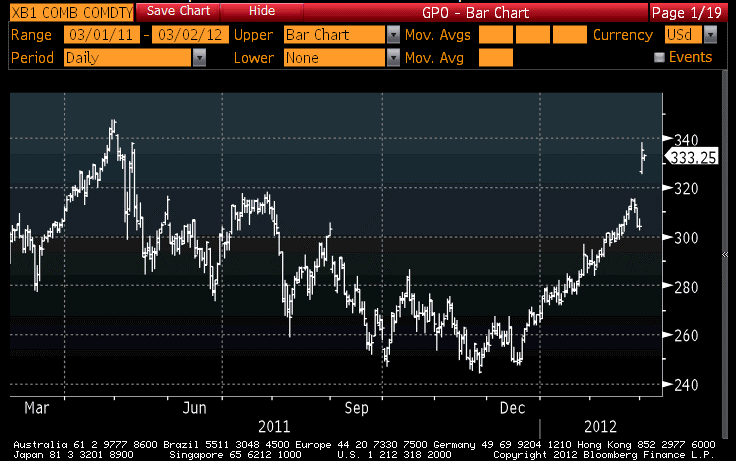
Front and center must be the huge rise in Crude Oil and Gasoline futures. Crude rose over $3 with NYMEX Crude topping $110. Some of this was due to rumors that a Saudi pipeline had been attacked and damaged, but a good portion of the run-up occurred before the rumor went around, and after the Saudis denied the rumor prices only fell back somewhat. The chart below (Source: Bloomberg) exaggerates the move in gasoline somewhat due to the fact that the front month rolled (the April contract rallied 9.45 cents/gallon, but March expired as the front month on Wednesday at $3.04 and April is now at $3.35), but however you want to look at it, this is a very high price for March 1st – in fact, the highest ever – and retail gasoline prices were already up to $3.74/gallon before this spike.
Meanwhile, the core PCE price index for January was reported this morning. While the month-on-month change didn’t round higher, the number was just enough higher-than-expected that the year-on-year number became 1.9% while economists were expecting 1.8%. Recall that core PCE is what the Fed is targeting to keep at 2.0%, and they were busy saying that the inflation dynamic had cooled (more on that later).
The Fed had previously assiduously avoided acknowledging the 15-consecutive-month acceleration in core CPI by saying that headline inflation (which they don’t normally care about) was ebbing, but now with energy prices rallying again they can’t retreat to that platitude. Core PCE is clearly still rising, and headline inflation is going to re-accelerate. I suppose Bernanke will have to focus on Nat Gas prices…that’s about the only price that’s actually falling.
Oh yes, Bernanke. Today’s second day of the Monetary Policy Report to the Congress (neé Humphrey-Hawkins) brought humor to an otherwise dry day. The Chairman was called on to defend the Fed’s extraordinary actions during the crisis (which honestly, isn’t really fair if you were busy cheering him on when they were happening, as most in Congressional oversight roles were). His defense was that (1) “we’ve had about 2.5 million jobs created,” which it turns out are the same 2.5 million jobs that the Congress and the Obama Administration say were due to their policies, (2) “We’ve seen big gains in stock prices, improvement in credit markets,” which is odd considering that he has previously claimed QE2 didn’t pump up asset markets, and (3) the actions helped produce a “more stable inflation environment.” In honor of baseball’s spring training: strike three, you’re out! I suppose a snapshot of a vase falling off a table looks stable too, as long as you don’t wait until it hits. Inflation happens to be near 2%, but that’s a coincidence of timing. It’s around 2%, on the way to someplace not particularly near 2%.
And it’s not just me who is saying so. Yesterday, Plosser was predicting the Fed could tighten policy this year and I noted a St. Louis Fed economist highlighting inflation risks; today FRB Atlanta President Lockhart predicted that if the Fed started QE3 it could cause inflation while not spurring lending. However, do not fear tighter policy yet; Lockhart considers that things have only just begun to show positive effects and just wants to ride the loan volume increase and inflationary increases for a while longer.
There are positive economic signs, but I fear these may be the best we see for a while. Auto sales, which have long languished at weak levels, surprised in February to post the strongest annualized sales pace since 2008 (see Chart, source Bloomberg). The level is almost back to the record levels where the car companies were bleeding losses back in the mid-2000s! The worst seems to be past for the automakers, although there is some suspicion that balmy weather (for February) helped the comparisons for the month. Still, the trend seems to be clear, for now.
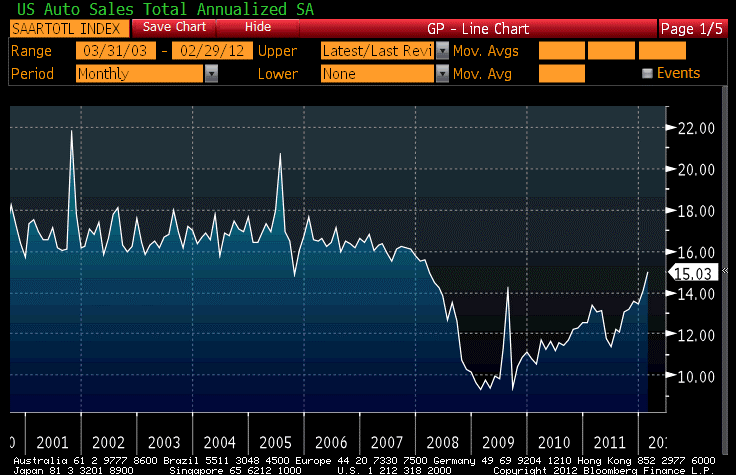
Claims are improving, auto sales are improving, manufacturing is doing generally well (although ISM was weaker-than-expected today). As I’ve said for a while, the economy has been improving slowly, and at this point continues to improve steadily. However, the stock market has priced in a robust recovery, and with all of the great economic news out there we also have sharply rising energy prices and other tax increases (such as the expiry of the increased depreciation allowance, which may have helped provoke the weak Durables number this week). We also have Western Europe (and the less said about that right now, the better). There is plenty of time to bask in the good news by being short bonds (the 10y yield rose above 2%, again, today), hoping that I’m wrong about the disappointments we are going to begin to see, I think, this month.
