Archive
Don’t Bank on it
Here is a post from Sober Look that has some really good charts on the changing asset mix at US banks. I was a little surprised that they didn’t point out the obvious connection in the charts, although they do make some key points in a previous post.
To summarize: the charts show that the loan-to-deposit ratio in the banking system recently hit a 35-year low, and that the proportion of cash on the balance sheet of banks has gone from maybe 5% to around 20% (eyeballing it) in the last ten years.
Obviously, these two facts are not unconnected, since loans and cash are both assets to banks. The reason for the shift from loans to cash is very simple: QE. Banks don’t want to hold as much cash (reserves) as they are carrying, but the alternative is to lend it to people in sub-optimal loans – that is, where the interest rate charged does not compensate for the risk that the loan will not be paid back, so that the lending has a negative NPV. Moreover, the cash itself has a positive return because the Fed is paying interest on excess reserves, so that the lending has a higher hurdle to achieve than it would if this was just “normal” cash or reserves.
Understanding this dynamic is really important. So here’s how this works: if interest rates rise, but reserves have the same yield, then lending becomes more profitable and loans will increase – that is, the money multiplier will rise, with less money in the vault and more money in transactional accounts. If, on the other hand, the Fed raises the interest on excess reserves while lending rates stay unchanged, then even fewer loans will be made and banks will hold more cash relative to loans. This is one mechanism by which higher interest rates initially encourage higher inflation.
(And yes, while the total amount of reserves in the system is fixed, the total amount of loans is not, so while the Fed controls the former they do not control the latter except indirectly).
So, consider the “exit” strategy. As interest rates rise, the multiplier will increase unless the Fed hikes interest on excess reserves. But since interest rates move more flexibly, more rapidly, and often further than do policy rates, this probably means the multiplier will be determined mostly by the market (I wonder if the Fed declared the IOER to be “10-year yields minus 250bps” if that would change things?). The gap is the thing. And, if Yellen actually cuts the IOER to zero, as she has intimated is possible, then the multiplier would rise…and we don’t know by how much.
On the flip side, if the Fed tapers QE to zero, and lending rates fall, then the multiplier would tend to fall further because that gap narrows. In that case, you really could get a disinflationary scenario…though I am skeptical that long rates can fall very much when public debt is so high and the Fed is withdrawing its support for the bond market. Still, a crisis could do it. To be clear: you’d need the Fed to stop adding reserves, to neglect the IOER – or increase it – and long rates to decline substantially (at least 100bps, say). So if you are a deflationist, there are your signposts. I don’t anticipate that any of that happening, except that I imagine they will screw up the IOER strategy and they could screw that up in either direction.
And by the way, I don’t think any of that would affect inflation much in 2014, since higher housing prices are already going to be pressing core inflation higher. But it could affect 2015.
However, I digress from the other point I wanted to make that was suggested by the Sober Look article, and that is this: it continues to amaze me how well bank stocks are trading. I’ve been saying this for years – which helps to illustrate that I am a strategic investor, not a twitchy tactical guy. Return on equity equals gross margin (profit/revenue), times asset turnover (revenue/assets), times leverage (assets/equity), and for banks all three of these components are under pressure. Gross margin is under pressure from the movement of more products to electronic trading and from increasing legal bills at banks (the FX trading scandal is the latest threat of multibillion-dollar fines, adding to the LIBOR scandal and probes of the gold and silver price fixing system as sources of legal headaches for banks). Banks have been forced via the crisis to shed leverage, as a chart I recently ran illustrated. And low interest rates combined with large amounts of cash compared to loans on the balance sheet pressures the asset turnover statistic. So it isn’t surprising that bank ROEs are low (see chart of the NASDAQ bank index ROEs, source Bloomberg). 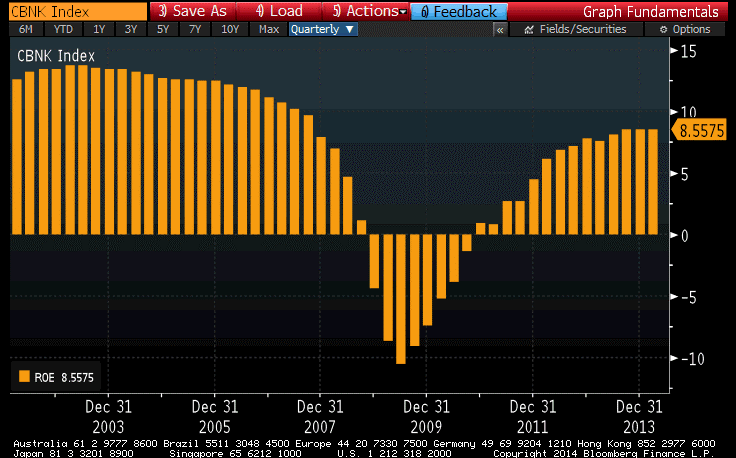 What is surprising is that they even got this high, and market pricing seems to anticipate that they’ll keep rising. Bank stocks are actually outperforming the S&P since late 2011, and their P/E ratios are essentially where they have always been, excluding the spike when earnings collapsed in the crisis, causing P/Es to skyrocket (see chart, source Bloomberg).
 Maybe all the bad news is already in the price of bank stocks, but it doesn’t look like it to me.
RE-BLOG: My Two Cents On Nonsense
Note: The following blog post originally appeared on March 13, 2012 and is part of a continuing year-end ‘best of’ series, calling up old posts that some readers may have not seen before. I have removed some of the references to then-current market movements and otherwise cut the article down to the interesting bits. You can read the original post here.
I had not planned to write tonight, but there was too much that happened today, and too much that is likely to be misunderstood and misinterpreted. Not, necessarily, that what follows will help that situation, but I felt a need to add my two cents (which, don’t forget, is two cents more than you paid for it, so you’re two cents ahead no matter what).
…
And this takes us to the final, and most interesting, event of the day. It began when JP Morgan trumpeted a nickel increase in its dividend and a $15bln stock buyback. My first reaction was that this is not a phenomenon you tend to see in bear markets or early in bull markets, but rather in mature bull markets. Firms have a marked tendency to buy stock back when it’s expensive, not when it’s cheap, and an even more marked tendency to announce a buyback when they want a stock price supported. An announcement of a buyback program is not a promise to buy, and often no stock is actually bought. It is only an announcement of an intention to buy, which the firm need not honor. And this is a bank. Anyone with even a passing knowledge of Basel III knows that banks are going to be raising Tier 1 capital – especially in Europe, but in the U.S. as well – for a while. There is no way that banks, whether or not they feel overcapitalized by 2000s standards or not, are actually going to be buying back large chunks of stock. So my second thought was “wow, are they actually going to scare up the stock so that they can sell more? That can’t be legal.”
Moments later, we found out what the real point was. It seems the Fed had completed the stress tests and informed all of the banks a couple of days ago (it’s unclear when), and were going to make a public announcement on Thursday.
Sidebar: This is why people think that Wall Street is run by a bunch of crooks. The moment that banks had this information, they were in possession of material nonpublic information that should have been immediately released if the banks were going to prepare any offering in their own securities. Whether the Fed says they can or can’t, the information must be released. And here is one positive checkmark for JPM: they announced that the Fed had approved their buyback and dividend plans in the context of passing the stress test. But thanks a lot, Fed, for putting banks in the awkward position of having to choose between ticking off the Fed, or ticking off the SEC. And great job, bank managements, for mostly choosing to keep a secret that makes you look like a member of an elite club/secret cabal, rather than choosing to release the information. Good job, JPM. (But I’m not done with you yet).
So, the Fed decided that they needed to immediately release the stress tests results, early. Well, not immediately; they decided to wait until 4:30ET, after the markets closed to retail investors, because golly it would be too much to ask to let people get the information when the markets were open. Sidebar: this is why people think the Fed is run by a bunch of crooks who are in bed with the Wall Street crooks. Who is running the PR at the Fed?
Bank of America bravely followed JP Morgan through the breach to announce that they, too, had passed the stress tests. US Bank announced a share buyback, dividend hike, and a passing stress test grade. (Quick quiz, with the answer to be given later: are the banks announcing share buybacks likely to be the strong banks or the weak banks with respect to the stress test? Write down your answer and we’ll come back to it.) Volume on the exchange spiked, with better than 50% of the day’s volume coming in the last hour of trading, and almost 30% in the last 7 minutes before the bell.
The stress test results were released, and four financials failed: Ally Financial, SunTrust, MetLife, and Citigroup. Well, good luck raising capital now, Citi. (Important Disclosure: I am expressing no opinion on any of these individual equities or any of the other securities of these companies. I neither own, nor intend to buy, nor sell, any of their securities in the near future. My negative opinion on banks generally is well-known, but I do not have any position, positive or negative, on the banking sector, nor do I plan to make such a sector bet in the near future).
Now, initially the press coverage listed three of the four firms that failed, but not MetLife, so I was forced to go skimming through the “CCAR” report to find the fourth one. If I hadn’t done that, I almost certainly would not have noticed Figure 7, which is reproduced below for your easy reference.
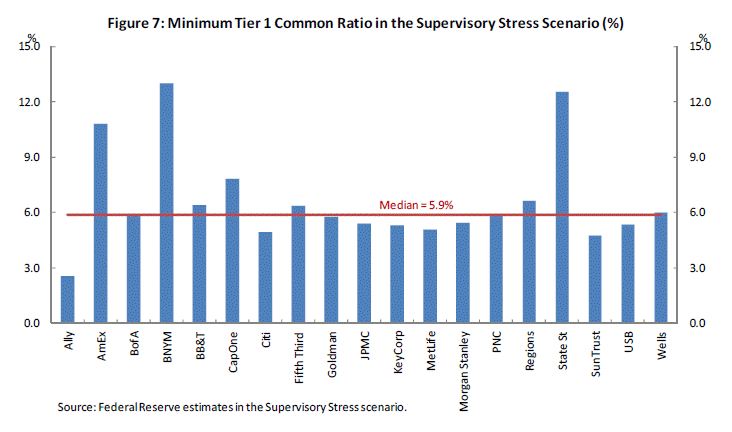
You can see the four banks which failed are the shortest bars on this chart, so you can easily pick out Ally, Sun Trust, Citi, and with a straightedge you can conclude that MetLife is the fourth. But then it’s a really close race for fifth-worst with KeyCorp, US Bank, Morgan Stanley, and… JP Morgan. It must be great to be JP Morgan. When you wonder why they drew the line where they did, you might imagine the counterfactual situation where JP Morgan came out on the other side of the line. JP Morgan, which was the Fed before there was a Fed, and will probably be the Fed after the Fed is gone. JP Morgan, which the Fed called on multiple times during the crisis to save the world (for example, by serving as a lending conduit to entities which the Fed could not directly lend to). I wonder what the odds are that JP Morgan would be allowed to fail? I’m going to speculate: zero. And that’s why the line is where it is.
Now, it is interesting to see which banks scored very highly. They’re banks that don’t have exposure to as many of the blow-up areas that were tested by the Fed (which is not to say they aren’t exposed to blow-ups: just that they’re not the ones that the Fed tested).
By the way, don’t let anyone tell you “well, this was a really severe test, and so these banks are actually in really good shape.” Yes, this test is much more stringent than the cotton-candy version the European regulators put their banks through last year, but it only measures expected reactions to broad macroeconomic events, and not the interaction of the entire system under such a stressful scenario. That reaction is non-linear, and it is very difficult to model. Moreover, we can’t model the unknown: a rogue trader, a $65billion Ponzi scheme, a tsunami and nuclear meltdown in Japan, a terrorist attack in New York. As Roseanne Roseannadanna used to say, “It’s always something.”
When all is said and done, are we better off that the Fed did these stress tests? I suppose the answer is yes, if only because it means the regulators actually took some interest in looking at these businesses and their risks. But if it creates a false sense of comfort, or reverses the trend towards greater capital cushions, then probably not. Time will tell.
I am about ranted out for today, and there are no important economic releases tomorrow. It will be interesting to see how the spin machines work on Citigroup and JP Morgan, which are after all separated by only a thin line on Figure 7, but by a huge gulf in reputation.
———
You can follow me @inflation_guy, or subscribe to receive these articles by email here.
Higher Rates, Higher Credit Growth: Sober Look
I wrote recently about money velocity and reminded readers that theory says higher interest rates tend to increase money velocity because it decreases the demand for real cash balances. This was around the discussion of whether the enormous demand for Verizon bonds could be anecdotal evidence that velocity is increasing.
Yesterday the blog Sober Look – which is one of my favorites because it gives intelligent looks at many different markets – ran an article entitled “Could rising rates fuel credit growth in the US?” in which they in turn cite Deutsche Bank research. It’s a very quick article and worth a read, because it sheds some light on one of the mechanisms by which credit growth may increase with higher rates. Ordinarily, higher rates inhibit money growth at the same time that they increase velocity, partly because the yield curve flattens. But in this case, higher rates may increase both credit growth and money velocity – at least when rates initially rise – since the market is moving ahead of the Fed and steepening the yield curve in a selloff.
It’s just another puzzle piece to rotate in your mind, to try and see how it all fits together!
The Fed and Regulators Should Draw the Veil
When I remark, from time to time, that I think the Fed has made a mistake in increasing transparency of its deliberations and actions, people occasionally look at me as if I had come out opposed to motherhood or apple pie. But my point is that transparency is good if it permanently decreases risk…but it doesn’t.
What matters is how market actors respond to increased transparency. It is much like the old debate about whether football players ought to wear helmets. It is clear that helmets decrease the likelihood of brain damage in any given collision, compared to the un-helmeted rider in an identical collision. But it is also clear that as helmets have gotten better and better, football players have played faster and faster, with more abandon, and lead with their heads a lot more than they did when all they had was a leather cap. The net effect is indeterminate.[1]
In markets, increased transparency from a central bank or regulator leads to increased leverage in a very direct way. The central bank’s dial is for transparency, but the investor’s dial is for risk appetite and when the central bank turns its dial it does not change the investor’s risk preferences. The result is that increasing transparency, which decreases the risk at any given leverage and at any particular moment, leads to higher levels of leverage, which lowers the tolerance for error. And, as we have seen, central banks and regulators are quite prone to error.
In an interesting way, this is tied into the volume question. The chart below (source: Bloomberg) shows rolling 250-trading-day volume for the NYSE in billions of shares. As has been well-documented, market volumes have been steadily declining for years.

As we have mentioned here before, there are lots of excuses for lower market volumes on the major exchanges, and probably many of those excuses are part of the answer. But we can no longer simply attribute this to the movement of volumes to “dark pools.” There is simply less going on in the markets, whether in rates or in equities. Ask the dealers. Dodd-Frank and the Volcker Rule are simply decimating volumes. And this is not just bad for dealers, it is bad for everyone.
When a trade happens, there is information revealed. Indeed, in some markets a meaningful proportion of the volume transacted is between dealers who are testing the market to get more information. More trades means that there are more quanta of information. More quanta of information produces more confidence in prices. More confidence in prices means more support for the current prices, and more de facto liquidity.
Think of it this way. If a bond has never traded, and two counterparties come together to trade some at a price of 103, what is your estimate of the true market for another trade? Is it one tick around 103? If so, then you are displaying almost outrageous overconfidence – one data point between two counterparties, about whose motivations you know precisely nothing, tells you almost zero about what the true market (by which I mean, the prices at which you could buy, for an offer, or sell, for a bid, a typical-sized transaction) is, and even less about what the support market (by which I mean the prices at which you could transact in substantially larger sizes) is. And so bid/offer spreads, whether quoted on-screen or over-the-counter from a dealer in the security, must be wider since the market-maker just doesn’t know as much as he would if volumes were higher – and, more to the point, the market must be wider because the client who initiates the trade is likely to know more than the market-maker does about the right price. This is because the market-maker must make a market whether or not he knows the fair price, but the buyer or seller doesn’t have to trade unless he/she believes the fair price is outside of the quoted range. Of course, that’s where the information comes from: if the offer is lifted, it means someone is saying “I think the fair price is higher than your offer,” and that is information.
I mention this today for several reasons. First, because it has been a while since I showed the NYSE volumes chart in a while. Second, because there was an article on Bloomberg today entitled “Professor Who Helped Pop Junk Bubble Says Trace Slows Trade” which ties transparency to diminished volumes. To the extent that Trace produces true transparency and reduces the need for “testing” trades, it is a good thing…but then we should see tighter spreads for size, and while the study is suggestive it isn’t conclusive on this point. More interestingly, the professor in question also made the point that “less trading may hurt investors if, instead of reducing ‘noise’ from the market, the reduction slows how quickly new information alters prices.” And this point is also key:
”…if the decrease in trading activity is the result of dealers’ unwillingness to hold inventory, transparency will have caused a reduction in the range of investing opportunities. That is, even if a decline in price dispersion reflects a decrease in transaction costs, the concomitant decrease in trading activity could reflect an increased cost of transacting due to the inability to complete trades.”
So transparency, it seems, is not an unalloyed positive like apple pie. But lower trading volumes, which are partly the result of transparency (and partly the result of poorly-conceived rules like Dodd-Frank, the Volcker Rule, and Basel III), are very probably bad for everyone. This doesn’t just affect hedge funds. Markets which are deep and liquid are much less prone to sudden price breaks. With the US equity market still floating near the highs despite rapid increases in nominal and real interest rates and worst-ever outflows from ETFs last month, this is a point that may be more than academic at the moment.
[1] However, no one disputes that the faster game is a lot more fun to watch. What I suspect has happened is that the introduction of hard-sided helmets probably increased injuries until players essentially reached maximum speed/recklessness, after which point the further improvements in helmet design probably started to make the game safer again. But it is really hard to prove that.
The Right Clearance for the Bumpy Road Ahead
There are many reasons to be scared of the financial system in Europe. The interweaving of sovereign risk and inter-sovereign risk with bank guarantees and the symbiosis in which countries guarantee (implicitly or implicitly) banks which then buy sovereign paper that is not considered a risk asset is enough to make anyone who looks closely pretty queasy. If Portuguese banks fail, what effect does that have on Spanish banks, or on the Europe-wide guarantee facilities? Is anyone even somewhat confident that they know?
However, with all of the reasons to fear a resurgence of the European banking crisis, the manufactured “underfunding” story is not one of them. According to the Financial Times, “Europe’s biggest banks will have to cut €661bn of assets and generate €47bn of fresh capital over the next five years to comply with forthcoming regulations aimed at reducing the likelihood of another taxpayer funded bailout.”
Those are big numbers, and scary, but … what do they mean? Do they mean that banks are underfunded by that amount?
Well, the numbers only mean that if somehow the Basel III requirement is magically the “right” number. And even then, I am not sure what it means to have the “right” number. If you have trouble driving your Cadillac on a country road, and it leads you to design a car with a higher clearance, how do you know you have the “right” clearance? It sort of depends on the road, doesn’t it? If the road is smooth, then you’ll be too high, but if the road is too rough, your higher clearance might not be high enough. Without seeing the road, all you can do is guess at the trade-off between the cost of the higher clearance, and the benefits of the higher clearance.
And we have no idea what the road ahead looks like in Europe, or anywhere else for that matter. So declaring a certain “clearance” as being the “right” clearance is presumptuous. Sure, we now know that roads can get bumpy even when central banks are trying to smooth them (and in some cases because they are trying to smooth them), so we think we need more clearance…but how much more? Never mind the fact that this isn’t as straightforward as measuring a car’s undercarriage clearance – if a rule can be written into Basel III, it can be engineered around by a bank. (That’s why we didn’t stop at Basel I.)
In general, I am skeptical that the right answer is reached by central banks, or even worse an international committee of central banks such as the BIS, sitting around in a room with a lot of smart economists counting angels on the head of a pin. Not that Jamie Dimon showed great risk acumen in allowing the London Whale to lose six billion bucks, but at least he makes decisions on risk on a regular basis instead of at annual banker meetings where there are presentations on how to tell a CDS from a CMO.
We clearly need to consider how to increase incentives for bank management and shareholders to capitalize banks correctly, where “correctly” means that the shareholders and stakeholders are taking the amount of risk they feel comfortable with, and that there are no unpriced externalities. It is this latter problem that is the issue, of course; a free government guarantee is simply value that bank management seized for themselves. It allows any bank to take more risk than they would if it was their own money. But limiting risk, or raising the “insurance” premium, just raises the clearance of the car. What we need, if banks are large enough to pose systemic risks, is a way to make the costs of poor risk decisions assessable in retrospect rather than in prospect. That is, remove the corporate veil for banking licenses. Require all banks to have a general partner or partnership group which has unlimited liability.
Here is what would happen in such a case. Small banks would have a general partner who would secure liability insurance (possibly paid for by the bank shareholders). Larger banks would find it more difficult and expensive to secure that insurance in amounts that completely covered the possible losses for the general partner, which would mean that the biggest banks would likely choose to break into smaller banks. And what is wrong with that? One of the solutions that has been put forth is to have banks sell off assets. Splintering into a number of smaller banks is the same as selling off all of the assets.
And then, you wouldn’t need implicit or explicit government guarantees (although deposit insurance might best be provided by, or backstopped by, a government entity). There’s already someone to go to in order to cover the losses: the general partner, or the insurer, or the reinsurer. Together with derivative clearing arrangements, a system built from smaller and redundant parts would likely be much more resilient than one built with just a few critical “TBTF” parts.
“I Say, Let ‘Em Crash”
John Mauldin wrote a piece last week about Brown-Vitter, a piece of legislation making its way through Congress that has a “simple” approach to getting the government out of the bank-rescue business: for big banks (basically defined in the legislation as banks who use derivatives to structure customer deals), a massive capital buffer is demanded, which would effectively take big US banks out of the derivative business and greatly increase costs and decrease variety of derivative and other solutions (many bonds issued by corporate entities are coupled with a swap to the dealer, which would now be subject to a massive capital charge).
The appeal of the legislation is its simplicity. It simply destroys the business model of the largest banks.
Moreover, it doesn’t solve the “too big to fail” problem. It merely changes the hurdle of how much bad stuff needs to happen, in order to cause a bank to fail in the first place and to require saving. It wouldn’t cause the government to exit the position of writing puts on banks: it would merely move the strike prices of those puts.
I will say that in my interactions with Wall Street banks, I have not run across anyone who is concerned, at least not yet, that Brown-Vitter will actually become law. It is simply too blunt of an approach – akin to burning a town down in order to keep it from being flooded.
The cynic in me says that all of this legislation is designed mainly to produce big contributions from banks to the reelection campaigns of public officials. There is a much simpler way to get the government out of the too-big-to-fail business, which furthermore does not involve causing massive side effects in the derivatives and other markets. Congress could simply pass a rule that prohibits the government (including the Fed) from bailing out a private enterprise. Problem solved, subsidy ended.
The Fed already has the power to close down and wind down insolvent banks. Of all of the Fed’s powers, this is the one that has been used most successfully over the years. It isn’t the failure of a bank that is the problem, but the chaotic failure of a bank that is the problem. Task the Fed with reducing the chaos inherent in large bank failures, and let the chips otherwise fall where they may.
Comparisons
With little economic data on the calendar, and the Fed speakers back-loaded at the Chicago Fed conference later in the week, there is time to reflect on other questions (unless, of course, the Israel/Syria back-and-forth turns into something more than the last couple of jabs have produced).
It is interesting to me that analysts and journalists truly enjoy finding comparisons between present situations and actors, except when the comparisons suggest unpleasant conclusions. This is at a time when there are really no comparable periods in history to compare to, at least with respect to major global policy initiatives!
I read comparisons between Shinzo Abe’s pressure on the Bank of Japan and Fed Chairman Bernanke’s campaign to resurrect the American economy with ever-greater monetary policy shocks. Somewhere, I saw an analyst ask “isn’t Abe taking note of the failure of U.S. monetary policy to goose the economy?” But the comparison is not apt because the two men, and the two economies, face very different challenges. Abe doesn’t need to increase consumer spending and reinvigorate the economy with monetary policy. While that might be nice, the main goal of Japanese monetary policy now is to raise the price level and the rate of inflation. They are using exactly the right tool to do so: lots of monetary easing. On the other hand, Bernanke is trying to kick-start the real economy with a monetary tool, while at least in principle avoiding an inflationary outcome. That’s like trying to hammer a nail with a fish. It might work, but it’s the wrong tool for the job. So the comparison doesn’t work: one man knows how to use his tools, the other does not.
Here is another useless comparison: “Bond Buyers See No 1994 as Bernanke Clarity Tops Greenspan.” The myth that transparency really helps markets in the long run is sort of silly: is there any sign that the crises caused by monetary policy have become less frequent since the Greenspan glasnost than they were before? I know that’s the belief, because the Fed has told us that’s the way it is. But my scorecard tells a sorry tale of bubbles and crashes since the early 1990s. It isn’t a lack of transparency that causes routs. It’s leverage, and negative gamma. Mortgage hedgers are more active now than they were in 1994, and they have larger books. Hedge funds are orders of magnitude larger. And Wall Street is smaller, and is able to provide less liquidity – partly because they are more levered (which they think is okay because of “Fed transparency”), and partly because the government doesn’t want them to take bets with the leverage they have (which, since they’re paying for failures under the current system, isn’t wholly absurd).
So will the next bond selloff not be as bad as in 1994, because the Fed will give more warning? Remember that no matter how transparent the Fed is, there is still a transition point. Somehow, the market goes from a state of thinking there will be no tightening of policy, to a state of thinking that there will be a tightening of policy. That requires a re-pricing, whether it occurs because the Fed signaled it in a speech or a statement, or because they signaled it by doing Matched Sales for the SOMA account with Fed funds already trading above target (as was the old way of telling us something had changed). There is no way to go from “not knowing” to “knowing” without a moment of realization. And when that phase change ultimately occurs, the greater leverage inherent in the market and the diminished role of market makers will cause the selloff (in my view) to very likely be more dramatic than in 1994.
One place where we cannot prevent comparisons – nor should we want to – is in the asset markets. Stocks are doing well, despite absurd valuations, because most other markets are either more-absurdly valued (e.g., Treasury bonds) or have horrible momentum that means they’re not popular right now (e.g., commodities). I have no doubt that equity performance over the next 10 years will be very uninspiring, because equity markets that start from this level of valuation never produce inspiring returns. But when people ask me what the trigger will be for a selloff, I have to shrug. There have been plenty of “reasons” for that to happen. But I think the ultimate reason is probably this: equities are perceived as the “only game in town.” I have read several articles recently that echo this one: “Bond Fund Managers are Loading Up on Stocks.” When there is some other asset class, or some other world market, that starts doing appreciably better, perhaps investors will decide to allocate away. Unfortunately, the candidates for that market are pretty few, given the general level of valuations. Could it be commodities, which is one of the few genuinely cheap markets? Or perhaps real estate, which is still only fair value but has some pretty striking momentum? I don’t know – but I am also not sitting around waiting for a “trigger event.” There may well be a selloff without such a trigger.
Stealing Really Is That Bad
Cyprus banks are closed until Thursday. At this point, the Cypriot legislature has not voted on any particular scheme of theft, although some Eurozone officials seem to think that it would be okay to only rape the people who have deposits bigger than €100,000, just as long as it’s a really brutal rape to make up for letting the smaller depositors off. (This only sounds like it makes sense if you use their words, but not if you use their meaning.)
It is incredible but the Eurozone elite really don’t seem to understand why the Cyprus plan is so bad. They really are natural Socialists! As Merkel and her party became the primary defenders of the decision to seize Cypriot depository assets today, there was a very good article in Businessweek that contained several jaw-dropping quotes.
“I have to go to my constituency and explain to my people in my constituency why we are willing to lend more than 3 billion euros ($3.9 billion) to Cyprus,” Michael Fuchs, deputy parliamentary leader of Merkel’s Christian Democratic Union party, said in an interview with BBC Radio 4 today. “Why should Germans bail out these people and they are not willing to accept at least a minor bailing out by themselves?”
Well, Mr. Fuchs, here is the problem: you didn’t ask them if they would “accept” at least a “minor” bailing out. You ordered people who didn’t need a bailout – savers with earned balances in the banks – to pay for the bailout. I daresay that it doesn’t seem “minor” to those who had their money stolen to save someone else.
Yes, I understand the parallel, that you feel the alternative was to have your taxpayers foot the bill, and they don’t need a bailout either so why should they pay for it? As Merkel said: “the responsible people are partly included and not only the taxpayers in other countries.” But here’s the thing – at least you have the authority to order that the taxes your citizens paid be used for things they didn’t want, but you did. You have no authority, and indeed no one had the authority, to order the seizure of private assets for something you wanted. (Cyprus, and Cypriot banks, had the ability to seize the assets, but that’s not the same as the legally-sourced authority to do so.)
Moreover, you had another alternative, and that’s to recognize that the elite who want the Union to survive in its current form can’t afford to foot the costs for it to do so – and to let Cyprus go. Yep, I understand that to you that would have been tantamount to Armageddon. But the more you destroy the foundations of capitalism and the free market in favor of naked Socialism, the more appealing Armageddon looks by comparison…
And here’s another quote, by the budget spokesman of Merkel’s main opposition party: “The profiteers of the Cypriot business model must pay the bill – not the European taxpayers.” I heartily agree, but the “profiteers” aren’t the depositors! If that appellation is attached to anyone, it would be to the bank equity holders, and perhaps the bondholders. Arguably, it may apply to the citizens of Cyprus, but almost equally to the people of the Eurozone who benefited when Cyprus lived and consumed beyond her means. But the depositors were not ‘profiteering’ by putting deposits in the bank. They were saving.
So it’s the Russian and the Greek depositors that you really wanted to target? Then why not target anyone who is Russian or Greek? I would go further and say that it isn’t the Russians’ fault that Cypriot banks were willing to take their money, and not the Greeks’ fault that European oversight of Eurozone banks was so fractured that Cypriot banks sought out these deposits as they grew and became unsustainable, ungainly creations. Being a Greek or a Russian with money isn’t a crime – unless you’re a Socialist. And if you’re a Socialist, then it isn’t the Greek or Russian part…it’s the “having money” part.
But they don’t seem to see why people are concerned.
Now, in the micro picture none of those reflections are very market-oriented, but in the macro picture they certainly are. We all have to deal on a day-to-day basis with the reality that markets are nakedly manipulated by central banks these days (with fancy names like “portfolio balance channel,” for example). I was speaking today to an investor about a particular type of arbitrage in my sphere of expertise. As we were brainstorming what could go wrong with the trade, the biggest possibility was “what if one central bank decides to stop manipulating markets and another central bank continues, but they’re the wrong ones? Or what if they start manipulating markets in a different way?” We didn’t directly consider the question of “what if they just seize the profits?” but investors actually now need to consider that in the calculus of risk and return.
But that part isn’t new, as some readers of my articles have pointed out. Government witch-hunts have long been carried out in search of the miscreants who “caused” market mayhem. After the 1929 crash, the Senate held hearings and even went after stock exchange members who’d actually held long positions during the crash. What is new is the targeting of people who have saved simply because it would be more convenient for the government to have their money.
They came for the hedge funds, and I didn’t speak out because I wasn’t a hedge fund. They came for the banks, and I didn’t speak out because I wasn’t a bank. They came for the savers…and there was no one left to speak for me. Right?
Equities took the news with surprising aplomb. Yes, stocks fell 0.55% after being down somewhat more than that, but that reverses only two average days during this most recent run. Commodities, which should be a direct beneficiary of global monkey-business associated with fiat money deposits, sold off hard with the notable (and reasonable) exception of gold. That is borderline insane, but consistent with the insanity of the last couple of months. These days I wake up every morning half expecting to see commodities prices offered at zero. Interestingly, inflation traders seemed to grasp the point, as 10-year inflation swaps and breakevens were stable even though rates generally declined. But commodities is Q1’s red-headed stepchild (and I say that as a red-headed stepchild).
It sounds crazy to say, but Europe losing its collective mind on this topic is bad for equities only if the bank run spreads to other countries in Europe, or if Cyprus decides to leave the Euro and to flee into the tender mercies of Russia’s embrace. Those aren’t certainties by any stretch of the imagination. Consequently, anything that looks vaguely like calm will likely be rewarded by a melt-up in stocks, probably to new highs. The outcomes are distinctly binary at the moment, which isn’t risk I personally care to take since equities are aggressively valued even if these risks were not present.
One Less Good Reason to Be Bearish On Inflation
If you’re bearish on U.S. inflation, I think your view boils down to one of the following arguments:
- I think growth will remain soft, or we might even slip into another (global?) recession. You can’t have inflation without too-rapid growth, so inflation isn’t going to happen.
- I think inflation expectations are well-anchored, and actual inflation only happens if people start expecting inflation and so adjust their demands for wages and/or prices.
- I perceive that wage growth is weak, and so there is no ‘cost-push’ inflation.
- Although money supply has been growing at a 7-10% pace for the last couple of years, money velocity has been declining. It is likely to continue to decline while banks and sovereigns are under structural pressure to de-leverage.
- I trust the Fed to tighten in time. I’m not sure what ‘in time’ means, but I figure they know what they’re doing.
- I think the whole darn thing is going to collapse.
You are entitled to hold any of those views, of course.
If #5 represents your view, I can’t help you. If #6 is your view, then there’s not much that can be done anyway. If #1 is your view, I won’t bore you with a recitation of the arguments I’ve presented before that suggest growth and inflation are correlated only spuriously and that the proposition that growth is the dominant consideration when forecasting inflation can be considered refuted (for example here, here, and here). #3 is more defensible, in my mind, since the evidence on leads/lags of wages versus prices is not conclusive although it seems to me that wages tend to follow prices, rather than lead them (there are some clear examples of wages following prices, and there are some times that they appear to move simultaneously, but I am not aware of any clear examples of prices following wages). #2 is not disprovable, since we don’t have a way to measure inflation expectations directly that is very useful (see here for a thorough discussion, and here for a shorter discussion). Therefore, while it may turn out to be true, I think this boils down to a question of faith, like #5.
So, to my mind, the most plausible argument that inflation is not going to be a concern – despite the fact that monetary policy stimulus is being applied around the globe to an unprecedented degree – is the supposition that money velocity is going to continue to slide for structural reasons for a long time. While U.S. banks have been growing commercial bank credit again at pre-crisis rates for the last year or so (see Chart below, source Fed Board of Governors), this may partially reflect a gain in lending market share versus European banks because the latter have been under severe pressure for the last year.

Global inflation ought to depend on global velocity as much as global money supply, which led me to write back in August that
If you want to make a case for slowing U.S. inflation, I do not believe you can look to the U.S., but rather must look to Europe. If domestic lending (and hence velocity) is rising partly because European lending (and velocity) is contracting, then some of the inflation potential is being sucked out, at least temporarily, by financial and credit strains in Europe.
In my view, the only plausible way we get appreciably lower inflation is if central banks abruptly stop quantitative easing (I don’t think there’s any measurable chance that they tighten) and the velocity of money in Europe (and Japan) drops faster than the velocity of money in the U.S. rises.
The reason I bring this up now is that one of the ‘negative tail’ outcomes became significantly less plausible yesterday after the Basel liquidity rules were delayed (for four years) and softened (by changing the definition of what assets are ‘liquid’).
Regardless of whether or not that increases the vulnerability of the banking system to another credit crisis (it surely does), it lowers the banks’ cost of funding a loan and thus, all else being equal (which it surely is not), should lead to a greater loan volume at any interest rate. In my view, this significantly reduces the likelihood that money velocity in Europe will collapse further (at least for a while) as banks hoard capital, and thus removes as I said one of the ‘negative tail’ outcomes from the list of active concerns.
Breakevens responded positively to this news, as did the equities of European bank stocks, especially ones such as Natixis and Commerzbank which have been under pressure for a long time. Commodities also rose, for a change: this year, commodities have had an awful start to the year despite the roaring of equities out of the gate. The chart below (source: Bloomberg) shows that the ratio of the S&P to the DJ-UBS index has now exceeded the highest relative valuation of the last year, and indeed the highest relative valuation of the last ten years.

By now, my suggestion should not be surprising – commodity indices are the place to position for a bad inflation event. A continuation of low and stable inflation in conjunction with a generous financing environment (if, for example, core inflation retreats gently to 1.75% or so even though central bankers continue to ease) will push this relationship further in the direction it has recently headed. The market is pricing in just such an outcome. An adverse outcome will likely cause a reversal of this relationship, implying a great outperformance of commodities relative to equities over the ensuing several years.
It’s anybody’s guess when and if that will happen, but as noted above I think one argument for the long-stocks/short-commodities trade has just receded.
Mounting Pressure
The most striking facet of today’s trading was that the stock market actually reacted to the Fed’s announcement, which was precisely as universally expected: no change in anything but the technical language about where the economy currently stands. It wasn’t a huge reaction, but the fact that the S&P actually dropped 5 points on the news is mind-boggling to me because it implies that some people were expecting big things out of the Fed today.
To be sure, the arrow of action on the Fed is clear and pointed to ever-increasing amounts of liquidity, but this wasn’t ever on the docket for today. However several Street economists have predicted, plausibly I think, that when Operation Twist expires in December (partly because the SOMA will run out of short-dated Treasuries to sell) the Fed might keep going with the buying leg of the Twist – effectively increasing the monthly outright purchases of paper to $85bln (including Treasuries) from $40bln (all mortgage paper) currently.
Operation Twist has been a useless operation from the standpoint of monetary policy – it has neither added nor subtracted liquidity from the system. It may have had some value from the standpoint of asset-market-maintenance policy, by removing duration from the market and forcing investors to accept more risk for the same amount of reward. So it may be the case that Twist had some effect, but mostly a bad effect since it certainly doesn’t seem from market pricing that investors have been timid about taking risk. And I suppose it ought also be observed that “asset-market-maintenance” isn’t part of the legislative mandate of the Federal Reserve. However, legislators can be generous when markets are being pumped up – it’s when the air goes out that they’re unhappy.
Weirdly, though, I would prefer Operation Twist, which has little impact, to what is likely to replace it (additional QE).
Policymakers globally are growing increasingly bold about quantitative easing. In Europe today, ECB President Draghi told German legislators that outright bond purchases by the ECB “will not lead to inflation. In our assessment, the greater risk to price stability is currently falling prices in some euro-area countries. In this sense, OMTs are not in contradiction to our mandate: in fact, they are essential for ensuring we can continue to achieve it.” (See also this story.)
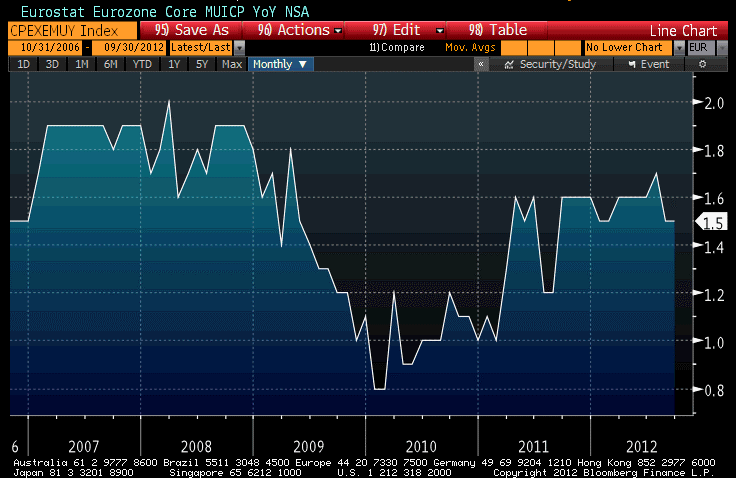
Central bankers are getting bold, but I’m not sure I understand why. They clearly see the connection between QE and inflation – fending off deflation was the purpose of QE2 and Draghi is clearly indicating the same even though core inflation in the Eurozone has risen from 0.8% in 2010 to 1.5% now (see chart below, source Bloomberg). That’s not exactly flashing red signals on inflation, but it is utterly fantastic to suggest that it indicates deflation is a greater risk.
In the U.S., QE3 and the likely acceleration of QE3 later this year is happening in the context of year-on-year rises in median new home sales prices (released today) and existing home sales prices (released last week) of over 11%, as the chart below (Source: Bloomberg) shows. Note that the existing home sales data is much more dependable on a month-to-month basis, because the number of existing homes and existing home sales swamps the number of new homes sold, but both show the same, clear trend. Home prices are now rising nearly as fast, nationwide, as they did in the bubble years.

For the record, the all-time record one-year price rise in existing home sales was 17.4% in May, 1979. Of course, in May 1979 core inflation was rising at 9.4%. In fact, with the exception of the last phases of the bubble of the early ‘Aughts, existing home sales prices are rising at the fastest margin above core inflation ever, as the chart below shows (Source: Bloomberg; Enduring Investments calculations)

Policymakers, and investors, seem to be numb to the threat of additional QE for one of two reasons. Either it is because of the belief that prior QE did not cause inflation (incorrect, as illustrated above and by the statements of intentionality of the policymakers themselves) or because they’re buying the line that QE is only adding to “sterile” excess reserves.
I think that this is dangerously sanguine. In fact, although it is true that QE initially results in greater excess reserves only, and these have only slowly trickled into transactional money, I think there’s reason to believe that adding more QE may increase that pace of transmission. Picture a large cylindrical vat, open on top with a small valve at the bottom. The water in the vat represents excess reserves, and the water trickling out through the valve is transactional money.
Many things can affect the pace at which the vat water flows through the valve – lending opportunities tied to credit demand and credit quality, disincentives to lend such as Interest on Excess Reserves (IOER), and moral suasion in both directions. Crank IOER to 25%, and all of the water poured into the vat remain as sterile excess reserves and QE is just reliquifying the banking system. Put IOER at a 10% penalty rate, and all of the water going in the top will flow out of the bottom very quickly – and all of the other water that’s already in the vat, too.
But even if you don’t adjust the valve at all, the greater weight of water in the cylinder, as you keep adding more water, will increase the flow out of the valve. Adding more QE is akin, economically, to increasing the weight of water in the cylinder.
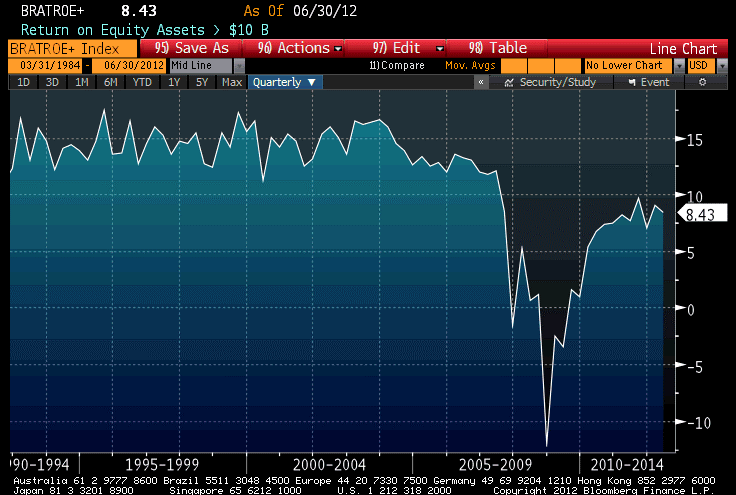
The parallel economic concept is that a greater of excess reserves increases the opportunity cost of reserves. The average return on assets for a bank gradually declines as more of these assets become excess reserves rather than required reserves against lent funds. Leverage also declines, with the result (as I have pointed out before) that return on equity suffers. The chart below (Source: Bloomberg) shows the return on equity for large banks (those with more than $10bln in assets). You can see that while bank earnings have recovered significantly from the nadir of the crisis, they also appear to have leveled off at around 8% compared to the 15% that was the consistent standard prior to 2007.
The lending officers in these banks, although they’re being told to increase the quality of their loans, are being told more and more to also increase the quantity of their loans. They cannot do both, but as the pressure of too many reserves on the balance sheet builds, the pressure to make more marginal loans increases as well. This is the part of the valve that the Fed cannot control, and where danger lies going forward. The multiplier may well respond, eventually, to the weight of the reserves themselves.
