Archive
Shots Fired
This isn’t the first time that stocks have corrected, even if it is the first time that they have corrected by as much as 4% in a long while. I point out that rather obvious fact because I want to be cautious not to suggest that equities are guaranteed to continue lower for a while. Yes, I have noted often that the market is overvalued and in December put the 10-year expected real return for stocks at only 1.54%. Earlier in that month, I pointed out and remarked on Hussman’s observation that the methods of Didier Sornette suggested a market “singularity” between mid-December and January. And, earlier this month, I followed up earlier statements in which I said I would be negative on stocks when momentum turned and added that I would sell new lows below the lows of the week of January 17th.
But none of that is a forecast of an imminent decline of appreciable magnitude, and I want to be clear of that. The high levels of valuation make any decline potentially dangerous since the levels that will attract serious value investors are so far away. But that is not tantamount to forecasting a waterfall decline, which I have not done and will not do. How does one forecast animal spirits? And that is exactly what a waterfall decline is all about. Yes, there may be precipitating events, but these are rarely known in prospect. Sure, stocks fell sharply after Bear Stearns in the summer of 2007 liquidated two mortgage-backed funds, but stocks reached new highs in October 2007. What happened in mid-October 2007 to trigger the top? Here is a crisis timeline assembled by the St. Louis Fed. There is basically nothing in October 2007. Similarly, as Bob Shiller has documented, at the time of the 1987 crash there was no talk whatsoever about portfolio insurance. The explanation came later. How about March 2000, the high on the Nasdaq (although the S&P 500 didn’t top until September)?
What two of these episodes – 2000 and 2007 – have in common is that valuations were stretched, but I think it’s important to note that there was no obvious precipitating factor at the time. It wasn’t until well into the stock market debacle in 2007-08 that it became obvious (even to Bernanke!) that the subprime crisis wasn’t just a subprime crisis.[1]
Here is my message, then: when you hear shots fired, it isn’t the best idea to wait around to figure out why people are shooting before you put your head down. Because as the saying goes: if the enemy is in range, so are you.
And, although it may not end up being a full-fledged firefight, shots are being fired, mere days before Janet Yellen takes the helm of the Fed officially (which may be ominous since Fed Chairmen are traditionally tested by markets early in their tenure). Last night, Turkey was forced to crank up money rates by about 450bps, depending which rate you look at. When Argentina was having currency issues, it wasn’t surprising – when you have runaway inflation, even if you declare inflation to be something else, the currency generally gets hit eventually. And Russia’s central bank was established only in 1990. But Turkey, about 65% larger in GDP terms than Argentina, is relatively modern economically and has a central bank that was established in the 1930s and has been learning lessons basically in parallel with our Fed since the early 1980s. Heck, it’s almost a member of the EU. So when that central bank starts cranking up rates to defend the currency, I take note. It may well mean nothing, but since global economics has been somewhat dull for the last year or so (and that’s a good thing), it stands out as something different.
What was not different today was the Fed’s statement, compared to its prior statement. The FOMC decided to continue the taper, down to “only” $65bln in purchases monthly now. This was never really in question. It would have been incredibly shocking if the Fed had paused tapering because of a mild ripple in global equity markets. The only real surprise was actually on the hawkish side, as Minnesota Fed President Kocherlakota did not dissent in favor of maintaining unchanged (or increased) stimulus – something he has been agitating for recently. Don’t get too used to the Fed being on the hawkish side of expectations, however. As noted above, Dr. Yellen takes the helm starting next week.
The Treasury held its first auction of floating rate notes (FRNs) today, and the auction was highly successful. And why should they not be? They are T-bill credits that reset to the T-bill rate quarterly, plus 4.5bps. In the next few days I will post an article explaining, however, why floating rate notes don’t provide “inflation protection;” there has been a lot of misinformation about that point, and while I explained why this isn’t true in a post from May 2012 when the concept of the FRN program was first mooted, it is worth reiterating in more detail.
So we now have a new class of securities. Why? What constituency was not being sufficiently served by the existing roster of 1-month, 3-month, 6-month, and 1-year TBills, and 2 year notes?
I will ask another “why” question. Why is the President proposing the “myRA” program, which is essentially a way to push savings bonds (the basics of the program is that if you sign up and meet certain income requirements, the government will give you the splendid opportunity to put your money in an account that returns a low, guaranteed rate of interest). This is absolutely nothing new. You can already set up an account with http://www.TreasuryDirect.gov and have your employer make a payroll direct deposit to that account. And there’s no income maximum, and no requirement to ever roll it into an IRA. Yes, it’s true – with Treasury Direct, you will have to pay federal taxes on the interest, but the target audience for the myRA program is not likely to be paying much in the way of taxes so that’s pretty small beer.[2]
The answer to the “why” in both cases is that the Treasury, noticing that one regular trillion-dollar buyer of its debt is leaving the trough, is looking rather urgently for new buyers. FRNs, and a new way to push Treasuries on middle-class America.
Interest rates have declined since year-end, partly because equities have been weak, partly because some growth indicators have been weak recently, and partly because the carry on long Treasury securities is positively terrific. But the Treasury is advertising fairly loudly that they are concerned about whether they’ll be able to raise enough money, at “reasonable” rates, through conventional auctions. Both of these “innovations” cause interest payments to be pegged at the very short end of the curve, where the Fed has pledged to control interest rates for now, but I think interest rates will rise eventually.
Probably not, however, while the bullets fly.
[1] In a note to Natixis clients on December 4th, 2007, entitled “Tragedy of the Commons,” I commented that “M2 has grown only at a 4.4% annual rate over the last 13 weeks, and that’s egregiously too little considering the credit mess (not just subprime, as I am sure my readers are aware, but Alt-A and Prime mortgages, auto loans and credit cards too),” but the idea that the crisis was broader than subprime wasn’t the general consensus at the time by any means. Incidentally, in that same article I said “We have not entered a recession with core inflation this low in many decades, and this recession looks to be a doozy. I believe that by late 2008 we will be confronting the possibility of deflation once again. And, as in the last episode, the Fed will face a stark choice: if short rates don’t get to zero before inflation gets to zero, the Fed loses as they will never be able to get short rates negative,” which I mention since some people think I have always been bullish on inflation.
[2] I wonder how the money is treated for purposes of the debt ceiling. If the Treasury is no longer able to issue debt, then surely it won’t be able to do what amounts to issuing debt in the “myRA” program? So if they hit the debt ceiling, does interest on the account go to zero?
Why Inflation Futures Matter
The Chicago Mercantile Exchange (CME) is currently having discussions with market participants and is considering launching in 2013 two new futures contracts related to inflation: a Consumer Price Index (CPI) futures contract and a deliverable TIPS futures contract. My company has been an advocate for these contracts and involved in their construction. We expect to be involved in making markets in them. Our interest is therefore no doubt obvious. But are these contracts important, in a larger sense, for the market? The answer is yes, and here is why.
It is a fact of financial life that most mature markets enjoy three legs of a liquidity ecosystem: cash markets, over-the-counter (OTC) derivatives, and exchange-traded derivatives. For example, in the nominal interest rates market Treasuries provide a deep and liquid cash market, there is a large and well-functioning market for LIBOR swaps, and there is efficient and transparent pricing in the futures markets as represented by Bond, Note, 5-year Note, 2-year Note, UltraBond, and Eurodollar contracts.
The presence of three legs, rather than only one or two, in this ecosystem is important. With two legs, there are only two directions of liquidity transmission: A to B and B to A. But with three legs, there are six ways that liquidity can be transferred: A to B, A to C, B to A, B to C, C to A and C to B. By adding the third leg, the avenues of liquidity transmission aren’t increased 50%, but threefold.
This richer liquidity ecosystem matters the most in crisis situations, such as during the credit crisis of 2008. Consider that during the crisis, credit and inflation markets became quite illiquid at times while equities, nominal rates, and commodities remained (comparatively) liquid. The main difference between these two sets is that the latter three markets all have cash, OTC, and exchange-traded instruments while the former two have only two (in both cases, cash and OTC derivatives).
Accordingly, while the inflation-linked bond market has become truly huge (see chart below, source Barclays Capital) and the inflation-linked swap market has enjoyed an almost uninterrupted rise in volumes since 2006, investors need the third component of the ecosystem: exchange-traded futures contracts on inflation and/or real rates. It is interesting to note that one analysis of the original CPI futures contract traded on the CSCE (many years ago) suggested that a prime cause of the contract’s failing was that “…the CPI futures market, unlike other futures markets, has no underlying asset which is storable or traded on an active spot market, which reduces the opportunities for arbitrageurs and speculators to participate in the market.” (Horrigan, B. R., “The CPI Futures Market: The Inflation Hedge That Won’t Grow”, Federal Reserve Bank of Philadelphia Business Review , May/June 1987, 3-14).

Adding these products will likely increase the volumes and the liquidity of all inflation products, including (perhaps especially) the liquidity of off-the-run TIPS. This liquidity will also remove the main lingering concern among those investors who have not yet made meaningful investments in the market.
Inflation-related futures are not a new idea. Since at least the 1970s, economists have anticipated that these instruments would one day be available. Several previous attempts, dating back to as early as the mid-1980s, have failed for various reasons – too early, too different, bad structure. But futures that present a different method of investing in, trading, or hedging inflation and real rate exposures are needed, not only because they create opportunities to make different sorts of trades or to trade more efficiently but also for the good of the market itself. Healthy markets in CPI futures and TIPS futures will create a better liquidity ecosystem for the entire inflation market, including for off-the-run TIPS bonds and seasoned inflation swaps.
Unfortunately, at the moment the CME appears to be afraid of launching new products that might not immediately work. It wasn’t always that way – once, a CME official told me that since it cost them virtually nothing to list a contract, they favored launching lots of them and seeing what the market took to. This has changed, and the pendulum has swung in the opposite direction. Now, although many market participants are asking for these futures and there are market-makers willing to make markets, the CME is deferring a decision on them until later in the year. I remain hopeful that they will launch, because they are sorely needed.
Deserving It
Does Chad “Ochocinco” Johnson deserve another chance?
That’s a question I saw several times bandied about today on the NFL Network. (It is, after all, kickoff night of the NFL and so you will perhaps forgive the digression.) But no one seemed to ask the question that I find much more interesting, and more relevant in other familiar contexts as well:
Does any other team deserve to be saddled with Ochocinco for another season?
Because really, it isn’t just a question of whether he deserves another chance. That would imply there is some objective standard by which his ‘deservedness’ should be measured. It seems to me that this begs the question. Shouldn’t the arbiters of whether he deserves another chance be the people who actually have to be saddled with the consequences of giving him another chance?
I’m just saying…
.
There is a very interesting development in inflation land: Deutsche Bank, which along with Credit Suisse distanced themselves from less-innovative firms earlier this year when they issued ETN/ETF structures that allow an investor to invest in a long-breakeven position, has created a tradeable index that proxies core inflation.
Now, it isn’t any mystery that you can create core inflation by taking headline inflation and stripping out energy (and, if you feel like torturing yourself with tiny futures positions, food) – for example, I presented a chart of ‘implied core inflation’ in the article linked here – so the DB product doesn’t break any new theoretical ground. But it is a huge leap forward in that it allows more market participants to trade in a direct way something that acts like core inflation.
Why would an investor care about core inflation? Is it because he “doesn’t care about buying gasoline and food”? No, an investor may wish to buy a core-inflation-linked bond for the same reason that a Fed governor wants to focus on core even though all prices matter: core inflation moves around less in the short run, but in the long run core and headline inflation move together. The chart below (Source: Bloomberg) shows the core CPI price index, and the headline CPI price index, normalized so that they were both 100 on December 31, 1979. Since then, prices have tripled, whether you are looking at headline or core. The difference in the compounded inflation rate? Core inflation has risen at a 3.471% inflation rate, while headline inflation has grown at 3.415%.
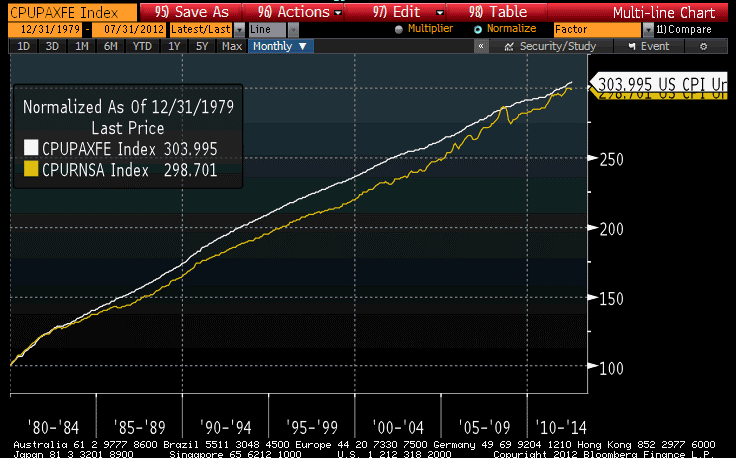
This is why central bankers want to focus on core – headline provides lots of noise but almost no signal. And it’s the same reason that investors should prefer bonds linked to core inflation: you get virtually all of the long-term protection against inflation that you do with headline-inflation-linked bonds (like TIPS), but with much lower short-term volatility.
Now, Deutsche’s index isn’t truly core inflation, but a proxy thereof. It appears to be a decent proxy, but it is still a proxy (and we have some more theoretical/quantitative critiques that are beyond the scope of this column). And their product is a swap, not a bond (although it would not surprise me to see bonds linked to this index in the very near future). So it isn’t perfect – but it is a huge step forward, and Deutsche Bank (and Allan Levin, the guy there who has the vision) deserves praise for actually innovating. Innovation tends to happen on the buy side, and with smaller firms, not with big sell-side institutions, and we should cheer it when we see it.
.
Now, back to actual markets: tomorrow, the ECB is expected to announce a new program of buying periphery bonds when necessary. Actually, it is a bit more than expectation, since the plan was leaked today. Supposedly, the ECB will announce that they are going to do “unlimited, sterilized bond buying” of securities three years and less in maturity.
The Euro was somewhat buoyed by this news. The idea is that big bond purchases will bring down sovereign yields, but sterilization of the purchases will mean that it isn’t truly monetization and therefore not inflationary.
This seems ridiculous to me. I am not surprised at the idea that the ECB would conduct large purchases of bonds that no one else seems to want; they did quite a bit of that with Greece, after all. But I’ve lost track – are they still sterilizing the billions in bonds that they’ve already bought, as well as the two LTRO operations which they claimed to sterilize, but never explicitly did except through the expedient of paying interest on reserves to sop up the liquidity?
How are they going to sterilize more purchases? There are basically three straightforward ways for a central bank to remove liquidity from the market. We used to think that there were only two, because the only ways the central bank ever did it was to (a) conduct large reverse-repurchase operations in which the central bank lent bonds and borrowed cash, taking the cash temporarily out of the economy and (b) to sell bonds outright, to make a permanent reduction in reserves. Now we recognize a third option, although we’re not sure how efficacious it is: (c) raising the interest rate on deposits of excess reserves at the central bank, so as to discourage the multiplication of those reserves.
But for the ECB’s purchases to be effective in terms of their size, they will be far too large to use reverse-repos as a sterilization method; and it doesn’t seem to make much sense to be selling bonds when they’re buying other bonds, unless they want to try and push up the yields of countries like the Netherlands and Germany (which might not be politically too astute) at the same time that they’re lowering the yields of Spain and Portugal. And they just cut the deposit rate to zero in July…are they going to raise it again?
I can understand the political cleverness of such an announcement, if the ECB makes it: make the bond buys “unlimited” to suggest that they can’t be outmuscled, but also sterilized so it’s not printing. But these can’t both be true – because there is not unlimited capacity for sterilization.
That plan can only work if, in fact, the ECB doesn’t actually buy many bonds. In the past, they’ve tried to trick the market into rallying with “bazooka-like” comments so that they didn’t actually have to do anything. To date, it has never worked. I doubt this will, either.
.
Back in the U.S., the wave of Employment data is about to hit. Tomorrow morning, Initial Claims (Consensus: 370k) will be released; about Claims the only thing I want to note is that while it is down considerably from the peak of the most-recent recession, it is only slightly below where it was at the peak of the last recession. Over the last 52 weeks, Claims have averaged 381k; in May of 2002 that average reached 419k. Also due out tomorrow is the ADP report (Consensus: 140k), which is expected to weaken slightly from last month’s figure. On Friday, of course, the Payrolls report is expected to show a rise of 127k new jobs with the Unemployment Rate steady at 8.3%.
Some observers have made a lot of the fact that the Citigroup Economic Surprise index has risen from -65 or so in July to nearly flat now. But this is not a sign of improving economic conditions; it is a sign of improving economic forecasts. Remember that this index doesn’t capture absolute levels, but the degree to which economists are missing. The current level is near flat because economists adapted their forecasts to the weak data, not because the data improved to catch up with the over-optimistic forecasts. I wouldn’t draw much relief from that indicator.
Now, with the ECB and the Fed on the calendar over the next week, markets may well get some relief. But the economy, not so much, even if we do deserve it.
Stalling?
Be careful here. The most dangerous market climates occur when the news and/or the economy is in transition. When things are great, everyone knows they’re great; the market may get overvalued but there’s not a catalyst for a drop. When times are awful, everyone knows they’re awful; the market may get undervalued (although this has not happened in a while) but there’s not a catalyst for a pop. It’s when the economy is in the middle of a phase change that sharp movements can occur as we shift from euphoria to lamentation, and sometimes right back, overnight.
The key test on Thursday was the auction of 10-year Spanish bonds. Spain also sold 2-year maturities, which gave it some flexibility to sell more of those and less of the 10-year and still sell “more than the €2.5bln target.” The bid:cover ratios were okay, but the 10-year got bombed after the auction, trading up 10bps in yield to 5.90%. Watch how this trades – it is very likely that some participants were arm-twisted into bidding, and those buyers will be dumping paper indiscreetly.
Meanwhile, in the background, Italian yields have been rising again as well. The 10-year bond is at 5.60% (see Chart, source Bloomberg). No one is worrying about Italy at the moment, because we’re all too busy worrying about Spain. But the positive momentum has evaporated there, as you can see from the chart. Somewhat amazingly, investors are completely ignoring the silly talk about the trillion-dollar firebreak. Today Poland announced it would contribute $8bln to the IMF effort. With Japan and Poland leading the way to saving Europe, we have officially descended into farce.

In the U.S., the economic data was weaker-than-expected. It wasn’t disastrous; the economy continues to grow, but isn’t gaining strength in any measurable way. Initial Claims were 386k (with an upward revision) compared to 370k expected. Philly Fed went from 12.5 last month to 8.5 this month (vs. 12.0 expected). Philly Fed is a good current illustration: the index measures not the level of activity, but the rate of change, by asking how conditions are compared to the prior month. So low, positive numbers means that growth is limping, but limping forward a little bit every month.
Existing Home Sales have fallen back after a couple of good-weather months. On the plus side, the inventory of existing homes remains near a seven-year low, which should help support the pricing dynamic in the housing market (as will the general buoyancy of inflation generally). More on housing, below.
Five-year TIPS were auctioned, and as is normal for the 5-year it was somewhat sloppy going in and coming out. Finding natural demand for long-dated real bonds is easy. Finding natural demand for shorter-dated real bonds is always somewhat iffy. After the auction, TIPS backed up 3-4bps across the board. Unlike with Spanish bonds, however, other investors are actually willing to buy TIPS at these levels (because, while very expensive, they’re still cheap relative to nominal bonds).
Tomorrow’s calendar is light, and trading will probably be thin. But as I say: be careful here.
.
The housing market is obviously still suffering, and one reason that the inventory of existing homes appears so manageable is that there is a considerable ‘shadow inventory’ of homes that aren’t on the market because the sellers are discouraged by market conditions. So it is even more surprising to me that we haven’t seen a development that some observers have been long waiting for in the U.S.: the home price indexed mortgage (hereafter abbreviated HPIM).
A HPIM is a loan, secured by a home, whose principal value rises or falls with the value of home prices. The index chosen for home prices can be a national index (which would enhance the securitization of the mortgage) or a more local index (which would more-closely connect the mortgage’s principal to the value of the particular home). The coupon is fixed, as with TIPS, but paid on a variable amount of principal. The principal amortizes over time as with a regular mortgage.
Various laws set up for the nominal world, and possibly taxation issues, have impaired the development of the HPIM in the U.S. But they exist in some other countries (e.g., Turkey), and theorists have spent some time examining the concept so this is not a “new” idea. But when the housing market was booming, and people saw their houses as leveraged speculative vehicles as well as places to live, borrowers also didn’t want to take a loan that they saw as likely to grow rapidly in principal value. Now, however, the value is more obvious:
If you are a homebuyer, you may be willing to take your time buying a home right now, fearful that prices could fall further. But with an indexed mortgage, if the value of the home falls then so does your loan. Therefore, there’s much less reason to defer a home purchase, which is one reason that HPIMs could help clear the housing market inventory. Also, while your total outlays will be similar if housing inflation actually turns out to be what is currently priced into the market when you take out your mortgage, the pattern of those outlays tends to help the homebuyer because the coupon payment would be lower than a nominal coupon, especially in the early years of the mortgage, as the inflation accrual adds to the principal.
At present, for example, 30-year mortgage yields are around 4%, so your interest payment on a $100,000 mortgage will be $333.33/month in the first month of the loan. However, the coupon on a HPIM would likely be around 1.5%, or $125/month, if long-term inflation is expected to be around 2.5%, and the principal would be expected to grow around 0.2% per month. And after one year (if no principal was paid, for simplicity) the coupon would be expected to rise to $128.12, which is 1.5% of the new principal ($100,000 * 1.025 = $102,500).
Again, in the boom years it would have been hard to persuade a homebuyer to give up his perceived upside, but notice that the “upside” depends on home prices rising faster than the nominal rate embedded in the loan. Still, a home financed with a fixed-rate loan does represent a serious inflation hedge in normal times. With an HPIM, however, the ability to participate in the upside doesn’t vanish – it is just limited to the amount of equity a homeowner has. So if I own a $100,000 house and I have an $80,000 mortgage and prices double, I still ‘participated’ in the home price rally: my asset is now worth $200,000, my liability is now worth $160,000, and instead of $20k equity I now have $40k equity. That’s not as good as if I had had a nominal loan, which is still worth $80,000 so that my equity is now $120k, but if I want more participation I can always buy more of my house back from the bank (that is, pay down the loan and build equity). In other words, with the HPIM structure a homebuyer cannot take a highly-levered speculative position in housing; however, you profit on the part of the house that your family, and not the bank, owns. This doesn’t sound like a bad idea, does it?
Moreover, the idea that taking out a mortgage to buy a house is a sure-fire way to build wealth was mostly a period myth anyway. Over the long haul, residential real estate grows at a real rate of only about 0.5%, which means that without a good bit of inflation, a mortgagor paying a fixed rate of 5% or 6% or 7% is actually falling behind in real value (even with the tax deductibility of interest, although that helps). It is true that in a boom, you can make lots of money borrowing 99% of a purchase that rises 15% in value every year…whether that purchase is a home or an internet stock. The problem is that you can lose it all by being levered in a bust, and you don’t do very well if prices simply stagnate.
As an investor, by the way, I’d love to be able to buy a bond backed by home-price-indexed mortgages. And the existence of such a market would allow the creation of bonds that paid inflation minus housing inflation; in other words, it would help the ‘inflation basis’ market germinate.
I don’t see much hope that this sort of mortgage is coming soon, because while there are proponents and theorists around for the concept, it is an innovation that requires some changes in legal and tax infrastructure – and there are few evangelists out there for this sort of product. But despite that, I am still a bit surprised that we don’t hear more talk about it – because it is a good idea.
